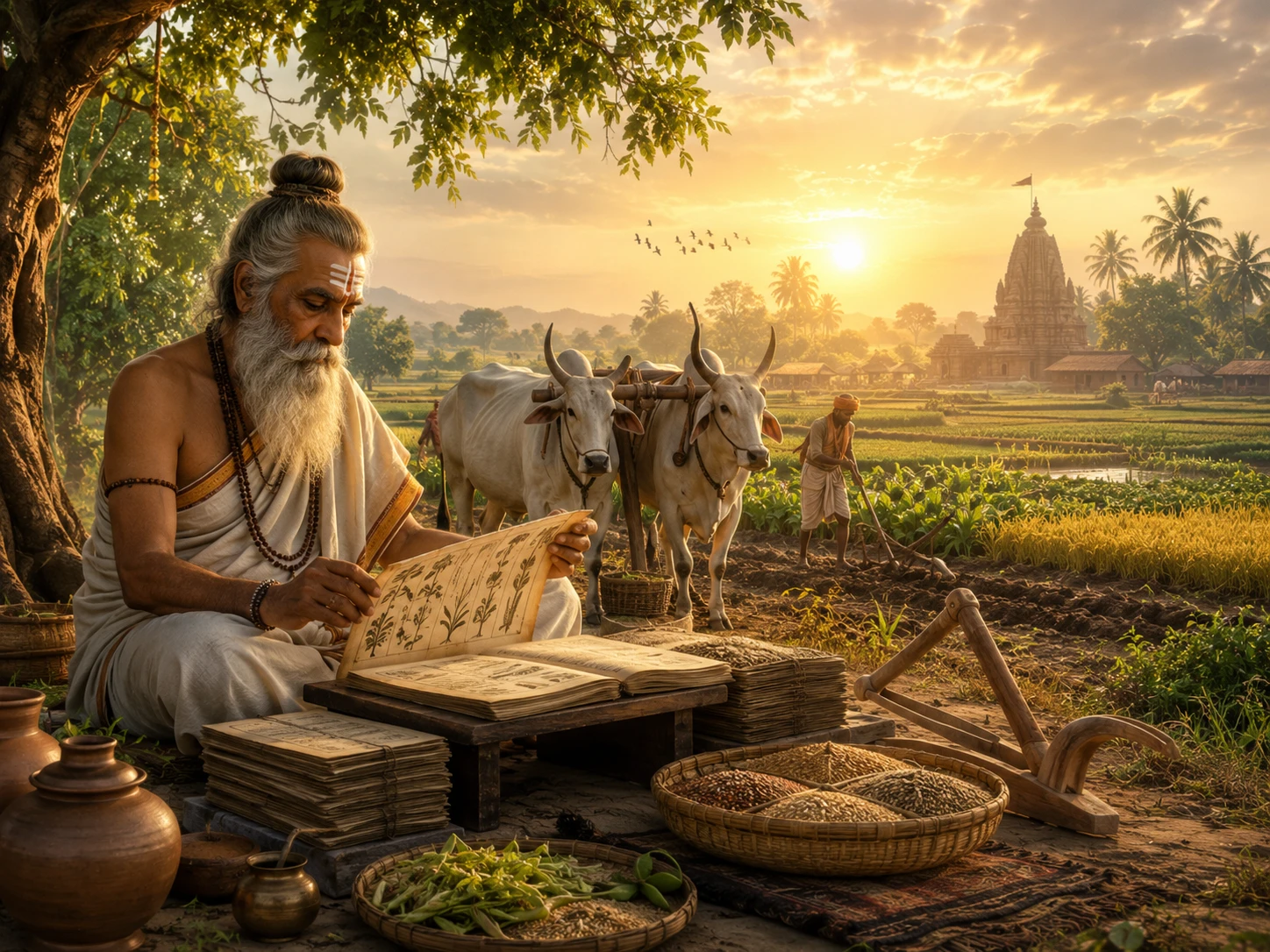
Krishi Parashara -- The Sage Who Wrote a Monsoon Almanac in Sanskrit
कृषि पराशर -- वो ऋषि जिसने संस्कृत में मानसून पंचांग रचा
If you ask any agronomist working in India today what the single hardest forecasting problem is, the answer is the monsoon. The Indian Meteorological Department uses ensemble climate models running on supercomputers at the Indian Institute of Tropical Meteorology in Pune. Even with that, the long-range monsoon forecast issued every April for June-to-September has an error margin of about 5 to 10 percent. For a farmer in Vidarbha or Bundelkhand or Marathwada, that margin is the difference between paying off this year's loan and walking into a debt that ends in tragedy.
A Sanskrit text written somewhere between the 4th century BCE and the 11th century CE -- the dating is genuinely contested -- spent its first 69 verses, more than a quarter of its total length, on this same problem. The text is Krishi Parashara, attributed to the sage Parashara. It contains 243 verses in mostly anushtubh meter, opens with a salutation to Prajapati and ends with a prayer to Lakshmi, and addresses itself explicitly krishakanam hitarthaya -- for the benefit of farmers.
The text was edited and translated into English by Dr Nalini Sadhale and published by the Asian Agri-History Foundation in 1999, with commentaries by H.V. Balkundi and Y.L. Nene. Before that it was almost entirely forgotten outside a few traditional Sanskrit pandits in Pune and Varanasi. The Sanskrit manuscript that became the basis of the modern edition came from the Bhandarkar Oriental Research Institute in Pune.
क्षेत्रस्य पतिना वयं हितेनेव जयामसि। गाम् अश्वं पोषयित्न्व आ स नो मृळातीदृशे॥
kṣetrasya patinā vayaṃ hiteneva jayāmasi | gām aśvaṃ poṣayitnvā sa no mṛḷātīdṛśe ||
With the Lord of the Field, like a friend, may we win our cultivation. May he, the nourisher of cow and horse, be gracious to us in our work.
— Rig Veda 4.57.1 (Kshetrapati Sukta -- Hymn to the Lord of the Field)
The Kshetrapati Sukta of the Rig Veda -- the hymn to the Lord of the Field -- is one of the few Vedic hymns explicitly devoted to agriculture. It runs across eight verses, asks the deity for sweet rain, fertile herbs, gentle winds, and protection from pests, and is addressed not to a temple priest but to the farmer himself. By the time Parashara wrote his agricultural treatise, this hymn was already two thousand years old. The framework Parashara inherits is straightforward: the field has a deity, the farmer is in cooperative relationship with that deity, and the work of agriculture is a partnership between human labour and natural forces that exceed human control.
What Parashara then does is translate that framework into operational instructions. The first 69 verses on rainfall prediction divide cleanly into three approaches. First, astronomical: the alignment of moon and sun in specific nakshatras at specific times of the agricultural calendar. Second, meteorological: wind direction read from a flag attached to a fixed pole, observed daily through Pausha (mid-December to mid-January). Third, biological: ants emerging from their burrows carrying their eggs, frogs croaking abruptly out of season, certain trees flowering early. Each method gives the farmer a different signal. Cross-checking them gives a forecast.
This is essentially what modern agro-meteorology does, with different instruments. The IMD's monsoon forecast combines satellite imagery (parallel to nakshatra observation), Indian Ocean and Pacific sea surface temperatures (parallel to wind-direction reading), and proxy indicators from previous monsoon years (parallel to biological signs). The vocabulary changed. The structure of the problem did not.
Parashara's Four Cloud Types
| Cloud type | मेघ | Character of rainfall | Modern interpretation |
|---|---|---|---|
| Avarta | आवर्त | Localised, intense, narrow rainfall belt | Convective cell -- localised cumulonimbus |
| Samvarta | सम्वर्त | Widespread, evenly distributed, abundant rain | Active monsoon trough -- broad rain band |
| Pushkara | पुष्कर | Sparse, scanty, drought-tending year | Weak monsoon -- below-normal rainfall pattern |
| Drona | द्रोण | Excessive, flood-tending, abundant rainfall | Strong active monsoon, depression activity |
Parashara prescribes a calculation: take the current Shaka year, add three, divide by four. The remainder gives the dominant cloud type that year. The mechanism is opaque to modern understanding, but the categories themselves -- localised, even, scanty, excessive -- map onto every classification system used by modern monsoon meteorologists. The terms moved from astrology to instrumentation. The four buckets did not.
Parashara prescribes that the farmer should fix a rod in the ground, attach a cloth flag to it, and observe wind direction every morning during the month of Pausha (mid-December to mid-January). North or west winds during these days indicate good rainfall in the coming monsoon. East or south winds indicate scanty rains. This is essentially a rudimentary anemometer -- the same instrument the IMD calibrates today, except modern weather stations use cup anemometers and digital wind vanes. The agricultural prediction logic of using winter wind direction as a predictor of summer monsoon strength is now formally documented through the El Nino Southern Oscillation framework.
After the rainfall section, the text moves to operations -- soil, sowing, ploughing, and the careful section on cattle care titled vahanavidhana (the way of the working animals). Parashara is unusually direct here. The bullocks of a farmer who keeps the cow shed strong, clean, and free of accumulated dung grow well even without special nourishment. The same farmer's draft animals last longer. The same farm produces more. There is no mysticism in this verse. It is a hygiene observation that any modern dairy extension officer would endorse.
The text describes the plough (hala) in detail -- size proportions, the angle of the share, when to sharpen the blade, how the yoke should sit on the shoulders of two bulls. It describes a tool called madika -- a ladder-shaped contrivance used to level rice fields after sowing. The Bengali word mai for the same tool comes directly from this Sanskrit root. There is a section on seed selection: heavy seeds, even-coloured, stored in hot dry conditions, treated with cow dung paste before sowing.
Parashara devotes verses to bullock welfare in a way that surprises most modern readers. The farmer is told to feed his bullocks before he eats himself, to bathe them once a week, to never beat them in anger, and to retire them with care when they grow old. This is not sentimentality. The text understands that draft animal welfare is identical to farm productivity. A bullock worked to exhaustion in March cannot pull a plough in June. Indian agriculture, until very recent mechanisation, ran on the bodies of cattle. Parashara was simply being practical about it.
The agricultural calendar in Krishi Parashara follows the Hindu month system, which is itself anchored to lunar nakshatras. Parashara walks the farmer through what to do in each month -- when to repair the cattle shed, when to sharpen ploughshares, when to begin pre-monsoon ploughing, when to sow first rains, when the second sowing is allowed, and when the harvest must be brought in before the autumn winds break. The cycle is so closely tied to the actual rhythm of north Indian rainfed agriculture that even a modern farmer in Madhya Pradesh or eastern Uttar Pradesh, reading the text alongside his own annual calendar, finds direct overlap.
The text uses a Sanskrit measurement system that translates clean enough into modern units. The adhaka, a unit Parashara uses to gauge rainfall, equals approximately 2.56 kilograms of water -- an oddly specific number that hints at a careful working system somewhere underneath. The angula is a finger-width, used for soil depth and seed depth. The krosha, about 3.6 kilometres, is the radius within which a single rain shower of a particular type might fall. None of these are mystical. They are working measurements that come up the same way furlongs and acres still appear in British agriculture documents.
There is no chapter in Krishi Parashara on chemistry. There is no botanical taxonomy in the modern sense, no Linnaean naming. There is no anticipation of nitrogen fixation or photosynthesis. What there is, throughout the text, is an ecosystem-level observation framework. The farmer is taught to read the field, the sky, the animal, the soil, and the calendar as a single integrated system, and to act on what they read together. This is closer to modern agro-ecological thinking than to chemistry-driven Green Revolution agronomy. It is also, not coincidentally, the framework that organic and natural farming movements in India have been rediscovering since the 1990s.
Krishi Parashara -- Topic Distribution Across Verses
| Section | खण्ड | Verse range | Content |
|---|---|---|---|
| Salutation and glorification | मंगलाचरण और कृषि-महिमा | 1-10 | Prajapati invocation; agriculture as foundation of dharma |
| Rainfall prediction | वर्षा भविष्यवाणी | 11-79 | 69 verses on cloud types, wind, nakshatra alignment, biological signs |
| Soil and field preparation | मिट्टी और क्षेत्र-तैयारी | 80-110 | Soil testing, ploughing depth, manure application |
| Sowing operations | बुआई संचालन | 111-150 | Seed selection, treatment, depth, timing |
| Cattle care (vahanavidhana) | वाहन-विधान | 151-190 | Bullock welfare, cow shed maintenance, training, retirement |
| Tools and implements | उपकरण और यन्त्र | 191-220 | Plough specifications, madika, harvest tools |
| Storage and Lakshmi prayer | भण्डारण और लक्ष्मी प्रार्थना | 221-243 | Granary construction, pest protection, closing prayer |
The text refers only to Manu and Garga as authorities, suggesting it predates the Nibandha literature of the 11th century CE. The internal coherence and the absence of references to later astronomical refinements point to a date no later than the 10th century, with several scholars favouring an earlier date.
What does any of this mean for an Indian farmer today? The honest answer is: less than enthusiasts claim, and more than sceptics admit.
The modern Indian farmer who plants paddy in eastern Uttar Pradesh in July, sells it in November, and replants the same field in wheat -- a rotation that supports the food security of a state of 240 million people -- is not running a Krishi Parashara operation. He is using HYV seeds developed by IRRI in the Philippines and ICAR in Karnal, urea and DAP supplied through subsidised channels, diesel-powered tube wells running on cheap power, and tractors. The yield he gets per hectare today is several times what Parashara's farmer could have managed.
But large parts of that system are now under stress. Groundwater is dropping. Soil organic matter is collapsing. Pesticide resistance is rising. The IMD's monsoon forecasts struggle with the increased volatility of climate-changed weather. And the financial economics of input-intensive farming have pushed millions of smallholders into debt. In response, the Government of India launched the Paramparagat Krishi Vikas Yojana in 2015, the Bharatiya Prakritik Krishi Paddhati in 2020, and a series of state-level natural farming missions in Andhra Pradesh, Karnataka, Himachal, and Sikkim. Almost every input recommended by these schemes -- jeevamrit, ghana-jeevamrit, beejamrit, dasaparni-arka, panchagavya -- traces back to Krishi Parashara, Vrikshayurveda, or Kashyapa's Krishi Sukti. Andhra Pradesh's Community Managed Natural Farming reaches over 600,000 farmers, the largest such programme in the world.
Parashara is not the answer to Indian agriculture's crisis. He is one of several voices that need to be read alongside ICAR research, IMD forecasts, and the working knowledge of the farmer himself. What Parashara does that no modern textbook does is treat the farmer as the primary expert, write in language a farmer can use, and build the entire framework around the farmer's success rather than around an external researcher's interest. That stance is worth recovering whether or not every prescription survives a randomised trial.
The opening verse of Krishi Parashara salutes Prajapati, the lord of creation. The closing verse is a prayer to Lakshmi, the goddess of prosperity. Between these two, all 243 verses sit. The framing is deliberate: agriculture begins in the act of creation (Prajapati), passes through human labour, and ends in prosperity (Lakshmi). The text is bracketed by deities the farmer would already know, and the entire technical content sits inside that bracket as a kind of duty owed by the householder to both the field and to the goddess of the field.
Read More on Vedic Sciences
Explore related Eternal Gyan articles on Vrikshayurveda, ancient water harvesting, Surya Siddhanta, and the Upavedas.
Tags
Eternal Raga · शाश्वत राग
Institutional voice — scholarly articles on Sanatan Dharma
Deepen Your Understanding
अपनी समझ और गहरी करें
vedic sciences
Vrikshayurveda -- The Ancient Indian Science of Trees
A 1000-year-old Sanskrit text by Surapala, found by accident in Oxford's Bodleian Library, gives 325 verses on tree care, soil, fermented manures, and pest control. Assam tea growers tried his fermented kunapa-jala in 2006 and watched their pesticide-resistant gardens recover. The science of plants existed long before botany became a Western word.
vedic sciences
Vedic Water Harvesting -- Stepwells, Tanks, and the Engineering Bharat Forgot
Bengaluru is running out of water. Chennai had a Day Zero. Yet a 5th-century Patan stepwell still holds water in summer. Sringaverapura's 2-million-litre Mauryan reservoir is intact. The water systems Bharat built between 1500 BCE and 1500 CE are starting to look like the future, not the past.
vedic sciences
Ancient Indian Metallurgy -- The Iron Pillar That Refuses to Rust
A 7-metre iron pillar has stood in open Delhi air for 1,600 years without rusting. Wootz steel from Tamil Nadu became the legendary Damascus blade. From Vedic kṛṣṇāyas to Vagbhata's bell-metal recipe -- the textual and material evidence of how Bharat worked metal.
vedic sciences
Upavedas -- The Four Applied Sciences of Hindu Tradition
The Vedas gave India its philosophy and rituals. The Upavedas gave India its professions. Four applied knowledge systems -- Ayurveda (medicine), Dhanurveda (warfare), Gandharvaveda (music and performing arts), and Sthapatyaveda (architecture) -- were classified as subsidiary Vedas, each attached to one of the four main Vedas. They represent the Hindu tradition's insistence that sacred knowledge must produce practical results: a healed body, a defended nation, a beautiful performance, a well-built home. Together, the Upavedas form the intellectual infrastructure of pre-modern Indian civilisation -- from the surgeon's scalpel to the architect's blueprint to the musician's raga.
vedic sciences
Ayurveda -- The 3,000-Year-Old Science That Knows Your Body Type Before You Do
Long before personalised medicine became a Silicon Valley buzzword, the Charaka Samhita classified every human being into one of seven constitutional types based on three biological forces -- Vata, Pitta, and Kapha. Modern genomic studies at CSIR-IGIB have found that these ancient types correlate with distinct gene expression profiles. Ayurveda did not guess. It observed.
vedic sciences
Surya Siddhanta -- The Ancient Astronomy Text That Got the Year Right to 1.4 Seconds
Before Copernicus, before Galileo, before the telescope existed -- an Indian text calculated the tropical year as 365.2421756 days. The modern value is 365.2421904. The difference is 1.4 seconds per year. The Surya Siddhanta also described gravity, computed planetary diameters within 1% accuracy, and invented the sine function. It did all this in Sanskrit verse.
Parashara prescribes that the farmer should fix a rod in the ground, attach a cloth flag to it, and observe wind direction every morning during the month of Pausha (mid-December to mid-January). North or west winds durin…
More in Vedic Sciences

Agnichayana -- The Falcon-Shaped Fire Altar That Survived 3,000 Years
12 min read
Ancient Indian Metallurgy -- The Iron Pillar That Refuses to Rust
13 min readAryabhata -- The Astronomer Who Said the Earth Turns
3 min readThe same translation error that turned '33 Koti' into '33 crore' in Hinduism also happened in Buddhism. The Chinese translation of Buddhist texts rendered 'Sapta Koti Buddha' (7 Supreme Buddhas) as '7 Crore Buddhas.' The…
Deities AvatarsCommunity Reflections
🕉️
Be the first to share your reflection.