Sugandha Shakti Peeth
सुगंधा शक्तिपीठ
The Goddess of the Sondha river, where Sati's nose came to earth on the eastern Bengal plain, and where centuries of Bengali Shakta devotion have kept her shrine continuously lit
Shikarpur, Barisal, Bangladesh
Sugandhā Devī MandirAlso known as: Sunanda Devi (variant), Sondha-tirtha (river-name form), Ugratara (alternative form identification), Shikarpur Sugandha Mandir (location-anchored form), सुनन्दा देवी, उग्रतारा, सोनदा देवी, সুনন্দা দেবী, উগ্রতারা, শিকারপুর সুগন্ধা মন্দির, सुगन्धा, उग्रतारा
पवित्र कथा · पवित्र कथा
On the bank of a small river in the eastern Bengal plain, a river called the Sondha, or in its more Sanskrit form Sugandha, 'the sweetly-fragrant', a temple of modest external scale holds one of the canonical fifty-one Shakti Peethas. When Vishnu's discus dismembered Sati's body to release Shiva from his grief-Tandava, her nose descended at this spot: the nāsikā, the organ of breath and fragrance, set down on a stretch of Bengal Delta land that already bore the name of fragrance through its river. The goddess seated here is Sugandha, the sweetly-fragrant one, who takes her name from the river that flows past her sanctum and gives her name back to it; in some traditions she is additionally identified as Ugratara, the fierce Tara-form revered across the Bengali Shakta landscape. Her paired Bhairava is Tryambaka, the three-eyed one, in an adjacent shrine. The temple's recorded history reaches back into the medieval Bengali Shakta tradition, when Sugandha was one of the principal pilgrimage destinations of the wider Bengal goddess geography, alongside Kamakhya to the northeast, Kalighat and Tarapith to the west across the Padma, and the smaller goddess shrines that dot the Delta. Through the centuries of pre-Mughal, Mughal, and colonial Bengal, pilgrim flows continued; the 1947 Partition placed Sugandha within East Pakistan, and the 1971 Liberation War established it within independent Bangladesh, where it continues to be administered through the local trust framework under the wider Bangladesh Ministry of Religious Affairs oversight. The temple has weathered the political and demographic changes of the eastern Bengal plain across these decades, sustained by the local Bangladeshi Hindu community of Barisal division and by Bengali Hindu pilgrim flows from across the border, from West Bengal and Tripura particularly. With the 2022 opening of the Padma Bridge, the road journey from Dhaka was halved, and pilgrim flows from Indian and diaspora Bengali Hindu communities have steadily grown. The Sondha river still flows past the temple at dusk; the priests still light the evening lamps in the sanctum where Sati's nose came to earth; and the small Bengal Delta shrine continues, after a thousand years and across two political borders, to be Sugandha.
Sacred Designationपवित्र पदनाम
Shakti Peeth
शरीर का अंग: Nāsikā (nose) per Pithanirnaya and the broader Tantric Peetha catalogue tradition. The nose attribution is one of the more consistently established body-part identifications in the 51-Peetha list and is corroborated across recensions of Pithanirnaya, Tantra Chudamani, and the Devi Bhagavata Purana's Shakti Peetha enumeration. The river Sondha (also spelled Sandhya / Sugandha) at the temple's foot lends its name to the goddess and forms part of the site's identification, the goddess is the Devi of the Sondha as well as the Devi of the descended nāsikā.
शक्ति: Sugandha, the sweetly-fragrant one, named for the Sondha (Sugandha) river that flows past the temple. Some traditions additionally identify the goddess here as Ugratara, the fierce Tara-form, a name with significant resonance in the broader Bengali Shakta tradition where Tara is a major worshipped form. The Sugandha-Ugratara overlap reflects the broader pattern of Bengali Shakta theology in which the great goddess wears many faces at her seats.
भैरव: Tryambaka (the Three-Eyed One, an epithet of Shiva) per Pithanirnaya. Some recensions render the name as Trayambaka; the canonical form refers to Shiva's three-eyed aspect, the same form invoked in the Maha Mrityunjaya mantra. The paired Bhairava shrine adjacent to the Sugandha sanctum continues this Shiva-Shakti pairing convention characteristic of the Shakti Peethas.
Sacred Origin Storyपवित्र उत्पत्ति कथा
The Shakti Peethas were established when Vishnu's Sudarshana chakra dismembered Sati's body during Shiva's grief-Tandava following her self-immolation at Daksha's yajna. Each fragment fell to earth and consecrated that spot as a seat of Shakti.
The Pithanirnaya, in its catalogue of the fifty-one Peethas, identifies the place of Sati's nose (nāsikā) as the Sondha-tirtha, the goddess seat at the Sondha river, in the eastern Bengal landscape. The Devi Bhagavata Purana's Skandha 7 enumeration and the Tantra Chudamani's parallel catalogue both corroborate the nāsikā attribution at this site.
The goddess seated here is named Sugandha, the sweetly-fragrant one, a name that draws on both her body-part attribution (the nose being the organ of fragrance) and on the name of the river beside which her seat is established. Her paired Bhairava is Tryambaka, the three-eyed one, Shiva's form whose name appears across the canonical Maha Mrityunjaya mantra tradition.
The Sugandha-Tryambaka pair holds its seat in the small Bengal Delta village of Shikarpur, in the Gournadi upazila of Barisal district. The temple's standing within the wider Bengali Shakta tradition is well-established; medieval Bengali devotional literature mentions Sugandha as one of the principal Shakti Peethas of the Delta, and the pilgrimage circuit linking Sugandha with Kamakhya (Assam), Kalighat and Tarapith (West Bengal), and other Eastern goddess shrines is documented across the pre-modern and colonial periods.
अन्य परंपराएँ · अन्य परंपराएँ
Bengali Shakta and Tantric (Mahavidya identification)
Bengali Shakta pilgrim-circuit tradition (continuous across pre- and post-1947 Bengal)
Historyइतिहास
The historical record of Hindu worship at Sugandha-pitha extends into the medieval Bengali Shakta period and likely earlier. The canonical Tantric Peetha catalogues, Pithanirnaya, Tantra Chudamani, and the Devi Bhagavata's Shakti Peetha enumeration, name Sondha-tirtha / Sugandha as an established Shakti seat by the early medieval period, and Bengali Shakta devotional literature from at least the late medieval period treats Sugandha as one of the principal pilgrimage destinations of the wider Bengal goddess geography.
The temple's pre-modern history is intertwined with the broader Bengali Shakta tradition, Sashibhusan Dasgupta's foundational scholarship documents the place of Sugandha within the network of Eastern goddess shrines that flourished under late-medieval and early-modern Bengali Hindu patronage.
Through the centuries of Mughal Bengal (1576 onward) and the subsequent British colonial period (1757 onward), the temple continued in worship. William W. Hunter's 'A Statistical Account of Bengal' Volume 5 (1875, 1877), covering the district of Bakerganj (the colonial name for Barisal), documents the Sugandha temple precinct and the pilgrim flows it received from across Bengal.
The 1947 Partition of British India placed Sugandha within East Pakistan, separating it from the West Bengal portion of its historic devotional circuit by an international border; pilgrim flows from West Bengal contracted in the post-Partition period, though the temple continued to be worshipped by the local Bangladeshi (then East Pakistani) Hindu community of Barisal and by such pilgrims as could secure visas to travel.
The 1971 Bangladesh Liberation War established the temple within independent Bangladesh; under the new state framework, the temple came under the broader oversight of the Bangladesh Ministry of Religious Affairs while continuing to be administered locally through the temple trust.
The post-Liberation decades have seen evolving conditions for Bangladeshi Hindu communities and their temples; the Bangladesh Hindu Bouddha Christian Oikya Parishad (BHBCOP), founded in 1988, serves as the principal national-level coordinating body for Hindu and other minority-community welfare and religious-site administration.
Pilgrim flows from West Bengal and Tripura have grown across the 1990s, 2000s, and especially 2010s alongside improving bilateral relations between India and Bangladesh, with sustained Indian pilgrim visits enabled by streamlined tourist-visa procedures.
The 2022 opening of the Padma Bridge, which reduced the Dhaka, Barisal road journey from approximately seven hours (with ferry) to approximately four (direct road), has further increased pilgrim accessibility; the post-2022 era has seen the largest annual pilgrim flows in the temple's modern history.
Historical Timelineऐतिहासिक कालक्रम
Establishing precise pre-medieval dates for any Shakti Peetha is methodologically difficult; the Peetha-catalogue tradition is itself an interpretive layer over older site veneration. Sugandha's living folk tradition and the steady documentary record from the colonial era onward are stronger evidence of continuous worship than any single textual reference.
Pilgrim numbers and demographic figures for the immediate post-Partition decades vary across sources; the broad pattern of contraction and local-community continuity is well-attested but exact quantification is uncertain.
What You'll Seeदर्शन में
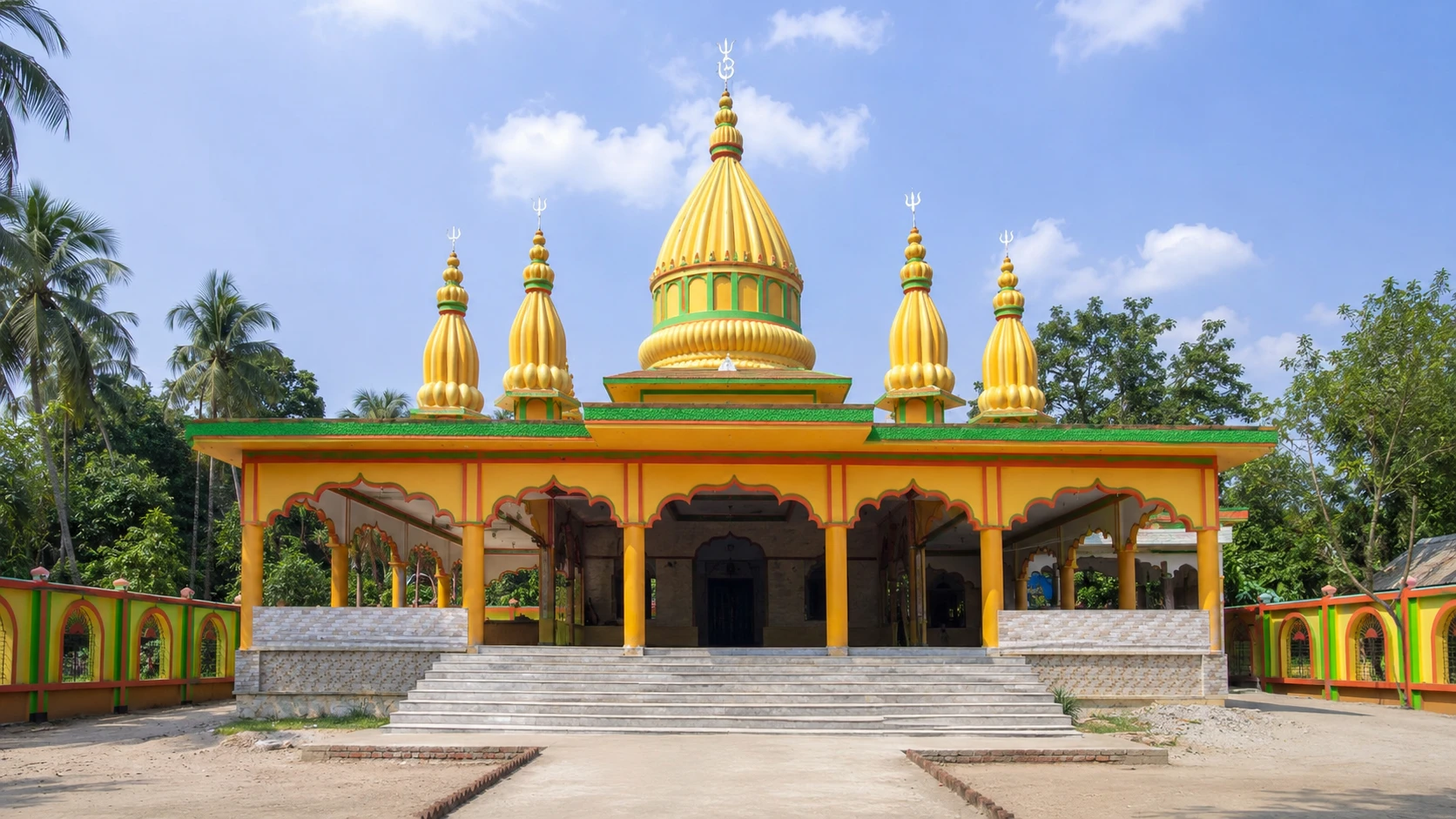
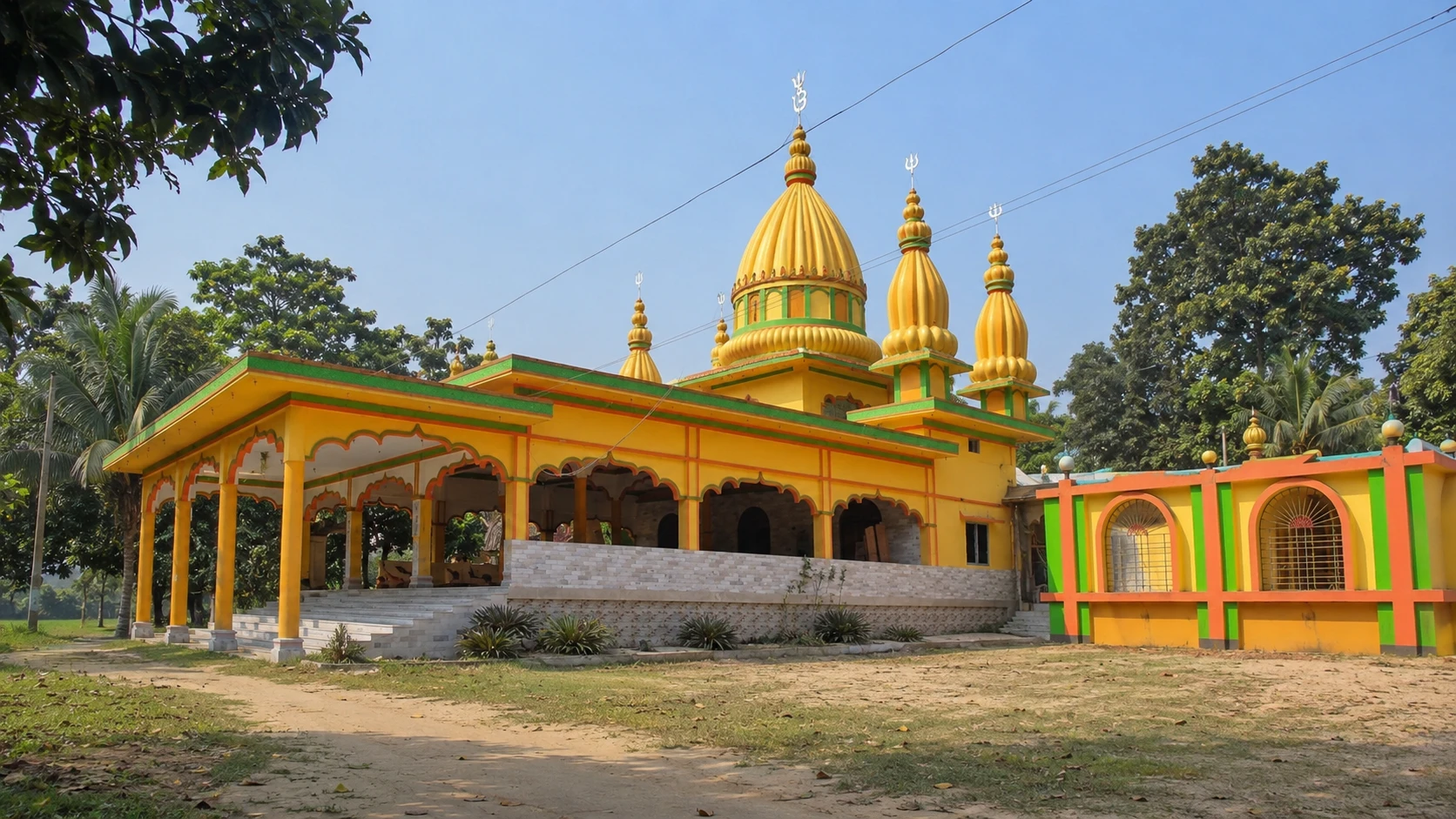
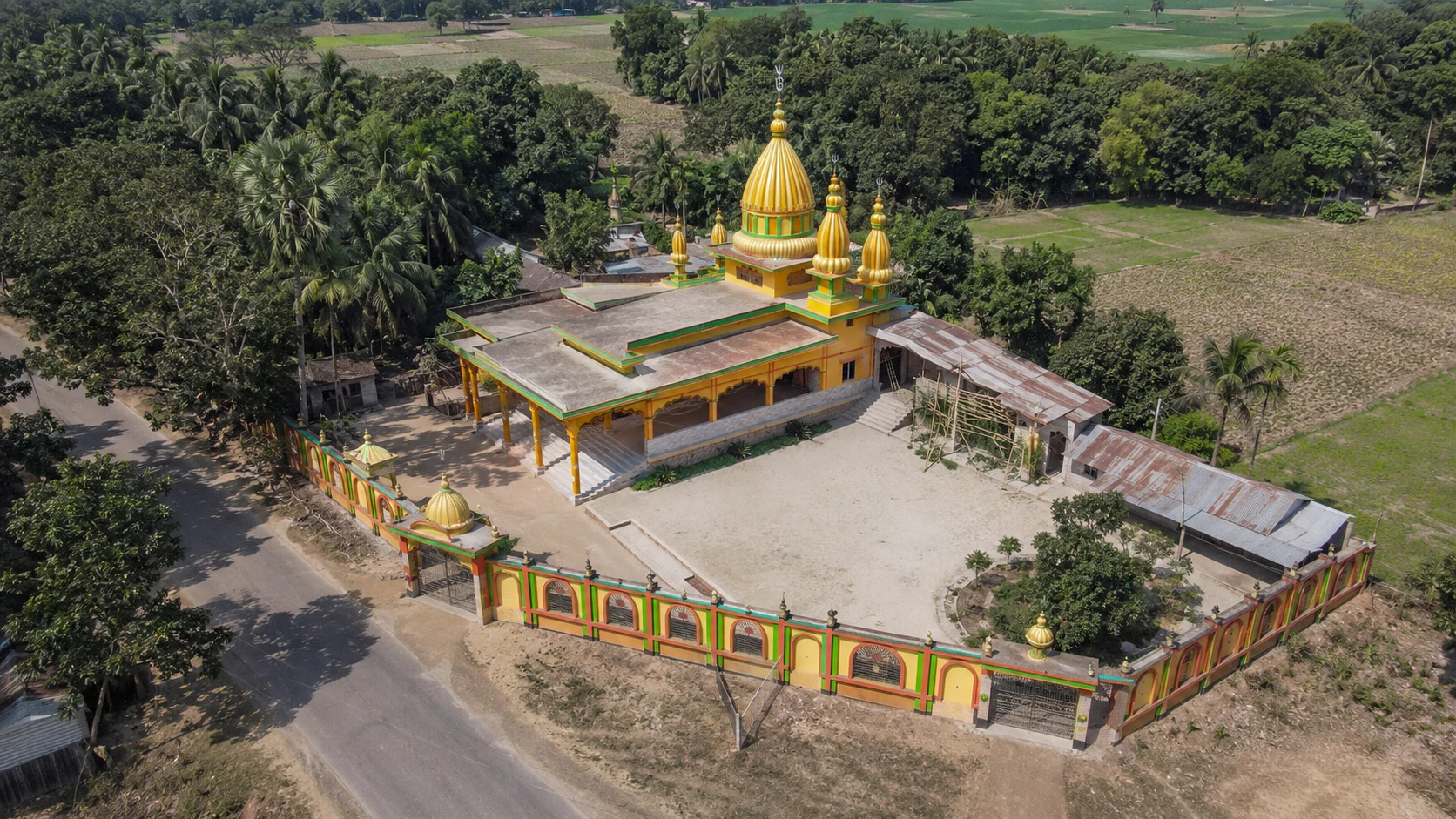
The Sugandha temple is a modest village-scale structure characteristic of Bengal Delta Hindu temples, a square-plan sanctum with an outer veranda and approach steps, set within a small walled compound on the bank of the Sondha river.
The principal object of worship in the sanctum is the murti of Devi Sugandha in classical Bengali Shakta iconographic convention: an anthropomorphic image of the Devi in seated or standing form, depending on the recension, draped in the red and gold textiles characteristic of Bengali Devi worship, adorned with traditional ornaments, and anointed daily with sindoor (vermillion) and sandal paste.
Some recensions of the local tradition additionally maintain a small natural stone or symbolic marker within the sanctum understood as the descended nāsikā of Sati, the iconographic representation of the body-part attribution that establishes the Peetha's identity.
The adjacent Bhairava shrine houses the Tryambaka form of Shiva, the three-eyed one paired with the goddess per the canonical Pithanirnaya attribution. The temple precinct includes the customary surrounding parikrama path, a small offering area, and the riverside access where pilgrims perform ablutions in the Sondha before approaching the sanctum.
The external architectural scale is modest, Sugandha is not a great-temple complex like Kamakhya or Kalighat in its built form, but the canonical Tier-A standing of the Peetha within the 51-Shakti-Peetha tradition makes the small Bengal Delta sanctum a destination of regional and trans-regional significance.
The understated village character of the temple is itself part of the Sugandha experience: a goddess of great canonical weight in a setting of intimate scale.
Distinctive Practicesविशिष्ट परंपराएँ
The Sondha riverside ablution and pre-darshan abhishek
सोन्धा नदी-तट अवगाहन एवं दर्शन-पूर्व अभिषेक
Year-round, particularly observed on Tuesdays and Fridays (auspicious for Devi worship) and on major festival days
Pilgrims arriving at Sugandha customarily begin their darshan at the bank of the Sondha river that flows past the temple, performing a brief ablution or symbolic touching of the river water before approaching the sanctum. The practice draws on the Bengali Shakta convention that the goddess and her river are theologically continuous, Sugandha is the goddess of the Sondha, and the river herself participates in the goddess's presence at the site. The ablution is not a full ritual bath in most pilgrim cases but a token contact with the river, pilgrims wash hands, splash water on the head, or offer a small handful of water back to the river before walking up to the temple precinct. Some pilgrims, particularly those completing the Bengali Shakta pilgrim circuit, perform a more elaborate riverside puja with flowers, incense, and an oil lamp set afloat on the river as an opening offering to the goddess before the principal sanctum darshan.
The river-goddess identity is foundational to Bengali Shakta theology, the great rivers of Bengal (Ganga, Padma, Hooghly, Brahmaputra) are themselves understood as goddess-presences, and smaller rivers carry the same theological weight in their local form. At Sugandha, the river is the goddess and the goddess is the river, and the pilgrim's ablution acknowledges this continuity before approaching the sanctum where the goddess takes anthropomorphic form. The Sanskrit word tirtha, pilgrimage, literally means 'a crossing,' and the riverside opening makes the pilgrimage's etymological foundation explicit at every visit.
Durga Puja Maha Ashtami at Sugandha, the Bengali Shakta festival centrepiece
सुगन्धा पर दुर्गा पूजा महा अष्टमी, बंगाली शाक्त उत्सव का केन्द्र
Sep, Oct (Ashwin Shukla Saptami to Dashami of Sharad Navaratri; the Maha Ashtami day is the festival's principal observance day at Sugandha)
Durga Puja is the foundational annual festival of the Bengali Shakta calendar, and at Sugandha the Maha Ashtami day in particular brings the largest pilgrim gathering of the year. The traditional Bengali Durga Puja format, with its day-by-day Devi-form progression (Saptami, Maha Ashtami, Maha Nawami, Dashami), the morning Sandhi Puja, the evening aratis, and the closing Dashami immersion, is observed at Sugandha in its Bengali Shakta convention. The Maha Ashtami day is particularly intense, with thousands of pilgrims from across Barisal division and from cross-border Bengali Hindu communities arriving for the morning Devi Mahatmya recitation and the Sandhi Puja that bridges the eighth and ninth days. Cross-border Indian Bengali Hindu pilgrim flows are particularly elevated during this festival period; the post-2022 Padma Bridge era has seen the highest Maha Ashtami pilgrim flows in the temple's modern history.
Durga Puja's place in Bengali Shakta worship is not merely festival-cultural but theologically central, the festival enacts the goddess's victory over Mahishasura, the demon of ignorance, and the Maha Ashtami Sandhi Puja represents the precise narrative moment of the demon's slaying. At Sugandha as at every Bengali Shakta seat, the festival is the pilgrim's annual participation in the goddess's cosmic act, the renewing of the world through her power. The cross-border Bengali pilgrim flows during Durga Puja at Sugandha also re-enact the pre-1947 unity of the Bengali Shakta pilgrim circuit, the festival is one of the moments when the conceptual unity of the wider Bengali goddess landscape is most visibly continuous across the international border.
Cross-border Bengali Shakta pilgrim circuit completion
सीमा-पार बंगाली शाक्त तीर्थयात्री-परिक्रमा पूर्णीकरण
Across multi-week pilgrimages, particularly during the Sharad Navaratri / Durga Puja window (Sep, Oct) and the Magh-Phalgun winter months when weather is most favourable for travel
Sugandha is one node of an extended Bengali Shakta pilgrim circuit linking the major goddess seats of the wider Bengal-Assam region: Kamakhya in Assam, Sugandha in the Bangladesh delta, Kalighat in Kolkata, Tarapith in Birbhum, Bahula at Ketugram, Kankalitala, Bakreshwar, Attahas, and several smaller seats scattered through both Bengal sides of the Padma. Bengali Hindu pilgrims from West Bengal and Tripura who undertake the Eastern goddess circuit increasingly include Sugandha in their itinerary as part of completing the full Bengali Shakta pilgrimage, a circuit that, before 1947, was a single regional pilgrimage and now requires an international border crossing. The contemporary completion of this circuit involves obtaining a Bangladeshi tourist visa, entering at one of the major land border crossings (Petrapole, Benapole, Hili, Hili, or Agartala, Akhaura for Tripura pilgrims), and combining Sugandha with whichever other Bangladesh-side goddess shrines fit the itinerary. For Tripura-based pilgrims in particular, Sugandha is geographically accessible via the Agartala, Akhaura crossing and the road through Comilla and Dhaka.
The Bengali Shakta tradition has retained the conceptual unity of the Eastern goddess circuit across the 1947 political division, Bengali devotional literature, festival calendars, and pilgrim song-traditions still treat the pre-Partition Bengal goddess landscape as a single geography rather than two. The cross-border pilgrimage circuit is the operational form of this devotional conviction: by crossing the border to complete what was once a single regional pilgrimage, the pilgrim enacts the older unity that the political division did not extinguish. The 2022 Padma Bridge era has made this contemporary circuit-completion more accessible than at any previous time since 1947.
Did You Know?क्या आप जानते हैं?
The goddess and the river share their name, Sugandha is the Sanskrit word for 'sweetly fragrant,' and the river that flows past the temple is itself called the Sondha or Sugandha. The body-part attribution at the Peetha is the nāsikā, the nose, the organ of fragrance. The threefold identity of goddess, river, and body-part organ of fragrance is one of the most layered etymological self-references in the entire Shakti Peetha catalogue.
Sanskrit lexicons including Monier-Williams; Pithanirnaya; Sircar (1973)
Sugandha is one node of an extended Bengali Shakta pilgrim circuit that, before the 1947 Partition, was a single regional pilgrimage linking Kamakhya in Assam, Sugandha in the eastern Bengal delta, and the West Bengal goddess seats (Kalighat, Tarapith, Bahula, Kankalitala, Bakreshwar, Attahas). The Bengali Shakta tradition has retained the conceptual unity of this circuit across the political division; contemporary cross-border pilgrim flows are the lived continuation of a pre-Partition devotional geography.
Dasgupta, 'Obscure Religious Cults' (1946); McDaniel (2004)
The Sugandha-Ugratara overlap, in which the goddess at Sugandha is additionally identified within Bengali Shakta and Tantric streams as Ugratara, the fierce Tara-form of the Mahavidya tradition, connects Sugandha theologically to the major Tara seat at Tarapith in West Bengal's Birbhum district. The gentle-fragrant Devi of the Sondha and the fierce cremation-ground Tara are, in this reading, the same goddess in her two faces. The overlap is characteristic of the broader Bengali Shakta theology in which a great goddess wears many faces at her seats.
Kinsley, 'Tantric Visions of the Divine Feminine' (1997); Dasgupta (1946)
The 2022 opening of the Padma Multipurpose Bridge halved the Dhaka, Barisal road journey from approximately seven hours (with ferry crossing) to approximately four hours (direct road), transforming pilgrim access to Sugandha. The post-2022 era has seen the largest annual pilgrim flows in the temple's modern history, with Indian Bengali Hindu pilgrim flows particularly elevated. The Padma Bridge stands among the most consequential infrastructure events for Hindu pilgrimage in Bangladesh.
Government of Bangladesh, Padma Multipurpose Bridge Project completion records, 2022; sustained press coverage
Sugandha's external scale is modest, a village-temple structure on a small walled compound, not a great-temple complex like Kamakhya or Kalighat, yet its canonical Tier-A standing within the 51-Peetha tradition makes it a destination of regional and trans-regional significance. The understated village character of the temple is part of the Sugandha experience: a goddess of great canonical weight in a setting of intimate scale.
On-site observation; Hunter, 'Statistical Account of Bengal', Vol. 5 (1875, 1877)
Visitor Accessप्रवेश जानकारी
Sugandha Devi Temple is open to all worshippers regardless of caste, sect, or national origin. The principal practical restriction is the requirement of a valid Bangladeshi visa for non-Bangladeshi citizens, including Indian pilgrims, who obtain a Bangladeshi tourist visa through the Bangladesh High Commission in India and its consulates. Bangladeshi Hindu citizens, including the local Barisal-division Hindu community, access the temple without restriction. Within the temple, no caste, sect, or community restriction is imposed on darshan; the temple follows the open-access convention characteristic of major Bengali Shakta shrines.
आध्यात्मिक आधार
The temple imposes no caste, sect, or community restriction on darshan, consistent with the open-access posture characteristic of Bengali Shakta shrines. The visa restriction is a state-level operational reality rather than a religious or temple-administered rule.
समकालीन संदर्भ
The Bangladesh tourist visa for Indian citizens is administered through the Bangladesh High Commission in New Delhi and its consulates (Kolkata, Mumbai, Chennai, Agartala). The process is generally straightforward for tourism / religious pilgrimage purposes and applications are typically processed within a few weeks. The Bangladesh High Commission in Kolkata and the Bangladesh Deputy High Commission in Agartala are the principal points of access for West Bengal and Tripura pilgrims respectively. The land border crossings most commonly used by pilgrims are Petrapole, Benapole (the principal West Bengal entry point), Hili, Hili, and Agartala, Akhaura (for Tripura pilgrims). The Indian-Bangladeshi bilateral relationship has supported sustained pilgrim and tourist flow, with periodic enhancements to bilateral visa and border-crossing procedures over recent years.
व्यावहारिक मार्गदर्शन
Indian and other foreign pilgrims should apply for the Bangladeshi tourist visa well in advance through the Bangladesh High Commission, Deputy High Commission, or relevant consulate. Pilgrim groups commonly book through licensed Indian tour operators with Bangladesh experience, who handle visas, transfers, and accommodation within a package. Modest dress is expected at the temple in keeping with Bengali Shakta convention. Footwear must be removed at the temple complex entrance. Mobile phones must be silenced inside the sanctum. The temple precinct has limited on-site amenities; pilgrims should plan food, water, and basic supplies through Barisal or Gournadi rather than relying on Shikarpur village resources. Bangladeshi taka (BDT) is the local currency; some larger establishments in Barisal accept international cards, but pilgrims should carry local currency for the temple precinct and small-village transactions.
Festivalsत्योहार
Durga Puja / Sharad Navaratri
दुर्गा पूजा / शरद नवरात्रि
Sep, Oct (Ashwin Shukla Pratipada to Dashami)
The Bengali Shakta calendar's foundational annual festival and the principal pilgrimage observance at Sugandha. The full nine-night observance includes the day-by-day Devi-form progression of the traditional Bengali format, with the Maha Ashtami day in particular drawing the largest pilgrim gathering of the year. The morning Sandhi Puja between Maha Ashtami and Maha Nawami is the festival's spiritual centrepiece; the evening aratis and the closing Dashami immersion complete the cycle. Cross-border Bengali Hindu pilgrim flows are particularly elevated during this festival period.
Kali Puja
काली पूजा
Oct, Nov (Kartika Amavasya, coinciding with the pan-Indian Diwali date)
The Bengali Shakta calendar's autumn dark-fortnight festival, observed alongside the wider Diwali period as the Bengali night-of-the-Goddess. At Sugandha, Kali Puja is observed in the Bengali tradition with night-vigil worship, traditional offerings, and the lighting of lamps that connect the festival to the wider Diwali theme. The Ugratara identification of the goddess at Sugandha gives this festival particular resonance, the fierce Tara-form is invoked through the night.
Maha Shivaratri
महाशिवरात्रि
Feb, Mar (Phalguna Krishna Chaturdashi)
Observed at Sugandha primarily as the night of the paired Bhairava Tryambaka, whose presence at the adjacent shrine is invoked through Shivaratri night-vigil recitations and offerings. The festival is observed on a moderate scale by the local Bangladeshi Hindu community and by such cross-border pilgrims as visit during this window. The Tryambaka identification of Shiva connects the festival to the Maha Mrityunjaya mantra tradition, which is often recited at the Bhairava shrine during the Shivaratri night.
Annual Devi Snan / temple annual bathing observance
वार्षिक देवी स्नान / मन्दिर वार्षिक अवगाहन उत्सव
Varies by local temple calendar; typically observed in the Magh, Phalgun winter window
An annual local observance specific to Sugandha in which the temple's ritual bathing of the goddess is performed at the bank of the Sondha river, drawing on the deep theological identity of goddess and river. The observance is one of the distinctively local festivals of Sugandha, not paralleled in identical form at every Shakti Peetha. Local Bangladeshi Hindu communities of Barisal division participate in significant numbers; cross-border pilgrim flows during this festival are smaller than for Durga Puja but the festival is increasingly drawing Bengali pilgrims who specifically seek the more intimate riverside observance.
Traditional Offeringsपारंपरिक अर्पण
Traditional offerings at Sugandha follow Bengali Shakta temple convention: red flowers (especially japa / hibiscus, considered particularly auspicious for Devi worship), red sarees and chunaris (offered both as cloth-offerings to the goddess and worn by women devotees), sindoor (vermillion), kumkum, sandal paste, coconut, fruits (banana especially), sweets including the Bengali staples of sandesh, rasgolla, and mishti, oil lamps (deepa), and traditional rice-based offerings such as pongal and bhog (the consecrated meal).
Annaprasana / community feeding (annadanam) is widely practised; pilgrim groups commonly sponsor a community meal for fellow pilgrims as part of their darshan, drawing on the Bengali Shakta convention of bhog distribution after the morning puja.
Animal sacrifice was practiced at some Bengali Shakta seats historically (most prominently at Kalighat) but is not a part of contemporary Sugandha worship; the temple's worship is vegetarian. The paired Bhairava shrine receives the standard Shiva offerings of bilva (bel) leaves, milk, and Ganga water alongside the Devi offerings.
How to Reachकैसे पहुँचें
Sugandha Devi Temple is located in Shikarpur village, Gournadi upazila, Barisal district, Barisal Division, Bangladesh, approximately 150 km southwest of Dhaka by road. The standard pilgrimage route originates in Dhaka (or, for Bangladeshi pilgrims, from any Bangladesh entry point).
From Dhaka: since the June 2022 opening of the Padma Multipurpose Bridge, the road journey takes approximately 4 hours by direct road via the Padma Bridge, Faridpur, and Gournadi, a substantial improvement over the pre-2022 ferry-dependent journey which took 7+ hours.
Bangladesh's traditional overnight river launches between Dhaka and Barisal city still operate and remain a culturally distinctive option for pilgrims who wish to incorporate the launch experience into their journey; the launch route takes approximately 10, 12 hours overnight.
Bangladesh's Biman Airlines and other domestic carriers operate flights to Barisal Airport (BZL) from Dhaka; from Barisal city, Shikarpur is approximately 35 km north by road, taking around 1 hour. For Indian pilgrims arriving overland, the principal entry points are: Petrapole, Benapole (the main West Bengal land border, road journey from Benapole to Sugandha approximately 5, 6 hours via Jessore and Faridpur); Hili, Hili (West Bengal); Agartala, Akhaura (for Tripura pilgrims, road journey to Sugandha via Comilla and Dhaka approximately 8, 10 hours).
Indian Bengali pilgrim groups typically arrange the full Sugandha-and-related-Shakti-Peeth-circuit pilgrimage through licensed tour operators familiar with the cross-border religious-tourism logistics. Within Shikarpur village, the temple precinct is reached on foot from the local arrival point.
Plan Your Visitयात्रा की योजना
🌤 सर्वोत्तम मौसम
October to March is generally the best time to visit Sugandha and the wider Bengal Delta, cooler temperatures, lower humidity, and minimal rainfall. The Durga Puja and Kali Puja festival window (September to early November) is the principal devotional season and brings the temple's largest pilgrim flows. The monsoon period (June to September) brings heavy rain across the Bengal Delta, with the Padma and other regional rivers running high; while the temple remains open through the monsoon, travel logistics are more challenging and the riverside precinct is more affected by water levels. April and May bring intense heat and high humidity that make pilgrimage logistically demanding for most pilgrims, though local devotees continue to attend. For pilgrims combining Sugandha with cross-border Bengali Shakta circuit destinations (Kalighat, Tarapith, Bahula, Kankalitala in West Bengal), the October, February window is the most operationally favourable for the multi-stage pilgrimage.
👘 पहनावे का नियम
Modest dress is expected at the temple in keeping with Bengali Shakta convention. Women pilgrims commonly wear sari or salwar-kameez with shoulders, arms, and legs covered; the traditional Bengali Devi-temple attire for women includes red-bordered white sari or red sari with traditional sankha-pola (conch-and-coral bangles for married women) and sindoor. Men should wear long trousers and full-sleeved shirts or kurta; the traditional Bengali pilgrim's attire of dhoti-and-kurta or dhoti-and-uttariya is widely worn by older pilgrims and during festival days. Footwear must be removed at the temple complex entrance. Red and yellow are auspicious colours for Devi worship; many pilgrims wear specifically chosen attire for darshan, particularly during Durga Puja.
📱 फोन और फोटोग्राफी
Mobile phones must be silenced inside the temple sanctum. Photography inside the sanctum is generally restricted; pilgrims should follow on-site temple-staff direction. Photography in the outer compound, the approach to the temple, and at the Sondha riverside is generally permitted; pilgrims commonly photograph the riverside views and the temple's exterior. Photography of other pilgrims requires their consent. Mobile network coverage in Shikarpur village and the Gournadi area is generally adequate (Bangladeshi mobile networks operate across the Barisal division) but can be intermittent at specific points; international roaming on Indian SIMs works in most areas but is expensive, a Bangladeshi local SIM is more economical for an extended pilgrimage.
🏨 आवास
Shikarpur village itself has minimal accommodation infrastructure; pilgrims typically base in Barisal city (approximately 35 km south) or in Dhaka. Barisal city has a range of hotels across price categories serving the post-2022 expanded tourist and pilgrim flow, with stronger options in the mid-range and budget categories than at the luxury end. Dhaka offers the full international hotel range and is the most common base for cross-border pilgrim groups who undertake Sugandha as a day-trip or overnight excursion from the capital. The Gournadi upazila headquarters has basic guesthouse accommodation; pilgrim groups occasionally arrange local guesthouse stays for the night before Maha Ashtami at Sugandha. The local Bangladeshi Hindu community of Barisal sometimes extends hospitality to cross-border pilgrim groups through community networks; arrangements should be made in advance through licensed pilgrim-tour operators or through the Bangladesh Hindu Bouddha Christian Oikya Parishad coordination network.
Book a Pujaपूजा बुक करें
Photography inside the sanctum is generally restricted by temple-staff direction; pilgrims must follow on-site guidance. Modest dress is expected in keeping with Bengali Shakta convention. Footwear must be removed at the temple complex entrance. Mobile phones must be silenced inside the sanctum. Mobile network coverage in Shikarpur village and the Gournadi area is generally adequate but can be intermittent at the temple precinct itself; pilgrims should not rely on continuous connectivity. The monsoon period (June, September) brings heavy rainfall to the Bengal Delta; the Sondha river runs high and the riverside precinct can be affected, though the temple remains open. April and May bring intense heat and humidity. During Durga Puja and other festival days, crowds at the temple precinct can be substantial; pilgrims with mobility constraints should plan visits with companions and allow extra time. The temple precinct has limited on-site amenities; pilgrims should plan food, water, and basic supplies through Barisal or Gournadi rather than relying on Shikarpur village resources.
Managed by: Sugandha Mandir local temple trust, in coordination with the Bangladesh Hindu Bouddha Christian Oikya Parishad (BHBCOP); overarching framework under the Bangladesh Ministry of Religious Affairs
Standard Darshan
साधारण दर्शन
Archana (priest-mediated personalised puja)
अर्चना (पुरोहित-मध्यस्थ व्यक्तिगत पूजा)
Durga Puja Sponsorship
दुर्गा पूजा प्रायोजन
Annadanam Sponsorship (community feeding)
अन्नदानम् प्रायोजन (समुदायिक भोजन)
Sacred Soundsपवित्र ध्वनि
क्या आप जानते हैं? · Did You Know?
वही अनुवाद त्रुटि जिसने हिन्दू धर्म में '33 कोटि' को '33 करोड़' बनाया, बौद्ध धर्म में भी हुई। बौद्ध ग्रन्थों के चीनी अनुवाद ने 'सप्त कोटि बुद्ध' (7 श्रेष्ठ बुद्ध) का अनुवाद '7 करोड़ बुद्ध' कर दिया। तिब्बती अनुवाद ने सही किया: 7 प्रकार, 7 करोड़ नहीं। एक संस्कृत शब्द, दो प्रमुख विश्व धर्मों में गलत पढ़ा गया, ने दो एकसमान भ्रम स्वतन्त्र रूप से उत्पन्न किए।
Related Contentसंबंधित सामग्री
Related Scriptures
Related Temples
Kamakhya Temple
कामाख्या मंदिर
Guwahati, Assam
Kalighat
कालीघाट
Kolkata, West Bengal
Tara Tarini Temple
तारा तारिणी मंदिर
Berhampur, Odisha
Bimala Temple
बिमला मंदिर
Puri, Odisha
Hinglaj Mata
हिंगलाज माता
Hinglaj, Balochistan
Lanka Shankari Temple
लंका शंकरी मन्दिर
Trincomalee, Eastern Province
Vaishno Devi
वैष्णो देवी
Katra, Jammu and Kashmir
Vindhyavasini
विंध्यवासिनी
Vindhyachal, Uttar Pradesh
Community Reflections
🕉️
Be the first to share your reflection.