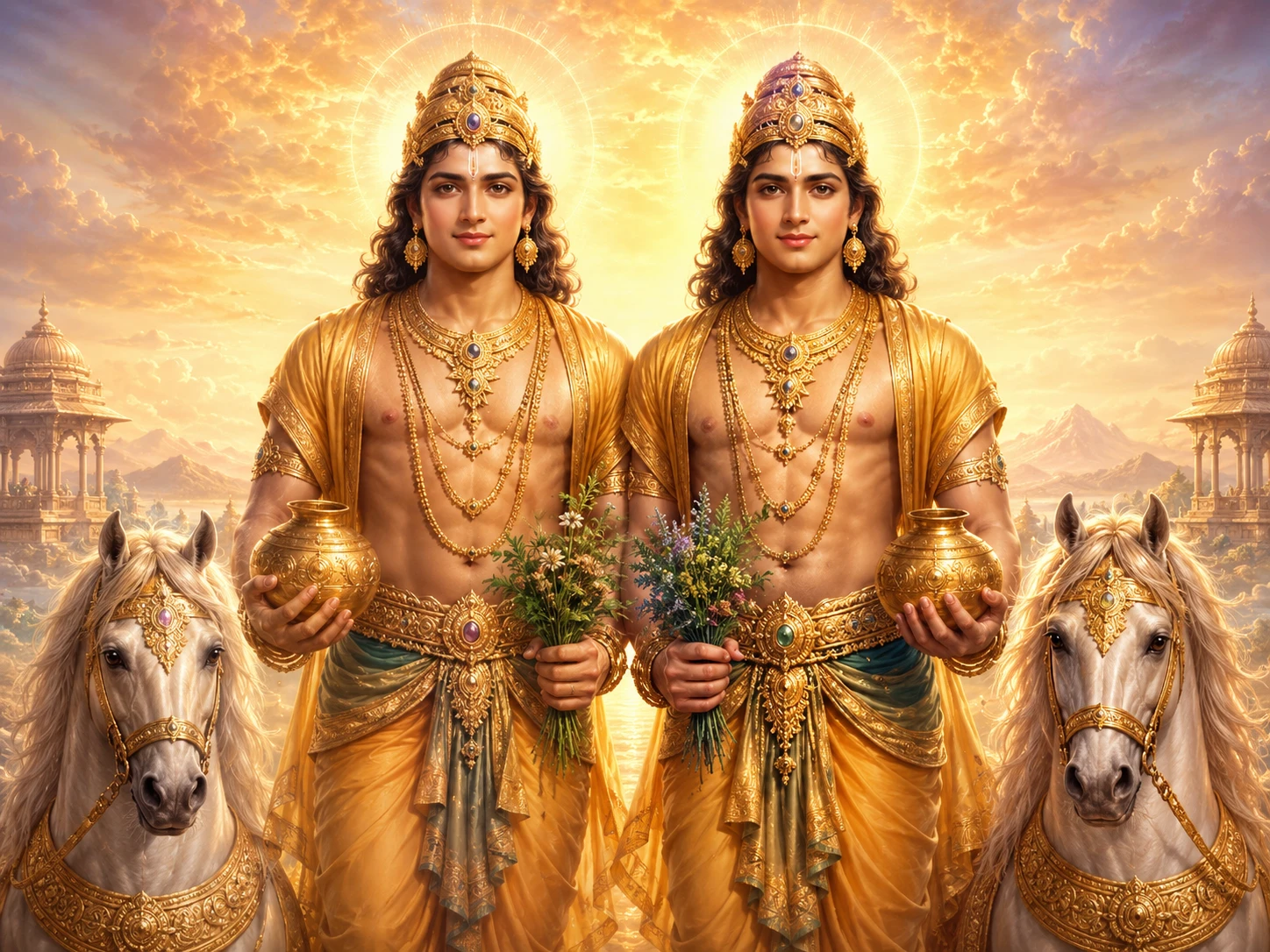
Ashwini Kumaras -- The Divine Physicians
अश्विनी कुमार -- दिव्य चिकित्सक
The Ashwini Kumaras are twin deities of Vedic Hinduism, specifically associated with medicine, healing, sunrise, and the dual brilliance of dawn-and-dusk twilight. Their individual names are Nasatya ('ever true') and Dasra ('enlightened giving'), but they are almost always invoked as a pair, never separately; their theology is precisely that of divine twinhood. Sanskrit ashvin means 'possessor of horses' or 'horse-like,' and they are imagined as eternally young horsemen racing across the sky in a golden chariot at the moment just before dawn. In temple iconography and popular Hindu art, they are shown as identical young men with horse heads, wearing golden armour, holding the reins of their chariot or a medicine pot. Their father is Surya, the sun, who approached his wife Saranyu in the form of a horse when she had taken the form of a mare to escape his excessive brilliance; the Ashwins were born from this equine union, which accounts for their horse-heads. Saranyu's mother-form means that Ashwins are twins who are also, at the theological level, sunrise itself: two aspects of the liminal dawn-moment when light first reaches earth. They are the deities invoked when one wants to see clearly, heal correctly, and arrive at the right moment -- all three being cognate functions in Vedic understanding.
The Rigveda dedicates 57 specific hymns to the Ashwini Kumaras, out of approximately 1,028 hymns in the entire collection -- a proportion that marks them as among the most important deities of the Vedic pantheon. They are mentioned 376 times across the Rigveda in various contexts. Their hymns are concentrated in the first, eighth, and tenth Mandalas (books), with RV 1.116 (the famous Ashwinau-sukta, 25 verses) being the most elaborate single account of their deeds. The Rigveda presents them as saviours: rescuing Bhujyu from the ocean when he was adrift, restoring sight to the blind sage Rijrashva, giving a new leg to Vishpala (a queen who had lost hers in battle), healing the lame Parāvrj, and providing husbands to unmarried daughters of kings. These are specific healing and restoration actions, not abstract benedictions. The hymns also describe the twins as possessors of the madhuvidya (the honey-doctrine), a specific esoteric knowledge that the sage Dadhyanc transmitted to them at the cost of his own head. In turn, they taught this wisdom to Indra and the other devas. The Ashwins are therefore not only physicians but also custodians of certain secret knowledge that bridges the physical and the spiritual. Vedic ritual continues to invoke them at the beginning of every shrauta (fire-based) ceremony in the pratar-anuvaka, the pre-dawn recitation of the adhvaryu priest.
दस्रा युवाकवः सुता नासत्या वृक्तबर्हिषः । आ यातं रुद्रवर्तनी ॥
dasrā yuvākavaḥ sutā nāsatyā vṛktabarhiṣaḥ | ā yātaṃ rudravartanī ||
O Dasras, the soma juice is pressed for you; O Nasatyas, the sacred grass is spread. Come, you whose path is strong as Rudra's.
— Rigveda 1.3.3 (the canonical Ashvin invocation verse in Mandala 1, Sukta 3)
The iconography of the Ashwini Kumaras in surviving temple sculpture is relatively rare compared to their Vedic prominence, reflecting the general decline of specifically Vedic-deity temples in the post-Vedic period as sectarian Shaiva and Vaishnava traditions rose. Where they do appear, typically in panels at older Vishnu temples and occasionally at Surya temples, they are shown as identical young men with horse heads, four-armed, each holding a kalasha (pot, typically representing medicine or amrita) in one hand and making a specific mudra with another hand. Their chariot, when depicted, is drawn by horses or birds, with Usha (the dawn goddess) sometimes shown between them as their charioteer. They are shown ascending into a reddish sky, the colour that Sanskrit aesthetic theory assigns to sandhya (twilight). The most significant surviving Ashwin sculptures are at the Konark Sun Temple in Odisha (thirteenth century), where they appear on the external walls of the Surya-deva's chariot-temple; at the Modhera Sun Temple in Gujarat (eleventh century), where small Ashwin panels are set into the walls; and at the Martand Sun Temple in Kashmir (eighth century, now in ruins), where their iconography is difficult to reconstruct from extant remains but likely resembled the Konark form. Living worship of the Ashwins specifically, as distinct from Surya-worship that mentions them in passing, is concentrated in a few small shrines in Haryana and in Ayurvedic medical institutions where they are invoked as patron deities of the profession.
The most famous narrative involving the Ashwini Kumaras is their rejuvenation of the aged sage Chyavana, recounted in the Mahabharata's Vana Parva and in the Shatapatha Brahmana. The sage Chyavana, old and frail beyond his years because of long penance, had recently married the young princess Sukanya, whose father gave her to him in recompense for an accidental injury to the sage during a hunt. The Ashwini Kumaras, passing through the ashram on one of their dawn-journeys, encountered Sukanya, found her beautiful, and tried to convince her to abandon the old husband and choose one of them instead. Sukanya refused. The Ashwins, impressed by her fidelity, offered a boon: they would restore Chyavana's youth and beauty, on condition that she afterwards choose correctly between the three of them -- her rejuvenated husband and the two Ashwins. Sukanya agreed. The Ashwins led Chyavana into a pond, immersed themselves with him, and all three emerged identically young and handsome. Sukanya meditated on the distinction between external appearance and essential identity, and chose correctly -- she identified her actual husband despite the identical surface. Chyavana, grateful, blessed the Ashwins with a specific boon: admission to the soma-drinking at Vedic yajnas, from which they had previously been excluded because of their non-deva (specifically half-horse) status. Indra violently objected, but Chyavana's tapas-power prevailed, and the Ashwins were admitted to full deva status. The narrative explains how the Ashwins came to be considered full devas rather than semi-divine horsemen.
Key Ashwini Kumara Healing Acts in the Rigveda
| Recipient | Situation | Ashwin Intervention |
|---|---|---|
| Bhujyu / भुज्यु | Shipwrecked in the cosmic ocean / ब्रह्मांडीय सागर में जहाज़-टूटा | Carried to safety in a three-wheeled chariot that travels water and sky. / जल और आकाश यात्रा करते तीन-पहियों वाले रथ में सुरक्षा तक पहुँचाया। |
| Vishpala / विष्पला | Lost a leg in battle / युद्ध में पैर खोया | Replaced with an iron leg, allowing her to return to combat. / लोहे के पैर से प्रतिस्थापित किया, जिससे वे युद्ध में लौट सकीं। |
| Rijrashva / ऋज्रश्व | Blinded by his father / पिता ने अंधा किया | Sight restored through specific healing action. / विशिष्ट उपचार-क्रिया से दृष्टि लौटाई। |
| Chyavana / च्यवन | Old and frail / वृद्ध और दुर्बल | Youth and beauty restored through immersion in a sacred pond. / पवित्र सरोवर में डुबाने से यौवन और सौंदर्य पुनर्स्थापित किया। |
| Paravrj / पराव्रज | Lame / लँगड़ा | Ability to walk restored. / चलने की क्षमता पुनर्स्थापित की। |
These five episodes are among the many healing acts the Rigveda attributes to the Ashwini Kumaras. The specificity of the cases -- a man at sea, a warrior-woman, a blinded son, a sick elder, a lame sage -- indicates a tradition that saw healing as addressed to specific conditions rather than generic blessing. The tradition of Ayurvedic diagnostic specificity can be traced conceptually back to these Vedic healing narratives.
The tonic Chyavanprash, named after the sage Chyavana, is a direct descendant of the Ashwini Kumaras' healing formulation. According to Ayurvedic tradition documented in the Charaka Samhita (book on pharmaceutical preparations) and the Ashtanga Hridaya, the Ashwins themselves prepared the original rasayana (rejuvenating tonic) that restored Chyavana's youth, at his ashram on Dhosi Hill in present-day Narnaul, Haryana. The preparation involved approximately 50 medicinal herbs -- including amalaki (Indian gooseberry) as the principal ingredient -- combined with ghee, honey, sugar, sesame oil, and specific spices. The traditional formula has been transmitted in Ayurvedic medical lineages for more than two thousand years and remains commercially produced today. Major Indian brands -- Dabur, Patanjali, Himalaya, Baidyanath, Zandu -- market Chyavanprash to approximately 100 million Indian households annually, with total sales exceeding 1,000 crore rupees per year. A child in Mumbai or Delhi whose grandmother spoons out a teaspoon of Chyavanprash before breakfast during the winter months is, at the theological level, receiving a medicinal preparation whose lineage traces directly to the Ashwini Kumaras' original formulation for the sage Chyavana. Dhosi Hill in Haryana, the site of Chyavana's ashram, is still a minor pilgrimage destination, particularly during Basant Panchami when tradition holds the rejuvenation took place.
The Ashwini Kumaras appear in the Mahabharata as the divine fathers of Nakula and Sahadeva, two of the five Pandava brothers. King Pandu, cursed that he would die if he engaged in sexual relations, asked his two wives Kunti and Madri to use a specific mantra given by the sage Durvasa to invoke devas and obtain sons by divine begetting. Kunti obtained Yudhishthira from Dharma, Bhima from Vayu, and Arjuna from Indra through this method, and then taught the mantra to Madri, who invoked the Ashwini Kumaras and obtained the twins Nakula and Sahadeva. The theological logic is consistent: the Ashwins, as dual deities, could only produce twins. Nakula inherits the Ashwins' beauty and horsemanship (he is described in the epic as the handsomest of the Pandavas and the most skilled with horses), while Sahadeva inherits their wisdom and knowledge (he is the most learned of the Pandavas and particularly skilled in astrology and Ayurveda). In the Bhagavad Gita's chapter 11, when Krishna shows Arjuna the vishvarupa (universal form), the Ashwins are among the deities Arjuna specifically sees on Krishna's body. This scene, illustrated in almost every Bhagavad Gita edition, is the principal post-Vedic image of the Ashwini Kumaras that most contemporary Hindus encounter. The twin gods are physically embedded in the Pandava lineage and in the Gita's theophanic vision.
The Ashwini Kumaras are considered the founders of Ayurveda in classical medical tradition, and they figure in the opening homage of several key Ayurvedic texts. The Charaka Samhita, probably the most authoritative surviving Ayurvedic text (current form between 100 BCE and 200 CE, with earlier oral layers), opens with praises to the Ashwins as teachers of Indra, who then taught the art of medicine to the sage Bharadvaja, who taught Atreya, who taught Agnivesha, who in turn wrote the foundational text that Charaka later redacted. The lineage is explicit: Ashwins to Indra to Bharadvaja to Atreya to Agnivesha to Charaka. Every Ayurvedic medical curriculum in India, including at the Banaras Hindu University Ayurveda Faculty, the Gujarat Ayurved University in Jamnagar, and the national AYUSH system's Central Council for Research in Ayurvedic Sciences, begins first-year instruction with this lineage and with a brief puja to the Ashwini Kumaras as patron deities of the profession. The Ayurveda Day (celebrated annually on Dhanteras since 2016 by the Ministry of AYUSH of the Government of India) is directly connected to Dhanvantari but functionally extends the Ashwin veneration into national commemoration. A young Ayurveda student in Kottakkal, Kerala, or in Jamnagar, Gujarat, is following in a lineage that treats the Ashwini Kumaras as the first physicians. The profession traces itself to these twin deities.
The Ashwini Nakshatra, the first of the 27 lunar mansions in the Vedic astrological system, is specifically named after and dedicated to the Ashwini Kumaras. In Vedic astrology, each nakshatra spans approximately 13 degrees 20 minutes of the ecliptic, and Ashwini Nakshatra covers the first 13 degrees 20 minutes of Aries (Mesha Rashi), corresponding to the stars beta and gamma Arietis in modern astronomical terminology. The nakshatra is associated with beginnings, speed, healing, sudden action, and the dawn of new endeavours. People born under Ashwini Nakshatra are traditionally said to possess healing abilities, athletic speed, transportation and logistics aptitude, and a tendency toward sudden life-direction changes. The classical characteristics attributed in Vedic astrological texts include: excellent constitution, quick recovery from illness, skill with horses and vehicles, and leadership through demonstration rather than command. Ashwini is the first of the gandanta nakshatras (transition-point nakshatras), traditionally considered auspicious for starting new ventures on particular days. Indian astrological software used at match-making agencies in Gujarati and Punjabi traditions checks Ashwini Nakshatra alignment specifically for questions involving health, children, and new career starts. A young IT professional in Bengaluru whose birth-chart places Moon in Ashwini Nakshatra may be told by her family astrologer that she has specific aptitudes for healthcare work, logistics, or entrepreneurship -- and the interpretation traces directly to the Ashwini Kumaras' traditional attributes.
The cross-cultural parallel between the Ashwini Kumaras and other Indo-European twin-horse deities is one of the most studied examples of comparative Indo-European mythology. The Greek Dioskouroi (Castor and Pollux), the Roman Castores, the Baltic Asvieniai, the Germanic Alcis (Hengist and Horsa), and the Celtic Divine Twins are all twin-brother deities associated with horses, sunrise, and rescue at sea. Scholars including Georges Dumezil, Michael Witzel, and Stephanie Jamison have traced these figures back to a shared Proto-Indo-European deity-pair, probably called *divó népoto (the divine sons), from which all the regional variants descend. The Vedic Ashwini Kumaras are, within this framework, the Indian branch of an extraordinarily deep mythological tradition that reaches back three to four thousand years. The horse-twin motif appears independently in too many Indo-European cultures to be coincidence, and the specific features -- twinhood, dawn, rescue at sea, healing, youth -- are remarkably consistent across the tradition. This does not make the Ashwini Kumaras derivative or foreign; they are the full Indian expression of a mythological deep-structure that reaches across Eurasia. A Delhi university student of comparative mythology is, when studying the Dioskouroi and the Ashwins, studying divergent branches of the same ancient mythological tree -- and the Indian branch is, in its Rigvedic elaboration, the most detailed and most theologically developed of all the surviving branches.
The specific theology of twinhood that the Ashwini Kumaras represent is worth considering on its own terms. Most Hindu deities are singular -- Shiva, Vishnu, Krishna, Rama, Ganesha -- and the tradition has a general preference for single identifiable deities over pairs or groups. The major exceptions are the Saptamatrikas (seven mothers), the Trimurti (three forms), and specifically the Ashwini Kumaras. Twin deities function in the tradition as a teaching about what can only be accomplished through cooperation. Healing, the Ashwins' primary domain, is a cooperative function: the physician and the patient must work together; diagnosis and treatment must coordinate; the body's own healing must combine with external intervention. No single agent can heal alone. The twin theology of the Ashwins makes this cooperative principle central to the domain. Compare this to Brahma's singular creation (an act of sovereign decision), Shiva's singular tapas (a solitary internal process), or Vishnu's singular avatars (each incarnation complete in itself). Healing, by contrast, is structurally dual. A contemporary doctor treating a patient, a Ayurvedic vaidya preparing a herbal formulation that must interact with the patient's specific constitution, a psychotherapist collaborating with a client -- all of these activities participate in the twin-structure of the Ashwini Kumaras' theology. The two deities together represent what one alone could not represent: healing as relationship rather than as unilateral action.
Contemporary worship of the Ashwini Kumaras is concentrated in a few specific contexts. Ayurvedic medical practitioners, particularly those in orthodox transmission lineages, begin their day with a brief Ashwin-smarana (remembrance) and invoke the twins before particularly difficult cases. The Navagraha temples (temples to the nine planetary deities) in Tamil Nadu include specific Ashwin shrines because of their connection to Ashwini Nakshatra; these shrines draw pilgrims born under Ashwini Nakshatra and those seeking the healing benefits associated with that nakshatra. The Dhosi Hill shrine in Haryana hosts a small annual pilgrimage on Basant Panchami, attended primarily by Ayurvedic practitioners and those seeking rejuvenation or recovery from chronic illness. In North Indian Sanskrit pathashalas, the Ashwin-stava (praise) is occasionally recited at the beginning of the academic day. Outside these specialized contexts, everyday Hindu practice only rarely invokes the Ashwins explicitly. They remain present in the pantheon but have receded from active popular devotion, which is concentrated on sectarian Shaiva, Vaishnava, and Shakta traditions. This gap between textual prominence (57 Rigveda hymns) and living worship is characteristic of Vedic deities generally; the Vedas are read, chanted, and studied, but the deities named in them are not as actively worshipped as the later Puranic deities. A contemporary Hindu who wants to consciously connect with the Ashwins is swimming against the popular current but is simultaneously entering one of the oldest and deepest streams of Vedic tradition.
The connection between the Ashwini Kumaras and modern Ayurvedic pharmaceutical production is worth specific note. The herbal formulation Chyavanprash -- their signature rejuvenation tonic -- is today produced commercially by at least a dozen major Indian brands with a combined annual market size exceeding 1,000 crore rupees. Each major brand traces its specific recipe to a traditional Ayurvedic manuscript, all of which ultimately cite the Ashwins as the original formulators. Dabur, founded in 1884 in Kolkata, is the largest producer with approximately 60 percent market share; its Chyavanprash recipe is published in its corporate literature as being based on the Charaka Samhita's description of the original Ashwin preparation. Patanjali Ayurved, founded in 1995 by Baba Ramdev, entered the market aggressively in the 2010s and now holds approximately 15 percent share. Himalaya Wellness, Zandu (owned by Emami), and Baidyanath complete the top five. The product is standard winter-season consumption across North Indian middle-class households, typically given to children, the elderly, and those recovering from illness. An estimated 100 million Indian consumers take a spoon of Chyavanprash daily during the October-March season. A grandchild in Jaipur or Lucknow whose grandmother gives her the daily spoonful does not typically know the mythological background, but the supply chain that puts the jar on her kitchen table traces directly back to the Ashwin-Chyavana narrative.
For a contemporary Hindu who wants to begin an Ashwini Kumara practice, the entry point is illness, healing, or the maintenance of health. The recommended observance is to recite the Ashwini Kumara dhyana during specific healthcare moments: before beginning an Ayurvedic medicine course, before a surgical procedure, on the first day of a new exercise regimen, at the onset of the winter season when immunity traditionally needs strengthening. The dhyana takes only 60 seconds but establishes a continuity with several thousand years of Vedic healing-invocation practice. A second practice, for those interested in Ayurveda specifically, is to establish a direct student-teacher relationship with a traditional Ayurvedic practitioner and to begin the day at the clinic or pharmacy with a brief Ashwin-smarana. For those born under Ashwini Nakshatra, a more elaborate practice is traditionally prescribed: a monthly Ashwin puja on the day when the Moon transits Ashwini Nakshatra, with offerings of amalaki fruits (gooseberry) and specific herbal preparations. For most Hindus, the simplest and most accessible practice is to begin each day with a brief nod of gratitude toward the dawn sky -- toward the direction where the sun rises -- and to reflect that the Vedic tradition names that moment of dawn as the specific time when the Ashwini Kumaras race across the sky. The gesture takes 10 seconds and aligns the practitioner with the oldest Vedic dawn-practice continuously performed in human history.
Recite the Ashwin Invocation at Dawn
Recite the opening verses of Rigveda 1.3, the Ashvin hymn, at dawn on Mondays, on the day the Moon transits Ashwini nakshatra, and before any healthcare decision. It is among the oldest dawn invocations still recited. The Rigveda itself is not yet on Eternal Raga; the Scriptures library holds the Upanishads, Gitas and Puranas that grew from it.
Tags
Eternal Raga · शाश्वत राग
Institutional voice — scholarly articles on Sanatan Dharma
Deepen Your Understanding
अपनी समझ और गहरी करें
deities avatars
Yama -- The God of Death and Dharma
Yama rides a buffalo, carries a noose, and keeps perfect records of every action in every lifetime. He is not the villain of Hindu mythology. He is the judge whose verdicts are based entirely on what a person has done. The Katha Upanishad's finest teaching comes from him, given to a nine-year-old boy who refused to leave without an answer. This is the god of death who is actually the god of dharma.
deities avatars
Indra -- King of the Devas
Once, Indra was the king of the Hindu pantheon. About 250 hymns of the Rig Veda -- more than for any other deity -- praise him. He slays the dragon Vritra, rides the white elephant Airavata, rules the heaven of Svarga. Then something happens in the Puranic period, and Indra recedes. This is the story of the Hindu god who used to be first.
deities avatars
Agni -- The Fire God
The very first verse of the Rig Veda opens with a single word: Agni. The fire god is the divine priest of every Vedic ritual, the messenger who carries offerings to the devas, the witness at every Hindu wedding. He has seven tongues of flame, three heads, two faces, and lives in every hearth where food is cooked. This is the deity without whom no Hindu ritual is complete.
deities avatars
Narayana -- Cosmic Vishnu Beyond Avatara
Before Krishna lifted Govardhan and Rama crossed the ocean, there was Narayana lying on the serpent Ananta in the milk ocean. The avatars come and go. Narayana remains. This is the theological Vishnu at the base of every Vaishnava tradition, from Ramanuja's Sri Vaishnavism to the Badrinath pilgrimage to the Ashtakshari mantra every devotee chants.
scriptural exegesis
Samudra Manthan -- When Gods and Demons Ran a Joint Venture and the Universe Almost Died
A cosmic ocean. A mountain for a churning rod. A serpent king for a rope. Gods on one end, demons on the other. And out came 14 treasures -- including wealth, beauty, medicine, immortality, and one poison so lethal it could end creation itself. The Samudra Manthan is not mythology. It is the original playbook for collaboration, crisis management, and how to handle it when your joint venture partner tries to cheat you.
deities avatars
Dashavatara -- Why Vishnu Comes Back Ten Times
Fish, tortoise, boar, half-lion, dwarf, axe-warrior, prince, cowherd, enlightened teacher, future horseman. The ten avatars of Vishnu are not random folklore. Read them in sequence and you get something startling -- a narrative that mirrors evolutionary biology, tracks the rise and fall of political systems, and argues that God does not sit above history but enters it, gets dirty, and does the work. The Dashavatara is Hinduism's answer to the question every civilisation asks: why does the world keep breaking, and who fixes it?
rituals traditions
Guru Purnima -- The Full Moon of the Teacher
On the full moon of Ashadha, Hindus honour the guru -- and through every teacher, the sage Vyasa, who arranged the Vedas and composed the Mahabharata. Why the day is also called Vyasa Purnima, what the word guru means, and how the day is kept.
The Ashwini Kumaras are considered the founders of Ayurveda in classical medical tradition, and they figure in the opening homage of several key Ayurvedic texts. The Charaka Samhita, probably the most authoritative survi…
More in Deities & Avatars
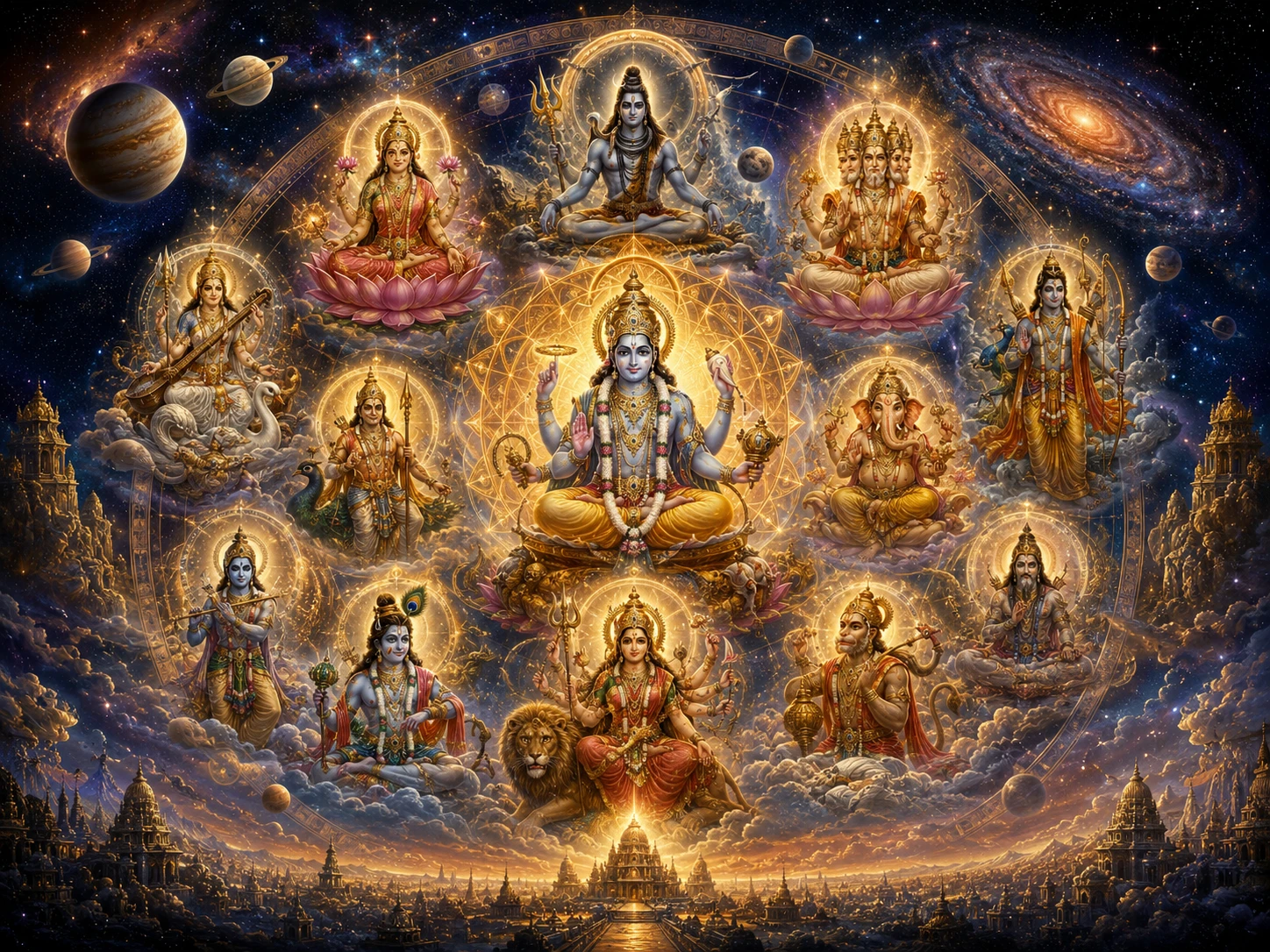
33 Koti Devata -- Why Hinduism Has 33 Types of Gods, Not 33 Crore
13 min read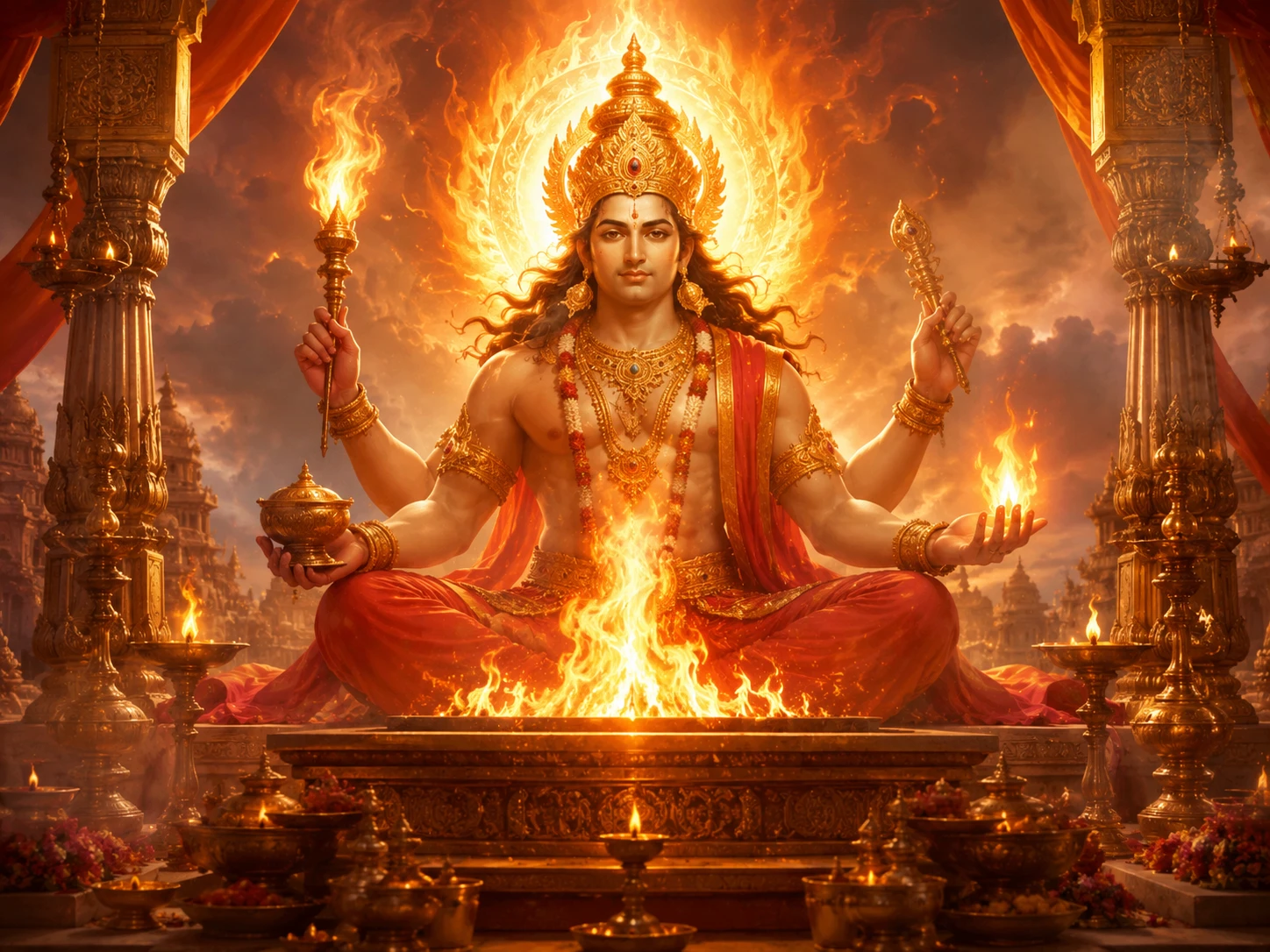
Agni -- The Fire God
19 min read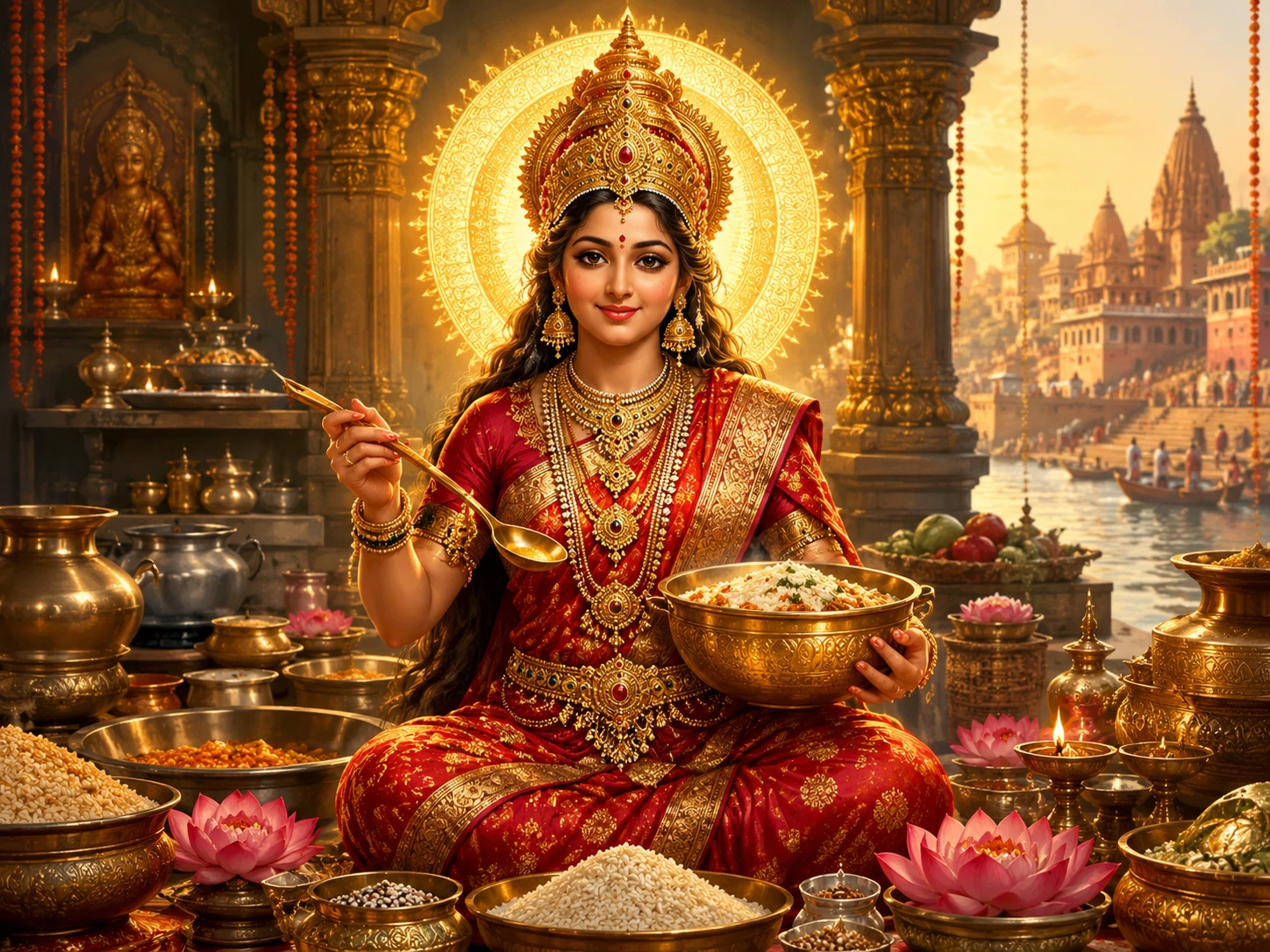
Annapurna -- Goddess of Food
19 min readThe same translation error that turned '33 Koti' into '33 crore' in Hinduism also happened in Buddhism. The Chinese translation of Buddhist texts rendered 'Sapta Koti Buddha' (7 Supreme Buddhas) as '7 Crore Buddhas.' The…
Deities AvatarsCommunity Reflections
🕉️
Be the first to share your reflection.