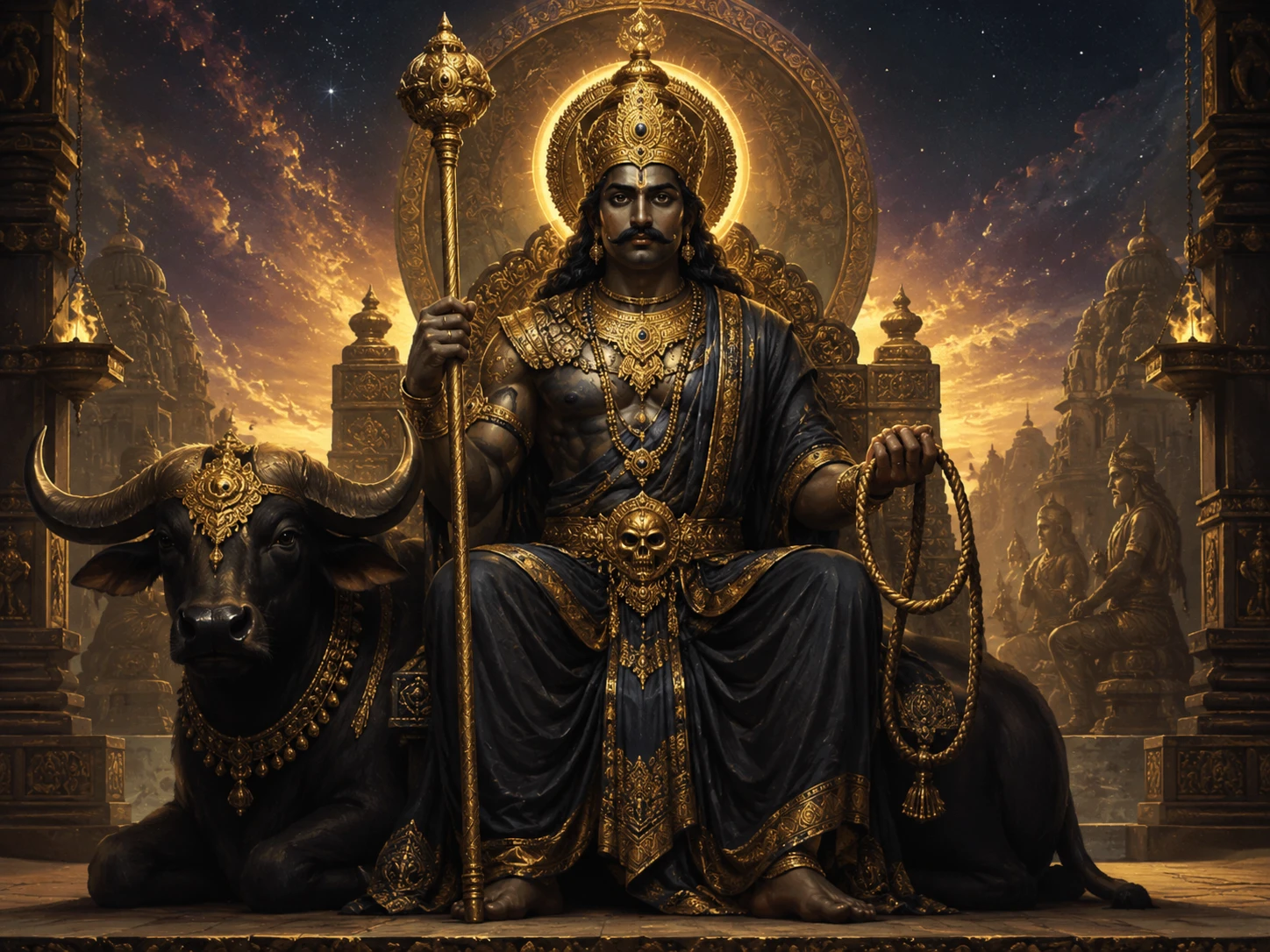
Yama -- The God of Death and Dharma
यम -- मृत्यु और धर्म के देवता
Yama is the Hindu god of death, but this single-phrase description misses most of what he is. In Hindu theology he is also Dharmaraja, the king of dharma, and his role is not to take life but to judge what happens after life. When a being dies, Yama's servants -- the Yamadutas -- escort the departed to Yamaloka, the southern world over which he presides. There, Chitragupta, Yama's record-keeper, presents the complete ledger of the being's actions: every kind deed, every lie, every charity, every cruelty, every mantra chanted, every debt unpaid. Based on this record, Yama assigns the being to a heavenly world, a hellish world, or a new birth on earth. The assignment is not capricious. It follows from what the being has done. This is why Hindu tradition does not fear Yama the way Western traditions fear the figure of Death. Yama is not arbitrary. He is the mirror in which karma finally becomes visible. A decent life produces a decent outcome. Yama is simply the officer who makes the paperwork explicit. Fear of Yama is fear of one's own record, not fear of him.
The origin of Yama in the Rig Veda places him as the first human to die, the one who discovered the path to the world of the ancestors. In Rig Veda 10.14 and in the Atharva Veda, he is the son of Vivasvan (the sun) and Saranyu, and his twin sister is Yami (also called Yamuna in later tradition, the goddess of the river). The twin relationship is theologically significant. Yama and Yami are the first pair of mortals. Their Rig Vedic dialogue, preserved in RV 10.10, is one of the oldest philosophical conversations in world literature. Yami, in grief over her brother's death, proposes that they unite as mates to continue the human line; Yama refuses, citing the prohibition on sibling union. This ancient dialogue establishes dharma as something that binds even the dying, something that cannot be waived even by the first humans even in extreme grief. The exchange is treated in classical commentary as the primordial moment at which dharma was established among humans. It is also the origin of Yama's role as Dharmaraja: he is the king of dharma because he was the first to obey it even at the cost of personal extinction.
उत्तिष्ठत जाग्रत प्राप्य वरान्निबोधत । क्षुरस्य धारा निशिता दुरत्यया दुर्गं पथस्तत्कवयो वदन्ति ॥१४॥
uttiṣṭhata jāgrata prāpya varān nibodhata | kṣurasya dhārā niśitā duratyayā durgaṃ pathas tat kavayo vadanti ||14||
Arise, awake, approach the great teachers and learn. The path is as sharp as a razor's edge, hard to cross, difficult to tread. So say the wise.
— Katha Upanishad 1.3.14 (spoken by Yama to Nachiketa)
The Katha Upanishad preserves the most important teaching ever attributed to Yama. A boy named Nachiketa, roughly nine years old, was given away to death by his angry father Vajashravasa during a yajna. Nachiketa travelled to Yama's kingdom, found the god absent, and waited three days and three nights without food or water at the gate. When Yama returned, he was so impressed with the boy's steadiness that he offered three boons. Nachiketa asked first that his father accept him back on his return; Yama granted this. He asked second for the fire ritual that leads to heaven; Yama taught him this in full. For the third boon, Nachiketa asked the question that gives the Upanishad its power: when a person dies, some say 'he still exists,' some say 'he does not.' Which is it? Yama tried to dissuade him. He offered wealth, long life, beautiful wives, political power, anything else. Nachiketa refused. He had come for the answer about death, and he would accept no substitute. Yama, impressed and perhaps resigned, then taught Nachiketa the entire doctrine of the atman -- the imperishable self -- in six chapters of verses, including the verse about the razor's edge that appears above. The Katha Upanishad is, among other things, the record of a nine-year-old who did not accept distraction.
Yama's iconography is severe but not horrifying. He is shown as a dark-complexioned man, usually red- or green-skinned in South Indian sculpture, seated on a black buffalo (mahisha). He holds the danda (a heavy club or staff) in one hand and the pasha (a noose) in the other. His garment is red. His crown is a kind of royal diadem, not the tall crowns of Shiva or Vishnu. His expression is stern but not angry. The companion at his right is Chitragupta, the scribe who maintains the record of all human actions. At his left sits Kala-purusha, the personification of time itself. His servants, the Yamadutas, are shown as muscular dark figures with clubs who escort souls to his kingdom. His dog has two pairs of eyes, four in total, and guards the gates of Yamaloka; this dog is called Shyama in some texts and is mentioned in the Rig Veda. The entire iconography is meant to communicate a specific quality: justice without favoritism, execution without cruelty, and awareness without compromise. Yama does not enjoy his work. He simply does what his position requires. Hindu temples rarely show him as the main deity, but his panel appears in the south-facing side of every classical temple, for Yama is the dikpala, the guardian of the southern direction.
The Court of Yama: Key Figures
| Figure | Role |
|---|---|
| Yama / यम | The presiding judge; king of dharma and lord of the southern world. / पीठासीन न्यायाधीश; धर्मराज और दक्षिण-लोक के स्वामी। |
| Chitragupta / चित्रगुप्त | The record-keeper who maintains the complete ledger of every being's deeds. / लेखाकार जो हर प्राणी के कर्मों का पूर्ण बही रखते हैं। |
| Yamadutas / यमदूत | The escorts who bring the departed souls to Yamaloka. / वे सेवक जो दिवंगत आत्माओं को यमलोक तक लाते हैं। |
| Kala-purusha / कालपुरुष | The personification of time itself, seated at Yama's left. / स्वयं काल का मानवीकरण, यम के बाईं ओर बैठे। |
| Shyama / श्याम | Yama's two-pairs-of-eyes dog, guardian of the gates of Yamaloka. / यम का चार आँखों वाला कुत्ता, यमलोक के द्वार का रक्षक। |
| Dhumorna / धूमोर्णा | Yama's consort, described in the Mahabharata as devoted and shining. / यम की पत्नी, महाभारत में निष्ठावान और तेजस्वी वर्णित। |
The detailed organization of Yama's court is given in the Garuda Purana (particularly the Preta-khanda, the section on the souls of the departed), and in later texts like the Yama Samhita.
The relationship between Yama and his sister Yamuna is celebrated in the Hindu festival of Yama Dwitiya, better known as Bhai Dooj, which falls on the second day of the waxing moon in Kartik (usually late October or early November). The story behind the festival is that after their separation, Yama visited his sister Yamuna at her home; she honored him, fed him an elaborate meal, and anointed his forehead with a tilak. Yama was so moved that he declared: any brother who visits his sister on this day and receives her tilak shall be freed from fear of premature death. Across North India, West Bengal, Maharashtra, Gujarat, and in Hindu diaspora communities worldwide, sisters celebrate Bhai Dooj by inviting their brothers, feeding them, applying tilak, and praying for their long lives. In Maharashtra and Goa, the festival is called Bhaubeej. In West Bengal, it is Bhai Phonta. In Nepal, it is Bhai Tika, observed with particularly elaborate ritual. A Gurgaon techie flying home to his parents' village in Uttar Pradesh for a single day to receive tilak from his sister and a Mumbai startup founder sending her brother a packet of sweets by courier because she cannot travel -- both are enacting the same ritual. The deity of death has, through his sister, made himself an ally of sibling love.
Yama's role as Dharmaraja makes him the personification of Hindu legal and ethical order; the Mahabharata's central character Yudhishthira is called Dharmaraja precisely because he is the son of Yama. The paternity is not metaphorical. When Kunti, before her marriage, used the mantra given to her by the sage Durvasa to test its power, she invoked Surya (whose son was Karna), and later after marriage she invoked Yama (whose son was Yudhishthira), Vayu (whose son was Bhima), and Indra (whose son was Arjuna). Yudhishthira's character throughout the Mahabharata -- his truth-telling, his fairness, his reluctance to harm, his acceptance of suffering over injustice -- reflects his divine parentage directly. At the end of the Mahabharata, in the Swargarohana Parva, Yudhishthira encounters a dog on the mountain path to Svarga. Indra tells him he cannot enter heaven with the dog. Yudhishthira refuses to abandon the dog. The dog then reveals himself as Yama, his own father, testing whether his son had finally become worthy of the name Dharmaraja. Yudhishthira passed the test by refusing to sacrifice dharma for reward. This single scene is one of the most loved in Indian literature and captures Yama's essential teaching: doing the right thing matters more than getting what you want.
The narrative of Savitri and Satyavan in the Mahabharata's Vana Parva is the most famous episode in which Yama is outwitted, though the narrative makes clear that he is outwitted by his own rules rather than by trickery. Savitri, a princess, married Satyavan knowing from the rishi Narada that he would die exactly one year after their marriage. On the appointed day, Satyavan fell in the forest and died; Yama himself came to take the soul. Savitri followed Yama as he carried her husband's soul southward. Yama, impressed by her devotion, offered her boons. She asked for boons that, when Yama granted them, made it impossible for him to take her husband: she asked for her blind father-in-law's sight restored, for her father's lost kingdom restored, for one hundred children to be born to her, and for her husband to live long enough to father them. When Yama granted the last one, Satyavan had to be returned. The lesson of the Savitri story is not that death can be avoided through cleverness but that dharma has its own internal logic: Yama cannot grant a boon that contradicts itself, and Savitri understood the logic better than Yama did. The story is recited every Vat Savitri Purnima in Maharashtra, Gujarat, and Uttar Pradesh, when married women observe a fast and circumambulate a banyan tree, praying for their husbands' long lives. The festival falls in May or June.
Yamaloka, the world over which Yama presides, is described in the Garuda Purana and other post-Vedic texts with specific geography and architecture. It sits in the southern direction, guarded by four gates. The dead travel there along the Vaitarani river, which flows with blood and waste. Those who have given a cow in charity during their lifetime are carried across by the cow; those who have not, swim across. The court of Yama is said to be capable of holding billions of souls simultaneously. Chitragupta presents the ledger; Yama reads the summary; the soul is assigned to one of 28 hells (naraka), to Svarga if the balance of merit is strong, or to rebirth. The specific hells are named and their specific punishments are catalogued in the Garuda Purana: Raurava for those who caused suffering to others, Kumbhipaka for those who killed animals for food, and so on. The specificity of the hells is not meant as literal zoology of the afterlife. It is meant as a pedagogic system -- a catalogue of how different sins corrupt the soul, presented as specific post-death experiences. Contemporary Hindu traditions vary in whether they treat these descriptions as literal, symbolic, or a middle ground; most practising Hindus treat them as broadly symbolic while accepting the underlying principle that action has consequences beyond the visible lifetime.
The tradition of observing Shraddha during Pitru Paksha, the fifteen-day lunar fortnight usually in September or October, is directly tied to Yama. During this period, the gates of Yamaloka are said to be loosened, and the souls of departed ancestors are permitted to visit the earth to receive offerings from their descendants. A family performs pitru-tarpan at a sacred river or at home, prepares specific foods that the ancestors used to love, feeds a Brahmin priest who represents the ancestors, and leaves a portion of the meal outside for crows (who are believed to be messengers between Yamaloka and earth). Tirthas specifically associated with Pitru Paksha include Gaya in Bihar, where a fourteen-day shraaddha at the Vishnupad Temple is considered the definitive liberation ritual for ancestors; the Godavari at Nashik-Triambakeshwar; and the Narmada at Omkareshwar. A North Indian family who has never performed any other Hindu ritual will often still perform annual shraaddha for their grandparents. The Yama connection is implicit in every tarpan mantra, which formally requests Yama to accept the offering on behalf of the named ancestor. Without Yama's cooperation, the ancestor cannot receive the food.
In contemporary Indian public life, Yama appears most visibly during the debate over organ donation. Several Hindu organizations, including the Art of Living foundation and the Isha Foundation, have actively campaigned for organ donation since the 2010s, arguing that the Yama-karma framework is fully compatible with gifting body parts after death. The theological argument is straightforward: the body is temporary, the soul moves on under Yama's jurisdiction regardless of what happens to the body, and saving another life through organ donation generates the same kind of punya (merit) as any other act of charity. As of 2024, India's national organ donation rates remain low by OECD standards, but religious barriers have been steadily breaking down, with gurus and swamis publicly signing donor cards at ceremonies. The question of whether a cremated body is preferable to an organ-donated body in traditional theology is debated, but the direction of the debate is clear. An elderly Gujarati businessman in Ahmedabad who tells his family to proceed with organ donation and immediate cremation of whatever remains is not departing from Hindu tradition; he is applying it to a modern context. Yama receives the soul regardless of the body's integrity. This is, in fact, the traditional teaching.
The fear of death, as distinct from fear of Yama, is treated extensively in the Katha Upanishad's teaching, in the Bhagavad Gita (especially chapters 2 and 8), and in the Yoga Vasishta. The central teaching across these texts is that death is not what the body does; it is what the mind experiences. The body is dissolved at death; the atman is not. Therefore fear of death is, technically, fear of the loss of something that is temporary anyway. The Katha Upanishad 1.3.15 (shortly after the razor's edge verse) states: asabdamasparsam arupamavyayam, tatha arasam nityam agandhavacca yat -- 'that which is without sound, without touch, without form, without decay, without taste, eternal, and without smell' -- this is the self, and one who knows it goes beyond the jaws of Yama. The teaching is dense but specific: Yama has authority over what is born and what dies. That is a lot of things. But what is never born cannot die, and the atman is never born. Therefore Yama has no authority over it. This is why the Katha Upanishad is sometimes described as the document that simultaneously shows Yama's greatness and his limits. He is the greatest of deities in his own sphere and nothing at all in the sphere beyond him.
Chitragupta, Yama's scribe and record-keeper, has his own distinct identity in Hindu theology and his own community of devotees. According to the Padma Purana and the Chitragupta Rahasya, Chitragupta was created by Brahma from his own body specifically to maintain the record of every action committed by every being. His name literally means 'hidden picture' -- chitra for picture, gupta for hidden -- referring to his role as the one who sees what others cannot see. The Kayastha community of North India, particularly in Uttar Pradesh and Bihar, traces its ancestry to Chitragupta and worships him directly during the festival of Chitragupta Puja, which falls on the second day after Diwali. On this day, Kayastha families traditionally set aside their pens, keep their account books closed, and offer worship to Chitragupta with specific mantras. The festival is a quiet professional identity marker: it says that the work of writing, accounting, and administration is not mundane but a continuation of Chitragupta's own cosmic work. A Kayastha IAS officer in Lucknow or a Kayastha chartered accountant in Kolkata who observes Chitragupta Puja on the day after Diwali is honoring the deity who first wrote the rules by which Yama judges. The Chitragupta iconography -- a seated figure with a quill in one hand, a ledger in the other, and an inkwell beside him -- survives today in temple panels across North India and in a small number of dedicated Chitragupta temples, the most significant being the ancient Chitragupta Temple at Kanchipuram in Tamil Nadu, which dates to the Pallava period and is one of the only functioning shrines in India where Chitragupta receives daily worship as the principal deity rather than as an attendant figure to Yama.
For someone beginning a Yama-related practice in contemporary life, the entry point is not worship at a temple but the quiet discipline of living with daily awareness of mortality. This sounds morbid; it is the opposite. The Buddhists call it maranasati, mindfulness of death. The Stoics call it memento mori. The Hindu tradition has its own version in the Upanishadic teaching that begins with 'asato ma sadgamaya, tamaso ma jyotirgamaya, mrityor ma amritam gamaya' -- 'from the unreal lead me to the real, from darkness to light, from death to immortality.' A simple practice: at the end of each day, for five minutes, sit quietly and review the day's actions as if Chitragupta were keeping a ledger. What was said that was kind, what was said that was unkind. What was done that was helpful, what was done that was avoidable harm. Where was dharma maintained, where was it violated. The practice is not meant to produce guilt or self-flagellation. It is meant to produce accuracy. At the end of the review, sit for two minutes in silence and then sleep. Done daily for forty days, this practice is said in the tradition to make a person ready for Yama's court long before Yama's court comes for them. It is a way of doing one's own accounting while time remains. The Maha Mrityunjaya Mantra from the Rig Veda 7.59.12 is the text most widely chanted by Hindus facing illness, accident, or any threat of untimely death. 'Tryambakam yajamahe sugandhim pushtivardhanam, urvarukamiva bandhanat mrityor mukshiya maamritat' -- we worship the three-eyed one who is fragrant and nourishing; may I be freed from the bondage of death like a ripe cucumber from its stalk, but not from immortality. The mantra is addressed to Shiva, but it operates entirely within Yama's framework: it does not ask to escape death permanently, only to not be taken prematurely. This is the Hindu tradition's mature position on the matter.
Recite the Tryambakam Mantra for Yama's Protection
Recite the Maha Mrityunjaya mantra (Tryambakam Yajamahe) 108 times on a rudraksha mala during Pitru Paksha or at times of illness. It addresses Shiva as the conqueror of death. Its page on Eternal Raga gives the meaning and how to chant it.
Tags
Eternal Raga · शाश्वत राग
Institutional voice — scholarly articles on Sanatan Dharma
Deepen Your Understanding
अपनी समझ और गहरी करें
tantra mantra yantra
Mahamrityunjaya Mantra -- Conquering Death
A 16-year-old boy clings to a Shiva Linga as the god of death throws a noose around his neck. Shiva emerges from the Linga, kicks Yama in the chest, and declares the boy immortal. That boy is Markandeya. That mantra is the Mahamrityunjaya. It appears in the Rig Veda, the Yajur Veda, and the Atharva Veda -- the only healing mantra attested in three of the four Vedas. It is chanted in ICU corridors, before surgeries, at bedsides, and in cremation grounds. This is not a mantra about avoiding death. It is a mantra about not being afraid of it.
deities avatars
Who is Shiva?
He is the ash-smeared ascetic who is also the ideal husband. The destroyer of the universe who is called 'The Auspicious One.' The god of death who drank poison to save all life. He sits in meditation on a Himalayan peak, and simultaneously dances the cosmos into existence and annihilation. No deity in Hinduism contains more contradictions -- and no deity resolves them more completely. This is not a mythology explainer. This is an attempt to stand at the foot of the mountain and look up.
deities avatars
Dashavatara -- Why Vishnu Comes Back Ten Times
Fish, tortoise, boar, half-lion, dwarf, axe-warrior, prince, cowherd, enlightened teacher, future horseman. The ten avatars of Vishnu are not random folklore. Read them in sequence and you get something startling -- a narrative that mirrors evolutionary biology, tracks the rise and fall of political systems, and argues that God does not sit above history but enters it, gets dirty, and does the work. The Dashavatara is Hinduism's answer to the question every civilisation asks: why does the world keep breaking, and who fixes it?
rituals traditions
Vrata -- What a Hindu Vow Really Means (It Is Not Just Fasting)
Your mother kept Karva Chauth without water for sixteen hours. Your grandmother observed Ekadashi every fortnight without fail. Your colleague skips lunch on Tuesdays 'for Hanuman.' The world sees Hindu fasting as dietary restriction. The tradition sees it as something far more radical: Vrata is a voluntary, time-bound act of self-imposed discipline that rewires the relationship between desire and willpower. Fasting is the most visible expression. But the real Vrata happens inside.
rituals traditions
Tirtha Yatra -- Why Hindus Travel to Get Closer to God
The word 'Tirtha' does not mean 'holy place.' It means 'crossing point' -- a ford where the river of worldly existence can be crossed to reach the far shore of liberation. Hindu pilgrimage is not tourism with a spiritual label. It is the deliberate journey to locations where the boundary between the material and the divine is believed to be thinnest -- where the crossing is easiest. From Kashi to Kailash, from Char Dham to Kumbh Mela, the tradition maps a sacred geography onto the physical landscape of the subcontinent, turning the act of travel itself into a spiritual practice.
deities avatars
Nine Forms of Shiva -- The Many Faces of Mahadeva
He is the silent teacher under a banyan tree and the screaming destroyer on a battlefield. He is half-woman and half-man. He drank the poison that would have ended the universe and his throat turned blue. Nine scripturally-attested forms of Shiva -- from Nataraja to Rudra -- and why each one exists.
scriptural exegesis
Samudra Manthan -- When Gods and Demons Ran a Joint Venture and the Universe Almost Died
A cosmic ocean. A mountain for a churning rod. A serpent king for a rope. Gods on one end, demons on the other. And out came 14 treasures -- including wealth, beauty, medicine, immortality, and one poison so lethal it could end creation itself. The Samudra Manthan is not mythology. It is the original playbook for collaboration, crisis management, and how to handle it when your joint venture partner tries to cheat you.
Yama's role as Dharmaraja makes him the personification of Hindu legal and ethical order; the Mahabharata's central character Yudhishthira is called Dharmaraja precisely because he is the son of Yama. The paternity is no…
More in Deities & Avatars
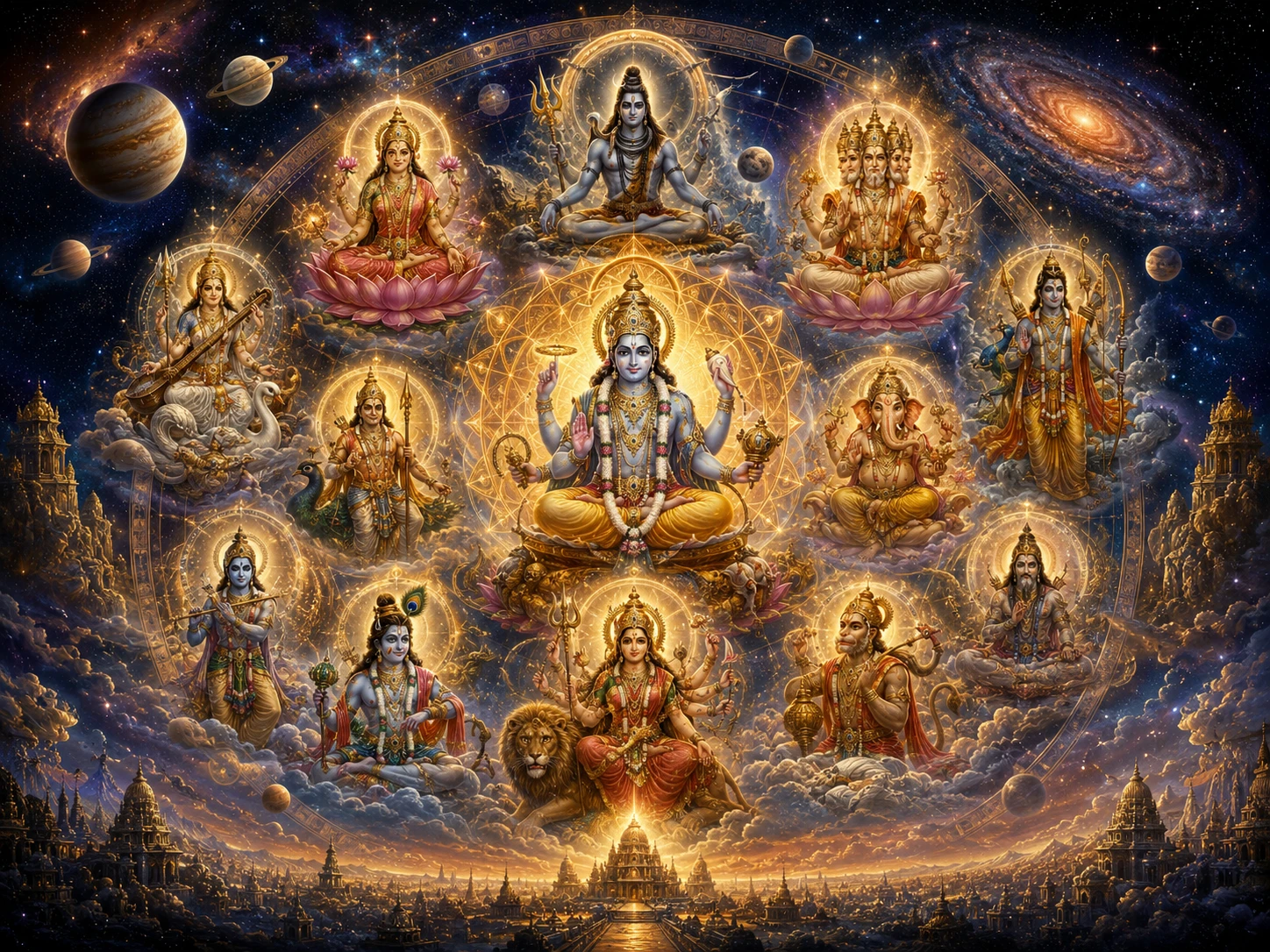
33 Koti Devata -- Why Hinduism Has 33 Types of Gods, Not 33 Crore
13 min read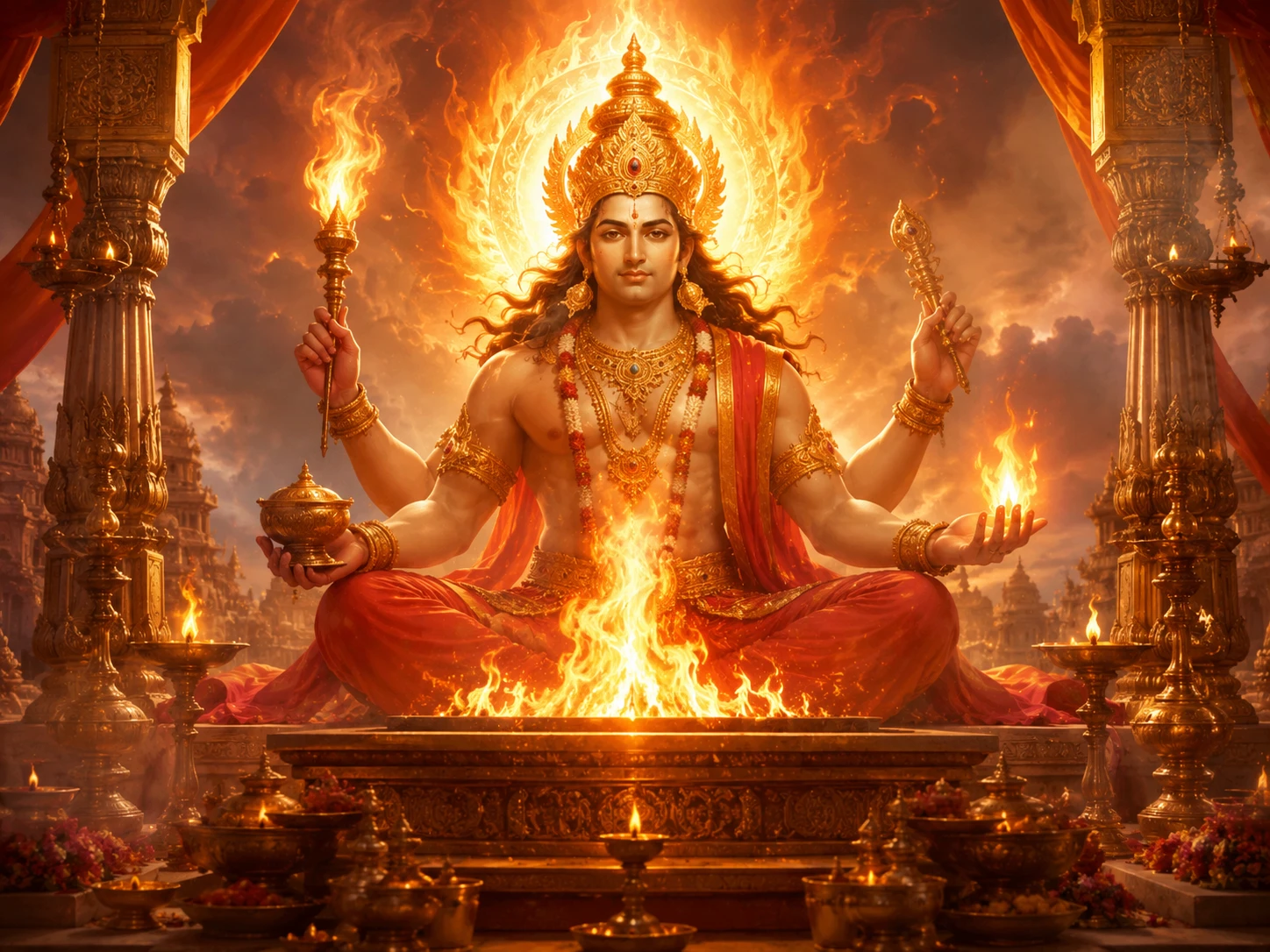
Agni -- The Fire God
19 min read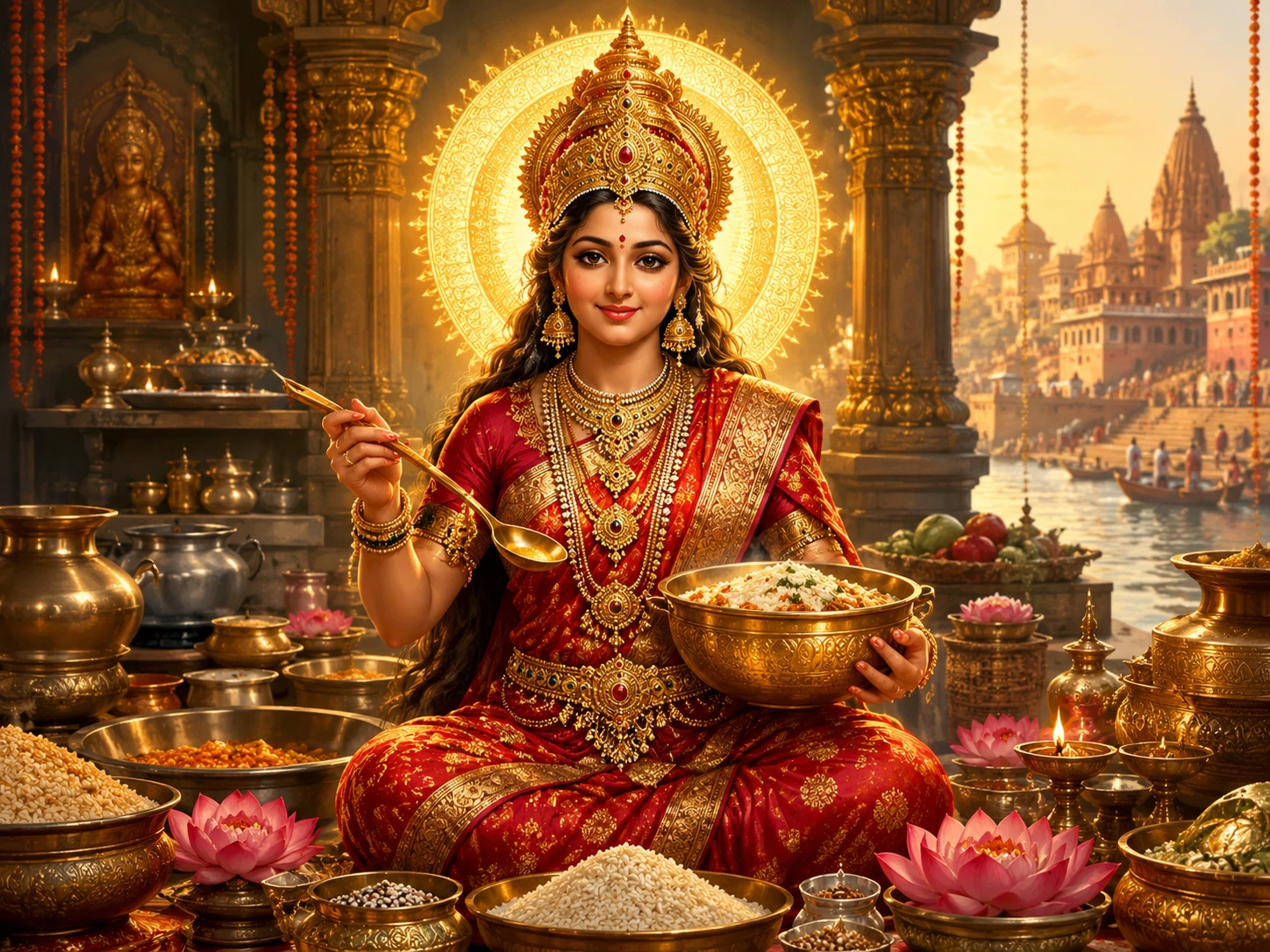
Annapurna -- Goddess of Food
19 min readThe same translation error that turned '33 Koti' into '33 crore' in Hinduism also happened in Buddhism. The Chinese translation of Buddhist texts rendered 'Sapta Koti Buddha' (7 Supreme Buddhas) as '7 Crore Buddhas.' The…
Deities AvatarsCommunity Reflections
🕉️
Be the first to share your reflection.