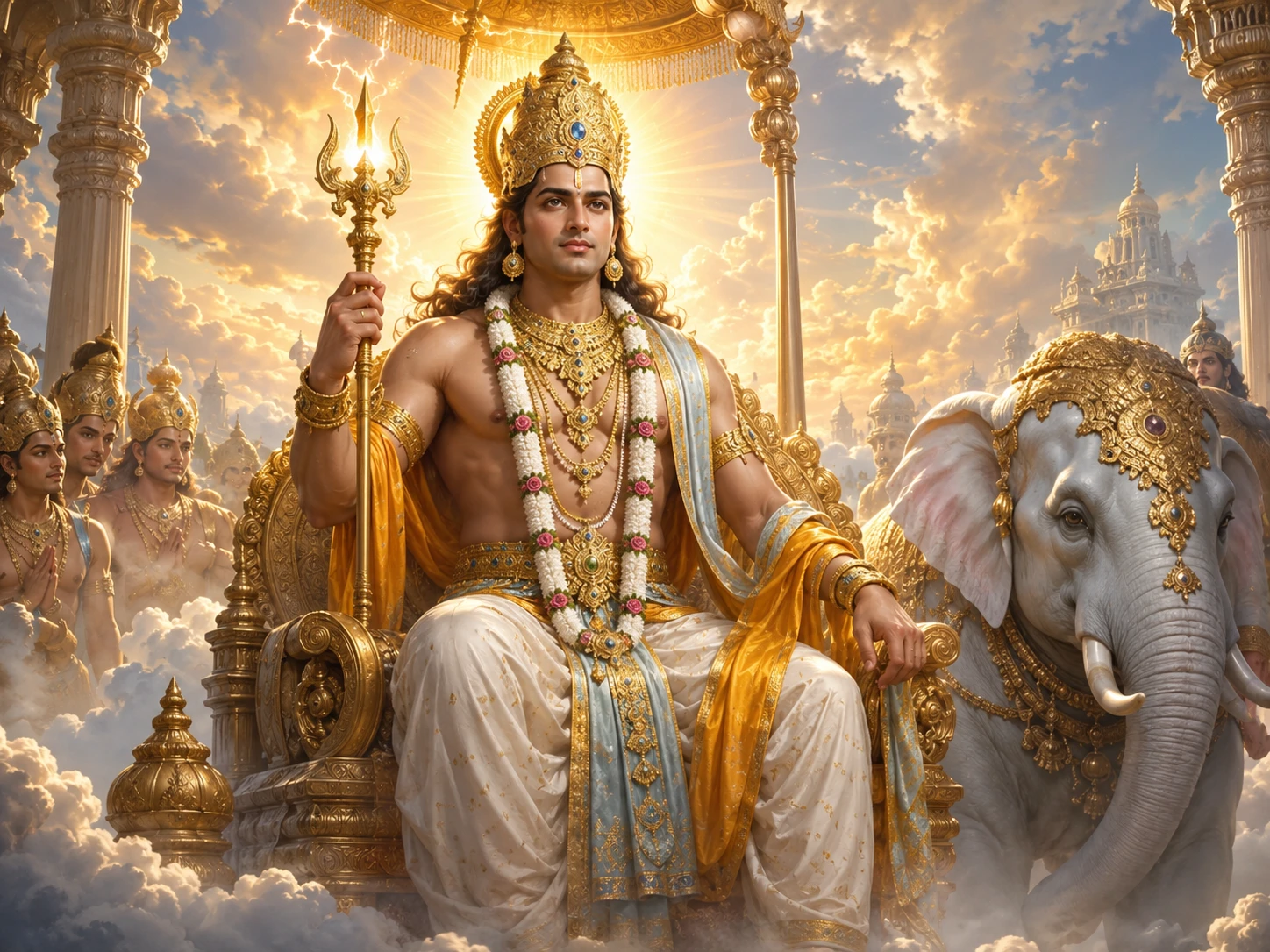
Indra -- King of the Devas
इन्द्र -- देवराज
The Rig Veda, the oldest surviving scripture of the Hindu tradition, addresses roughly a quarter of its 1,028 hymns to a single deity. His name is Indra. About 250 hymns are dedicated to him alone, more than to Agni (about 200), more than to Soma (about 120), and vastly more than to Vishnu (fewer than ten in the Rig Veda proper) or to Rudra, the early form of Shiva (about three). No other deity in early Vedic religion comes close. Indra is the thunderbolt-wielding king of the Devas, the slayer of the dragon Vritra, the giver of rain, the drinker of Soma, the warrior who defeats the Dasyus, and the ruler of Svarga, the celestial world at the summit of Mount Meru. If you had asked a Vedic priest around 1200 BCE who was the supreme god, the answer would almost certainly have been Indra. Two millennia later, the same question put to almost any Indian household produces the answer Shiva, Vishnu, Devi, or one of the regional forms of these -- rarely Indra. The story of how that shift happened is one of the most important transitions in the history of Hindu religion, and it begins with understanding who Indra was at his height.
The defining deed of Indra in the Rig Veda is the slaying of Vritra, the serpent who had coiled around a mountain and blocked the flow of the seven rivers. In a severe drought, Indra prepares himself by drinking Soma, takes up the vajra (the thunderbolt) that Tvashtri had forged from the bones of the sage Dadhichi, and strikes Vritra down. The released waters flow. Rains return. Cattle survive. Rig Veda 1.32, attributed to the sage Hiranyastupa Angirasa, describes this deed in detail over fifteen verses. The Vritra-vadha is not a minor episode. It is the single most referenced myth in the Rig Veda, invoked dozens of times across the ten mandalas. The significance is both meteorological and cosmological. At a literal level, the slaying of Vritra is a monsoon myth: a society dependent on rain-fed agriculture is ritually securing the monsoon's return through the hero who defeats drought. At a cosmological level, Vritra is the principle of obstruction itself, and Indra's vajra is the principle that cuts through obstruction. Every subsequent battle scene in Hindu mythology, including the battles of Krishna with demons and the fights of the Devi with Mahishasura, draws on the template first set by Indra and Vritra.
इन्द्रस्य नु वीर्याणि प्र वोचं यानि चकार प्रथमानि वज्री । अहन्नहिमन्वपस्ततर्द प्र वक्षणा अभिनत्पर्वतानाम् ॥१॥
indrasya nu vīryāṇi pra vocaṃ yāni cakāra prathamāni vajrī | ahann ahim anv apas tatarda pra vakṣaṇā abhinat parvatānām ||1||
I shall now proclaim the heroic deeds of Indra, the thunderbolt-wielder, the first that he achieved. He slew the serpent, carved out the waters, and split open the flanks of the mountains.
— Rig Veda 1.32.1 (Hiranyastupa Angirasa)
Indra's iconography, when he is shown at all in later temple sculpture, is distinct and rich. He is seated on his mount Airavata, the four-tusked white elephant who emerged from the Samudra Manthan (the churning of the ocean). In his right hand he holds the vajra, typically shown as a short club with prongs at either end, resembling a stylized thunderbolt. His body is coloured pale gold or yellow, sometimes described as gora (golden-yellow) in the Rig Veda. His eyes number a thousand, a detail arising from the story of Indra's encounter with the sage Gautama, to which we will return. He wears a crown; his wife Sachi, also called Indrani, sits beside him. Around him stand his advisors -- Brihaspati the guru of the devas, Kubera the treasurer, Vayu the wind god, and Agni the fire god. Over his head arches Indradhanush, literally 'Indra's Bow' -- the rainbow, a sight Indian children still learn as Indra-dhanush in Hindi even when they no longer know it is named for him. His capital is Amaravati, a city of gold set at the summit of Mount Meru. His palace is Vaijayanta. His charioteer is Matali. None of this iconography appears in the Rig Veda; almost all of it is elaborated in the Puranic period when Indra had already begun to recede.
Svarga, Indra's heaven, is described in the Mahabharata and in several Puranas with specific topography. It sits at the peak of Mount Meru, the axis of the universe. The Ganga, before descending to earth through Shiva's matted hair, first flows through Svarga. The garden of Indra is called Nandana-vana, and it contains five wish-fulfilling trees, including the Kalpavriksha, the Parijata (whose theft by Krishna from Svarga for Satyabhama is recounted in the Harivamsa), and the Santana. Indra's court includes apsaras -- celestial dancers, including Urvashi, Menaka, Rambha, Tilottama -- and gandharvas, celestial musicians. The gate of Svarga is guarded by Airavata, and entry is restricted to those who have accumulated sufficient punya (merit) through righteous action or tapas. Most importantly, Svarga is not the final destination in Hindu soteriology. The Bhagavad Gita states plainly in chapter 9.21 that even the dwellers of Svarga fall back into the world of birth and death when their punya is exhausted. Svarga is a temporary reward, not final liberation. This theological detail, often overlooked by casual readers, is the key to understanding why Indra does not command the ultimate devotion that Vishnu or Shiva do. Indra rules the relative. The absolute is elsewhere.
Indra's Major Myths Across the Texts
| Myth | Source | Theme |
|---|---|---|
| Slaying of Vritra / वृत्र-वध | Rig Veda 1.32 / ऋग्वेद 1.32 | Victory over drought; release of waters. / सूखे पर विजय; जल की मुक्ति। |
| Gautama's curse / गौतम का शाप | Ramayana, Bala Kanda / रामायण, बाल कांड | Punishment for seducing Ahalya; the thousand eyes. / अहल्या-छल का दंड; हज़ार आँखें। |
| Parijata theft / पारिजात चोरी | Harivamsa / हरिवंश | Krishna and Satyabhama take the wish-tree. / कृष्ण और सत्यभामा कल्पवृक्ष ले जाते हैं। |
| Govardhan humiliation / गोवर्धन अपमान | Bhagavata Purana / भागवत पुराण | Krishna lifts Govardhan; Indra's pride broken. / कृष्ण गोवर्धन उठाते हैं; इन्द्र का गर्व टूटता है। |
| Indra's flag festival / इन्द्रध्वज उत्सव | Mahabharata, Harivamsa / महाभारत, हरिवंश | The ancient autumn festival of raising the Indradhvaja. / इन्द्रध्वज उठाने का प्राचीन शरद उत्सव। |
Indra also plays supporting roles in many other narratives: he is the father of Arjuna (through the boon to Kunti), the one who tests Yudhishthira in the final Mahabharata episode, and the deity who grants Vishwamitra's progress by sending down apsaras to disrupt his tapas.
The shift away from Indra has several explanations in scholarly and traditional Hindu thought. The first and most widely accepted is theological: as the bhakti movements of Shaivism and Vaishnavism grew during the late Vedic, Upanishadic, and early Puranic periods, devotion reorganized itself around supreme deities who offered moksha -- liberation from rebirth -- rather than Svarga. Indra could give you rain, cattle, victory, and pleasure, but he could not give you moksha. Once the goal of Hindu spiritual life shifted from worldly flourishing to absolute liberation, Indra's domain became secondary. The second explanation is narrative: the Puranas actively worked to subordinate Indra to Vishnu and Shiva. The Govardhan episode in the Bhagavata Purana, where Krishna lifts Govardhan hill on his little finger for seven days to protect the residents of Vrindavan from Indra's storm, is a direct theological dethroning. Krishna tells the villagers to stop worshipping Indra and to worship the hill and the cattle instead; Indra responds with rain; Krishna counters with the mountain; Indra is humbled. Every Krishna-bhakta child learns this story. Every child learns, implicitly, that Indra lost. The third explanation is historical: as the Vedic yajna culture declined and temple worship rose, deities associated with ritual fire (Indra, Agni, Soma) yielded space to deities with fixed iconic forms in stone and metal (Vishnu, Shiva, Devi).
The title 'Indra' is in fact an office, not a fixed individual, in Puranic theology. The Vishnu Purana (3.1-3.2) explains that every manvantara -- a cyclic period of approximately 306.72 million years -- has a different being holding the title of Indra. The current Indra, who ruled during the Vaivasvata manvantara (the present one), is named Purandara. Previous Indras include Yajna, Satya, and others; future Indras include Bali, who in Puranic tradition holds the title during the next manvantara. This theological scheme is genuinely unusual in world religion. It means that in Hindu thought, even the kingship of heaven is provisional. A being who has accumulated enough tapas and punya can ascend to the throne of Indra; a being who misuses the position can be removed. The title is structurally closer to a political office than to a dynastic crown. The Mahabharata's Udyoga Parva records a conversation between Vyasa and Yudhishthira in which this fact is explained, and the Mahabalipuram sculptures in Tamil Nadu depict the rival claims of successive Indras in sequence.
The story of Ahalya and Indra is one of the more troubling episodes in Hindu mythology, and it has been retold many times with different moral verdicts. The basic narrative, from the Bala Kanda of the Ramayana, is this: Ahalya was the wife of the sage Gautama, and Indra, attracted to her beauty, came to their ashram in the form of Gautama while the real Gautama was away. Ahalya, either deceived or (in some tellings) not deceived, accepted him. When Gautama returned and discovered what had happened, he cursed both. In the Valmiki Ramayana, Ahalya is rendered invisible until Rama touches her with his foot and redeems her; in later retellings, she is turned into stone. Indra is cursed to have a thousand vaginas appear all over his body, which are later converted into a thousand eyes; hence his epithet sahasraksha, 'thousand-eyed.' This myth has been read in strongly different ways. In one reading, the curse on Ahalya and her restoration through Rama's touch is an allegory of the female soul's fall and divine recovery. In a feminist rereading, it is a cautionary tale about how women are blamed in patriarchal moral frameworks for sexual violations committed against them. In a theological reading, it is a direct statement that even the king of the Devas is accountable to moral law. All three readings are available in contemporary commentary, and the tradition does not force a single interpretation.
Indra's association with soma is structurally important to Vedic religion. Soma was a plant (identification disputed; some scholars propose Ephedra, others Amanita muscaria mushroom, others say the identity is now lost) whose juice was pressed, filtered through sheep's wool, mixed with milk, and offered to the gods as the central oblation of the Vedic yajna. Indra is the most enthusiastic drinker of soma in the Rig Veda. Hymn after hymn describes his drinking soma, being strengthened by it, performing feats of valor under its influence. Rig Veda 10.119, famously, is a first-person hymn in which Indra himself speaks while intoxicated on soma: 'Have I been drinking soma? Yes, I have drunk. I could pick up the earth. I could scatter the sky. One wing of mine is in the higher world, the other I drag through the worlds.' This rare first-person utterance places soma at the centre of Indra's power. When the Vedic soma rituals faded -- as they did, gradually, through the first millennium BCE -- Indra lost not only his iconic drink but his iconic ritual context. The sacrifice he was fed at simply stopped being performed. He could not survive the disappearance of his substrate. Modern Vedic revivalists, including some Srauta ritualists in Kerala and Karnataka who continue Somayajna in attenuated form, still offer soma substitute to Indra, though without the original plant the rite is necessarily symbolic.
Indra persists in the Hindu imagination through language rather than worship. Indradhanush, the Hindi word for rainbow, is used daily by millions of Hindi speakers who never stop to think about its etymology. Indravajra, the name of a specific Sanskrit metre, is learned by every student of Sanskrit prosody. Aindri, the feminine form of Indra, is one of the Saptamatrikas, the seven mother goddesses. Indraloka, Indra's world, is an address for spiritual aspiration even when no one is praying to its ruler. The month of Margashirsha is traditionally Indra's month. The festival of Indradhvaja, the raising of Indra's banner, was once the principal autumn festival of northern India, described in detail by Kalidasa in the Raghuvamsha and celebrated at royal courts until the medieval period; today it survives only in scattered localities, most notably as Indra Jatra in Kathmandu, Nepal, where it remains a major annual festival. The linguistic survival is broader than the ritual survival. Indra has receded from the altar but not from the lexicon. Every time a Hindi-speaking child says 'indradhanush' after a monsoon rain, Indra is being named -- and the Vedic god who slew Vritra so that rain could fall is being obliquely acknowledged, even if the child does not know it.
Indra's role in the Mahabharata is a specific later transformation. He is the divine father of Arjuna through Kunti's mantra-invocation, and he plays a supporting role in the epic as the father who gives his son divya-astras (celestial weapons) during Arjuna's visit to Svarga. He tests Yudhishthira at the end of the Mahabharata by asking him to abandon his dog before entering heaven; the dog is revealed to be Yudhishthira's own dharma, and the test is passed only because Yudhishthira refuses. In this scene, Indra functions not as a supreme deity but as a gatekeeper whose job is to administer moral tests. The Mahabharata also includes the famous exchange in the Vana Parva where the sage Lomasa tells Yudhishthira that Indra defeated Vritra only through trickery (by violating a truce and attacking at an unfair moment), and that as a result of this karma Indra suffered guilt and had to perform austerities to regain his position. This is an unsettling narrative: the king of the gods committing a moral violation and paying for it. It is also a tell about the Mahabharata's theological attitude toward Indra. The Vedic deity is being reframed as a fallible figure whose actions can be judged against an independent dharmic standard. Krishna, in the same epic, is not judged against any standard because he is the standard. The demotion is implicit but unmistakable.
In 2026, direct worship of Indra continues in specific Vedic-ritual contexts rather than in general popular devotion. The Somayajna, when performed by Srauta ritualists in Kerala's Trichur district, Karnataka's coastal belt, and parts of Andhra Pradesh, includes offerings to Indra as the principal deity. These performances, organized by organizations like the Srauta Kosha or by local vaidika families, are often weeks long and cost substantial money to conduct; they draw Sanskritists and scholars from across India and abroad. A 2019 Somayajna at Panjal village in Kerala drew academic observers from Harvard, Heidelberg, and Kyoto. For the grihastha who does not have access to such elaborate ritual, a simple form of Indra-smarana is available: during the monsoon, pouring water offered to Indra at the household tulsi plant while reciting Indradhanush-kavachamantra. The practice is not common. It is not mandatory. But it survives in pockets among elder families in Maharashtra, Tamil Nadu, and Odisha who have not forgotten that the rain falls because someone, long ago, cut a serpent from a mountain and let the waters move again.
The Govardhan-dharan episode in the Bhagavata Purana (10.24-10.27) deserves closer attention because it is the single most important narrative moment of Indra's demotion in the Hindu imagination. The young Krishna, living among the cowherds of Vraja, tells his adoptive father Nanda and the assembled villagers to stop the annual Indra-yajna they had always performed. Instead, he says, they should worship Govardhan hill directly, because it is the hill that provides grazing for their cattle, and they should worship the cattle themselves, because the cattle sustain their lives. The villagers follow his advice. Indra, enraged at being deposed by a cowherd boy, sends a seven-day deluge to destroy Vraja. Krishna lifts Govardhan on his little finger and holds it as an umbrella over the entire village until the storm ends. Indra arrives, sees the truth, descends from his elephant, and prostrates before Krishna, who then forgives him. This is not a minor myth. Every schoolchild in a Krishna-bhakti household learns it. Every Annakut festival in November reenacts it: food mountains are prepared and offered to Govardhan, not to Indra. Over the course of two millennia of repeated performance, this single narrative trained the Hindu imagination to understand Indra as the deity whom Krishna displaced. The theological lesson is clear: the storm god of the Vedas cannot survive a direct encounter with the avatar of the Puranas.
The Vedic Indra shared a remarkable structural similarity with storm gods of other Indo-European traditions. Comparative philology of the nineteenth and twentieth centuries established that Indra's profile -- thunderbolt-wielding warrior, slayer of a dragon or serpent, ruler of the other gods, associated with rain and fertility -- shows direct parallels with Zeus in Greek religion, Jupiter in Roman religion, Thor in Germanic religion, Perun in Slavic religion, and Taranis in Celtic religion. All of these deities slay a serpent; all wield a lightning-weapon; all preside over their respective pantheons. The shared name of the thunderbolt is etymologically informative: Sanskrit vajra, Avestan vazra, Old Norse Mjölnir, and Greek keraunos share root concepts if not shared roots. Scholars including Georges Dumézil and more recently Calvert Watkins have mapped these parallels in detail. The implication is that the Indra story predates the Sanskrit Rig Veda by many centuries and reflects a proto-Indo-European religious layer from which all these later traditions descended. The Indra we meet in the Rig Veda is already a specific Indo-Aryan development of a much older figure. This comparative history does not diminish Indra's Hindu specificity; it places him in a broader context that makes his Vedic centrality more intelligible. The storm god is one of humanity's oldest religious forms.
The Aitareya Brahmana preserves an episode in which Indra is held responsible for the brahmahatya, the killing of a brahmin, because Vritra in the Brahmana narrative is classified as a brahmin. Indra wanders in despair, his deed weighing on him, unable to find purification. He is told that the sin must be divided and carried by four created entities: the earth (which takes a fourth of the sin and carries it as saline soil), trees (which carry a fourth as their sap bleeding when cut), women (who carry a fourth as menstruation), and water (which carries a fourth as froth). Only then is Indra partially purified. This myth, while uncomfortable to modern readers for its framing of menstruation, is theologically significant because it shows the Vedic and Brahmanical tradition's awareness that even the king of the gods was accountable to cosmic moral law. The Brahmanas often take this kind of unsparing position about the fallibility of the gods. Indra in the Brahmana literature is not a paragon. He is a figure who commits violations, suffers for them, and is restored through specific ritual procedures. The moral logic is clear: no being, however exalted, stands above the consequences of action. Even for those uncomfortable with the specific distribution mentioned in this myth, the larger principle is one of the tradition's most important: karma operates universally.
Indra also survives, in a specifically modern form, as a symbol in Indian political and military life. The Bharatiya Vayu Sena (Indian Air Force) uses a range of emblems and mottos drawing on Indra imagery, and its principal fighter aircraft squadrons have historically chosen call signs and names that echo the Vedic deity. The DRDO's tactical surface-to-air missile system Akash and its predecessor Trishul were sometimes informally linked to Indra's vajra in early defence-journalism coverage. The Army's 17 Mountain Strike Corps headquartered in Panagarh has an insignia featuring a stylized thunderbolt. This military symbolism is not accidental. Indra was, after all, the warrior god first, before he was the king. His weapon defined the Indian imagination of 'irresistible strike' long before it passed into Mahayana Buddhism as the vajra of the Tibetan tradition and then into English as 'vajra' or sometimes 'dorje.' The Tibetan Buddhist tradition took Indra's vajra as its central ritual symbol, and every Tibetan monk's altar holds a small metal vajra beside a ghanta (bell). This transfer of the weapon -- from Vedic deity to Buddhist ritual object to global symbol of spiritual strike -- is one of the longest-running symbolic migrations in Asian religious history.
Chant the Indra Gayatri at Dawn
Chant the Indra Gayatri -- Om Devarajaya Vidmahe, Vajrahastaya Dhimahi, Tanno Shakrah Prachodayat -- 108 times on a mala at dawn, especially in the monsoon months. It is not yet on Eternal Raga; the mantra library has the Vedic suktams.
Eternal Raga · शाश्वत राग
Institutional voice — scholarly articles on Sanatan Dharma
Deepen Your Understanding
अपनी समझ और गहरी करें
scriptural exegesis
Samudra Manthan -- When Gods and Demons Ran a Joint Venture and the Universe Almost Died
A cosmic ocean. A mountain for a churning rod. A serpent king for a rope. Gods on one end, demons on the other. And out came 14 treasures -- including wealth, beauty, medicine, immortality, and one poison so lethal it could end creation itself. The Samudra Manthan is not mythology. It is the original playbook for collaboration, crisis management, and how to handle it when your joint venture partner tries to cheat you.
deities avatars
Dashavatara -- Why Vishnu Comes Back Ten Times
Fish, tortoise, boar, half-lion, dwarf, axe-warrior, prince, cowherd, enlightened teacher, future horseman. The ten avatars of Vishnu are not random folklore. Read them in sequence and you get something startling -- a narrative that mirrors evolutionary biology, tracks the rise and fall of political systems, and argues that God does not sit above history but enters it, gets dirty, and does the work. The Dashavatara is Hinduism's answer to the question every civilisation asks: why does the world keep breaking, and who fixes it?
deities avatars
Mahishasuramardini -- The Slayer of the Buffalo Demon and India's Most Iconic Image of Power
No single image has been reproduced more in Indian art than a goddess standing on a buffalo, trident in hand. From Gupta-era gold coins to Kolkata's 40,000 Durga Puja pandals, Mahishasuramardini -- the Slayer of the Buffalo Demon -- is the defining visual of Hindu civilisation's most radical claim: that the ultimate power in the universe is feminine.
rituals traditions
Vrata -- What a Hindu Vow Really Means (It Is Not Just Fasting)
Your mother kept Karva Chauth without water for sixteen hours. Your grandmother observed Ekadashi every fortnight without fail. Your colleague skips lunch on Tuesdays 'for Hanuman.' The world sees Hindu fasting as dietary restriction. The tradition sees it as something far more radical: Vrata is a voluntary, time-bound act of self-imposed discipline that rewires the relationship between desire and willpower. Fasting is the most visible expression. But the real Vrata happens inside.
deities avatars
Nine Forms of Shiva -- The Many Faces of Mahadeva
He is the silent teacher under a banyan tree and the screaming destroyer on a battlefield. He is half-woman and half-man. He drank the poison that would have ended the universe and his throat turned blue. Nine scripturally-attested forms of Shiva -- from Nataraja to Rudra -- and why each one exists.
deities avatars
Who is Shiva?
He is the ash-smeared ascetic who is also the ideal husband. The destroyer of the universe who is called 'The Auspicious One.' The god of death who drank poison to save all life. He sits in meditation on a Himalayan peak, and simultaneously dances the cosmos into existence and annihilation. No deity in Hinduism contains more contradictions -- and no deity resolves them more completely. This is not a mythology explainer. This is an attempt to stand at the foot of the mountain and look up.
tantra mantra yantra
Mahamrityunjaya Mantra -- Conquering Death
A 16-year-old boy clings to a Shiva Linga as the god of death throws a noose around his neck. Shiva emerges from the Linga, kicks Yama in the chest, and declares the boy immortal. That boy is Markandeya. That mantra is the Mahamrityunjaya. It appears in the Rig Veda, the Yajur Veda, and the Atharva Veda -- the only healing mantra attested in three of the four Vedas. It is chanted in ICU corridors, before surgeries, at bedsides, and in cremation grounds. This is not a mantra about avoiding death. It is a mantra about not being afraid of it.
The title 'Indra' is in fact an office, not a fixed individual, in Puranic theology. The Vishnu Purana (3.1-3.2) explains that every manvantara -- a cyclic period of approximately 306.72 million years -- has a different …
More in Deities & Avatars
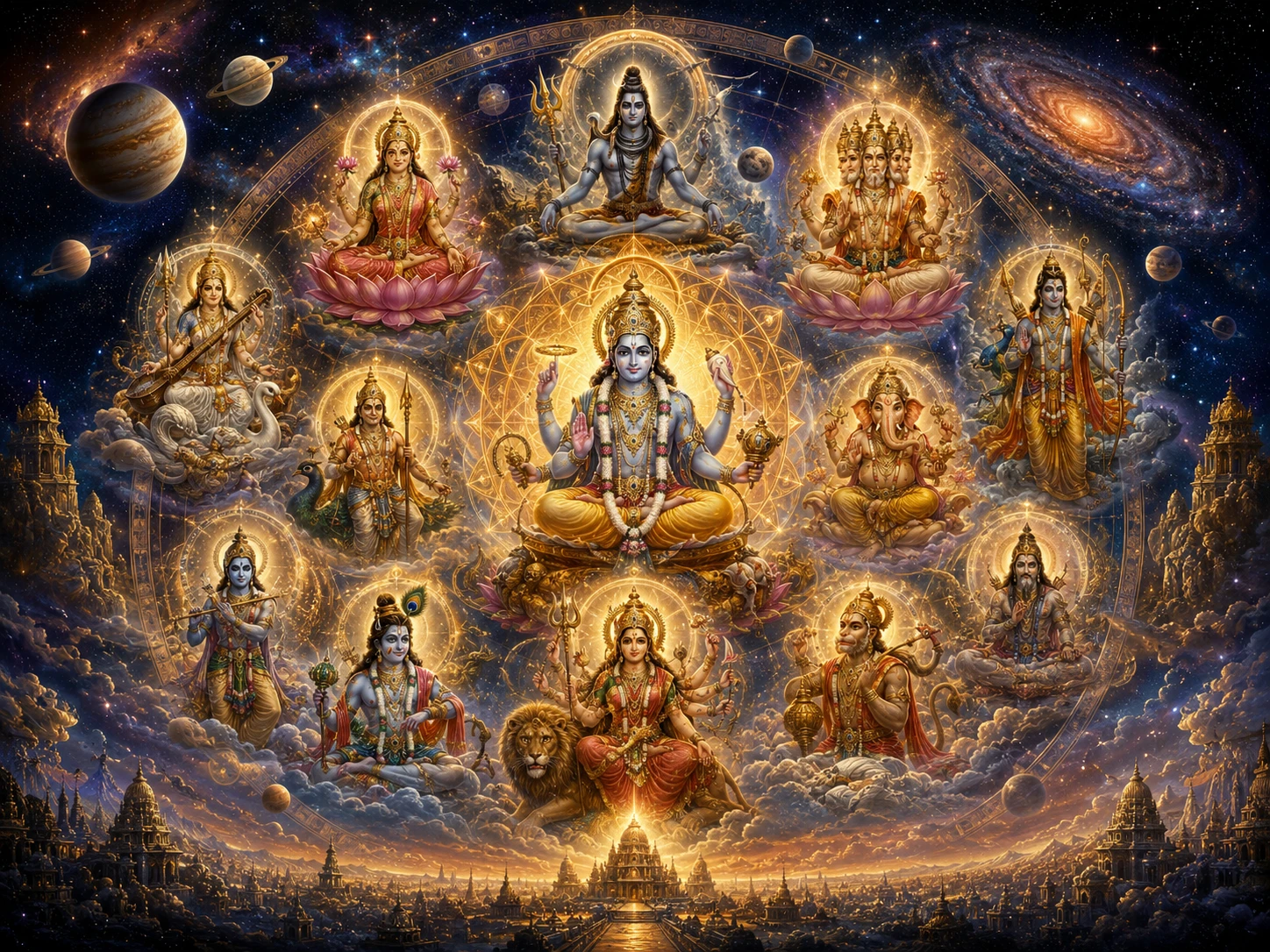
33 Koti Devata -- Why Hinduism Has 33 Types of Gods, Not 33 Crore
13 min read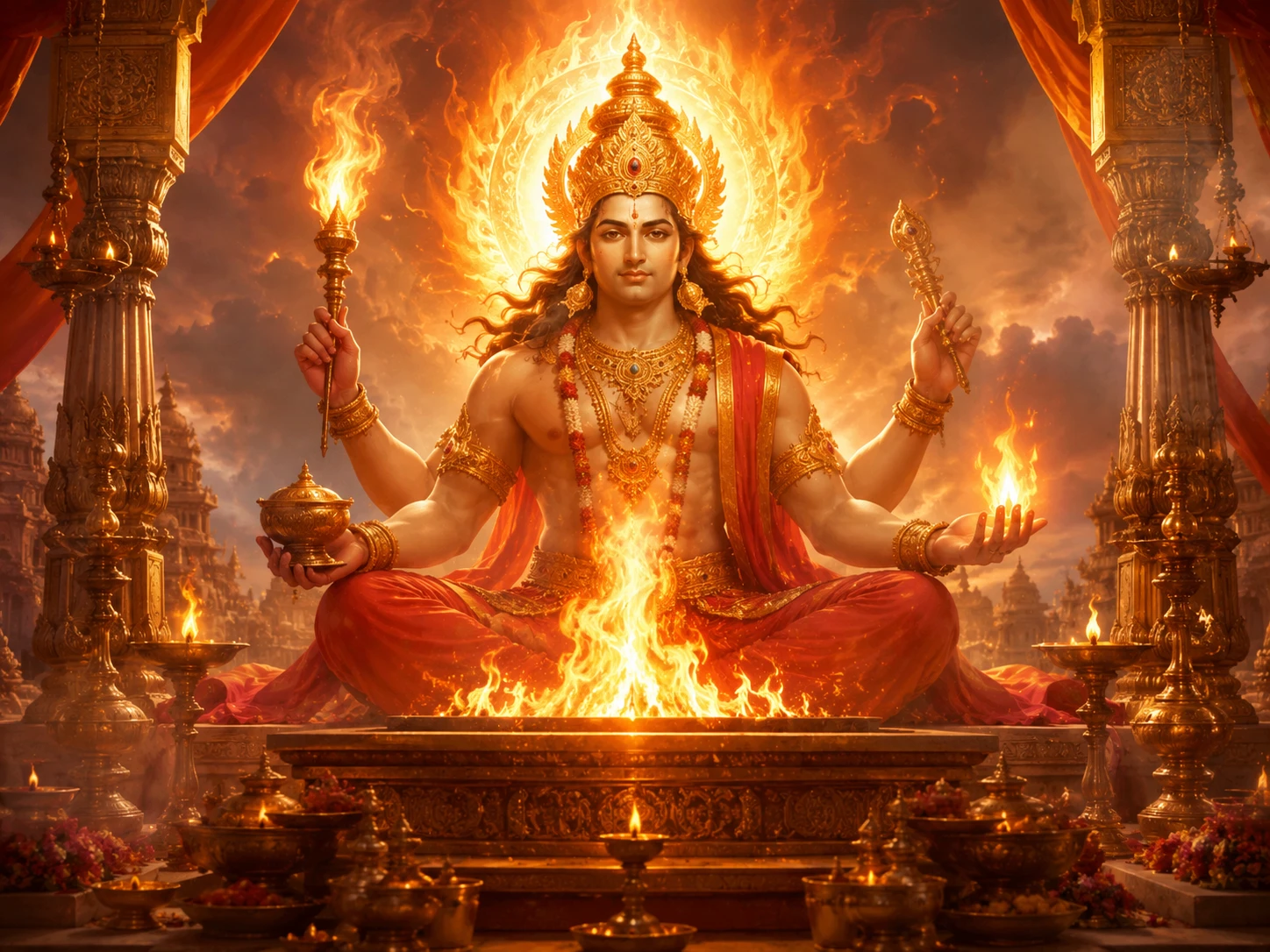
Agni -- The Fire God
19 min read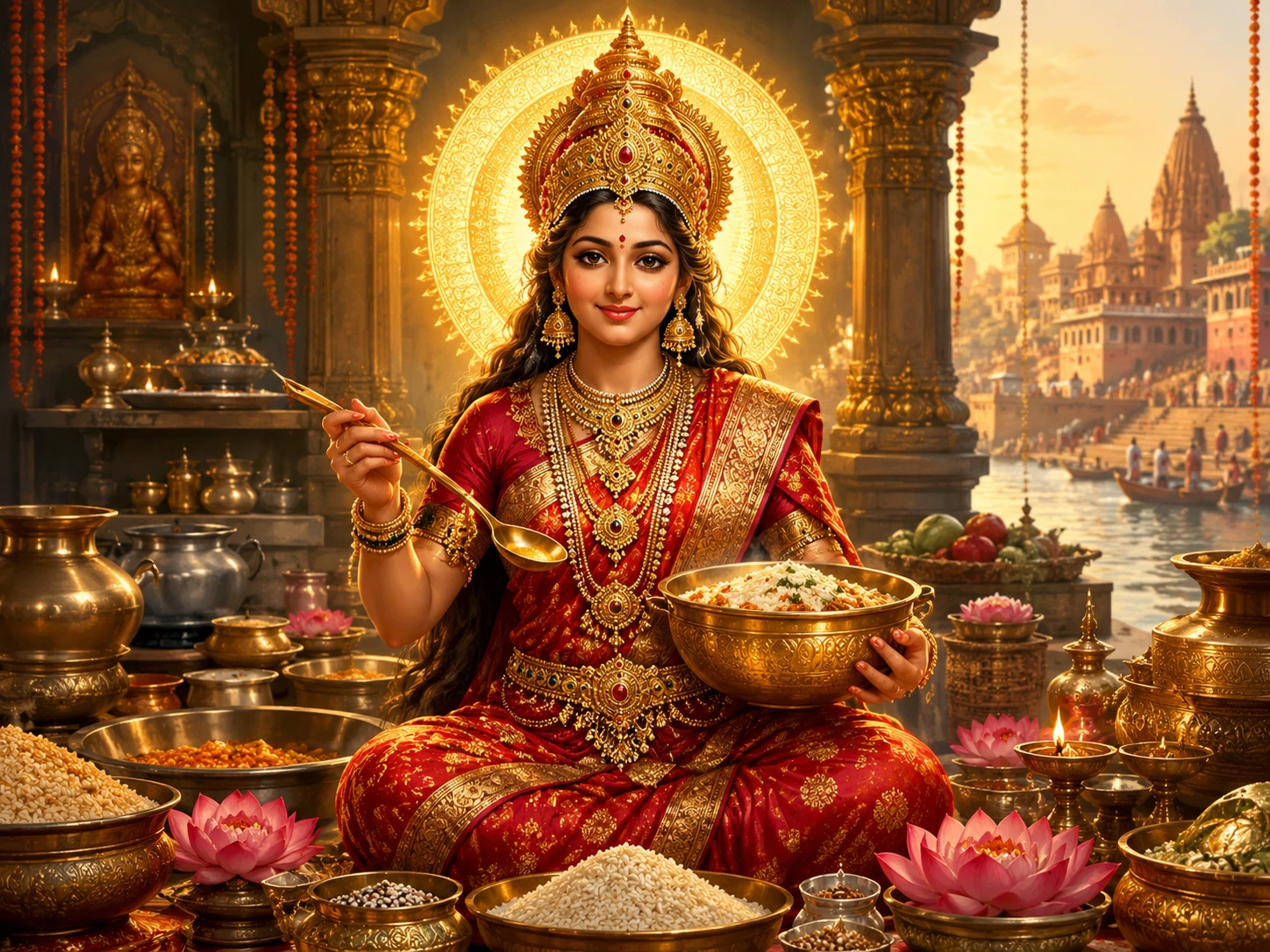
Annapurna -- Goddess of Food
19 min readThe same translation error that turned '33 Koti' into '33 crore' in Hinduism also happened in Buddhism. The Chinese translation of Buddhist texts rendered 'Sapta Koti Buddha' (7 Supreme Buddhas) as '7 Crore Buddhas.' The…
Deities AvatarsCommunity Reflections
🕉️
Be the first to share your reflection.