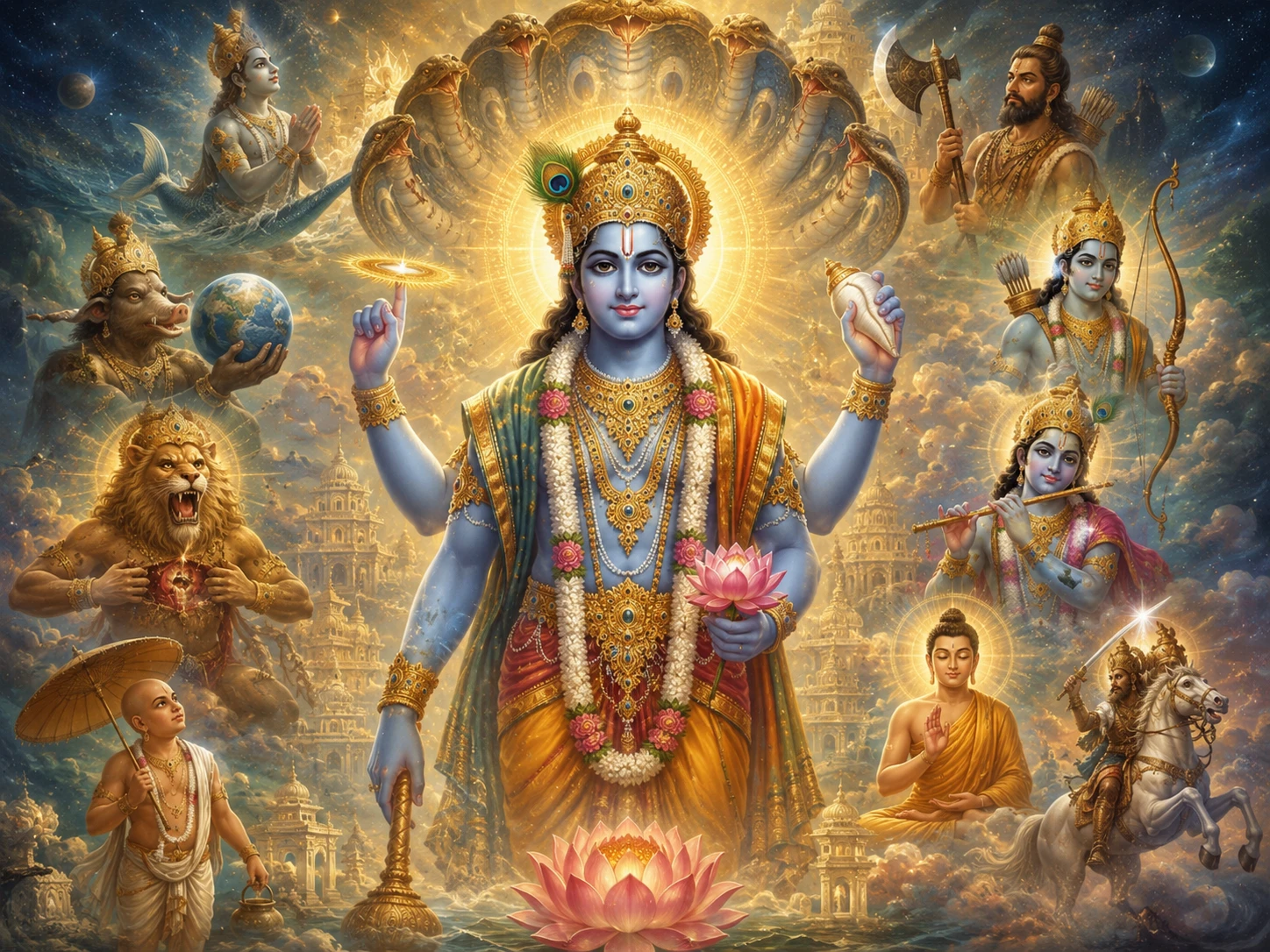
Bal Krishna vs Kamsa's Demons -- How a Toddler Defeated an Army
बाल कृष्ण बनाम कंस के दानव -- कैसे एक शिशु ने सेना हराई
Introduction -- Kamsa's Failed Assassination Programme
The moment Kamsa heard the prophecy -- 'Devaki's eighth child will be your death' -- he launched what may be the most incompetent assassination programme in cosmic history. He imprisoned Devaki and Vasudeva, killed six of their newborns, and when the eighth child (Krishna) was miraculously smuggled to Vrindavan, Kamsa sent a rotating roster of demons to find and kill a baby hiding among cowherds.
Every single one failed. Not because they were weak -- these were formidable Asuras with specific supernatural powers, many blessed by tapas to Shiva or Brahma. They failed because their target was not a baby. He was the Supreme Personality of Godhead playing the role of a baby, and each assassination attempt became a Leela (divine play) that the Bhagavata Purana narrates with the combined registers of thriller, comedy, and theology.
The Bhagavata Purana (Skanda 10, Chapters 6-37) chronicles these encounters in chronological order, from Krishna's infancy through his childhood in Vrindavan to his arrival in Mathura where he finally killed Kamsa himself. Each demon has a specific form (animal, natural phenomenon, or humanoid), a specific power, and a specific method of defeat that reveals something about Krishna's nature.
Srila Bhaktivinoda Thakura, the 19th-century Vaishnava theologian, added a layer of interpretation: each demon also represents an 'anartha' -- an inner impurity or spiritual obstacle. Putana represents the false guru. Trinavarta represents intellectual pride. Aghasura represents cruelty. The child Krishna's defeats are not just physical victories but allegories for the soul's progressive purification.
For a parent telling bedtime stories in Mumbai or Houston, these are the tales that define Hindu childhood. For a Kathakali dancer in Kerala or a Bharatanatyam performer in Chennai, these episodes form the core abhinaya repertoire. For a theology student, they are case studies in how the divine interacts with evil -- not through cosmic war (that comes later in the Mahabharata) but through the disarming simplicity of a child's play.
परित्राणाय साधूनां विनाशाय च दुष्कृताम्। धर्मसंस्थापनार्थाय सम्भवामि युगे युगे॥
paritraanaaya saadhunaam vinaashaaya cha dushkrtaam dharma-samsthaapanaarthaaya sambhavaami yuge yuge
For the protection of the righteous, for the destruction of the wicked, and for the establishment of dharma, I manifest myself age after age.
— Bhagavad Gita, Chapter 4, Verse 8
Kamsa's Demons -- The Complete Roster
| Demon | Form | Krishna's Age | Power/Attack | How Krishna Defeated | Anartha (Inner Impurity) | Bhagavata Ref |
|---|---|---|---|---|---|---|
| Putana | Beautiful woman (disguised demoness) | 7 days | Poisoned breast milk | Sucked her milk and life force through her breasts; she died in her true gigantic form | False guru / pseudo-spirituality | 10.6 |
| Shakatasura | Ghost possessing a cart | ~1 month | Collapsed cart onto baby | Baby Krishna kicked the cart with his tiny foot; cart shattered, demon destroyed | Burden of old bad habits and lethargy | 10.7 |
| Trinavarta | Whirlwind demon | ~1 year | Tornado that lifted Krishna into sky | Became impossibly heavy; grabbed demon's neck; strangled him; demon fell dead | Intellectual pride / false philosophy | 10.7 |
| Vatsasura | Calf mixed into Krishna's herd | ~5 years | Infiltration; planned to trample | Identified the fake calf; grabbed hind legs; whirled and smashed against a tree | Childish greed and mischief | 10.11 |
| Bakasura | Gigantic crane / stork | ~5 years | Swallowed Krishna whole | Became burning hot inside the beak; crane spat him out; Krishna split the beak apart | Cunning duplicity and deception | 10.11 |
| Aghasura | Python 8 miles long, mouth like a mountain | ~5 years | Swallowed all cowherd boys | Entered the mouth; expanded his own body until the demon suffocated and burst | Cruelty and violence | 10.12 |
| Dhenukasura | Donkey demon guarding Talavana forest | ~7-8 years | Kicked with powerful hind legs | Balarama (not Krishna) caught his legs, whirled him, smashed against palm trees | Gross materialism / spiritual ignorance | 10.15 |
| Kaliya | Multi-headed venomous serpent in Yamuna | ~8 years | Poisoned entire Yamuna river | Danced on Kaliya's hoods (Kaliya Nartana); subdued but did not kill; banished to ocean | Residual rage and envy | 10.16-17 |
| Pralambasura | Disguised as cowherd boy | ~9 years | Tried to kidnap Balarama during a game | Balarama recognised the deception; struck Pralambasura's head with his fist; killed | Lust and desire for enjoyment | 10.18 |
| Arishtasura | Gigantic bull | ~10 years | Charged with mountain-like horns; shook the earth | Seized by horns; threw 18 steps; yanked out a horn; beat him to death with his own horn | Pride from penance-born power | 10.36 |
| Keshi | Demonic horse | ~10 years | Charged with gaping mouth, kicked with hooves | Thrust his arm into the horse's mouth; arm expanded; Keshi choked and split apart | False ego of practitioners | 10.37 |
| Vyomasura | Son of Maya Danava; disguised as cowherd | ~10 years | Kidnapped cowherd boys into a cave during play | Krishna chased him; caught him in his demon form; killed him like a sacrificial animal | Deception and imposture | 10.37 |
Source: Bhagavata Purana, Skanda 10 (chapters as noted). Anartha interpretations from Srila Bhaktivinoda Thakura's Sri Chaitanya Siksamrita. Ages are approximate based on Puranic chronology. Dhenukasura was killed primarily by Balarama, not Krishna. Kaliya was subdued but not killed -- Krishna showed mercy and banished him. After these, Krishna and Balarama went to Mathura where Krishna killed the wrestlers Chanura and Mushtika, the elephant Kuvalayapida, and finally Kamsa himself.
The Theology of Play -- Why a God Fights as a Child
There is a theological question embedded in these stories that is worth surfacing: why does Krishna fight demons as a child? He is the Supreme Personality of Godhead. He could have appeared in Mathura as an adult warrior, killed Kamsa on day one, and avoided the entire Vrindavan childhood. Why the elaborate detour through infancy, toddlerhood, and boyhood -- complete with butter theft, flute playing, and demon-slaying between naps?
The Bhagavata Purana's answer is Leela -- divine play. Krishna's childhood is not a weakness to be endured before he reaches fighting age. It is the point. The demons are not obstacles to the plot. They are the plot. Each encounter reveals a different aspect of Krishna's divinity through the most unlikely medium: a baby's body.
Putana comes with poison. Krishna turns her weapon (breast milk) into the instrument of her death. The message: evil that disguises itself as nurture is the most dangerous kind, and the divine sees through disguises that deceive everyone else.
Trinavarta lifts Krishna into the sky as a whirlwind. Krishna simply becomes heavy. Not strong. Not aggressive. Just heavy. The tornado cannot carry him. The message: sometimes the divine response to violence is not counter-violence but immovable presence.
Aghasura opens his mouth like a mountain cave. The cowherd boys walk in, thinking it is a cave. Krishna walks in knowing it is a demon -- and expands from within until the demon bursts. The message: the divine enters darkness not to escape it but to destroy it from inside.
Kaliya poisons an entire river. Krishna does not kill him. He dances on his hoods -- the famous Kaliya Nartana -- and then sends him away to the ocean. The message: not all enemies need to be destroyed. Some need to be redirected.
For a child watching a Krishna cartoon on YouTube Kids, these are adventure stories. For a Bharatanatyam dancer performing at Navaratri in San Jose or Mylapore, they are the ultimate abhinaya challenges -- how do you perform a baby fighting a python? For a philosopher, they are parables about the nature of divine power: that it is most fully expressed not in cosmic destruction (that is Shiva's domain) but in the quiet, playful, often humorous disarming of evil by innocence.
The English word 'tornado' is believed by some etymologists to have connections to the Sanskrit 'Trinavarta' (the whirlwind demon) through Indo-European linguistic roots, though mainstream etymology traces it to Spanish 'tronada' (thunderstorm). What is undisputed is that the Bhagavata Purana's description of Trinavarta -- a demon who takes the form of a devastating whirlwind that lifts objects into the sky and creates total darkness with dust -- is one of the earliest detailed literary descriptions of tornado-like meteorological phenomena in world literature, predating Western tornado documentation by over a millennium.
Kaliya is the only 'demon' in the Vrindavan sequence whom Krishna does not kill. Instead, Krishna dances on his hoods (Kaliya Nartana), subdues him, and then -- at the request of Kaliya's wives (the Nagapatnis) -- lets him go to Ramanaka Dwipa in the ocean. The Nagapatnis' prayers to Krishna (Bhagavata Purana 10.16.33-53) are considered among the most beautiful devotional verses in the entire text. The festival of Nag Nathaiya in Varanasi and other UP cities re-enacts this episode annually. The Kaliya episode is also the single most depicted scene in Indian miniature painting -- more common than even the Rasa Leela.
Recite the Bal Krishna Hymns
The Bal Krishna demon-slaying episodes are celebrated in stotras, bhajans and kirtans across traditions. The Damodarashtakam, on Krishna being tied by Yashoda, is on Eternal Raga with its meaning; the Nagapatni Stuti, the prayer of Kaliya's wives, is in chapter 16 of the Bhagavata Purana's tenth canto, also on the site.
Tags
Eternal Raga · शाश्वत राग
Institutional voice — scholarly articles on Sanatan Dharma
Deepen Your Understanding
अपनी समझ और गहरी करें
scriptural exegesis
Chandravanshi -- The Lunar Dynasty from Moon to Mahabharata
The Solar Dynasty gave India Rama. The Lunar Dynasty gave India everything else: Krishna, the Pandavas, the Kauravas, Bharata (after whom India is named), Shakuntala (Kalidasa's masterpiece), and the Mahabharata itself. It begins with a scandal -- the Moon god Soma abducting Tara, wife of Brihaspati -- and it ends with the greatest war in mythology. One lineage. Two branches. Every epic.
deities avatars
Dashavatara -- Why Vishnu Comes Back Ten Times
Fish, tortoise, boar, half-lion, dwarf, axe-warrior, prince, cowherd, enlightened teacher, future horseman. The ten avatars of Vishnu are not random folklore. Read them in sequence and you get something startling -- a narrative that mirrors evolutionary biology, tracks the rise and fall of political systems, and argues that God does not sit above history but enters it, gets dirty, and does the work. The Dashavatara is Hinduism's answer to the question every civilisation asks: why does the world keep breaking, and who fixes it?
deities avatars
Kashyapa's Wives -- How One Sage Fathered Gods, Demons, and Everything In Between
Why are gods and demons always at war? Because they are cousins -- half-brothers sharing the same father, the sage Kashyapa. Aditi's sons became the Devas. Diti's sons became the Daityas. Vinata's sons became Garuda and Aruna. Kadru's sons became the serpents. And the family dynamics that produced them explain the entire cosmic conflict of Hindu mythology.
scriptural exegesis
Krishna's 16,108 Queens -- The Story Behind the Number
The number sounds absurd until you understand what it means. Krishna did not 'collect' 16,108 wives. He rescued 16,100 women from a demon's prison, and when no one in society would accept them back -- because they were 'tainted' -- he married every single one to restore their honour. Add 8 named queens (the Ashtabharya) married through love, valour, or diplomacy, and you get the most misunderstood number in Hindu mythology. This is not a harem story. It is the largest social rehabilitation programme in ancient literature.
scriptural exegesis
Samudra Manthan -- When Gods and Demons Ran a Joint Venture and the Universe Almost Died
A cosmic ocean. A mountain for a churning rod. A serpent king for a rope. Gods on one end, demons on the other. And out came 14 treasures -- including wealth, beauty, medicine, immortality, and one poison so lethal it could end creation itself. The Samudra Manthan is not mythology. It is the original playbook for collaboration, crisis management, and how to handle it when your joint venture partner tries to cheat you.
The English word 'tornado' is believed by some etymologists to have connections to the Sanskrit 'Trinavarta' (the whirlwind demon) through Indo-European linguistic roots, though mainstream etymology traces it to Spanish …
More in Deities & Avatars
33 Koti Devata -- Why Hinduism Has 33 Types of Gods, Not 33 Crore
13 min read
Agni -- The Fire God
19 min read
Annapurna -- Goddess of Food
19 min readThe same translation error that turned '33 Koti' into '33 crore' in Hinduism also happened in Buddhism. The Chinese translation of Buddhist texts rendered 'Sapta Koti Buddha' (7 Supreme Buddhas) as '7 Crore Buddhas.' The…
Deities AvatarsCommunity Reflections
🕉️
Be the first to share your reflection.