Bhuvaneshwari Mahavidya: The Queen of the Worlds and the Goddess of Space
भुवनेश्वरी महाविद्या: भुवनों की अधिरानी और अवकाश की देवी
Bhuvaneshwari is the fourth of the ten Mahavidyas, the ten great wisdom goddesses of Shakta Tantra. Her name joins bhuvana, a world or a region of space, with ishvari, queen. She is the queen of the worlds, and in the system of the ten she stands for space: the container within which creation happens. The Dasha Mahavidya page on Eternal Raga puts the pairing plainly. Where Kali is Time, Bhuvaneshwari is Space, and together the two supply the basic coordinates of existence.
Her image has none of the terror of the goddesses around her. She is golden and beautiful, seated on a lotus, with a noose and a goad. The tradition calls this sovereignty without force. This page is her profile: the image, the meaning of space as a divine quality, and a guide to the four hymns to her on Eternal Raga, including a Chalisa that is shorter than most readers expect.
Why Space Counts as a Goddess
Indian thought treats space, akasha, as the first of the five elements and the one that holds the others. Nothing moves, grows or burns without room to do it in. Bhuvaneshwari gives that idea a face. She is the capacity of the universe to contain things, and a mother's capacity to make room for a child.
The same quality shows in how her worship is described. The devotional texts ask her for spaciousness, stability and cosmic protection. They ask for knowledge and prosperity together, and for the welfare of a family. A reader who has felt crowded by work, obligation or noise will recognise what is being requested: space to think, a settled home, a mind that is not cramped.
In the Devi Bhagavata Purana tradition, the highest abode of the Goddess is Manidvipa, the island of jewels, and Bhuvaneshwari is the form of the Goddess most closely associated with it. Her seed syllable is Hreem, often called the Maya beej. Assam's Kamakhya complex on Nilachal Hill is known for shrines to the ten Mahavidyas, and a Bhuvaneshwari shrine stands on the hill.
Her Image and the Common Readings
| Symbol | प्रतीक | In the image | Common reading |
|---|---|---|---|
| Golden colour | स्वर्ण वर्ण | A bright, golden body | The light of a ruler who is generous and not frightening |
| Lotus seat | कमलासन | Seated on a lotus | Rising above the water without being wet by it |
| Noose | पाश | Held in one hand | What binds: attachment and limits, held under control |
| Goad | अंकुश | Held in the other | What directs without hurting; guidance |
| Moon-like face | चंद्रमुख | A tilak shines on her moon-bright face in the third verse of the Chalisa | Coolness and calm at the centre of rule |
Her Kavach is called Trailokya Mangalam, the auspiciousness of the three worlds. It is framed as a request from Parvati to Shiva for the crowning armour, after she has already learned Bhuvaneshwari's other vidyas, and it weaves the seed syllables of the goddess into its protective verses. It comes from the Rudrayamala Tantra and runs to 31 verses.
The Four Texts and What Each Is For
The Bhuvaneshwari Chalisa on Eternal Raga is shorter than the usual 40-chaupai chalisa. It has 18 verses: an opening doha, 16 chaupai couplets and a closing doha. This is the version in wide circulation. A reader who expects forty verses should know that this is not an abridgement made here.
The Bhuvaneshwari Aarti is the short sung offering that closes a puja.
The Bhuvaneshwari Ashtakam is a traditional eight-verse Sanskrit hymn. It places the goddess on the bank of the Krishna river, praises her as the wish-fulfilling tree for her devotees and the giver of siddhi, fearlessness and liberation, and describes her as the inner controller of all beings.
The Bhuvaneshwari Kavach is the protective hymn described above, drawn from the Rudrayamala Tantra.
When and How Her Hymns Are Read
The recitation notes with her Chalisa name Friday, Purnima, Navratri, Bhuvaneshwari Jayanti and Mahavidya puja, and they suggest morning Devi worship. The benefits listed are spaciousness and stability, knowledge and prosperity together, family welfare and protection. Of the four goddesses profiled in this series, hers is the gentlest set of requests.
The usual caution holds. Reading a Chalisa or singing an aarti is open devotion. Mantra japa, including her seed syllable, and ritual worship are done with a guru. For a reader at the start, a short morning reading of the 18-verse Chalisa is the lightest way into her worship.
Read the Bhuvaneshwari Chalisa
Eighteen verses in Hindi with transliteration and meaning, suited to a short morning reading. The Aarti, Ashtakam and Kavach are on their own pages.
Tags
Eternal Raga · शाश्वत राग
Institutional voice — scholarly articles on Sanatan Dharma
Deepen Your Understanding
अपनी समझ और गहरी करें
tantra mantra yantra
Dasha Mahavidya -- Ten Wisdom Goddesses Who Map the Entire Universe
One holds her own severed head. Another is an ugly old widow. A third paralyses enemies by seizing their tongues. The Dasha Mahavidya are not comfortable goddesses. They are the ten dimensions of reality that most religions are too afraid to acknowledge -- from transcendent beauty to terrifying destruction, from cosmic abundance to abject poverty. Together, they form the most complete map of feminine divinity ever conceived.
deities avatars
Kali -- The Fierce Mother Who Devours Time Itself
Black-skinned, wild-haired, wearing a garland of fifty severed heads and a skirt of severed arms, standing on Shiva's chest with her tongue extended in shock -- Kali is the most misunderstood deity in Hinduism and the most theologically radical. She is not a demon. She is not 'dark energy.' She is Time in feminine form, the cosmic mother who destroys everything so that everything can be reborn. Ramakrishna called her 'Ma.' Millions still do.
deities avatars
Devi Swaroopa -- Forms of the Goddess
She is Durga on the battlefield and Annapurna in the kitchen. She is Kali at the cremation ground and Lakshmi in the boardroom. She is Saraswati at the university and Parvati in the family. The Hindu Goddess is not one deity with accessories -- she is the entire spectrum of feminine power, from terrifying to tender, from cosmic to domestic. Understanding her forms is understanding the universe itself.
deities avatars
Lalita Tripurasundari -- The Supreme Goddess Who Is Beautiful in All Three Worlds
She holds a sugarcane bow and flower arrows -- weapons made not of metal but of desire, beauty, and attraction. Lalita Tripurasundari is Hinduism's most philosophically sophisticated goddess, the Supreme Reality in feminine form, worshipped through the Sri Vidya tradition that has been called the PhD of Hindu spiritual practice.
deities avatars
Dhumavati Mahavidya: The Goddess of Smoke, Emptiness and Hard Times
Dhumavati is the seventh of the ten Mahavidyas and the only one pictured as an old, unadorned widow on a horseless chariot with a crow on its banner. This profile explains who she is, how to read each symbol in her image, what her Chalisa, Aarti, Ashtakam and Kavach are for, and how devotion to her is traditionally approached.
deities avatars
Matangi Mahavidya: The Dark Goddess of Speech, Music and the Margins
Matangi is the ninth of the ten Mahavidyas: dark green, a veena in her hands, a parrot at her side, and a tradition that places her among the outcastes. She governs speech, music and art. This profile explains who she is, how she differs from Saraswati, and what her Chalisa, Aarti, Ashtakam and Kavach are used for.
deities avatars
Tripura Bhairavi Mahavidya: The Fire of Tapas and the Many Meanings of Bhairavi
Tripura Bhairavi is the fifth of the ten Mahavidyas, the goddess of tapas, discipline and purifying fire. The name Bhairavi also belongs to a raga and to the women teachers of tantra, and the three are easily confused. This profile separates them, reads her image, and explains what her Chalisa, Aarti, Ashtakam and Kavach are used for.
Her Kavach is called Trailokya Mangalam, the auspiciousness of the three worlds. It is framed as a request from Parvati to Shiva for the crowning armour, after she has already learned Bhuvaneshwari's other vidyas, and it…
More in Deities & Avatars
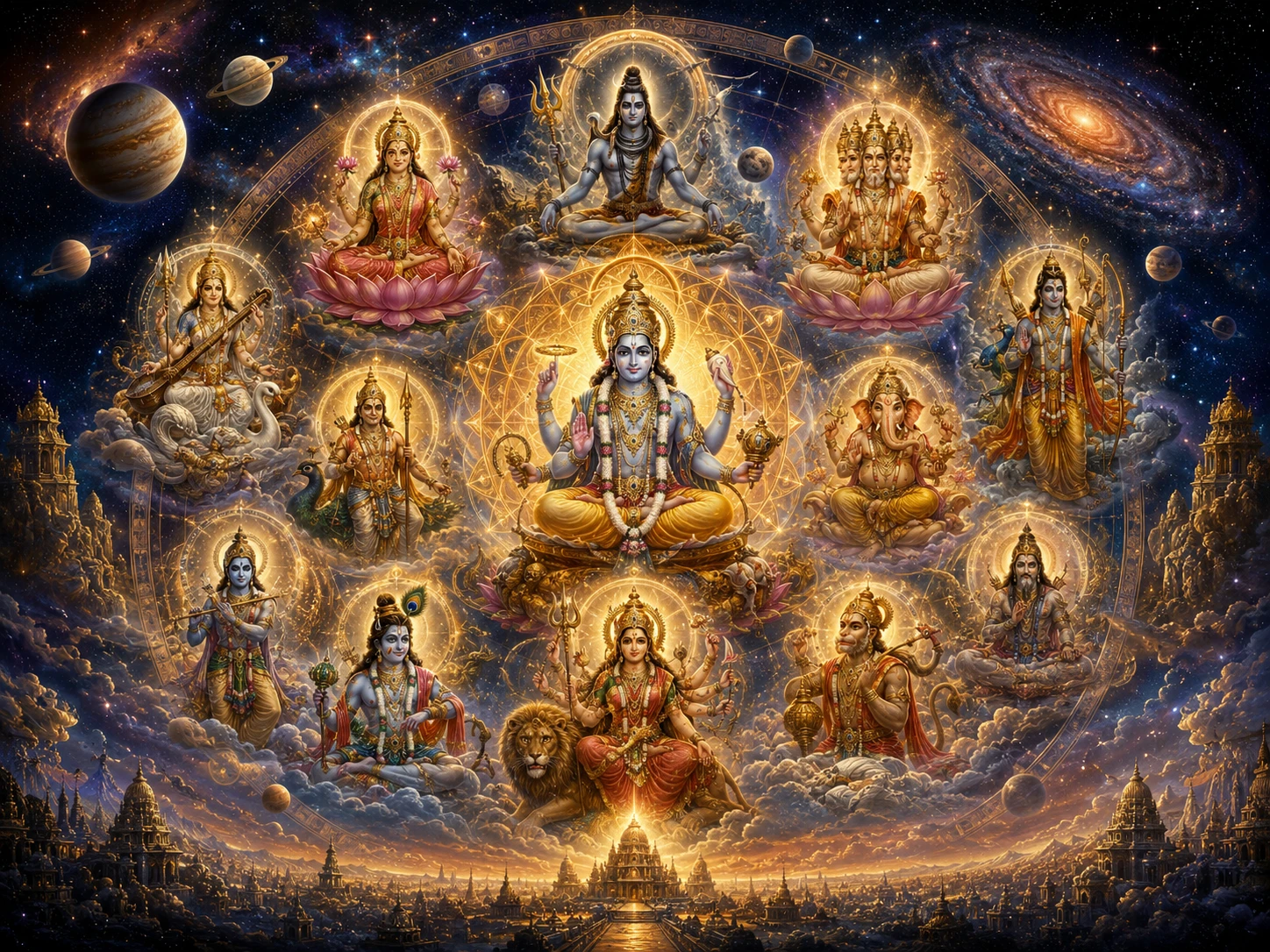
33 Koti Devata -- Why Hinduism Has 33 Types of Gods, Not 33 Crore
13 min read
Agni -- The Fire God
19 min read
Annapurna -- Goddess of Food
19 min readThe same translation error that turned '33 Koti' into '33 crore' in Hinduism also happened in Buddhism. The Chinese translation of Buddhist texts rendered 'Sapta Koti Buddha' (7 Supreme Buddhas) as '7 Crore Buddhas.' The…
Deities AvatarsCommunity Reflections
🕉️
Be the first to share your reflection.