Dhumavati Mahavidya: The Goddess of Smoke, Emptiness and Hard Times
धूमावती महाविद्या: धुएँ, शून्यता और कठिन समय की देवी
Dhumavati is the seventh of the ten Mahavidyas, the ten great wisdom goddesses of Shakta Tantra. Her name comes from dhuma, the Sanskrit word for smoke, and the picture of her is the opposite of what most people expect from a goddess. She is tall, thin and old. Her clothes are soiled and her hair hangs loose. In the images and in the tantric manuals she is a widow, with no consort beside her, riding a chariot that has no horses and flies a banner with a crow on it. Many descriptions put a winnowing basket in her hand, the flat tray village kitchens use to separate grain from husk.
That is the whole point of her. The other Mahavidyas offer power, beauty or protection. Dhumavati offers company in the places where those things have gone missing. This page is her profile: who she is, how to read her image, what the four hymns to her on Eternal Raga are for, and how devotion to her is approached in the tradition. Her origin legend and the date of her manifestation day are told in the separate Dhumavati Jayanti article.
Reading Her Image, Symbol by Symbol
Smoke is what is left after a fire has done its work. It is not flame and it is not ash. It hides what it touches, and it drifts. A name built on that word points to wisdom that arrives after loss, when the fire of an event has passed and the air is still unclear.
The widow's form is the feature people discuss most. It shows a goddess with nothing added: no husband, no ornament, no attendant. The Dhumavati Jayanti article gives the legend, from the Pranatoshini Tantra, in which Sati swallows Shiva and is then separated from him. The legend explains the widowhood; the image makes the point that the divine is present even where nothing auspicious remains.
The crow is a bird of the cremation ground, and it is also the bird fed during the shraddha rites for ancestors, because it is said to carry the offering across. Putting it on her banner places her at the border between the living and the departed. The horseless chariot is read as motion with no one steering, a life whose usual drivers have gone. The winnowing basket, where it appears, is the tool of sorting: keep the grain, let the husk fly off.
These readings come from devotional commentary and not from one fixed rule. Lineages describe her slightly differently, and a reader should treat the table below as the common reading, not the only one.
Her Image and the Common Readings
| Symbol | प्रतीक | In the image | Common reading |
|---|---|---|---|
| Smoke | धूम | Her name and her grey, smoke-dark complexion | What remains after a fire of loss, wisdom that arrives when the flames are over |
| Widow's form | विधवा रूप | No consort, no ornaments, soiled clothes | The divine present where nothing auspicious is left |
| Crow banner | काक-ध्वज | A crow on the flag of her chariot | The border between the living and the departed; the bird fed in shraddha |
| Horseless chariot | अश्वहीन रथ | A chariot drawn by nothing | Motion with no driver; a life whose usual supports have gone |
| Winnowing basket | सूप | Held in her hand in many descriptions | Sorting grain from husk; keeping what matters |
| Old age | वृद्धावस्था | Tall, thin and aged in the descriptions | The face of time that is not softened for the viewer |
The Sanskrit Dhumavati Ashtak Stotra on Eternal Raga ends with a colophon that names the Urdhvamnaya, one of the transmission lines (amnaya) of Shakta Tantra. The hymn is written in the fierce style of the Kali and Chandika stotras, so it reads very differently from the quiet Hindi Chalisa. The two texts address the same goddess in two different registers.
The Four Texts and What Each Is For
The Dhumavati Chalisa is the text most readers arrive for. The version on Eternal Raga is a devotional compilation of 42 verses: an opening doha, 40 chaupais and a closing doha. It has no single named author. Its themes are detachment, silence and the clarity that follows hardship, and it is the gentlest way into her worship.
The Dhumavati Aarti is the short sung offering at the end of a puja, written in the same register as the Chalisa.
The Dhumavati Ashtakam is a Sanskrit hymn of the tantric kind, transmitted anonymously. It is fierce in language and meant for readers comfortable with that idiom.
The Dhumavati Kavach is a protective hymn, framed as a conversation in which Parvati asks Bhairava for the hidden armour of the goddess. Tradition attributes it to the sage Pippalada. It breaks her name into protective syllables, Dhu, ma, va, ti, and asks each to guard a part of the body.
Approaching Her: What the Tradition Advises
The recitation notes attached to her Chalisa name the same few occasions: Amavasya, the Gupt Navratri, Saturdays, and a quiet evening or night. The benefits listed are modest and inward: steadiness in loss, detachment, patience, and clarity in a hard season. None of them promises a change in circumstances.
The same notes add one condition worth taking seriously. Formal Mahavidya upasana, meaning mantra practice and ritual worship, is done under the guidance of a guru. Reading a Chalisa or singing an aarti is open devotional practice. A structured mantra japa is a different undertaking. Some lineages also restrict her worship for householders, and others do not, so a reader who belongs to a tradition should follow the teacher of that tradition.
For a reader with no lineage, the plain approach is the one the tradition itself models: sit in the evening with one lamp, read the Chalisa slowly, and let the text do what it says, which is to keep company with what has ended.
Read the Dhumavati Chalisa
Forty-two verses in Hindi with transliteration and meaning, best read slowly on a quiet evening. The Aarti, Ashtakam and Kavach are on their own pages.
Tags
Eternal Raga · शाश्वत राग
Institutional voice — scholarly articles on Sanatan Dharma
Deepen Your Understanding
अपनी समझ और गहरी करें
tantra mantra yantra
Dasha Mahavidya -- Ten Wisdom Goddesses Who Map the Entire Universe
One holds her own severed head. Another is an ugly old widow. A third paralyses enemies by seizing their tongues. The Dasha Mahavidya are not comfortable goddesses. They are the ten dimensions of reality that most religions are too afraid to acknowledge -- from transcendent beauty to terrifying destruction, from cosmic abundance to abject poverty. Together, they form the most complete map of feminine divinity ever conceived.
rituals traditions
Dhumavati Jayanti -- The Manifestation Day of the Goddess Who Is Never Beautiful
Dhumavati, the seventh of the Ten Mahavidyas covered in full on Eternal Raga's Das Mahavidya page, is the only one of the ten shown as an old widow, riding an empty chariot with a crow banner, offered nothing pleasant and asking for nothing pleasant in return. Dhumavati Jayanti is her manifestation day, and even the sources that mark it disagree on which exact tithi it falls on, a genuine discrepancy this article states honestly rather than smoothing over.
tantra mantra yantra
10 Mahavidya Yantras
Ten goddesses. Ten geometries. Ten frequencies of awakening. The Das Mahavidya yantras are the most advanced tools in Shakta tantra, each a precision-engineered diagram mapped to a specific goddess, a specific siddhi, and a specific emotional landscape. Kali is not Kamala. Chinnamasta is not Bhuvaneshwari. The yantras make the difference visible.
philosophy darshana
Shakta Philosophy -- Devi as Ultimate Reality
What if God is not He but She? Not an abstract principle but a living, breathing, dancing power? Shakta philosophy does not merely add a feminine dimension to Hindu theology. It inverts the entire structure: Shakti is the primary reality, and consciousness without her is inert. Shiva without Shakti is shava -- a corpse. This is not metaphor. This is metaphysics.
deities avatars
Kali -- The Fierce Mother Who Devours Time Itself
Black-skinned, wild-haired, wearing a garland of fifty severed heads and a skirt of severed arms, standing on Shiva's chest with her tongue extended in shock -- Kali is the most misunderstood deity in Hinduism and the most theologically radical. She is not a demon. She is not 'dark energy.' She is Time in feminine form, the cosmic mother who destroys everything so that everything can be reborn. Ramakrishna called her 'Ma.' Millions still do.
The Sanskrit Dhumavati Ashtak Stotra on Eternal Raga ends with a colophon that names the Urdhvamnaya, one of the transmission lines (amnaya) of Shakta Tantra. The hymn is written in the fierce style of the Kali and Chand…
More in Deities & Avatars
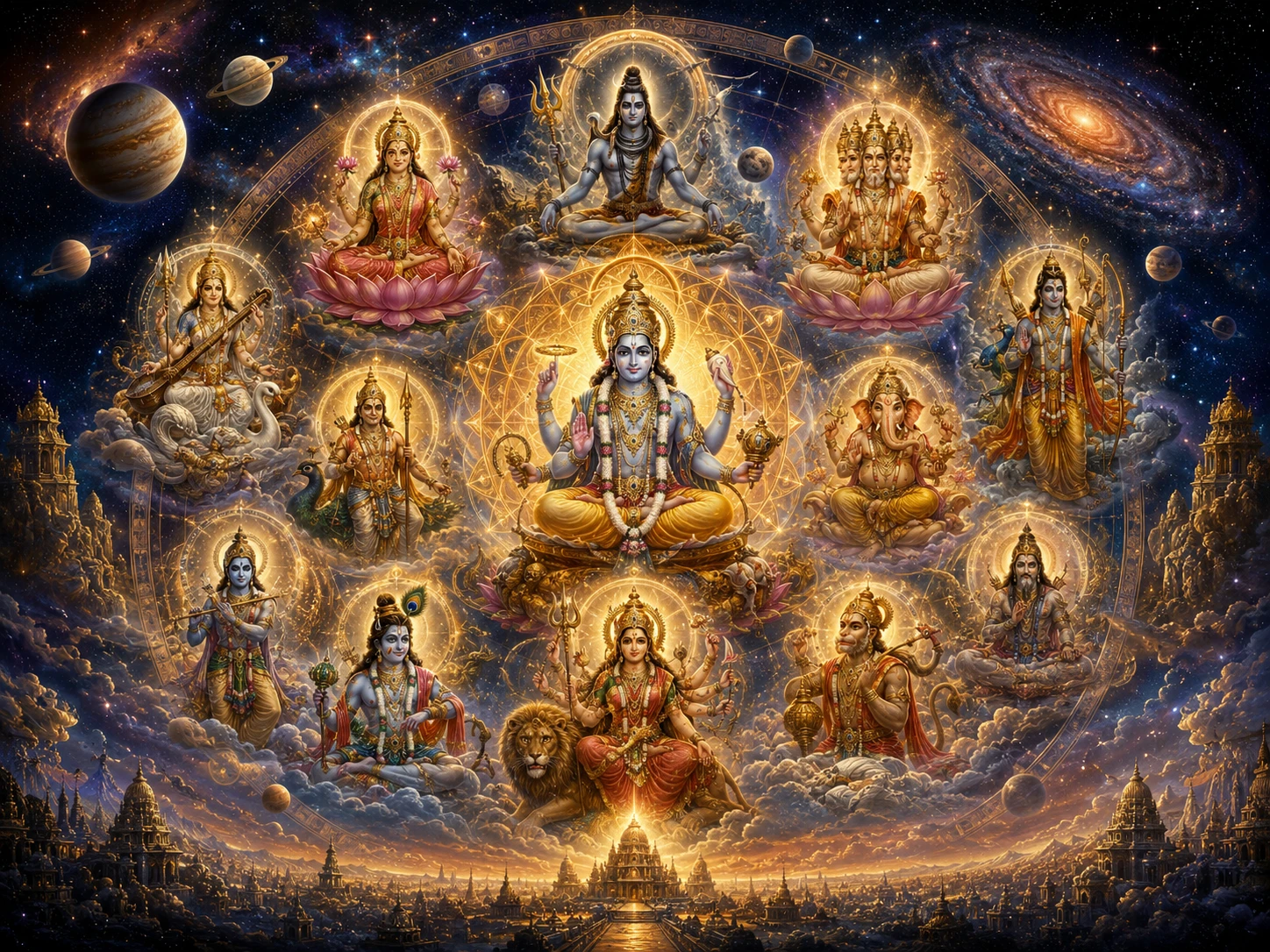
33 Koti Devata -- Why Hinduism Has 33 Types of Gods, Not 33 Crore
13 min read
Agni -- The Fire God
19 min read
Annapurna -- Goddess of Food
19 min readThe same translation error that turned '33 Koti' into '33 crore' in Hinduism also happened in Buddhism. The Chinese translation of Buddhist texts rendered 'Sapta Koti Buddha' (7 Supreme Buddhas) as '7 Crore Buddhas.' The…
Deities AvatarsCommunity Reflections
🕉️
Be the first to share your reflection.