Kalki Avatar -- The Avatar Who Is Still to Come
कल्कि अवतार -- वह अवतार जो अभी आना है
Every list of Vishnu's ten avatars ends with a figure who has not yet appeared. The fish, the tortoise, the boar, the man-lion, the dwarf, Parashurama, Rama, Krishna -- and Balarama or the Buddha, depending on the list -- all belong to stories already told. The tenth, Kalki, belongs to the future. He is the avatar of the end of the Kali Yuga, the last and darkest of the four ages, and his coming closes one cycle of time and opens the next.
The Bhagavata Purana mentions him twice. In its first book, listing the avatars, it says that at the junction of the ages, when kings have become little better than robbers, the Lord of the world will be born as Kalki, son of Vishnuyasha. In its twelfth book, which describes the decline of the Kali Yuga, it adds the details that have shaped every later image of him.
अथासौ युगसन्ध्यायां दस्युप्रायेषु राजसु । जनिता विष्णुयशसो नाम्ना कल्किर्जगत्पतिः ॥
athāsau yugasandhyāyāṃ dasyuprāyeṣu rājasu | janitā viṣṇuyaśaso nāmnā kalkirjagatpatiḥ ||
Then, at the junction of the ages, when kings have become mostly robbers, the Lord of the world will be born as Kalki, son of Vishnuyasha.
— Srimad Bhagavata Purana 1.3.25
The twelfth book first paints the age that needs him. As the Kali Yuga wears on, it says, wealth alone will decide a person's worth, might will be counted as right, marriage will rest on mere attraction, learning will be judged by outward show, and rulers will plunder their own people. Lives will grow short, and people will be anxious and quarrelsome.
Then, in the village of Shambhala, in the house of a noble brahmin named Vishnuyasha, Kalki will be born. Riding the swift horse Devadatta, sword in hand, endowed with the eight divine powers, he will ride across the earth and destroy the millions of thieves who pass themselves off as kings. With them gone, the minds of the people will become pure again, their children will be born in the nature of goodness, and the Satya Yuga, the age of truth, will return.
शम्भलग्राममुख्यस्य ब्राह्मणस्य महात्मनः । भवने विष्णुयशसः कल्किः प्रादुर्भविष्यति ॥
śambhalagrāmamukhyasya brāhmaṇasya mahātmanaḥ | bhavane viṣṇuyaśasaḥ kalkiḥ prādurbhaviṣyati ||
In the village of Shambhala, in the house of the great-souled brahmin Vishnuyasha, the chief man of the village, Kalki will appear.
— Srimad Bhagavata Purana 12.2.18
Kalki in the Sources
| Source | What it says |
|---|---|
| Mahabharata (Vana Parva) | Markandeya foretells a brahmin named Kalki Vishnuyasha who will end the age of decline |
| Bhagavata Purana 1.3.25 | Kalki, son of Vishnuyasha, born at the junction of the ages when kings are mostly robbers |
| Bhagavata Purana 12.2.16-24 | Born in Shambhala; rides the horse Devadatta with a sword; destroys the robber-kings; the Satya Yuga returns |
| Vishnu Purana and others | Similar accounts of the end of the Kali Yuga and Kalki's coming |
| Kalki Purana | A comparatively late work that expands the story into a full narrative of his life and battles |
| Gita Govinda (12th century) | Kalki is the tenth avatar in Jayadeva's hymn, "dhumaketum iva kim api karalam" -- fearsome, like a comet |
When will Kalki come? By the traditional reckoning, the Kali Yuga began in 3102 BCE, around the time Krishna left the world, and lasts 432,000 years -- so on this count only about five thousand years of it have passed, and the end lies very far ahead. Many teachers have read the Kalki prophecy less as a date than as a promise built into the structure of time: no age of decline is final, and every cycle turns again towards truth.
That is also why the tradition has been wary of anyone claiming to be Kalki, and there have been several such claimants. The Purana's Kalki is not a sectarian leader but a cosmic event -- the Lord himself, arriving when the whole world needs renewal.
Shambhala appears in Buddhist tradition too. The Kalachakra Tantra, an important Tibetan Buddhist text, describes a hidden kingdom of Shambhala ruled by a line of kings called Kalki or Kulika, the last of whom will defeat the forces of darkness and open a new golden age -- a striking parallel to the Puranic Kalki.
In art Kalki is usually shown as a warrior on a white horse, sword raised; some temple images give him a horse's head, and in a few he stands beside his horse. He is rarely the main deity of a temple, though there are some, and he appears in the sculptured panels of the ten avatars on many Vaishnava temples. For most devotees, his place in the list is what matters: it turns the story of the avatars from a record of the past into a promise about the future.
Read the Bhagavata's account of the Kali Yuga
Srimad Bhagavata 12.2: the signs of the Kali Yuga and the coming of Kalki, verse by verse.
Tags
Eternal Raga · शाश्वत राग
Institutional voice — scholarly articles on Sanatan Dharma
Deepen Your Understanding
अपनी समझ और गहरी करें
deities avatars
Dashavatara -- Why Vishnu Comes Back Ten Times
Fish, tortoise, boar, half-lion, dwarf, axe-warrior, prince, cowherd, enlightened teacher, future horseman. The ten avatars of Vishnu are not random folklore. Read them in sequence and you get something startling -- a narrative that mirrors evolutionary biology, tracks the rise and fall of political systems, and argues that God does not sit above history but enters it, gets dirty, and does the work. The Dashavatara is Hinduism's answer to the question every civilisation asks: why does the world keep breaking, and who fixes it?
vedic sciences
The Four Yugas -- How Long They Last, How People Lived, and Where We Are Now
Hindu cosmology divides time into four ages -- Satya, Treta, Dvapara, and Kali -- each shorter, darker, and more morally degraded than the last. In Satya Yuga, humans lived 100,000 years and dharma stood on all four legs. In Kali Yuga -- our age -- the average lifespan is 100 years and dharma balances on one leg. This is not pessimism. It is a cosmic weather forecast.
deities avatars
Matsya Avatar -- The Fish Who Saved the World from the Flood
A tiny fish asks a king for protection, outgrows every vessel he puts it in, and turns out to be Vishnu, come to carry the seeds of a new world through the flood. The first of the ten avatars, from its earliest telling in the Shatapatha Brahmana to the Bhagavata Purana.
deities avatars
Varaha Avatar -- The Boar Who Lifted the Earth
When the earth sank to the bottom of the cosmic ocean, Vishnu came out of Brahma's nostril as a boar the size of a thumb, grew to the size of a mountain, and dived to bring her back on his tusks. The story of the third avatar, the demon Hiranyaksha, and why the boar is also the sacrifice itself.
vedic sciences
Kaal Ganana -- The Hindu Measure of Time
From a single blink of the eye (Nimesha) to one Day of Brahma (4.32 billion years) -- explore the complete cosmic time hierarchy of Hindu cosmology, anchored in Vishnu Purana 1.3, with its remarkable parallels to modern science.
deities avatars
Narayana -- Cosmic Vishnu Beyond Avatara
Before Krishna lifted Govardhan and Rama crossed the ocean, there was Narayana lying on the serpent Ananta in the milk ocean. The avatars come and go. Narayana remains. This is the theological Vishnu at the base of every Vaishnava tradition, from Ramanuja's Sri Vaishnavism to the Badrinath pilgrimage to the Ashtakshari mantra every devotee chants.
Shambhala appears in Buddhist tradition too. The Kalachakra Tantra, an important Tibetan Buddhist text, describes a hidden kingdom of Shambhala ruled by a line of kings called Kalki or Kulika, the last of whom will defea…
More in Deities & Avatars
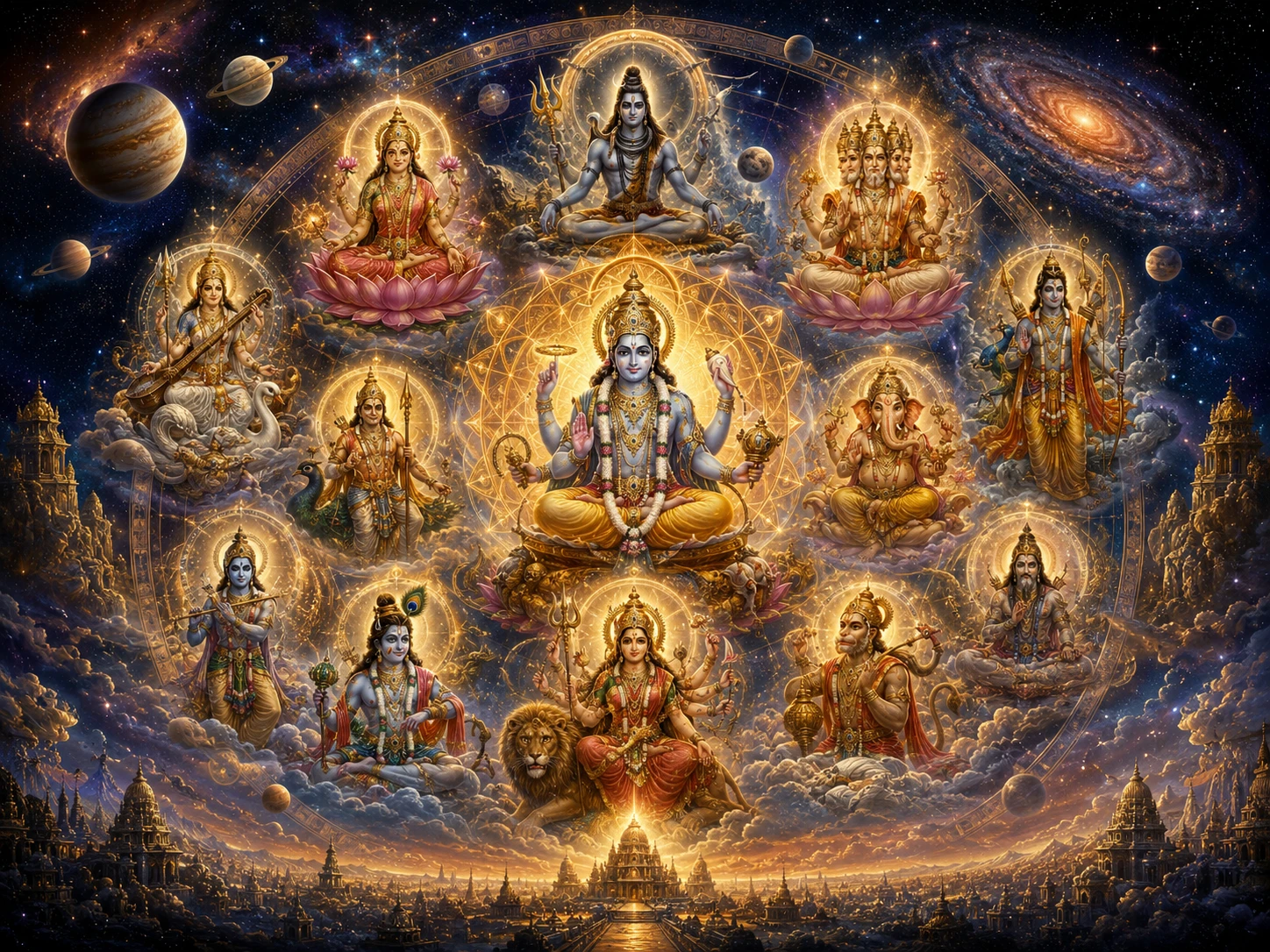
33 Koti Devata -- Why Hinduism Has 33 Types of Gods, Not 33 Crore
13 min read
Agni -- The Fire God
19 min read
Annapurna -- Goddess of Food
19 min readThe same translation error that turned '33 Koti' into '33 crore' in Hinduism also happened in Buddhism. The Chinese translation of Buddhist texts rendered 'Sapta Koti Buddha' (7 Supreme Buddhas) as '7 Crore Buddhas.' The…
Deities AvatarsCommunity Reflections
🕉️
Be the first to share your reflection.