Varaha Avatar -- The Boar Who Lifted the Earth
वराह अवतार -- वह वराह जिसने पृथ्वी को उठाया
At the beginning of creation, the Bhagavata says, Brahma looked for a place for the creatures he was about to make, and found none: the earth had sunk into the waters at the bottom of the universe. As he wondered what to do, a tiny boar, no bigger than a thumb, came out of his nostril -- and in a moment, as Brahma and his sons watched, it grew to the size of an elephant and then of a mountain, roaring until the heavens echoed.
The boar was Vishnu. He sniffed out the earth's scent as a boar searches for food, plunged into the ocean, and found her at its depths. He lifted her on the tips of his white tusks and rose out of the water, the earth with all her mountains resting on his tusk like a lotus carried by an elephant coming out of a lake.
इत्यभिध्यायतो नासाविवरात्सहसानघ । वराहतोको निरगादङ्गुष्ठपरिमाणकः ॥
ityabhidhyāyato nāsāvivarātsahasānagha | varāhatoko niragādaṅguṣṭhaparimāṇakaḥ ||
As he was thinking this, O sinless one, suddenly from his nostril there came out a baby boar no bigger than a thumb.
— Srimad Bhagavata Purana 3.13.18
Why had the earth sunk? In the Bhagavata's fuller telling, it was the work of Hiranyaksha, the "golden-eyed" demon, twin brother of Hiranyakashipu. Hiranyaksha, swollen with power from his boons, had pressed the earth down into the ocean and roamed it looking for an opponent worthy of him. When Varaha rose with the earth, Hiranyaksha attacked him with his mace; Vishnu fought and killed him. His brother's death is what turned Hiranyakashipu into Vishnu's bitter enemy -- the hatred that sets up the story of Prahlada and the Narasimha avatar.
The Bhagavata also tells why the brothers were born as demons at all. They were Jaya and Vijaya, Vishnu's own doorkeepers in Vaikuntha, cursed to be born three times as his enemies after turning away the four Kumaras at his gate. Hiranyaksha and Hiranyakashipu were the first of those births.
Varaha in Brief
| Aspect | Detail |
|---|---|
| Place among the avatars | Third of the ten, after Matsya and Kurma |
| Consort | Bhudevi, the earth goddess, whom he rescues |
| Opponent | Hiranyaksha, twin of Hiranyakashipu |
| Main sources | Bhagavata Purana 3.13 and 3.18-19; the Varaha Purana; earlier Vedic accounts of a boar raising the earth |
| Cosmic age | The present kalpa is called Shveta-Varaha Kalpa, "the age of the white boar" |
| Famous images | The colossal relief at Udayagiri (Madhya Pradesh, Gupta period); the free-standing boar at Khajuraho |
Earlier still, Vedic texts already speak of a boar that raised the earth from the waters; the Puranas made it Vishnu. They also made the boar a symbol of the Vedic sacrifice itself. In the hymn the sages sing to Varaha in the Bhagavata, each part of his body is a part of the ritual -- his snout the sacrificial ladle, his tongue the pravargya rite, his tusks the opening and closing rites. Hence the name Yajna-Varaha, "the sacrifice-boar": the god who lifts the earth is the same as the rite that sustains it.
दंष्ट्राग्रकोट्या भगवंस्त्वया धृता विराजते भूधर भूः सभूधरा । यथा वनान्निःसरतो दता धृता मतङ्गजेन्द्रस्य सपत्रपद्मिनी ॥
daṃṣṭrāgrakoṭyā bhagavaṃstvayā dhṛtā virājate bhūdhara bhūḥ sabhūdharā | yathā vanānniḥsarato datā dhṛtā mataṅgajendrasya sapatrapadminī ||
O Lord, bearer of the earth, held on the tip of your tusk the earth with all her mountains shines like a lotus plant with its leaves, held in the tusks of a great elephant coming out of the water.
— Srimad Bhagavata Purana 3.13.40
At Tirumala, the hill of Venkateswara, tradition holds that the land first belonged to Varaha, and that Venkateswara asked his permission to stay there. Pilgrims are traditionally expected to visit the Bhu Varaha Swamy temple beside the temple tank before Venkateswara's darshan, and the first offering of the day is made to Varaha.
Varaha's best-known image is the great relief at Udayagiri near Vidisha, carved in the early fifth century: a man's body with a boar's head, one foot raised on a serpent king, the small figure of the earth goddess clinging to his tusk, and rows of sages and gods looking on. Kings of the time took him as a symbol of the ruler who rescues and protects the land. For devotees, the meaning is simpler and closer. Whatever has sunk out of reach, the story says, God will dive for it -- and bring it back lovingly, as Varaha holds Bhudevi.
Read Varaha's appearance in the Bhagavata
Srimad Bhagavata 3.13, verse by verse: the boar from Brahma's nostril and the hymn of the sages.
Tags
Eternal Raga · शाश्वत राग
Institutional voice — scholarly articles on Sanatan Dharma
Deepen Your Understanding
अपनी समझ और गहरी करें
deities avatars
Dashavatara -- Why Vishnu Comes Back Ten Times
Fish, tortoise, boar, half-lion, dwarf, axe-warrior, prince, cowherd, enlightened teacher, future horseman. The ten avatars of Vishnu are not random folklore. Read them in sequence and you get something startling -- a narrative that mirrors evolutionary biology, tracks the rise and fall of political systems, and argues that God does not sit above history but enters it, gets dirty, and does the work. The Dashavatara is Hinduism's answer to the question every civilisation asks: why does the world keep breaking, and who fixes it?
deities avatars
Bhudevi -- The Earth Goddess Rescued by Varaha
Before a single brick is laid at most Indian construction sites, someone still asks the ground for forgiveness. That request goes to Bhudevi, the earth goddess, Vishnu's second consort alongside Lakshmi. The Puranas remember her as the woman a demon dragged into the cosmic depths, and Vishnu's boar-avatar Varaha as the one who fought to bring her back on his tusks. Every Bhoomi Puja performed today, from a single house to a hundred-acre factory, repeats that ancient debt.
deities avatars
Matsya Avatar -- The Fish Who Saved the World from the Flood
A tiny fish asks a king for protection, outgrows every vessel he puts it in, and turns out to be Vishnu, come to carry the seeds of a new world through the flood. The first of the ten avatars, from its earliest telling in the Shatapatha Brahmana to the Bhagavata Purana.
deities avatars
Kalki Avatar -- The Avatar Who Is Still to Come
Nine of Vishnu's ten avatars belong to the past. The tenth rides at the end of the Kali Yuga, on a white horse with a sword in his hand, to end an age of greed and begin the cycle again. What the Puranas actually say about Kalki -- and what they do not.
deities avatars
Narasimha -- The Avatar Who Broke Every Rule to Keep His Word
Hiranyakashipu thought he had hacked the universe. His boon covered every loophole -- no man, no animal, no weapon, no time, no place could kill him. He forgot one thing: God is not bound by the categories God created. Narasimha -- half-man, half-lion, appearing at twilight on a threshold with bare claws -- is Hinduism's most terrifying avatar and its most precise legal argument. The message is not that tyranny will be punished. The message is that tyranny's own logic contains its destruction.
scriptural exegesis
Prahlada and Narasimha -- Faith That Split a Pillar
A five-year-old boy told the most powerful being in the universe that God exists everywhere -- even in a pillar. His father smashed the pillar to prove him wrong. God stepped out. The Prahlada-Narasimha story is not a children's tale. It is the most radical statement about faith in all of Hindu literature.
At Tirumala, the hill of Venkateswara, tradition holds that the land first belonged to Varaha, and that Venkateswara asked his permission to stay there. Pilgrims are traditionally expected to visit the Bhu Varaha Swamy t…
More in Deities & Avatars
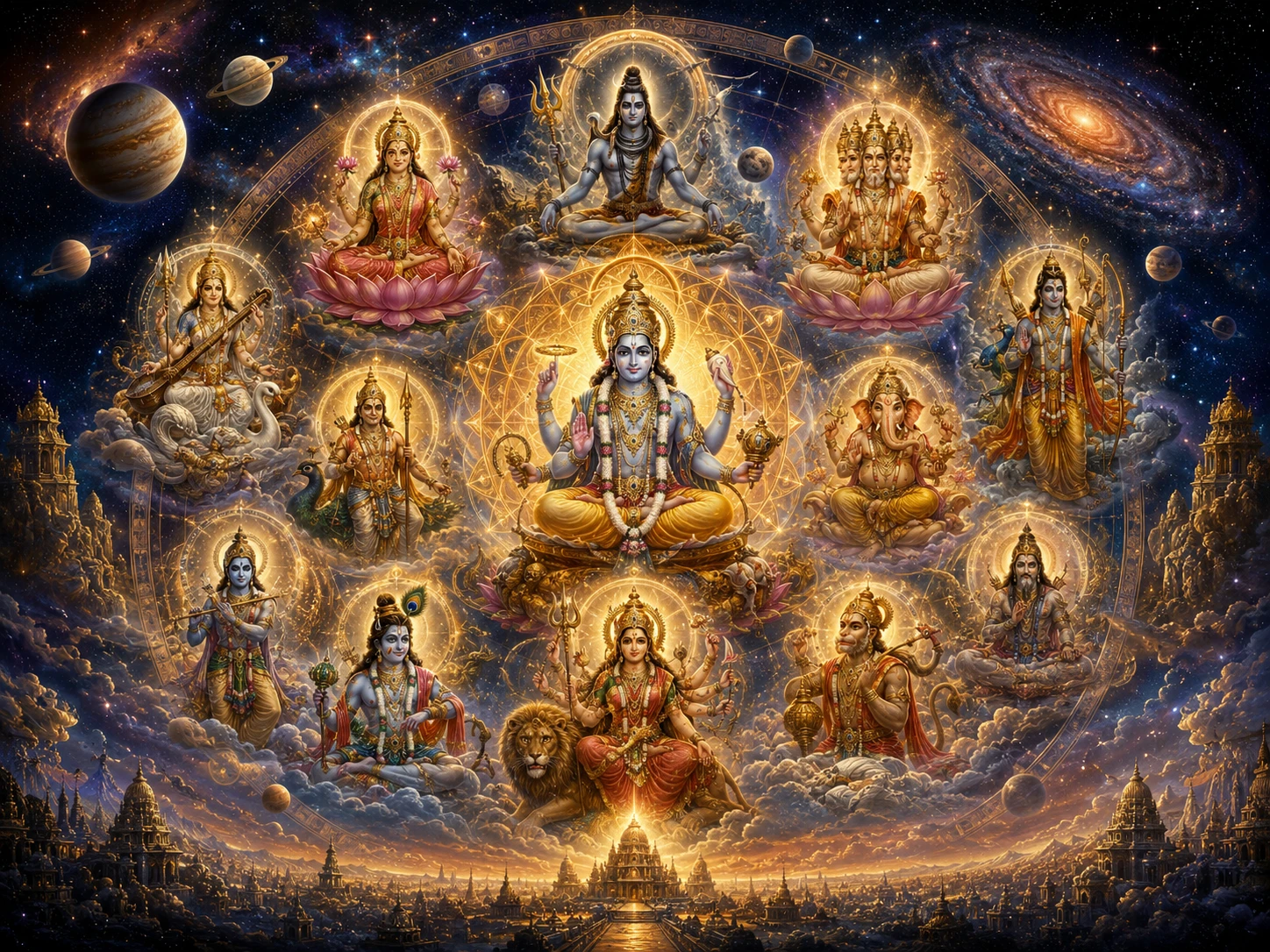
33 Koti Devata -- Why Hinduism Has 33 Types of Gods, Not 33 Crore
13 min read
Agni -- The Fire God
19 min read
Annapurna -- Goddess of Food
19 min readThe same translation error that turned '33 Koti' into '33 crore' in Hinduism also happened in Buddhism. The Chinese translation of Buddhist texts rendered 'Sapta Koti Buddha' (7 Supreme Buddhas) as '7 Crore Buddhas.' The…
Deities AvatarsCommunity Reflections
🕉️
Be the first to share your reflection.