
Ratri -- The Night That the Rig Veda Trusted
रात्रि -- वह रात्रि जिस पर ऋग्वेद ने भरोसा किया
Most ancient religious literature treats night as the time when protection fails: the hour of wild animals, of raiders, of the unknown pressing in once the fire burns low. Rig Veda 10.127 does the opposite. It addresses Ratri, Night, directly as a goddess who has already taken charge of the situation. She spreads herself across the sky through countless stars, purutra devyakshabhih, in many places, with her divine eyes, and settles over every form of beauty in the world. She is called amartya, immortal, and described as filling both the low places and the high. Rather than being the absence that Dawn will have to fix, she is credited with her own light, one that actively bhadate tamah, pushes back darkness, well before her sister Ushas, the Dawn, ever appears. The hymn is short, eight verses in the standard recension, and it is traditionally counted among a small number of Rig Vedic hymns credited to a woman seer, a fact that has made it a point of particular interest for scholars of the Rig Veda's women rishikas for well over a century.
What the hymn asks Ratri to do is remarkably practical. It does not ask for cosmic favour or abstract blessing; it asks for the specific safety that a household or a travelling group needs after sunset in a world without electric light or locked doors. Villages settle down, the hymn says, and those who walk and those who fly come to rest; even the hawks, restless hunters by nature, become still. The petitioner asks to be sheltered the way birds rest in a tree, ni te yaman na vikshmahi, we settle down within your protective passage. The hymn's final plea is the most concrete of all: yavaya vrikyam vrikam, drive away the she-wolf and the wolf, yavaya stenam, drive away the thief. These are not metaphorical dangers. They are the real hazards of an agrarian and pastoral world after dark, predators near livestock and human settlements, and human thieves moving under cover of darkness. Ratri is asked to make the night sutara, easy to cross, language that treats darkness the way one might speak of a river or a difficult stretch of road: something to be gotten through safely with the right guide, not something to be feared for its own sake.
रात्री व्यख्यदायती पुरुत्रा देव्यक्षभिः । विश्वा अधि श्रियोऽधित ॥
rātrī vyakhyadāyatī purutrā devyakṣabhiḥ | viśvā adhi śriyo'dhita ||
Night, the Goddess, approaching, spreads out and reveals herself through many places, with her divine eyes. She has taken her place above all forms of beauty.
— Rig Veda 10.127.1, opening verse of the Ratri Sukta
The anukramani, the traditional index that lists the seer, deity, and metre of every Rig Vedic hymn, gives an unusual dual attribution for 10.127: kushika saubharo, ratrir va bharadvaji, Kushika Saubhari, or, in an alternate tradition, Ratri Bharadvaji, a woman identified as the daughter of the sage Bharadvaja. The later Brihaddevata, a Vedic index text that catalogues the Rig Veda's deities, groups Ratri among a small named set of brahmavadinyah, women who are remembered as having realized and voiced Vedic truth directly, alongside figures such as Ghosha, Apala, Lopamudra, and Vishvavara. Only a small fraction of the Rig Veda's roughly one thousand hymns carry a female name anywhere in their traditional attribution, which is what makes the Ratri Sukta a hymn scholars of Vedic women return to repeatedly, even though the tradition itself preserves both a male and a female name for its authorship.
The relationship the hymn draws between Ratri and her sister Ushas, Dawn, is worth reading carefully, because it resists a moralizing pattern that becomes far more common in later Hindu and non-Hindu religious writing alike, where darkness stands generically for ignorance, danger, or evil and light for their opposite. Rig Veda 10.127 does not do this. Ratri and Ushas are described as sisters, niru svasaram askrit, night makes way for her sister, in an orderly, cooperative handover rather than a defeat. Night is not driven off by a superior force; she steps aside for her sister the way one family member yields a task to another. Darkness in this hymn already has its own light, its own eyes, its own capacity to protect, well before it needs Dawn to redeem it. The later Sanskrit philosophical vocabulary that treats tamas, darkness, as the lowest of the three gunas, associated with inertia and delusion, belongs to a different stratum of Hindu thought than this specific hymn, and reading 10.127 through that later lens risks importing a judgment about darkness that the Ratri Sukta itself does not make. Here, night is simply the other half of the day, owed the same respect as its sister, and worthy of address in its own right rather than as a problem waiting for morning to solve.
Ratri and Ushas: Two Sisters, Very Different Visibility
| Goddess / देवी | Rig Vedic Presence / ऋग्वैदिक उपस्थिति | Contemporary Visibility / समकालीन दृश्यता |
|---|---|---|
| Ratri (Night) / रात्रि | One dedicated hymn, Rig Veda 10.127, eight verses / एक समर्पित सूक्त, ऋग्वेद १०.१२७, आठ श्लोक | Recited at dusk in some households; included as an anga text alongside Devi Suktam in some Chandi Path and Devi Mahatmya liturgies / कुछ घरों में सायं पढ़ा जाता है; कुछ चंडी पाठ और देवी महात्म्य अनुष्ठानों में देवी सूक्त के साथ अंग-पाठ के रूप में सम्मिलित |
| Ushas (Dawn) / उषा | About twenty dedicated hymns across multiple mandalas, one of the most celebrated goddesses of the entire Rig Veda / पूरे ऋग्वेद में विभिन्न मंडलों में लगभग बीस समर्पित सूक्त, संपूर्ण ऋग्वेद की सबसे प्रशंसित देवियों में से एक | Widely known by name among Hindus familiar with Vedic goddesses; no comparable anga-text role in Shakta liturgy / वैदिक देवियों से परिचित हिंदुओं में नाम से व्यापक रूप से जानी जाती हैं; शाक्त अनुष्ठान में रात्रि जैसी अंग-पाठ भूमिका नहीं |
Ushas received roughly twenty times the dedicated hymn count Ratri did, and remains far better known among Rig Vedic goddesses. Ratri's comparative obscurity has less to do with theological importance than with simple volume of surviving verse.
Ratri's afterlife in Hindu practice runs along two separate tracks, and it is worth keeping them distinct rather than merging them. The first is direct and simple: some households and Vedic practitioners recite the Ratri Sukta at dusk, as part of sandhya, the twilight prayer junction, treating the hymn as a straightforward evening invocation for a safe and peaceful night, much as it appears to have functioned in its original setting. The second track is more theologically layered. A number of Shakta ritual manuals used for Chandi Path, the recitation of the Devi Mahatmya during Navaratri and other occasions, include the Ratri Sukta alongside the Rig Vedic Devi Suktam as one of the anga texts, subsidiary recitations read before or after the main text, positioning Ratri as an early Vedic voice absorbed into the later, much larger theology of the Goddess as supreme reality. This absorption does not mean Ratri is simply another name for Durga or Kali in the way, for instance, the Puranas treat Parvati and Kali as forms of one Devi; the connection is closer to a lineage claim, in which Shakta tradition reads its own roots back into one of the Rig Veda's oldest addresses to a goddess. Both tracks keep the same hymn alive for different reasons: one for the practical peace of an ordinary evening, the other for a much larger claim about where the worship of the Goddess in Hinduism ultimately begins.
Recite the Ratri Suktam at Dusk
The Ratri Suktam is on Eternal Raga with its meaning. Recite it at dusk, as part of evening sandhya, before sleep, or before travelling after dark. It asks Ratri's protection through the night -- for safety, rest and freedom from fear of the dark.
Tags
Eternal Raga · शाश्वत राग
Institutional voice — scholarly articles on Sanatan Dharma
Deepen Your Understanding
अपनी समझ और गहरी करें
scriptural exegesis
Devi Mahatmya -- The Three Charitas That Changed How India Worships the Feminine
700 verses. 13 chapters. Three battles. One thesis: when every god in the universe has failed, a woman finishes the job. The Devi Mahatmya from the Markandeya Purana is not just a scripture -- it is the founding document of Shakta theology and the reason 300 million people celebrate Navaratri.
deities avatars
Durga -- The Warrior Goddess Who Cannot Be Defeated
When every male god in the Hindu pantheon failed to defeat the buffalo demon Mahishasura, they pooled their tejas -- their divine radiance and rage -- into a single being. What emerged was not another god. It was a goddess. And she succeeded where they could not. That is the origin story of Durga, and it rewrites every assumption about power.
rituals traditions
Navratri -- Nine Nights That Transform India
For nine nights, India becomes a different country. In Gujarat, millions dance garba till dawn. In Bengal, the streets turn into open-air art galleries. In Varanasi, nine temples light up in sequence. In Mysore, the palace blazes with 100,000 bulbs. Navratri is not a single festival -- it is nine nights of goddess worship that unite India's most diverse traditions into one cosmic celebration.
rituals traditions
Sandhyavandana -- The Daily Vedic Practice That Even Rama and Krishna Never Skipped
Three times a day, at the junction of night and day, morning and afternoon, afternoon and night, the twice-born Hindu is commanded to stop everything and perform Sandhyavandana. It combines pranayama, the Gayatri Mantra, water offerings, and meditation into a single twenty-minute ritual. The Ramayana shows Rama doing it in the forest. The Mahabharata shows Krishna doing it before battle. And somewhere in India right now, an IIT student is doing it in his hostel room.
scriptural exegesis
Nasadiya Sukta -- The Rigvedic Hymn That Questioned Creation Itself
Seven verses in the tenth mandala of the Rigveda. No cosmic egg, no deity speaking creation into being, no parted waters. Just a rishi asking, without flinching, where everything came from -- and whether even the overseer of creation in the highest heaven knows the answer.
The anukramani, the traditional index that lists the seer, deity, and metre of every Rig Vedic hymn, gives an unusual dual attribution for 10.127: kushika saubharo, ratrir va bharadvaji, Kushika Saubhari, or, in an alter…
More in Deities & Avatars
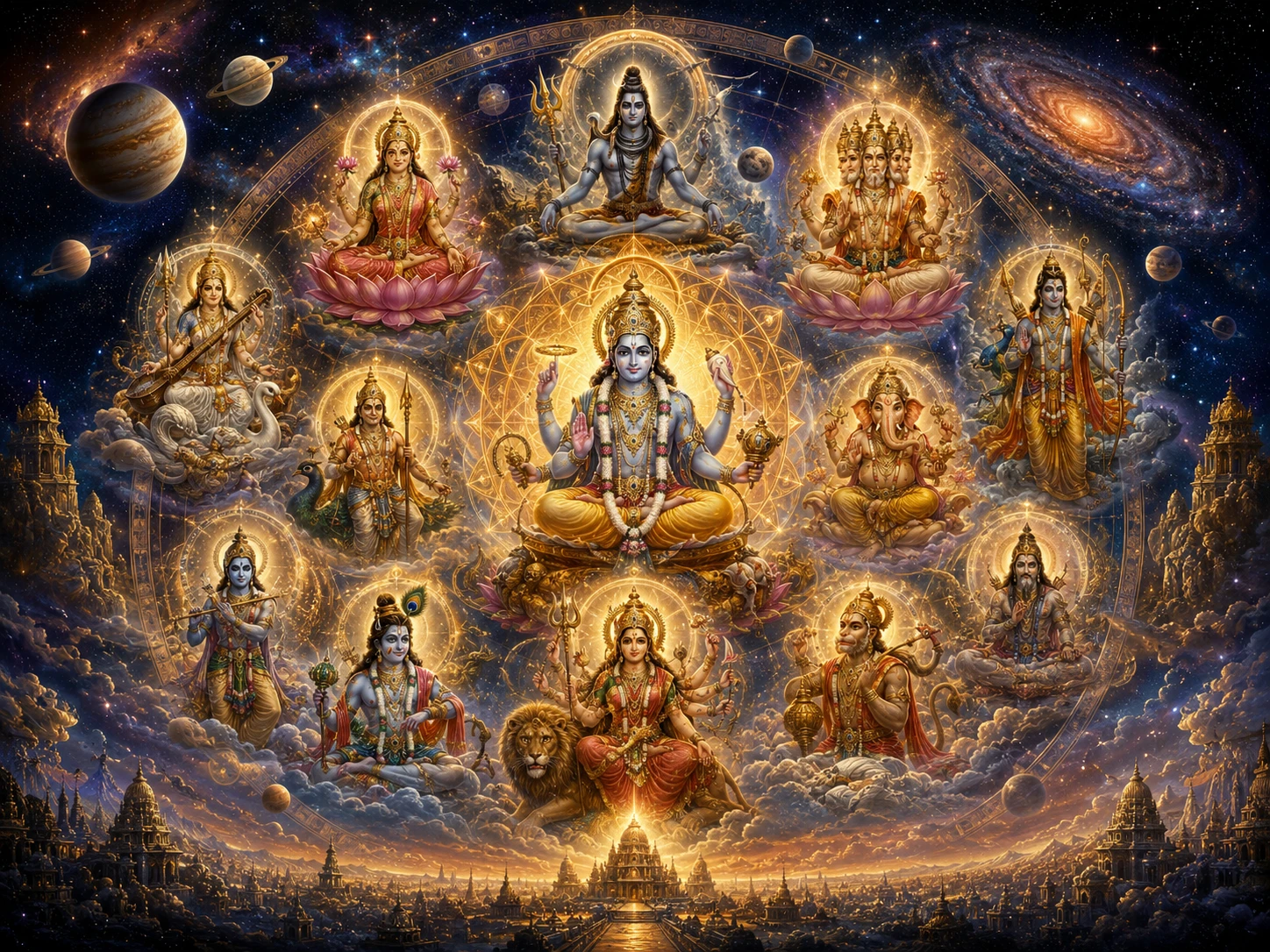
33 Koti Devata -- Why Hinduism Has 33 Types of Gods, Not 33 Crore
13 min read
Agni -- The Fire God
19 min read
Annapurna -- Goddess of Food
19 min readThe same translation error that turned '33 Koti' into '33 crore' in Hinduism also happened in Buddhism. The Chinese translation of Buddhist texts rendered 'Sapta Koti Buddha' (7 Supreme Buddhas) as '7 Crore Buddhas.' The…
Deities AvatarsCommunity Reflections
🕉️
Be the first to share your reflection.