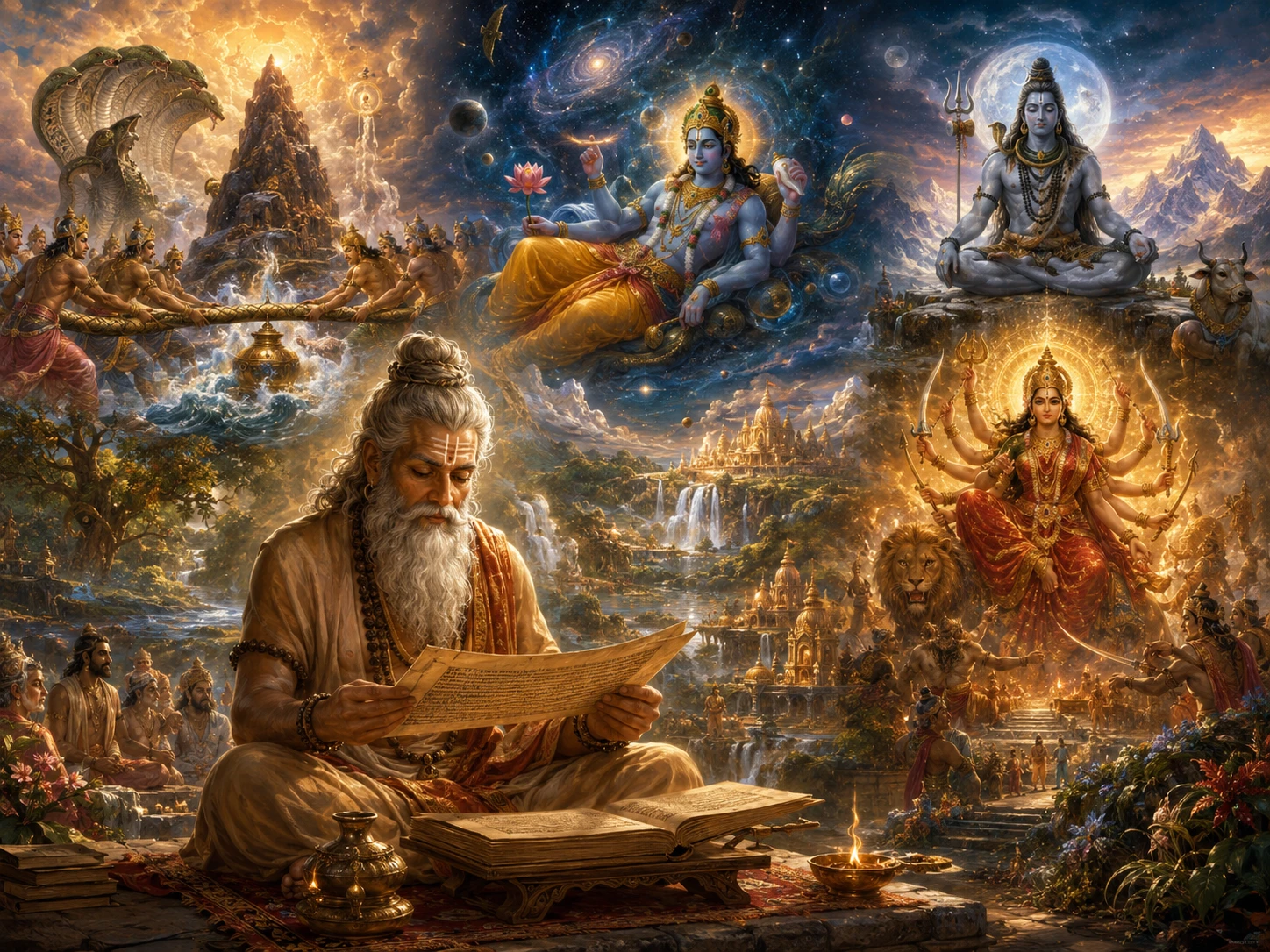
Nasadiya Sukta -- The Rigvedic Hymn That Questioned Creation Itself
नासदीय सूक्त -- वह ऋग्वैदिक सूक्त जिसने सृष्टि पर ही प्रश्न उठाया
The Nasadiya Sukta is not a creation story. It is a creation question. Seven verses in the tenth mandala of the Rigveda, roughly one hundred and forty words of Sanskrit, and in them the rishi does something no other ancient religious text dares: he opens the origin of everything with a shrug. Then there was neither existence nor non-existence. No waters parted. No cosmic egg hatched. No deity spoke the world into being. Just a stark sentence that refuses the two categories any thinking mind wants to lean on. Existence. Non-existence. Neither, says the rishi. Then what? Read on and the hymn keeps pulling the rug out -- no death, no immortality, no day, no night -- until the last verse lands on a confession most religious texts would never permit themselves to make. Even the overseer of this creation, in the highest heaven, may or may not know where it came from.
For a UPSC aspirant grinding through philosophy optional in Old Rajinder Nagar, this is the text that makes Western first-cause arguments feel a little clumsy. Aristotle's unmoved mover assumes the question has an answer. Anselm's ontological proof assumes existence is the obvious starting point. The Nasadiya rishi, composing somewhere in the second millennium BCE, already knew both assumptions were optional. He took them away. He kept the question. In a civilization that later gets caricatured as dogmatic or purely devotional, this hymn sits at the headwaters of the tradition and does something that looks, from a certain angle, indistinguishable from the opening move of modern science. Hold the question open. Refuse the easy answer. Let doubt be the engine.
Some context before the first verse. The Rigveda has ten mandalas. The first nine were composed earlier, mostly by specific rishi clans -- Vasishtha, Vishvamitra, Bharadvaja, Atri -- and they are full of hymns to named deities. Agni. Indra. Soma. Varuna. The tenth mandala is different. It is later, more diverse, more philosophical. It contains the Purusha Sukta, the Hiranyagarbha Sukta, the Devi Sukta, the Nasadiya Sukta. Creation hymns, funeral hymns, hymns on the nature of speech and mind. The rishi traditionally credited with the Nasadiya Sukta is Prajapati Parameshthin, a name that already signals the hymn's character -- the lord of creatures, the one standing in the highest place. Whether a single historical individual composed it or the attribution is retrospective, the text is preserved in the Shakala recension of the Rigveda, the only branch of this Veda that has survived in continuous recitation.
The meter is trishtubh -- eleven syllables per pada, four padas per verse, the meter of much of Vedic philosophical speech. Verse seven has a famous defect. Its second pada is two syllables short, and Joel Brereton, the Vedic scholar at the University of Texas, argued in 1999 that this was not a transmission error. It was deliberate. A syntactic stumble built into the hymn to embody puzzlement itself. The rishi refused to make the closing line metrically neat because the thought it carried -- that even the overseer of creation may not know -- is not the kind of thought that deserves a neat ending. An IIT Bombay astrophysics PhD who has also read Brereton's paper will tell you that this is the Rigvedic equivalent of leaving the equation unsolved on the blackboard on purpose. The white space is the point.
नासदासीन्नो सदासीत्तदानीं नासीद्रजो नो व्योमा परो यत्। किमावरीवः कुह कस्य शर्मन्नम्भः किमासीद्गहनं गभीरम्॥
nāsad āsīn no sad āsīt tadānīṃ nāsīd rajo no vyomā paro yat | kim āvarīvaḥ kuha kasya śarmann ambhaḥ kim āsīd gahanaṃ gabhīram ||
Then there was neither non-existence nor existence; there was no realm of air, no sky beyond it. What stirred? Where? In whose shelter? Was there water, bottomlessly deep?
— Rigveda 10.129.1
Read that first verse slowly and you notice the rishi is not playing with paradox for its own sake. He is doing something far more careful. He is removing the two mental scaffolds a Sanskrit-speaking listener would automatically reach for. Sat and asat. Existence and non-existence. In later Upanishadic vocabulary, sat will come to mean reality, truth, being, that which endures; asat will mean unreality, falsehood, what passes. Here, at the fountainhead, the rishi refuses both. Then he asks four questions in rapid succession. What stirred? Where? In whose shelter? Was there water, bottomlessly deep? The Sanskrit word gahana, which I have translated as bottomless, carries the taste of a well at night -- something you cannot see the bottom of because there may be no bottom at all. A Bengaluru startup founder at 2 AM, trying to decide whether a product has a market before anyone has used it, sits in a smaller version of that well. The question cannot be answered from inside the question.
Notice also what the rishi is not doing. He is not saying there was nothing. Nothing is asat, and he has ruled that out too. He is saying our categories of something and nothing were themselves not yet operative. Language, which always runs on contrast, had no handhold. This is not mystical fuzz. It is a precise philosophical move. The hymn will not let us begin with the comfortable assumption that we know what we are asking about. And that discipline -- of refusing the comfortable frame -- is the single most important thing the Nasadiya Sukta gives to the entire history of Indian philosophy. Every darshana that comes later, from Samkhya to Vedanta to Buddhism, inherits this posture in some form. The question is always bigger than the inherited vocabulary for it.
न मृत्युरासीदमृतं न तर्हि न रात्र्या अह्न आसीत्प्रकेतः। आनीदवातं स्वधया तदेकं तस्माद्धान्यन्न परः किंचनास॥
na mṛtyur āsīd amṛtaṃ na tarhi na rātryā ahna āsīt praketaḥ | ānīd avātaṃ svadhayā tad ekaṃ tasmād dhānyan na paraḥ kiṃ canāsa ||
There was then neither death nor immortality, no sign of night or day. That One breathed, windless, by its own power. Other than That, there was nothing beyond.
— Rigveda 10.129.2
The phrase tad ekam -- That One -- is the single most loaded compound in this hymn. It is not eka devata, one god. It is not Brahman, a term that comes later in the Upanishads. It is just tad, that, a neuter demonstrative pronoun, and ekam, one. Whatever it was, it was before naming. Before gender. Before predicates. And it breathed -- anid -- windless, svadhaya, by its own swadha, its own intrinsic power. The verse holds a stunning image. Breath without wind. A pulse without atmosphere. The rishi will not call it a god and will not call it a thing. He will only grant it motion, the smallest sign of being alive, and then stop.
Pick up any Upanishad that comes after and you will find tad ekam refracted into a dozen names. Brahman in the Chandogya. Atman in the Brihadaranyaka. Purusha in the Shvetashvatara. Each later sage tries to put a handle on the doorknob the Nasadiya rishi refused to name. Cricket captains know something about this. In the final hour before a test match begins, when the coin has not yet been tossed and the lineup is still being argued about in the dressing room, there is a state that is neither winning nor losing, neither playing nor resting. The Nasadiya rishi would recognize that hour. Breathing, by its own power. No wind yet. Nothing decided. All decisions already contained in what is about to begin. The hymn is not mystifying the reader. It is pointing at a state that every culture's wisdom literature circles eventually, but that most of them rush past on their way to a tidier cosmology.
तम आसीत्तमसा गूळ्हमग्रेऽप्रकेतं सलिलं सर्वमा इदम्। तुच्छ्येनाभ्वपिहितं यदासीत्तपसस्तन्महिनाजायतैकम्॥
tama āsīt tamasā gūḷham agre 'praketaṃ salilaṃ sarvam ā idam | tucchyenābhv apihitaṃ yad āsīt tapasas tan mahinājāyataikam ||
Darkness in the beginning was concealed by darkness; all this was unmarked water. That which, becoming, was covered by the void -- that One was born through the greatness of its heat.
— Rigveda 10.129.3
Two words here deserve attention. Salilam, which I have translated as water, is not the water of lakes and rivers. It is a word for undifferentiated flow -- a primal medium without shoreline or current, the word Vedic poets used for the cosmos in its unformed state. Read Biblical Genesis one-two and the phrase the spirit of God moved upon the face of the waters uses a similar figure, though the framing is different. What strikes in the Rigvedic verse is what comes next. The One is born tapasas mahinā -- through the greatness of tapas. Tapas is one of the most important words in the entire Vedic vocabulary and it almost never translates cleanly. Literally it means heat. Specifically, the heat of austerity, of concentrated effort, of a being gathering its powers and holding them until something gives. Ascetics in later tradition will generate tapas through fasting and meditation and the holding of postures. Here, the entire cosmos is born from tapas -- from something like the pressure of concentration itself.
An IIT Madras thermodynamics student will immediately notice the structure. A system in a high-energy state, constrained, then released, produces form. A marathon runner at kilometer thirty-two, lungs burning, legs negotiating with the mind, knows a smaller version of what tapas means in practice. The rishi is saying that the cosmos came into being not through a cheerful divine utterance but through something more like strain. Concentrated, contained, internal heat -- and then emergence. This is the first hint in the hymn that creation is not effortless. Whatever That One is, it had to work for this.
कामस्तदग्रे समवर्तताधि मनसो रेतः प्रथमं यदासीत्। सतो बन्धुमसति निरविन्दन्हृदि प्रतीष्या कवयो मनीषा॥
kāmas tad agre sam avartatādhi manaso retaḥ prathamaṃ yad āsīt | sato bandhum asati nir avindan hṛdi pratīṣyā kavayo manīṣā ||
In the beginning, desire arose upon That -- it was the first seed of mind. Searching with wisdom in their hearts, the seers found the bond between existent and non-existent.
— Rigveda 10.129.4
This is the most radical verse in the hymn. Kama. Desire. Not love as Victorians would translate it, not lust as the modern English word has narrowed it to, but the prior pull toward being -- the ache of potential for itself. Kama is the first seed of mind. Retas prathamam yad asit. The Sanskrit word for seed, retas, is biological. It is the word used for semen, for what carries the pattern of the next generation. The rishi is saying that before there was a mind, before there was a thinker, there was already a pull toward being-something -- and that pull is itself the origin of mind. This is a psychology of the cosmos, not just of the person. Desire precedes knowing. Wanting comes before the one who wants.
For anyone who has written a Bollywood song, this line from the Rigveda is not alien territory. Kama has been the subject of Indian aesthetic and ethical thought for three thousand years. The Kamasutra of Vatsyayana, later philosophical texts on the purusharthas, bhakti poetry that calls Krishna kama's master -- all of them are in conversation with this single verse. The second line is equally striking. The seers, searching with wisdom in their hearts, found the bond between the existent and the non-existent. Hridi pratishya manisha. Not reasoning. Hridi -- in the heart. Pratishya -- by searching, by inquiry. Manisha -- wisdom. The rishi says the link between sat and asat was discovered not by argument from outside but by a contemplative probe from within. A Koramangala founder who has shipped three products will tell you that the distinction between what exists and what does not is decided much earlier than anyone admits, and in a much quieter place than a conference room. It is decided in the heart, by wisdom searching itself.
Four Vedic and Puranic Accounts of Creation
| Source Text | Starting Point | Creative Agent | Final Epistemic Stance |
|---|---|---|---|
| Nasadiya Sukta (Rigveda 10.129) | Neither existence nor non-existence | That One (tad ekam), breathing by its own power, born of tapas | Even the highest overseer may or may not know the origin |
| Purusha Sukta (Rigveda 10.90) | The Cosmic Being (Purusha) with a thousand heads | Purusha sacrificed by the devas at the primordial yajna | Explicit cosmogony -- varna, moon, sun, sky, earth all named as products |
| Hiranyagarbha Sukta (Rigveda 10.121) | The Golden Embryo (Hiranyagarbha) | Prajapati, who arose from the embryo as the one lord of creatures | Named creator, repeated refrain 'kasmai devaya havisha vidhema' (to what god shall we offer oblation?) |
| Puranic cosmogony (Bhagavata, Vishnu Purana) | Vishnu in yoganidra upon Shesha on the cosmic ocean | Brahma arising from Vishnu's navel-lotus, then creating through mind | Cyclical kalpas with precise time-calculations; full epistemic confidence |
The Nasadiya Sukta stands apart from the other three by refusing to name a creative agent with confidence and by ending in explicit doubt. It is a unique stance within Hindu scriptural literature, and it is this uniqueness -- not any one doctrine -- that has made the hymn a continuing touchstone for Indian philosophical inquiry.
Verses five and six of the hymn deepen the puzzle further. Verse five speaks in dense imagery of a ray stretched across, of seed-placers and greatnesses, of self-power below and impulse above. Scholars disagree sharply on the exact cosmological picture -- whether the rishi is describing the emergence of a vertical axis, a horizontal line of force, a sexual polarity, or something else entirely. The commentary of Sayana, the fourteenth-century Vijayanagara scholar whose gloss on the Rigveda shaped every later reading, takes the verse as a description of the male and female principles arising together. Modern scholars like Wendy Doniger and Stephanie Jamison have read it more reservedly, granting that the verse resists a single clean interpretation.
Verse six is blunt where verse five is opaque. Ko addha veda. Who truly knows? Ka iha pra vochat. Who can here declare it? Kuta ajata kuta iyam visrishtih. From where was it born, from where this creation? Arvag deva asya visarjanena. The gods are on this side of creation's unfurling -- that is, they came after. Atha ko veda yata ababhuva. So who knows from where it came to be? Every conscious being in the hymn's world is placed on the wrong side of the question. The gods post-date creation. Humans come later still. Whatever witnessed the origin, if anything did, is not available for questioning. The hymn makes no concession to religious comfort here. It does not say that though we cannot know, the gods do. It says the gods cannot know either. They are downstream.
इयं विसृष्टिर्यत आबभूव यदि वा दधे यदि वा न। यो अस्याध्यक्षः परमे व्योमन्त्सो अङ्ग वेद यदि वा न वेद॥
iyaṃ visṛṣṭir yata ābabhūva yadi vā dadhe yadi vā na | yo asyādhyakṣaḥ parame vyoman so aṅga veda yadi vā na veda ||
This creation -- from where it came to be, whether it was established or whether not -- the one who is its overseer in the highest heaven, he verily knows -- or perhaps he does not know.
— Rigveda 10.129.7
So aṅga veda yadi vā na veda. He verily knows -- or perhaps he does not know. No other ancient religious text closes like this. Genesis ends its creation week with a blessing. The Enuma Elish of Babylon ends with the enthronement of Marduk. The Norse Voluspa ends with the twilight of the gods and a new earth. The Nasadiya Sukta ends with a particle -- aṅga, roughly truly, verily -- and then a doubt so complete it folds back on the whole preceding framework. The particle is doing enormous work. It sets up the expectation of emphatic confirmation and then delivers its opposite. Classical Sanskrit readers of this verse have argued for twenty-five centuries about whether the rishi is affirming that the overseer knows or cautioning that he does not. The honest reading is that the verse deliberately refuses to settle the question, because the whole hymn has been training the listener not to settle it.
An ISRO scientist watching a Chandrayaan liftoff from Sriharikota knows both sides of this sentence. The mission planners know the trajectory to a precision of meters per second. They also know that what they are trying to do is place a lander on a moon inside a cosmos whose ultimate origin their best instruments cannot reach. Both kinds of knowing are real. Both kinds of knowing are honest. The Nasadiya rishi, at the end of his hymn, is not mocking the overseer. He is saying that even at the highest vantage point, there is a limit. That is not defeat. That is the mark of a mature mind. And it is, not incidentally, the mark of science as a method, as opposed to dogma as a posture.
Two modern touchpoints make the Nasadiya Sukta strangely contemporary. In 1980, the American astronomer Carl Sagan devoted a portion of episode ten of his landmark PBS series Cosmos -- titled The Edge of Forever -- to this hymn, praising what he called India's tradition of skeptical questioning and unselfconscious humility before the great cosmic mysteries. For a generation of Indian science students who grew up watching Cosmos on VHS tapes borrowed from British Council libraries, this was the first time they heard a Western scientist treat a Sanskrit hymn as a methodological peer rather than as exotica. Eight years later, in 1988, Shyam Benegal's DD National series Bharat Ek Khoj -- a televisual adaptation of Jawaharlal Nehru's Discovery of India -- opened every single episode with a rendition of the Nasadiya Sukta composed by Vanraj Bhatia, with vocals that haunted Sunday afternoons across Indian households for fifty-three episodes. The hymn became the sonic signature of the idea of India as an inquiry rather than an assertion. A UPSC aspirant today who streams the series on YouTube is listening to what is probably the oldest philosophical voice in the human record asking, with the same voltage the first rishi brought to it, from where did all this come?
Where This Sits
The Nasadiya Sukta sits at the very root of Stage 1 -- the Rigveda, the oldest layer of the Vedas. Here is where it falls in the full Map of Hindu Literature.
A word of caution before the hymn gets pulled too enthusiastically into modern physics. There is a cottage industry of writings that claim the Nasadiya Sukta anticipated the Big Bang, proved quantum indeterminacy, or contains the Heisenberg uncertainty principle. This is an over-reading. The hymn does not describe an expanding universe. It does not use mathematics. Its darkness concealed by darkness and its unmarked water are not cosmological physics. What the hymn does do -- and this is the more interesting and more defensible claim -- is model an epistemic posture that modern physics has also arrived at for its own reasons. The posture of holding the question open. The posture of recognizing that the ultimate origin is not available to investigation in the ordinary way. The posture of treating doubt not as an embarrassment to be suppressed but as a datum to be acknowledged.
A physics teacher in Chandigarh, explaining to class twelve students why the equations of general relativity break down at the singularity before the Big Bang, is in the same posture as the Nasadiya rishi. Neither is defeated. Neither is mystifying. Both are simply honest. The hymn's continuing power in the world is not that it solves the problem of creation. It does not. Its power is that it refuses to pretend the problem is solved. In a culture that would go on to produce the Upanishads, the Gita, the six darshanas, and centuries of commentary, this was the founding act of intellectual humility. Hold the question open. Answers will come, and many will be useful. But no answer will be the answer. The overseer in the highest heaven may or may not know. The rishi said so. The tradition never forgot.
Chant the Nasadiya Sukta
Mandala 10 of the Rigveda is where the philosophical hymns sit -- Nasadiya, Purusha, Hiranyagarbha, Devi. Start with the Nasadiya Sukta (10.129) and let its seven verses land in the order the rishi placed them. It is on Eternal Raga with Sanskrit, transliteration and meaning; the full Rigveda is not yet on the site.
Tags
Eternal Raga · शाश्वत राग
Institutional voice — scholarly articles on Sanatan Dharma
Deepen Your Understanding
अपनी समझ और गहरी करें
philosophy darshana
The Four Mahavakyas -- Upanishadic Sentences That Changed Civilisation
Four sentences. Twelve words of Sanskrit. Three thousand years of commentary. The Mahavakyas are the most compressed, most powerful, and most debated statements in all of Indian philosophy. Each one claims that the individual self and the ultimate reality of the universe are not two different things. And each one has been interpreted to mean something completely different by every major school of Vedanta.
scriptural exegesis
Chandogya Upanishad -- Tat Tvam Asi
A 24-year-old returns from 12 years of Vedic study, bloated with pride and stuffed with textbook knowledge, only to have his father demolish his certainty with nine repetitions of three words: Tat Tvam Asi -- You Are That. The Chandogya Upanishad is the text that broke the wall between God and you.
scriptural exegesis
Katha Upanishad -- Nachiketa and Yama
A teenage boy walks into the house of Death, waits three days without food, and then proceeds to negotiate the universe's deepest secret out of Yama himself. The Katha Upanishad is not a dusty scripture -- it is the original startup pitch where a kid with zero leverage outplayed the CEO of the afterlife.
scriptural exegesis
Brahma's Children -- The First Generation of Creation
Brahma tried three times to populate the universe. First he created four sons who refused to reproduce and became monks. Then he got so angry that Rudra burst from his forehead. Finally he created ten Prajapatis from his mind -- and through them, every god, demon, human, animal, and plant in existence traces its origin. This is the original org chart of the cosmos.
scriptural exegesis
Shastra Vriksha -- The Complete Map of Hindu Scriptures
Vedas, Upanishads, Puranas, Gita -- everyone has heard these names, but almost nobody knows how they connect to each other. Shastra Vriksha is the GPS of Hindu scripture -- a single interactive tree that maps every major text, from the root of the four Vedas to the 126 catalogued Gitas, and finally makes the whole system click.
scriptural exegesis
Samudra Manthan -- When Gods and Demons Ran a Joint Venture and the Universe Almost Died
A cosmic ocean. A mountain for a churning rod. A serpent king for a rope. Gods on one end, demons on the other. And out came 14 treasures -- including wealth, beauty, medicine, immortality, and one poison so lethal it could end creation itself. The Samudra Manthan is not mythology. It is the original playbook for collaboration, crisis management, and how to handle it when your joint venture partner tries to cheat you.
Two modern touchpoints make the Nasadiya Sukta strangely contemporary. In 1980, the American astronomer Carl Sagan devoted a portion of episode ten of his landmark PBS series Cosmos -- titled The Edge of Forever -- to th…
More in Scriptural Exegesis
Abhimanyu and the Chakravyuha -- The Boy Who Knew How to Enter but Not How to Leave
14 min read
Adbhuta Ramayana -- The Ramayana Where Sita Becomes Kali
9 min read
After Kurukshetra -- What Happened Next
14 min readThe same translation error that turned '33 Koti' into '33 crore' in Hinduism also happened in Buddhism. The Chinese translation of Buddhist texts rendered 'Sapta Koti Buddha' (7 Supreme Buddhas) as '7 Crore Buddhas.' The…
Deities AvatarsCommunity Reflections
🕉️
Be the first to share your reflection.