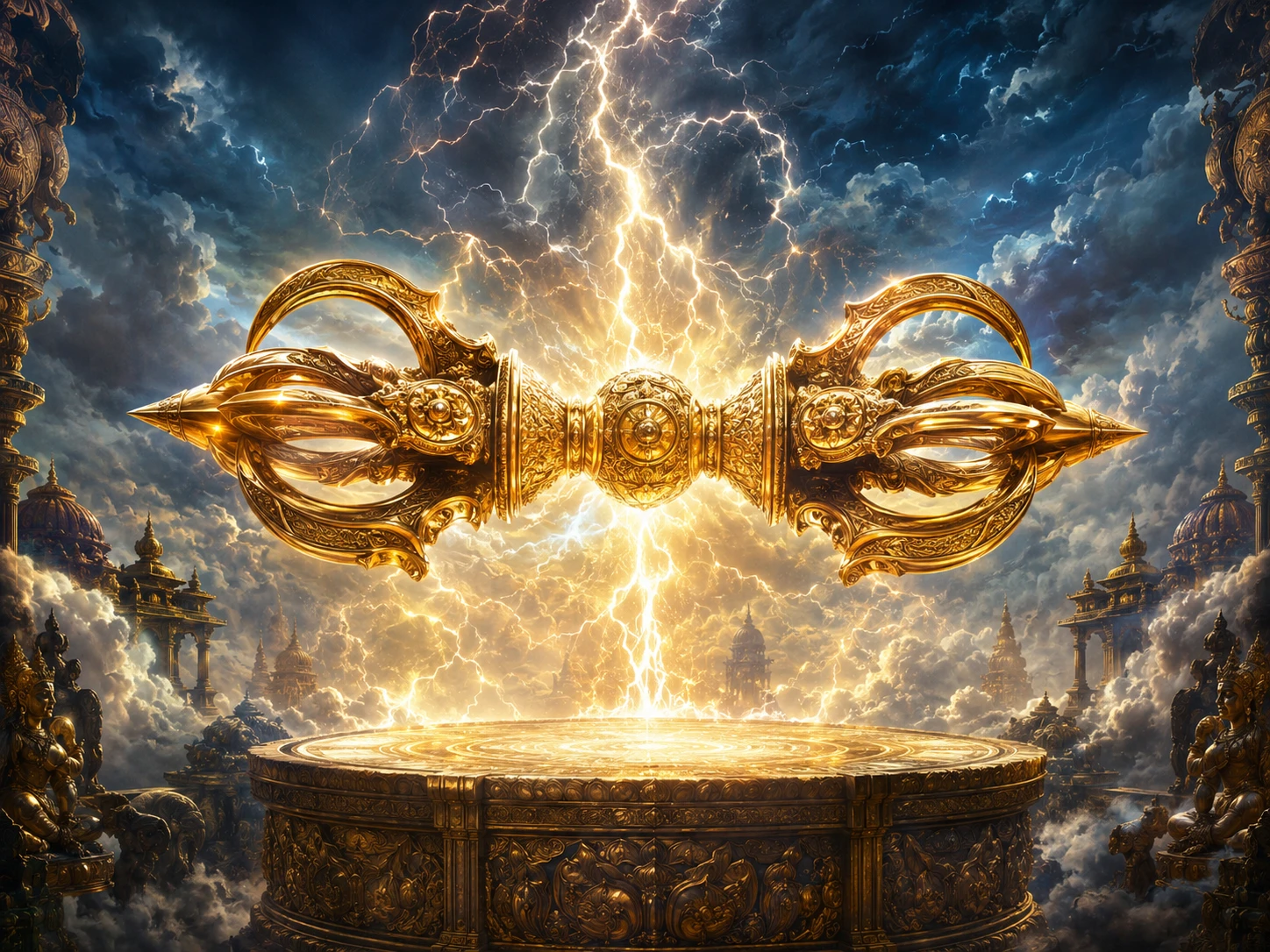
Vajra of Indra -- The Thunderbolt Forged from a Sage's Bones
इन्द्र का वज्र -- ऋषि की अस्थियों से गढ़ा वज्रायुध
The Rigveda's greatest story is not about creation. It is about a weapon.
Hymn 1.32, attributed to the poet Hiranyastupa of the Angiras clan, narrates in fifteen stanzas the battle between Indra and the serpent-demon Vritra -- the foundational myth of Vedic civilisation. Vritra (literally 'the Coverer' or 'the Obstacle') had imprisoned the cosmic waters inside a mountain fortress, causing a primordial drought that threatened all existence. To free the waters and restore the cosmic order (Rita), Indra needed a weapon unlike any that existed.
The problem was Vritra's boon. In the Puranic elaboration (particularly the Bhagavata Purana, Canto 6), Vritra had been granted immunity from any weapon known at the time of the boon's granting, and additionally from any weapon made of wood, metal, or stone, and from anything that was wet or dry. This is the Mahabharata's favourite narrative device: the perfectly worded boon that seems to guarantee invincibility but contains a logical gap that the gods must exploit. The gap here: the boon said nothing about weapons made from bone -- specifically, bone that had been sanctified by a lifetime of austerity and that had absorbed the divine arsenal itself.
This is where Dadhichi enters -- and transforms a military problem into a spiritual event of cosmic significance.
Sage Dadhichi (also called Dadhyancha or Dadhyanga), son of the sage Atharvan (author of the Atharvaveda), had been entrusted by the gods with safeguarding their weapons during a period when the Asuras were using arcane arts to steal divine armaments. Dadhichi guarded the weapons for so long that, tiring of the responsibility, he dissolved them in sacred water and drank the mixture. The weapons became part of his bones. When the gods returned and asked for their weapons back, Dadhichi informed them that the arsenal now resided in his skeleton -- and the only way to retrieve it was for him to die.
Dadhichi did not hesitate. He asked only for the time to complete a pilgrimage to all the holy rivers. Indra, unwilling to wait, brought the waters of all sacred rivers to Naimisharanya so the sage could bathe without travelling. Dadhichi then entered yogic samadhi, released his prana from his body, and died -- voluntarily, consciously, and with complete equanimity.
Vishwakarma (or Tvastar, depending on the textual tradition) then fashioned the Vajrayudha from Dadhichi's spine -- a weapon that was neither wood nor metal nor stone, neither wet nor dry, and was unknown at the time of Vritra's boon. It was, in modern terms, a zero-day exploit against Vritra's security system: a weapon class that did not exist when the defences were designed.
Armed with the Vajra, Indra confronted Vritra. The battle, as described in Rigveda 1.32, is one of the most vivid passages in all of Vedic literature. Indra smashed Vritra with the thunderbolt, split open the mountain, freed the imprisoned waters, and restored sunlight, dawn, and the cosmic order. The rivers flowed to the ocean 'like bellowing milk-cows.' Vritra's mother Danu was also destroyed. The primordial drought ended. Life resumed.
For the IIT student studying materials science or the DRDO engineer working on next-generation armour: the Vajra myth encodes a profound weapons-design principle. The most effective weapon is not the most powerful but the one that exploits a gap in the enemy's defences. Vritra was immune to every category of weapon -- except a category that did not yet exist. Innovation, not escalation, was the solution. The Vajra was not stronger than a Brahmastra. It was different from everything. And that difference was sufficient.
इन्द्रस्य नु वीर्याणि प्र वोचं यानि चकार प्रथमानि वज्री। अहन्नहिमन्वपस्ततर्द प्र वक्षणा अभिनत्पर्वतानाम्॥
indrasya nu vīryāṇi pra vocaṃ yāni cakāra prathamāni vajrī | ahann ahim anv apas tatarda pra vakṣaṇā abhinat parvatānām ||
I will now proclaim the heroic deeds of Indra, the first deeds that the wielder of the Vajra accomplished. He slew the serpent, then disclosed the waters, and split open the bellies of the mountains.
— Rigveda 1.32.1 (Hiranyastupa Angirasa -- the foundational Indra-Vritra hymn)
Dadhichi's Sacrifice -- The Ethics of Self-Giving
Dadhichi's sacrifice is the Vedic tradition's supreme illustration of a principle that runs through all of Hindu ethics: the highest action is not what you achieve but what you give up.
Consider the structure of what Dadhichi did. He was not a warrior. He was a Brahmin sage -- a man of knowledge, meditation, and renunciation. He had no obligation to fight the gods' battles. He had no personal stake in the outcome of the Indra-Vritra conflict. He had achieved spiritual mastery sufficient to release his life-force at will. He could have refused the gods' request and continued in his ashram, unbothered, for centuries.
He chose instead to give his body. Not symbolically. Not in battle, where adrenaline and anger override the fear of death. In cold, deliberate, conscious clarity, sitting in meditation, he released his prana and offered his skeleton to be fashioned into a weapon he would never wield. This is not heroism in the Kshatriya sense. This is something rarer: the Brahmin's sacrifice -- where the instrument of power is not the self but the self's complete dissolution into purpose.
The tradition commemorates Dadhichi as one of the supreme examples of Dana (giving). His sacrifice is invoked in the context of organ donation (the modern parallel is exact: giving one's body so that others may live), in the context of soldiers who die for their country (the Indian Air Force's Dadhichi Deh Dan scheme for body donation is named after the sage), and in the context of scientific research that requires personal sacrifice for the advancement of knowledge.
The Dadhichi story also encodes a subtle philosophical point about the relationship between knowledge and power. The sage's bones were powerful not because they were physically strong but because they had absorbed the divine arsenal through years of custodianship and were sanctified by decades of tapas. The Vajra's destructive power came not from metallurgy but from the accumulated spiritual merit of its material. This inverts the usual weapons logic: the weapon is strong not because of how it was forged but because of who it was made from. Character precedes capability.
For the IAS officer navigating the civil services, for the doctor in a rural PHC working 80-hour weeks, for the teacher in a government school who has given decades to students who may never know her name: Dadhichi's sacrifice is the template. You dissolve yourself into your function. Your bones become the weapon. And the weapon outlasts you.
The Vajra Across Civilisations -- From Vedic Thunderbolt to Buddhist Diamond
| Tradition | Name | Form | Wielder / User | Symbolism | Living Practice |
|---|---|---|---|---|---|
| Rigvedic | Vajra / Vajrayudha | Thunderbolt weapon; open prongs | Indra (Vajrin, Vajrabhrit) | Destruction of cosmic obstacles; release of waters; triumph of Rita over chaos | Vedic fire rituals; Indra invocation during monsoon prayers |
| Puranic Hinduism | Vajrayudha (from Dadhichi) | Thunderbolt forged from sage's spine | Indra; later Arjuna (Vajra Astra) | Sacrifice as the source of ultimate power; bone stronger than metal | Dadhichi Deh Dan (body donation); Vajra as motif in temple architecture |
| Tibetan Buddhism | Dorje (rDo rje) | Five-pronged sceptre; closed prongs | Ritual implement; paired with bell (ghanta) | Indestructible diamond nature of enlightenment; method (upaya) | Vajrayana initiation; daily practice; monastery rituals across Ladakh, Sikkim |
| Japanese Buddhism | Kongosho / Tokko | Single or triple-pronged metal implement | Esoteric Buddhist priests (Shingon, Tendai) | Cutting through ignorance; ritual purification | Shingon temple rituals; Kukai lineage practices |
| Greek parallel | Keraunos (Zeus's thunderbolt) | Lightning bolt | Zeus, king of Olympian gods | Divine authority; punishment of hubris; weather control | Mythological (no living practice); iconographic in Western art |
| Norse parallel | Mjolnir (Thor's hammer) | War hammer; always returns to thrower | Thor, god of thunder | Protection; consecration; strength against chaos giants | Mythological; revived in neopagan Asatru practice |
The Buddha is said to have taken the Vajra from Indra and closed its prongs -- transforming a weapon of destruction into a symbol of indestructible wisdom. The Buddhist Vajra (Dorje) and the Hindu Vajra (Thunderbolt) share the same etymological root but carry opposite implications: one destroys external enemies, the other destroys internal ignorance. The weapon became a mirror.
From Weapon to Symbol -- The Vajra in Buddhism and Beyond
The Vajra's journey from Vedic weapon to Buddhist ritual implement is one of the most remarkable transformations in the history of world religion.
In Vedic Hinduism, the Vajra is purely destructive -- Indra's weapon of war, wielded to smash enemies and release waters. But when Buddhism adopted the symbol, it underwent a complete inversion. The Vajrayana (Diamond Vehicle) school of Buddhism -- dominant in Tibet, Mongolia, Bhutan, Ladakh, Sikkim, Arunachal Pradesh, and historically in Nepal and parts of Southeast Asia -- takes its very name from the Vajra. The Vajra here represents not destruction but indestructibility -- the diamond-like nature of enlightened mind that cannot be broken, cut, or destroyed by any force.
The physical form changed too. Hindu iconography depicts the Vajra with open prongs -- a weapon radiating destructive energy outward. Buddhist iconography shows the Vajra (Dorje in Tibetan) with closed prongs -- energy contained, directed inward, sealed for meditation rather than combat. Legend credits the Buddha himself with closing the prongs: he took Indra's weapon and transformed it from an instrument of external violence into a tool of internal liberation.
The Vajra-Ghanta (thunderbolt and bell) combination in Tibetan Buddhist practice represents the union of Upaya (method, masculine) and Prajna (wisdom, feminine) -- the two wings of enlightenment. The practitioner holds the Dorje in the right hand and the bell in the left, symbolising that wisdom without method is passive and method without wisdom is blind. This ritual pairing is performed in every Vajrayana initiation, every sadhana session, and every major Buddhist ceremony from Dharamsala to Tawang to Thimphu.
The geopolitical significance is underappreciated. India's connection to Vajrayana Buddhism through the Vajra symbol links it culturally to Tibet, Mongolia, Bhutan, and the Buddhist civilisations of Southeast Asia. The Nalanda University ruins in Bihar -- where Vajrayana Buddhism was systematised before spreading to Tibet -- are a UNESCO World Heritage Site and a symbol of India's role as the source of one of the world's major spiritual traditions. When the Dalai Lama performs a Vajra ritual in Dharamsala, he is using a symbol that originated in Rigvedic India, was transformed by the Buddha, was systematised at Nalanda, was carried to Tibet by Padmasambhava and Atisha, and now returns to Indian soil in the person of a Tibetan exile. The Vajra's journey is India's civilisational story -- creation, transformation, export, and return.
The Rigvedic Vajra vs The Puranic Vajra -- Two Origin Stories
The Vajra has two distinct origin stories, and understanding both reveals how Hindu mythology evolves across millennia while preserving core meaning.
In the Rigveda (the oldest layer, approximately 1500-1200 BCE), the Vajra is made by Tvastar (also called Tvashtr) -- the divine artisan, the smith of the gods. There is no mention of Dadhichi. Tvastar simply fashions the weapon for Indra, and Indra uses it to slay Vritra. The Rigvedic Vajra is a craftsman's product -- a weapon created by divine engineering skill. Indra's epithets reflect this: Vajrabhrit (bearer of the Vajra), Vajrin (armed with the Vajra), Vajrahasta (holding the Vajra in his hand), Vajradakshina (holding it in his right hand). The weapon is identified so completely with Indra that his identity is inseparable from it.
In the Puranic elaboration (particularly the Bhagavata Purana, Devi Bhagavata Purana, and Vishnu Purana -- composed between roughly 300-1000 CE), the Dadhichi story is introduced. Now the Vajra is not merely crafted -- it is born from sacrifice. Vishwakarma (the later equivalent of Tvastar) fashions it from the sage's spine, but the material itself carries the accumulated spiritual power of Dadhichi's tapas and the dissolved divine weapons he consumed. The Puranic Vajra is a spiritual product -- a weapon whose power derives not from metallurgy but from the moral quality of its material.
The shift tells us something important about how Hindu civilisation understands weapons and power. In the Vedic period, power comes from craft -- the right materials shaped by the right maker. By the Puranic period, power comes from sacrifice -- the right person giving themselves entirely. The Vajra evolves from an engineering achievement to a spiritual achievement. And this evolution mirrors the broader transition in Hindu thought from Karma Kanda (ritual action) to Jnana/Bhakti (knowledge/devotion) as the primary source of transformative power.
For the student of comparative literature at JNU or Ashoka, or the cultural studies researcher examining how myths evolve: the Vajra's dual origin is a textbook case of 'mythological stratification' -- layers of meaning deposited over centuries, each layer reflecting the concerns of its era while building on the foundation laid by the previous one. The Rigvedic warrior culture valued craft and strength. The Puranic devotional culture valued sacrifice and character. Both are preserved in the same weapon, and neither cancels the other.
The Vajra's Children -- Weapons Forged From Dadhichi's Bones
The Puranic texts state that Vishwakarma fashioned not just the Vajra but multiple weapons from Dadhichi's skeleton -- each bone yielding a different divine armament.
The spine became the Vajra -- the primary weapon, given to Indra. The ribs became the Sudarshana-like discus weapons for other devas. The smaller bones became various secondary astras distributed among the divine army. The tradition thus presents Dadhichi's body as a one-man arsenal -- a single sacrifice producing an entire weapons programme.
This multiplier effect adds another dimension to the sacrifice narrative. Dadhichi did not give one bone for one weapon. He gave his entire body, and every bone was used. Nothing was wasted. This is the principle of total utilisation that Indian manufacturing philosophy (later expressed in the concept of jugaad -- maximum output from minimum resources) celebrates. Dadhichi's body was the original jugaad: a single input (one sage's body) producing maximum defensive output (an entire divine arsenal).
The Vajra's material composition also raises fascinating questions for the materials scientist. Bone is a composite material -- collagen fibres (flexible) embedded in hydroxyapatite crystite (rigid). This combination gives bone extraordinary properties: it is lighter than steel, more flexible than ceramic, and resistant to impact forces through its internal microarchitecture of trabecular (spongy) and cortical (dense) layers. A weapon fashioned from bone that had additionally absorbed divine metallic weapons would be, in materials science terms, a meta-composite: organic matrix reinforced with metallic inclusions, further strengthened by the crystalline reorganisation produced by decades of yogic heat (tapas literally means 'heat').
Is this mythology? Certainly. Is it also an intuitive description of composite materials engineering? Remarkably, yes. The IIT Kanpur composites lab, which develops bone-inspired composite structures for aerospace applications, is working on materials that combine organic polymers with metallic reinforcements -- structurally analogous to what the Puranic authors described Dadhichi's bones as containing. The convergence is not scientific proof of ancient technology. It is evidence of ancient observational intelligence -- the ability to look at bone, notice its extraordinary structural properties, and construct a mythology that honours those properties as divine.
The Indian Air Force runs a voluntary body donation programme called the Dadhichi Deh Dan Samiti, named after the sage whose bones became the Vajra. The programme encourages serving and retired personnel to pledge their bodies for medical research after death -- drawing a direct line from the Vedic sage's sacrifice to modern India's defence community. Meanwhile, India's DRDO Vajra programme (a separate initiative from the Vajra missile system) explores advanced composite materials -- and the irony is noted: the Rigveda's Vajra was effective precisely because it was made from 'composite material' (bone infused with divine weapons), anticipating by three millennia the principle that composites outperform pure metals in extreme-stress applications. The IIT Madras composites lab, which develops carbon-fibre structures for ISRO and HAL, is doing Vishwakarma's work -- fashioning weapons-grade material from unlikely sources.
Channel Dadhichi's Strength -- The Vajra Meditation
Visualise your spine as Dadhichi's spine -- the axis of your being, carrying years of effort, learning and devotion. Sit upright for ten minutes, breathe along the spine from Muladhara to Sahasrara, and affirm that your accumulated discipline is your Vajra. Like Dadhichi, your strength is not in your muscles but in your backbone -- the core that holds everything together. The Central Line dharana on Eternal Raga is a related practice.
Eternal Raga · शाश्वत राग
Institutional voice — scholarly articles on Sanatan Dharma
Deepen Your Understanding
अपनी समझ और गहरी करें
divine arsenal
Astra vs Shastra -- The Two Classes of Weapons in Hindu Warfare
One is hurled with mantras and divine invocation. The other is wielded by hand and muscle. Understanding the fundamental difference between Astra and Shastra unlocks the entire weapons philosophy of ancient India.
divine arsenal
Pashupatastra -- The Supreme Weapon Never Used
The most fearsome weapon in the Mahabharata was never deployed on the battlefield. Shiva granted it to Arjuna after a wrestling match in the forests of Indrakila, yet Arjuna carried it through all eighteen days of Kurukshetra without ever invoking it. The Pashupatastra's true power lay not in its destruction, but in its restraint -- a philosophy that modern nuclear doctrine would independently discover thousands of years later.
divine arsenal
Narayanastra -- The Weapon That Could Only Be Defeated by Surrender
After Drona's death, his son Ashvatthama released the personal weapon of Narayana on the Pandava army. It grew stronger the harder it was fought, and Krishna's answer was the strangest order of the war: lay down your arms. The story of the Narayanastra.
deities avatars
Dashavatara -- Why Vishnu Comes Back Ten Times
Fish, tortoise, boar, half-lion, dwarf, axe-warrior, prince, cowherd, enlightened teacher, future horseman. The ten avatars of Vishnu are not random folklore. Read them in sequence and you get something startling -- a narrative that mirrors evolutionary biology, tracks the rise and fall of political systems, and argues that God does not sit above history but enters it, gets dirty, and does the work. The Dashavatara is Hinduism's answer to the question every civilisation asks: why does the world keep breaking, and who fixes it?
divine arsenal
The Divine Shields and Armour -- Karna's Kavach-Kundal, Agastya's Gift, and the Spiritual Meaning of Protection
Karna was born wearing armour that made him invincible -- and gave it away to the one man who wanted him dead. Rama received divine armour from a sage moments before facing Ravana. In Hindu tradition, the greatest protection is not what you wear on your body but what you carry in your soul.
divine arsenal
10 Weapons That Changed the War
Across the Ramayana and Mahabharata, certain weapons did not merely kill -- they altered the course of history. From Rama shattering Shiva's bow to win Sita, to the Shakti that saved the Pandavas by killing the one person it should not have, these ten weapon-moments are the pivot points on which two epics turn.
divine arsenal
Brahmastra vs Brahmashirsha -- The Escalation Ladder of Brahma's Weapons
Brahmastra was the nuclear bomb. Brahmashirsha -- with four heads of Brahma at its tip -- was the thermonuclear bomb, four times more powerful. And Brahmanda Astra could destroy the entire solar system. Three escalation tiers of the same divine weapons programme, created by the god of creation himself. The ethics of their use drives the Mahabharata's most devastating moral crisis.
The Indian Air Force runs a voluntary body donation programme called the Dadhichi Deh Dan Samiti, named after the sage whose bones became the Vajra. The programme encourages serving and retired personnel to pledge their …
More in Divine Arsenal
Akshauhini -- The Epic Army Structure Where Every Digit Sums to 18
14 min read
Ancient Indian Martial Arts -- Kalaripayattu to Malla-Yuddha
14 min read
Astra Invocation and Withdrawal -- The Ritual of Weapons
16 min readThe same translation error that turned '33 Koti' into '33 crore' in Hinduism also happened in Buddhism. The Chinese translation of Buddhist texts rendered 'Sapta Koti Buddha' (7 Supreme Buddhas) as '7 Crore Buddhas.' The…
Deities AvatarsCommunity Reflections
🕉️
Be the first to share your reflection.