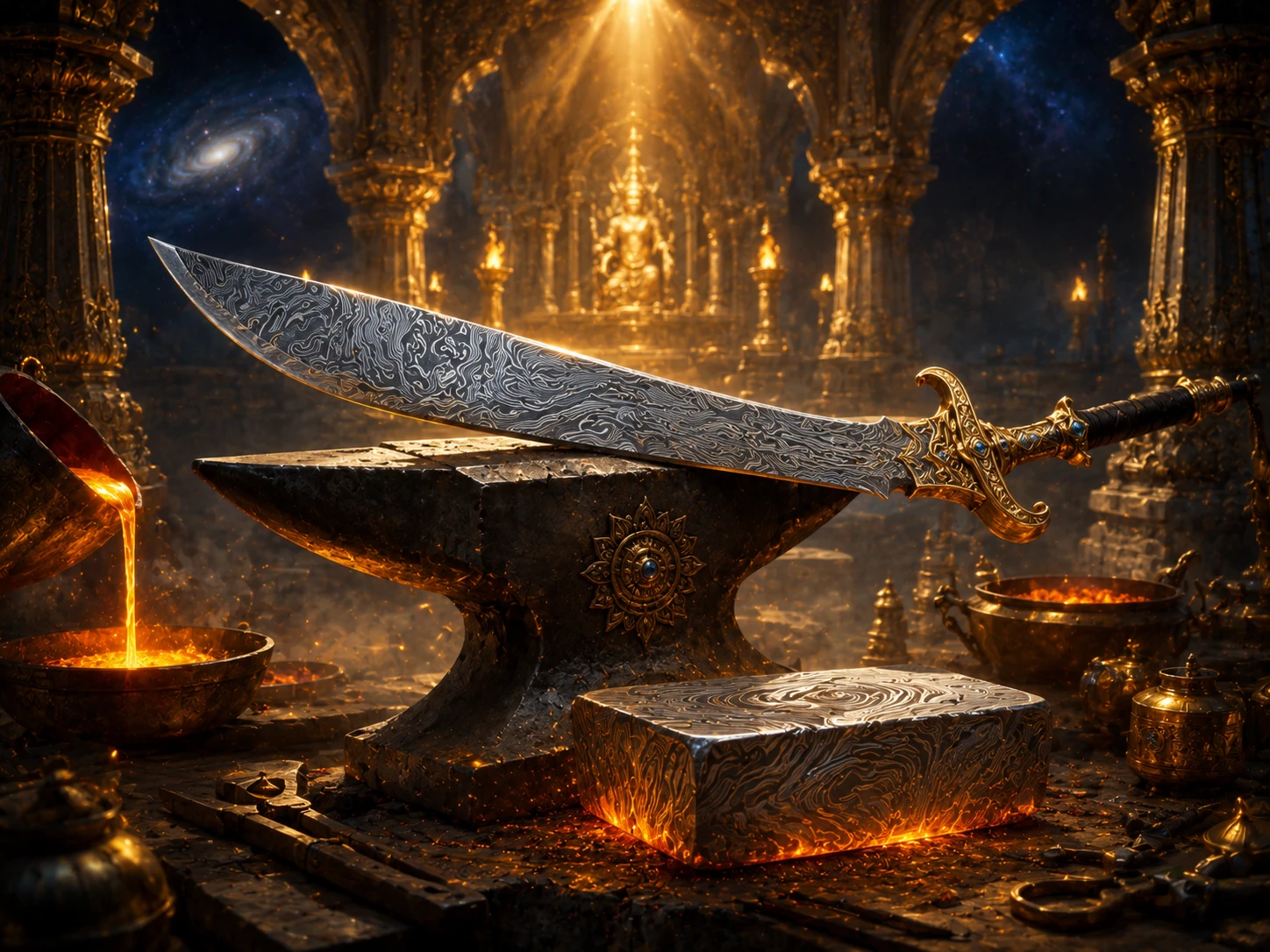
Wootz Steel -- How India Armed the Ancient World
वूट्ज़ इस्पात -- कैसे भारत ने प्राचीन विश्व को सशस्त्र किया
There is a persistent myth in popular history that ancient India was a land of philosophers and poets who had little interest in technology. The metallurgical record demolishes this completely. India invented crucible steel. India perfected high-carbon blade manufacture. India exported the finest sword-making material in the ancient world to every major civilisation from Rome to China. And India produced a wrought iron pillar that has resisted atmospheric corrosion for over 1,600 years using a technique that modern materials scientists are still studying.
The word 'Wootz' is an anglicisation of 'Ukku,' the Kannada and Telugu word for steel. Europeans encountered this material through Arab and Persian intermediaries who forged it into the legendary 'Damascus' blades -- but Damascus was the marketplace, not the manufacturer. The steel itself came from crucibles in what is now Karnataka, Tamil Nadu, Telangana, and Andhra Pradesh. When a Crusader knight faced a Saracen warrior wielding a Damascus sword, the metal in that blade had been smelted in a South Indian village, possibly in the forests near Mysuru or the iron-rich soils of Bellary.
This is not peripheral history. This is a story about India's position at the centre of global technology for two millennia -- a position that was systematically obscured by colonial historiography and is only now being recovered by materials scientists, archaeometallurgists, and historians who have access to both the physical evidence and the textual record.
अयोघनेन महता तप्तं निस्तुदतो मुहुः। मलं लोहस्य यत्किञ्चित् तत्सर्वं निर्गतं बहिः॥
ayoghanena mahataa taptam nistudato muhuh | malam lohasya yatkincit tatsarvam nirgatam bahih ||
Striking repeatedly with a great iron hammer upon the heated metal, whatever impurities existed in the iron were all expelled outward.
— Rasaratnasamuchchaya (13th century CE alchemical text, Chapter on Loha Shodhana)
The Wootz process, as reconstructed by modern archaeometallurgists including Dr. Sharada Srinivasan of the National Institute of Advanced Studies (NIAS) in Bangalore and Dr. S. Jaikishan of the Telangana government's heritage department, worked as follows. Iron ore was smelted with charcoal in small clay crucibles sealed with a mud-and-rice-husk lid. The crucibles were heated in pit furnaces using charcoal fuel and bellows-driven air for several hours at temperatures between 1,200 and 1,500 degrees Celsius. The sealed environment created a reducing atmosphere that allowed carbon from the charcoal to diffuse into the iron at precisely controlled rates -- typically reaching 1.5 to 2.0 percent carbon content, the ideal range for ultra-hard blade steel.
The resulting ingot -- called a 'cake' or 'puck' of Wootz -- weighed approximately 1 to 2 kilograms and displayed a distinctive internal crystalline structure. When this ingot was carefully forged (not cast) into a blade by a skilled smith, the cementite (iron carbide) particles within the steel aligned into bands that produced the famous 'watered' or 'damascened' surface pattern. This pattern was not decorative. It was structural. The alternating bands of hard cementite and softer pearlite created a blade that was simultaneously hard enough to hold a cutting edge and flexible enough to absorb impact without shattering.
The archaeological evidence for Wootz production in South India stretches back to at least the 3rd century BCE. Crucible steel fragments have been excavated at Kodumanal in Tamil Nadu (dated to 300 BCE), Mel-Siruvalur, and Gatihosahalli in Karnataka. The Sangam-era Tamil text Pattinappalai references the export of fine steel. Roman sources, including Pliny the Elder's Natural History (77 CE), mention 'Seric iron' imported from India as the finest ferrous material known to the empire. The Arab geographer Edrisi (12th century) specifically identifies India as the source of the steel used in the finest Damascus blades.
Indian Metallurgical Achievements -- Global Timeline
| Achievement | Date | Location | Significance | Modern Validation |
|---|---|---|---|---|
| Crucible steel (Wootz) production | ~300 BCE or earlier | Kodumanal, Tamil Nadu; Gatihosahalli, Karnataka | First high-carbon steel produced in sealed crucibles anywhere in the world | Dr. Sharada Srinivasan, NIAS Bangalore; excavations confirm crucible fragments |
| Iron Pillar of Delhi | ~402 CE (Gupta period) | Mehrauli, Delhi (originally possibly Udayagiri, MP) | 1,600+ years of corrosion resistance in open air; 7.2 metres, 6 tonnes | IIT Kanpur (Prof. R. Balasubramaniam): phosphorus-rich iron creates protective misawite layer |
| Zinc distillation | ~1st millennium CE | Zawar, Rajasthan | First industrial-scale zinc production; Europe achieved this only in 18th century | Archaeological Survey of India; smelting furnaces excavated at Zawar mines |
| Carbon nanotubes in Wootz | Throughout production period | South India | Wootz steel contains carbon nanotubes and nanowires that give it unique properties | Peter Paufler, TU Dresden (2006); electron microscopy confirmed nanostructures |
| Export to Damascus/Arabia | ~3rd century BCE to 17th century CE | Overland + maritime (Malabar coast) | India was sole global source of crucible steel for ~2,000 years | Al-Kindi (9th century), Edrisi (12th century) cite Indian origin |
| Steel wire drawing | ~1st century CE | South India, later pan-India | Fine steel wire for jewellery and chainmail | Archaeological finds at Arikamedu, Puducherry |
| High-tin bronze mirrors | ~2nd millennium BCE | Indus Valley; later South India | Precise tin-copper alloy control for reflective mirrors | National Museum, New Delhi collection; NIAS analysis |
India maintained global leadership in ferrous metallurgy for approximately 2,000 years (300 BCE to 1700 CE). This dominance was ended not by a superior technology but by colonialism: the East India Company systematically dismantled indigenous steel production to create a captive market for British iron and steel.
The Iron Pillar of Delhi deserves separate treatment because it is the most visible proof of Indian metallurgical achievement, standing in the Qutub Minar complex where millions of tourists see it every year -- often without understanding what they are looking at.
The pillar is 7.21 metres tall, weighs approximately 6 tonnes, and is made of 98 percent wrought iron. It was erected during the Gupta period, around 402 CE, originally as a Dhwaja Stambha (victory pillar) dedicated to Vishnu, probably at Udayagiri in Madhya Pradesh before being moved to Delhi. The Sanskrit inscription on the pillar records the military victories of a king named Chandra, identified by most scholars as Chandragupta II (Vikramaditya).
The extraordinary fact is that the pillar has not rusted in over 1,600 years, despite standing in the open air through Delhi's monsoons, extreme heat, and winter fog. Modern metallurgical analysis -- led by Professor R. Balasubramaniam of IIT Kanpur, whose research on this pillar spans multiple decades -- has identified the reason: the iron contains an unusually high phosphorus content (0.25 percent, compared to 0.05 percent in modern iron). When exposed to atmospheric moisture, this phosphorus reacts to form a thin layer of iron hydrogen phosphate hydrate (a compound called misawite) on the surface. This layer is amorphous, crack-free, and self-healing -- it seals any exposed iron surface and prevents the oxidation chain reaction that produces rust.
The Gupta-era smiths did not know the word 'misawite.' They did not have electron microscopes. But they had empirical knowledge, refined over generations, that told them exactly how to manipulate iron composition to produce corrosion-resistant metal. This is not accidental. This is technology.
In 2006, Peter Paufler and colleagues at the Technical University of Dresden, Germany published a landmark paper in the journal Nature confirming the presence of carbon nanotubes and cementite nanowires in a Damascus steel blade forged from Wootz. Carbon nanotubes were 'discovered' by modern science in 1991 and are considered a breakthrough material for aerospace, electronics, and medicine. Indian smiths were producing them -- unknowingly but consistently -- in their crucible steel process over 2,000 years ago. The nanotubes formed naturally during the slow cooling of the high-carbon Wootz ingot, creating the unique microstructure that gave these blades their legendary edge retention and flexibility.
The decline of Indian steel production is a story of colonialism, not of technological failure. Until the 17th century, India was the world's largest steel producer and exporter. British metallurgist Dr. Benjamin Heyne, writing in 1795, documented Wootz production in Mysore and described the steel as superior to anything produced in Europe at the time. Michael Faraday himself experimented with Wootz steel in the 1820s, trying (and failing) to replicate its properties.
The East India Company's policies systematically destroyed this industry. Heavy taxes were imposed on indigenous iron smelters. Forest access was restricted, cutting off charcoal supply. Indian steel was classified as inferior to British steel in government procurement despite evidence to the contrary. By 1850, the millennia-old Wootz tradition was effectively dead, replaced by imported British iron.
Today, the revival is underway but incomplete. The Indian Institute of Science, Bangalore has conducted extensive archaeometallurgical research. IIT Bombay, IIT Kanpur, and NIAS have published papers on Wootz microstructure. A few traditional smiths in Karnataka and Telangana have been identified who retain fragments of the old knowledge. The Wootz steel revival is now part of India's craft heritage initiatives.
For any engineering student at IIT, NIT, or BITS preparing for their materials science exam, the Wootz story is not just history. It is a case study in how empirical knowledge, iterative process refinement, and generations of skilled craftwork can produce materials that formal science takes centuries to understand. The Indian smith who sealed his crucible with rice-husk mud and controlled his furnace temperature by watching flame colour was doing materials science. He just did not call it that.
Surat in Gujarat and Golconda (Hyderabad) were the twin centres of India's metallurgical export economy for centuries. Surat was the primary port from which Wootz ingots were shipped to Arab, Persian, and East African markets. Golconda, already famous for diamonds, was also a hub for steel and arms manufacture. When Tipu Sultan of Mysore fought the British, his army used swords, rockets, and firearms made from locally produced Wootz steel. Tipu's rockets -- iron-cased Mysorean rockets -- were so effective that the British Army's William Congreve studied captured specimens to develop the Congreve rocket, which was later used at the Battle of Waterloo. India's metallurgy did not just arm India. It armed India's colonisers against their own European rivals.
Sing the Vishwakarma Aarti
Vishwakarma -- the divine architect and smith -- is the patron deity of all craftspeople, including the ironsmiths who made wootz. Honour this tradition by singing the Vishwakarma Aarti, especially on Vishwakarma Puja day. It is on Eternal Raga with its meaning.
Tags
Eternal Raga · शाश्वत राग
Institutional voice — scholarly articles on Sanatan Dharma
Deepen Your Understanding
अपनी समझ और गहरी करें
divine arsenal
The Cosmic Forge -- Vishwakarma, Divine Engineer
Every divine weapon. Every celestial city. Every flying chariot. They all have the same maker. Vishwakarma -- the architect of the gods -- built Lanka for Kubera, Dwarka for Krishna, Indraprastha for the Pandavas, and forged every weapon in the divine arsenal. He is the patron deity of Indian engineers, craftsmen, and factory workers, worshipped annually on Vishwakarma Puja with the tools of modern industry laid at his feet.
divine arsenal
The Sacred Swords -- Chandrahasa, Nandaka, Asi, and the Wootz Steel Legacy
Ravana's Chandrahasa laughed like the crescent moon as it cut. Vishnu's Nandaka separated truth from illusion with a single stroke. And the first sword ever created -- Asi -- was forged by Brahma himself as a living being of fire. These blades shaped mythology, and the steel that made them shaped world history.
divine arsenal
Astra vs Shastra -- The Two Classes of Weapons in Hindu Warfare
One is hurled with mantras and divine invocation. The other is wielded by hand and muscle. Understanding the fundamental difference between Astra and Shastra unlocks the entire weapons philosophy of ancient India.
divine arsenal
Ancient Indian Martial Arts -- Kalaripayattu to Malla-Yuddha
India may have invented the concept of systematic combat training. Kalaripayattu is arguably the oldest martial art on earth. Malla-Yuddha produced wrestlers who fought Alexander's soldiers. Gatka armed the Sikh Khalsa. Silambam inspired Filipino Eskrima. From Parashurama's legendary training grounds in Kerala to Akharas still operating in Varanasi -- Indian martial arts are the unacknowledged root of half the world's fighting systems.
divine arsenal
Rules of War -- Dharmayuddha and the Geneva Conventions
Three thousand years before the Geneva Conventions, Indian warriors debated whether you could strike a man who had dropped his weapon. The Mahabharata's rules of engagement cover night fighting bans, non-combatant immunity, treatment of prisoners, proportional force, and the use of weapons of mass destruction -- and then shows what happens when every single rule is broken.
vedic sciences
Ancient Indian Metallurgy -- The Iron Pillar That Refuses to Rust
A 7-metre iron pillar has stood in open Delhi air for 1,600 years without rusting. Wootz steel from Tamil Nadu became the legendary Damascus blade. From Vedic kṛṣṇāyas to Vagbhata's bell-metal recipe -- the textual and material evidence of how Bharat worked metal.
In 2006, Peter Paufler and colleagues at the Technical University of Dresden, Germany published a landmark paper in the journal Nature confirming the presence of carbon nanotubes and cementite nanowires in a Damascus ste…
More in Divine Arsenal
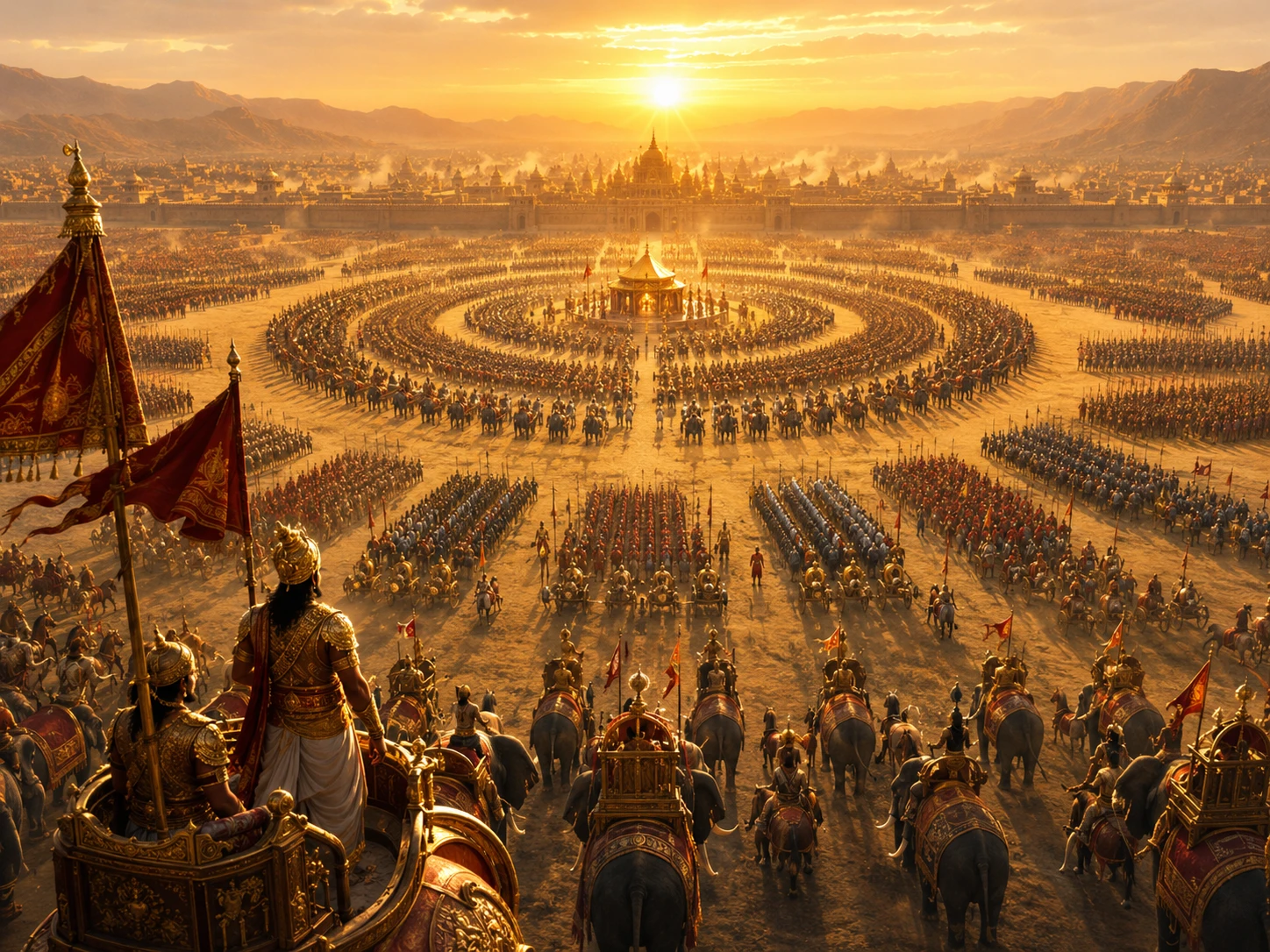
Akshauhini -- The Epic Army Structure Where Every Digit Sums to 18
14 min read
Ancient Indian Martial Arts -- Kalaripayattu to Malla-Yuddha
14 min read
Astra Invocation and Withdrawal -- The Ritual of Weapons
16 min readThe same translation error that turned '33 Koti' into '33 crore' in Hinduism also happened in Buddhism. The Chinese translation of Buddhist texts rendered 'Sapta Koti Buddha' (7 Supreme Buddhas) as '7 Crore Buddhas.' The…
Deities AvatarsCommunity Reflections
🕉️
Be the first to share your reflection.