Adi Shankaracharya -- The Teacher of Advaita
आदि शंकराचार्य -- अद्वैत के आचार्य
Shankara was born in Kalady, a village on the Periyar river in Kerala, to a brahmin family; most historians place his life in the eighth century CE, though some monastic traditions give much earlier dates. His father died when he was young. The boy learnt the Vedas with astonishing speed and longed to become a sannyasi, but his mother would not allow it. The story goes that one day, while he was bathing in the river, a crocodile seized his leg; he called to his mother that he would die unless she let him take sannyasa, and she agreed -- and the crocodile let go. He promised her that he would come back to be with her at her death, and tradition says he did.
He went north in search of a teacher, and found him on the bank of the Narmada at Omkareshwar: Govinda Bhagavatpada, a disciple of Gaudapada, the author of the earliest surviving systematic work of Advaita, the Mandukya Karika. Under Govinda he was initiated and studied, and then, the biographies say, was sent to Varanasi to teach.
मनोबुद्ध्यहङ्कारचित्तानि नाहं न च श्रोत्रजिह्वे न च घ्राणनेत्रे। न च व्योमभूमिर्न तेजो न वायुः चिदानन्दरूपः शिवोऽहम् शिवोऽहम् ॥
manobuddhyahaṅkāracittāni nāhaṃ na ca śrotrajihve na ca ghrāṇanetre| na ca vyomabhūmirna tejo na vāyuḥ cidānandarūpaḥ śivo'ham śivo'ham ||
I am not mind, intellect, ego or memory; not the ears or tongue, nor the nose or eyes; not space, nor earth, nor fire, nor air. I am consciousness and bliss -- I am Shiva, I am Shiva.
— Nirvana Shatakam (attributed to Adi Shankaracharya), verse 1
What he taught is Advaita, "non-duality". Brahman, the one reality, is pure existence, consciousness and bliss; the individual self, the Atman, is not other than Brahman; and the world of many separate things is not a second reality alongside it but an appearance, real for practical purposes yet not ultimately so -- like the snake seen in a rope in dim light. The cause of bondage is ignorance, avidya, which superimposes the limitations of body and mind on the Self. Liberation is not something produced by action or reached somewhere else; it is the removal of that ignorance through knowledge, gained by hearing the teaching of the Upanishads, reflecting on it and contemplating it.
Shankara set this out above all in his commentaries: on the Brahma Sutras, on the principal Upanishads and on the Bhagavad Gita -- the prasthana-traya. His commentary on the Brahma Sutras, with its famous introduction on superimposition, is one of the masterpieces of Indian philosophy. Many independent treatises, such as the Upadeshasahasri, and many hymns are attributed to him, though scholars debate which of these are his own.
The Four Mathas Attributed to Shankara
| Direction | Matha | Place | Veda in its charge |
|---|---|---|---|
| South | Sringeri Sharada Peetham | Sringeri, Karnataka | Yajurveda |
| West | Dwaraka Sharada Peetham | Dwarka, Gujarat | Samaveda |
| East | Govardhana Matha | Puri, Odisha | Rigveda |
| North | Jyotir Matha | Jyotirmath (Joshimath), Uttarakhand | Atharvaveda |
Tradition holds that Shankara placed one of his principal disciples at the head of each. The Kanchi Kamakoti Peetham in Tamil Nadu also traces itself to Shankara. The heads of these mathas carry the title Shankaracharya to this day.
The traditional biographies, the Shankara Digvijayas, describe his life as a journey of debate across India. The most famous is his debate with Mandana Mishra, a great scholar of ritual, judged by Mandana's learned wife Ubhaya Bharati; Mandana lost, became Shankara's disciple and is remembered as Sureshvara. Shankara organised the monks of his tradition into ten orders, the Dashanami Sampradaya, whose names -- Giri, Puri, Bharati, Sarasvati and others -- sannyasis still take. By tradition he died at the age of thirty-two at Kedarnath, where a memorial stands behind the temple.
His influence is hard to overstate. Advaita became the most widely known school of Indian philosophy, and in modern times, through Swami Vivekananda, Ramana Maharshi and others, it became much of what the world knows of Hindu thought. Yet Shankara was not only a philosopher. The hymns associated with him -- the Bhaja Govindam, the Nirvana Shatakam, the Kanakadhara Stotram, hymns to Shiva, Vishnu and the Goddess -- are still sung everywhere, and show a teacher for whom non-dual knowledge and heartfelt devotion were not opposed.
भज गोविन्दं भज गोविन्दं गोविन्दं भज मूढमते। सम्प्राप्ते सन्निहिते काले नहि नहि रक्षति डुकृञ्करणे ॥
bhaja govindaṃ bhaja govindaṃ govindaṃ bhaja mūḍhamate| samprāpte sannihite kāle nahi nahi rakṣati ḍukṛñkaraṇe ||
Worship Govinda, worship Govinda, worship Govinda, O foolish mind! When the appointed time of death arrives, the rules of grammar will not save you.
— Bhaja Govindam (attributed to Adi Shankaracharya), verse 1
The Bhaja Govindam has a story attached to it. In Varanasi, the tradition says, Shankara saw an old scholar repeating rules of Sanskrit grammar, and was moved to compose the hymn on the spot: of what use is grammar when death comes? Its refrain, bhaja govindam, became one of the best-loved lines in Hindu devotion.
Recite the Bhaja Govindam
The hymn attributed to Shankara on what truly matters before death, verse by verse with meaning.
Tags
Eternal Raga · शाश्वत राग
Institutional voice — scholarly articles on Sanatan Dharma
Deepen Your Understanding
अपनी समझ और गहरी करें
philosophy darshana
Advaita Vedanta Explained -- Shankara's Radical Philosophy of Non-Duality
You are not your job title. You are not your Instagram bio. According to Adi Shankaracharya, you are not even your body or mind -- you are Brahman itself, the infinite consciousness wearing a temporary costume. Advaita Vedanta is the most radical philosophical claim in Indian history: that the entire universe is one undivided reality, and separation is the grandest illusion.
philosophy darshana
Adhyasa -- Superimposition and the Foundational Error of the Self
Why does a rope look like a snake in a half-lit room? And why does the eternal Self look like a busy, mortal, anxious individual to itself? Shankaracharya answers both questions with one word: adhyasa, superimposition. Out of this single concept, all of Advaita Vedanta unfolds.
philosophy darshana
The Brahma Sutras -- The Short Book Every School of Vedanta Had to Explain
Some five hundred and fifty terse sentences that set out to organise the teaching of the Upanishads -- so terse that they cannot be read without a commentary, and every great teacher of Vedanta wrote one. What the Brahma Sutras are, how they are arranged, and why their first sutra is famous.
philosophy darshana
The Four Mahavakyas -- Upanishadic Sentences That Changed Civilisation
Four sentences. Twelve words of Sanskrit. Three thousand years of commentary. The Mahavakyas are the most compressed, most powerful, and most debated statements in all of Indian philosophy. Each one claims that the individual self and the ultimate reality of the universe are not two different things. And each one has been interpreted to mean something completely different by every major school of Vedanta.
deities avatars
Dakshinamurti -- The Silent Teacher Who Taught the Universe Through Silence
Under a banyan tree sits a young guru, surrounded by old disciples. He says nothing. They understand everything. This is Dakshinamurti -- Shiva as the original teacher -- and his image is the most profound statement on education in any civilisation: the highest knowledge cannot be spoken. It can only be transmitted through presence.
philosophy darshana
Dvaita vs Advaita -- The Greatest Debate in Hindu Philosophy
Are you and God the same being, temporarily confused? Or are you and God eternally different, connected by love but never identical? This question split Hindu philosophy into rival schools, produced centuries of razor-sharp debate, and still determines whether you pray saying 'I am Brahman' or 'I am Brahman's servant'. The answer depends on which genius you believe -- Shankaracharya or Madhvacharya.
The Bhaja Govindam has a story attached to it. In Varanasi, the tradition says, Shankara saw an old scholar repeating rules of Sanskrit grammar, and was moved to compose the hymn on the spot: of what use is grammar when …
More in Philosophy & Darshana
The 14 Lokas -- Hindu Cosmology as a Map of Consciousness
14 min read
Achintya Bhedabheda -- Chaitanya's Theology of Inconceivable Difference-and-Unity
13 min read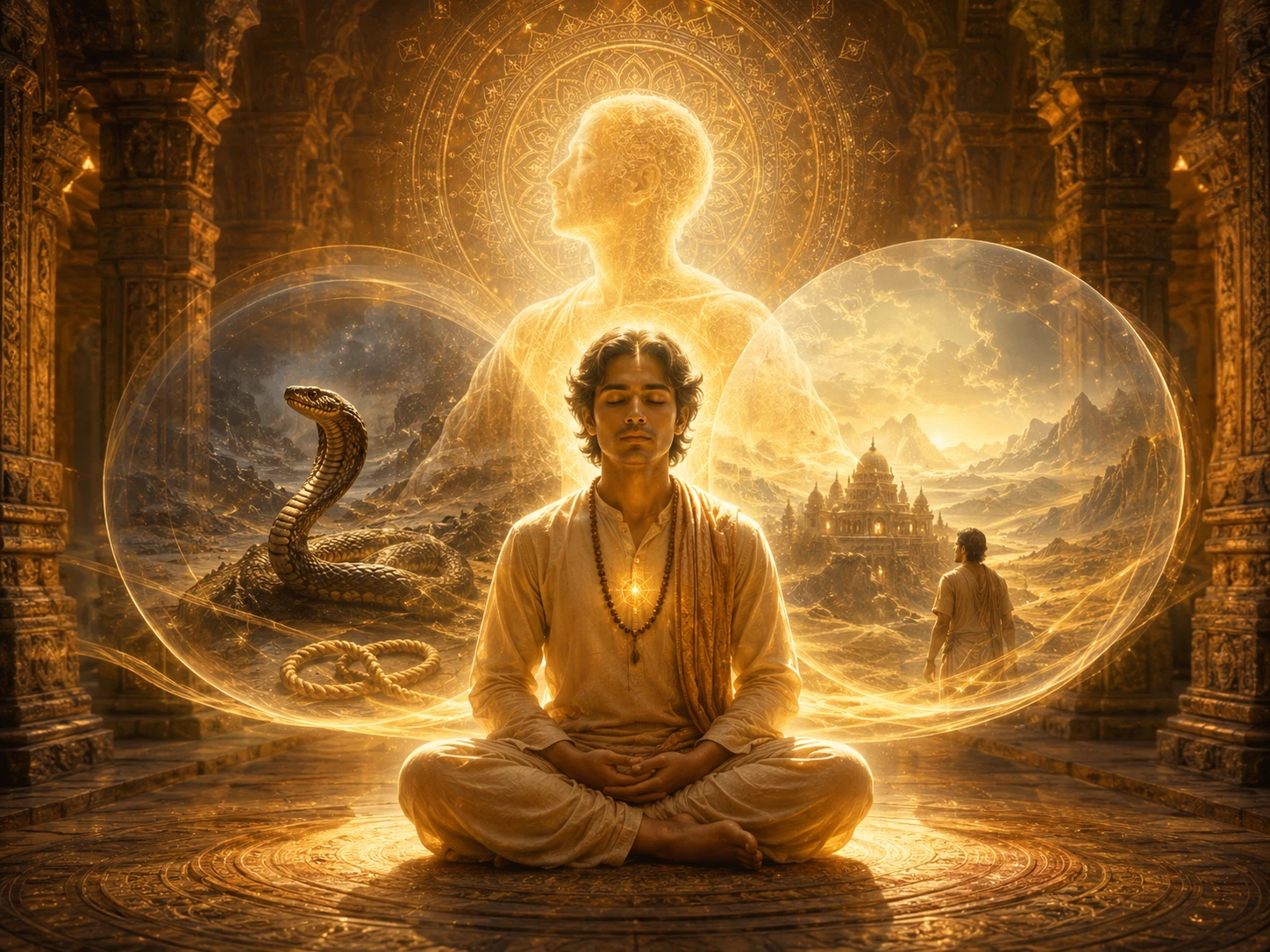
Adhyasa -- Superimposition and the Foundational Error of the Self
13 min readThe same translation error that turned '33 Koti' into '33 crore' in Hinduism also happened in Buddhism. The Chinese translation of Buddhist texts rendered 'Sapta Koti Buddha' (7 Supreme Buddhas) as '7 Crore Buddhas.' The…
Deities AvatarsCommunity Reflections
🕉️
Be the first to share your reflection.