
Gaura Purnima -- The Full Moon That Gave Bengal Its Golden Saint
गौर पूर्णिमा -- वह पूर्णिमा जिसने बंगाल को उसका स्वर्णिम संत दिया
Gaura Purnima falls on the full moon of Phalguna, the same tithi on which most of India begins Holi, and in 2026 that date is 3 March. The name means the full moon of the Golden One, Gaura being one of Chaitanya Mahaprabhu's own names, given for his unusually fair complexion in a region where it was noticed. Unlike a number of festivals on Eternal Raga's calendar, this one commemorates a documented historical person rather than a purely mythic event: Chaitanya Mahaprabhu (1486-1534 CE) was born at Navadvip in Bengal, in a locality now called Mayapur, to the Brahmin scholar Jagannath Mishra and his wife Sachi Devi. The Chaitanya-caritamrta, the sixteenth-century biography most Gaudiya Vaishnavas treat as authoritative, records that a lunar eclipse coincided with his birth, and that the town's residents, already gathered in the streets chanting Hari's name as was customary during eclipses, unknowingly welcomed the infant into the world to that same chant.
This article covers Chaitanya's life, the movement he founded, and the festival built around his birthday. It treats the Gaudiya Vaishnava theological claims about his nature honestly and precisely, as claims specific to that lineage and its descendants, including ISKCON, rather than as beliefs shared uniformly across Krishna devotion or Hinduism generally.
हरे कृष्ण हरे कृष्ण कृष्ण कृष्ण हरे हरे। हरे राम हरे राम राम राम हरे हरे॥
hare kṛṣṇa hare kṛṣṇa kṛṣṇa kṛṣṇa hare hare | hare rāma hare rāma rāma rāma hare hare ||
A direct address to Krishna and Rama through their names, calling on Hari, without a literal word-for-word translation, since the mantra is understood as an invocation rather than a statement.
— The Hare Krishna maha-mantra, traced to the Kali-Santarana Upanishad and popularised across Bengal and later the world by Chaitanya Mahaprabhu's sankirtan movement
From Nimai the Scholar to Chaitanya the Sankirtan Saint
As a boy, Chaitanya was called Nimai, after the neem tree outside his family's house, and he grew into a widely respected Sanskrit scholar and logician at Navadvip, a town then known across Bengal as a centre of learning. The turning point in his life, by his tradition's own account, came at around age twenty-two, when he travelled to Gaya to perform funeral rites for his father and underwent an intense devotional experience there. He returned to Navadvip changed, no longer principally a scholar but a bhakta consumed by love for Krishna, and he began the sankirtan movement: public, congregational chanting of Krishna's names, conducted in processions through the streets, open to anyone regardless of caste, and deliberately without the ritual gatekeeping that governed most temple worship of the period. He is recorded as dancing, weeping, and losing ordinary bodily awareness during these kirtans, a devotional style Gaudiya Vaishnavism treats as itself a teaching rather than an excess.
Chaitanya's historical importance to Bengal's religious life is not contested by scholars: he is credited with reviving and popularising bhakti devotion to Krishna across the region on a scale that reshaped its religious culture, and his direct disciples, particularly the six Goswamis of Vrindavan, systematised his teaching into the theological framework known as achintya bhedabheda, an inconceivable simultaneous oneness and difference between the soul and God. What is a specifically theological claim, not a historical one, is the belief his own tradition holds about who he was: that Chaitanya is not merely a saint or reformer but a combined avatar of Radha and Krishna appearing in one golden body, God experiencing his own devotion from the devotee's side. Eternal Raga's Radhashtami article notes this same claim in passing while covering Radha's theological standing; this article states it directly and precisely, as Gaudiya Vaishnavism's own position rather than a pan-Hindu one.
Chaitanya Mahaprabhu -- Historical Fact vs Gaudiya Theology
| Claim | Status |
|---|---|
| Born at Navadvip in 1486 CE to Jagannath Mishra and Sachi Devi | Historical, accepted by scholars of Bengal's religious history |
| Founded the sankirtan movement of congregational chanting | Historical, documented across contemporary and near-contemporary sources |
| Reshaped Bengal's bhakti culture and founded Gaudiya Vaishnavism | Historical, widely accepted by historians of Indian religion |
| Is a combined avatar of Radha and Krishna in one body | Theological, specific to Gaudiya Vaishnavism and its descendant traditions, including ISKCON |
The first three rows are matters of historical record. The fourth is a devotional truth claim held within a specific lineage; a reader can accept the history of Chaitanya's life without adopting the theology built on top of it, and Gaudiya Vaishnavas themselves would say the two are meant to be held together, not that the history alone proves the theology.
The precise site of Chaitanya's birth was identified as Mayapur, a specific locality within the greater Navadvip area, only in the nineteenth century, through textual and geographical research by the Gaudiya theologian Bhaktivinoda Thakura (1838-1914). His son, Bhaktisiddhanta Sarasvati Thakura, expanded the site into a major institutional centre, and A.C. Bhaktivedanta Swami Prabhupada, a disciple in that same lineage, founded ISKCON in New York in 1966 before returning to inaugurate its world headquarters at Mayapur on Gaura Purnima in 1972. Mayapur today draws Gaudiya pilgrims from over a hundred countries for Gaura Purnima week, and its Temple of the Vedic Planetarium, still under construction, is designed with a central dome intended to exceed the diameter of St. Peter's Basilica in Rome. Some other Gaudiya institutions place Chaitanya's exact birthsite slightly differently within the wider Navadvip complex, a minor and openly acknowledged disagreement within the tradition rather than a settled fact.
One Night, Two Festivals
Because Gaura Purnima and Holi share the same tithi, the two festivals visibly overlap without being the same event, and Eternal Raga's Holi and Holika Dahan article covers Holi's own separate origin story in full. In Gaudiya Vaishnava households and at ISKCON temples worldwide, the day typically opens with Mangala Aarti before dawn, moves through a full day of kirtan and readings from the Chaitanya-caritamrta, and often includes a fast kept until moonrise, when the birth itself is marked with an abhishekam of Chaitanya's deity form and a burst of colour play that folds Holi directly into the evening's kirtan. At Mayapur and Nabadwip specifically, the week is treated as the single largest pilgrimage occasion of the Gaudiya calendar, drawing far larger crowds than Janmashtami does at those same sites.
Outside Gaudiya Vaishnava and ISKCON communities, Chaitanya is widely respected across Bengal as a historical and cultural figure, a reformer who opened bhakti to castes and communities the era's temple establishment had kept at a distance, but he is not typically framed in those wider circles with the same avatar theology his own tradition holds. Both the historical Chaitanya of Bengal's cultural memory and the theological Chaitanya of Gaudiya Vaishnavism are real to the communities that hold them; this article's aim has been to describe each honestly rather than collapse one into the other.
Chant the Maha-Mantra on Gaura Purnima
Chant the Hare Krishna maha-mantra on a mala on Gaura Purnima. The Gaudiya tradition holds this chant, more than any single ritual, to be Chaitanya Mahaprabhu's own gift, and reciting it on his birthday the most direct way to mark the day. Its page on Eternal Raga gives the meaning and how to chant it.
Tags
Eternal Raga · शाश्वत राग
Institutional voice — scholarly articles on Sanatan Dharma
Deepen Your Understanding
अपनी समझ और गहरी करें
deities avatars
Radha -- Krishna's Eternal Beloved and the Supreme Devotee Who Became Greater Than God
She is not mentioned by name in the Bhagavata Purana. She has no temple at the centre of Vrindavan. She did not marry Krishna. And yet -- in the devotional traditions of North India, in the poetry of Jayadeva, in the philosophy of Chaitanya, and in the hearts of millions who chant 'Radhe Radhe' -- she is considered superior to Krishna himself. That is the paradox and the power of Radha.
deities avatars
Krishna Leela -- Why God Chose to Play
He stole butter, broke pots, lied to his mother's face, danced with married women under the full moon, and lifted an entire mountain on his little finger. The Bhagavata Purana's Tenth Skandha -- the most popular 4,000 verses in all of Hindu literature -- is not a biography. It is a theological argument that the Supreme Being's highest expression is not creation, destruction, or cosmic governance. It is play. Krishna Leela is the radical idea that God's truest nature is joy.
rituals traditions
Janmashtami -- Birth of Krishna
A midnight birth in a locked prison. A father walking through a flooding river with a newborn on his head. The most celebrated birthday in Hindu civilisation is not about cake and candles -- it is about dharma arriving exactly when the world needs it most. Janmashtami is the night India stays awake.
rituals traditions
Holi and Holika Dahan -- The Night a Child's Faith Burned an Empire
Before the colours fly, the fire burns. The night before Holi, India lights bonfires to commemorate the moment a five-year-old boy named Prahlad sat in flames and survived because he chanted Vishnu's name -- while the demoness Holika, who was supposed to be fire-proof, burned to ash. The story comes from the Bhagavata Purana, Seventh Canto, and it is one of Hinduism's most powerful narratives about the cost of faith and the fragility of power.
rituals traditions
Radhashtami -- Fifteen Days After Janmashtami, and a Different Kind of Birthday
Fifteen days after Krishna's midnight birth in a prison cell, Hindu tradition marks a second birth, quieter in most calendars but treated by an entire theological school as the more consequential of the two. Radhashtami honours Radha's appearance in Barsana on the eighth day of Bhadrapada's bright fortnight. In Gaudiya Vaishnavism specifically, and it is worth stressing that this is one lineage's framing rather than a pan-Hindu consensus, she is worshipped as Krishna's supreme devotee, the one without whom his own divinity is considered incomplete.
The precise site of Chaitanya's birth was identified as Mayapur, a specific locality within the greater Navadvip area, only in the nineteenth century, through textual and geographical research by the Gaudiya theologian B…
More in Rituals & Traditions
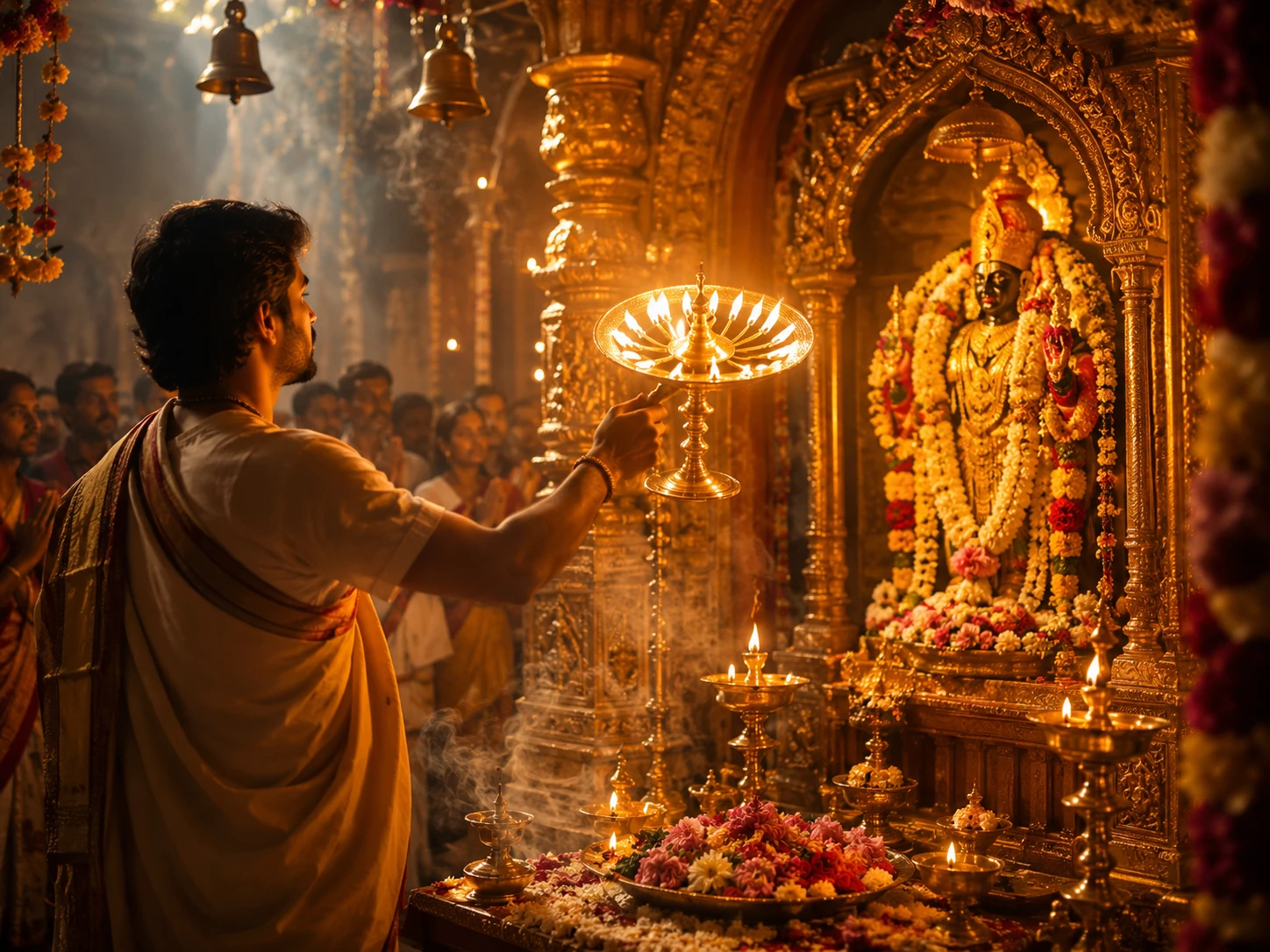
Aarti -- Why Hindus Circle Light Before God
13 min read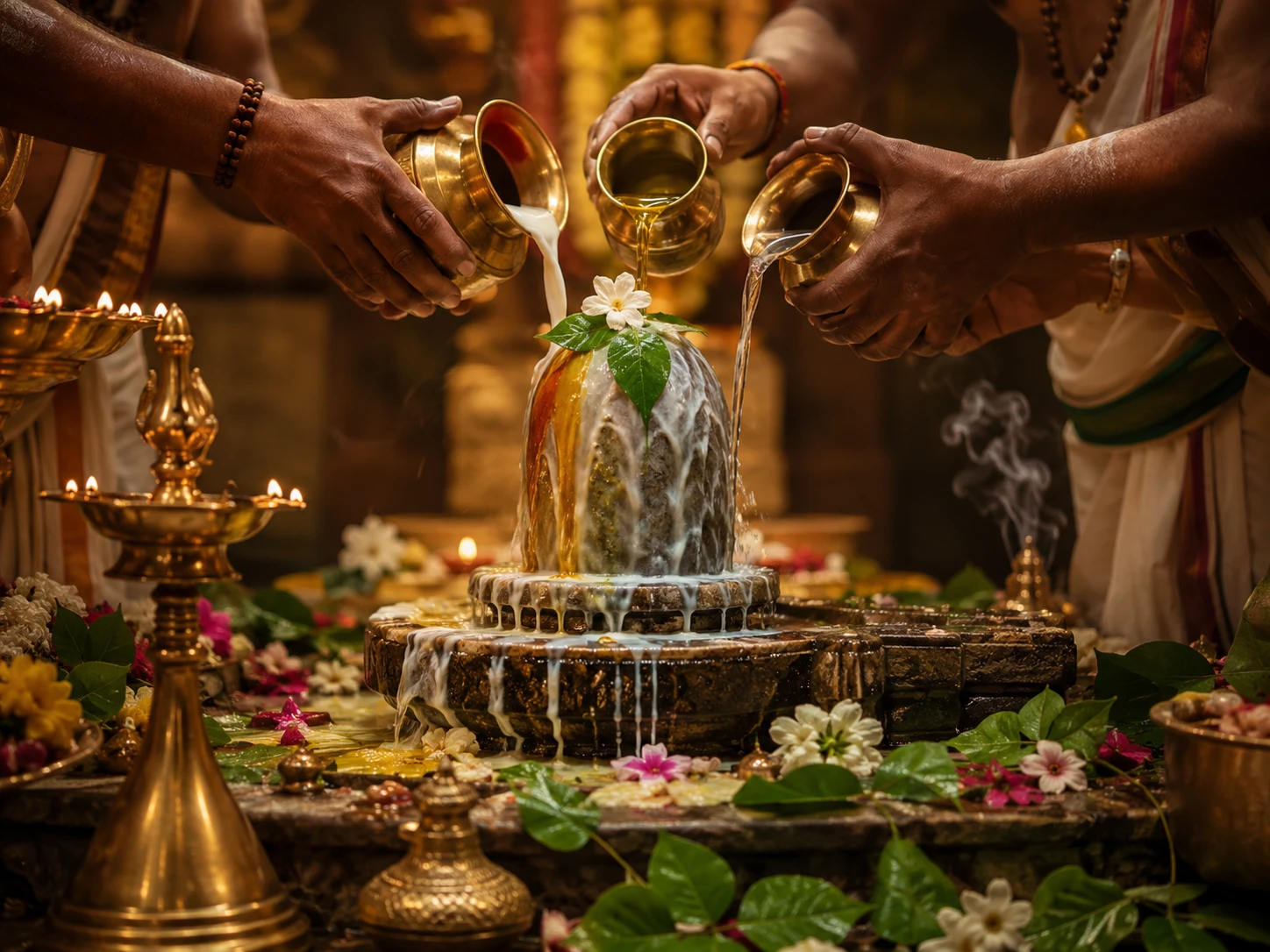
Abhisheka -- Why Hindus Bathe Their Gods
10 min read
Akshaya Tritiya -- The Day Nothing Given Away Runs Out
12 min readThe same translation error that turned '33 Koti' into '33 crore' in Hinduism also happened in Buddhism. The Chinese translation of Buddhist texts rendered 'Sapta Koti Buddha' (7 Supreme Buddhas) as '7 Crore Buddhas.' The…
Deities AvatarsCommunity Reflections
🕉️
Be the first to share your reflection.