
Radhashtami -- Fifteen Days After Janmashtami, and a Different Kind of Birthday
राधाष्टमी -- जन्माष्टमी के पंद्रह दिन बाद, एक भिन्न प्रकार का जन्मदिन
Krishna's birthday, Janmashtami, falls on the eighth day of Bhadrapada's dark fortnight, usually in August. Exactly fifteen days later, on the eighth day of the same month's bright fortnight, comes Radhashtami, the day tradition marks as Radha's appearance on earth. In 2026 the Ashtami tithi runs through the afternoon of 19 September, and most panchang traditions place the observance on that date.
The birth narrative, drawn mainly from the Brahma Vaivarta Purana and later Vaishnava hagiographies rather than from the Bhagavata Purana (which, as Eternal Raga's article on Radha covers in full, never names her at all), places her birth in Barsana, a town roughly 50 kilometres from Mathura, as the daughter of Vrishabhanu, a local chieftain, and his wife Kirtida. Some versions of the story hold that the infant kept her eyes closed for eleven days until Krishna's father Nanda brought the infant Krishna to see her, and that she opened her eyes only on seeing him, a detail devotees read as an early sign of a bond the tradition treats as older than either of their births. Whatever the age of this specific detail, the town has held onto the identification completely: Barsana is called Radha's birthplace (janmasthan) by devotees today with the same confidence Mathura is called Krishna's, and its skyline is dominated by the temple built around that claim.
This article covers the festival built around that day, its dominant observances, and its place within Krishna devotion. It does not re-narrate Radha's full theological biography, her absence from and later identification in the Bhagavata's Rasa Lila chapters, her place in the Gita Govinda, or the philosophical debates within Vaishnava schools about her nature; that ground is covered on Eternal Raga's dedicated Radha page, linked below.
तप्तकाञ्चनगौराङ्गि राधे वृन्दावनेश्वरि। वृषभानुसुते देवि प्रणमामि हरिप्रिये॥
tapta-kāñcana-gaurāṅgi rādhe vṛndāvaneśvari | vṛṣabhānu-sute devi praṇamāmi hari-priye ||
O Radha, fair-limbed as molten gold, queen of Vrindavan, daughter of Vrishabhanu, beloved of Hari, I bow to you.
— Radha Pranama Mantra, a widely recited invocation in Gaudiya Vaishnava and Pushtimarg worship, chanted on entering Vrindavan and at the start of Radhashtami puja
Barsana -- The Town Built Around Her
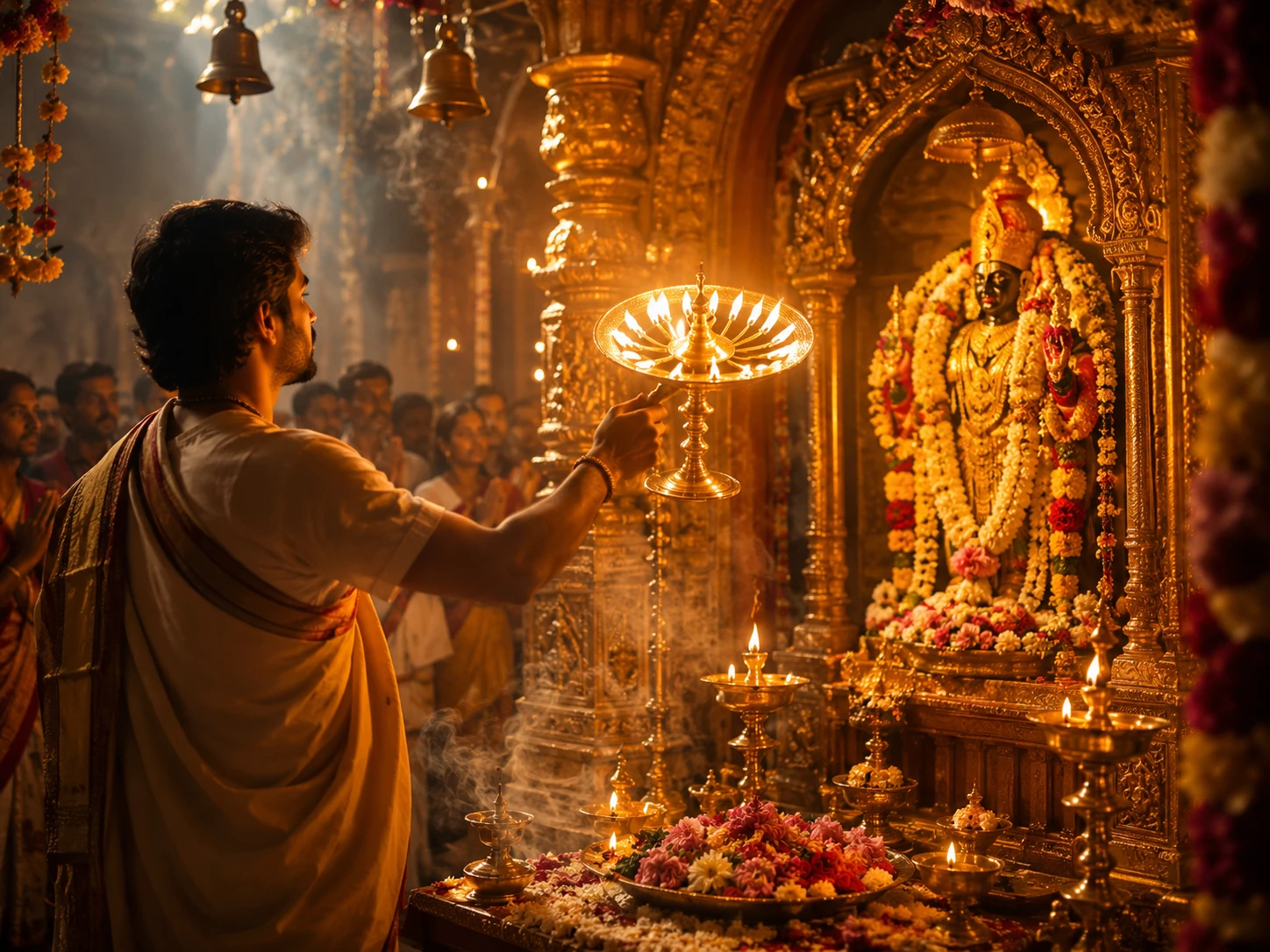
Barsana today is smaller and quieter than Mathura or Vrindavan, but on Radhashtami it becomes the centre of the entire Braj region's devotional calendar. The town's principal shrine, the Shri Ladli Ji (or Ladli Lal) Temple, sits atop a hill and is one of very few major temples in North India dedicated to Radha with Krishna in a secondary role rather than the reverse, a detail Eternal Raga's Radha article covers as part of the wider pattern of her being named first in Vaishnava address (Radhe-Krishna, not Krishna-Radhe) despite her more limited independent temple presence elsewhere in India. On Radhashtami, the temple performs an elaborate abhishekam (ritual bathing of the deity, typically with milk, curd, honey, and water) before dawn, followed by an alankara, the dressing and ornamentation of the idol, and a day of continuous darshan, kirtan, and, toward evening, a public celebration that draws pilgrims from across the Braj region and increasingly from ISKCON and Pushtimarg communities worldwide.
Barsana is also, at a different point in the calendar, the town behind Lathmar Holi, the boisterous Holi tradition in which women from Barsana ceremonially beat men from neighbouring Nandgaon (Krishna's traditional village) with sticks, re-enacting a playful episode of young Krishna teasing Radha and her friends. Eternal Raga's article on Holi and Holika Dahan covers that festival's origin and choreography in full; the connection worth noting here is only that Barsana's identity as Radha's town produces two very different annual expressions of the same devotion, one a springtime festival of mock combat and colour, the other an autumn festival of birth and stillness before the deity.
Households outside Braj that observe Radhashtami without access to a Radha-centred temple typically keep the day simpler: a Krishna or Radha-Krishna shrine at home is cleaned and decorated, a vrat (fast) is kept until the midday puja, and the Radha Ashtakam or similar devotional hymns are recited through the day.
Radhashtami Fasting -- Two Levels of Observance
| Level | स्तर | What Is Permitted | Who Typically Observes It |
|---|---|---|---|
| Nirjala (waterless) | निर्जला | Nothing, not even water, until the midday puja concludes | Elder devotees and some ISKCON and Gaudiya renunciate communities |
| Phalahar (fruit-based) | फलाहार | Fruit, milk, nuts, and water through the day, grains avoided | Most householders observing the vrat |
| Simplified household observance | सरल गृहस्थ पालन | A normal diet with a temple visit, puja, and kirtan, no formal fast | Families for whom a full-day fast is impractical, particularly outside Braj |
There is no single mandated form. Even within Gaudiya Vaishnavism, different acharyas have prescribed different lengths of fast; ISKCON's founder Srila Prabhupada is recorded as having introduced a half-day fast broken after the midday puja, in contrast to stricter full nirjala observances kept by some of his own predecessors.
In most Vaishnava address and iconography, Radha's name is placed before Krishna's, as in Radhe-Krishna or Radha-Krishna, and ISKCON's central deities worldwide are formally named in that order. Yet the Bhagavata Purana, the single most authoritative text on Krishna's life for most Hindu traditions, never names her, identifying his most beloved companion in the Vrindavan Raas Lila only as an unnamed gopi. This gap between her devotional primacy and her textual absence is the specific reason Gaudiya Vaishnavism developed such an elaborate independent theology around her, most influentially through the sixteenth-century philosopher-saint Chaitanya Mahaprabhu, whom his own tradition holds to be a combined incarnation of Radha and Krishna in one body. Readers should treat this framing, covered in full on Eternal Raga's Radha page, as specific to Gaudiya and closely related Vaishnava schools rather than as a claim shared uniformly across every Krishna-worshipping community in India.
One Devotion, Framed Two Different Ways
It is worth being direct about something the festival itself does not always make explicit: the theological weight placed on Radhashtami varies sharply by tradition. In Gaudiya Vaishnavism, the school founded on Chaitanya Mahaprabhu's teaching and carried into the modern world largely through ISKCON, Radha is not simply Krishna's consort but the personification of his own hladini shakti, his internal pleasure-giving energy, without which the tradition holds that his own experience of divine love would have no object and no completion. Some Gaudiya and Pushtimarg teachers go further and describe her as, in a specific devotional sense, superior to Krishna, since it is her love that draws out and completes his. This is a serious, textually developed theological position within these lineages, not folk exaggeration, and Radhashtami is one of its clearest calendrical expressions.
Outside these specific schools, Krishna devotion across most of India treats Radha with deep affection and frequent invocation but does not carry the same formal doctrine of her supremacy; in many Vaishnava and general Hindu households, Radhashtami is observed warmly, alongside Janmashtami, without the day being framed as a rival or superior celebration to Krishna's own birthday. Both framings are genuinely held by real, large communities of devotees. Neither is more authentically Hindu than the other, and this article's job has been to describe what each says about the day, not to adjudicate between them.
Recite the Radha Ashtakam This Radhashtami
The Radha Ashtakam is on Eternal Raga with its meaning. If you are observing a vrat, begin the recitation before the midday puja and keep it up until you complete your parana.
Tags
Eternal Raga · शाश्वत राग
Institutional voice — scholarly articles on Sanatan Dharma
Deepen Your Understanding
अपनी समझ और गहरी करें
deities avatars
Radha -- Krishna's Eternal Beloved and the Supreme Devotee Who Became Greater Than God
She is not mentioned by name in the Bhagavata Purana. She has no temple at the centre of Vrindavan. She did not marry Krishna. And yet -- in the devotional traditions of North India, in the poetry of Jayadeva, in the philosophy of Chaitanya, and in the hearts of millions who chant 'Radhe Radhe' -- she is considered superior to Krishna himself. That is the paradox and the power of Radha.
rituals traditions
Janmashtami -- Birth of Krishna
A midnight birth in a locked prison. A father walking through a flooding river with a newborn on his head. The most celebrated birthday in Hindu civilisation is not about cake and candles -- it is about dharma arriving exactly when the world needs it most. Janmashtami is the night India stays awake.
deities avatars
Krishna Leela -- Why God Chose to Play
He stole butter, broke pots, lied to his mother's face, danced with married women under the full moon, and lifted an entire mountain on his little finger. The Bhagavata Purana's Tenth Skandha -- the most popular 4,000 verses in all of Hindu literature -- is not a biography. It is a theological argument that the Supreme Being's highest expression is not creation, destruction, or cosmic governance. It is play. Krishna Leela is the radical idea that God's truest nature is joy.
rituals traditions
Holi and Holika Dahan -- The Night a Child's Faith Burned an Empire
Before the colours fly, the fire burns. The night before Holi, India lights bonfires to commemorate the moment a five-year-old boy named Prahlad sat in flames and survived because he chanted Vishnu's name -- while the demoness Holika, who was supposed to be fire-proof, burned to ash. The story comes from the Bhagavata Purana, Seventh Canto, and it is one of Hinduism's most powerful narratives about the cost of faith and the fragility of power.
rituals traditions
Vrata -- What a Hindu Vow Really Means (It Is Not Just Fasting)
Your mother kept Karva Chauth without water for sixteen hours. Your grandmother observed Ekadashi every fortnight without fail. Your colleague skips lunch on Tuesdays 'for Hanuman.' The world sees Hindu fasting as dietary restriction. The tradition sees it as something far more radical: Vrata is a voluntary, time-bound act of self-imposed discipline that rewires the relationship between desire and willpower. Fasting is the most visible expression. But the real Vrata happens inside.
In most Vaishnava address and iconography, Radha's name is placed before Krishna's, as in Radhe-Krishna or Radha-Krishna, and ISKCON's central deities worldwide are formally named in that order. Yet the Bhagavata Purana,…
More in Rituals & Traditions
Aarti -- Why Hindus Circle Light Before God
13 min read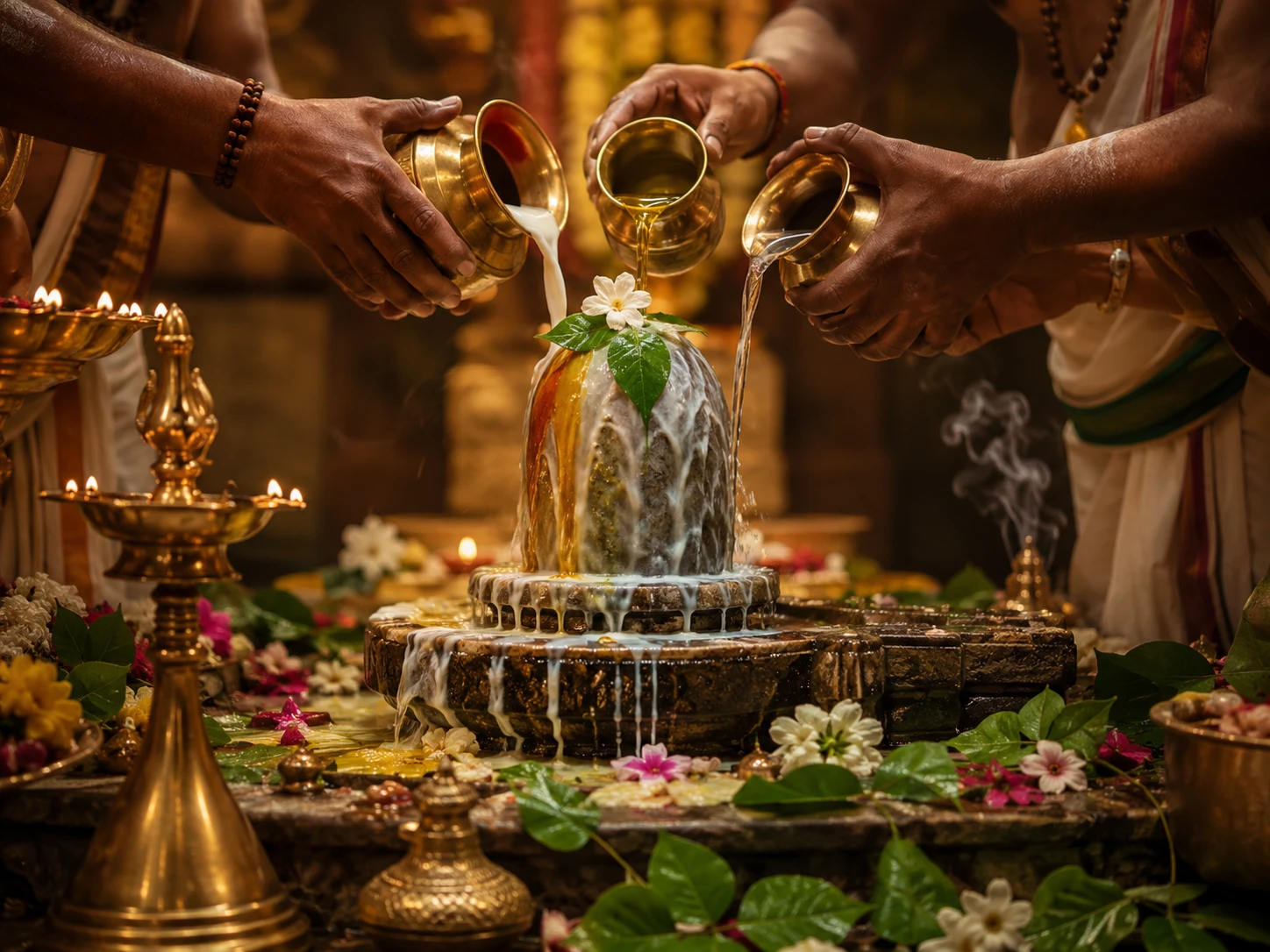
Abhisheka -- Why Hindus Bathe Their Gods
10 min read
Akshaya Tritiya -- The Day Nothing Given Away Runs Out
12 min readThe same translation error that turned '33 Koti' into '33 crore' in Hinduism also happened in Buddhism. The Chinese translation of Buddhist texts rendered 'Sapta Koti Buddha' (7 Supreme Buddhas) as '7 Crore Buddhas.' The…
Deities AvatarsCommunity Reflections
🕉️
Be the first to share your reflection.