Guru Purnima -- The Full Moon of the Teacher
गुरु पूर्णिमा -- गुरु की पूर्णिमा
On the full moon of the month of Ashadha, usually in July, students across India touch the feet of their teachers, disciples gather at the ashrams of their gurus, and households offer flowers before a picture of whoever first taught them. The day is Guru Purnima, the full moon of the teacher.
Its other name explains its origin. It is also Vyasa Purnima, kept in honour of Veda Vyasa, whom tradition remembers as the sage who arranged the Vedas into four, composed the Mahabharata and, in many accounts, gave the Puranas their form. By tradition this full moon is his birthday. To honour Vyasa is to honour the source of most of what a Hindu teacher teaches; so on this day the seat from which a guru teaches is often called the vyasa-pitha, the seat of Vyasa.
परीक्ष्य लोकान् कर्मचितान् ब्राह्मणो निर्वेदमायान्नास्त्यकृतः कृतेन । तद्विज्ञानार्थं स गुरुमेवाभिगच्छेत् समित्पाणिः श्रोत्रियं ब्रह्मनिष्ठम् ॥
parīkṣya lokān karmacitān brāhmaṇo nirvedamāyānnāstyakṛtaḥ kṛtena | tadvijñānārthaṃ sa gurumevābhigacchet samitpāṇiḥ śrotriyaṃ brahmaniṣṭham ||
Having examined the worlds that are won by action, a seeker should grow detached: what is not made cannot be gained by what is made. To know that, let him go, fuel in hand, to a guru who is learned in the Veda and established in Brahman.
— Mundaka Upanishad 1.2.12
The Upanishads assume that the highest knowledge cannot simply be read; it has to be received from someone who has it. That is the idea behind the guru. A popular traditional etymology, found in a late Upanishad, divides the word into gu, "darkness", and ru, "that which removes it" -- the guru is the one who dispels the darkness of ignorance. Grammarians derive it more plainly from guru, "heavy" or "weighty": the one whose words carry weight. Both say something true about what Hindus expect a teacher to be.
The Gita gives the method in one line. Arjuna is told to learn by bowing, by questioning and by serving -- not one of these, but all three together.
तद्विद्धि प्रणिपातेन परिप्रश्नेन सेवया । उपदेक्ष्यन्ति ते ज्ञानं ज्ञानिनस्तत्त्वदर्शिनः ॥
tadviddhi praṇipātena paripraśnena sevayā | upadekṣyanti te jñānaṃ jñāninastattvadarśinaḥ ||
Learn it by bowing down, by asking questions and by serving. The wise who have seen the truth will teach you that knowledge.
— Bhagavad Gita 4.34
How Guru Purnima Is Kept
| Where | What people do |
|---|---|
| In the home | Offer flowers, a lamp and sweets before an image of the guru, Vyasa or Dakshinamurti; recite a guru stotra; touch the feet of parents and elders |
| In ashrams and maths | Guru puja (often worship of the guru's sandals, paduka puja); disciples gather to hear the guru teach; many renew vows |
| In schools and music | Students honour their teachers; in classical music and dance, disciples offer gurudakshina and perform before the guru |
| For monks | Traditionally the start of chaturmasa, the four months of the rains when wandering sannyasis stay in one place to study and teach |
Who was the Vyasa being honoured? The Mahabharata tells his birth: he was the son of the sage Parashara and Satyavati, a fisherman's daughter, born on an island (dvipa) in the Yamuna and dark in complexion -- hence his full name, Krishna Dvaipayana, "the dark one born on the island". He is woven into the very story he tells: by the custom of niyoga he fathered Dhritarashtra, Pandu and Vidura, so the Kauravas and Pandavas are his grandchildren, and he appears at turning points of the war to counsel, console and, at the end, grieve. His son Shuka is the narrator of the Bhagavata Purana. Tradition counts Vyasa among the chiranjeevis, the immortals who remain in the world.
That is the figure behind the day: not a distant author but a teacher who arranged knowledge so that others could carry it, and who stayed close to the people in his story. Many traditions open teaching on Guru Purnima by reciting their guru-parampara, the line of teachers from Vyasa or Dakshinamurti down to the present guru -- a reminder that no teacher starts from nothing.
The same full moon is sacred to Buddhists, who keep it as Asalha Puja: by Buddhist tradition, it was on the full moon of Ashadha that the Buddha gave his first sermon to five companions at the deer park of Sarnath, near Varanasi -- the beginning of his life as a teacher.
The traditional understanding of guru is wider than a single person. Parents are counted as the first teachers, and the scriptures describe Dakshinamurti, Shiva as the silent teacher seated under a banyan tree, and the avadhuta of the Bhagavata -- identified by tradition with Dattatreya -- who names twenty-four "gurus" he learnt from in nature, from the earth to a honeybee. Guru Purnima holds all of these: the day is less about one teacher than about the act of learning from anyone who knows more than we do -- and the gratitude that goes with it.
Recite the Guru Stotram
"Akhanda mandalakaram" -- the hymn to the guru recited on Guru Purnima, with meaning.
Tags
Eternal Raga · शाश्वत राग
Institutional voice — scholarly articles on Sanatan Dharma
Deepen Your Understanding
अपनी समझ और गहरी करें
tantra mantra yantra
Guru-Shishya Parampara -- How Knowledge Passes from Teacher to Student
For three thousand years, the most important knowledge in India -- the Vedas, philosophy, yoga, music and dance -- has been passed on not through books alone but from one living teacher to one living student. What the guru-shishya parampara is, what it asks of each side, and why it still matters.
tantra mantra yantra
Diksha -- Why Initiation Matters and What It Actually Means
The Kularnava Tantra is unambiguous: there is no liberation without Diksha, no Diksha without a Guru, and no Guru without a Parampara. In an age where mantras are available on YouTube and spiritual apps offer 'instant enlightenment,' understanding why initiation is non-negotiable separates the seeker from the tourist.
deities avatars
Dakshinamurti -- The Silent Teacher Who Taught the Universe Through Silence
Under a banyan tree sits a young guru, surrounded by old disciples. He says nothing. They understand everything. This is Dakshinamurti -- Shiva as the original teacher -- and his image is the most profound statement on education in any civilisation: the highest knowledge cannot be spoken. It can only be transmitted through presence.
deities avatars
Dattatreya -- The Three-Headed Guru
Dattatreya is the only Hindu deity in whom Brahma, Vishnu, and Shiva appear in one body. He walks naked with four dogs beside him, carries the begging bowl of the avadhuta, and teaches that every creature a person meets can be a teacher. This is the deity Maharashtra and Karnataka call simply Guru.
deities avatars
Brihaspati -- Guru of the Gods and Lord of Jupiter
Three thousand years before he became the yellow-robed planet consulted before every Hindu wedding date, Brihaspati was Brahmanaspati, the Rig Veda's Lord of Prayer, a god made entirely of correct ritual speech. Centuries later the Puranas gave him a wife who left him for the Moon, a son born from a war over her, and a title, Devaguru, that still opens the Ganapati mantra chanted at the start of every Vedic ritual today. This is the planet with two very different pasts.
scriptural exegesis
The Four Vedas -- An Overview of Hinduism's Oldest Scriptures
Rig, Yajur, Sama and Atharva: what each Veda contains, how every Veda is layered from hymns to Upanishads, why the Vedas are called shruti, "what was heard", and how they were carried for thousands of years without being written down.
scriptural exegesis
The Mahabharata -- The Text Behind the World's Longest Epic
Most people who say they have read the Mahabharata mean they have read a retelling of the dice game, the exile, and Kurukshetra. Few have asked how the book itself is built: eighteen numbered parvas, a traditional count of one hundred thousand verses, and a story that reaches every reader through three narrators nested inside one another, the outermost speaking at a sacrifice convened because a king's father died of snakebite. This is that architecture, not the episodes.
The same full moon is sacred to Buddhists, who keep it as Asalha Puja: by Buddhist tradition, it was on the full moon of Ashadha that the Buddha gave his first sermon to five companions at the deer park of Sarnath, near …
More in Rituals & Traditions
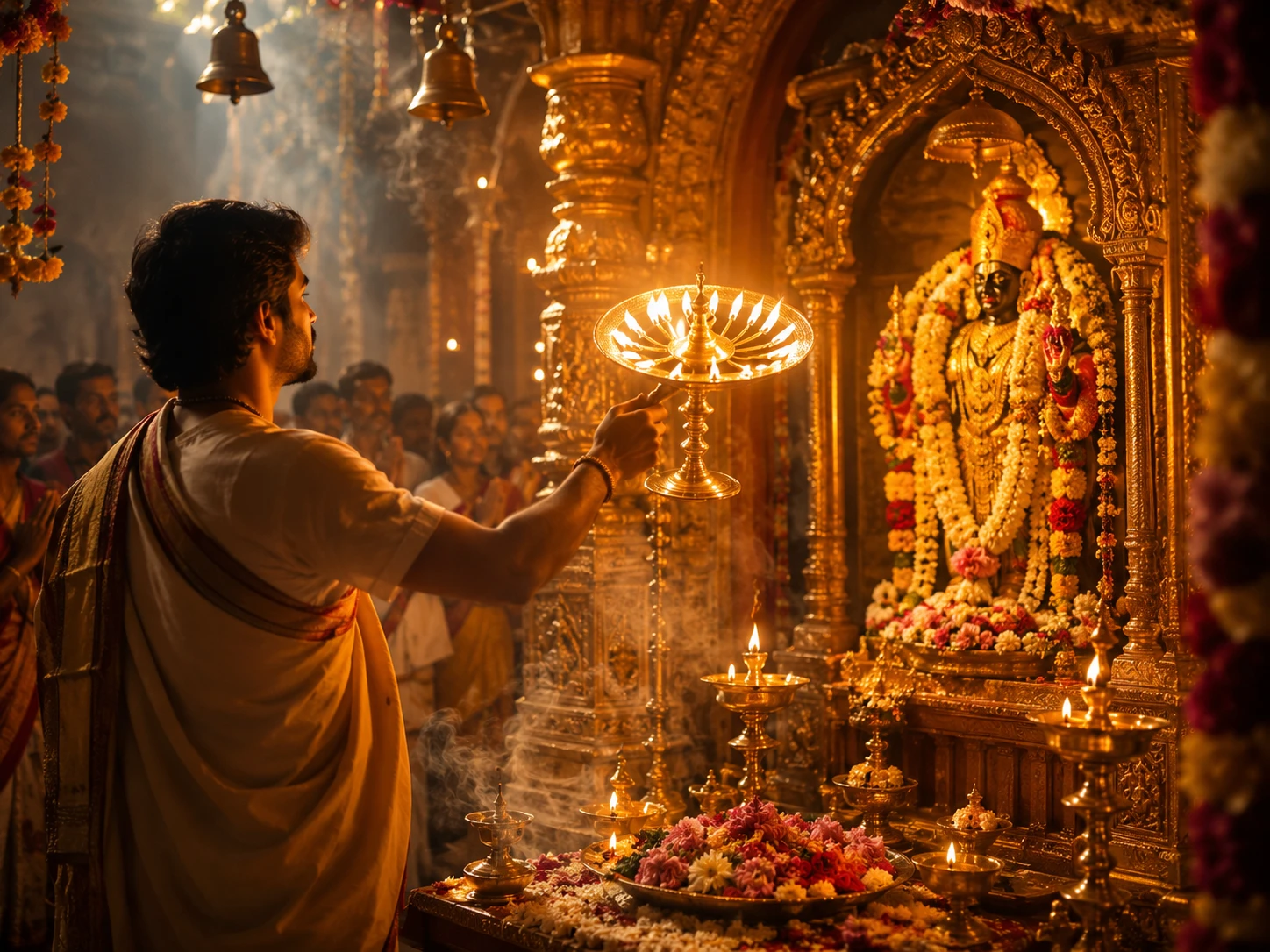
Aarti -- Why Hindus Circle Light Before God
13 min read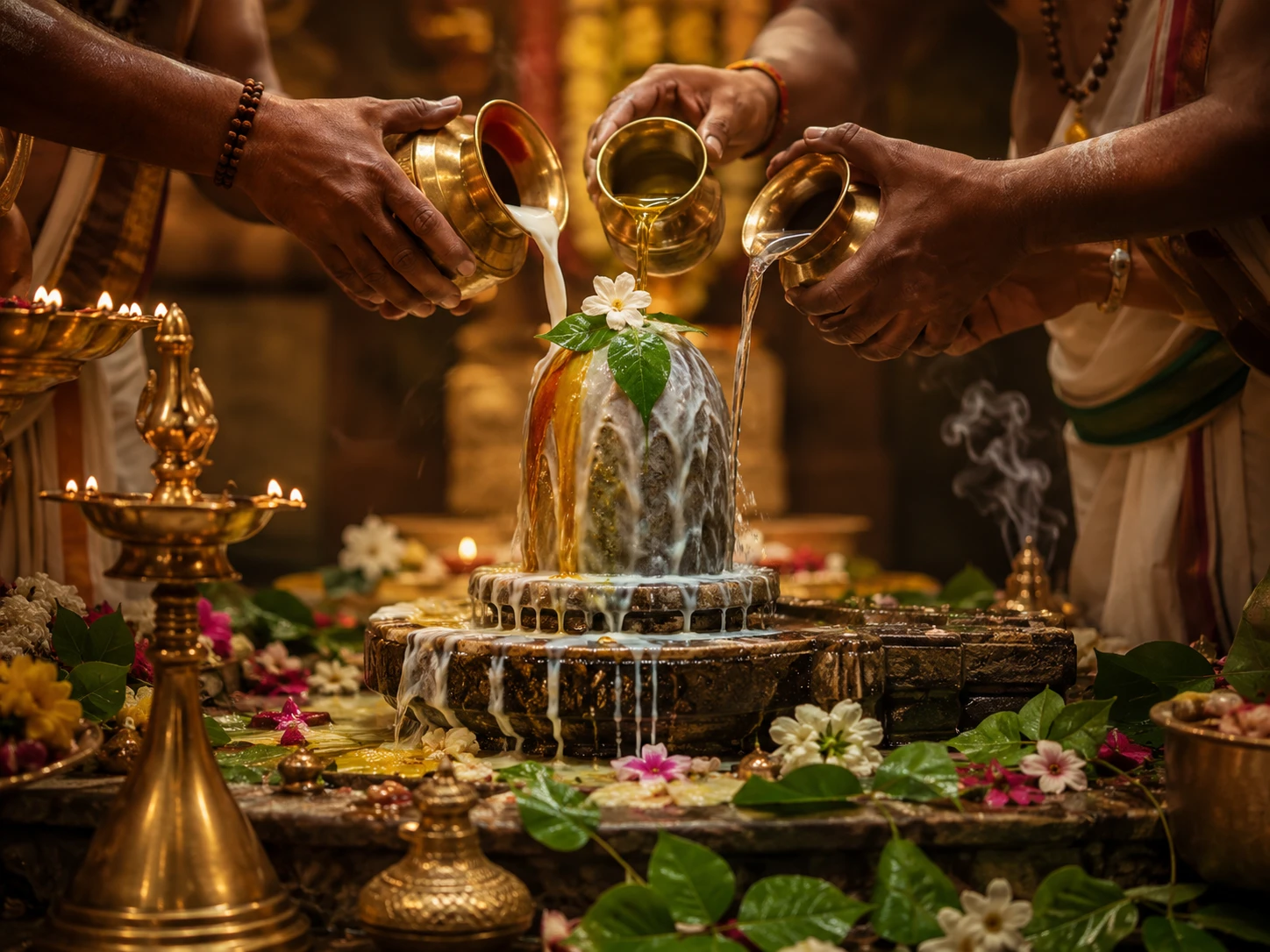
Abhisheka -- Why Hindus Bathe Their Gods
10 min read
Akshaya Tritiya -- The Day Nothing Given Away Runs Out
12 min readThe same translation error that turned '33 Koti' into '33 crore' in Hinduism also happened in Buddhism. The Chinese translation of Buddhist texts rendered 'Sapta Koti Buddha' (7 Supreme Buddhas) as '7 Crore Buddhas.' The…
Deities AvatarsCommunity Reflections
🕉️
Be the first to share your reflection.