The Four Vedas -- An Overview of Hinduism's Oldest Scriptures
चार वेद -- हिन्दू धर्म के सबसे प्राचीन शास्त्रों का परिचय
Long before any of it was written down, a body of hymns, rituals and teachings was being memorised syllable by syllable, teacher to student, in the households of priestly families in north-western India. That body of sound is the Veda, from the root vid, "to know". Hindus have called it shruti, "what was heard", because tradition holds that the rishis did not compose it but received it -- heard it in deep insight -- and passed it on unchanged. Everything else in Hindu literature, the epics and Puranas and law books included, is smriti, "what is remembered", and counts as authoritative only where it agrees with the Veda.
There are four Vedas. Most scholars place the oldest hymns, those of the Rigveda, in the second millennium BCE, with the later layers of all four collections taking shape over many centuries after. Tradition regards them as without beginning. Both agree on one thing that matters for how the Vedas are read: they were spoken and sung long before they were read.
The Four Vedas at a Glance
| Veda | What it mainly contains | Its role in the ritual |
|---|---|---|
| Rigveda | Over a thousand hymns in ten books (mandalas), praising Agni, Indra, Soma, Varuna and others, with philosophical hymns such as the Nasadiya Sukta | The hotri priest recites its verses to invoke the deities |
| Yajurveda | Ritual formulas, partly in prose, for performing the sacrifice; two branches, Shukla (White) and Krishna (Black) | The adhvaryu priest performs the actions and murmurs its formulas |
| Samaveda | Melodies (saman) set to verses, most of them taken from the Rigveda | The udgatri priest sings its chants; the root of Indian music in tradition |
| Atharvaveda | Hymns and charms for healing, protection, household life and kingship, alongside speculative hymns | Associated with the brahman priest who oversees the whole rite |
The Gita (9.17) names the first three in one breath -- rik, sama and yajus -- reflecting the old idea of the "triple Veda" (trayi). The Atharvaveda was added to that core later, which is one reason it has a distinct character.
Each Veda is not a single book but a library in layers. At the centre is the Samhita, the collection of hymns or formulas. Around it grew the Brahmanas, prose texts that explain the ritual and the meaning behind each act. Then come the Aranyakas, the "forest books", which turn the ritual inward and treat it as meditation. Last are the Upanishads, which ask what lies behind the ritual and its gods altogether, and answer with Brahman, the one reality, and Atman, the Self. Because the Upanishads come at the end of the Veda, their teaching is called Vedanta, "the end of the Veda".
This layering explains why one tradition can hold both elaborate fire rituals and the teaching that ritual cannot give the highest goal. The Mundaka Upanishad says so plainly: it lists the four Vedas and their six auxiliary sciences as the "lower knowledge", and calls the knowledge by which the imperishable is grasped the "higher".
तत्रापरा ऋग्वेदो यजुर्वेदः सामवेदोऽथर्ववेदः शिक्षा कल्पो व्याकरणं निरुक्तं छन्दो ज्योतिषमिति । अथ परा यया तदक्षरमधिगम्यते ॥
tatrāparā ṛgvedo yajurvedaḥ sāmavedo'tharvavedaḥ śikṣā kalpo vyākaraṇaṃ niruktaṃ chando jyotiṣamiti | atha parā yayā tadakṣaramadhigamyate ||
Of these, the lower is the Rigveda, Yajurveda, Samaveda and Atharvaveda, phonetics, ritual, grammar, etymology, metre and astronomy. The higher is that by which the imperishable is attained.
— Mundaka Upanishad 1.1.5
How do you keep a text exact for three thousand years without writing it down? The Vedic answer was to memorise it several times over, in different patterns. Students learnt the continuous text (samhita-patha), then each word separately (pada-patha), then words in overlapping pairs (krama-patha), and in the most demanding methods, such as jata and ghana, in pairs repeated forwards and backwards. A mistake in one pattern shows up against the others. Pitch accents were marked by hand movements as the verses were chanted. The result is one of the most precise oral traditions known, and in 2008 UNESCO inscribed the Vedic chanting tradition on its list of the Intangible Cultural Heritage of Humanity.
The Vedas also produced the first Indian sciences. To chant correctly, perform the rite at the right moment and build the fire altar to the right measurements, six auxiliary disciplines grew up: phonetics, ritual, grammar, etymology, metre and astronomy -- the six Vedangas. Panini's grammar and the geometry of the Shulba Sutras both began here.
Tradition credits the sage Vyasa with arranging the one undivided Veda into four collections so that people of a shorter-lived age could learn them -- which is how he got the name Veda-Vyasa, "the divider of the Veda". Guru Purnima, also called Vyasa Purnima, honours him for it.
पिताहमस्य जगतो माता धाता पितामहः । वेद्यं पवित्रमोंकार ऋक्साम यजुरेव च ॥
pitāhamasya jagato mātā dhātā pitāmahaḥ | vedyaṃ pavitramoṃkāra ṛksāma yajureva ca ||
I am the father of this world, its mother, its sustainer and its grandsire; I am what is to be known, the purifier, the syllable Om, and the Rik, the Sama and the Yajus.
— Bhagavad Gita 9.17
Most Hindus today meet the Vedas not as whole books but in pieces that never left daily life: the Gayatri mantra from the Rigveda, recited at dawn; the Purusha Sukta and Shri Sukta at pujas; the Rudram from the Krishna Yajurveda in Shiva temples; Vedic verses at every wedding and funeral. And through the Upanishads, the Vedas' philosophical end, they shape the questions Hindu thought still asks: what is real, what is the Self, and how is it known.
Read the Upanishads and Vedangas
Eleven principal Upanishads, verse by verse, and the texts of all six Vedangas on Eternal Raga.
Tags
Eternal Raga · शाश्वत राग
Institutional voice — scholarly articles on Sanatan Dharma
Deepen Your Understanding
अपनी समझ और गहरी करें
vedic sciences
Upavedas -- The Four Applied Sciences of Hindu Tradition
The Vedas gave India its philosophy and rituals. The Upavedas gave India its professions. Four applied knowledge systems -- Ayurveda (medicine), Dhanurveda (warfare), Gandharvaveda (music and performing arts), and Sthapatyaveda (architecture) -- were classified as subsidiary Vedas, each attached to one of the four main Vedas. They represent the Hindu tradition's insistence that sacred knowledge must produce practical results: a healed body, a defended nation, a beautiful performance, a well-built home. Together, the Upavedas form the intellectual infrastructure of pre-modern Indian civilisation -- from the surgeon's scalpel to the architect's blueprint to the musician's raga.
vedic sciences
Shad Vedangas -- The Six Limbs of the Veda
The Vedas are not a single book you can pick up and read. They are a living system with six auxiliary sciences -- phonetics, metre, grammar, etymology, astronomy, and ritual procedure -- that function like limbs of a body. Without them, the Vedas are a voice without a mouth, a path without eyes. Here is the operating manual India's knowledge system ran on for three thousand years.
scriptural exegesis
Nasadiya Sukta -- The Rigvedic Hymn That Questioned Creation Itself
Seven verses in the tenth mandala of the Rigveda. No cosmic egg, no deity speaking creation into being, no parted waters. Just a rishi asking, without flinching, where everything came from -- and whether even the overseer of creation in the highest heaven knows the answer.
tantra mantra yantra
The Gayatri Mantra -- 24 Syllables That Illuminate the Mind
The most chanted verse in human history is not a prayer for wealth, power, or protection. It is a prayer for light -- for the divine radiance to illuminate the intellect. 24 syllables from Rig Veda 3.62.10, attributed to Rishi Vishwamitra, have shaped Indian civilisation for over three thousand years.
philosophy darshana
The Four Mahavakyas -- Upanishadic Sentences That Changed Civilisation
Four sentences. Twelve words of Sanskrit. Three thousand years of commentary. The Mahavakyas are the most compressed, most powerful, and most debated statements in all of Indian philosophy. Each one claims that the individual self and the ultimate reality of the universe are not two different things. And each one has been interpreted to mean something completely different by every major school of Vedanta.
scriptural exegesis
Chandogya Upanishad -- Tat Tvam Asi
A 24-year-old returns from 12 years of Vedic study, bloated with pride and stuffed with textbook knowledge, only to have his father demolish his certainty with nine repetitions of three words: Tat Tvam Asi -- You Are That. The Chandogya Upanishad is the text that broke the wall between God and you.
philosophy darshana
The Brahma Sutras -- The Short Book Every School of Vedanta Had to Explain
Some five hundred and fifty terse sentences that set out to organise the teaching of the Upanishads -- so terse that they cannot be read without a commentary, and every great teacher of Vedanta wrote one. What the Brahma Sutras are, how they are arranged, and why their first sutra is famous.
Tradition credits the sage Vyasa with arranging the one undivided Veda into four collections so that people of a shorter-lived age could learn them -- which is how he got the name Veda-Vyasa, "the divider of the Veda". G…
More in Scriptural Exegesis
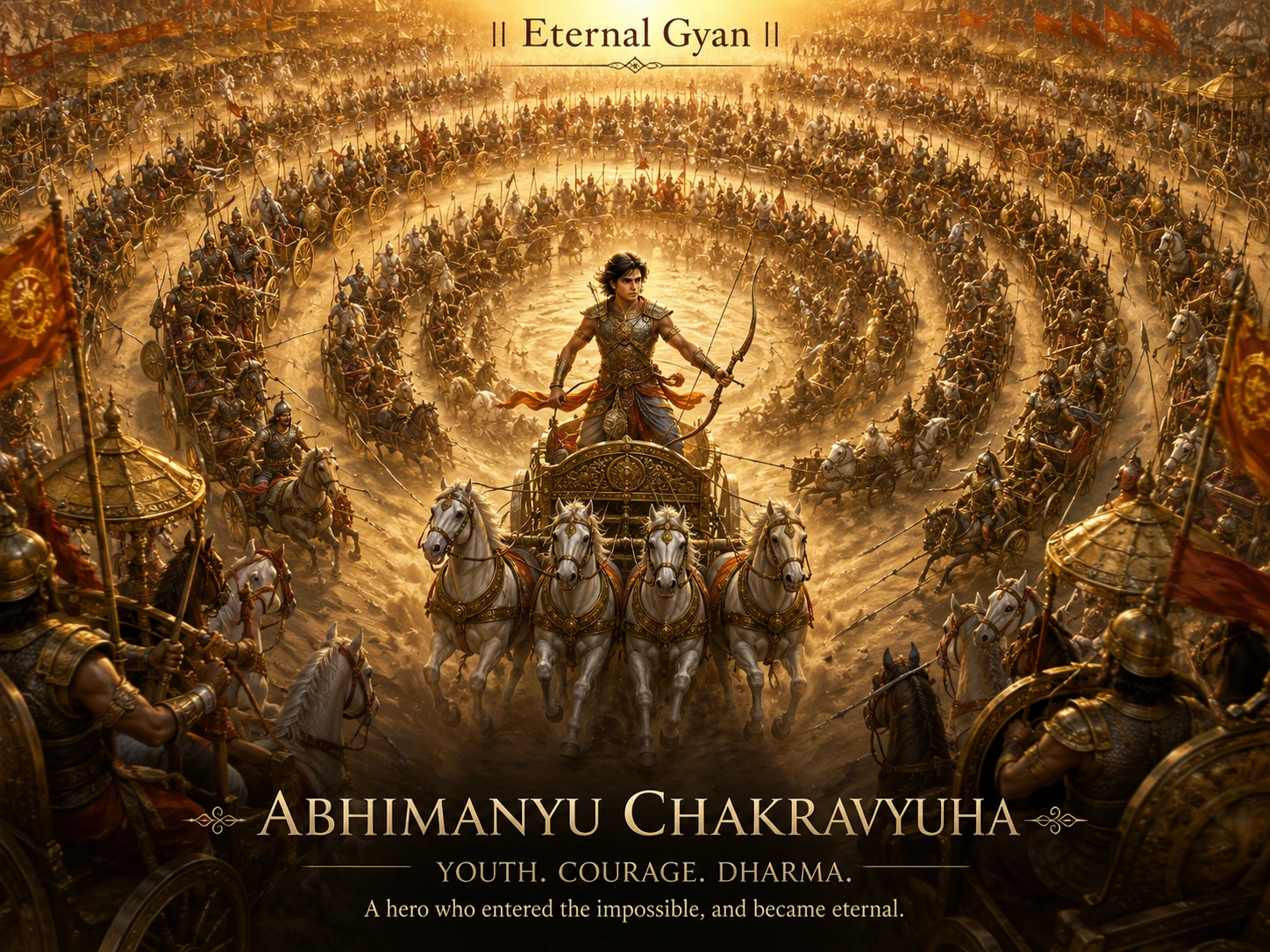
Abhimanyu and the Chakravyuha -- The Boy Who Knew How to Enter but Not How to Leave
14 min read
Adbhuta Ramayana -- The Ramayana Where Sita Becomes Kali
9 min read
After Kurukshetra -- What Happened Next
14 min readThe same translation error that turned '33 Koti' into '33 crore' in Hinduism also happened in Buddhism. The Chinese translation of Buddhist texts rendered 'Sapta Koti Buddha' (7 Supreme Buddhas) as '7 Crore Buddhas.' The…
Deities AvatarsCommunity Reflections
🕉️
Be the first to share your reflection.