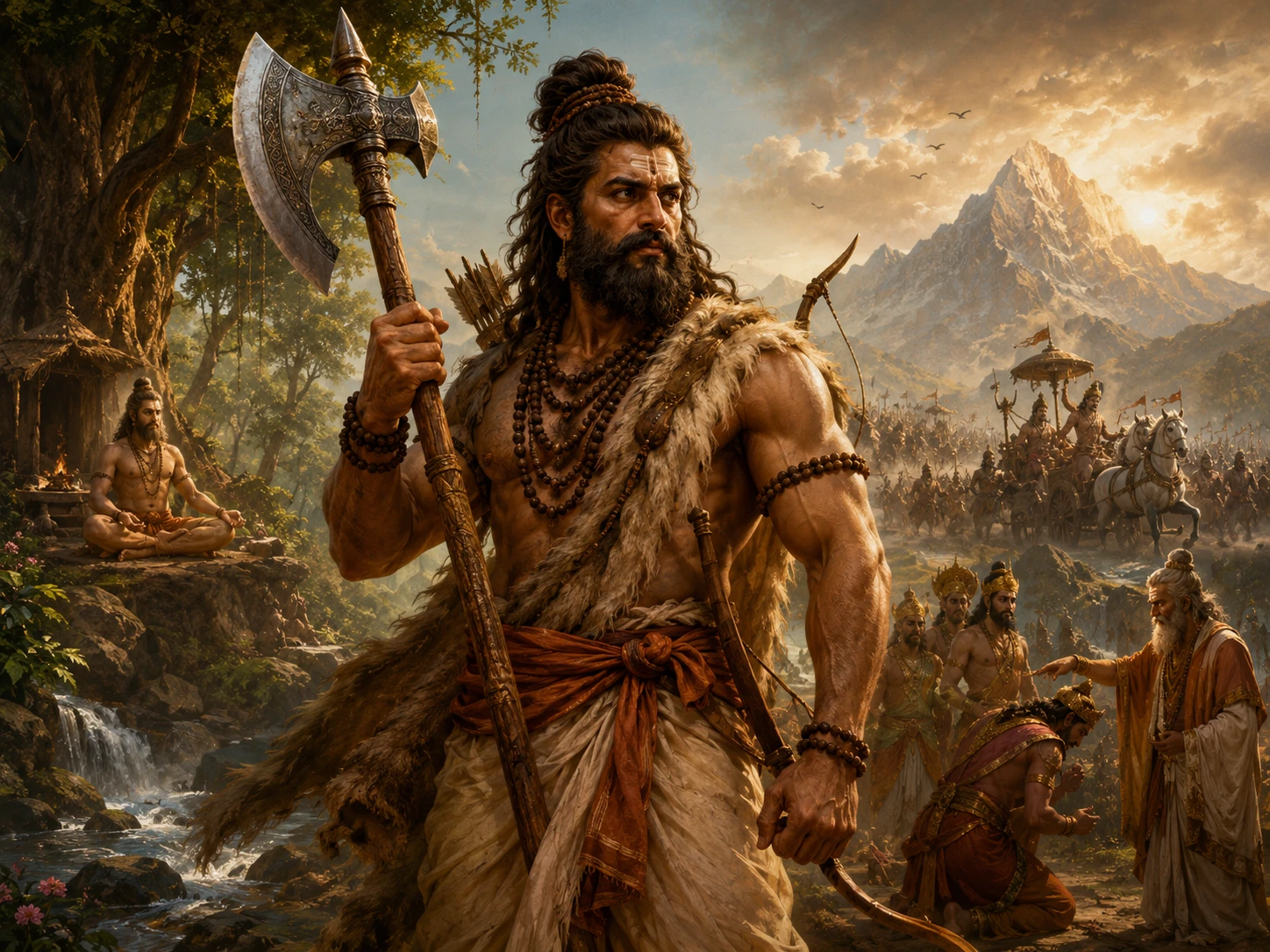
Parashurama -- Why He Killed All Kshatriyas 21 Times
परशुराम -- उन्होंने 21 बार सभी क्षत्रियों का वध क्यों किया
Every other avatar of Vishnu makes intuitive sense. Rama is the perfect king. Krishna is the perfect strategist. Narasimha is divine fury against a specific tyrant. But Parashurama -- a Brahmin sage who picks up an axe and exterminates an entire social class twenty-one times over -- is the avatar that disturbs. He does not restore dharma through diplomacy, through war with rules, or through divine play. He does it through sustained, generational rage.
Parashurama (literally 'Rama with the Parashu/axe') is the sixth of Vishnu's Dashavatara. He is born in the Treta Yuga, before Rama's avatar, and is one of the seven Chiranjeevis -- the immortals who are still alive and will return as the guru of Kalki, Vishnu's final avatar, at the end of the Kali Yuga. His story appears in the Mahabharata (Vana Parva, Chapters 115-117), the Bhagavata Purana (Skandha 9, Chapters 15-16), the Vishnu Purana, and the Brahmanda Purana.
The background: by the late Treta Yuga, the Kshatriya warrior-kings had become corrupt. They used their military power not to protect the people and the sages but to oppress them. Taxes became extortion. Ashrams were raided. Cows were stolen. Brahmins were humiliated. The social contract between the knowledge-holding Brahmins and the power-holding Kshatriyas had collapsed. Dharma required a correction -- not a gentle nudge but a hard reset.
Into this world, Parashurama was born to the sage Jamadagni (a descendant of the Bhrigu clan) and Renuka (a princess who married into the Brahmin order). He was trained in both Vedic knowledge and martial arts. Shiva himself, pleased with the young Brahmin's tapasya, gifted him the Parashu -- a divine axe -- and trained him in warfare. Parashurama was a Brahmin by birth, a warrior by destiny, and a destroyer by divine mandate.
क्षत्रं द्विजहुतं वह्नावपचद्भार्गवोत्तमः। त्रिःसप्तकृत्वः पृथिवीं कृत्वा निःक्षत्रियां प्रभुः॥
kṣatraṃ dvijaahutaṃ vahnāv apacad bhārgavottamaḥ | triḥsaptakṛtvaḥ pṛthivīṃ kṛtvā niḥkṣatriyāṃ prabhuḥ ||
The foremost of the Bhargavas offered the Kshatriya race as an oblation into the fire. Twenty-one times did the mighty one make the earth bereft of Kshatriyas.
— Bhagavata Purana, Skandha 9, Chapter 16 (Parashurama's campaigns)
The Trigger -- Kamadhenu, Kartavirya, and a Father's Murder
The specific chain of events begins with Kartavirya Arjuna -- also called Sahasrabahu (the thousand-armed), the Haihaya king of Mahishmati on the Narmada. He had received a thousand arms as a boon from the sage Dattatreya and was the most powerful Kshatriya king of his era. One day, Kartavirya and his army visited the ashram of Jamadagni. Despite the ashram's simplicity, Jamadagni served the entire army a lavish feast -- made possible by Kamadhenu, the divine wish-fulfilling cow.
Kartavirya's greed was immediate. He demanded the cow. Jamadagni refused -- the cow was essential for the ashram's rituals and the maintenance of Vedic fire. Kartavirya's soldiers destroyed the ashram and dragged the cow away. When Parashurama returned and learned what had happened, he marched alone to Mahishmati, fought Kartavirya's entire army, severed his thousand arms, and killed him.
Jamadagni, a pacifist sage, was horrified. He told Parashurama that killing a king was a sin for a Brahmin and ordered him to atone through pilgrimage. Parashurama obeyed and departed.
While Parashurama was away, Kartavirya's sons and their Kshatriya allies attacked the undefended ashram. They beheaded Jamadagni while he sat in meditation. They left 21 wounds on his body. Renuka, finding her husband's mutilated corpse, beat her chest 21 times in grief and called out for Parashurama.
When Parashurama returned and saw the scene, he made a vow that would echo through the ages: for each wound on his father's body, for each beat of his mother's grief, he would cleanse the earth of the corrupt Kshatriya class. Not once. Twenty-one times.
Why 21 Times?
The number is explained differently across texts. The most visceral reason: Renuka beat her chest 21 times. The most practical: each time Parashurama killed the Kshatriya warriors, their wives survived and gave birth to new generations who grew up seeking revenge. The cycle of violence perpetuated itself. Parashurama had to repeat the purge 21 times because the sons of the slain kept rebuilding the same corrupt structures.
The Bhagavata Purana says he filled five lakes with Kshatriya blood at Samanta Panchaka (near Kurukshetra) -- the same site that would later host the Mahabharata war. He then performed the Ashvamedha sacrifice (a sovereign king's rite) and donated all the conquered land to the Brahmins -- specifically to the sage Kashyapa.
This is the most uncomfortable part of the Parashurama narrative for modern readers: it is, on the surface, caste-based violence sanctioned by divine mandate. But the Puranic tradition is careful to frame it as a correction of dharma, not a war against a birth-class. Parashurama killed Kshatriyas who had become tyrants -- not the class itself. In fact, the Kshatriya lineages survived (through the women and children), and the great dynasties of the Ramayana and Mahabharata -- the Solar (Suryavanshi) and Lunar (Chandravanshi) -- descend from these survivors. Parashurama did not destroy a varna. He pruned it.
Parashurama in the Larger Mahabharata-Ramayana World
| Encounter | Source Text | What Happened | Significance |
|---|---|---|---|
| Vs. Kartavirya Arjuna | Bhagavata Purana 9.15-16 | Killed the thousand-armed king; triggered 21 campaigns | Primary mission as avatar: correct Kshatriya corruption |
| Vs. Rama (at Sita Swayamvar) | Ramayana, Bala Kanda | Challenged Rama after hearing he broke Shiva's bow Pinaka; Rama strung Vishnu's bow; Parashurama recognised him as Vishnu's next avatar | Two avatars meet; Parashurama's mission ends; Rama's begins |
| As Guru of Bhishma | Mahabharata, Adi Parva | Trained Bhishma in warfare; later fought Bhishma for 23 days over Amba's request (inconclusive) | Teacher-student relationship spanning two avatar-eras |
| As Guru of Drona | Mahabharata, Adi Parva | Taught Drona advanced weapons after donating all wealth to Brahmins | Drona trained Pandavas/Kauravas -- Parashurama's teaching rippled into Kurukshetra |
| As Guru of Karna | Mahabharata, Adi Parva | Karna (disguised as Brahmin) learned weapons from Parashurama; was cursed when truth revealed | Karna's curse shaped the Mahabharata war's outcome |
| Chiranjeevi destiny | Kalki Purana | Will return as Kalki's guru at end of Kali Yuga | The warrior-Brahmin's mission is not yet complete |
Parashurama's influence spans the Ramayana, the Mahabharata, and the yet-to-come Kalki avatar. He is the connective tissue between three of Vishnu's incarnations.
Parashurama is traditionally credited with creating the Konkan and Malabar coastlines by pushing back the sea with his axe. According to the Kerala Brahmins (Namboodiris), Parashurama reclaimed the land from the Arabian Sea to settle the Brahmins he had displaced during his campaigns. The geological fact that the western coast of India was indeed shaped by tectonic and sea-level changes over millennia gives this myth a curious echo of geological memory. Parashurama Kshetra (the land of Parashurama) is the traditional name for the coastal strip from Goa to Kerala -- and the axe-wielding Brahmin is its founding figure.
Chant Om Namo Bhagavate Vasudevaya
Parashurama is an avatar of Vishnu. Connect with the preserver through the dvadashakshari mantra, Om Namo Bhagavate Vasudevaya, chanted 108 times on a mala. Its page on Eternal Raga gives the meaning and how to chant it.
Tags
Eternal Raga · शाश्वत राग
Institutional voice — scholarly articles on Sanatan Dharma
Deepen Your Understanding
अपनी समझ और गहरी करें
deities avatars
Dashavatara -- Why Vishnu Comes Back Ten Times
Fish, tortoise, boar, half-lion, dwarf, axe-warrior, prince, cowherd, enlightened teacher, future horseman. The ten avatars of Vishnu are not random folklore. Read them in sequence and you get something startling -- a narrative that mirrors evolutionary biology, tracks the rise and fall of political systems, and argues that God does not sit above history but enters it, gets dirty, and does the work. The Dashavatara is Hinduism's answer to the question every civilisation asks: why does the world keep breaking, and who fixes it?
scriptural exegesis
Warriors Who Defeated Ravana Before Rama
Before Rama drew his bow, Ravana had already been humiliated by at least five beings -- crushed under Shiva's toe, trapped in Vali's armpit, imprisoned by Kartavirya Arjuna, clawed by Jatayu's father, and humbled by a child-sage. The 'invincible' demon king of Lanka was anything but. Here is the resume of defeats that the Dussehra effigies never mention.
scriptural exegesis
Karna's Tragedy -- The Sun's Forgotten Son
Born with divine armor, abandoned at birth, raised by a charioteer, humiliated for his caste, cursed by his teacher, and killed while defenseless -- Karna's story is not the Mahabharata's subplot. It is the Mahabharata's conscience. Every system that failed him is a system that still fails people today.
scriptural exegesis
Bhishma's Terrible Vow
A crown prince gave up the throne, love, marriage, and children -- forever -- so his father could marry a fisherwoman. That single vow made Bhishma immortal in name and set the entire Mahabharata into motion. Was it the noblest sacrifice in literature, or the most catastrophic?
scriptural exegesis
7 Chiranjeevis -- The Immortals of Hindu Tradition
Seven beings who will not die until the end of this cosmic age. One is cursed to wander in agony. One rules the underworld. One compiled every scripture you have ever read. One is the most worshipped deity in India. The Chiranjeevis are not a mythology trivia list -- they are a map of how immortality works in Hindu thought, and why it is not always a blessing.
scriptural exegesis
Suryavanshi -- The Solar Dynasty from the First King to Rama
Rama was not the first king of Ayodhya. He was the 67th. Before him came Ikshvaku, who sneezed into existence from Manu's nostril. Then Harishchandra, who sold himself into slavery for truth. Then Sagara, whose 60,000 sons were burned to ash. Then Bhagiratha, who brought Ganga from heaven to redeem them. Then Raghu, who conquered the world. Then Dasharatha, who gave his life for a promise. This is the Solar Dynasty -- the longest unbroken royal lineage in any mythology on earth.
Parashurama is traditionally credited with creating the Konkan and Malabar coastlines by pushing back the sea with his axe. According to the Kerala Brahmins (Namboodiris), Parashurama reclaimed the land from the Arabian …
More in Scriptural Exegesis
Abhimanyu and the Chakravyuha -- The Boy Who Knew How to Enter but Not How to Leave
14 min read
Adbhuta Ramayana -- The Ramayana Where Sita Becomes Kali
9 min read
After Kurukshetra -- What Happened Next
14 min readThe same translation error that turned '33 Koti' into '33 crore' in Hinduism also happened in Buddhism. The Chinese translation of Buddhist texts rendered 'Sapta Koti Buddha' (7 Supreme Buddhas) as '7 Crore Buddhas.' The…
Deities AvatarsCommunity Reflections
🕉️
Be the first to share your reflection.