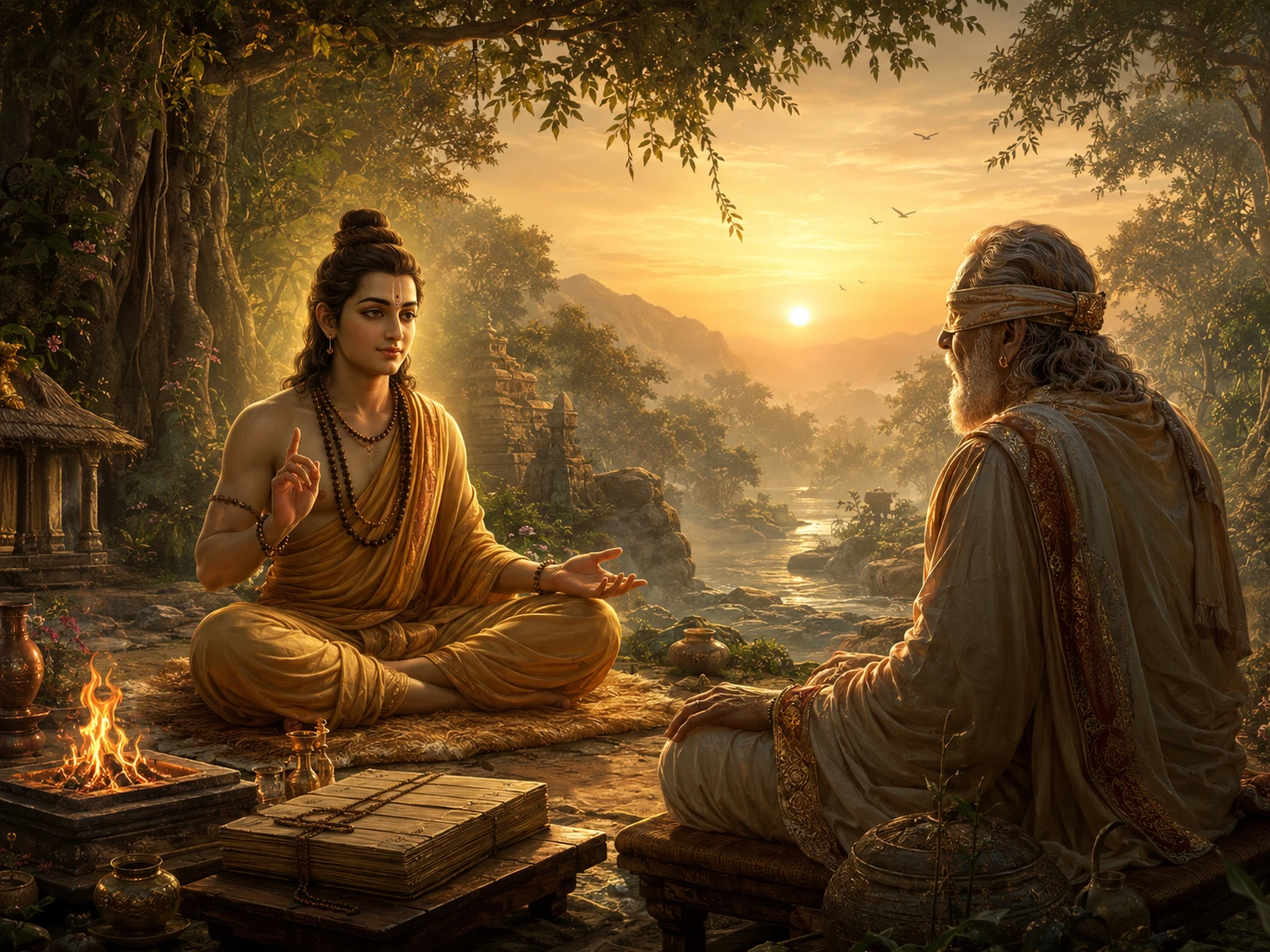
Sanatsujatiya -- The Night Sermon Before the War
सनत्सुजातीय -- युद्ध से पूर्व की रात्रि-देशना
The King Who Could Not Sleep
It was the night before the Mahabharata war, and an old blind king could not sleep.
Dhritarashtra had sent his charioteer Sanjaya to the Pandava camp to hear their final terms. Sanjaya had returned in the evening, but had refused to deliver the message until court was convened the next morning. The king was left alone with his anxiety. His sons were ranged against his nephews. Eighteen days of war were about to begin. He had spent his life choosing his own children over justice, and now the cost of every choice was coming due in a single ledger.
He summoned Vidura. The half-brother who had warned him for forty years. The man whose advice he had ignored often enough that ignoring had become habit. That night, Vidura came. He spoke at length. The collected dharma-speeches he gave that night came to be known as the Vidura Niti -- a manual of statecraft and ethics that Indian administrators have read for two thousand years.
But at a certain point, Vidura stopped. He told the king something almost no one else in the Mahabharata says aloud. Vidura, born of a maidservant of the Sudra varna, said the highest spiritual teaching could not come from him. It had to come from a Brahmin sage of impeccable lineage. He named one: Sanatsujata, the eternally young, one of the four Kumaras born of Brahma's mind.
Sanatsujata came. The conversation that followed is the Sanatsujatiya -- five chapters embedded in the Udyoga Parva of the Mahabharata. It is not, technically, an Upanishad. But functionally, it has been treated as one for a thousand years. Adi Shankara, the founder of Advaita Vedanta, wrote a full commentary on it. Across the entire Mahabharata, Shankara wrote commentaries on only three texts: the Bhagavad Gita, the Vishnu Sahasranama, and the Sanatsujatiya. That alone tells you what stature this conversation carries in the tradition.
The whole night, while the rest of Hastinapura slept and the Pandava and Kaurava camps slept and even the war itself slept its last hours of sleep, two voices spoke in a torchlit chamber. A king who had failed at every choice his life offered him. And a sage who tried, in one night, to give him the only thing that could not be lost.
प्रमादं वै मृत्युमहं ब्रवीमि तथाप्रमादममृतत्वं ब्रवीमि। प्रमादादसुरास्ते पराजिता अप्रमादाद् ब्रह्मभूता हि देवाः॥
pramaadam vai mrityum aham braveemi tathaa apramaadam amritatvam braveemi pramaadaad asuraaste paraajitaa apramaadaad brahmabhootaa hi devaah
I declare: heedlessness is death itself. And vigilance is immortality. Through heedlessness the asuras were defeated. Through vigilance the devas became one with Brahman.
— Mahabharata, Udyoga Parva, Sanatsujatiya 41.4 (Ganguli numbering)
What Pramada Really Means
Dhritarashtra had asked Sanatsujata a strange opening question. He said he had heard two contradictory teachings: that death does not exist for the realized, and that even the gods had to practise austerity to escape death. Which was true?
Sanatsujata answered, 'Both.'
Then came the line. Pramadam vai mrityum aham braveemi. Heedlessness is death.
The word pramada is layered. Its root mad means to be intoxicated. The prefix pra intensifies it. So pramada literally means a kind of drunken negligence -- intoxication so deep that you forget what you are. Adi Shankara, in his commentary, defines it precisely: pramada is the slipping away from one's natural state of Brahman-consciousness. The moment you forget what you are, you fall into mortality. Not because you physically die, but because you have lost connection to the part of yourself that does not die.
This is a radical reframe. In ordinary language, we treat death as an event that happens to a body. Sanatsujata is telling Dhritarashtra that death is happening to him every moment he lives unconsciously. Every choice the king made out of attachment to his sons rather than dharma was a small death. Eighteen years of preferring Duryodhana to Yudhishthira had killed him long before any soldier picked up a weapon. The war the next morning was just the bookkeeping.
The inverse is also stated. Apramada -- vigilance, mindfulness, presence -- is amrita, immortality. Not because vigilant people live forever in their bodies. But because they live continuously connected to the part of themselves that was never born and will never die.
For a 24-year-old in Gurugram who scrolls Instagram for three hours every night before sleeping, who finishes a series she does not even remember enjoying, who reaches for her phone the moment she opens her eyes -- the Sanatsujatiya is unsettlingly direct. The sage is not condemning. He is naming. Every minute of pramada is a minute the soul is not awake. The cumulative effect of those minutes, across years, is the slow death of the only self that mattered.
Why Vidura Could Not Speak
The setup matters. Vidura's deferral to Sanatsujata is one of the most surprising moments in the Mahabharata, and reading past it is to miss what the text is doing.
Vidura was no ordinary minister. He was the incarnation of Yama, the lord of dharma himself, born into the body of a maidservant's son. He had spent decades giving the Kauravas counsel that, if heeded, would have averted the war entirely. His Vidura Niti is studied in Indian civil services academies even today as a reference on statecraft. By any spiritual measure, Vidura was qualified to give the deepest teaching.
And yet he steps aside. Why?
One reading, often offered by traditionalists, is that the rules of varna require teachings of supreme metaphysics to come from a Brahmin. This reading exists in the text. But there is a deeper reading the text also supports. Vidura had been speaking to Dhritarashtra for forty years. Familiarity itself had become an obstacle. The king had stopped hearing him. Vidura was no longer a sage; he was a long-suffering relative whose advice could be filed away. To break through to a man on the eve of his greatest catastrophe, a different voice was needed. A voice the king did not already know how to disregard.
This is also the wisdom for modern life. The advisors closest to us, who have given us the same counsel for years, often lose their power not because their counsel was wrong but because we have learned to anaesthetize ourselves to them. A young entrepreneur in Indiranagar dismisses her elder sister's gentle warnings about burnout, but listens raptly when an unknown speaker says the same thing at a startup conference. A young man tunes out his mother's pleas about diet but agrees with a podcast host who says it differently. Pramada is not only intoxication with pleasure. It is also intoxication with the familiar.
Sanatsujata's effectiveness lies partly in his strangeness. He is not Vidura. He has no relationship to manage with the king. He has nothing to lose if Dhritarashtra rejects him. He can speak with the precision that only a stranger can afford. And the king, for the first time in years, hears.
Three Wisdom Texts of the Mahabharata Adi Shankara Commented On
| Text | ग्रन्थ | Speaker | Setting | Core Teaching |
|---|---|---|---|---|
| Bhagavad Gita | भगवद्गीता | Krishna to Arjuna | Battlefield, dawn before war | Karma, jnana, bhakti as paths to liberation |
| Vishnu Sahasranama | विष्णुसहस्रनाम | Bhishma to Yudhishthira | Bed of arrows, after war | 1000 names as meditative apparatus |
| Sanatsujatiya | सनत्सुजातीय | Sanatsujata to Dhritarashtra | Palace at night, before war | Pramada is death, vigilance is immortality |
Together, these three texts form the spiritual core that Adi Shankara identified within the Mahabharata. They span three settings (battlefield, deathbed, palace), three speakers (avatar, dying patriarch, eternally young sage), and three moments (dawn, dusk, midnight) of human spiritual crisis.
मृगहस्तीपतङ्गभ्रमरमत्स्याः पञ्च पञ्चभिरेव हता ये। किमुत यः सर्वभिः सेव्यमानो न हन्यते चित्रमिदं तु लोके॥
mriga-hastee-patanga-bhramara-matsyaah pancha panchabhir eva hataa ye kim uta yah sarvabhih sevyamaano na hanyate chitram idam tu loke
The deer, the elephant, the moth, the bee, and the fish -- these five are destroyed each by surrender to a single sense. Sound destroys the deer, touch the elephant, sight the moth, fragrance the bee, taste the fish. What then of the man whom all five senses serve at once? That he is not destroyed -- this is the strange wonder of the world.
— Mahabharata, Udyoga Parva, Sanatsujatiya (echoed in Shanti Parva 174.45 with same imagery)
The Four Paths of Brahmacharya
Sanatsujata then introduces something most modern Hindus do not realize is in the text. He outlines four paths of brahmacharya -- four ways of leading the disciplined life that yields knowledge of Brahman.
The word brahmacharya itself is misunderstood today, often reduced to mere celibacy. In Sanatsujata's framing, it is far broader. Brahma-charya literally means 'movement in Brahman' or 'conduct that goes towards Brahman'. It includes celibacy, but it includes much more: control of speech, control of thought, surrender of fruits, study of scripture, and the patient cultivation of vigilance.
The four paths Sanatsujata describes vary by the seeker's temperament and stage of life. Some can be celibate from youth and pursue jnana directly. Others must serve a teacher and earn knowledge through long apprenticeship. Others practise austerity in the world without retreating from it. Others realize that true brahmacharya is not external regulation but internal alignment -- a state in which the senses are not denied but no longer rule.
This last point is critical for the audience Dhritarashtra represents. The king is too old, too entangled, too compromised to start from scratch as a celibate ascetic. Sanatsujata offers him a path that does not require dismantling his life. It requires changing his relationship to his own consciousness. The king cannot, at 80 and blind, become a forest-dwelling sage. But he can, even in this last night, choose vigilance over heedlessness. He can choose to hear what is being said, rather than what he wishes to hear.
For a 35-year-old marketing manager in Mumbai who has read three books on minimalism and quit none of her commitments, the four paths offer a familiar comfort. You do not have to give up your life to begin spiritual practice. You have to give up the inattentiveness with which you are living your life. The two are different. The first is renunciation. The second is awakening. The Sanatsujatiya was always pointing at the second.
Adi Shankara wrote commentaries on exactly three Mahabharata texts, and the three together form a hidden architecture. The Bhagavad Gita is taught at dawn on the first day of war. The Sanatsujatiya is taught at midnight on the night before that war begins. The Vishnu Sahasranama is taught at dusk by a dying Bhishma after the war ends. Dawn, midnight, dusk -- the three liminal hours of consciousness in Indian thought. Shankara saw what was hidden in the structure: the Mahabharata is not just an epic. It is also a complete map of how spiritual teaching enters human life at the moments when human life is most desperate to receive it.
Silence, Speech, and the Real Brahmacharya
Deeper into the dialogue, Sanatsujata says something that startles even Dhritarashtra. The king has been asking about external practices: rituals, austerities, vows. Sanatsujata interrupts the line of questioning with a sharp redirection. He says that the brahmacharya the world celebrates -- the man who controls his body, fasts ostentatiously, sits in meditation for hours at a stretch -- is often not brahmacharya at all. It is performance. The real brahmacharya happens in a place no one else can see.
The sage describes the inner practice in three layers. The first is restraint of speech. Most spiritual deterioration begins in conversation. The hour you spend gossiping about a colleague is not just a moral lapse. It is a slow leak of consciousness. Words rehearse the mind into the patterns they describe. Speak ill of others enough times, and your inner state will accommodate that speech by becoming ill itself. Sanatsujata's instruction is not to take a vow of silence. It is to notice what your speech is doing to your interior every time it leaves your mouth.
The second is restraint of thought. This goes further. Even silent rumination, repeated grievance, mental rehearsal of an injury -- these damage the seeker as surely as spoken words, often more. The inner monologue is the most intimate environment a person inhabits. To leave it untended is to leave the most important room of one's life unswept for years.
The third is what the sage calls satya-vrata, the vow of truth. Not just truthfulness in speech, but alignment between what one perceives, what one feels, what one says, and what one does. When these four are not aligned, energy leaks at every join. When they are aligned, even ordinary action becomes spiritually charged. This is the condition Sanatsujata identifies as the real brahmacharya, and the only condition in which knowledge of Brahman becomes possible.
For a 30-year-old in Delhi navigating a difficult workplace -- a manager she resents, peers she does not trust, a job she cannot leave yet -- the sage's three-layer teaching is unexpectedly practical. She cannot change her workplace. She can change what she says about it, what she rehearses about it in her head while walking to the metro, and whether her actions match her stated values when no one is watching. Three corrections, none requiring renunciation. Each one a small movement from pramada toward apramada. Each one a small immortality.
The Question of Authenticity
Honest scholarship requires admitting what historians have noted. The Sanatsujatiya may be a later interpolation into the Mahabharata. Some textual scholars, including J.A.B. van Buitenen who produced one of the most rigorous English editions of the Udyoga Parva, have argued that the Sanatsujatiya was inserted into the epic at some later stage, perhaps by Vedantic teachers wanting to ground their philosophy in the Mahabharata's authority. The Bhandarkar Oriental Research Institute's critical edition treats the question carefully.
Does this matter? It depends on what you are asking the text to be.
If you want to know whether Sanatsujata historically taught Dhritarashtra on the eve of the Kurukshetra war, the answer is: we cannot know. The Mahabharata as a whole layered itself over centuries, and any single passage could be older or younger than its narrative position suggests.
If you want to know whether the Sanatsujatiya is a profound Vedantic text whose teachings have shaped two millennia of Hindu thought -- the answer is unambiguously yes. Adi Shankara did not commentate on minor or spurious texts. The fact that he wrote a full bhashya on the Sanatsujatiya tells you that, by the 8th century at the latest, the tradition had recognized this text as worth the deepest engagement.
A mature reader holds both truths. The Sanatsujatiya is probably not eyewitness reportage of an actual conversation in 3102 BCE Hastinapura. The Sanatsujatiya is also unquestionably a major scriptural text that the greatest commentators of the tradition treated with seriousness. Both can be true. Insisting on the first does not require denying the second. The teachings of the Sanatsujatiya stand or fall on their own merit, not on whether they were spoken on the precise night the narrative claims.
This kind of mature engagement is itself, perhaps, what apramada looks like in scholarship. Read the text honestly. Receive what it teaches. Do not need it to be more than it is to find it valuable.
The Sanatsujatiya passes this test. Whether composed in the early Mauryan period or layered into the Mahabharata over several centuries, the teaching it carries -- that heedlessness is the real death and that bondage in the Self is the only freedom -- has been read, copied, commented on, and lived for at least two thousand years across the subcontinent. That is enduring authenticity of a different kind, the kind that matters most for a young Indian reader who has neither the time nor the training for manuscript dating but does have a single life to spend in vigilance or in pramada.
वेदाहमेतं पुरुषं महान्तम् आदित्यवर्णं तमसः परस्तात्। तमेव विदित्वातिमृत्युमेति नान्यः पन्था विद्यतेऽयनाय॥
vedaaham etam purusham mahaantam aadityavarnam tamasah parastaat tam eva viditvaatimrityumeti naanyah panthaa vidyate-yanaaya
I know this great Purusha, of the colour of the sun, beyond all darkness. By knowing him alone does one transcend death. There is no other path for liberation.
— Mahabharata, Udyoga Parva, Sanatsujatiya (verse drawn from Shvetashvatara 3.8 / Vajasaneyi Samhita 31.18 -- shared across the Vedantic corpus)
The Outcome and the Lesson
Did Dhritarashtra change?
The answer the Mahabharata gives is honest, and harder to receive than a happy ending. The next morning, when Sanjaya finally delivered the Pandava terms in court, Dhritarashtra heard them. He even acknowledged that what Yudhishthira asked -- five villages -- was reasonable. But when Duryodhana refused, the king did not stop him. He had been given a full night of teaching by an eternally young sage. He had heard that pramada is death. And then, when the moment for vigilance came, he chose familiarity over consciousness one more time. The war began.
This is the most painful part of the Sanatsujatiya, and the most important. Teachings do not save us automatically. Hearing 'pramada is death' is not the same as escaping pramada. The Upanishad-grade wisdom of an eternally young sage cannot rewire a king who has spent eighty years rewiring himself in the opposite direction. The Sanatsujatiya tells the truth about its own limit. Even the deepest teaching, given to the right person at the right hour, may not be received in time to change anything visible.
What then is the lesson?
Not that teaching is useless. The lesson is the urgency of receiving teaching while it can still change something. Dhritarashtra had decades when small course corrections would have saved his sons, his kingdom, and a million soldiers. He spent those decades in pramada. By the night Sanatsujata came, the structure was already standing. Even an eternal sage could not pull it down in one conversation.
For a young person reading this, the takeaway is not despair. It is appointment. Every choice, every day, that you make in vigilance saves you a Dhritarashtra-night decades from now when no sage on earth can undo what habit has built. The point of receiving the Sanatsujatiya is not to imagine yourself in the king's chair listening at midnight. The point is to live the kind of life in which you never need that midnight conversation, because you have already been having the smaller version of it -- with yourself, with your conscience, with the part of you that already knows -- every day.
There is a second, subtler lesson buried in Dhritarashtra's response that night. He does not argue with Sanatsujata. He does not reject the teaching. Instead, he asks another question, then another, then another. Sixteen questions across six chapters. A modern reader might think this is admirable engagement. The Mahabharata frames it differently. Sanatsujata is teaching about pramada, and Dhritarashtra is using sophisticated questioning to remain in pramada about his own immediate decision. The conversation becomes its own form of heedlessness. This is something every student of philosophy in a Bengaluru reading group, every Indiranagar entrepreneur with a self-help shelf, every Hyderabad PhD scholar quoting Vedanta on weekends needs to hear plainly: spiritual conversation can become the most respectable form of pramada available to an educated human being. The mind feels engaged. The bookshelf grows. The actual decision -- to stop the war inside one's own house, to confront the one habit one has been postponing for twenty years -- remains untouched. Dhritarashtra is the patron saint of this failure mode, and the Sanatsujatiya, by including his unchanged choice the next morning, warns every later reader against repeating it.
The Apramada Practice
Begin a five-minute evening review. Sit before sleep and ask: where today was I in pramada -- inattentive, drifting, choosing comfort over consciousness? Where today was I in apramada? No judgement. Just naming. This is the simplest practical application of Sanatsujata's teaching, and the easiest to begin.
Tags
Eternal Raga · शाश्वत राग
Institutional voice — scholarly articles on Sanatan Dharma
Deepen Your Understanding
अपनी समझ और गहरी करें
scriptural exegesis
Shvetashvatara Upanishad -- Rudra and the Birth of Bhakti
The Upanishad that turned Vedantic abstraction into devotional fire. Five questions, one answer, and the first time the word 'bhakti' appears in Vedic literature -- this is where Shaiva theology was born.
scriptural exegesis
Vidura Niti -- The Wisest Counsel That the King Heard and Still Ignored
The night before the Pandavas' exile ended, when war was one decision away, a sleepless king called his wisest adviser. For eight chapters of the Udyoga Parva, Vidura -- the bastard son who could never be king, the only man in Hastinapura who always told the truth -- delivered 593 verses of raw, unfiltered counsel on leadership, ethics, self-mastery, and statecraft. Dhritarashtra listened to every word. Agreed with every point. And then did the opposite. Vidura Niti is not just political philosophy. It is the anatomy of a man who knew the right thing, had the right adviser, and chose wrong anyway.
scriptural exegesis
The Bhagavad Gita -- An Overview of the Song of God
Seven hundred verses spoken between two armies, in the minutes before a war. What the Bhagavad Gita is, where it sits in the Mahabharata, how its eighteen chapters are arranged, and why a dialogue about duty on a battlefield became the most read book of Hindu thought.
tantra mantra yantra
The Sahasranama Tradition -- Why God Needs a Thousand Names
On a bed of arrows, dying but not yet dead, Bhishma reveals to Yudhishthira the thousand names of Vishnu -- and changes Hindu devotional practice forever. The Sahasranama is not a list. It is a map of infinity compressed into 107 Sanskrit verses, chanted by millions every morning from Srirangam to Silicon Valley.
philosophy darshana
The Four Mahavakyas -- Upanishadic Sentences That Changed Civilisation
Four sentences. Twelve words of Sanskrit. Three thousand years of commentary. The Mahavakyas are the most compressed, most powerful, and most debated statements in all of Indian philosophy. Each one claims that the individual self and the ultimate reality of the universe are not two different things. And each one has been interpreted to mean something completely different by every major school of Vedanta.
vedic sciences
Kaal Ganana -- The Hindu Measure of Time
From a single blink of the eye (Nimesha) to one Day of Brahma (4.32 billion years) -- explore the complete cosmic time hierarchy of Hindu cosmology, anchored in Vishnu Purana 1.3, with its remarkable parallels to modern science.
Adi Shankara wrote commentaries on exactly three Mahabharata texts, and the three together form a hidden architecture. The Bhagavad Gita is taught at dawn on the first day of war. The Sanatsujatiya is taught at midnight …
More in Scriptural Exegesis
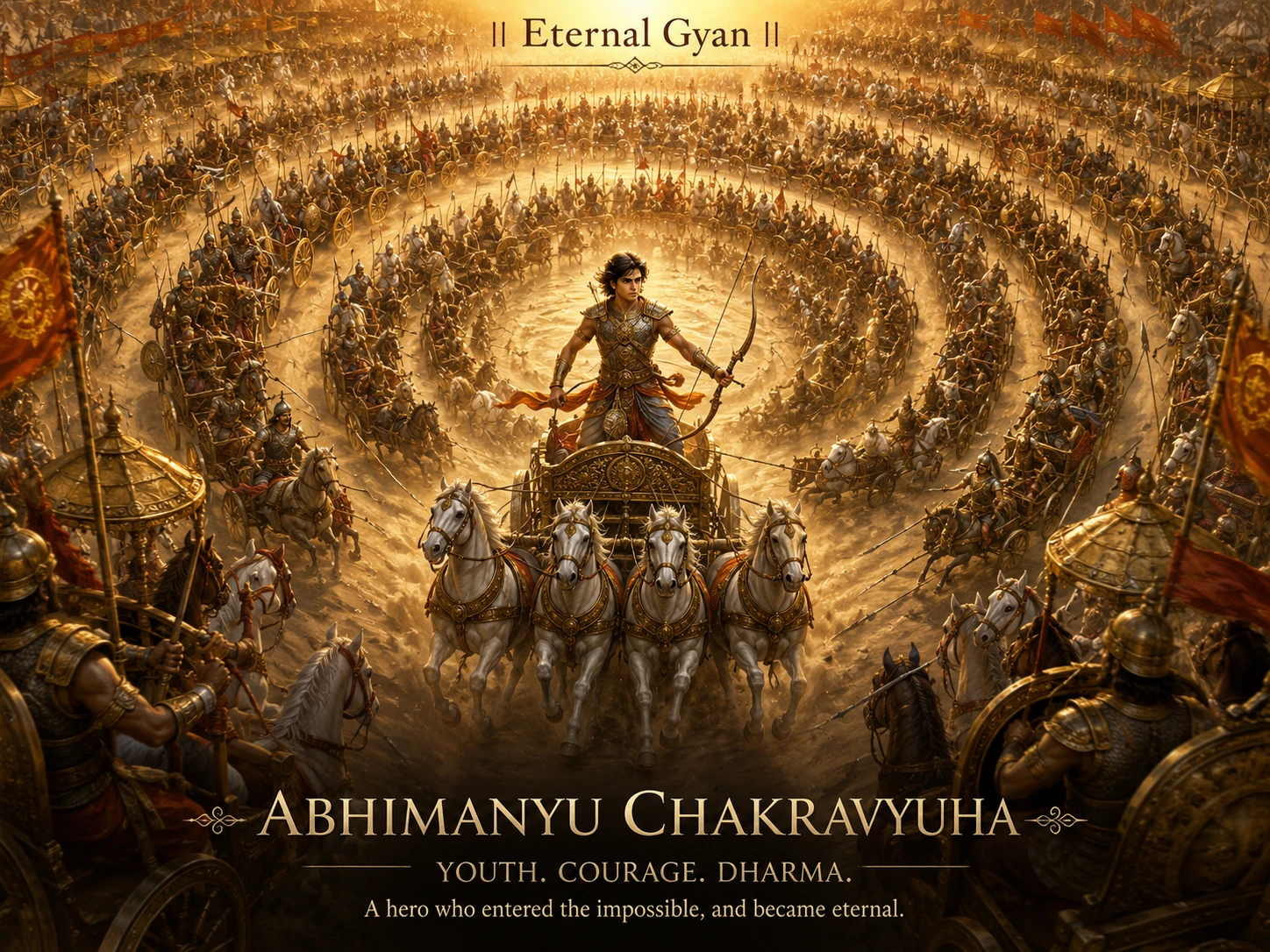
Abhimanyu and the Chakravyuha -- The Boy Who Knew How to Enter but Not How to Leave
14 min read
Adbhuta Ramayana -- The Ramayana Where Sita Becomes Kali
9 min read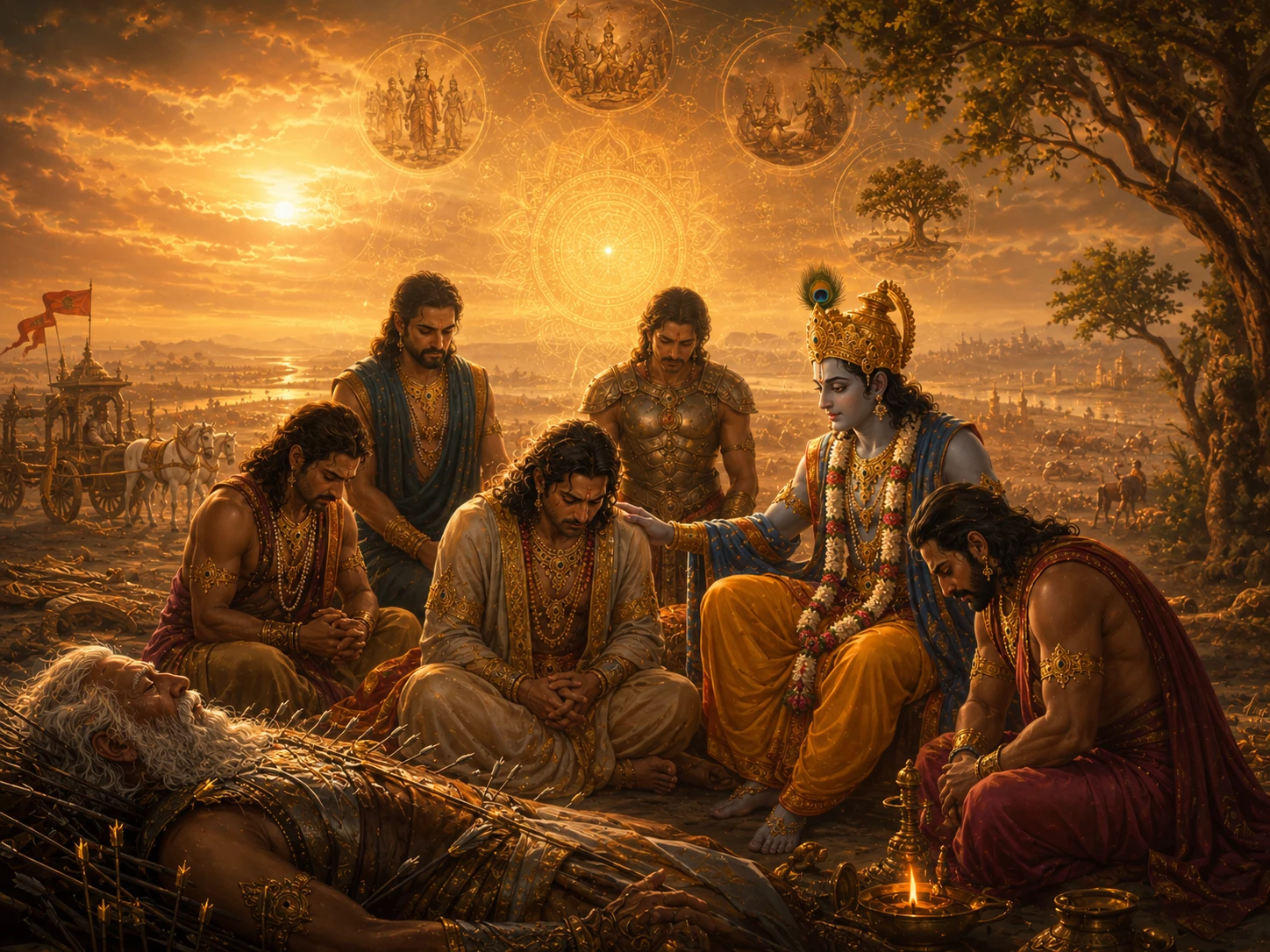
After Kurukshetra -- What Happened Next
14 min readThe same translation error that turned '33 Koti' into '33 crore' in Hinduism also happened in Buddhism. The Chinese translation of Buddhist texts rendered 'Sapta Koti Buddha' (7 Supreme Buddhas) as '7 Crore Buddhas.' The…
Deities AvatarsCommunity Reflections
🕉️
Be the first to share your reflection.