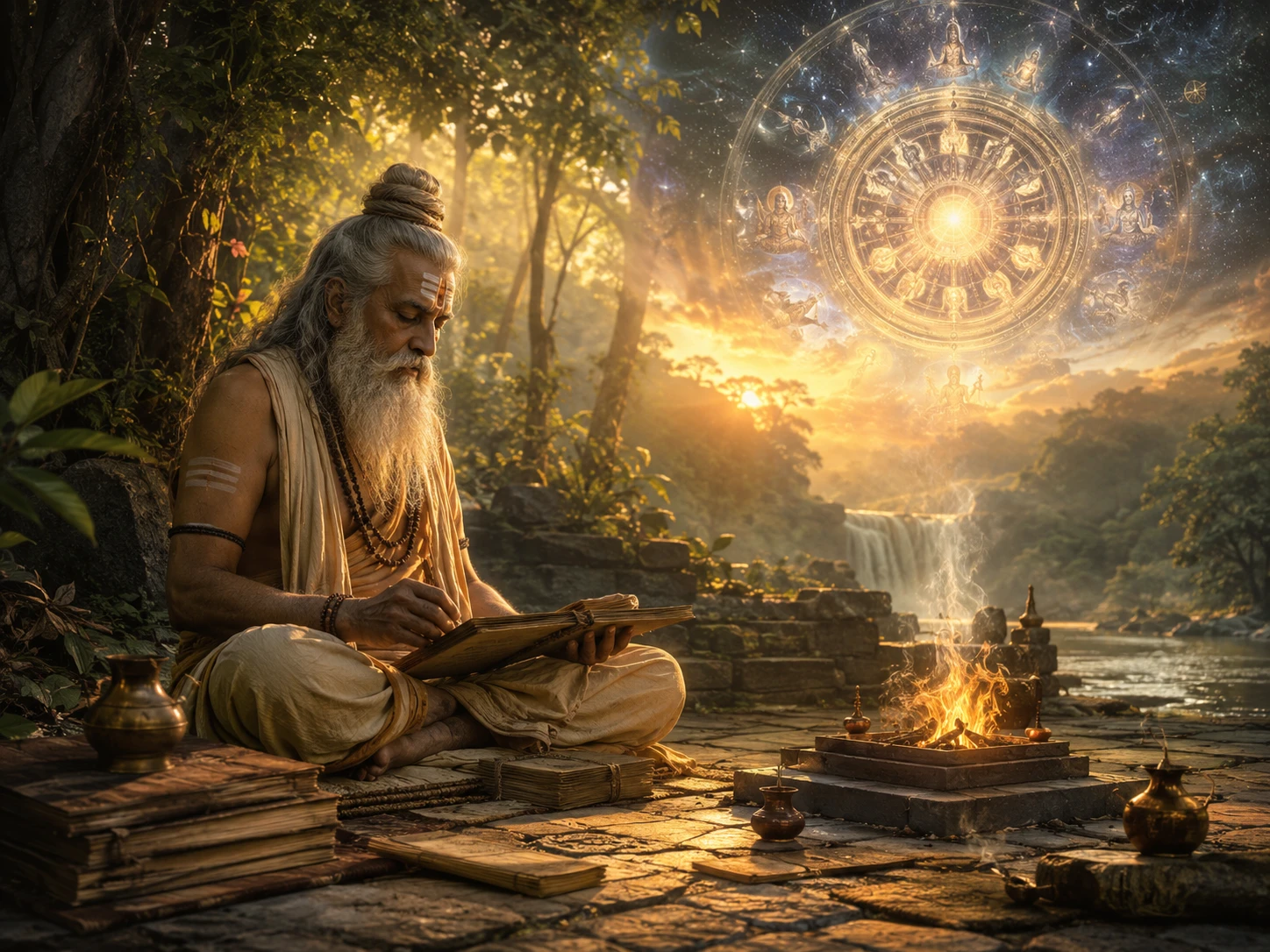
Shvetashvatara Upanishad -- Rudra and the Birth of Bhakti
श्वेताश्वतर उपनिषद् -- रुद्र और भक्ति का जन्म
Where Vedanta Caught Fire
Most Upanishads ask quiet questions. The Shvetashvatara begins with a thunderclap.
Five questions are flung into the universe in the very first verse: What is the cause of the cosmos? Is it Brahman? Where do we come from? By what do we live? Where do we finally rest? No preamble, no settling-in, no philosophical throat-clearing. The reader is dropped straight into the deepest waters of Vedantic enquiry.
What makes this Upanishad extraordinary is not just the urgency of its questions, but the form of its answer. Where the Brihadaranyaka teaches through royal courts and the Chandogya through lyrical metaphors, the Shvetashvatara breaks open Vedantic abstraction and pours devotional fire into it. The impersonal Brahman of earlier Upanishads is here recognized as Rudra, the One Lord, and -- for the first time in surviving Sanskrit literature -- the word bhakti is used to name the proper response of the soul.
This is the Upanishad where Vedanta meets bhakti, where philosophy meets surrender, where the seeker stops asking 'what is reality' and starts asking 'whom should I love'. Embedded in the Krishna Yajurveda and counted as the fourteenth in the Muktika canon of 108 Upanishads, the Shvetashvatara contains 113 mantras across six chapters. Sage Shvetashvatara is named in its closing verse as the one who taught it to the most worthy among his students.
For Shaivas, this is the foundational Upanishad. For Vedantins, it is the bridge that connects Advaita's silent absolute to the devotional currents that would later flower into the Bhakti movement. For modern seekers, it is the Upanishad that proves Vedanta and devotion were never enemies in the Hindu tradition. They were, from the beginning, two faces of one search.
किं कारणं ब्रह्म कुतः स्म जाता जीवाम केन क्व च सम्प्रतिष्ठाः। अधिष्ठिताः केन सुखेतरेषु वर्तामहे ब्रह्मविदो व्यवस्थाम्॥
kim kaaranam brahma kutah sma jaataa jeevaama kena kva ca sampratishthaah adhishthitaah kena sukhetareshu vartaamahe brahmavido vyavasthaam
What is the cause? Is it Brahman? From where are we born? By what do we live? Where do we finally rest? Governed by whom do we, knowers of Brahman, move through pleasure and pain in their proper measure?
— Shvetashvatara Upanishad 1.1
The Sage Behind the Name
Who was Shvetashvatara? The compound name itself is a clue. Shveta means 'white', ashva means 'horse' (or by some readings, mule). The name literally translates to 'one whose horse is white' -- a metaphor traditional commentators read as 'one whose senses have been purified, made luminous'. The white horse is the disciplined sense-organ. The sage who tames his white horse is one who has mastered the inner conveyance.
Little else is known of him historically. He is named in the closing colophon of the Upanishad itself: 'By the power of his austerity and the grace of the Lord, the wise Shvetashvatara taught this supreme, sacred secret to the most worthy ascetics.' The dating of the text is contested -- most scholars place it in the late Upanishadic period, somewhere between the 6th and 4th centuries BCE, after the Brihadaranyaka and Chandogya but before the Mandukya. By this period, the Vedic ritual culture was being internalized into yogic practice, and the abstract Brahman of earlier seers was being gathered into the personal form of Ishvara.
The Upanishad is unusual in another way. Many of its mantras are not original. Verses 2.1 through 2.3 also appear in the Taittiriya Samhita and the Shatapatha Brahmana. Several verses across chapters 3 to 6 echo passages in the Rig Veda, Yajur Veda, and Atharva Veda. This is not plagiarism. The Upanishad is consciously gathering the most powerful Vedic mantras about Rudra and re-presenting them through a Vedantic lens. It is, in effect, the first theological synthesis in the Hindu tradition -- an attempt to argue that the Rudra of the Vedic hymns and the Brahman of the Upanishads are one and the same.
For a young seeker today reading this in a Bandra apartment between deadline cycles, the Upanishad's structure is itself a teaching. Sometimes the deepest answers are not new revelations. Sometimes they are old truths gathered into a new pattern, until you finally see what was always there.
एको हि रुद्रो न द्वितीयाय तस्थु- र्य इमाँल्लोकानीशत ईशनीभिः। प्रत्यङ् जनास्तिष्ठति सञ्चुकोचा- न्तकाले संसृज्य विश्वा भुवनानि गोपाः॥
eko hi rudro na dviteeyaaya tasthur ya imaa.nl lokaanee.shata ee.shaneebhih pratyang janaastishthati sa.nchukochaa- ntakaale samsrijya vishvaa bhuvaanaani gopaah
There is one Rudra alone. They do not allow a second. He governs all worlds by his powers. He stands within all beings. After projecting all the worlds, the Protector withdraws them at the end of time.
— Shvetashvatara Upanishad 3.2
The Theological Move
Read verse 3.2 carefully. It is doing something extraordinary in the Vedic landscape. In the Rig Veda, Rudra is one deity among many, fierce and uncertain. By the time of the Shatarudriya hymn in the Yajur Veda, Rudra is being addressed in a hundred forms across cities, forests, mountains, and weapons. But here, in the Shvetashvatara, Rudra has become the One. There is no second.
This is the seed of all later Shaiva theology. The Pashupata sect would later draw directly from this Upanishad for its core doctrine. Lakulisha, the founder of historical Pashupata Shaivism (around 2nd century CE), is recorded as quoting Shvetashvatara verses verbatim. Centuries later, Abhinavagupta of Kashmir Shaivism would build his entire system on the Shvetashvatara's claim that Shiva is both the witness and the witnessed, both the actor and the stage.
But the Upanishad is also careful. Read verse 3.2 again: 'They do not allow a second.' Whose 'they'? The wise. The Upanishad is not commanding belief. It is reporting what those who have realized the truth have always said. This is not theological imperialism. It is testimony.
For a Bengali college student in Jadavpur who grew up in a Kalighat-going household, this verse offers a quiet liberation. The mother goddess of her childhood and the Shiva of her grandfather's bhajans are not in competition. They are aspects of the same One whom the Shvetashvatara names Rudra and the later tantras name Shiva-Shakti. The Upanishad clears the philosophical ground for every later Hindu reconciliation -- of Vaishnavas with Shaivas, of Shaktas with Vedantins, of household devotion with monastic abstraction.
The word 'Eka' (One) is doing immense work here. Not 'one among many'. Not 'the most important one'. The One who alone is, who appears as the many. From this single sentence, the entire architecture of Hindu non-dualism would later be raised.
एको देवः सर्वभूतेषु गूढः सर्वव्यापी सर्वभूतान्तरात्मा। कर्माध्यक्षः सर्वभूताधिवासः साक्षी चेता केवलो निर्गुणश्च॥
eko devah sarvabhooteshu goodhah sarvavyaapee sarvabhootaantaraatmaa karmaadhyakshah sarvabhootaadhivaasah saakshee chetaa kevalo nirgunashca
The one Lord is hidden in all beings. He is all-pervading. He is the inmost Self of all creatures. He presides over all action. He resides within all things. He is the Witness, the Awareness, the Absolute, free from the gunas.
— Shvetashvatara Upanishad 6.11
The First Time Bhakti Was Named
Now we come to the verse that changed Hindu spirituality forever. In the closing chapter of the Upanishad, almost as a final transmission, comes this:
'Yasya deve para bhaktih, yatha deve tatha gurau.' The one who has supreme bhakti for the Lord, and equal bhakti for the guru -- to such a great soul, the meanings of the teaching shine forth. (Verse 6.23)
This is, by current scholarly consensus, the first occurrence of the word 'bhakti' in surviving Vedic Sanskrit literature. The word existed before in non-religious senses (devotion to a king, attachment to a cause). But here, for the first time in the corpus, bhakti is named as the spiritual relationship of a soul to the divine.
The consequences are difficult to overstate. From this single word, every later development of devotional Hinduism eventually flows. The Bhagavata Purana's nine forms of bhakti, the Alvars and Nayanars singing in Tamil, Mirabai's surrender to Krishna, Tulsidas's Ramcharitmanas, Tukaram's abhangas in Marathi, the modern grandmother's Hanuman Chalisa at dusk -- all of it has its earliest scriptural footprint here, in a six-chapter Upanishad embedded in the Krishna Yajurveda.
What is striking is how naturally bhakti enters the Vedantic conversation. There is no dramatic announcement. The Upanishad has been arguing for the radical immanence of Rudra -- One, beyond gunas, hidden in every being. And then, almost as a quiet conclusion, it says: when you have realized this, the appropriate response is bhakti. Not philosophical pride. Not theological certainty. Bhakti -- love that has become surrender.
For a 25-year-old data scientist in Hyderabad who chants the Maha Mrityunjaya Mantra every morning before opening her laptop, this verse explains why her practice does not feel contradictory to her work. Bhakti is not the rejection of intellect. It is what intellect arrives at when it has gone far enough.
Where Shvetashvatara Stands Among the Major Upanishads
| Upanishad | उपनिषद् | Veda | Core Teaching | Tone |
|---|---|---|---|---|
| Brihadaranyaka | बृहदारण्यक | Shukla Yajur Veda | Aham Brahmasmi -- I am Brahman | Royal court dialogues, dialectical |
| Chandogya | छान्दोग्य | Sama Veda | Tat Tvam Asi -- That thou art | Lyrical, parable-rich |
| Katha | कठ | Krishna Yajur Veda | The Self is unborn, eternal | Narrative -- Nachiketa and Yama |
| Mundaka | मुण्डक | Atharva Veda | Two birds, two paths to know Brahman | Concise, metaphor-driven |
| Mandukya | माण्डूक्य | Atharva Veda | Om and the four states of consciousness | Compressed, technical |
| Shvetashvatara | श्वेताश्वतर | Krishna Yajur Veda | Eko Rudro -- One Lord, hidden in all | Theistic, devotional, synthetic |
Shvetashvatara is the only major Upanishad to fully integrate theism and bhakti into Vedantic enquiry. The others speak of Brahman without naming it as a personal Lord; this one names Rudra and prescribes devotion.
The Three Strands -- Brahman, Atman, and Maya
One of the Shvetashvatara's most influential contributions to Indian philosophy is its early articulation of three irreducible realities: the supreme Brahman (the Lord), the individual atman (the soul), and prakriti or maya (the matrix of manifestation). Most early Upanishads collapse these into one. The Shvetashvatara holds them in productive tension, and centuries of Hindu philosophy would unfold around the question of how exactly the three relate.
In chapter 4, the Upanishad introduces the famous image of the two birds on a single tree. One bird eats the sweet and bitter fruits. The other simply watches, untouched. The first bird is the individual self caught in the cycle of action and reaction. The second is the witness-Self, the unchanging Atman that observes without being implicated. The same image would later be quoted in the Mundaka Upanishad and become one of the most discussed metaphors in Vedantic literature. Shankara would use it to argue for non-duality. Ramanuja would use it to argue for qualified non-duality. Madhva would use it to argue for duality. The image is so rich it can support all three readings.
The Upanishad also speaks of maya, but not in the dismissive sense the word later acquired in popular discourse. Maya is not 'illusion' in the sense of 'fake'. Maya is the creative power of the Lord through which the One appears as the many. In verse 4.10, the Upanishad uses the striking phrase 'maayam tu prakritim vidyaad maayinam tu maheshvaram' -- understand that maya is prakriti, and the wielder of maya is the great Lord himself. Maya is not the enemy of liberation. It is the energy by which the Lord creates the world we live in. Liberation is not denying the world but seeing it for what it is: the Lord's own creative play.
This matters for a 28-year-old physicist working at TIFR Mumbai who has been told that 'Hinduism teaches the world is unreal'. The Shvetashvatara teaches no such thing. It teaches that the world is the Lord's creative self-manifestation, and that liberation comes from recognizing the One who is appearing as the many. This is a positive metaphysics, not a world-denying one. The yoga the Upanishad prescribes, the bhakti it names, the questions it opens with -- all of it is in the service of remaining fully alive in this manifested world while no longer being deceived about what is doing the appearing.
The Maha Mrityunjaya Mantra ('tryambakam yajamahe') that millions of Indians chant daily comes from the Rig Veda 7.59.12. But it was the Shvetashvatara Upanishad that first absorbed Rudra-worship into the Vedantic mainstream. Without this Upanishad's theological move, the Maha Mrityunjaya might have remained a sectarian Vedic chant rather than the pan-Hindu mantra it became. From a Bandra apartment to the Banaras ghats to a Tamil temple priest's morning sandhya, the chain of transmission runs through six chapters of the Shvetashvatara.
The Yoga Inside the Upanishad
The Shvetashvatara is also one of the earliest Upanishads to describe yoga as a structured practice. Chapter 2 contains some of the most quoted passages on posture, breath control, and sense-withdrawal in all of Indian literature. Verse 2.10 instructs the seeker to find a quiet place, free of pebbles, fire, and sand, sheltered from wind, water, and noise -- a description that has shaped temple-yoga halls and modern meditation rooms alike. Verse 2.8 prescribes holding the body, head, and neck erect in three equal lines -- the foundational instruction of every Hatha Yoga manual that would follow over the next two thousand years.
What makes the Shvetashvatara's yoga distinctive is that it is never merely physical. Posture is preparation for the encounter with Rudra. Breath is the bridge between the seeker's body and the cosmic Self. Sense-withdrawal is not a calming technique. It is the soul learning to look inward, where the One God is hidden. By integrating yoga, theism, and Vedanta into a single text, the Shvetashvatara prefigures the entire Indian contemplative tradition that would follow.
For a 21-year-old engineer in Bengaluru who started her morning yoga practice during the pandemic and has now begun reading translations of the Upanishads, the Shvetashvatara is a homecoming. The asana she has been practising for four years is not separate from the wisdom literature she is just discovering. The text knew, two and a half millennia ago, that body, breath, and bhakti are not three different paths. They are three doors into one inner room.
The Upanishad does not split philosophy from practice or devotion from discipline. It places them in the same chapter, in the same breath. Read aloud, the verses still feel like a whispered instruction from a teacher who knew that knowledge without devotion is brittle, devotion without knowledge is wild, and yoga without both is just stretching.
यस्य देवे परा भक्तिर्यथा देवे तथा गुरौ। तस्यैते कथिता ह्यर्थाः प्रकाशन्ते महात्मनः॥
yasya deve paraa bhaktir yathaa deve tathaa gurau tasyaite kathitaa hyarthaah prakaashante mahaatmanah
The one who holds supreme bhakti for the Lord, and equal bhakti for the guru -- to such a great soul, all these teachings, when spoken, shine forth in their full meaning.
— Shvetashvatara Upanishad 6.23 -- the first scriptural use of the word 'bhakti' in surviving Sanskrit literature.
The Six Chapters at a Glance
Reading the Shvetashvatara front to back rewards effort. Each chapter has a distinct character, and the progression is deliberate. Chapter 1 opens with the five great questions and gathers the existing Vedic and Upanishadic positions on causation -- some say time is the cause, some say nature, some say chance, some say the elements. The chapter concludes that none of these alone is sufficient. There must be an Ishvara, a conscious supreme who orders the cosmos.
Chapter 2 turns inward. The Vedic mantra 'yunjaanah prathamam manah' (yoking the mind first) opens a sustained meditation on yoga as preparation. The chapter contains the practical instructions on posture, breath, and place that are still recited in some traditions before sitting for sadhana. This is where Hindu yoga first becomes visible in scriptural form as a structured discipline rather than scattered Vedic hints.
Chapter 3 returns to theology. Rudra is named explicitly and exalted as the One who manifests as the many. The chapter contains the verse 'eko hi rudro na dvitiyaya tasthuh' that we have already explored, and several mantras adapted from the Rig Veda's Purusha Sukta. This is where the Upanishad's Shaiva theology is most clearly stated.
Chapter 4 introduces maya, prakriti, and the two-birds metaphor. It is the Upanishad's most philosophically dense chapter, and the one most often quoted by later Vedantic commentators. The famous verse 'ya eko varnah bahudhaa shaktiyogaad varnaan anekan nihitaartho dadhaati' -- the One Lord, who is colourless, by the power of his own yoga places many colours in his hidden purpose -- comes from this chapter.
Chapter 5 is short and gathers the previous teachings. It speaks of the soul's bondage and liberation, the seer and the seen, ignorance and knowledge. It is dense with paradox: the Lord is both within the cave of the heart and beyond all space, both unborn and the source of all birth.
Chapter 6 is the climax and the colophon. Here the bhakti verse appears. Here the Upanishad's authorship is acknowledged. Here the long meditation on the One who is both Brahman and Rudra reaches its emotional peak: the recognition that knowledge alone is not enough, that even the deepest understanding must finally bow. The Upanishad ends not in propositional certainty but in surrender. This is its final teaching.
Why This Upanishad Still Matters
Adi Shankara wrote a commentary on the Shvetashvatara. Ramanuja, the Vaishnava acharya who saw the world differently from Shankara on almost everything, also drew on it. Madhva, who founded Dvaita Vedanta and disagreed with both, cited it. The 14th-century Vedanta scholar Vijnana Bhikshu used it to argue for the unity of Sankhya, Yoga, and Vedanta. In the 20th century, Sri Aurobindo's translation of the Upanishads gave the Shvetashvatara extended treatment. Swami Chinmayananda's commentary on it filled lecture halls in Mumbai through the 1970s. In every era, when Hindu thinkers have wanted to argue that intellect and devotion are one path, the Shvetashvatara has been their proof text.
Why does this matter to a young person navigating a tech career, a difficult relationship, or a parent's illness in 2026? Because the Upanishad addresses the modern crisis precisely. The educated Indian today often feels split. The intellectual side of her wants Vedanta -- the cool, analytical examination of consciousness. The emotional side wants devotion -- the comfort of an Aarti, the surrender of a temple visit, the catch in the throat when a bhajan is sung well. The Shvetashvatara says: stop apologizing for either. They were never opposed. They were always the same Rudra, approached through different doors.
The Upanishad does not ask you to choose. It asks you to integrate. The questions it opens with -- where do we come from, by what do we live, where do we rest -- are not solved by philosophy alone. They are not solved by emotion alone. They are answered by the slow ripening of a self that has learned both to think and to love, both to question and to surrender, both to study and to chant.
This is why the Shvetashvatara endures. It is the Upanishad of the integrated seeker. And the integrated seeker, in every century, is the one who comes home.
A final note worth keeping. The Shvetashvatara has been the favourite Upanishad of working scientists in India for nearly a hundred years. C.V. Raman quoted from it. The 1953 critical edition produced at the Tilak Maharashtra Vidyapeeth in Pune treated it with the same textual rigour applied to a manuscript at BORI. Physicists at TIFR Mumbai and IUCAA Pune have written essays on the parallels between its language of the One showing itself as many and the language of quantum field theory, while honestly noting that parallels are not proofs and the Upanishad is not a physics paper. This is the right tone. The Shvetashvatara does not need to be retrofitted to modern science to matter. It already does what science cannot: it tells the seeker that the same intelligence that lit the first star is the intelligence that is reading these words right now, and that recognition -- not equation -- is the destination. For an engineer in Bengaluru, a doctor in Chennai, a teacher in Patna, or a homemaker in Lucknow, this is not an abstract claim. It is the most practical instruction the tradition has left.
Begin with the Maha Mrityunjaya
The simplest entry into the Shvetashvatara's world is the Maha Mrityunjaya Mantra, which honours the Rudra of this Upanishad. Begin with 11 repetitions before sleep, building to 108 over time.
Eternal Raga · शाश्वत राग
Institutional voice — scholarly articles on Sanatan Dharma
Deepen Your Understanding
अपनी समझ और गहरी करें
philosophy darshana
The Four Mahavakyas -- Upanishadic Sentences That Changed Civilisation
Four sentences. Twelve words of Sanskrit. Three thousand years of commentary. The Mahavakyas are the most compressed, most powerful, and most debated statements in all of Indian philosophy. Each one claims that the individual self and the ultimate reality of the universe are not two different things. And each one has been interpreted to mean something completely different by every major school of Vedanta.
scriptural exegesis
Chandogya Upanishad -- Tat Tvam Asi
A 24-year-old returns from 12 years of Vedic study, bloated with pride and stuffed with textbook knowledge, only to have his father demolish his certainty with nine repetitions of three words: Tat Tvam Asi -- You Are That. The Chandogya Upanishad is the text that broke the wall between God and you.
deities avatars
Who is Shiva?
He is the ash-smeared ascetic who is also the ideal husband. The destroyer of the universe who is called 'The Auspicious One.' The god of death who drank poison to save all life. He sits in meditation on a Himalayan peak, and simultaneously dances the cosmos into existence and annihilation. No deity in Hinduism contains more contradictions -- and no deity resolves them more completely. This is not a mythology explainer. This is an attempt to stand at the foot of the mountain and look up.
vedic sciences
Kaal Ganana -- The Hindu Measure of Time
From a single blink of the eye (Nimesha) to one Day of Brahma (4.32 billion years) -- explore the complete cosmic time hierarchy of Hindu cosmology, anchored in Vishnu Purana 1.3, with its remarkable parallels to modern science.
tantra mantra yantra
Tantra, Mantra and Yantra -- The Three Pillars of Spiritual Practice
Tantra is the loom, Mantra is the thread, Yantra is the pattern. Together they form the complete technology of spiritual transformation that India gifted to the world -- and they are far more profound than popular culture imagines.
scriptural exegesis
Markandeya -- The Sage Who Conquered Death
A boy given sixteen years to live, who clung to a Shiva linga when Death came for him; a sage who survived the end of the world and saw a child floating on a banyan leaf. The two great stories of Markandeya, the deathless rishi of the Puranas.
The Maha Mrityunjaya Mantra ('tryambakam yajamahe') that millions of Indians chant daily comes from the Rig Veda 7.59.12. But it was the Shvetashvatara Upanishad that first absorbed Rudra-worship into the Vedantic mainst…
More in Scriptural Exegesis
Abhimanyu and the Chakravyuha -- The Boy Who Knew How to Enter but Not How to Leave
14 min read
Adbhuta Ramayana -- The Ramayana Where Sita Becomes Kali
9 min read
After Kurukshetra -- What Happened Next
14 min readThe same translation error that turned '33 Koti' into '33 crore' in Hinduism also happened in Buddhism. The Chinese translation of Buddhist texts rendered 'Sapta Koti Buddha' (7 Supreme Buddhas) as '7 Crore Buddhas.' The…
Deities AvatarsCommunity Reflections
🕉️
Be the first to share your reflection.