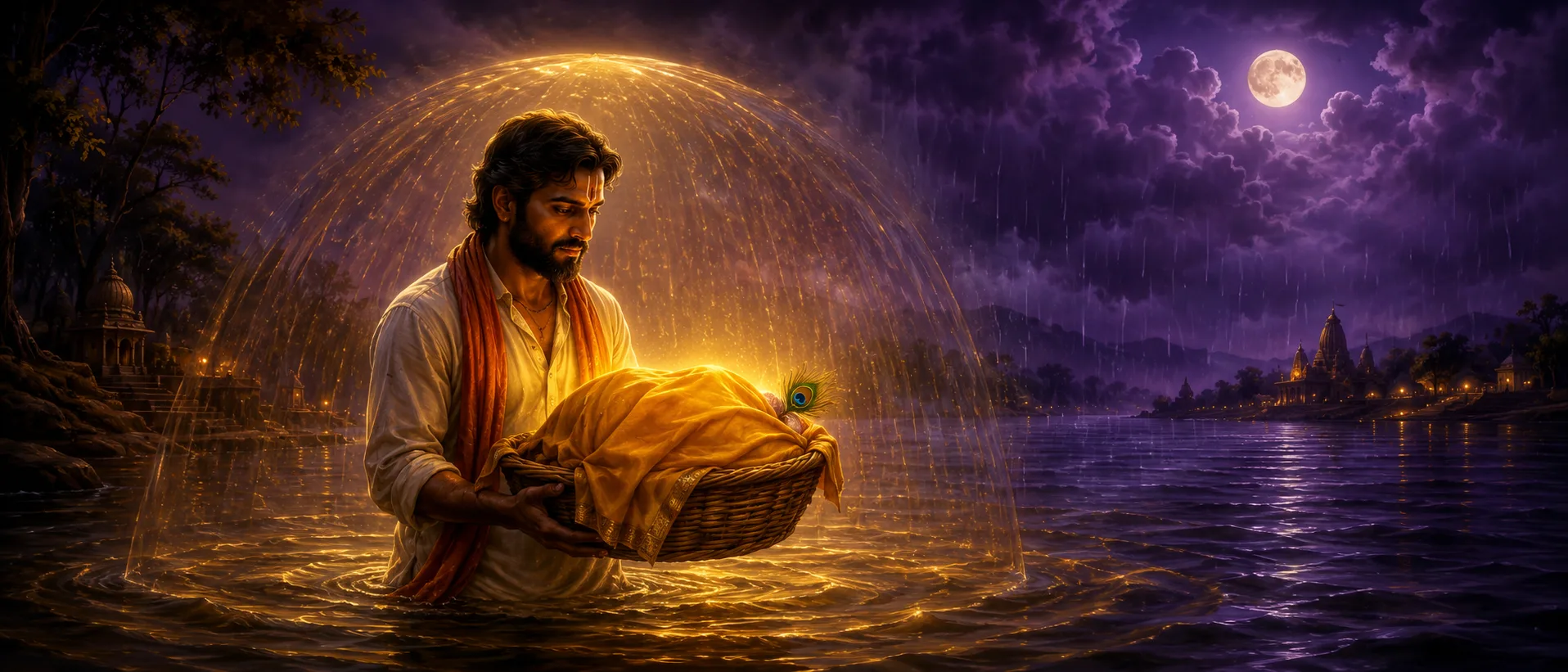
Skandha 4 opens with the Nara-Narayana sages' austerities disturbed by the Apsaras, Prahlada's own pilgrimage and battle-vision of Narayana, and the story of Bhrigu's curse on Vishnu after Vishnu kills Bhrigu's wife in Shiva's defense — a curse resolved only through the entangled Shukracharya-Jayanti-Brihaspati episode. The skandha then widens its lens to catalogue Hari's avatars in general before narrowing back to one in particular: the full story of Krishna's birth in Devaki's prison cell, his exchange for Yashoda's daughter, Kamsa's death at the hands of his own sister's child, and — in one of this skandha's most distinctive passages — a systematic roll call of which Mahabharata-era figures (Karna, Bhishma, Draupadi, Vidura, and others) are the partial earthly descents of which gods. The skandha's final movement turns to Krishna's own asceticism: his Pashupata austerities to win a weapon from Shiva, during which Shiva foretells the eventual mutual destruction of the entire Yadava clan — a grief the Goddess herself steps in to console — closing with a philosophical declaration of Para Shakti's all-encompassing omniscience.
Chapters
Why it matters today
The amsha-avatarana catalogue in this skandha — mapping Mahabharata-era humans to specific partial divine descents — is one of Puranic literature's clearest examples of retroactive theological systematization, taking an already-famous epic's cast and re-reading it through a cosmological lens the epic itself doesn't fully spell out.