
Nila Devi -- Vishnu's Third and Least-Known Consort
नीला देवी -- विष्णु की तीसरी और सबसे अल्पज्ञात संगिनी
Walk into almost any Vishnu temple across South India and the sanctum shows a familiar pair: Sridevi on one side, holding a lotus and identified with Lakshmi, and Bhudevi on the other, standing for the earth itself. Ask a Sri Vaishnava priest whether there is a third consort and most will confirm it without hesitation. Her name is Nila Devi, sometimes written Neela Devi or Niladevi. She is real within the tradition, she has a documented Vedic hymn addressed to her, and she has at least one working temple built specifically around her. But she is not carved into the base of most Vishnu murtis. She has no festival calendar that rivals Navaratri or Diwali. She does not appear among the thousand names of the Vishnu Sahasranama. If a devotee has never heard her name, that is not a failure of religious education. It reflects how thin and scattered the documentation on her actually is, confined mostly to a specific stream of Tamil Sri Vaishnava (Vishishtadvaita) theology and a handful of Sanskrit and Tamil devotional texts. Nila Devi's name comes from nila, meaning dark or blue, the same word used for Krishna's complexion and for the blue lotus, the utpala. In the theology of the Sri Vaishnava lineage, she completes a trio: Sridevi, Bhudevi, and Nila Devi, together regarded as the three modes in which Vishnu's consort Lakshmi's grace reaches the world. What follows is an honest account of what is actually documented about her, and where the documentation runs out.
Nila Devi's clearest appearance in devotional literature comes through two separate figures whom Sri Vaishnava tradition treats as her incarnations, one in Tamil bhakti poetry and one in Sanskrit Puranic literature. In the Tamil tradition of the Alvars, the wandering poet-saints of Sri Vaishnavism between roughly the sixth and ninth centuries, she is Nappinnai, described in the Divya Prabandham (the collected Tamil hymns of the Alvars) and in the Sangam-era epic Cilappatikaram as a cowherd girl, the daughter of Kumbhagan, said to be a brother of Yashoda. Krishna wins her hand by subduing seven ferocious bulls that no other suitor could control, a trial that Tamil tradition still connects to jallikattu, the bull-taming sport practised in villages across Tamil Nadu. In the Sanskrit tradition of the Bhagavata Purana, the same motif appears attached to a different woman: Nagnajiti, also called Satya, daughter of King Nagnajit of Kosala, one of Krishna's eight principal queens (the Ashtabharya) at Dvaraka. She too is won by taming seven bulls that no prince before Krishna could master. Sri Vaishnava commentators identify both Nappinnai and Nagnajiti-Satya with Nila Devi, though the two women come from different social worlds, a cowherd's daughter in one telling and a king's daughter in the other, and from different texts written in different languages centuries apart. Whether this is one figure remembered twice or two separate legends absorbed into a single theological category is not something the sources settle. What is documented is that the bull-taming trial, not any single genealogy, is the thread that ties Nila Devi's Krishna-era identity together across both traditions.
स्तोमत्रयस्त्रिंशे भुवनस्य पत्नि विवस्वद्वाते अभि नो गृणाहि ।
stoma-trayastriṃśe bhuvanasya patni vivasvad-vāte abhi no gṛṇāhi |
You who dwell among the thirty-three, mistress of the world, borne on the vital wind of Vivasvan (the sun): hear us and respond to our praise.
— Nila Suktam (also called Vishnu Patni Suktam), Taittiriya Samhita, Krishna Yajur Veda
Nila Devi's status is anchored, thinly but genuinely, in text. The Taittiriya Samhita of the Krishna Yajur Veda contains the Nila Suktam above, and Vaishnava tradition groups it together with the Purusha Sukta, the Sri Sukta, and the Bhu Sukta as hymns central to the worship of Vishnu and his consorts. This puts her in real, if minor, Vedic company. It is worth being precise about what that company means: the Sri Suktam is chanted daily in thousands of Lakshmi temples and homes; the Nila Suktam is recited by comparatively few people, mostly within specific Sri Vaishnava lineages, and does not appear in the standard daily puja manuals most Hindu households use. A separate and much later text, the Sita Upanishad, attached to the Atharva Veda and composed, by most scholarly estimates, somewhere between the twelfth and fifteenth centuries CE, offers a specific philosophical reading: it identifies Sita with three goddesses, Shri, Bhumi, and Nila, and maps them onto the Samkhya theory of three gunas, sattva, rajas, and tamas, with Nila representing tamas. This is one text's framework, composed centuries after the Vedic core and outside the mainstream Rama tradition, not a universally accepted Hindu classification of the three consorts. A separate line of Vaikhanasa Agama literature, the ritual manuals still used in Vishnu temple worship in parts of South India, describes Vishnu's iccha shakti, his will or desire-energy, as manifesting through three consorts. Both frameworks agree that Nila Devi is real and specific within Sri Vaishnava theology. Neither is scripture in the sense the Bhagavad Gita or the major Upanishads are, and a devotee is not required to adopt either reading to hold Sridevi, Bhudevi, and Nila Devi as three names of Lakshmi's grace.
The Three Consorts of Vishnu: What Is Actually Documented
| Consort / संगिनी | Vedic Hymn / वैदिक सूक्त | Guna per Sita Upanishad / सीता उपनिषद अनुसार गुण | Common Iconographic Position / सामान्य मूर्ति-स्थिति |
|---|---|---|---|
| Sridevi (Lakshmi) / श्रीदेवी (लक्ष्मी) | Sri Suktam (Rigveda khila) / श्री सूक्त (ऋग्वेद खिल) | Sattva / सत्त्व | Usually carved beside Vishnu in the main sanctum, holding a lotus / प्रायः गर्भगृह में विष्णु के पास तराशी जाती हैं, हाथ में कमल |
| Bhudevi / भूदेवी | Bhu Suktam / भू सूक्त | Rajas / रजस् | Usually carved beside Vishnu opposite Sridevi, representing the earth / प्रायः श्रीदेवी के विपरीत विष्णु के पास तराशी जाती हैं, पृथ्वी की प्रतीक |
| Nila Devi (Neeladevi) / नीला देवी (नीलादेवी) | Nila Suktam (Taittiriya Samhita) / नील सूक्त (तैत्तिरीय संहिता) | Tamas / तमस् | Absent from most Vishnu sanctums; principal deity at Nachiyar Kovil, Kumbakonam / अधिकांश विष्णु गर्भगृहों में अनुपस्थित; कुम्बकोणम के नाचियार कोविल की प्रमुख देवी |
Most home puja images and temple sculptures of Vishnu show only Sridevi and Bhudevi. Nila Devi's place in the trimurti of consorts is, for most Hindus, a theological and textual fact rather than something they have seen carved in stone. Nachiyar Kovil is the documented exception, and even there she is worshipped as Vanjulavalli or Niladevi Nachiyar rather than always under the Sanskrit name Nila Devi.
The clearest physical anchor for Nila Devi worship is Nachiyar Kovil, also called the Thirunarayur Nambi Temple, in Thirunaraiyur village near Kumbakonam in Tamil Nadu's Thanjavur district. Tradition credits its construction to the Chola king Kochengat Cholan in the third century CE, with later additions by medieval Chola and Vijayanagara rulers; it is one of the 108 Divya Desams, the Vishnu shrines sung about by the Alvars. The temple's own legend holds that the sage Medhavi found a young girl under a vanjula tree in his hermitage, raised her as Vanjulavalli, and that Vishnu later sought her in marriage on the specific condition that she, not he, would hold precedence at this shrine. Nachiyar Kovil keeps that promise in ways that visibly reverse the usual temple order: the goddess, worshipped as Vanjulavalli Nachiyar or Niladevi Nachiyar, is carried first in processions, is served first, and her image is shown standing slightly ahead of Vishnu's rather than beside or behind it. This makes Nachiyar Kovil one of a small number of Divya Desams where the goddess, not the god, is the pradhana or principal deity. The Alvar saint Thirumangai composed more than a hundred verses in praise of this temple and is said to have received his religious initiation here. The temple also keeps a stone Garuda image, the Kal Garudan, that devotees describe as changing weight during processions, requiring anywhere from four to over a hundred bearers depending on the occasion; this is presented by the temple tradition as a wonder, not as a claim this article can verify. What can be verified is the temple's age, its Divya Desam status, its unusual goddess-first ritual order, and its identification of the presiding goddess with Nila Devi under the name Vanjulavalli.
The bull-taming trial that wins Nila Devi her Krishna-era husband, whether told as the story of Nappinnai in Tamil or Nagnajiti-Satya in Sanskrit, is widely credited as the mythological root of jallikattu, the bull-taming sport still practised in villages across Tamil Nadu, most famously around Alanganallur near Madurai during the Pongal harvest festival. In the sport, young men attempt to grab the hump of a charging bull and hold on, echoing the seven-bulls trial Krishna is said to have passed to marry the goddess. Jallikattu has survived colonial-era restrictions, a 2014 Supreme Court prohibition on animal welfare grounds, and a 2017 legislative reversal that restored it in Tamil Nadu under strict safety rules, making it one of the few living rural sports in India with a continuous thread back to a specific consort-goddess legend rather than to a general martial or agricultural custom.
Nila Devi's most vivid literary presence, in the Nappinnai identification, comes through the poet-saint Andal, the only woman among the twelve Alvars, who lived in Tamil Nadu probably in the eighth or ninth century. In her Tiruppavai, thirty verses composed as if sung by a group of cowherd girls performing a vow to win Krishna's favour, Andal reaches Krishna's house and, before she calls out to Krishna himself, she calls out to Nappinnai. Pasurams eighteen through twenty of the Tiruppavai are addressed to Nappinnai directly: the girls ask her to wake, to open the door, and to persuade Krishna, who is described as sleeping in her embrace, to come out and bless them. The sequence matters theologically to the Sri Vaishnava tradition beyond its poetry. It casts Nappinnai, and by extension Nila Devi, in the specific role of purushakara, an intermediary whose intercession precedes and enables access to Vishnu himself, the same structural role Sri Vaishnava theology gives to Lakshmi more broadly. Some commentators within the tradition go further and treat Andal herself as an aspect of Nila Devi, since both are Tamil women absorbed into the god's inner circle through devotion rather than birth into a royal or priestly household. This last claim is a devotional reading specific to certain Sri Vaishnava commentators, not a claim found stated outright in the Tiruppavai itself, and it should be understood as later theology built on top of the poem rather than something Andal wrote about herself.
Put together, what is solidly documented about Nila Devi is this: a named place in Sri Vaishnava consort theology alongside Sridevi and Bhudevi; a genuine Vedic hymn, the Nila Suktam, thinly transmitted compared to the Sri Suktam; two Krishna-era identifications, Nappinnai and Nagnajiti-Satya, linked by the same bull-taming trial in two different language traditions; a documented role as intercessor in Andal's Tiruppavai; and one working temple, Nachiyar Kovil at Kumbakonam, where she is worshipped under the name Vanjulavalli as the principal deity. What is not documented, at least not in any source this research could verify, is a widespread festival calendar in her own name, a standard iconographic form independent of Sridevi and Bhudevi, or a body of vernacular folk practice comparable to what exists for Lakshmi, Radha, or Andal. Nila Devi survives, in most of Hindu practice, as a name devotees invoke inside a formula, three consorts, one grace, rather than as a figure most people picture, pray to individually, or celebrate on a marked calendar day. That is not a flaw in the tradition. Sri Vaishnava theology has always held that Vishnu's grace works through modes that do not need equal public visibility to be equally real. Nila Devi's obscurity is itself consistent with what the tradition says she does: she is the grace that answers when someone approaches with devotion specific and personal enough that it rarely gets written down.
Recite Andal's Nappinnai Pasurams During Margazhi
During the Tamil month of Margazhi (mid-December to mid-January), when Andal's Tiruppavai is recited daily up to Vaikuntha Ekadashi, read pasurams eighteen to twenty aloud. They call on Nappinnai, identified in Sri Vaishnava tradition with Nila Devi, to wake and bring Krishna to the door. The Tiruppavai is not yet on Eternal Raga; the mantra library has other Vishnu hymns.
Tags
Eternal Raga · शाश्वत राग
Institutional voice — scholarly articles on Sanatan Dharma
Deepen Your Understanding
अपनी समझ और गहरी करें
deities avatars
Lakshmi -- Beyond Wealth, the Goddess Who Refuses to Stay
India lights 300 million diyas on Diwali night for a goddess whose central teaching is that wealth is not meant to be hoarded. Lakshmi is the most worshipped and most misunderstood deity in Hinduism -- she represents not money but the flow of abundance, and the moment you try to trap her, she leaves.
deities avatars
Narayana -- Cosmic Vishnu Beyond Avatara
Before Krishna lifted Govardhan and Rama crossed the ocean, there was Narayana lying on the serpent Ananta in the milk ocean. The avatars come and go. Narayana remains. This is the theological Vishnu at the base of every Vaishnava tradition, from Ramanuja's Sri Vaishnavism to the Badrinath pilgrimage to the Ashtakshari mantra every devotee chants.
deities avatars
Krishna Leela -- Why God Chose to Play
He stole butter, broke pots, lied to his mother's face, danced with married women under the full moon, and lifted an entire mountain on his little finger. The Bhagavata Purana's Tenth Skandha -- the most popular 4,000 verses in all of Hindu literature -- is not a biography. It is a theological argument that the Supreme Being's highest expression is not creation, destruction, or cosmic governance. It is play. Krishna Leela is the radical idea that God's truest nature is joy.
deities avatars
Radha -- Krishna's Eternal Beloved and the Supreme Devotee Who Became Greater Than God
She is not mentioned by name in the Bhagavata Purana. She has no temple at the centre of Vrindavan. She did not marry Krishna. And yet -- in the devotional traditions of North India, in the poetry of Jayadeva, in the philosophy of Chaitanya, and in the hearts of millions who chant 'Radhe Radhe' -- she is considered superior to Krishna himself. That is the paradox and the power of Radha.
scriptural exegesis
Samudra Manthan -- When Gods and Demons Ran a Joint Venture and the Universe Almost Died
A cosmic ocean. A mountain for a churning rod. A serpent king for a rope. Gods on one end, demons on the other. And out came 14 treasures -- including wealth, beauty, medicine, immortality, and one poison so lethal it could end creation itself. The Samudra Manthan is not mythology. It is the original playbook for collaboration, crisis management, and how to handle it when your joint venture partner tries to cheat you.
deities avatars
Dashavatara -- Why Vishnu Comes Back Ten Times
Fish, tortoise, boar, half-lion, dwarf, axe-warrior, prince, cowherd, enlightened teacher, future horseman. The ten avatars of Vishnu are not random folklore. Read them in sequence and you get something startling -- a narrative that mirrors evolutionary biology, tracks the rise and fall of political systems, and argues that God does not sit above history but enters it, gets dirty, and does the work. The Dashavatara is Hinduism's answer to the question every civilisation asks: why does the world keep breaking, and who fixes it?
The bull-taming trial that wins Nila Devi her Krishna-era husband, whether told as the story of Nappinnai in Tamil or Nagnajiti-Satya in Sanskrit, is widely credited as the mythological root of jallikattu, the bull-tamin…
More in Deities & Avatars
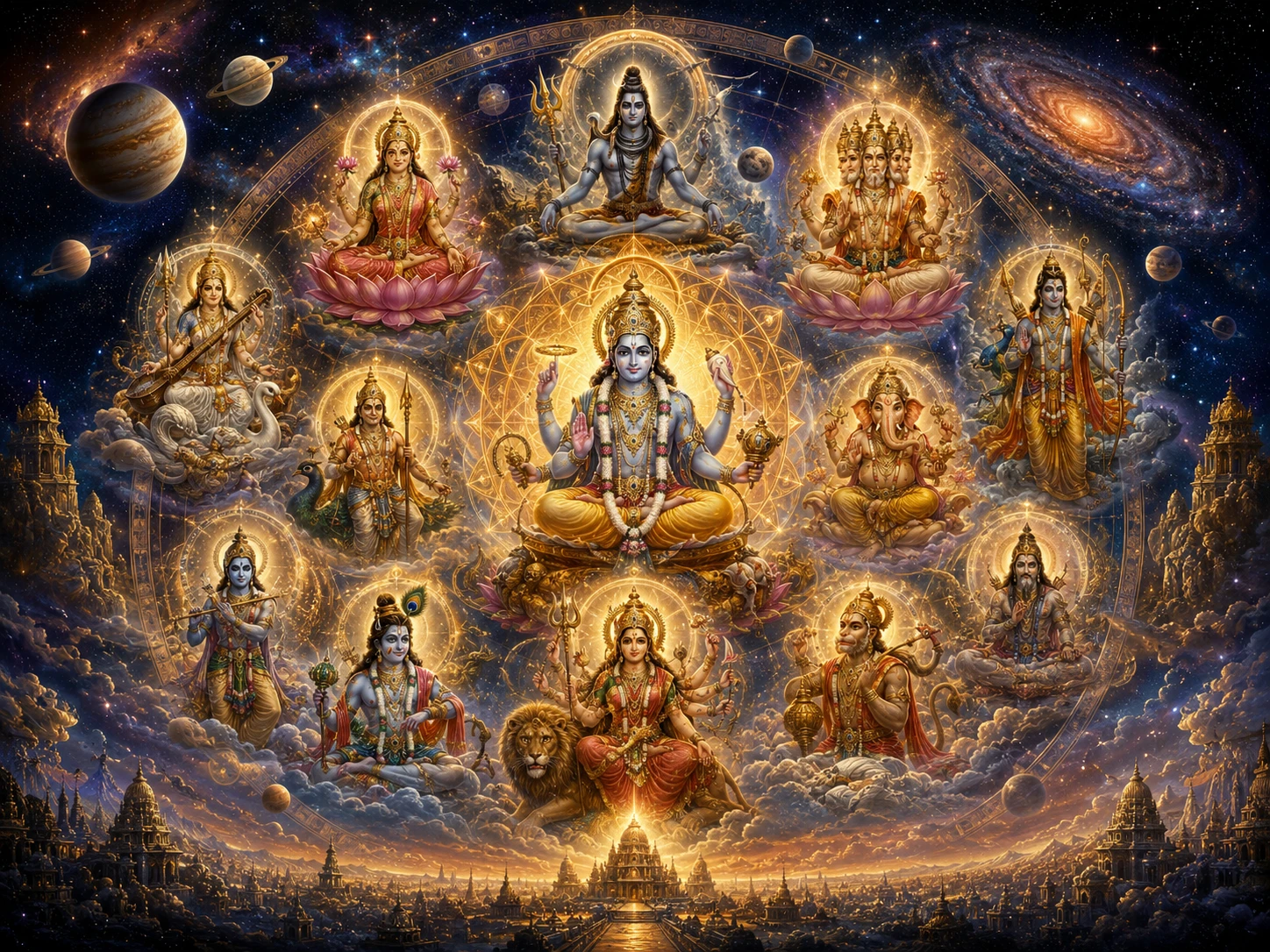
33 Koti Devata -- Why Hinduism Has 33 Types of Gods, Not 33 Crore
13 min read
Agni -- The Fire God
19 min read
Annapurna -- Goddess of Food
19 min readThe same translation error that turned '33 Koti' into '33 crore' in Hinduism also happened in Buddhism. The Chinese translation of Buddhist texts rendered 'Sapta Koti Buddha' (7 Supreme Buddhas) as '7 Crore Buddhas.' The…
Deities AvatarsCommunity Reflections
🕉️
Be the first to share your reflection.