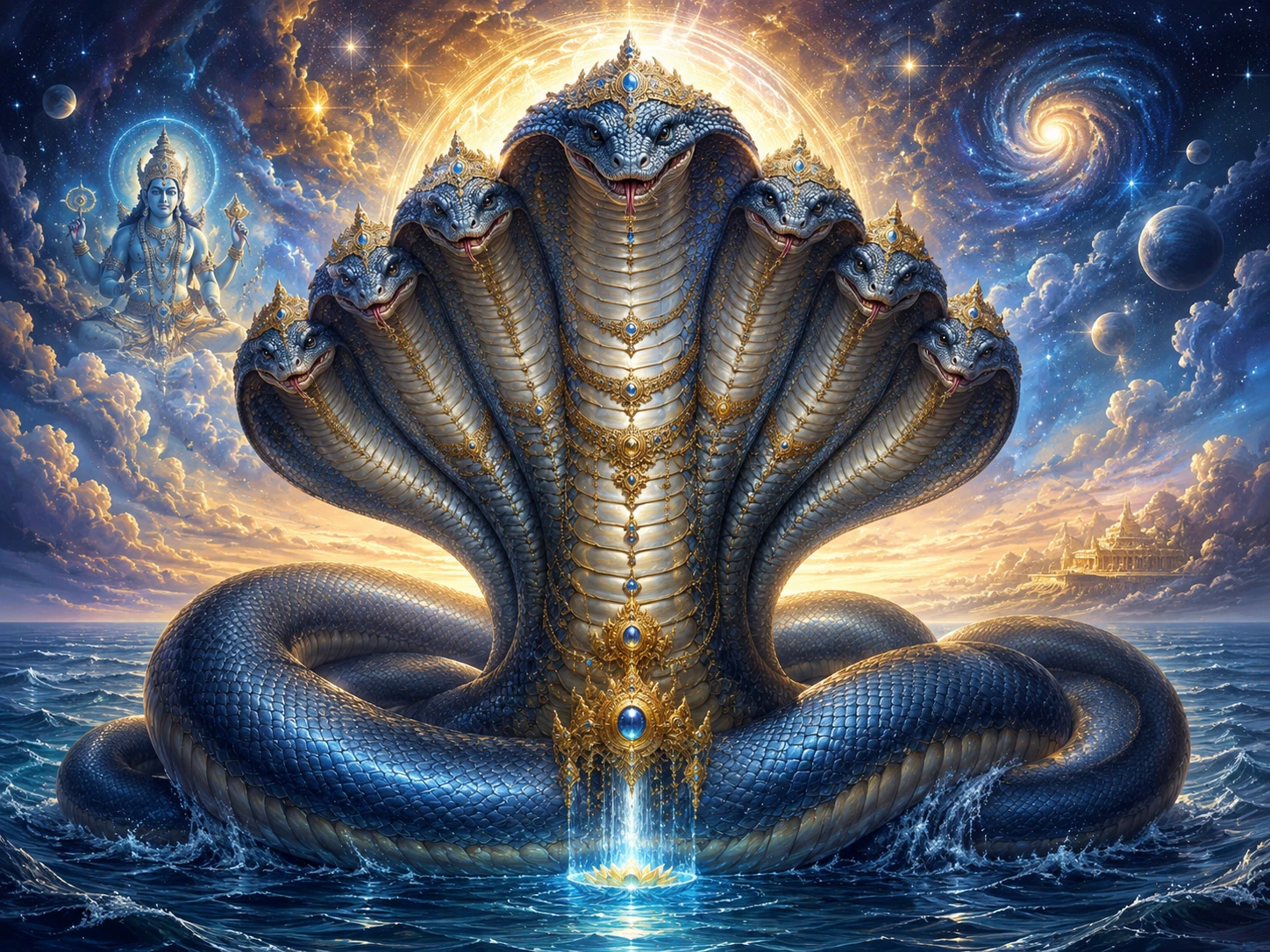
Shesha / Ananta -- The Infinite Serpent
शेष / अनन्त -- अनन्त नाग
Shesha is the cosmic serpent on whom Vishnu reclines during the period of pralaya, the cosmic dissolution that separates one cycle of creation from the next. His other major name is Ananta, 'the endless,' because the Hindu cosmological tradition treats these dissolution periods as extended quiet in which only Shesha remains while everything else has folded back into undifferentiated substance. The visual image is one of the most widely reproduced in Hindu iconography: Vishnu lying in repose on the coils of a thousand-headed serpent floating on the milk-ocean (Kshirasagara), with Lakshmi at his feet gently pressing them, a lotus emerging from Vishnu's navel bearing Brahma in meditation, and sometimes Garuda standing nearby in attendance. Every panel of this scene carries specific theological weight. Shesha is the substrate. Vishnu is the consciousness resting on the substrate. Brahma is the active creative principle that emerges when the consciousness chooses to stir. Lakshmi is the auspicious presence that attends the consciousness even in rest. Together, these four figures describe what Hindu theology considers the fundamental architecture of cosmic existence. Shesha is therefore not a subordinate character in someone else's story; he is one of four principals in the picture of the cosmos at rest.
The etymology of Shesha's name carries the whole theology. Sanskrit shesha means 'remainder,' 'what is left over,' 'residual.' When the Hindu cosmic cycle reaches pralaya and the universe collapses back into its source, what remains after everything else has dissolved is Shesha. Brahma's worlds fold back into him. Vishnu's avatars return to their source. The seven lokas, the fourteen bhuvanas, the elements, the senses, the concepts of time and space -- all these dissolve. Shesha does not. Shesha is, by definition, what cannot be dissolved because he is the substrate on which dissolution takes place. This etymological reading is made explicit in the Bhagavata Purana and elaborated in the commentaries of Ramanuja and Madhva. For Ramanujacharya, Shesha's identity is the clearest demonstration of the doctrine of sharira-shariri-bhava, the body-embodied relationship: everything that is, exists as a body of which the Lord is the embodied self. Shesha is the name of that relationship at its most extensive. The thousand hoods are not decorative. They represent the infinity of what is held up, supported, carried. To exist at all, in Vaishnava understanding, is to rest on Shesha, whether the existing being knows it or not. The serpent's name is the name of the condition of existence itself.
शान्ताकारं भुजगशयनं पद्मनाभं सुरेशं विश्वाधारं गगनसदृशं मेघवर्णं शुभाङ्गम् । लक्ष्मीकान्तं कमलनयनं योगिभिर्ध्यानगम्यं वन्दे विष्णुं भवभयहरं सर्वलोकैकनाथम् ॥
śāntākāraṃ bhujagaśayanaṃ padmanābhaṃ sureśaṃ viśvādhāraṃ gaganasadṛśaṃ meghavarṇaṃ śubhāṅgam | lakṣmīkāntaṃ kamalanayanaṃ yogibhir dhyānagamyaṃ vande viṣṇuṃ bhavabhayaharaṃ sarvalokaikanātham ||
I salute Vishnu -- whose form is peace, who reclines on the serpent, from whose navel springs the lotus, who is the lord of the devas; who is the support of the universe, vast as the sky, cloud-coloured, auspicious in every limb; the beloved of Lakshmi, lotus-eyed, attainable by yogis through meditation; the remover of the fear of worldly existence, the one lord of all the worlds.
— Vishnu Sahasranama Dhyana Shloka (Mahabharata, Anushasana Parva)
The iconography of Shesha in the Anantashayana depictions is specific and structured. He is shown as a vast dark serpent, typically coiled three or more times to form a thick cushion beneath Vishnu's reclining body. His many heads -- conventionally a thousand, though artistic representations usually show five, seven, or nine to keep the image legible -- rise up behind Vishnu like a canopy or hood that shelters the reclining figure. Each head bears a small crown, and from each head the central eye gazes outward. The serpent's body coils disappear into the milk-ocean, suggesting that what we see is only the surface of a body whose full extent is not visible. His tongue is sometimes shown as forked, sometimes single. The overall effect is of vast, watchful, protective presence -- not threat. Temple reliefs of this scene are found across India, including at the Dashavatara Temple at Deogarh (sixth century, one of the earliest surviving depictions), at the massive rock-cut relief at Saranga in Odisha (ninth century, 51 feet long), at Mahabalipuram in Tamil Nadu, and most famously at the Padmanabhaswamy Temple in Thiruvananthapuram (where the Anantashayana murti is 18 feet long and is viewed through three doors, each showing a different portion of the deity's body). The scene is iconic enough to serve as a shorthand for the entire Vishnu theology in two-dimensional art: if you see a reclining figure on a many-hooded serpent, you do not need caption or inscription.
Shesha's two great descents to earth are theologically specific and widely celebrated. The first is as Lakshmana, brother of Rama, in the Treta Yuga. When Vishnu incarnated as Rama to defeat Ravana, Shesha could not bear to be separated from his lord, so he incarnated as Rama's younger brother Lakshmana. This kinship underlies much of the Ramayana: Lakshmana's complete, unquestioning devotion to Rama, his willingness to leave his wife Urmila for fourteen years of exile, his constant service in the forest, and his near-death from the nagapasha all make theological sense only in light of Shesha's underlying identity. The Ramayana gives Lakshmana's wife Urmila as the incarnation of Shesha's consort Nagalakshmi; when Lakshmana left for the forest, Urmila is said to have slept for fourteen years so that her husband could remain wakeful -- transferring his sleep-quota to her so he could serve Rama uninterrupted. The second descent is as Balarama, elder brother of Krishna in the Dvapara Yuga. Balarama's nature is consistent with Shesha's: heavier, slower, more earthen than Krishna; fond of plough and club rather than flute and lila; the steady counterweight to Krishna's fluid movement. These two descents show that Shesha follows Vishnu wherever Vishnu goes; the substrate does not leave the consciousness it supports.
Major Anantashayana Vishnu Temples
| Temple | Location | Features |
|---|---|---|
| Padmanabhaswamy Temple / पद्मनाभस्वामी मंदिर | Thiruvananthapuram, Kerala / तिरुवनंतपुरम, केरल | The 18-foot reclining Vishnu on Shesha, viewed through three doors. India's richest temple by treasure holdings. / शेष पर 18-फ़ुट का शयन-विष्णु, तीन द्वारों से देखा जाता है। ख़ज़ाने की दृष्टि से भारत का सबसे समृद्ध मंदिर। |
| Ranganathaswamy Temple / रंगनाथस्वामी मंदिर | Srirangam, Tamil Nadu / श्रीरंगम, तमिलनाडु | The largest Vaishnava temple in India; presiding deity is Ranganatha in reclining form on Shesha. / भारत का सबसे बड़ा वैष्णव मंदिर; मुख्य देवता शेष पर शयन-मुद्रा में रंगनाथ। |
| Ranganathaswamy, Srirangapatna / रंगनाथस्वामी, श्रीरंगपट्टनम | Karnataka / कर्नाटक | One of the five Ranganatha temples on the Kaveri; Anantashayana murti at the centre. / कावेरी पर पाँच रंगनाथ मंदिरों में से एक; केंद्र में अनंतशयन मूर्ति। |
| Sheshashayi Vishnu / शेषशायी विष्णु | Bhitargaon, Uttar Pradesh / भितरगाँव, उत्तर प्रदेश | Fifth-century Gupta-era temple; one of the earliest depictions of Anantashayana in stone. / पाँचवीं सदी का गुप्त-कालीन मंदिर; पत्थर पर अनंतशयन के सबसे पुराने चित्रणों में से एक। |
| Anantashayana Saranga / अनंतशयन सारंग | Dhenkanal, Odisha / ढेंकानाल, ओड़िशा | Ninth-century open-air rock relief, 51 feet long; largest horizontal Vishnu image in India. / नौवीं सदी का खुला शिलोत्कीर्ण पैनल, 51 फ़ुट लंबा; भारत की सबसे बड़ी क्षैतिज विष्णु छवि। |
The Anantashayana iconography spread from India to Southeast Asia and is found at Angkor Wat in Cambodia, at Chau Say Tevoda, and in Khmer, Cham, and Javanese art. The Padmanabhaswamy Temple remains the most visited contemporary Anantashayana site, drawing millions annually.
The festival of Ananta Chaturdashi, the fourteenth day of the waxing moon in Bhadrapada (usually August-September), is specifically dedicated to Shesha in his form as Ananta. Observance centres on the ananta-sutra, a sacred cord with fourteen knots that devotees tie on their wrists -- men on the right wrist, women on the left -- after a day-long fast and worship. The fourteen knots are said to represent the fourteen worlds supported by Shesha, and each knot is meant to remind the devotee of a specific quality associated with the cosmic serpent: patience, steadfastness, unspoken service, protection, support, forbearance, infinite duration. The vow associated with wearing the cord is typically a fourteen-year commitment renewed each year, though many families observe it for a lifetime. In Gujarat, Maharashtra, and parts of Karnataka, the festival is integrated with Ganesh Visarjan because of the calendrical overlap -- the tenth day of Bhadrapada is Ganesh immersion, and the fourteenth is Ananta Chaturdashi. Orthodox families carry out the Ananta worship separately after Ganesh. In North India, Ananta Chaturdashi is observed more quietly, with a household puja in the evening and recitation of the Ananta Sahasranama, the thousand names of Shesha found in the Padma Purana.
The city of Thiruvananthapuram, the capital of the Indian state of Kerala, takes its name directly from Shesha in his form as Ananta. The Sanskrit name is thiru-anantha-puram, 'the city of the sacred Ananta,' and it is named for the presiding deity of the Padmanabhaswamy Temple at its heart -- Vishnu reclining on Ananta. The city has borne this name since at least the thirteenth century, when the Travancore royal family formally adopted the Padmanabhaswamy temple's deity as the state deity and made Thiruvananthapuram the capital. The royal title of the Travancore rulers became Padmanabha Dasa, 'servant of Padmanabha,' and the entire kingdom was technically considered the property of the temple deity, administered by the king on the deity's behalf. This theological-political arrangement continued until the accession of Travancore to the Indian Union in 1949. Even today, the ceremonial guardian of the Padmanabhaswamy Temple remains a member of the Travancore royal family, and the temple's enormous treasure -- estimated in 2011 at over 1 lakh crore rupees ($20 billion USD) of gold, jewels, and coins locked in six vaults -- is legally the property of the deity, not the family, with the family serving as custodian. A visitor walking through central Thiruvananthapuram is therefore walking through the city that carries the cosmic serpent's name at the civic level.
The philosophical concept that Shesha carries the weight of the worlds on his hoods is treated in Puranic cosmology with specific quantitative detail. The Bhagavata Purana (5.25) states that the fourteen worlds -- bhur-loka (earth), bhuvar-loka (atmosphere), svar-loka (heaven), mahar-loka, jana-loka, tapa-loka, satya-loka above, and atala, vitala, sutala, talatala, mahatala, rasatala, patala below -- all rest on Shesha. Each world is said to be carried by one of his heads, and when Shesha shifts position, the worlds feel the tremor as earthquakes. The Mahabharata states that at the end of each kalpa, Shesha exhales fire from his mouths, and this fire-breath is what initiates pralaya. The theological point behind these cosmographic details is that existence requires constant effortful support; nothing in the Hindu universe stays up by itself. The Earth does not merely spin; it is held. The atmosphere does not merely persist; it is supported. The heavens do not merely exist; they are carried. Shesha is the name of the continuous activity by which existence is sustained. If the serpent ever ceased to hold, the worlds would fall into the ocean from which they emerged. Contemporary physicists studying the fine-tuning of cosmological constants might appreciate the general intuition: existence is a matter of improbable specifics being held in improbable balance. The tradition's way of naming this intuition was to give the balance a serpent's form.
Balarama, Shesha's Dvapara-yuga descent as the elder brother of Krishna, deserves closer attention because his character is so distinct from his famous younger brother. Where Krishna is playful, tricky, melodious, urban, diplomatic, Balarama is steady, strong, farm-oriented, rustic, direct. He wields a plough (hala, which gives him one of his epithets, Halayudha) and a mace rather than Krishna's flute and discus. He is associated with wine, with wrestling, with physical strength, and with a particular kind of elder-brother steadfastness that tolerates Krishna's mischief without joining in. In the Mahabharata, Balarama refuses to take sides in the Kurukshetra war, going on pilgrimage while his brother fought; the tradition treats this not as moral failure but as Shesha's role being fundamentally different from Vishnu's. The preserver acts; the support remains in place. Balarama's temples are relatively few -- the major ones include the Baladeva Temple in Vrindavan and several sites in Odisha where he is worshipped alongside Jagannath and Subhadra at the Puri Jagannath Temple. In the Jagannath trinity, Balarama stands to the left of Jagannath, Subhadra in the middle, and Jagannath to the right; every Rath Yatra procession carries these three deities in three chariots, with Balarama always in the first. The order matters. The substrate leads; the consciousness follows; the sister-feminine accompanies.
The theological position of Shesha within the Chaitanya-Vaishnava tradition of Bengal and Odisha is particularly detailed. Chaitanya Mahaprabhu (1486-1534), whose followers constitute the Gaudiya Vaishnava sampradaya and whose modern missionary expression is ISKCON (founded by A.C. Bhaktivedanta Swami Prabhupada in 1966), taught that Nityananda Prabhu -- his close associate and the one who spread his message of Krishna consciousness across Bengal -- was an incarnation of Balarama, which made Nityananda, in turn, an incarnation of Shesha. The theological logic was that the mission of Chaitanya (who was taught to be Krishna himself) required Shesha's steady support in the person of Nityananda for the teaching to reach anyone. Gaudiya Vaishnavas today, including ISKCON devotees in Mumbai, Vrindavan, Moscow, Dallas, and worldwide, routinely chant the names of Chaitanya and Nityananda together: Jaya Sri Krishna Chaitanya Prabhu Nityananda. The pairing is not decorative; it is a theological assertion that Krishna cannot operate in the world without Shesha. The teacher needs the ground on which to teach. The consciousness needs the substrate on which to rest. This is why Gaudiya Vaishnava altars typically show both figures side by side, with Nityananda often slightly to the viewer's left of Chaitanya -- in the same position Balarama holds relative to Krishna in the Jagannath trinity.
The Mahabharata identifies Shesha with a specific episode at the time of the Samudra Manthan, the churning of the ocean of milk. To churn the ocean, the devas and asuras needed a rope long enough to wrap around Mount Mandara, which they had placed in the centre of the ocean as the churning stick. No rope on earth was long enough. Vasuki, king of serpents and a son of Kashyapa and Kadru (like Shesha), volunteered to serve as the rope. The devas held the head end and the asuras the tail, and the churning produced fourteen treasures including amrita. The relationship between Vasuki and Shesha in the Mahabharata genealogies is that of brothers; both are older sons of Kashyapa and Kadru, with Shesha being the eldest. Some texts blur the identity and use Ananta, Vasuki, and Shesha interchangeably; stricter textual traditions distinguish them. The Nava Naga Stotram, a traditional Vaishnava hymn, invokes nine principal naga deities beginning with Anantha (Shesha) and including Vasuki, Padmanabha, Kambala, Shankhapala, Dhritarashtra, Takshaka, and Kaliya. Daily recitation of this stotra is traditionally recommended for those suffering from kala sarpa dosha, naga dosha, or other afflictions in Vedic astrology involving the lunar nodes Rahu and Ketu. The practice overlaps with but is not identical to Shesha-worship proper.
The Padmanabhaswamy Temple deserves closer examination because it is the single most important Shesha-centric temple in India today and has been in the international news for its immense treasure. Located in the heart of Thiruvananthapuram, the temple as a structure dates to the eighth century in its earliest form, with major expansions in the sixteenth and eighteenth centuries. The deity within is Padmanabha -- Vishnu reclining on Ananta with a lotus emerging from his navel bearing Brahma -- carved from a single block of green-black stone approximately 18 feet long. The temple has six vaults; five have been officially opened, revealing gold ornaments, crowns, sovereigns, coins, precious stones, and ceremonial objects. Vault B, the sixth, remains unopened; the Supreme Court of India in 2011 appointed a committee to examine whether it should be opened. Traditional custodians argue that opening Vault B would violate the deity's wishes and trigger cosmic calamity, invoking Shesha's role as keeper of what should not be disturbed. Legal, theological, and heritage-management considerations continue to intersect. A Hindu pilgrim entering the temple in 2026 -- currently only Hindus are permitted, with strict dress codes (men bare-chested with dhoti, women in sari) -- is walking through a building that embodies, at the scale of urban architecture, the Shesha-Vishnu theological relationship: massive, ancient, wealth-guarding, reposed.
Shesha's identity as the serpent who supports the earth has a specific geological corollary in Hindu cosmological thought: earthquakes are caused by Shesha shifting his position when tired. The Bhagavata Purana (5.25.2) describes how Shesha holds the globe of the earth as if it were a mustard seed on one of his thousand hoods; when even one hood tires and moves slightly to shift the load to another, the tremor travels through the earth as an earthquake. The theological commentary on this verse, found in several classical Vaishnava sources, treats the image as pedagogic rather than geological: the teaching is that everything that holds us up is subject to fatigue, and we should be grateful to the substrate rather than impatient with its imperfect constancy. A modern seismologist at the National Centre for Seismology in Delhi would describe earthquakes in terms of tectonic plate boundaries, stress accumulation, and sudden release -- an entirely different framework. The two explanations do not contradict; they operate at different registers. The seismologist explains the mechanism of ground motion. The Puranic teacher explains why ground motion should teach gratitude rather than fear. Hindu pedagogy has, for two millennia, used cosmographic images to carry moral and psychological lessons that abstract discourse might not deliver as effectively.
For a contemporary Hindu who wants to begin a Shesha practice, the entry point is gratitude rather than petition. Sit before any image of Anantashayana Vishnu -- easily obtained as a poster, a small bronze, or a digital image. Light a lamp. Do not ask for anything. Instead, for five minutes, silently acknowledge what is already being held up in your life without your active effort: your breath, your heartbeat, the structural integrity of the building around you, the social arrangements that provided your dinner, the sleep you will be given tonight, the continuity of the people you love. The list is longer than ordinary attention suggests. Every one of these items is, in Vaishnava theology, Shesha's work. The substrate is not a metaphor; it is the actual condition of your being able to do anything. Having acknowledged, recite the Shantakaram Bhujagashayanam verse once or three times. Then sit for two minutes in silence. The practice takes ten minutes. It is particularly recommended for people who feel they are carrying too much -- executives, caregivers, parents of young children, healthcare workers -- because the theological point of the practice is that you are not actually carrying it all alone. Shesha is under you. Once you notice this, your own posture changes. The ten-minute practice over forty days measurably reduces anxiety in most practitioners; this is not the tradition's primary claim, but it is a consistent side-effect.
Recite the Shantakaram on Ananta Chaturdashi
The Shantakaram Bhujagashayanam dhyana-shloka is on Eternal Raga with its meaning. Recite it on Ananta Chaturdashi (Bhadrapada Shukla Chaturdashi), on Ekadashi, and whenever you feel you are carrying too much alone -- it pictures Vishnu at rest on the serpent who bears the worlds.
Tags
Eternal Raga · शाश्वत राग
Institutional voice — scholarly articles on Sanatan Dharma
Deepen Your Understanding
अपनी समझ और गहरी करें
deities avatars
Garuda -- The Divine Eagle
Garuda is the king of birds, the vahana of Vishnu, the sworn enemy of serpents, and the thief who once stole amrita from heaven to free his mother. His name became the national symbol of Indonesia. A temple in Tirumala preserves a statue of him that has been bowing to Venkateswara for a thousand years. This is the Hindu bird-god whose iconography appears on coins, airlines, and military insignia from Kabul to Jakarta.
deities avatars
Dashavatara -- Why Vishnu Comes Back Ten Times
Fish, tortoise, boar, half-lion, dwarf, axe-warrior, prince, cowherd, enlightened teacher, future horseman. The ten avatars of Vishnu are not random folklore. Read them in sequence and you get something startling -- a narrative that mirrors evolutionary biology, tracks the rise and fall of political systems, and argues that God does not sit above history but enters it, gets dirty, and does the work. The Dashavatara is Hinduism's answer to the question every civilisation asks: why does the world keep breaking, and who fixes it?
scriptural exegesis
Samudra Manthan -- When Gods and Demons Ran a Joint Venture and the Universe Almost Died
A cosmic ocean. A mountain for a churning rod. A serpent king for a rope. Gods on one end, demons on the other. And out came 14 treasures -- including wealth, beauty, medicine, immortality, and one poison so lethal it could end creation itself. The Samudra Manthan is not mythology. It is the original playbook for collaboration, crisis management, and how to handle it when your joint venture partner tries to cheat you.
deities avatars
Narayana -- Cosmic Vishnu Beyond Avatara
Before Krishna lifted Govardhan and Rama crossed the ocean, there was Narayana lying on the serpent Ananta in the milk ocean. The avatars come and go. Narayana remains. This is the theological Vishnu at the base of every Vaishnava tradition, from Ramanuja's Sri Vaishnavism to the Badrinath pilgrimage to the Ashtakshari mantra every devotee chants.
scriptural exegesis
Krishna's 16,108 Queens -- The Story Behind the Number
The number sounds absurd until you understand what it means. Krishna did not 'collect' 16,108 wives. He rescued 16,100 women from a demon's prison, and when no one in society would accept them back -- because they were 'tainted' -- he married every single one to restore their honour. Add 8 named queens (the Ashtabharya) married through love, valour, or diplomacy, and you get the most misunderstood number in Hindu mythology. This is not a harem story. It is the largest social rehabilitation programme in ancient literature.
rituals traditions
Tirtha Yatra -- Why Hindus Travel to Get Closer to God
The word 'Tirtha' does not mean 'holy place.' It means 'crossing point' -- a ford where the river of worldly existence can be crossed to reach the far shore of liberation. Hindu pilgrimage is not tourism with a spiritual label. It is the deliberate journey to locations where the boundary between the material and the divine is believed to be thinnest -- where the crossing is easiest. From Kashi to Kailash, from Char Dham to Kumbh Mela, the tradition maps a sacred geography onto the physical landscape of the subcontinent, turning the act of travel itself into a spiritual practice.
The city of Thiruvananthapuram, the capital of the Indian state of Kerala, takes its name directly from Shesha in his form as Ananta. The Sanskrit name is thiru-anantha-puram, 'the city of the sacred Ananta,' and it is n…
More in Deities & Avatars
33 Koti Devata -- Why Hinduism Has 33 Types of Gods, Not 33 Crore
13 min read
Agni -- The Fire God
19 min read
Annapurna -- Goddess of Food
19 min readThe same translation error that turned '33 Koti' into '33 crore' in Hinduism also happened in Buddhism. The Chinese translation of Buddhist texts rendered 'Sapta Koti Buddha' (7 Supreme Buddhas) as '7 Crore Buddhas.' The…
Deities AvatarsCommunity Reflections
🕉️
Be the first to share your reflection.