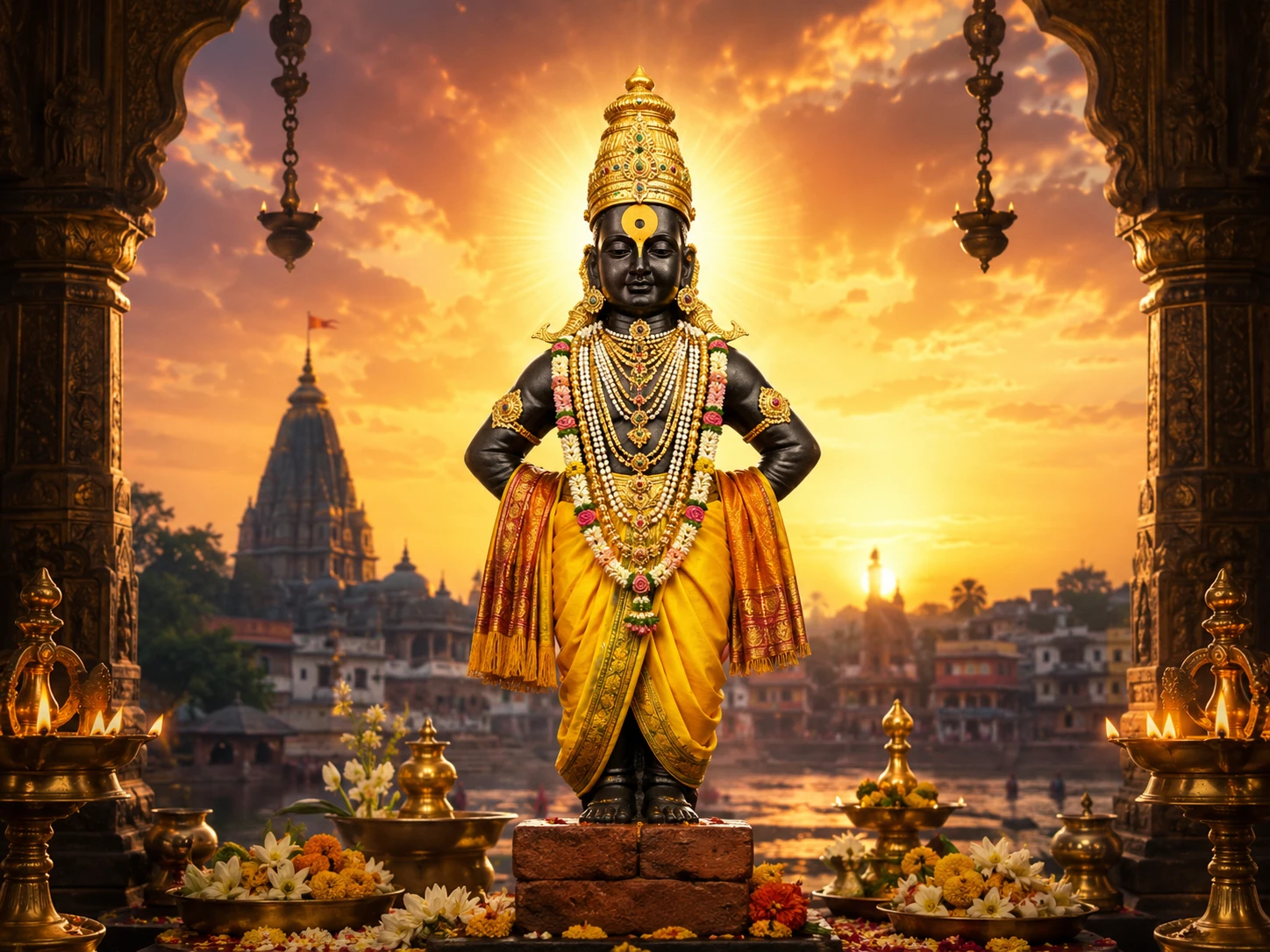
Vitthala / Vithoba -- The Standing God of Pandharpur
विट्ठल / विठोबा -- पंढरपुर के खड़े भगवान
In the town of Pandharpur on the bank of the Chandrabhaga river in southern Maharashtra, there stands in a small sanctum an unusual form of the Hindu god. He has no weapon in his hand. He carries no discus and no conch. His four-armed Vishnu iconography has been pared down to two arms, both resting on his hips. His feet are placed squarely on a single brick. This is Vitthala, also called Vithoba, Pandurang, and Vitthal. The deity has been standing there since at least the twelfth century, when the earliest Marathi poet-saints composed their first abhangas to him, and probably much longer. Every year, more than seven hundred thousand pilgrims called Warkaris walk to Pandharpur on foot from Alandi and Dehu, arriving on Ashadhi Ekadashi in June or July. The only thing Vitthala is doing in his temple is waiting. In a tradition full of active gods who hunt demons and wield weapons, Vitthala's stillness is itself the teaching. The god waits for the devotee. The devotee does not wait for the god.
The story that explains why Vitthala is standing on a brick is told in the Skanda Purana and the Padma Purana and is sung by every Warkari from childhood. A young man named Pundalik lived with his wife and his aged parents in a village on the Chandrabhaga. Pundalik neglected his parents, mistreated them, and paid attention only to his wife. On pilgrimage to Kashi he met the sage Kukkuta, whose three companions were the holy rivers themselves in disguise, come to wash away the sage's debt. Watching this, Pundalik understood what he had been failing to do. He returned home and devoted himself to serving his parents. His devotion to them became so complete that Krishna himself, hearing of it, came one night from Vaikuntha to give Pundalik a blessing. Pundalik was inside, massaging his father's feet. Without opening the door, he threw a brick outside and told the Lord to stand on it and wait, because his duty to his father came first. Krishna stood on the brick. He placed his hands on his hips, and he waited. The father's feet were served. Only then did Pundalik come out. The Lord is still waiting there. The brick is still there. The teaching, for everyone who hears it, is that seva to one's parents outranks even a personal audience with God.
तडिद्वाससं नीलमेघावभासं रमामन्दिरं सुन्दरं चित्प्रकाशम् । वरं त्विष्टिकायां समन्यस्तपादं परब्रह्मलिङ्गं भजे पाण्डुरङ्गम् ॥२॥
taḍidvāsasaṃ nīlameghāvabhāsaṃ ramāmandiraṃ sundaraṃ citprakāśam | varaṃ tviṣṭikāyāṃ samanyastapādaṃ parabrahmaliṅgaṃ bhaje pāṇḍuraṅgam ||2||
His garment shines like lightning against his blue-cloud body. He is the temple of Lakshmi, beautiful, a visible form of pure consciousness. The great boon-giver, with both feet placed upon a brick. I worship that Panduranga, the living sign of the supreme Brahman.
— Pandurangashtakam by Adi Shankaracharya, Verse 2
The name Vitthala itself carries the theology of the image. Warkari philology reads it as two words: vith from vit, meaning brick, and thal from the Sanskrit sthala, meaning standing. Vitthala is literally 'the one who stands on a brick.' Other names layer on meaning. Vithoba adds the affectionate suffix -ba used for elders and loved ones across Maharashtra, making the deity a family member rather than a cosmic figure. Panduranga, meaning 'the white-limbed one,' is an older Sanskrit epithet that connects Vitthala to an earlier Shiva-associated deity at the same site; Warkari theology reads the name as proof that Vitthala is Hari-Hara, Vishnu and Shiva in one. The hands on the hips, called kati-var-kara in Marathi, are themselves read as scripture. One Warkari interpretation holds that the hands say 'the ocean of worldly existence is only this deep, my friends -- no deeper than my waist, so do not fear.' Every element of this still, almost motionless image is readable, debatable, and alive in the practice of the tradition.
The Warkari sampradaya, meaning 'those who make the wari,' began in the thirteenth century with the saint Dnyaneshwar, who wrote the Dnyaneshwari, a Marathi commentary on the Bhagavad Gita, when he was about sixteen years old. Dnyaneshwar and his siblings Nivrutti, Sopan, and Muktabai composed abhangas to Vitthala that are still sung on the road to Pandharpur. Three centuries later, Tukaram, a Kunbi grocer from the village of Dehu, wrote roughly four thousand more abhangas that pushed the tradition into every farmhouse and every village square in Maharashtra. The wari itself is an annual walking pilgrimage. In late June, the padukas (sandals) of Dnyaneshwar leave Alandi and the padukas of Tukaram leave Dehu, carried in silver palkhis (palanquins) on the shoulders of devotees. The two processions walk for roughly twenty-one days, covering about 250 kilometers, converging at Pandharpur on Ashadhi Ekadashi. A software engineer in Pune's Koregaon Park who has taken two weeks of leave walks in the same line as a farmer from Satara district. No special darshan line exists. There are no VIP passes. The ground does not distinguish feet.
The Four Great Poet-Saints of the Warkari Tradition
| Saint | Century | Village | Contribution |
|---|---|---|---|
| Dnyaneshwar / ज्ञानेश्वर | 13th CE / तेरहवीं सदी | Alandi / आलंदी | Wrote the Dnyaneshwari, a Marathi commentary on the Bhagavad Gita. / 'ज्ञानेश्वरी' लिखी, भगवद्गीता पर मराठी टीका। |
| Namdev / नामदेव | 13th-14th CE / तेरहवीं-चौदहवीं सदी | Narsi Bamani / नरसी बामणी | Carried Warkari bhakti north; his abhangas are in the Guru Granth Sahib. / वारकरी भक्ति को उत्तर ले गए; उनके अभंग गुरु ग्रंथ साहिब में हैं। |
| Eknath / एकनाथ | 16th CE / सोलहवीं सदी | Paithan / पैठण | Bridged Sanskrit scholarship with village devotion. / संस्कृत विद्वत्ता और ग्राम्य भक्ति के बीच सेतु बने। |
| Tukaram / तुकाराम | 17th CE / सत्रहवीं सदी | Dehu / देहू | Composed about 4,000 abhangas that remain the Warkari canon. / लगभग 4000 अभंग रचे, जो वारकरी परंपरा का मूल पाठ हैं। |
Janabai, the maidservant of Namdev, and Muktabai, younger sister of Dnyaneshwar, stand alongside the four as major women saints of the tradition.
The abhanga is a specific literary form, composed in Marathi, built on a metrical foundation called ovi. The word abhanga means 'unbroken' or 'without interruption.' What it captures is the insistence of devotional memory: the mind returns to Vitthala even when pulled elsewhere. Tukaram's abhangas are often brief, four or six lines, set to tunes a farmer can hum while cleaning the plough. They argue with Vitthala, complain to him, mock the pretensions of pandits and landlords, confess private failings, praise simple meals. The register is startling for an Indian listener coming from Sanskrit stuti literature: there is no prostration in abhanga. There is friendship, quarrel, and long conversation. The Carnatic and Hindustani musical traditions both took up abhanga after the twentieth century, with Bhimsen Joshi and Kishori Amonkar producing recordings that have crossed ten million plays on digital platforms. A listener in a Gurgaon apartment, hearing 'Majhe Maher Pandhari' (Pandhari is my mother's home), gets not only the devotional content but the emotional stance: you are allowed to speak to the deity the way you would speak to your oldest friend.
The annual Pandharpur Wari is one of the oldest continuously observed walking pilgrimages in the world. It has been walked every single year since at least 1685, when the tradition was formally organized by Tukaram's youngest son Narayan Maharaj. It was not interrupted by Mughal invasions, British rule, two World Wars, Partition, or the Emergency. It was interrupted for the first time in over three hundred years by the COVID-19 pandemic in 2020, when only symbolic palanquins by helicopter were permitted. By 2022 the full walking wari had resumed. In a country where almost every social practice has been broken and rebuilt multiple times, Vitthala's devotees have simply kept walking.
The geography of Pandharpur itself carries the story. The Chandrabhaga, on whose bank the temple sits, is actually the Bhima river, renamed here because it bends like a half-moon (chandra means moon; bhaga means part). The great saint-composer Kanaka Dasa, a sixteenth-century Kannada poet, walked to Pandharpur from what is now Karnataka and wrote kirtans about the deity that are still sung across Dharwad, Hubli, and the Bellary region. The temple attracts Telugu devotees who worship Vitthala as Vitthal Rakhumai, Marathi speakers for whom he is Vithoba, Kannada speakers for whom he is Vitthala Pandari, and Gujarati pilgrims who come from Saurashtra. Pandharpur is sometimes called the Dakshin Kashi, the Kashi of the south, but it is genuinely multilingual in a way Varanasi is not. On a single Ashadhi Ekadashi, four linguistic communities sing the same deity in four different musical registers, and the deity simply keeps standing.
Rukmini, Vitthala's consort, has her own separate temple within the Pandharpur complex, about a hundred meters from the main sanctum. This separation is theological, not architectural. Warkari tradition says Rukmini once grew annoyed with Vitthala and retreated into the forest of Dindirvana. Vitthala came looking for her, found her, and persuaded her to return, but she insisted on her own shrine. Her temple is the first stop on the pilgrim circuit. Married women in particular make a full circumambulation of Rukmini's sanctum before approaching Vitthala. The practice preserves something the pan-Hindu Lakshmi-Vishnu iconography tends to smooth over: the goddess has her own agency, her own reasons, her own temple. She does not sit at the Lord's feet in perpetual devotion. She holds her own address in the same town and receives her own visitors. A Mumbai executive who has flown down for Ashadhi darshan will often tell you she went to Rukmini first, and then to Vitthala. The order matters.
Warkari practice is built on a small set of clearly stated commitments that any follower can take on without initiation fee, caste requirement, or gurukul training. The Warkari wears a tulsi mala of 108 beads around the neck, fasts on the two Ekadashi days of each lunar month, eats a vegetarian diet, reads or listens to the Dnyaneshwari and the Gatha of Tukaram, and walks the wari at least once in a lifetime. Nothing else is mandatory. There is no mantra initiation. There is no privileged temple priesthood. The sampradaya has produced saints from every caste and occupation: Dnyaneshwar was a Brahmin, Tukaram a Shudra grocer, Chokhamela a Mahar Dalit, Gora Kumbhar a potter, Sant Savata Mali a gardener, Narahari Sonar a goldsmith. The Warkari ethic is summarized by a line from Tukaram that every devotee knows: 'Jo jaye, je vanchhit to teve labhe' -- 'whatever the heart truly desires, that is what is received.' The tradition's social effect across Maharashtra has been democratizing for eight centuries. This is not propaganda. It is structure.
The sound of the wari is one of the signature Indian soundscapes. The tal (a pair of small cymbals), the mridangam, and the chipli (wooden clappers) carry the rhythm while the dindi (the walking group of roughly fifty to a hundred devotees) sings abhangas in unison. The lead singer is called the vinakar, because he carries the tanpura-like vina. At fixed stops along the 250-kilometer route -- at Saswad, at Jejuri, at Valha, at Lonand, at Natepute -- the procession pauses, takes food, and performs a round of bhajan called ringan, in which a single unhorsed rider on a decorated horse, the maulicha ghoda, gallops through the circle of devotees. The ringan lasts about twenty minutes. Thousands of people have their hands raised and their eyes on a horse. The horse is understood to be Dnyaneshwar himself, returning briefly to his own wari. The symbolism is consistent with the Warkari principle that the saint, once gone, does not leave. He returns every year. He keeps his own promise.
In the past fifteen years, the wari has gained a new kind of walker. Software professionals from Pune and Mumbai take sabbaticals from IT firms. Indian students home from MS programs in the United States join their grandmother's dindi. NRI families fly in from Dubai and Sydney to walk four of the twenty-one days. Marathi film actors and television anchors walk incognito. One notable trend since 2019 has been the participation of corporate CSR teams from Tata, Infosys, Bajaj, and Kirloskar, which now set up hydration stations, medical camps, and toilet facilities along the route. The question of whether this new corporate presence changes the character of the wari is debated in Marathi editorial columns every July. One view says the wari absorbs anything without losing itself. Another says dindis are becoming indistinguishable from branded marathons. The truth is probably that the tradition has survived Mughal swords and British bureaucracy and will very likely survive corporate sponsorship too. What it asks of the walker remains unchanged: walk, sing, eat simple food, and arrive at Vitthala on Ashadhi.
The Ekadashi fast is the heartbeat of Warkari practice. Every lunar month has two Ekadashis, the eleventh day of the waxing and waning moons, and a committed Warkari observes both. The fast is not a total abstention. Warkaris consume only phalahar food: fruits, milk, groundnuts, sabudana khichdi, varai rice, sweet potato. No grains, no salt in the primary meaning of the word, no onion or garlic. Ashadhi Ekadashi in June-July and Kartiki Ekadashi in November are the two great Ekadashis of the Pandharpur year. On Ashadhi the Wari arrives. On Kartiki the pilgrims return for the second great gathering, smaller but equally devoted. The philosophical point of the fast, explained patiently by any elder in a dindi, is that the stomach is the first mirror. If the stomach can be disciplined, the mind begins to follow. Warkari Ekadashi is the embodied foundation of the entire tradition. Without the twenty-four fasts a year, the abhangas lose their traction and the walk becomes an excursion. With the fasts, the walk becomes a return.
The caste-transcending character of the Warkari sampradaya is not a modern liberal gloss. It is in the founding texts themselves. Chokhamela, a Mahar Dalit saint of the fourteenth century, wrote abhangas of such direct pain that they are still difficult to read aloud in Marathi: he was forbidden from entering the Pandharpur temple in his own lifetime and stood at the doorway composing his songs. His wife Soyarabai, his sister Nirmala, his son Karmamela, and his brother-in-law Banka were all saints. The family has its own memorial (samadhi) on the first of the eighteen steps at the Pandharpur temple, a placement that Warkari tradition reads as the deity's own answer to the caste exclusion of the historical moment. Tukaram in the seventeenth century openly took spiritual initiation from Babaji Chaitanya, a lower-caste guru, and wrote abhangas denouncing Brahmin ritualism. The tradition's internal commentary on caste is far sharper than its external critics often recognize. The wari in 2026 continues to mix Maharashtra's Mahars, Mangs, Chamars, Marathas, Brahmins, and others in the same dindi with the same plate of khichdi. This is not tolerance. It is how the path is designed.
The architecture of the Pandharpur temple is surprisingly humble for a site of such density. The main sanctum is small. The garbhagriha accommodates roughly twenty standing pilgrims at a time. The deity himself is no more than about one meter tall. There is no equivalent of the Tirupati prayer queue system or the Jagannath Puri crowd control apparatus. Warkaris descend in hundreds of thousands, take darshan for perhaps ninety seconds, and move on. On Ashadhi, pilgrims may wait between eight and twenty-four hours for those ninety seconds. The pada-sparsh darshan, in which a pilgrim is allowed to touch the feet of the deity, is a particular grace that older Warkaris recall from earlier decades; in recent years safety protocols have restricted this. The temple's construction has expanded over the centuries -- the Maratha general Anaji Datto contributed significantly in the seventeenth century, and the current sabha-mandapa was extensively renovated in the nineteenth. But the shrine remains close to its origin. Whatever else changes in Pandharpur, the brick stays where it is. The deity remains standing. The hands remain on the hips. Eight centuries of architectural patronage have refused to enlarge or elevate what was always meant to stay at eye level with the devotee.
The daily puja schedule at Pandharpur is tight and ancient. The first service is Kakad Arati, performed at four-thirty in the morning when the deity is woken with a fire-lamp waved in slow circles and with an abhanga of Tukaram sung by the temple priests. Kakad means cotton-wick torch; the arati is meant to be the first thing the deity sees as he opens his eyes after the night. A queue of perhaps five hundred Warkaris stands in the darkness outside the sanctum door, holding lamps of their own, waiting for it. Mahapuja follows at six, with a full bath, fresh garments, sandal paste on the forehead, and the food offerings that will feed the deity through the day. Madhyahna puja is at noon. Panchamrut abhishek -- a bath with five nectars of milk, curd, honey, ghee, and sugar -- happens on specific days. Shej arati, the putting-to-bed service, is at eleven at night. Between Kakad and Shej, roughly eighteen hours of devotional activity surround the standing deity without interruption. The priesthood at Pandharpur is hereditary, held by Badve and Utpat families who have served the shrine for at least seven centuries. A first-time visitor can watch any of the aratis by arriving fifteen minutes before the scheduled time. The schedule is published on the temple board and on the Shri Vitthal Rukmini Mandir website maintained by the government-constituted temple committee. A pilgrim who attends both Kakad and Shej on a single day, covering the eighteen-hour arc from waking to sleeping, is said by Warkari tradition to have completed a darshan equivalent to a month of ordinary visits. The ritual day at Pandharpur is itself a teaching: the god does not rest, and the devotee who stays with him the full day learns what steady service feels like in the body.
For someone who cannot walk the wari, the tradition offers a simple home practice. Light a small oil lamp at dusk. Set a small image or photograph of Vitthala on a clean cloth. Recite the mantra 'Vitthala Vitthala Jai Hari Vitthala' in the rhythm used on the road: two-two-two syllables, one cymbal stroke per syllable. Then read one abhanga. Tukaram's 'Vriksha velhi soyara, vanchare sukh saar' (the tree is my friend, the forest bird is the essential joy) is a reasonable first choice because it is brief and the sentiment is visible in any city park. After the abhanga, sit in silence for two minutes. That is the whole practice. It takes seven minutes. Warkari teachers in Maharashtra insist that the seven minutes done every evening for one year will change a person more than a single intense experience at Pandharpur. The logic is Tukaram's own: devotion is not measured by the height of the peak but by the steadiness of the climb.
Chant Vitthala Vitthala 108 Times
Chant 'Vitthala Vitthala Jai Hari Vitthala' 108 times on a mala, in the Varkari rhythm sung on the road to Pandharpur. The Vitthala Ashtakam is on Eternal Raga with its meaning.
Tags
Eternal Raga · शाश्वत राग
Institutional voice — scholarly articles on Sanatan Dharma
Deepen Your Understanding
अपनी समझ और गहरी करें
scriptural exegesis
Krishna's 16,108 Queens -- The Story Behind the Number
The number sounds absurd until you understand what it means. Krishna did not 'collect' 16,108 wives. He rescued 16,100 women from a demon's prison, and when no one in society would accept them back -- because they were 'tainted' -- he married every single one to restore their honour. Add 8 named queens (the Ashtabharya) married through love, valour, or diplomacy, and you get the most misunderstood number in Hindu mythology. This is not a harem story. It is the largest social rehabilitation programme in ancient literature.
deities avatars
Dashavatara -- Why Vishnu Comes Back Ten Times
Fish, tortoise, boar, half-lion, dwarf, axe-warrior, prince, cowherd, enlightened teacher, future horseman. The ten avatars of Vishnu are not random folklore. Read them in sequence and you get something startling -- a narrative that mirrors evolutionary biology, tracks the rise and fall of political systems, and argues that God does not sit above history but enters it, gets dirty, and does the work. The Dashavatara is Hinduism's answer to the question every civilisation asks: why does the world keep breaking, and who fixes it?
deities avatars
Rukmini and Krishna -- The Princess Who Wrote First
Promised by her brother to another king, the princess of Vidarbha sent Krishna a letter of seven verses asking him to carry her away. The story of Rukmini, chief queen of Dwarka, revered as Lakshmi herself -- and why her letter is one of the great love poems of the Bhagavata.
scriptural exegesis
Mohini and Shiva -- Why the Bhagavatam Tells This Story
Social media loves verse 8.12.32 -- Shiva loses control chasing Mohini. It never shows verse 8.12.36 -- where Shiva recovers instantly and is not at all surprised. It never shows 8.12.37 -- where Vishnu is very pleased to see Shiva unagitated and unashamed. And it never shows 8.12.38 -- where Vishnu Himself declares that Shiva is 'established in his position' despite everything. This is not a story about Shiva's weakness. It is the Bhagavatam's most powerful teaching on Maya, surrender, and why even the greatest ascetic needs divine grace.
rituals traditions
Tirtha Yatra -- Why Hindus Travel to Get Closer to God
The word 'Tirtha' does not mean 'holy place.' It means 'crossing point' -- a ford where the river of worldly existence can be crossed to reach the far shore of liberation. Hindu pilgrimage is not tourism with a spiritual label. It is the deliberate journey to locations where the boundary between the material and the divine is believed to be thinnest -- where the crossing is easiest. From Kashi to Kailash, from Char Dham to Kumbh Mela, the tradition maps a sacred geography onto the physical landscape of the subcontinent, turning the act of travel itself into a spiritual practice.
rituals traditions
Vrata -- What a Hindu Vow Really Means (It Is Not Just Fasting)
Your mother kept Karva Chauth without water for sixteen hours. Your grandmother observed Ekadashi every fortnight without fail. Your colleague skips lunch on Tuesdays 'for Hanuman.' The world sees Hindu fasting as dietary restriction. The tradition sees it as something far more radical: Vrata is a voluntary, time-bound act of self-imposed discipline that rewires the relationship between desire and willpower. Fasting is the most visible expression. But the real Vrata happens inside.
deities avatars
Who is Shiva?
He is the ash-smeared ascetic who is also the ideal husband. The destroyer of the universe who is called 'The Auspicious One.' The god of death who drank poison to save all life. He sits in meditation on a Himalayan peak, and simultaneously dances the cosmos into existence and annihilation. No deity in Hinduism contains more contradictions -- and no deity resolves them more completely. This is not a mythology explainer. This is an attempt to stand at the foot of the mountain and look up.
The annual Pandharpur Wari is one of the oldest continuously observed walking pilgrimages in the world. It has been walked every single year since at least 1685, when the tradition was formally organized by Tukaram's you…
More in Deities & Avatars
33 Koti Devata -- Why Hinduism Has 33 Types of Gods, Not 33 Crore
13 min read
Agni -- The Fire God
19 min read
Annapurna -- Goddess of Food
19 min readThe same translation error that turned '33 Koti' into '33 crore' in Hinduism also happened in Buddhism. The Chinese translation of Buddhist texts rendered 'Sapta Koti Buddha' (7 Supreme Buddhas) as '7 Crore Buddhas.' The…
Deities AvatarsCommunity Reflections
🕉️
Be the first to share your reflection.