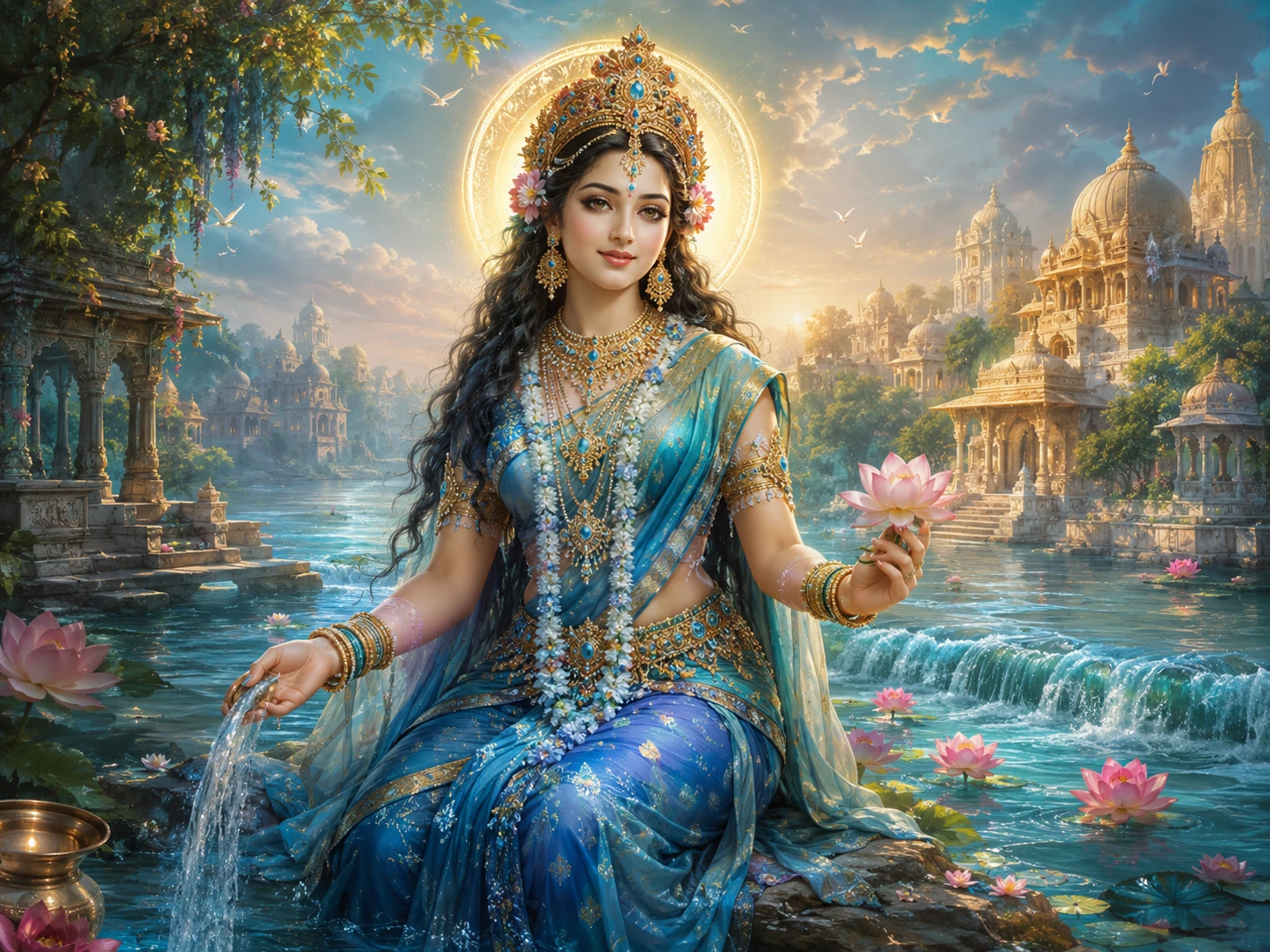
Yamuna as Goddess
यमुना -- देवी रूप
The Yamuna is the second of the two great rivers of northern India, and in Hindu theology she is paired with the Ganga at every level: iconographically at temple doors, geographically at Prayagraj where the two merge with the invisible Sarasvati at the Triveni Sangam, and theologically as the pair that defines the sacred north-Indian plain. She rises at Yamunotri glacier in Uttarakhand at approximately 6,315 meters above sea level, flows approximately 1,376 kilometers south-east through Haryana, Delhi, and Uttar Pradesh, and joins the Ganga at Allahabad. If the Ganga is the river of kings and sages, the Yamuna is the river of lovers. Every major Krishna narrative takes place on her banks. Vasudeva carried the infant Krishna across her flooded waters to Gokul during a storm; the child Krishna played with his cowherd friends in her shallows; the young Krishna danced the raas lila with the gopis on her moonlit sands; the adolescent Krishna dived into her poisoned depths and subdued the serpent Kaliya; the grown Krishna returned to Mathura on her bend to confront the tyrant Kamsa. Without the Yamuna, there is no geographic home for Krishna's story. She is not setting; she is structure.
Yamuna's parentage is shared with Yama, the god of death -- they are twin children of Surya (the sun) and Saranyu. Their Rig Vedic dialogue in RV 10.10, which we discussed in the article on Yama, establishes Yamuna as the sister who wanted to continue the human line and Yama as the brother who held to dharma. In later Puranic tradition, this sibling relationship produced the festival of Yama Dwitiya or Bhai Dooj, described in the Yama article, in which Yama's annual visit to his sister Yamuna became the template for sister-brother bonding across Hindu culture. But Yamuna's theological identity evolved far beyond this Vedic origin. In the Bhagavata Purana and in the Padma Purana, she becomes the consort of Krishna, specifically as one of his eight principal queens (ashta-mahishis). She is also identified in various texts with Kalindi, the name of a dark river goddess whom Krishna marries after a specific episode in which Arjuna helps him abduct her. The three identities -- Yami the Vedic sister, Yamuna the sacred river, Kalindi the Krishna queen -- are treated in high Vaishnava commentary as three modes of the same goddess appearing in three yugas. Her presence thus spans Vedic, Puranic, and devotional literature in a continuous theological line.
मुरारिकायकालिमाललामवारिधारिणी तृणीकृतत्रिविष्टपा त्रिलोकशोकहारिणी । मनोनुकूलकूलकुञ्जपुञ्जधूतदुर्मदा धुनोतु नो मनोमलं कलिन्दनन्दिनी सदा ॥१॥
murārikāya-kālimā-lalāma-vāri-dhāriṇī tṛṇīkṛta-triviṣṭapā triloka-śoka-hāriṇī | manonukūla-kūla-kuñja-puñja-dhūta-durmadā dhunotu no manomalaṃ kalindanandinī sadā ||1||
She who carries waters coloured by the dark body of Murari (Krishna); she who treats even heaven as a blade of grass; she who removes the grief of the three worlds; she whose groves along the pleasing banks shake out all arrogance -- may the daughter of Kalinda (Yamuna) always wash away the dirt of our minds.
— Yamuna Ashtakam by Adi Shankaracharya, Verse 1
Yamuna's iconography in temple sculpture and Puranic description carries one notable feature that distinguishes her from Ganga: she is dark. Where Ganga is shown white or pale gold, riding a makara (crocodile), Yamuna is shown with a deep blue or dark complexion, riding a turtle (kurma). The water pot in her left hand and the lotus in her right repeat Ganga's attributes, but the colour inverts. The theological explanation, given in the Padma Purana and in Pushtimarg commentary, is direct: Yamuna's water is darkened because she carries the reflection of Krishna's body. Krishna is shyama, dark, and the river that touches his body is permanently coloured by him. Ganga is tarani, the bright one; Yamuna is tamomayi, the dark one; together they complete a duality that Hindu aesthetic theology treats as foundational. The pair at every temple doorway -- light Ganga and dark Yamuna -- is an architectural statement of the complete spectrum within which devotional experience occurs. To enter any Hindu temple properly, the tradition holds, one must acknowledge both: the bright river of liberation and the dark river of love. Neither is complete without the other.
The Kaliya-daman episode in the Bhagavata Purana (10.15-10.17) is among the most widely illustrated Krishna narratives, and it centres on the Yamuna. Kaliya, a venomous serpent with multiple hoods, had taken residence in a deep pool of the Yamuna near Vrindavan, poisoning the water and killing anyone who entered. One day young Krishna's ball fell into the water. He dived in. Kaliya attacked and wrapped Krishna in his coils. The cowherds on the bank watched in horror. Krishna expanded his body, burst Kaliya's grip, and emerged dancing on the serpent's hoods, beating time with his feet as Kaliya's wives pleaded for his life. Krishna spared the serpent on condition that he leave the Yamuna permanently. Kaliya departed. The Yamuna's water cleared. This episode is read at multiple theological levels. At the devotional level, it is Krishna restoring the purity of his sister-lover. At the yogic level, Kaliya represents the poisoned ego that must be subdued by the dancing rhythm of discipline. At the ecological level, contemporary Hindu commentators have observed that the narrative is almost literally a pollution remediation story: a body of water poisoned by a specific source, cleared by divine intervention. The Kaliya-ghat at Vrindavan is the site identified as the location of the episode, and it remains a major pilgrimage point.
Major Yamuna Pilgrimage Sites
| Site | Location | Significance |
|---|---|---|
| Yamunotri / यमुनोत्री | Uttarakhand / उत्तराखंड | The source; one of the Chota Char Dham sites. Open May-November. / उद्गम; छोटा चार धाम में से एक। मई-नवंबर तक खुला। |
| Vrindavan / वृंदावन | Uttar Pradesh / उत्तर प्रदेश | The land of Krishna's childhood; Keshi Ghat and Kaliya Ghat on the Yamuna. / कृष्ण के बचपन की भूमि; यमुना पर केशी घाट और कालिय घाट। |
| Mathura / मथुरा | Uttar Pradesh / उत्तर प्रदेश | Krishna's birthplace; Vishram Ghat is the primary bathing site. / कृष्ण की जन्मभूमि; विश्राम घाट प्राथमिक स्नान-स्थल। |
| Gokul / गोकुल | Uttar Pradesh / उत्तर प्रदेश | Where the infant Krishna was raised; pilgrimage to Raman Reti sands. / जहाँ शिशु कृष्ण का पालन हुआ; रमण रेती बालू की तीर्थ-यात्रा। |
| Prayagraj Sangam / प्रयागराज संगम | Uttar Pradesh / उत्तर प्रदेश | The confluence with Ganga and invisible Sarasvati; Kumbh Mela site. / गंगा और अदृश्य सरस्वती से संगम; कुम्भ मेला स्थल। |
The Braj region -- spanning Vrindavan, Mathura, Gokul, Goverdhan, Nandgaon, and Barsana -- treats the Yamuna as the living goddess of Krishna bhakti. The annual Braj parikrama walking pilgrimage of 84 kosas (about 300 kilometers) is centred on her banks.
The Pushtimarg tradition, founded by Vallabhacharya (1479-1531) in the Braj region, elevated Yamuna to a theological position she does not hold in other Vaishnava traditions. For the Pushtimarg, Yamuna is not merely a sacred river or even a principal queen of Krishna; she is the personified grace (pushti) of Krishna himself. Worship of Yamuna is the necessary gateway to Krishna-bhakti. Every Pushtimarg ceremony begins with Yamuna Stotras, and the Yamuna Ashtakam composed by Vallabhacharya (distinct from the Shankara composition quoted above) is recited daily by Pushtimarg practitioners. Vallabhacharya taught that Yamuna is the refuge even from Krishna himself: when the soul has done something that even Krishna might refuse to forgive, Yamuna as his beloved mediates and secures forgiveness. The tradition has spread widely through Gujarati Vaishnavas, particularly in Ahmedabad, Surat, and the Hindu diaspora in East Africa and the United Kingdom. A Gujarati Pushtimargi family in Leicester or in Edison, New Jersey, begins its morning with a short Yamuna prayer even though no Yamuna flows anywhere near. The river has been internalized as a theological principle of grace that the physical geography cannot limit. This move -- from geographic deity to theological principle -- is characteristic of how the great devotional movements extended Hindu practice to communities far from the original sacred territory.
The Raas Lila, Krishna's moonlit dance with the gopis, takes place on the banks of the Yamuna in the Bhagavata Purana (10.29-10.33). The setting is specific: an autumn night under a full moon, on the sand banks of the Yamuna near Vrindavan, the gopis slipping away from their households to answer the call of Krishna's flute. The dance begins, Krishna multiplies himself so that each gopi has him as her partner, and the entire night becomes a cosmic circle in which the individual soul meets the divine. The Yamuna is not mere setting to this; she is the space that makes it possible. The sand is her body. The reflected moonlight that illuminates the scene falls on her water. The flute-sound travels on air that has passed over her surface. The Gaudiya Vaishnava tradition of Chaitanya has elaborated this into a complete theological system: the raas lila is the eternal reality underneath phenomenal existence, and the Yamuna is the eternal sacred ground on which that reality plays out. For Chaitanya's followers, particularly in the ISKCON movement founded by Srila Prabhupada, visiting Vrindavan and bathing in the Yamuna at Keshi Ghat is the most direct available access to that eternal reality in this life. The practice is not pilgrimage to a past event. It is participation in a present ongoing reality.
The Yamuna is today one of the most polluted rivers in the world, particularly in its stretch through Delhi. Between the Wazirabad barrage at the city's northern edge and the Okhla barrage at its southern edge -- approximately 22 kilometers through the national capital -- the river receives so much untreated sewage that during the dry season the water quality index falls to near zero. Faecal coliform counts in Delhi stretches routinely exceed safe limits by factors of several hundred. The paradox is theologically severe: the goddess whom Pushtimargi Gujaratis pray to every morning, whom Chaitanyite Bengalis visit for darshan, whose waters once carried the infant Krishna, is in practical terms a sewer for Delhi's fifty-million-person urban agglomeration. The Supreme Court of India has been hearing petitions on Yamuna pollution since 1994; the Yamuna Action Plan, launched in 1993 with Japanese aid, and the National River Conservation Plan have produced uneven results. The Chhath Puja festival in November sees hundreds of thousands of Delhi devotees bathing in toxic foam. This contradiction -- between theological reverence and actual ecological abandonment -- is one of contemporary Hinduism's most visible failures. Several Hindu organizations, including the Art of Living's rally for rivers and certain Pushtimarg groups, have begun treating Yamuna cleanup as a specifically religious duty rather than a secular one.
Krishna's marriage to Kalindi, narrated in the Bhagavata Purana's Uttar Khanda (10.58), is one of the less-retold but theologically interesting episodes involving Yamuna. On a visit to Indraprastha (modern Delhi), Krishna is taken hunting by Arjuna along the banks of the Yamuna. They encounter a beautiful woman performing tapas on the riverbank. Krishna approaches her. She identifies herself as Kalindi, daughter of Surya, and says she has been performing penance in the hope of marrying Krishna; she cannot return to her father's world until she does. Krishna takes her with him to Dvaraka and marries her; she becomes one of his eight principal queens. The Puranic text treats Kalindi as identical to Yamuna in her personified form. The theological point is that the river has two aspects: one is the sister of Krishna's childhood, playmate of his Vrindavan days; the other is his grown consort in Dvaraka, queen of his mature kingdom. The river embodies the continuous relationship across his life stages. For a serious Vaishnava reader, the Kalindi-narrative is important because it shows that Krishna's devotion to the Yamuna is reciprocated structurally: she chooses him, performs tapas for him, marries him. The river is not passive. She is an active devotee who secured her relationship through effort.
The annual festival of Yamuna Chhath, the sixth day of the waxing moon in Chaitra (usually March or April), celebrates the day the Yamuna is said to have descended to earth. The festival is observed particularly in the Braj region, in Mathura, in Vrindavan, and along the river wherever it flows. Devotees bathe in the river at dawn, offer prayers, and release small clay diyas and flowers on the water. A second major Yamuna festival, Yamuna Shashthi, falls in late April or early May. The seven days between these two festivals are considered particularly auspicious for Yamuna-related vows and observances. Beyond these festivals, the Yamuna is central to Chhath Puja, the major Bihari festival in October-November which honours Surya, the Yamuna's father; Bihari migrants across India and particularly in Delhi, Mumbai, and the Gulf cities observe Chhath with elaborate four-day rituals that include standing waist-deep in the Yamuna at sunrise and sunset. The festival is politically significant in Delhi -- Bihari migrant votes are courted partly through Chhath-specific infrastructure like temporary ghats, cleaning drives, and police arrangements. The goddess-river thus anchors a festival that is simultaneously devotional, diasporic, and electoral.
The Yamuna's theological distinctiveness from the Ganga becomes sharp when read through the lens of what each river offers. The Ganga offers moksha -- liberation from rebirth. The Yamuna offers prema -- divine love. These are not the same goal, and in classical Hindu soteriology they are sometimes positioned as alternatives. Moksha is the end of the cycle of existence; prema is the fullest flowering of relationship within existence. Advaita Vedanta, with its destination in undifferentiated Brahman, emphasises the Ganga path. Vaishnava bhakti traditions, with their destination in eternal service to Krishna, emphasise the Yamuna path. A simplified (perhaps too simple) way of putting it is: Ganga for mukti, Yamuna for bhakti. Neither path excludes the other -- the great bhakti traditions do not reject moksha, and the great Advaitin teachers do not reject love -- but the emphases are genuinely different. A Kashmiri Shaivite and a Gujarati Pushtimargi are both Hindus, but their theological centres of gravity differ; and these different centres correspond, imperfectly but suggestively, to the two rivers they hold most sacred. The Triveni Sangam at Prayagraj, where Ganga and Yamuna meet along with the invisible Sarasvati, is theologically the point at which these two paths join again. The pilgrim bathing at the Sangam is, at a symbolic level, participating in both soteriologies at once.
For a contemporary Hindu who wants to begin a Yamuna practice at home, the entry point matches the Krishna-devotional framework rather than the ritual-bathing framework of Ganga practice. The simplest practice is as follows: on any day, sit before an image of Krishna -- the Govardhan-dhari pose, the Vrindavan bansuri pose, or any other Krishna form. Visualize the Yamuna flowing behind him, dark water moving gently. Recite any short Yamuna-stotra, whether the Shankara composition quoted above or the Vallabhacharya composition or the simpler Yamuna Gayatri (om kalindi-nandinyai vidmahe yamuna-devyai dhimahi, tanno yamuna prachodayat). Reflect for two minutes on the specific character of Yamuna in the Krishna narrative: the one who carried him as infant, played as sister, danced with him as gopi, married him as Kalindi. Close with a short namaskar. This takes five minutes. For those who want a physical ritual, keeping a small vessel of Yamuna water on the puja shelf -- available at the same shops that stock Ganga water -- is traditional. A few drops added to the abhishekam water of a Krishna murti is the orthodox integration. The Pushtimargi and Gaudiya traditions have detailed daily protocols; for those outside these sampradayas, the minimal practice is sufficient. The Yamuna is not a goddess who demands elaboration; she is a goddess of relationship, and relationship is conducted through attention rather than scale. Some Pushtimarg families also keep a photograph of Shrinathji, the specific Krishna form of the Pushtimarg tradition, on their puja shelf alongside their Yamuna-jal vessel; the theological logic is that Shrinathji and Yamuna together complete the minimum required shrine. A Gujarati grandmother in Surat or a third-generation NRI in Leicester who maintains this arrangement is not performing an elaborate ritual. She is keeping a small relationship open.
The Yamuna's dark colour has meteorological and geological explanations alongside the theological one. The river's headwaters flow through shale and dark sedimentary rock formations in the Uttarakhand Himalayas, picking up fine particulate matter that persists downstream. The Yamuna also carries heavier silt loads than the Ganga due to the geology of its catchment, and during monsoon months the water darkens further with suspended material from the Chambal, Betwa, and Ken tributaries that join her in the plains. The traditional Hindu observation of her darkness is therefore not symbolic alone; it is an accurate empirical observation of a river that is genuinely darker than the Ganga along most of its length. What the tradition added was a theological reading of that fact: the darkness is the colour of Krishna, and the river carries Krishna's colour because she carried Krishna's body. This overlay of theological meaning onto empirical observation is characteristic of how Hindu thought treats the sacred geography. The river is not re-described to fit the theology; the theology is derived from and remains true to the river's observed character. A Hindu biologist taking a water sample from the Yamuna near Vrindavan and finding it darker than a comparable sample from Haridwar on the Ganga is not disconfirming the tradition. She is confirming the specific empirical fact the tradition has always noted.
The lasting image the Yamuna leaves in the Hindu imagination is not of a pilgrimage site but of a presence in Krishna's life. She is the first thing he touched outside his mother's body -- Vasudeva waded across her flooded waters in the storm of his birth night, holding the newborn over his head. She is the last thing he remembered -- when Krishna lay dying at Prabhas in Gujarat, struck by the hunter's arrow, the tradition holds that his final vision was of Vrindavan, of the Yamuna in moonlight, of the gopis calling his name across her waters. Between these two moments, everything happened on her banks. She is therefore, in the Hindu theological imagination, what the self-aware companion is to any long life: not an audience but a witness, not mere scenery but a participant, not an occasion but a continuity. Every devotee who reads the Bhagavata Purana is walking, at a textual level, along the banks of the Yamuna. Every Krishna bhajan sung in a Pushtimarg haveli, every Hare Krishna chanted in an ISKCON temple, every rasa-lila performance in Vrindavan reenacts an event that happened on her shore. She may be polluted. She may be diminished. She may receive the sewage of a capital city. But in the theological imagination, she is still, every evening at sunset, the place where Krishna is about to walk out to meet the gopis, and where the flute is about to start.
Recite the Yamuna Ashtakam before Krishna Worship
The Yamuna Ashtakam is on Eternal Raga with its meaning. Recite its eight verses before any Krishna puja, especially on Yamuna Chhath (Chaitra Shukla Shashthi). The Pushtimarg tradition holds that remembering Yamuna comes before remembering Krishna.
Tags
Eternal Raga · शाश्वत राग
Institutional voice — scholarly articles on Sanatan Dharma
Deepen Your Understanding
अपनी समझ और गहरी करें
deities avatars
Ganga as Goddess
The Ganga is not a river with divine associations. In Hindu theology she is a goddess who takes the form of a river. She flows from the feet of Vishnu through the matted hair of Shiva to the plains of North India, and every drop is considered capable of dissolving lifetimes of accumulated karma. This is the living goddess whose physical body 600 million Hindus drink, bathe in, and surrender their ashes to.
scriptural exegesis
Krishna's 16,108 Queens -- The Story Behind the Number
The number sounds absurd until you understand what it means. Krishna did not 'collect' 16,108 wives. He rescued 16,100 women from a demon's prison, and when no one in society would accept them back -- because they were 'tainted' -- he married every single one to restore their honour. Add 8 named queens (the Ashtabharya) married through love, valour, or diplomacy, and you get the most misunderstood number in Hindu mythology. This is not a harem story. It is the largest social rehabilitation programme in ancient literature.
deities avatars
Dashavatara -- Why Vishnu Comes Back Ten Times
Fish, tortoise, boar, half-lion, dwarf, axe-warrior, prince, cowherd, enlightened teacher, future horseman. The ten avatars of Vishnu are not random folklore. Read them in sequence and you get something startling -- a narrative that mirrors evolutionary biology, tracks the rise and fall of political systems, and argues that God does not sit above history but enters it, gets dirty, and does the work. The Dashavatara is Hinduism's answer to the question every civilisation asks: why does the world keep breaking, and who fixes it?
deities avatars
Rukmini and Krishna -- The Princess Who Wrote First
Promised by her brother to another king, the princess of Vidarbha sent Krishna a letter of seven verses asking him to carry her away. The story of Rukmini, chief queen of Dwarka, revered as Lakshmi herself -- and why her letter is one of the great love poems of the Bhagavata.
rituals traditions
Tirtha Yatra -- Why Hindus Travel to Get Closer to God
The word 'Tirtha' does not mean 'holy place.' It means 'crossing point' -- a ford where the river of worldly existence can be crossed to reach the far shore of liberation. Hindu pilgrimage is not tourism with a spiritual label. It is the deliberate journey to locations where the boundary between the material and the divine is believed to be thinnest -- where the crossing is easiest. From Kashi to Kailash, from Char Dham to Kumbh Mela, the tradition maps a sacred geography onto the physical landscape of the subcontinent, turning the act of travel itself into a spiritual practice.
scriptural exegesis
Samudra Manthan -- When Gods and Demons Ran a Joint Venture and the Universe Almost Died
A cosmic ocean. A mountain for a churning rod. A serpent king for a rope. Gods on one end, demons on the other. And out came 14 treasures -- including wealth, beauty, medicine, immortality, and one poison so lethal it could end creation itself. The Samudra Manthan is not mythology. It is the original playbook for collaboration, crisis management, and how to handle it when your joint venture partner tries to cheat you.
scriptural exegesis
Mohini and Shiva -- Why the Bhagavatam Tells This Story
Social media loves verse 8.12.32 -- Shiva loses control chasing Mohini. It never shows verse 8.12.36 -- where Shiva recovers instantly and is not at all surprised. It never shows 8.12.37 -- where Vishnu is very pleased to see Shiva unagitated and unashamed. And it never shows 8.12.38 -- where Vishnu Himself declares that Shiva is 'established in his position' despite everything. This is not a story about Shiva's weakness. It is the Bhagavatam's most powerful teaching on Maya, surrender, and why even the greatest ascetic needs divine grace.
The Yamuna is today one of the most polluted rivers in the world, particularly in its stretch through Delhi. Between the Wazirabad barrage at the city's northern edge and the Okhla barrage at its southern edge -- approxi…
More in Deities & Avatars
33 Koti Devata -- Why Hinduism Has 33 Types of Gods, Not 33 Crore
13 min read
Agni -- The Fire God
19 min read
Annapurna -- Goddess of Food
19 min readThe same translation error that turned '33 Koti' into '33 crore' in Hinduism also happened in Buddhism. The Chinese translation of Buddhist texts rendered 'Sapta Koti Buddha' (7 Supreme Buddhas) as '7 Crore Buddhas.' The…
Deities AvatarsCommunity Reflections
🕉️
Be the first to share your reflection.