Narayanastra -- The Weapon That Could Only Be Defeated by Surrender
नारायणास्त्र -- वह अस्त्र जिसे केवल समर्पण से हराया जा सकता था
On the fifteenth day of the Kurukshetra war, Drona -- teacher of both the Kauravas and the Pandavas -- laid down his weapons after hearing that his son Ashvatthama was dead, and was killed where he sat by Dhrishtadyumna. The report had been a ruse: it was an elephant named Ashvatthama that had died. When the real Ashvatthama learnt how his father had been deceived and killed, his grief turned into fury, and he reached for the most terrible weapon he possessed.
It was the Narayanastra, the personal weapon of Narayana -- Vishnu himself. In the Drona Parva of the Mahabharata, Ashvatthama explains that his father had received it from Narayana, who warned that it must not be used lightly, and that Drona had passed it to his son alone.
When Ashvatthama released it, the sky filled with weapons. The epic describes thousands of arrows, flaming discs, maces and spears pouring down on the Pandava army, burning and cutting down every warrior who raised a weapon against them. The more the Pandava soldiers resisted, the more furiously the weapon struck. Panic spread. Even Arjuna, the greatest archer of the age, could not stop it.
Then Krishna gave an order no general had given in the war. He told the whole army to throw down their weapons and step down from their chariots, elephants and horses -- to stand unarmed and bow before the weapon. The Narayanastra, he explained, strikes only those who fight it. To those who lay down their arms and submit, it does no harm.
The army obeyed -- all except Bhima. Too proud to submit, he charged the weapon on his chariot, and at once the whole force of the Narayanastra turned on him alone, wrapping him in fire. Krishna and Arjuna ran into the blaze, seized Bhima, dragged him from his chariot and forced the weapons from his hands. The moment he stood disarmed, the weapon's fury subsided, and it was quietened.
Duryodhana begged Ashvatthama to use it again. Ashvatthama refused: the Narayanastra, he said, could not be called back and released a second time -- if he tried, it would turn on him. The most powerful weapon of the war had been used once, and defeated not by a stronger weapon but by surrender.
Narayanastra Beside the Other Great Astras
| Astra | Presiding deity | How it was countered in the epics |
|---|---|---|
| Narayanastra | Narayana (Vishnu) | Only by laying down arms and submitting; resistance makes it stronger |
| Brahmastra | Brahma | By another Brahmastra, or withdrawn by its user; Arjuna withdrew his, Ashvatthama could not |
| Brahmashirsha | Brahma (four-headed) | Ashvatthama's, aimed at the unborn Parikshit, was redirected; Krishna protected the child |
| Pashupatastra | Shiva | Given to Arjuna by Shiva; never used in the war, as it could destroy the world |
| Vaishnavastra | Vishnu | Used by Bhagadatta against Arjuna; Krishna received it on his own chest, where it became a garland |
The Narayanastra was not the only time Krishna took a Vishnu weapon on himself. On the twelfth day, when Bhagadatta hurled the Vaishnavastra at Arjuna, Krishna rose in the chariot and received it on his chest, where it turned into the Vaijayanti garland. Arjuna protested that Krishna had promised not to fight; Krishna explained that the weapon was his own, and no one but he could receive it.
The story is easy to read as a parable, and the tradition has always read it that way. The weapon belongs to Narayana; fighting it is fighting God, and pride, like Bhima's, only draws its full force. What saves the army is the posture of the devotee: weapons down, heads bowed, nothing to defend. Krishna's order echoes the teaching he had given Arjuna on the first morning of the war -- abandon everything and take refuge in me alone -- now enacted by a whole army on the battlefield.
It is also a story about Krishna's care. In the middle of a war he did not fight, he does not leave Bhima to his pride, but walks into the fire after him.
Compare the Brahmastra and Brahmashirsha
The other great astras of the war, and Ashvatthama's last and most terrible weapon.
Tags
Eternal Raga · शाश्वत राग
Institutional voice — scholarly articles on Sanatan Dharma
Deepen Your Understanding
अपनी समझ और गहरी करें
divine arsenal
Brahmastra vs Brahmashirsha -- The Escalation Ladder of Brahma's Weapons
Brahmastra was the nuclear bomb. Brahmashirsha -- with four heads of Brahma at its tip -- was the thermonuclear bomb, four times more powerful. And Brahmanda Astra could destroy the entire solar system. Three escalation tiers of the same divine weapons programme, created by the god of creation himself. The ethics of their use drives the Mahabharata's most devastating moral crisis.
divine arsenal
Pashupatastra -- The Supreme Weapon Never Used
The most fearsome weapon in the Mahabharata was never deployed on the battlefield. Shiva granted it to Arjuna after a wrestling match in the forests of Indrakila, yet Arjuna carried it through all eighteen days of Kurukshetra without ever invoking it. The Pashupatastra's true power lay not in its destruction, but in its restraint -- a philosophy that modern nuclear doctrine would independently discover thousands of years later.
scriptural exegesis
Ashwatthama and the Brahmashirsha -- The Night the War Refused to End
The war ended on Day 18 when Bhima shattered Duryodhana's thighs. The victory celebrations should have begun. Instead, that night, three Kaurava survivors -- Ashwatthama, Kripa, and Kritavarma -- entered the sleeping Pandava camp and slaughtered everyone inside. The five sons of Draupadi. Dhrishtadyumna. Shikhandin. Thousands of soldiers who believed the war was over. Then Ashwatthama launched the Brahmashirsha Astra at the unborn child in Uttara's womb -- Arjuna's grandson, the last heir of the Pandava line. Krishna saved the child and cursed Ashwatthama to wander the earth for 3,000 years in agony. He is still walking.
divine arsenal
Astra Invocation and Withdrawal -- The Ritual of Weapons
A divine Astra was not merely fired. It was invoked -- summoned through a specific mantra, charged with the deity's power, released with precise intention, and -- if the warrior was skilled enough -- withdrawn before impact. The protocol for activating and deactivating a celestial weapon was as ritualised as a nuclear launch sequence. And the inability to withdraw was the difference between a warrior and a war criminal.
scriptural exegesis
The Kurukshetra War -- What Happened in Eighteen Days
Eighteen armies, eighteen days, and four Kaurava commanders who fell one after another. A day-by-day guide to the war at the heart of the Mahabharata -- who led, who fell, and how the rules agreed on the first morning were broken one by one.
divine arsenal
Sudarshana Chakra -- The Disc of Divine Will
Vishnu's spinning disc is not merely a weapon -- it is cosmic justice made manifest. With 108 serrated edges, it never misses, never falters, and returns to the hand that released it. From Shishupala's hundredth sin to the Sudarshana Homa still performed in South Indian temples, this is the story of divine precision.
The Narayanastra was not the only time Krishna took a Vishnu weapon on himself. On the twelfth day, when Bhagadatta hurled the Vaishnavastra at Arjuna, Krishna rose in the chariot and received it on his chest, where it t…
More in Divine Arsenal
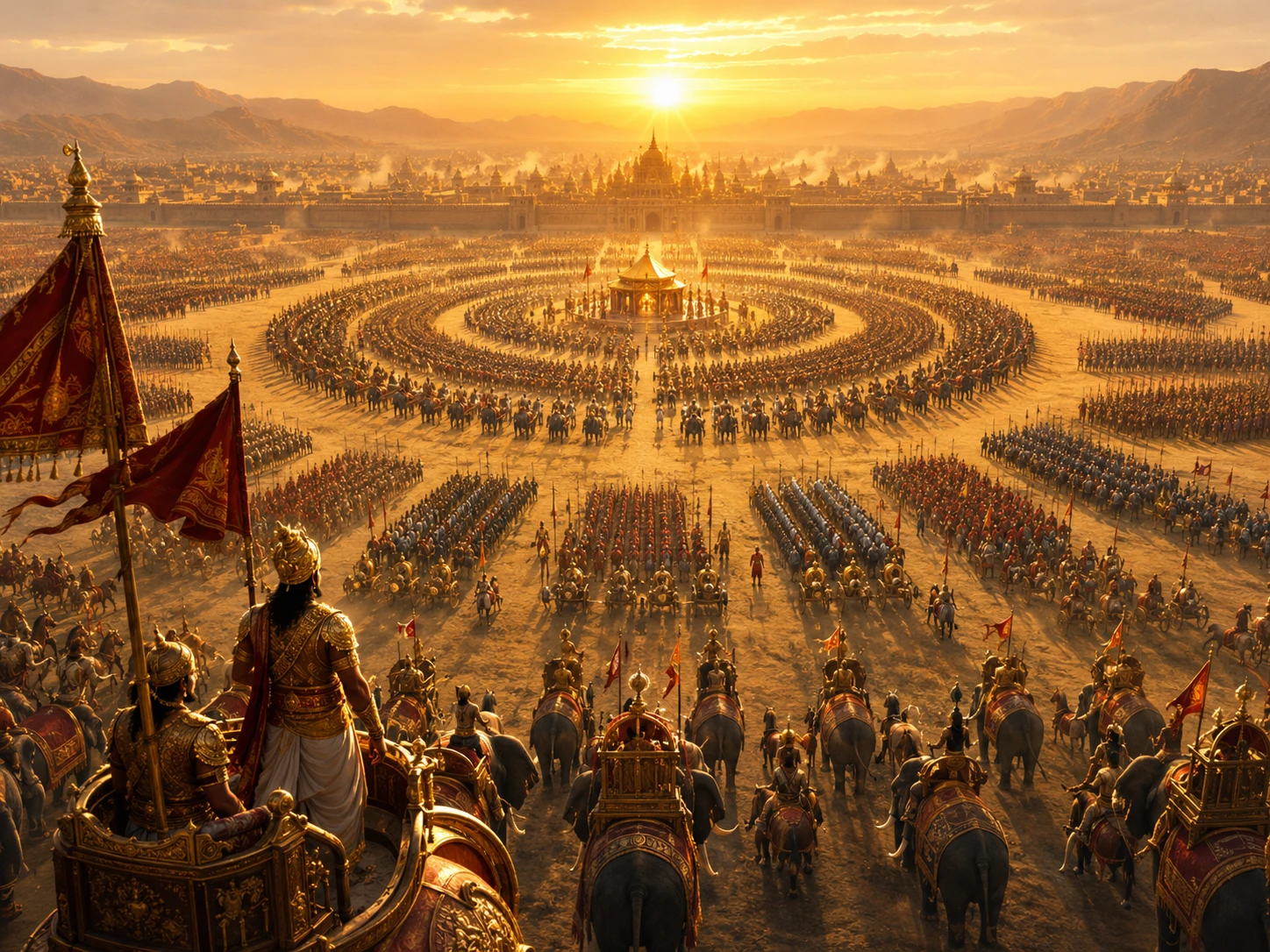
Akshauhini -- The Epic Army Structure Where Every Digit Sums to 18
14 min read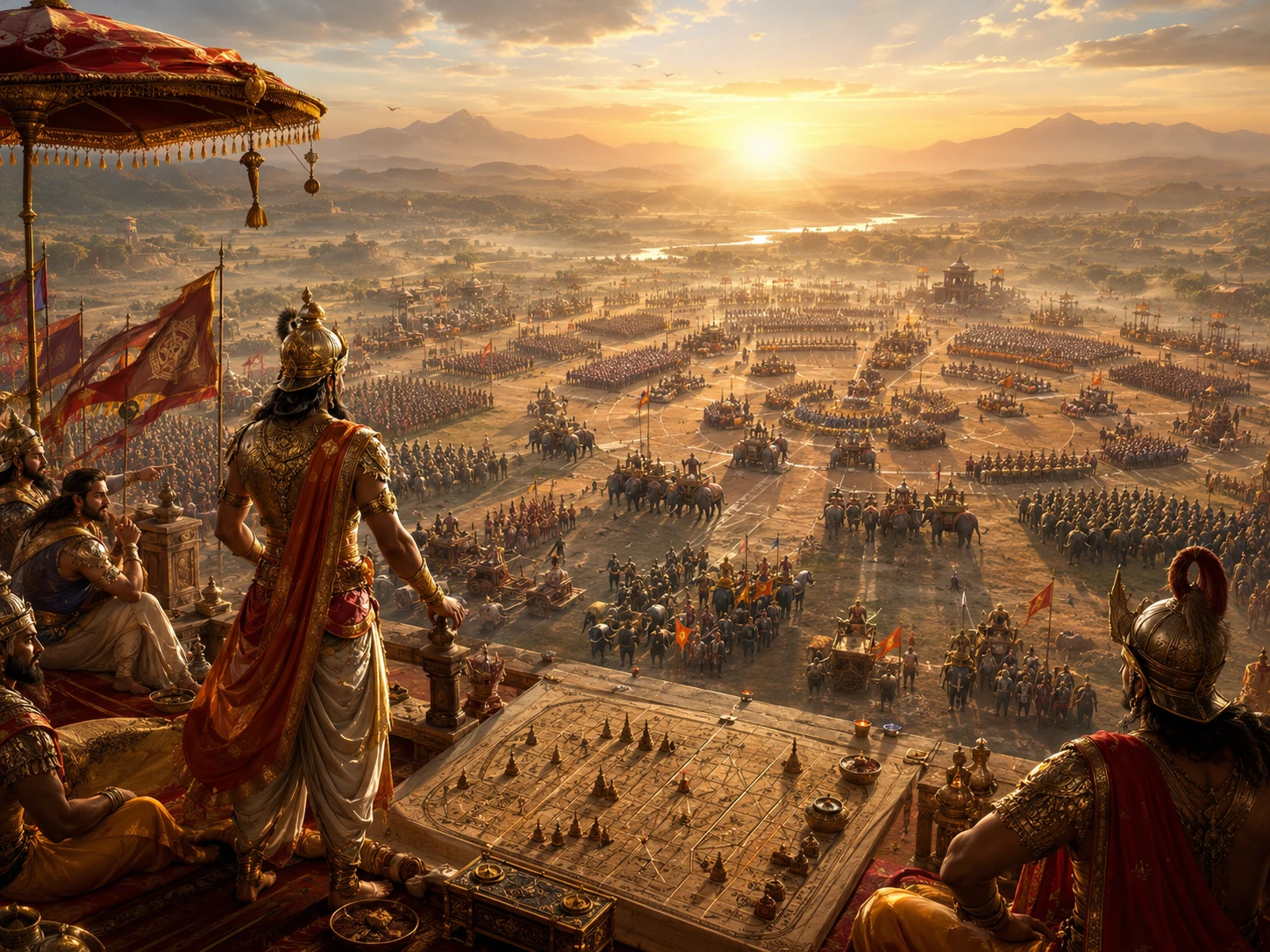
Ancient Indian Martial Arts -- Kalaripayattu to Malla-Yuddha
14 min read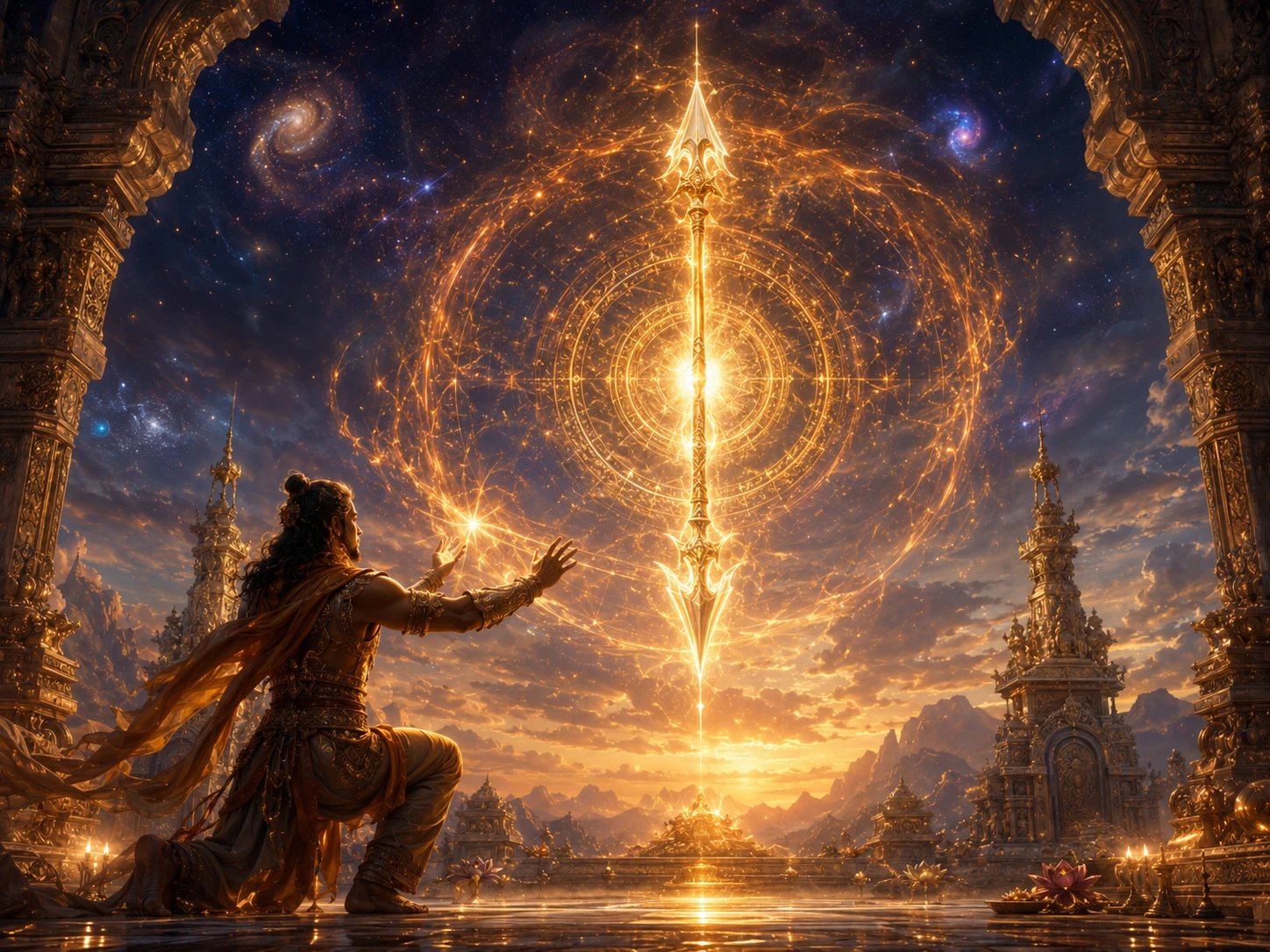
Astra Invocation and Withdrawal -- The Ritual of Weapons
16 min readThe same translation error that turned '33 Koti' into '33 crore' in Hinduism also happened in Buddhism. The Chinese translation of Buddhist texts rendered 'Sapta Koti Buddha' (7 Supreme Buddhas) as '7 Crore Buddhas.' The…
Deities AvatarsCommunity Reflections
🕉️
Be the first to share your reflection.