The Kurukshetra War -- What Happened in Eighteen Days
कुरुक्षेत्र युद्ध -- अठारह दिनों में क्या हुआ
The war of the Mahabharata lasted eighteen days. On the plain of Kurukshetra, north of present-day Delhi, eighteen akshauhinis -- the epic's largest unit of army, each a fixed combination of chariots, elephants, horses and foot soldiers -- met in battle: eleven on the side of Duryodhana and the Kauravas, seven with the Pandavas. Almost every king of the land fought on one side or the other.
Before the fighting began, the two sides agreed on rules: warriors would fight only their equals, no one would strike a man who had surrendered, fled or lost his weapon, and charioteers, messengers and drummers would be spared. Then, as the armies stood ready, Arjuna asked Krishna to drive his chariot between the lines, and the Bhagavad Gita was spoken. The rest of the war can be read as the slow failure of those first-morning rules.
धर्मक्षेत्रे कुरुक्षेत्रे समवेता युयुत्सवः । मामकाः पाण्डवाश्चैव किमकुर्वत सञ्जय ॥
dharmakṣetre kurukṣetre samavetā yuyutsavaḥ | māmakāḥ pāṇḍavāścaiva kimakurvata sañjaya ||
Dhritarashtra said: On the field of dharma, on the field of the Kurus, gathered together and eager to fight, what did my sons and the sons of Pandu do, Sanjaya?
— Bhagavad Gita 1.1
The Four Kaurava Commanders
| Days | Kaurava commander | How the phase ended | Book of the Mahabharata |
|---|---|---|---|
| 1 -- 10 | Bhishma | Arjuna, sheltering behind Shikhandi, whom Bhishma would not fight, brings him down; he lies on a bed of arrows awaiting the sun's northward turn | Bhishma Parva |
| 11 -- 15 | Drona | Told that "Ashvatthama is dead" -- an elephant of that name -- Drona lays down his arms and is killed by Dhrishtadyumna | Drona Parva |
| 16 -- 17 | Karna | His chariot wheel sinks into the earth; Arjuna kills him while he tries to free it | Karna Parva |
| 18 | Shalya | Killed by Yudhishthira; Duryodhana flees, then falls to Bhima in a mace duel | Shalya Parva |
On the Pandava side the commander-in-chief throughout was Dhrishtadyumna, Draupadi's brother. The night after the last day, Ashvatthama's raid on the sleeping Pandava camp is told in a book of its own, the Sauptika Parva.
For ten days Bhishma, the grandsire of both families, held the Kaurava army together. He had promised to fight for Hastinapura but would not kill the Pandavas, and he could only be overcome if he chose to be. On the ninth night the Pandavas went to his tent and asked him how. He told them: he would not raise his bow against Shikhandi, who had been born a woman. On the tenth day Arjuna shot from behind Shikhandi until Bhishma fell, so pierced with arrows that his body did not touch the ground.
Under Drona the war grew harder. On the thirteenth day the Kauravas formed the chakravyuha, the circular formation, and Arjuna's sixteen-year-old son Abhimanyu, who knew how to break into it but not how to get out, was surrounded and killed by several warriors at once -- against the rules. On the fourteenth Arjuna kept his vow to kill Jayadratha before sunset, and that night Karna spent his one unfailing weapon, the Vasavi shakti, on Bhima's son Ghatotkacha. On the fifteenth, Drona was undone by a half-truth spoken by Yudhishthira, the one man whose word he trusted.
Karna led for two days. On the sixteenth and seventeenth, the war came to its most painful encounters: Bhima fulfilled his vow against Duhshasana, who had dragged Draupadi into the dice hall, and Karna and Arjuna -- brothers, though only Karna knew it -- finally met. When Karna's chariot wheel stuck in the earth, he asked for time under the rules of war; Krishna reminded him of every rule broken against Draupadi and Abhimanyu, and Arjuna shot.
The eighteenth day was the end. Shalya fell to Yudhishthira, the Kaurava army broke, and Duryodhana hid in a lake. Drawn out, he chose Bhima for a mace duel, and Bhima, on Krishna's signal, struck his thigh -- a blow below the waist, forbidden in mace combat, that fulfilled another vow made in the dice hall. That night, Ashvatthama, Kripa and Kritavarma attacked the sleeping Pandava camp, killing Dhrishtadyumna and Draupadi's five sons. Of the vast hosts, the epic says, only a handful of warriors on each side survived.
The epic names the survivors. On the Pandava side: the five Pandavas, Krishna, Satyaki and Yuyutsu, a son of Dhritarashtra who had crossed over to the Pandavas before the battle. On the Kaurava side: only Ashvatthama, Kripa and Kritavarma -- the three who carried out the night raid.
Why does the Mahabharata dwell so much on broken rules? Partly because the epic is honest that the righteous side won by bending them too -- Bhishma through Shikhandi, Drona through a half-truth, Karna while he was helpless, Duryodhana with a forbidden blow. Krishna's defence, given in the epic itself, is that against an enemy who had already broken every rule, there was no other way to end a war that was destroying the world. The epic lets that answer stand but never makes it comfortable. The Stri Parva that follows, in which the widows of both sides walk among the dead, is its real verdict on the eighteen days.
Read the Gita spoken on the first morning
The Bhagavad Gita, chapter by chapter, with Sanskrit and translation -- the dialogue that opened the war.
Tags
Eternal Raga · शाश्वत राग
Institutional voice — scholarly articles on Sanatan Dharma
Deepen Your Understanding
अपनी समझ और गहरी करें
scriptural exegesis
The Bhagavad Gita -- An Overview of the Song of God
Seven hundred verses spoken between two armies, in the minutes before a war. What the Bhagavad Gita is, where it sits in the Mahabharata, how its eighteen chapters are arranged, and why a dialogue about duty on a battlefield became the most read book of Hindu thought.
scriptural exegesis
The Mahabharata -- The Text Behind the World's Longest Epic
Most people who say they have read the Mahabharata mean they have read a retelling of the dice game, the exile, and Kurukshetra. Few have asked how the book itself is built: eighteen numbered parvas, a traditional count of one hundred thousand verses, and a story that reaches every reader through three narrators nested inside one another, the outermost speaking at a sacrifice convened because a king's father died of snakebite. This is that architecture, not the episodes.
divine arsenal
Akshauhini -- The Epic Army Structure Where Every Digit Sums to 18
1 chariot. 1 elephant. 3 horses. 5 foot soldiers. That is the Patti -- the smallest tactical unit of the Mahabharata's military system. Multiply it through nine hierarchical levels and you get the Akshauhini: 218,700 warriors. Multiply that by 18 and you get the Kurukshetra War: nearly four million soldiers arranged in the most precisely documented military hierarchy in all of ancient literature.
divine arsenal
Rules of War -- Dharmayuddha and the Geneva Conventions
Three thousand years before the Geneva Conventions, Indian warriors debated whether you could strike a man who had dropped his weapon. The Mahabharata's rules of engagement cover night fighting bans, non-combatant immunity, treatment of prisoners, proportional force, and the use of weapons of mass destruction -- and then shows what happens when every single rule is broken.
divine arsenal
Vyuha Formations -- The Strategic Chess of Kurukshetra
Eighteen formations deployed across eighteen days. Every morning, the commander-in-chief chose a shape -- eagle, lotus, crescent, thunderbolt, tortoise, crocodile -- and nearly four million soldiers rearranged themselves accordingly. Each vyuha had a counter-vyuha. Each counter had a counter-counter. The Mahabharata's battle tactics are the world's oldest documented game theory -- played with real armies on a real field.
scriptural exegesis
Krishna -- The Charioteer Who Steered the Cosmos
He was Vishnu's purna avatar in human form, born in a Mathura prison, raised in a Vrindavan cowherd village, king of Dwaraka, charioteer to Arjuna, the speaker of the Gita, the witness who watched the Mahabharata unfold and quietly guided every consequential decision in it. The other characters in this cluster are people. Krishna is something else. The Mahabharata is, in the end, his story.
divine arsenal
Narayanastra -- The Weapon That Could Only Be Defeated by Surrender
After Drona's death, his son Ashvatthama released the personal weapon of Narayana on the Pandava army. It grew stronger the harder it was fought, and Krishna's answer was the strangest order of the war: lay down your arms. The story of the Narayanastra.
The epic names the survivors. On the Pandava side: the five Pandavas, Krishna, Satyaki and Yuyutsu, a son of Dhritarashtra who had crossed over to the Pandavas before the battle. On the Kaurava side: only Ashvatthama, Kr…
More in Scriptural Exegesis
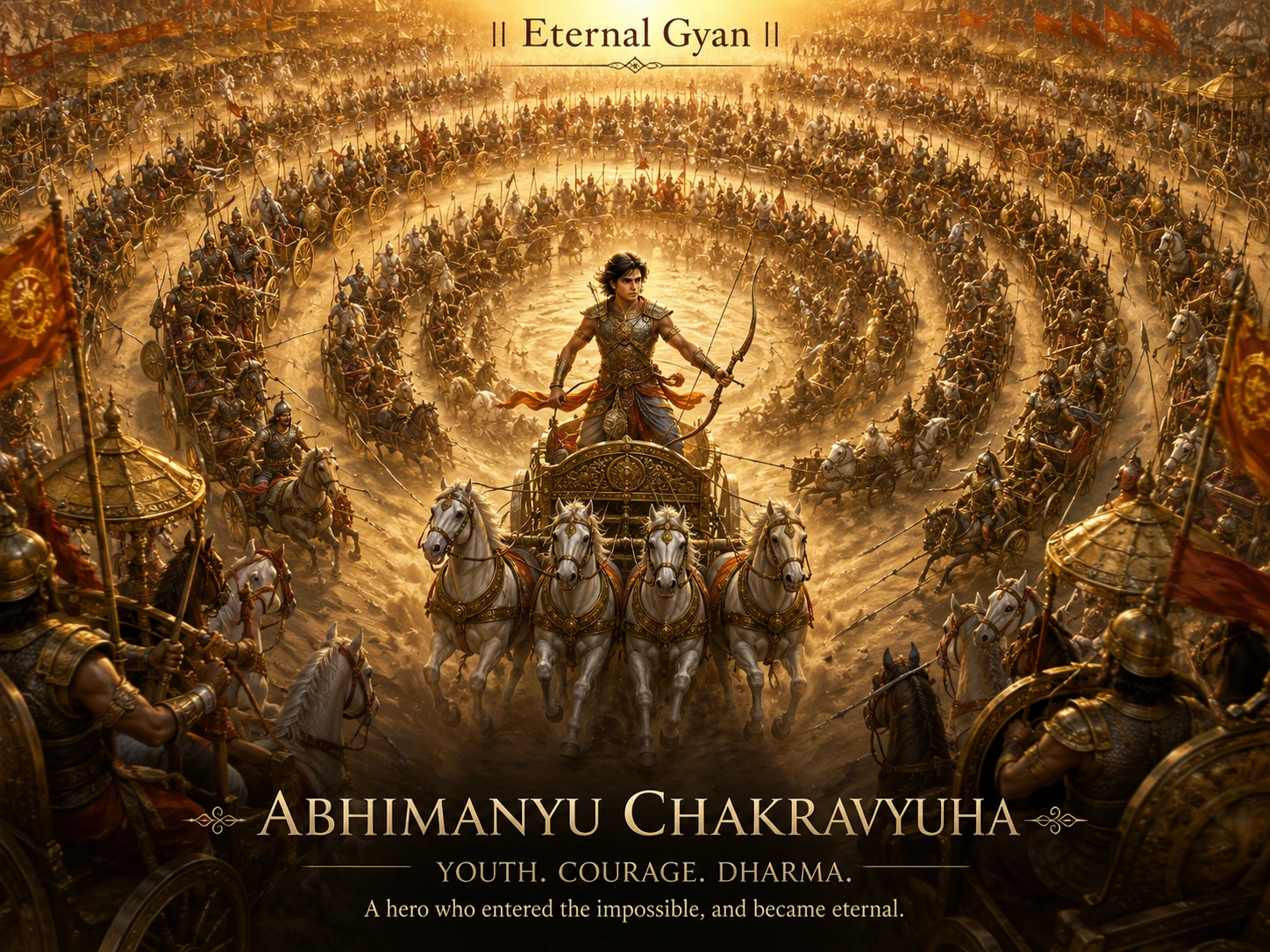
Abhimanyu and the Chakravyuha -- The Boy Who Knew How to Enter but Not How to Leave
14 min read
Adbhuta Ramayana -- The Ramayana Where Sita Becomes Kali
9 min read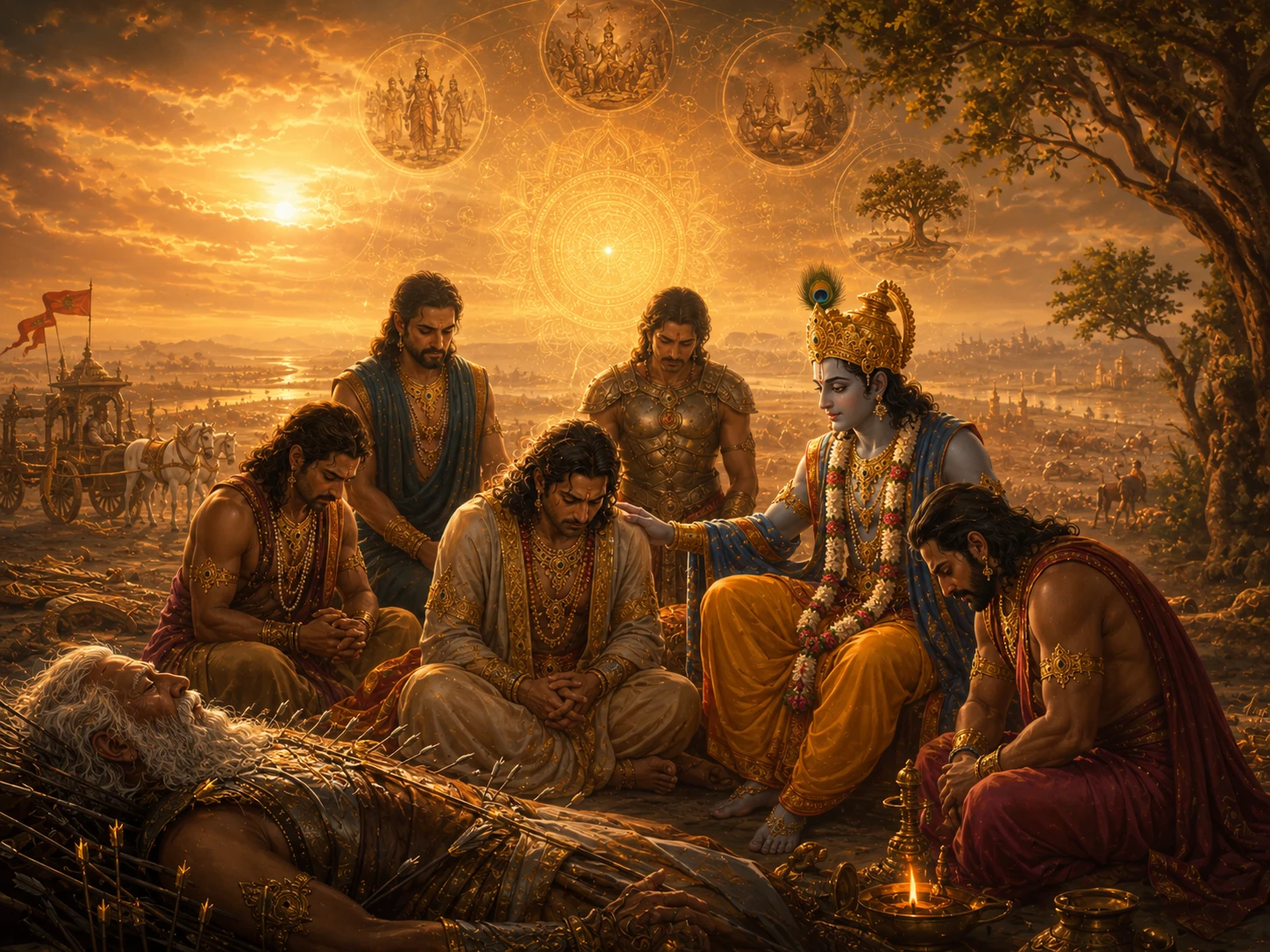
After Kurukshetra -- What Happened Next
14 min readThe same translation error that turned '33 Koti' into '33 crore' in Hinduism also happened in Buddhism. The Chinese translation of Buddhist texts rendered 'Sapta Koti Buddha' (7 Supreme Buddhas) as '7 Crore Buddhas.' The…
Deities AvatarsCommunity Reflections
🕉️
Be the first to share your reflection.