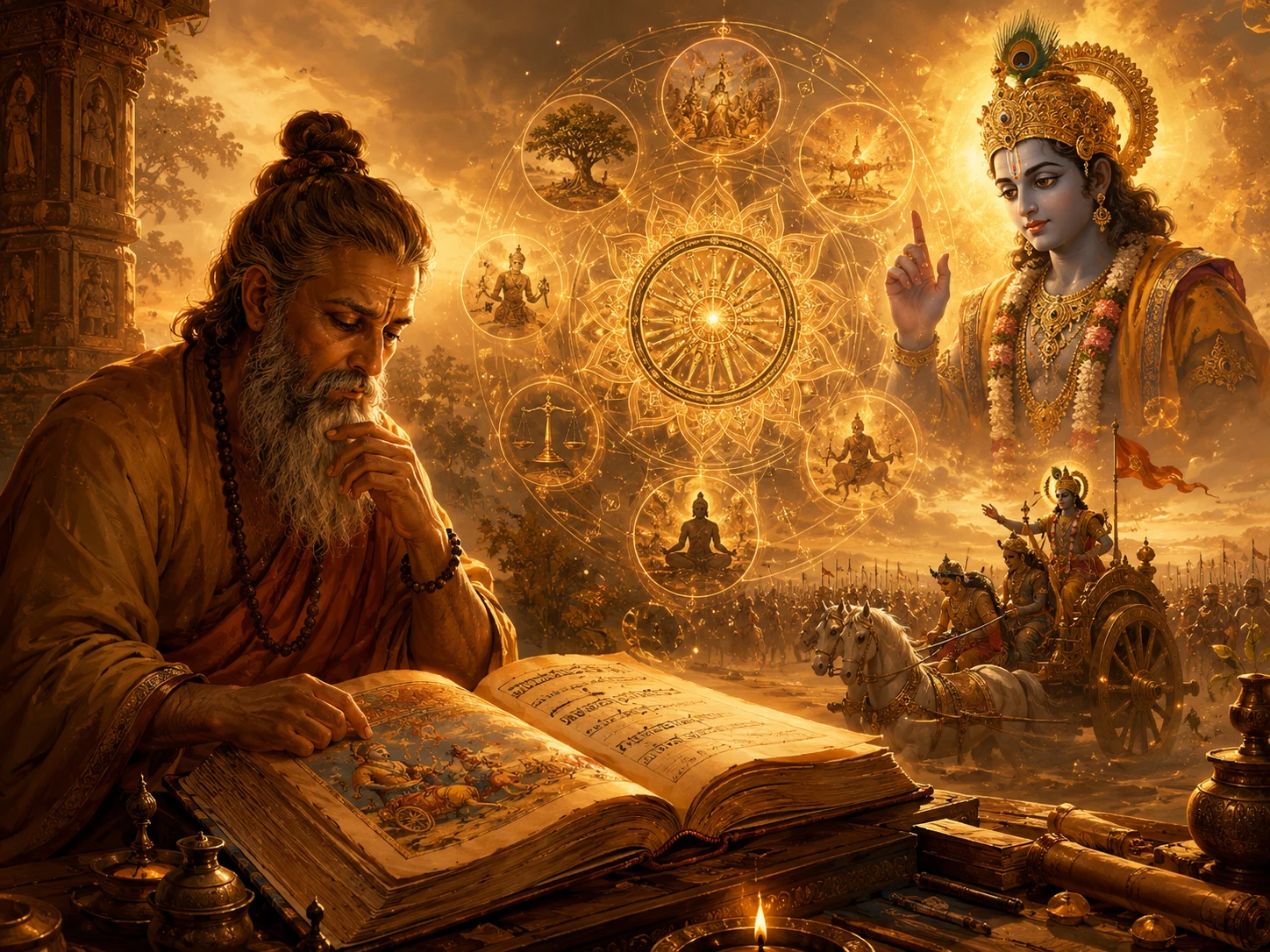
Krishna -- The Charioteer Who Steered the Cosmos
कृष्ण -- वह सारथी जिसने ब्रह्माण्ड चलाया
Krishna is the only character in this nine-character cluster who is not, primarily, a person. The other eight -- Arjuna, Karna, Duryodhana, Bhishma, Shakuni, Vidura, Draupadi, Yudhishthira -- are mortals working out their dharma inside a kingdom that is breaking. Krishna is the avatar through whom the kingdom is being broken on purpose. He is the eighth avatar of Vishnu in the dashavatara count, the purna avatar of the present yuga, the cosmic intelligence that has taken human form for the explicit purpose of clearing a generation of kshatriyas off the earth so that the moral arc can begin a new cycle. The Mahabharata is, structurally, his story. The eighteen-day war is, structurally, his outcome. Every other character in this cluster is operating inside a frame Krishna has set, often without realising the frame is set.
This is the most demanding character to write about, because the moment you treat Krishna as a person you misread him, and the moment you treat him as a god you flatten him. The Mahabharata is exact about this. Krishna eats. Krishna drinks. Krishna marries. Krishna gets angry. Krishna has eight queens and 16,100 women rescued from Narakasura whom he gave the status of his wives. Krishna laughs. Krishna lies, when lying serves the larger dharma. Krishna kills, when killing serves the larger dharma. Krishna grieves, in private, for the people he has had to lose. He is, in every observable way, a man. He is also, simultaneously, the ground of being that the man stands on. The text holds both at once. The reader has to hold both at once.
Krishna's role in the Mahabharata is the most strategic and the least dramatic. He does not fight. He does not even take up arms -- he had taken a vow before the war, made publicly to Duryodhana, that he would not personally fight. He kept that vow, with one famous exception during Bhishma's onslaught when he leapt from the chariot to attack Bhishma and was stopped only by Arjuna's plea. Apart from that single moment, Krishna spent the eighteen days of the war driving Arjuna's chariot, giving the Gita on the morning of day one, and quietly steering each of the major duels through indirect means. The Drona deception. The reminder to Arjuna to use the curse against Karna at the chariot wheel moment. The signal to Bhima to break Duryodhana's thigh. The protection of the Pandavas through the Sauptika night. The sealed marriage of Subhadra to Arjuna years before. The advice to Yudhishthira to accept the throne. The pacification of Draupadi. The escort of Vidura's body to Yudhishthira at the end. Krishna touches every important decision in the epic, almost always from the side, almost never from the front.
This article will walk through his life. It will not pretend that the human-side of him and the avatar-side of him are easy to balance. They are not. The Mahabharata's Krishna is the most demanding theological figure in any world epic. Read what follows knowing that the text itself is using a different register here than for any other character.
सर्वधर्मान्परित्यज्य मामेकं शरणं व्रज। अहं त्वा सर्वपापेभ्यो मोक्षयिष्यामि मा शुचः॥
sarva-dharmān parityajya mām ekaṃ śaraṇaṃ vraja ahaṃ tvā sarva-pāpebhyo mokṣayiṣyāmi mā śucaḥ
Abandon all dharmas, surrender to me alone. I will free you from all sins. Do not grieve.
— Bhagavad Gita 18.66 -- Krishna's final and most quoted instruction to Arjuna at the close of the Gita, considered by many commentators to be the charama-shloka, the supreme verse of the entire teaching
Krishna's birth is the most overdetermined event in the Mahabharata. His mother Devaki was the sister of Kamsa, the asuric king of Mathura. A divine voice had warned Kamsa that Devaki's eighth son would kill him. Kamsa imprisoned Devaki and her husband Vasudeva in a Mathura cell and killed each of their first six children at birth. The seventh, Balarama, was transferred mystically to Rohini's womb in a different city. The eighth was Krishna. He was born at midnight, in the prison cell, during a thunderstorm. The text records that the prison guards fell into a sudden sleep at the moment of birth. The shackles fell off Vasudeva's wrists. The prison doors swung open. Vasudeva, carrying the newborn in a basket on his head, walked out of Mathura with the child, crossed the swollen Yamuna whose waters parted for him, reached the cowherd village of Gokul, exchanged the newborn boy for the newborn daughter of Yashoda and Nanda, walked back, gave the daughter to Kamsa, and returned to the cell as if nothing had happened. The daughter, when Kamsa tried to dash her against a stone, rose into the air, revealed herself as the goddess Yogamaya, and warned him that his killer was already born and growing up elsewhere.
Krishna's childhood in Vrindavan, the cowherd settlement near Mathura, is recorded most fully in the Harivamsa and the Bhagavata Purana, with shorter references in the Mahabharata itself. The lila of childhood -- killing the demoness Putana sent by Kamsa, lifting the Govardhana mountain on his finger, the rasa-lila with the gopis, his love for Radha, the killing of various asuras sent by Kamsa over the years, the tying of his belly to a mortar by Yashoda when he was caught stealing butter -- these stories are present in the Mahabharata as background but not at the centre. The Mahabharata is concerned with the adult Krishna. The childhood is the foundation. The text assumes the reader knows it.
The transition into adulthood was sharp. Krishna and Balarama returned to Mathura, killed Kamsa in the public arena, freed Devaki and Vasudeva, restored Ugrasena to the throne, and began the work of consolidating the Yadava clans. They moved the entire Yadava population from Mathura, which was being repeatedly attacked by Jarasandha (Kamsa's father-in-law and king of Magadha), to a fortified coastal city Krishna had constructed: Dwaraka. The move was a logistical feat the Mahabharata records with admiration. An entire population was relocated, an entire city built. Krishna became, in effect, king of Dwaraka, though he never formally took the throne -- Ugrasena retained the title. Krishna was the operating power without the formal crown.
This is the position from which Krishna entered the Mahabharata's main narrative. He arrived at Draupadi's swayamvara as the Pandavas in disguise as Brahmins won her. He recognised them. He did not announce them. He went home and quietly arranged through his sister Subhadra's marriage to Arjuna for an alliance that would matter for the next thirty years. He helped the Pandavas build Indraprastha. He attended the Rajasuya yajna. He killed Shishupala in the assembly hall when Shishupala's hundred insults were finally exhausted. He saved Draupadi at the dice game by extending the akshaya-vastra to cover her. He was a constant, watchful, strategic presence in the Pandavas' lives from the moment they came back from the lakshagriha tunnel.
Krishna's relationship with Draupadi is one of the most touching in the Mahabharata. They called each other sakha and sakhi -- friends, in the most intimate non-romantic sense the Sanskrit allows. The text records that Draupadi, in moments of crisis, would think of Krishna before her own husbands, and Krishna would arrive. He arrived to extend the akshaya-vastra during the disrobing. He arrived to eat the single grain of leftover rice from her vessel during the Vana Parva, satisfying himself and thereby satisfying Durvasa's hundred disciples whose hunger she could not meet. He arrived after the Upapandavas were killed, to console her in a way no Pandava husband could. The bond is older than her marriage, older than the war, older than the kingdom. The Mahabharata never explains it. It records it. The reader is left to feel what it means that the avatar of Vishnu had a closest friend on earth, and the friend was not Arjuna -- it was Draupadi.
The peace embassy is the moment Krishna's strategic patience is most visible. After the thirteen-year exile ended, Yudhishthira asked, modestly, for just five villages -- Indraprastha, Vrikasthala, Makandi, Varanavata, and any fifth village. Krishna agreed to go to Hastinapura himself as the Pandavas' ambassador. The embassy was, by every reasonable read of the situation, doomed before it began. Duryodhana had refused to compromise on every prior occasion. Bhishma, Drona, Vidura, Gandhari, and Dhritarashtra had each individually pleaded with him and failed. Krishna knew the embassy would fail.
He went anyway. The Mahabharata is precise about why. Krishna went so that, when the war came, no one in Bharatvarsha could say the Pandavas had not exhausted every peaceful option. The embassy was a moral witnessing. It was a public, undeniable performance of the Pandavas' willingness to settle for less than they were owed. Krishna offered five villages. Then four. Then three. Then any place to stay. Then any compromise at all. Each offer was refused. Duryodhana rose at the end of the assembly and tried to have Krishna himself arrested -- believing he could neutralise the Pandavas by capturing their ambassador. Krishna, in response, manifested his vishvarupa, his cosmic form, in the assembly hall. The blind Dhritarashtra was given temporary sight to see it. Bhishma and Drona saw it. The court saw their hands and feet glow with the light of a thousand suns, the entire pantheon of devas visible inside Krishna's body, the universe contained in him. Then he withdrew the form. He walked out of the chamber with Vidura.
This is the most cinematic single moment in the Mahabharata, and the popular telling tends to focus on the visual spectacle. The text is more interested in what the spectacle proved. Krishna had given Duryodhana every chance, including the chance to recognise the avatar in front of him. Duryodhana saw the cosmic form. Duryodhana still proceeded with the war. The text records the choice. There would be no later argument that Duryodhana had not been warned, had not been shown, had not been given the opportunity to relent. The war that followed was a war chosen by Duryodhana with full information about what he was choosing.
Krishna left Hastinapura in his chariot. Karna was in the city. Krishna asked Karna to ride out with him for a private conversation. The conversation in Udyoga Parva is one of the most painful exchanges in the entire Mahabharata. Krishna told Karna that he was Kunti's first-born, the eldest Pandava, the rightful heir. Karna already knew. Krishna offered him the throne if he would switch sides. Karna refused. The refusal was given in full knowledge of the cost. Krishna accepted the refusal without trying to break it further. He returned to the Pandavas' camp. He told them only what they needed to know. The fact of Karna's birth he kept to himself, to spare Yudhishthira from the impossible knowledge that he was about to fight his own elder brother. The text records Krishna's discretion in this moment with care.
Krishna's Strategic Interventions in the Eighteen Days of Kurukshetra
| Day / Moment | What Krishna Did | Why | Outcome |
|---|---|---|---|
| Day 1 morning -- Arjuna's collapse | Gave the Bhagavad Gita on the chariot, between the two armies | Arjuna was about to walk away from the war on grounds of personal grief; the war could not be fought without him | Arjuna stood up, took the Gandiva, and the war began. The teaching survived for the next several thousand years |
| Day 9 -- Bhishma's onslaught | Leapt from the chariot to attack Bhishma personally, breaking his vow not to take up arms; was stopped by Arjuna's plea | Bhishma was so unstoppable that the Pandavas were on the verge of total defeat; Krishna's willingness to break his own vow signalled to Arjuna how serious the moment was | Arjuna fought harder. Bhishma fell on day 10 by the Shikhandi-arrangement Krishna had earlier endorsed |
| Day 10 -- Bhishma's fall | Confirmed to Yudhishthira that asking Bhishma directly how he could be killed was dharma in this case | The grandfather had himself given the technical solution; refusing to use it would have been a different kind of disrespect | Bhishma fell. The first major Kaurava commander was off the field |
| Day 13 -- Abhimanyu's death | Privately consoled Arjuna; did not let Arjuna's grief turn into a battlefield abandonment | Abhimanyu was Krishna's nephew through Subhadra; the loss was personal as well as strategic | Arjuna kept his vow to kill Jayadratha by sunset on day 14, which Krishna engineered through a temporary illusion of sunset |
| Day 14 -- Jayadratha's killing | Created a temporary illusion of sunset using his own divine power, drawing Jayadratha out of hiding | Arjuna had vowed to kill Jayadratha by sunset or to enter the fire himself; the day was nearly over and Jayadratha was hidden | Jayadratha emerged believing he was safe. The sun returned. Arjuna shot him. The vow was kept |
| Day 15 -- Drona's killing | Engineered the half-lie about Ashwatthama's death; instructed Yudhishthira to say it | Drona was unstoppable in straight battle; the only way to defeat him was to break his will to live by making him believe his son was dead | Drona laid down his weapons and was beheaded by Dhrishtadyumna. Yudhishthira's chariot, which had floated four inches above the ground for his lifetime, sank to earth |
| Day 17 -- Karna's chariot wheel | Reminded Arjuna at the precise moment the wheel sank that Karna had no claim to the kshatriya code of mercy, given his actions in the sabha | Arjuna had hesitated to shoot a disarmed and dismounted opponent; the war required Karna's death | Arjuna shot. Karna died. The eldest Pandava (in cosmic identity) was killed by his next-eldest brother. Krishna alone knew the full weight of what had just happened |
| Day 18 -- Duryodhana's thigh | Slapped his thigh in front of Bhima during the mace duel, signalling Bhima to break the kshatriya code and strike below the waist | Duryodhana was Bhima's equal in mace combat; a clean fight would have been a draw, and Duryodhana would have escaped to start the war over | Bhima broke Duryodhana's thigh. Duryodhana fell. The war ended. The Pandavas' technical violations were many; Krishna had authorised every one |
Notice the pattern. Krishna did not fight. He did not even take up arms with one famous exception. What he did was instruct, signal, remind, console, and engineer. Every major moment that turned the war was a moment Krishna had quietly steered through indirect means. The Mahabharata is exact about this. Krishna's cosmic role required that he not personally kill anyone in the war. His strategic role required that he be present at every consequential moment. He held both at once.
The Bhagavad Gita is the eighteen chapters of teaching Krishna gave Arjuna on the chariot at the start of day one of the war. The popular telling treats it as a single continuous discourse delivered between two armies frozen in suspended animation. The text supports this reading. The discourse covers everything from the immediate problem (whether Arjuna should fight) to the most abstract metaphysics (the nature of the self, the nature of Brahman, the nature of action without attachment, the nature of devotion, the nature of cosmic time). The Gita is, in effect, a complete spiritual curriculum delivered in seven hundred verses on a battlefield.
What the Gita does for Arjuna in the immediate sense is to allow him to stand back up. He had collapsed in the first chapter, declaring he would rather die than fight his teachers and grandfathers and friends. Krishna's teaching brought him back to his feet, and not by softening the moral horror of what he was about to do. Krishna told him bluntly that the war was unavoidable, that the killing was real, that the cost would be borne, and that his only choice was whether to do his duty as a warrior with his ego intact or with his ego surrendered. The teaching does not deny the suffering. It refuses to allow the suffering to be an excuse for inaction.
The most quoted verses from the Gita are not the metaphysical ones but the ones on action. Karmanyevadhikaraste ma phaleshu kadachana. Sarva dharman parityajya mam ekam sharanam vraja. Yada yada hi dharmasya glanir bhavati Bharata, abhyutthanam adharmasya tadatmanam srjamy aham -- whenever there is a decline of dharma and a rise of adharma, I incarnate myself. The verses are recited in temples, on TV serials, in school recitations, by Indian-origin scientists at IIT graduations and ISRO mission launches. The teaching has, in many ways, become the closest thing to a single canonical Hindu text. The Mahabharata's larger story is, for many readers, a frame around the Gita rather than the other way round.
The Gita's place in modern India in 2026 is unusual. It is read in business schools as a leadership manual. It is recited at corporate retreats. It is invoked in BJP campaign speeches and Congress press conferences with equal facility. It is found in every Indian household with any pretensions to literacy in Hinduism. It is also, the text is honest about, a document delivered to a specific man (Arjuna) at a specific moment (the start of an unavoidable war) about a specific decision (whether to do his kshatriya duty). The universalisation of the Gita is a gift the text has earned, but the original setting is what gives it its weight. The teaching that allowed Arjuna to stand up was given on a battlefield, at the start of a war that would kill almost everyone he loved. Reading the Gita without remembering this is reading it without its centre.
After the war ended, Krishna lived in Dwaraka for thirty-six more years -- the same length as Yudhishthira's reign in Hastinapura. The two kingdoms were quietly twinned during this period. Krishna performed his duties as the operating power of Dwaraka. He oversaw the Yadava clan. He maintained alliances. He attended Yudhishthira's ashvamedha yajna. He visited the Pandavas during major rites. The text records these years as quiet years. Then Gandhari, after the deaths of all hundred of her sons in the war, cursed Krishna -- since he had been able to prevent the war and chose not to, since the kingdom of his own people would now collapse exactly as the Kuru kingdom had. Krishna accepted the curse. He blessed Gandhari for the precision of her grief. The Yadava clan, thirty-six years later, would destroy itself in a drunken brawl on the beach near Dwaraka, with the entire male population dying in a single night. Krishna's prophecy and Gandhari's curse converged.
Krishna's death is the most quietly handled exit in the entire Mahabharata. After the Yadava clan destroyed itself, Krishna and Balarama walked into the forest near the Prabhasa coast. Balarama performed yoga and sent his life-breath upward through the brahmarandhra; the white snake Sesha emerged from his mouth and slithered into the sea. Balarama's body died. Krishna walked alone deeper into the forest. He sat down beneath a peepal tree, his left foot raised in the half-lotus, his red-soled foot showing through the leaves.
A Nishada hunter named Jara, mistaking the foot for a deer's red flank in the forest dappling, shot at it. The arrow pierced Krishna's foot. Jara approached, saw what he had done, and was overcome with horror. Krishna comforted him. He told Jara that this had been Jara's role in the cosmic accounting from a previous life -- in his life as Vali, killed by Rama through deception, the karmic balance had to be settled, and now it was. Krishna blessed Jara, asked him to take the news to Dwaraka, and then withdrew his pranas. The avatar of Vishnu died of an arrow wound in a foot, alone in a forest, comforting the man who had accidentally killed him.
The Mahabharata records this with no spectacle. There is no cosmic display. No vishvarupa. No celestial chariot. Just a tree, a hunter, a foot, an arrow, and a god who had taken human form for the explicit purpose of dying as a human. The text seems to be saying something quietly here. Krishna had spent his entire avatar performing miracles for everyone else. His own death was given the dignity of being entirely ordinary. He died as a man dies. The cosmic role had been completed. The avatar withdrew.
Dwaraka itself was swept into the sea within seven days of Krishna's death. The waters rose. The buildings collapsed. The Yadava women who had survived the brawl on the beach were taken to safety by Arjuna. Arjuna himself, escorting them through the desert toward Hastinapura, was attacked by ordinary bandits and discovered that his Gandiva no longer worked, his arrows did not reach their targets, his strength had failed -- because Krishna was no longer alive on earth and the cosmic permission for Arjuna's powers had been withdrawn. Arjuna walked into Hastinapura with the surviving Yadava women, gave them refuge, and waited for the cosmic moment that would tell him his own time was over.
When the news of Krishna's death reached the Pandavas, the text records each brother's reaction. Yudhishthira understood, accepted, and immediately began the preparations for the Mahaprasthana. Bhima, who had loved Krishna as much as he had loved his brothers, wept openly. Arjuna, the closest companion of Krishna in this life, sat in silence for days. The Pandavas had outlived the avatar. They were now ready to go.
यदा यदा हि धर्मस्य ग्लानिर्भवति भारत। अभ्युत्थानमधर्मस्य तदात्मानं सृजाम्यहम्॥
yadā yadā hi dharmasya glānir bhavati bhārata abhyutthānam adharmasya tadātmānaṃ sṛjāmy aham
Whenever there is a decline of dharma, O Bharata, and a rise of adharma, then I bring myself forth.
— Bhagavad Gita 4.7 -- Krishna's most quoted self-description, the cosmic charter of avatar
Why does Krishna matter to you in 2026?
This question is harder than the corresponding question for any other character in this cluster, because Krishna is not a pattern you can fall into or a trap you can avoid. Krishna is the ground on which the patterns play out. He is not the man whose example you study to emulate. He is the cosmic intelligence in whose presence every other study takes place. The Mahabharata's other eight characters are diagnoses. Krishna is the one to whom the diagnosis is being delivered, and the one giving it.
What the text does offer for modern readers is a particular relationship to Krishna -- the relationship of bhakti, devotion. The Gita's final verse, sarva-dharman parityajya mam ekam sharanam vraja, is the operational instruction. After Krishna has explained karma yoga, jnana yoga, dhyana yoga, raja yoga, and the cosmic vishvarupa, his closing instruction is the simplest. Surrender to me. Stop trying to figure out which dharma to follow. Stop calculating the right action by yourself. Trust the cosmic intelligence that is already operating, and act in alignment with it.
For a modern Indian reader in 2026, this is the most counterintuitive instruction in the entire epic. It is counterintuitive because every other character in the cluster has been failing precisely because they were trying to figure out the right dharma by themselves. Bhishma calculated his vow and was bound by it. Yudhishthira calculated the dice game and lost. Karna calculated his loyalty and could not switch. Vidura calculated his counsel and was overruled. The pattern of the Mahabharata's tragedies is the pattern of self-directed dharmic calculation reaching its natural failure mode.
The Krishna corrective is the dropping of self-directed calculation in favour of relationship with the cosmic intelligence. This is what bhakti means in the Gita. Not emotional excess. Not ritual elaboration. The simple, sustained surrender of the calculation to the One who is already running it. The Mahabharata seems to be saying that the only character in the entire epic who comes through unbroken is the one who relates to Krishna in this way. Arjuna, in the Gita, surrenders. Arjuna fights and survives. Draupadi, throughout the epic, calls on Krishna in moments of crisis. Draupadi survives every crisis the text throws at her until the Mahaprasthana itself. Yudhishthira, who learned the lesson last, becomes the one Pandava to enter svarga in his physical body.
This is not a religious instruction in the narrow sense. It is a structural observation. The Mahabharata is asking you, by the time you reach the end of this nine-character cluster, to notice that there is a way through these patterns and that the way is not more cleverness. The way is the discipline of releasing your own ego's claim to know what right action is, and trusting that the cosmic intelligence -- which the Gita names as Krishna -- is already running the field. Your job is to act in alignment with what the field is already doing. Not to calculate it by yourself.
The diagnostic question is, finally, the simplest. Where in your life are you currently exhausting yourself trying to calculate what the right dharma is? Where have you been trying to figure out, by your own effort, what is true and what is required? Krishna's instruction in the final verse of the Gita is to release that effort and instead orient toward the One. The text does not tell you the One has to be Krishna in any sectarian sense. The text tells you that the One is the cosmic intelligence that runs the field. If you trust that intelligence, the calculation becomes simpler. If you do not, you will exhaust yourself trying to be Bhishma or Karna or Yudhishthira and fail in their patterns.
The Mahabharata closes with Krishna's death and the Pandavas' Mahaprasthana. The frame closes. The avatar is gone. What he left behind was the Gita, the war, and the kingdom. He also left behind a structural claim that has held for the next two millennia. The claim is that whenever dharma is in decline, the cosmic intelligence will incarnate to set things right. Yada yada hi dharmasya glanir bhavati. The verse is recited at every auspicious occasion in modern India. It is the closing word of this cluster. The cosmic intelligence is, by the text's claim, still operating. Your job in 2026 is the same as Arjuna's in the Gita. Stand up. Pick up the bow. Trust the charioteer.
Recite the closing chapter of the Gita -- one verse a day for eighteen days
The eighteenth chapter of the Bhagavad Gita is Krishna's final summation, ending with the charama-shloka -- sarva-dharman parityajya mam ekam sharanam vraja. Read or recite one verse each morning for eighteen days, in Sanskrit and in your own language. Notice which verses make you flinch -- those are the ones speaking to your current question. The chapter is itself a complete spiritual curriculum. The eighteen days correspond to the eighteen days of Kurukshetra. By the end, you will have rebuilt one small section of your inner battlefield in alignment with the charioteer.
Tags
Eternal Raga · शाश्वत राग
Institutional voice — scholarly articles on Sanatan Dharma
Deepen Your Understanding
अपनी समझ और गहरी करें
scriptural exegesis
The Kurukshetra Within -- Reading the Mahabharata as a Mirror of Your Mind
Vyasa wrote that whatever exists in the world also exists in the Mahabharata, and whatever is not there exists nowhere. This is not a boast. It is an instruction: every character in the epic is a character inside you. Read the war as a map of your mind.
scriptural exegesis
Arjuna -- The Paralysed Achiever
He could shoot the eye of a wooden bird seeing only its reflection in water. He carried Gandiva, the bow of the gods. He won Draupadi at the swayamvara. And on the day of the war, his hands shook so badly the bow slipped from his grip. Arjuna is what happens when preparation meets the moment of execution.
scriptural exegesis
Yudhishthira -- The King Who Inherited a Wasteland
He was the eldest. The dharmaputra. The man whose chariot rode four inches above the ground because he had never lied. He lost a kingdom at dice and won it back through a war that killed almost everyone he loved. The Mahabharata gives us the strangest gift in the eldest Pandava -- a man whose dharma was so exact that even his dog could enter heaven, and whose grief at the cost of that exactness made him refuse heaven if his enemies were there.
scriptural exegesis
Draupadi -- The Question That Burned Down a Kingdom
She was born from fire, married to five husbands by accident and rule, hostess of the most magnificent palace ever built, dragged by her hair into a court of silent men, and asked the one question they could not answer. The Mahabharata was written so that question could be asked. The kingdom burned down so that question could be answered.
scriptural exegesis
Karna -- The Loyal Warrior on the Wrong Side
Born to a princess who abandoned him, raised by a charioteer who loved him, refused by the kshatriya teachers, accepted by the man who would lead him to ruin -- Karna's life is the Mahabharata's longest meditation on what loyalty costs when it is given to the wrong person at the wrong moment.
scriptural exegesis
Krishna's 16,108 Queens -- The Story Behind the Number
The number sounds absurd until you understand what it means. Krishna did not 'collect' 16,108 wives. He rescued 16,100 women from a demon's prison, and when no one in society would accept them back -- because they were 'tainted' -- he married every single one to restore their honour. Add 8 named queens (the Ashtabharya) married through love, valour, or diplomacy, and you get the most misunderstood number in Hindu mythology. This is not a harem story. It is the largest social rehabilitation programme in ancient literature.
scriptural exegesis
After Kurukshetra -- What Happened Next
The war ended. The Pandavas won. And then everything fell apart. Krishna's clan destroyed itself in a drunken brawl. Dwaraka sank into the sea. Arjuna's divine powers vanished. And the five brothers who fought the greatest war in history walked into the Himalayas to die. The Mahabharata's post-war chapters are darker, stranger, and more relevant than the war itself.
Krishna's relationship with Draupadi is one of the most touching in the Mahabharata. They called each other sakha and sakhi -- friends, in the most intimate non-romantic sense the Sanskrit allows. The text records that D…
More in Scriptural Exegesis
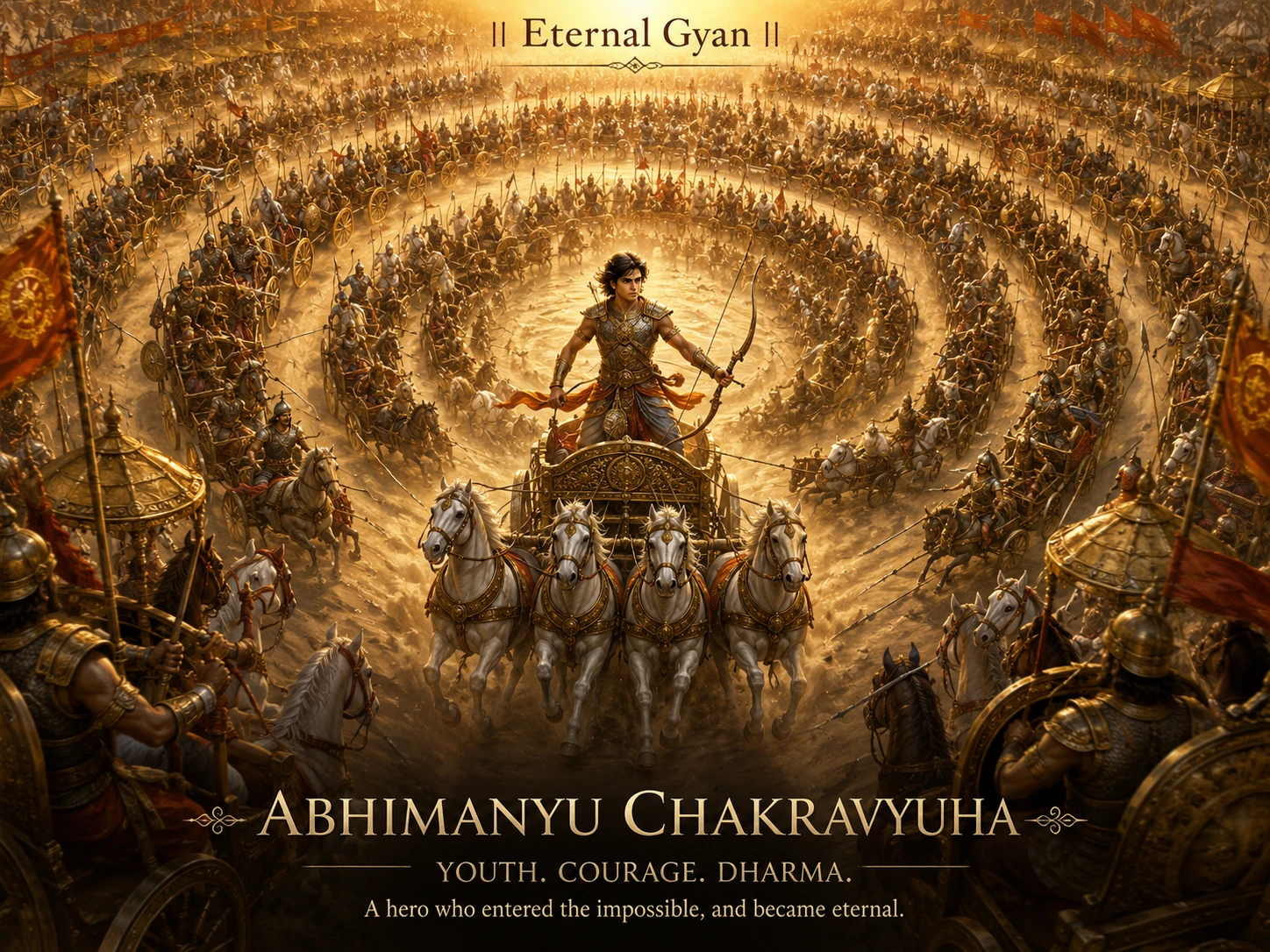
Abhimanyu and the Chakravyuha -- The Boy Who Knew How to Enter but Not How to Leave
14 min read
Adbhuta Ramayana -- The Ramayana Where Sita Becomes Kali
9 min read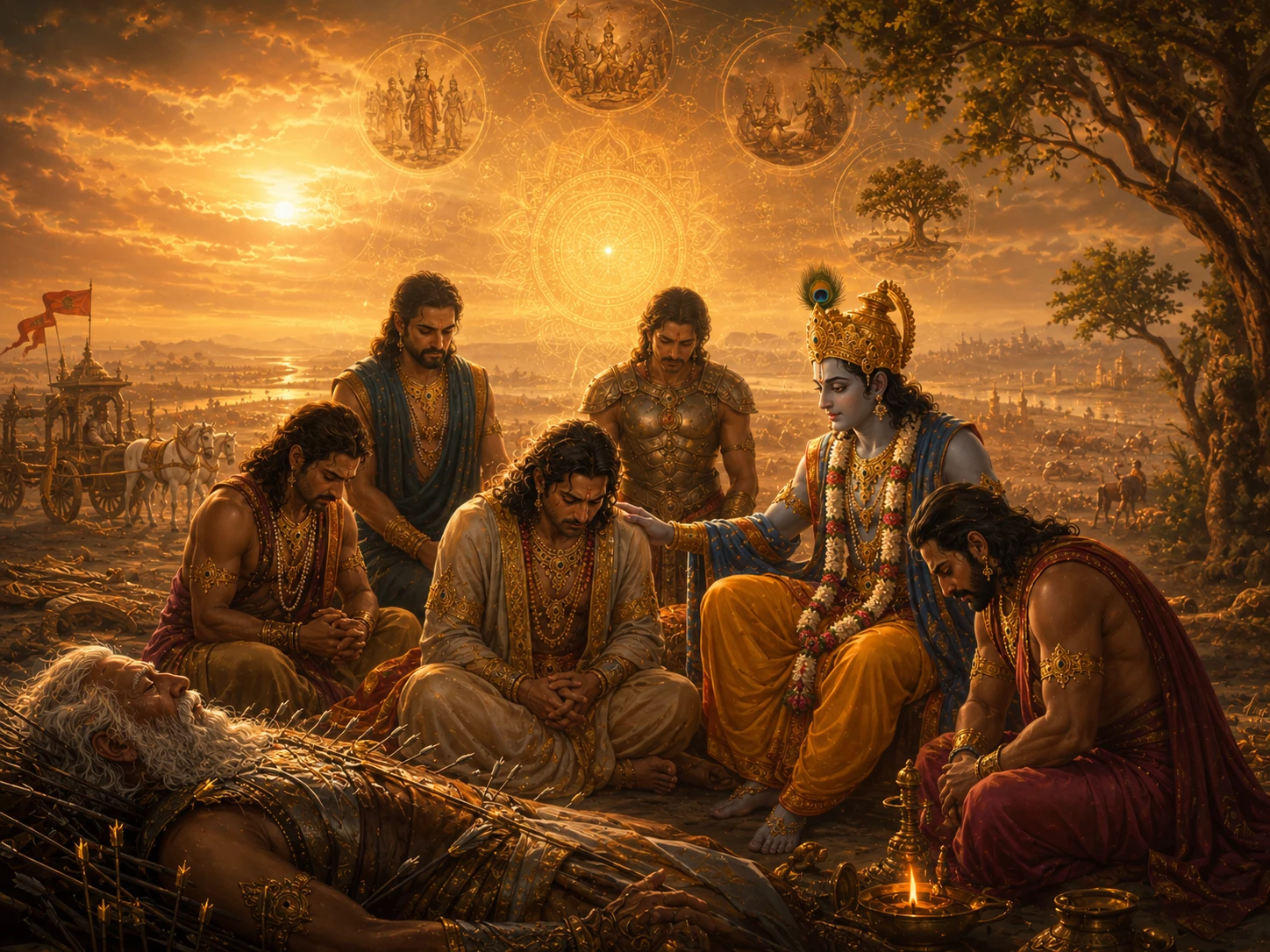
After Kurukshetra -- What Happened Next
14 min readThe same translation error that turned '33 Koti' into '33 crore' in Hinduism also happened in Buddhism. The Chinese translation of Buddhist texts rendered 'Sapta Koti Buddha' (7 Supreme Buddhas) as '7 Crore Buddhas.' The…
Deities AvatarsCommunity Reflections
🕉️
Be the first to share your reflection.