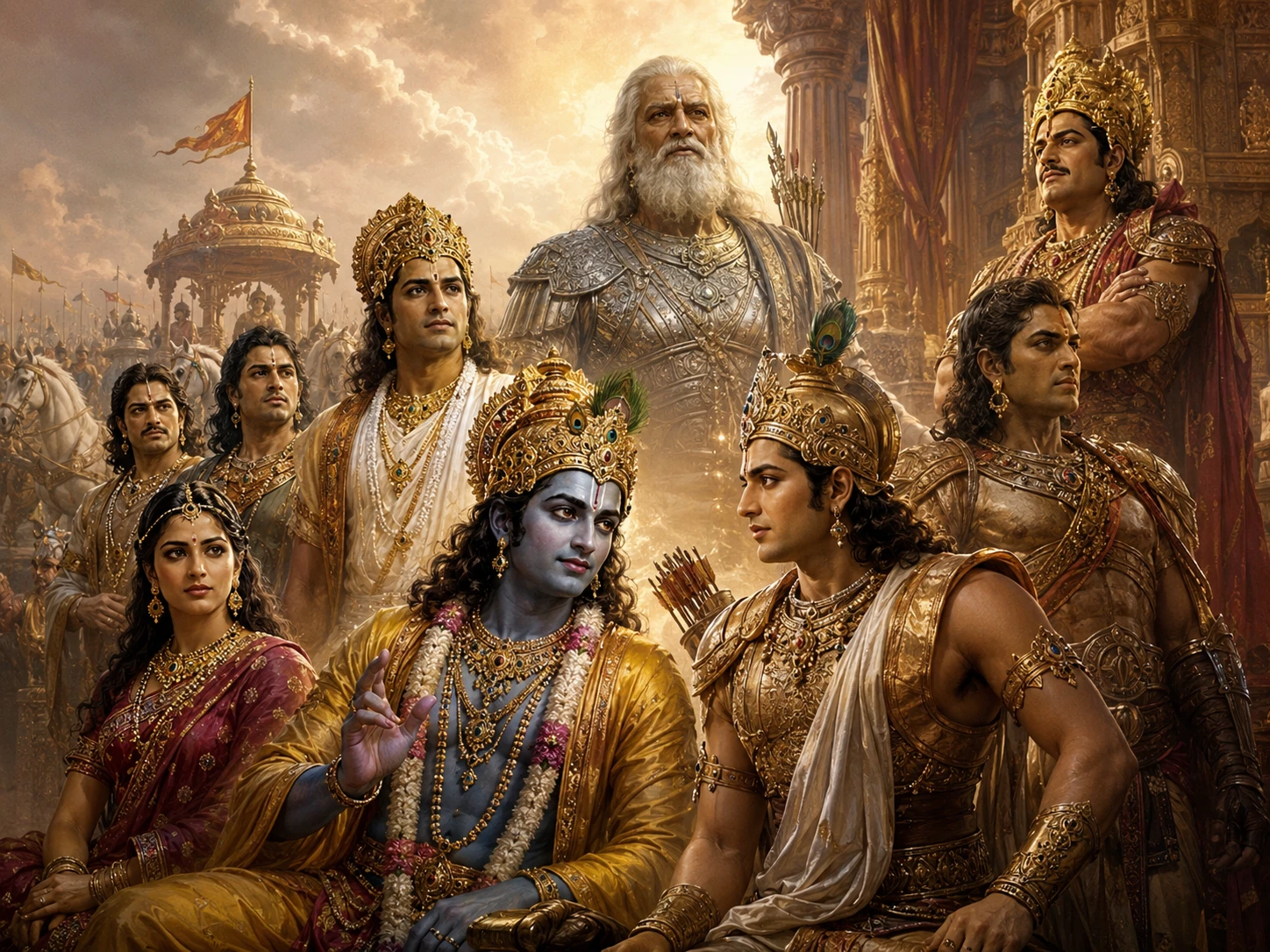
Yudhishthira -- The King Who Inherited a Wasteland
युधिष्ठिर -- वह राजा जिसे खण्डहर मिला
Yudhishthira is the most morally exact character in the Mahabharata, and the one most often dismissed by modern Indian readers as boring. Both judgements are connected. He is dismissed because he does not give us the satisfactions the other Pandavas give. He does not have Arjuna's romantic intensity. He does not have Bhima's appetite for action. He does not have the twins' gentleness or the obvious heroism of a warrior who walks into battle with a clear cause. What he has, in vast and uncomfortable quantities, is dharma. The text makes him the dharmaputra -- the son of Yama-Dharma himself, the cosmic judge of right action. His chariot is recorded as travelling four inches above the ground in his early life, the explicit symbol of a man who had never told a lie. He is the eldest. He is the heir. He is the one who will eventually become samrat -- emperor of all the surrounding kingdoms after the Rajasuya yajna.
And then he loses everything in a single afternoon at the dice board.
This is the puzzle the Mahabharata wants you to sit with. The most dharmically exact man in the entire epic is the one who triggers the war by failing to walk away from a rigged gambling match. He stakes his treasury, his army, his kingdom, his four brothers, himself, and finally his wife -- in that order, with full awareness that each successive stake was worse than the last, with the option to stop at every step, with the elders of the court watching in silence. He did not stop. The man who could not lie could not refuse the next throw. The text records this with a precision that no devotional retelling has ever fully softened. Yudhishthira's dharma did not save him from the most catastrophic single decision in the epic. His dharma was, in fact, part of what trapped him -- the kshatriya code required that an invitation to dice could not be refused without dishonour. His dharma did not include the ability to break a lower dharma to serve a higher one.
This is the structural problem the Mahabharata uses Yudhishthira to explore. The man whose ethics are most exact is the man who is most vulnerable to ethics being weaponised against him. Every kind of trap can be set for a man who cannot lie, cannot refuse a guest, cannot break a kshatriya code, cannot walk away from a wager once it is offered. Shakuni knew this. Duryodhana knew this. Krishna, on the Pandavas' side, would spend the entire war and its aftermath trying to teach Yudhishthira that there are situations in which the higher dharma requires breaking the lower one -- and Yudhishthira, even as the war ended, even as he sat on the recovered throne, would never quite learn the lesson with the speed at which Krishna wanted him to learn it.
This article walks through his life. The frame is simple. He is the only Pandava who survives the war emotionally as well as physically. He is the only one who has to govern the wasteland the war produced. He is the only one who walks the Mahaprasthana from beginning to end and reaches svarga in his physical body. The text gives him these distinctions precisely because his dharma was exact. The same exactness that made him vulnerable to the dice game also made him the only person capable of carrying the kingdom through what came after. Read his life as the Mahabharata's most extended meditation on what it costs to be the most ethical person in a system that does not reward ethics.
अहन्यहनि भूतानि गच्छन्तीह यमालयम्। शेषाः स्थावरमिच्छन्ति किमाश्चर्यमतः परम्॥
ahany ahani bhūtāni gacchantīha yamālayam śeṣāḥ sthāvaram icchanti kim āścaryam ataḥ param
Day after day, beings depart for the abode of Yama. Those that remain still desire permanence. What greater wonder is there than this?
— Mahabharata, Vana Parva 313.116 -- Yudhishthira's answer to the Yaksha at the lake, identifying the greatest wonder in the world
Yudhishthira was born to Kunti by the cosmic union she had with Yama-Dharma -- the same Yama-Dharma whose mortal incarnation was Vidura, his uncle. The doubled lineage matters. Yudhishthira had the same cosmic father as Vidura. The deepest moral relationship of his life was with the man who, by every social marker, was his junior in the household but, by cosmic identity, was his exact equivalent. The Mahabharata wants you to feel this without saying it explicitly. Yudhishthira and Vidura recognised each other across the gap of caste because at a level no one in the palace could see, they were the same Yama in two different bodies.
Kunti was a young widow when she invoked the mantra. Pandu, cursed by a sage to die if he ever embraced his wife, had asked Kunti to use the mantra she had received from Durvasa to obtain children by various devas. Yudhishthira was the first. The text says he was born with a mark on his face that the wise read as the sign of a future king. He grew up in Hastinapura with his four brothers, his hundred Kaurava cousins, and the trinity of elders -- Bhishma, Drona, Vidura -- who would shape his entire moral education. Drona taught him weapons. Vidura taught him dharma. Bhishma taught him the operations of statecraft.
What the text tells us about his early life is that he was, even as a young man, exact. He did not lie. He did not boast. He did not engage in the casual cruelty that runs through Bhima and Duryodhana's interactions. The Mahabharata gives Bhima and Arjuna a hundred small adventures in their youth -- killing rakshasas in the forest, contests with Kauravas, rivalries over food. Yudhishthira's youth is recorded much more sparsely. He was, even then, the still figure around whom the brothers organised themselves. Bhima protected him. Arjuna won prizes for him. The twins served him. He, in return, considered every decision and refused to act in haste.
The Pandavas were sent to Khandavaprastha after the kingdom was divided. The forest tract was a punishment posting. Yudhishthira, with his brothers, transformed it into Indraprastha -- a city built around the Mayasabha that Mayasura had constructed. He performed the Rajasuya yajna there. The yajna required him to be acknowledged as samrat by every kshatriya king in Bharatvarsha. The Pandava brothers spent a year on military expeditions in all four directions, securing tribute from kings as far as Pragjyotisha in the east, Sindhu in the west, the Himavat in the north, and the Pandya kingdom in the south. The tribute was brought to Indraprastha. The yajna was performed. Yudhishthira was anointed samrat.
This was the apex of his pre-war life. He was the most powerful king in the known world. Every other kshatriya bowed to him. The Mayasabha was the most magnificent palace ever built. His four brothers were unmatched warriors. His wife was Draupadi, fire-born princess of Panchala. He had everything. The text places him here, at this exact peak, just before the dice game, because the text wants the contrast to be unbearable.
The Yaksha Prashna is the moment that defines Yudhishthira's character outside the war frame. It happens in the Vana Parva, late in the twelve-year forest exile, just before the disguise year at Virata's court. A Brahmin came to the Pandavas asking for help -- a deer had taken his arani, the wooden sticks used to start fire for Vedic rituals, in its antlers. Without arani, the rishi could not perform his daily yajna. The Pandavas pursued the deer through the forest. The deer vanished. The brothers, exhausted and thirsty, came to a lake.
The younger brothers went one by one to fetch water. Each was warned by a voice from the lake -- before drinking, you must answer my questions. Each ignored the warning. Each drank. Each fell dead. Yudhishthira, the last to arrive, found his four brothers lying dead at the water's edge. He did not panic. He did not rage. He sat by the water and waited for the voice. The voice came. The Yaksha asked. Yudhishthira answered.
The questions are around 124 in the text, on dharma, philosophy, the qualities of the wise, the obligations of householders, the meaning of birth and death, the path of liberation. The most famous exchange is the verse cited above. The Yaksha asked, what is the greatest wonder in this world? Yudhishthira answered -- every day, beings depart for Yama's abode, and yet those who remain desire permanence. The wonder is that we, watching everyone die, still believe we ourselves will not.
The Yaksha was satisfied. He offered to revive one of Yudhishthira's brothers. Yudhishthira chose Nakula -- not Bhima, not Arjuna. The Yaksha asked why. Yudhishthira answered -- my mother Kunti has me, her son. Madri, my stepmother, has no son alive if I do not ask for one of hers. To restore the balance, give me Nakula. The Yaksha was so pleased with the impartiality that he revived all four brothers. Then he revealed himself -- he was Yama-Dharma, Yudhishthira's own father in cosmic identity, who had taken the form of a deer, then a yaksha, to test his son. He blessed Yudhishthira. He gave him the boon that during the disguise year at Virata, no one would be able to recognise the Pandavas.
This is the moment the text wants you to hold against everything else Yudhishthira does. He could be exact in choosing Nakula over his own full-brother Bhima. He could not be equivalently exact in walking away from the dice match that had cost him his kingdom. The same dharma operated in both situations. In one, it produced an answer that pleased the cosmic father. In the other, it produced the worst single decision in the epic. Dharma is not a simple thing. The man whose dharma was the most exact in the Indian tradition was the one who, in another moment, could not see his way clear. The Mahabharata asks you to sit with this without resolving it.
Yudhishthira's epithet Ajatashatru -- 'one whose enemy has not yet been born' -- is recorded throughout the Mahabharata before the war begins. The name was earned, not inherited. Even Duryodhana, who hated him, did not personally hate him as a man -- the hatred was structural, about the throne and the inheritance. The text gives Yudhishthira no personal enemies in the original sense. He treated everyone, including his cousins, with the same exact courtesy. After the war, when he had become king of the wasteland, the name took on a darker resonance. He had no enemies left because his enemies had all been killed. The man whose enemy had not yet been born had outlived every enemy he might have had.
Three Moments Yudhishthira Was Asked to Choose Between Two Dharmas
| Moment | Lower Dharma at Stake | Higher Dharma at Stake | What He Chose |
|---|---|---|---|
| The dice game in Hastinapura | Kshatriya code that an invitation to dice cannot be refused without dishonour | The protection of his kingdom, his brothers, and his wife from a rigged match he could see was rigged | He chose the lower dharma. He played. He lost everything. The text records this without softening |
| The killing of Drona on day fifteen of the war | His vow that he had never told a lie -- and Krishna's request that he say 'Ashwatthama is dead' so that Drona, hearing of his son's death, would lay down his weapons and be killable | The end of the war and the saving of Pandava lives | He half-chose the higher dharma. He said the words 'Ashwatthama is dead' aloud, then added in a low voice 'the elephant of that name', to preserve technical truth. Drona heard only the loud part. Drona laid down his weapons. Drona was killed. Yudhishthira's chariot, which had floated four inches above the ground for his lifetime, sank to earth. The man who could not lie had now told a half-lie. The chariot never rose again |
| The Yaksha Prashna at the lake | The natural impulse to grieve a brother and act in haste | The patience to answer the Yaksha's questions completely and impartially | He chose the higher dharma without compromise. He answered every question. He chose Nakula over Bhima for revival to honour his stepmother. The result was full restoration of all four brothers. The exactness of his choice was rewarded by the cosmos |
Notice the pattern. The man who could not balance lower against higher dharma in the dice game was the same man who could balance them perfectly at the Yaksha's lake. What was different? The dice game asked him to break a kshatriya social code. The Yaksha asked him to balance two domestic loves. He could see the second clearly. He could not see the first. The Mahabharata wants you to feel that even the dharmaputra had blind spots, and the blind spots were precisely in the areas where his society had pre-trained him not to look.
The Drona deception on day fifteen of the war is the most morally complicated single act of Yudhishthira's life. Drona was the master archer commanding the Kaurava army after Bhishma fell. The Pandavas had no weapon that could defeat him in straight battle. Krishna proposed a strategy. He told Bhima to kill an elephant named Ashwatthama -- the same name as Drona's son. Bhima killed the elephant. Krishna then told Yudhishthira to announce loudly that Ashwatthama was dead. Yudhishthira refused at first. He had never lied. Krishna pressed him. The war hangs on this, Krishna said. Drona will not stop unless he believes his son is dead. Say the words.
Yudhishthira said them. He said 'Ashwatthama is dead' loudly enough that Drona, on the other end of the battlefield, could hear. Then, in his most precise compromise, he added in a quieter voice 'the elephant of that name'. Drona heard only the first part. Drona, who could see his son's death foretold, laid down his weapons. Dhrishtadyumna -- Drupada's son, the one fire-born twin to Draupadi who had been born specifically to kill Drona -- approached the unarmed guru and beheaded him.
Yudhishthira's chariot, which had floated four inches above the ground for his entire adult life, sank to the earth in that moment. The text records the sinking with care. The boon of perfect truth had been broken. The half-lie had cost him the cosmic privilege of the chariot. He won the war. He never recovered the floating chariot.
This is the most painful image in his life. The Yudhishthira who walks the rest of the war and the post-war years walks on ordinary ground. He has the kingdom. He has the throne. He has the prestige of the samrat. But the small physical sign that had marked him, in his own body, as the one who never lied -- that sign is gone. He had been asked to choose between his personal dharma and the survival of his side, and he had chosen survival. The cosmos noted the choice. The chariot stayed on the ground.
Krishna, throughout the rest of the Mahabharata, treats this not as a defeat but as Yudhishthira's first real lesson. The man who can never sacrifice his personal dharma for the larger dharma is the man who cannot govern. Krishna had been trying to teach Yudhishthira this since the first day of the war. The Drona moment was when the lesson finally took. The cost was the chariot. The benefit, in Krishna's view, was a king who had finally understood that ruling requires occasional contamination of the self.
Yudhishthira did not see it as a benefit. He grieved the chariot for the rest of his life. The text gives him several scenes in the Shanti Parva where Bhishma, lying on the bed of arrows, has to remind him that the half-lie was necessary. Yudhishthira does not fully accept this. He governs the kingdom. He performs the ashvamedha yajna. He sits on the throne. But he never stops mourning, in private, the moment his chariot stopped floating.
नाहं स्वर्गमिच्छामि भ्रातृभिर्विरहीकृतम्। सुहृज्जनैर्विना च्छिन्नं पुत्रदारैर्विवर्जितम्॥
nāhaṃ svargam icchāmi bhrātṛbhir virahīkṛtam suhṛjjanair vinā cchinnaṃ putradārair vivarjitam
I do not desire heaven separated from my brothers, severed from my friends and well-wishers, deprived of my children and wife. Such heaven I refuse.
— Mahabharata, Svargarohana Parva (paraphrasing the structure of multiple verses where Yudhishthira refuses heaven without his brothers and Draupadi)
After the war, Yudhishthira was crowned king of Hastinapura. The kingdom he inherited was the wasteland the Mahabharata had been building toward. Almost every kshatriya in Bharatvarsha was dead. Bhishma was lying on the bed of arrows, dying slowly through fifty-eight days of dharma discourse. Drona was dead. Karna was dead. Duryodhana was dead. The hundred Kauravas were dead. Abhimanyu was dead. The five Upapandavas, Draupadi's sons, were dead. The kingdom's male population had been gutted. The widows were everywhere. The women's quarters of Hastinapura, after the war, was effectively a city of weeping.
Yudhishthira tried to refuse the throne. He told Vyasa, Krishna, Bhishma, and his brothers that he would prefer to retire to the forest. He could not bear governing the wasteland his decisions had helped produce. Each of these advisors, in turn, refused his refusal. Vyasa told him -- you are the eldest, you fought the war, you must rule. Krishna told him -- the dharma of the kshatriya does not include retirement after victory. Bhishma, on the bed of arrows, gave him the entire Shanti Parva and Anushasana Parva specifically as a manual for governing the wasteland.
Yudhishthira accepted the throne under protest. He performed the ashvamedha yajna to consolidate the kingdom. He served his elders -- the blind Dhritarashtra, Gandhari, Vidura, Kunti -- with the deference he had always shown them. When Dhritarashtra and Gandhari left for vanaprastha after fifteen years, accompanied by Vidura, Yudhishthira walked them to the forest's edge. He visited them in their forest hermitage. When the news came that the three of them had died in a forest fire, Yudhishthira mourned them as fully as if they had been his own parents.
The rule lasted thirty-six years, the text says. They were quiet years. The kingdom recovered slowly. The widows were settled. The succession was managed. Parikshit, son of Abhimanyu and grandson of Arjuna, was groomed as the heir. Krishna, in Dwaraka, performed his own duties. The cosmic age moved forward. And then Krishna died -- killed by a hunter's arrow in the forest near Dwaraka, ending his earthly avatar. Dwaraka itself was swept into the sea shortly afterward. The Yadava clan destroyed itself in a drunken brawl on the beach. The text records all of this with the same precision it has always used. The Krishna who had been Yudhishthira's living anchor for the entire post-war period was gone.
With Krishna's death, Yudhishthira understood that his time was over. He installed Parikshit on the throne. He set out, with his four brothers and Draupadi and a single dog, on the Mahaprasthana -- the great northward final journey toward Mount Sumeru and svarga.
The Mahaprasthana, in the Mahaprasthanika Parva, is the only journey in the Mahabharata where every step is a moral test in real time. The five Pandavas and Draupadi began the walk together, accompanied by a stray dog who attached himself to Yudhishthira at the start. One by one, the others fell. Draupadi fell first -- the text says, because of her partiality to Arjuna. Sahadeva fell next -- the text says, because of his pride in his learning. Nakula fell -- because of his pride in his beauty. Arjuna fell -- because of his pride in his archery and the unkept boast that he could destroy his enemies in a single day. Bhima fell -- because of his gluttony and his pride in strength. Yudhishthira walked on. He did not turn back to mourn any of them. He had been told before the journey began that this was the test. Each fall was a karmic settling that he was to accept without breaking his stride.
The dog walked with him through everything. When Indra arrived at the foot of Mount Sumeru with his celestial chariot to take Yudhishthira to svarga, Indra said -- you alone may enter heaven in your physical body. Your brothers and Draupadi have already gone ahead by their respective karmic routes. Climb in. Yudhishthira asked -- and the dog? Indra said the dog was not allowed in svarga. Yudhishthira refused to enter heaven without the dog.
This is the most exact moment of dharma in his entire life. He had stayed silent while Draupadi was disrobed. He had told a half-lie to kill Drona. He had walked away from his fallen brothers and wife on the Mahaprasthana. He had governed a wasteland for thirty-six years without complaint. Now, at the gate of svarga itself, he refused to enter without a stray dog who had walked with him for the final journey. The dharma of the dog -- the loyalty he had received without asking, the simple companionship of an animal who had nothing to offer in exchange for kindness -- could not be set aside even for the entry to heaven.
Indra argued. Yudhishthira refused. The dog then revealed himself. He had been Yama-Dharma all along, walking beside his son in animal form, testing him to the very last step. The Mahabharata closes the human portion of Yudhishthira's story with this revelation. The cosmic father had walked beside him through the final journey to see whether his son's dharma extended even to a creature with no social or political value. It did. Yudhishthira had passed.
He entered svarga. And then the Mahabharata gave him the strangest test of all. Inside heaven, he found Duryodhana seated on a throne in honour. He did not find his brothers. He did not find Draupadi. He demanded an explanation. Indra said -- your brothers and Draupadi are in naraka, hell, paying small accumulated karmic debts. They will be released soon. Duryodhana, who died on the battlefield in the duel he had himself chosen, has earned vira-loka. This is how the cosmic accounting works.
Yudhishthira, hearing this, said -- if my brothers are in hell, take me to hell. He refused to remain in heaven while those he loved suffered. Indra led him through naraka. He saw his brothers. He saw Draupadi. He saw Karna -- whom he now knew was his eldest brother. He saw the men who had loved him most being punished for small breaches he could barely remember. He decided he would stay in hell with them rather than return to heaven without them.
Indra revealed it had been the final test. The hell was an illusion. His brothers and Draupadi were already in svarga. The illusion was given to test whether he, on entering heaven, would stay there while those he loved suffered. He had refused. The dharma of the king was again exact. He was given his full place in svarga. The brothers and Draupadi joined him. The Mahabharata's epic narrative ends here. The man who had inherited the wasteland was the only Pandava to enter heaven in his physical body. The dog, who had been Yama-Dharma, returned to his celestial role. The cycle was complete.
Why does Yudhishthira matter to you in 2026?
Because Yudhishthira is the Mahabharata's diagnosis of what it costs to be the most ethical person in a system that does not protect ethics. The pattern is recognisable across modern Indian life. The professional who never cuts corners, never bribes, never lies on a tax return, never lets a junior take the blame for his own mistake -- and who watches, year after year, less ethical colleagues advance faster, take credit for his work, win the promotions he should have received. The student who refuses to cheat in a system where many of his peers do, and who watches them get into the IIT he himself was rejected from. The startup founder who refuses to inflate metrics in pitch decks, and who watches founders willing to inflate get the funding round he could not close. The civil servant who refuses to bend a rule for a powerful relative, and who is transferred to a remote posting while the colleague who bent the rule is promoted to a metro.
The modern Yudhishthira pays the cost of his ethics in real time. He knows he is paying it. He continues paying it anyway. The Mahabharata is honest about this. It does not pretend the cost is illusory. It does not pretend the man who keeps his ethics is happier in the moment. The chariot stays on the ground. The promotion goes to someone else. The kingdom inherited is a wasteland.
What the text does insist on is the long arc. The man who pays the cost is the one who can govern the wasteland. The colleagues who advanced faster are not the ones the institution turns to when the institution itself is breaking. The founder who inflated is not the one investors trust when the company hits real difficulty. The civil servant who bent the rule is not the one called in when the system itself faces a crisis. The Yudhishthira who lost the dice game and won the war and inherited the wasteland is the one who, in the end, walks into svarga with the dog. The text gives him the privilege of physical entry to heaven not because he was always exact -- he was not -- but because he kept choosing to be exact in the small ways even after his exactness had cost him everything.
The diagnostic question for you is the simplest in this cluster. Pick a small moment in your last week where you could have cut a corner, told a small lie, taken credit you did not earn, accepted a benefit you should have refused. Did you? If you did, the Mahabharata is not condemning you -- Yudhishthira himself failed at the dice game. If you did not, the Mahabharata is naming what you did. It is naming the cost you are quietly paying. It is also naming the seat at the gate of heaven that the cost is buying you.
Yudhishthira's life is the proof that the cost is real and the seat is real. The Mahabharata does not romanticise the cost. The chariot did fall. The kingdom did become a wasteland. The brothers did fall on Mahaprasthana. But the seat at heaven was real. The dog was Yama-Dharma in disguise. The wife who had partiality for another husband was given back to him in svarga. Even Karna, the brother he had killed in war, was waiting in svarga to embrace him. The Mahabharata is the most morally unsentimental text in Indian literature. It does not give him these things because he was perfect. It gives them because he never stopped trying to be exact, even after exactness had cost him almost everything.
This is the one promise the text makes to you. The cost is real. The seat is real. You will pay both. The question is only whether, when the dog walks beside you to the gate of heaven, you will be the kind of person who refuses to enter without him.
Read the Yaksha Prashna out loud, in Sanskrit and English
The Yaksha Prashna in Vana Parva 312-313 contains 124 questions and 124 answers between Yudhishthira and his cosmic father in the form of a yaksha. Read them slowly. Most are short. Many are still answerable in your own life. The text is the Mahabharata's only chapter that is structured as a self-administered moral examination. Use it as one. The questions you cannot answer in your own life are the ones the text is asking you to learn from.
Tags
Eternal Raga · शाश्वत राग
Institutional voice — scholarly articles on Sanatan Dharma
Deepen Your Understanding
अपनी समझ और गहरी करें
scriptural exegesis
The Kurukshetra Within -- Reading the Mahabharata as a Mirror of Your Mind
Vyasa wrote that whatever exists in the world also exists in the Mahabharata, and whatever is not there exists nowhere. This is not a boast. It is an instruction: every character in the epic is a character inside you. Read the war as a map of your mind.
scriptural exegesis
Yaksha Prashna -- Questions at the Lake
Four brothers lie dead beside an enchanted lake. One brother remains. A voice from the water asks 124 questions about dharma, death, happiness, and the self. Yudhishthira's answers in Vana Parva remain the most sophisticated ethical examination in all of Sanskrit literature.
scriptural exegesis
Vidura -- The Wisest Man No One Listened To
He was an incarnation of Yama-Dharma, born to a maid, raised in the palace, brother to the king he could not crown. He spoke truth in every chamber the Mahabharata gave him. He was thanked, dismissed, and overruled in chamber after chamber. Vidura is the most painful character in the epic because his pattern is the most ordinary -- the right counsel given in the wrong room.
scriptural exegesis
The Dice Game -- The Darkest Hour of the Mahabharata
A king who cannot say no to a challenge. An uncle whose dice are loaded with the bones of the dead. A court full of elders who watch injustice and say nothing. And a woman who asks one question that nobody in the room can answer: 'Did my husband lose himself first, or me?' The dice game in the Sabha Parva is not a plot device. It is the moral black hole at the centre of the Mahabharata. Everything before it is prologue. Everything after it is consequence. And the central horror is not what happens -- it is who lets it happen.
scriptural exegesis
After Kurukshetra -- What Happened Next
The war ended. The Pandavas won. And then everything fell apart. Krishna's clan destroyed itself in a drunken brawl. Dwaraka sank into the sea. Arjuna's divine powers vanished. And the five brothers who fought the greatest war in history walked into the Himalayas to die. The Mahabharata's post-war chapters are darker, stranger, and more relevant than the war itself.
scriptural exegesis
Pandavas in Hell -- The Shocking Finale of the Mahabharata
The Mahabharata does not end with victory. It ends with the heroes falling dead on a Himalayan climb, the villains seated in heaven, and the one righteous king demanding to be sent to hell. The Swargarohana Parva is the most unsettling, most philosophically radical, and most misunderstood finale in all of world literature.
scriptural exegesis
Draupadi -- The Question That Burned Down a Kingdom
She was born from fire, married to five husbands by accident and rule, hostess of the most magnificent palace ever built, dragged by her hair into a court of silent men, and asked the one question they could not answer. The Mahabharata was written so that question could be asked. The kingdom burned down so that question could be answered.
Yudhishthira's epithet Ajatashatru -- 'one whose enemy has not yet been born' -- is recorded throughout the Mahabharata before the war begins. The name was earned, not inherited. Even Duryodhana, who hated him, did not p…
More in Scriptural Exegesis
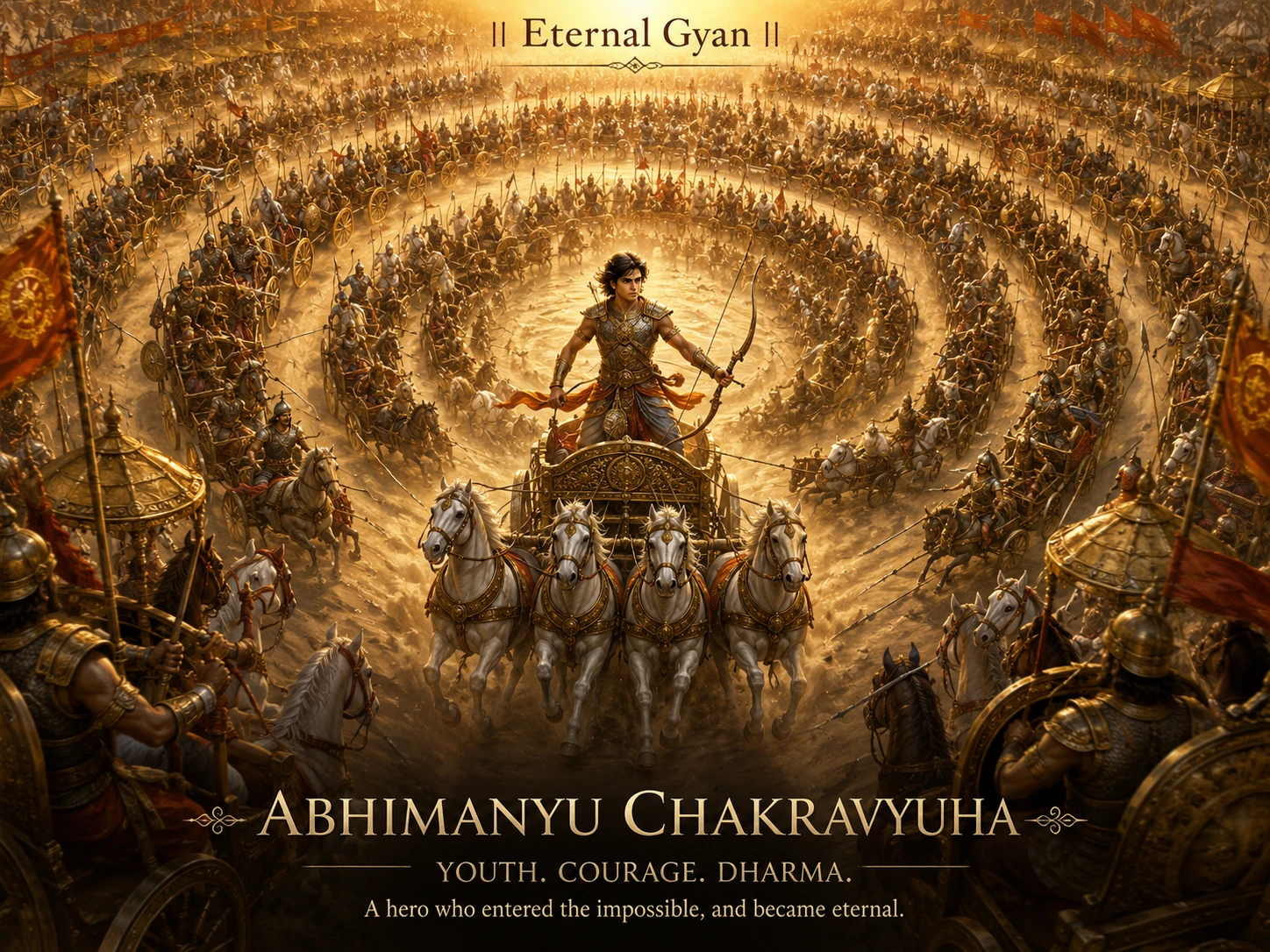
Abhimanyu and the Chakravyuha -- The Boy Who Knew How to Enter but Not How to Leave
14 min read
Adbhuta Ramayana -- The Ramayana Where Sita Becomes Kali
9 min read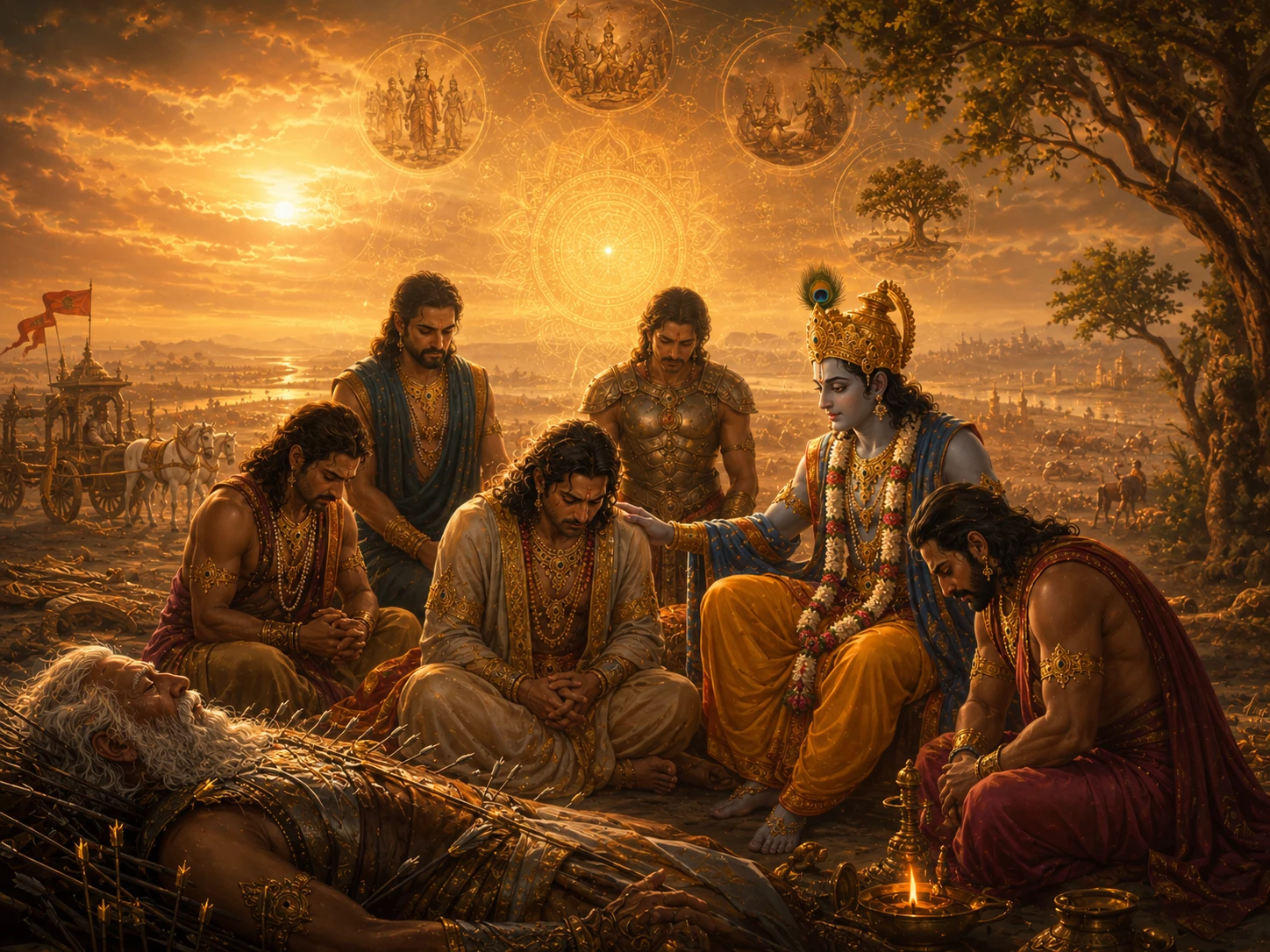
After Kurukshetra -- What Happened Next
14 min readThe same translation error that turned '33 Koti' into '33 crore' in Hinduism also happened in Buddhism. The Chinese translation of Buddhist texts rendered 'Sapta Koti Buddha' (7 Supreme Buddhas) as '7 Crore Buddhas.' The…
Deities AvatarsCommunity Reflections
🕉️
Be the first to share your reflection.