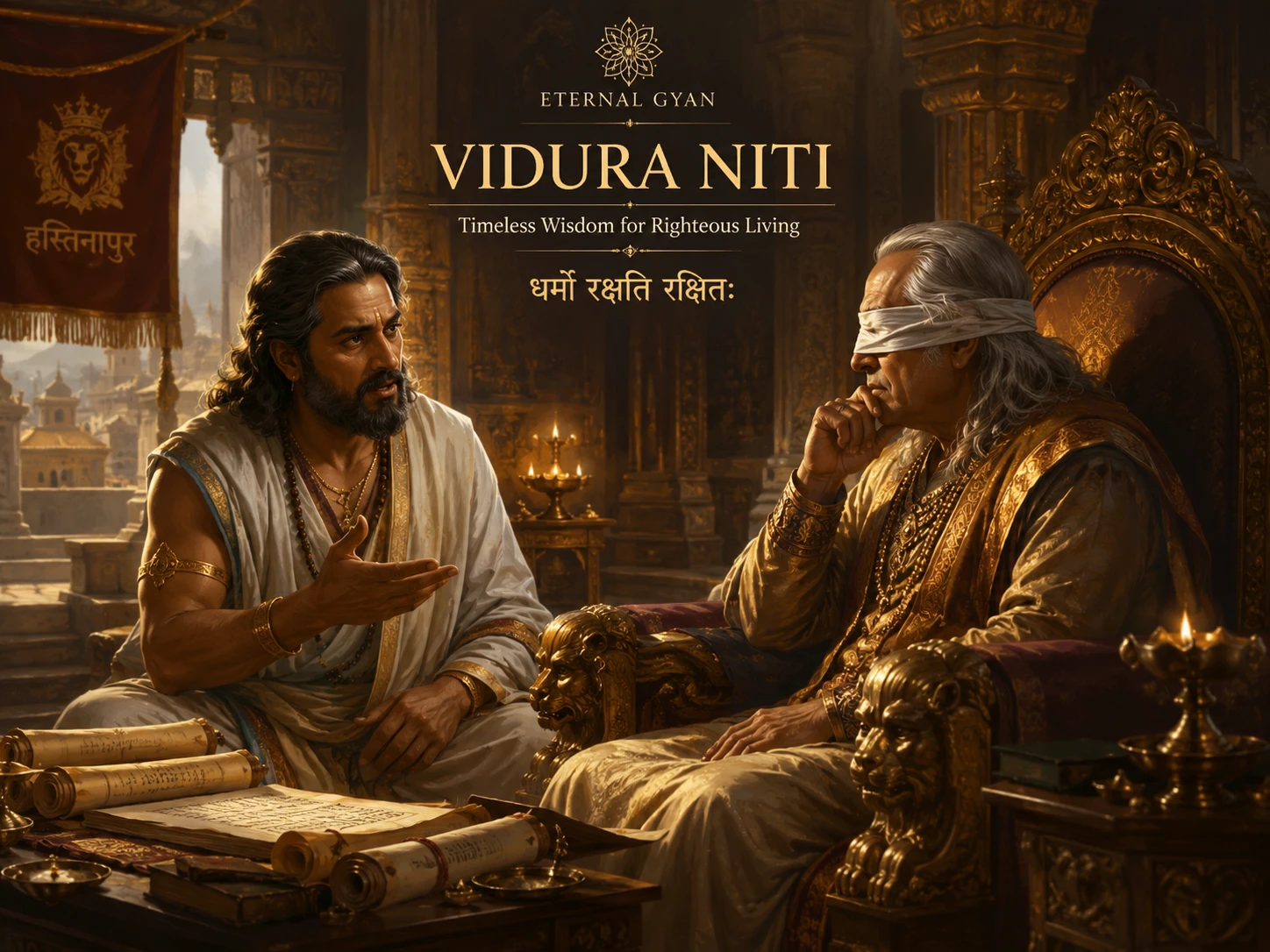
Vidura -- The Wisest Man No One Listened To
विदुर -- वह बुद्धिमान जिसकी किसी ने नहीं सुनी
Vidura is the character the Mahabharata builds its moral frame around, and the character almost no one in the story actually listens to. This is the structural irony of his presence. He is given the longest sustained ethical discourse in the epic outside the Gita itself -- the Vidura Niti, eight chapters of the Udyoga Parva, more than five hundred verses on right conduct, governance, friendship, character, and the qualities of the wise. His advice is correct on every major decision the Kuru house faces. The kingdom would have been spared the war if any of his counsel had been followed in time.
None of it was followed in time. The text records this without ornament. Vidura speaks. The king nods. The king does the opposite. Vidura speaks again. The king nods again. The king does the opposite again. The pattern repeats for eighty years.
This is the most ordinary catastrophe the Mahabharata diagnoses. Not the great villain. Not the corrupt minister. Not the betrayal in the inner circle. The ordinary catastrophe is the wise advisor who is heard with respect and overruled with affection by a leader who cannot bear to hear what would actually save him. Every Indian institution has a Vidura. The chief of staff who flagged the disaster six quarters early and was thanked for the warning. The compliance officer the board overruled in 2017 and only remembered after the SEBI notice arrived. The senior auntie at every wedding who said the boy was wrong and was told to keep family politics out of the function. The HR director who warned about the toxic founder for three years and was offered a generous severance the day she sent the formal complaint. They are everywhere. They are usually right. They are usually ignored.
Vidura's tragedy, in the Mahabharata's reading, is not that he was wrong. He was right. His tragedy is that being right was not enough to change anything, because the room he was speaking into was not actually a room that wanted answers. It wanted reassurance. It wanted reasons not to act. It wanted, in the case of Dhritarashtra, the comfort of having heard the warning without the burden of having to obey it.
This article walks through Vidura's life. It is shorter than the others in this cluster, because Vidura's life is, in a sense, almost entirely a life of speaking. He has fewer adventures than Arjuna, fewer wounds than Karna, fewer sins than Duryodhana, fewer vows than Bhishma. What he has, abundantly, is words. The words he spoke survived him. The kingdom that ignored those words did not.
एकः सम्पन्नमश्नाति वस्ते वासश्च शोभनम्। योऽसंविभज्य भृत्येभ्यः को नृशंसतरस्ततः॥
ekaḥ sampannam aśnāti vaste vāsaś ca śobhanam yo'saṃvibhajya bhṛtyebhyaḥ ko nṛśaṃsataras tataḥ
He who alone enjoys the rich meal, who alone wears the fine cloth, who shares nothing with his servants -- who could be more cruel than such a man?
— Mahabharata, Udyoga Parva 33.40 (Vidura Niti) -- one of Vidura's most direct moral statements to Dhritarashtra
Vidura's birth is one of the strangest origin stories in the Mahabharata. He was, in his previous existence, Yama -- the god of dharma and death himself, the one who measures every action and assigns its consequence. The sage Mandavya, in deep tapasya, had been falsely accused of theft and impaled on a stake by a king. Yama, in his role as karmic judge, had assigned Mandavya the punishment as a delayed consequence of a childhood act -- as a small boy, Mandavya had skewered insects with sharp grass. Mandavya survived the impalement, learned the cause from Yama, and cursed Yama for the disproportion. A childhood mistake by a four-year-old, Mandavya argued, did not justify lifelong impalement on a stake. Yama, hearing the curse, accepted it. He would be born as a mortal, into a low-status birth, and would have to live the consequences of imperfect law before he again returned to his role.
The vehicle for Yama's birth was the dynastic crisis at Hastinapura. Vichitravirya had died young without heirs. Bhishma had refused to break his vow. Satyavati had summoned Vyasa to perform niyoga on Vichitravirya's two widows, Ambika and Ambalika, plus a serving maid. Ambika, frightened by the rishi's appearance, closed her eyes during the encounter -- her son Dhritarashtra was born blind. Ambalika, frightened, turned pale -- her son Pandu was born with a pale complexion that affected his later life. The serving maid, the only one of the three who behaved with composure, gave birth to a healthy son with no defect. That son was Vidura. Yama, born to a Shudra woman, raised in the royal palace, brother by the same biological father to Dhritarashtra and Pandu but lower in social status because of his mother's birth.
This combination is the structural fact of Vidura's life. He had the same father. He had the same upbringing in the same palace. He was, in many ways, the most intellectually gifted of the three brothers -- the text says explicitly that he surpassed Dhritarashtra and Pandu in mastery of dharmashastra. But he could not be king. The Kuru succession went to Dhritarashtra, and when Dhritarashtra was passed over for blindness, to Pandu. Vidura was made the kshatta -- the chief minister, the keeper of records, the formal advisor, the man who stood beside the throne but could not sit on it.
The word kshatta is itself revealing. It carries connotations of both authority and constraint. The kshatta has the king's ear. The kshatta does not have the king's command. Vidura's entire life is lived inside this gap.
The first major intervention Vidura made was in the lakshagriha episode. Duryodhana, advised by Shakuni and Purochana, had built a wax house at Varanavata and invited the Pandavas to stay there during a festival. The plan was to set the house on fire on a chosen night. The Pandavas, wholly trusting their cousins, would burn alive in their sleep. The hundred Kauravas would inherit. The kingdom would be uncontested.
Vidura learned of the plot. He could not stop it openly -- he had no command authority, and accusing Duryodhana directly would have been refused by Dhritarashtra. He did what he could. He spoke to Yudhishthira just before the Pandavas left, in coded language. He told him -- you should know that fire which is born outside the body and which is fanned by the wind, can be escaped by knowing the way out. He spoke obliquely about how a small mole-like creature digs tunnels and survives. Yudhishthira understood every word. Vidura then arranged for a Khanaka, a tunneller, to visit the lakshagriha disguised as a workman, dig a tunnel from inside the house out to the forest, and slip away.
The night came. The house was set on fire. The Pandavas, with their mother Kunti, escaped through the tunnel. A Nishada woman and her five sons, who had been resting in the house and whose presence the Pandavas had not noticed, perished -- the text records this with sorrow. The Pandavas emerged into the forest. They were alive because of Vidura.
This is the most operationally consequential thing Vidura did in the entire Mahabharata. He saved five lives that would, decades later, win the Kurukshetra war. He did it through indirect speech, secret assistance, and the courage to act against his own brother's son. The Mahabharata records the act without making a great showing of it. Vidura did not boast. He went back to his work in the palace as if nothing had happened.
The pattern of his life is established here. He acts when he can. He speaks when he must. He never has the command authority to stop the wrong from happening at the source. He intervenes around the edges. The Pandavas survived because of those edges. The kingdom would not.
The Vidura Niti, embedded in chapters 33 to 40 of the Udyoga Parva, contains 593 verses on right governance, character, and friendship. It was given over a single sleepless night when Dhritarashtra, anxious about Sanjaya's report, summoned Vidura to advise him. Among its most quoted verses is na tat parasya sandadhyāt pratikūlaṃ yad ātmanaḥ -- 'do not do unto others what would be disagreeable to yourself' -- the Indian formulation of what the Christian tradition calls the Golden Rule, given by Vidura roughly two thousand years before that phrase entered English. The Vidura Niti is studied today in business schools across India as a treatise on leadership, even though its original audience -- King Dhritarashtra -- did not act on a single one of its recommendations.
The dice game scene is the moment of Vidura's most public failure -- and his loudest protest. He spoke against the dice game from before it began. He warned Dhritarashtra that calling the Pandavas to a rigged match would destroy the family. Dhritarashtra agreed verbally and did nothing. Vidura warned again. Dhritarashtra agreed again. The match went forward. Yudhishthira lost everything.
When Dushasana dragged Draupadi into the assembly hall by her hair, Vidura stood up. He was the only senior member of the assembly to speak with full clarity. He told the assembled court -- this is wrong. He told Duryodhana directly that the act would destroy the Kuru race. He invoked the example of Prahlada -- the asura prince who refused to follow his father into adharma. He cited the legal principle that a slave cannot wager another. He gave the technical reasoning that Draupadi could not have been won, because Yudhishthira had wagered himself first and become a slave, and a slave has no property to wager. The text records his protest at length. The text also records that the protest was ignored.
Duryodhana mocked him as a half-blood. Karna mocked him as a man whose dharma was suspect because of his mother's birth. Bhishma was silent on the legal question. Drona was silent. Dhritarashtra was silent. Vidura's voice in that hall was the only one that named the act for what it was, and that voice was overruled because the people who could have backed it chose not to speak.
Draupadi was eventually saved by the divine intervention of the akshaya-vastra and by Dhritarashtra's late-night reversal of the dice game's results. But the moral structure had already been broken. Vidura had been right. Vidura had said so. The court had heard him. The court had carried on regardless. The pattern was now fully visible. The Pandavas would be sent into exile. The war would become inevitable.
In the years between the dice game and the war, Vidura continued his daily work. He counselled Dhritarashtra on every major decision. He pleaded for moderation in the negotiations. When Krishna came as ambassador, Vidura received him in his own home before the formal court reception, and Krishna -- who could have stayed in the royal guest quarters with Duryodhana -- chose to eat in Vidura's house. The gesture was deliberate. Krishna was telling the kingdom and the cosmos that the moral centre of Hastinapura was not in the throne room. It was in the kshatta's quarters. The text records the meal in detail. Krishna ate the simple food Vidura's wife served. The richness of Duryodhana's preparations went uneaten in the palace.
Vidura's Five Warnings -- And What Happened After Each
| Moment | Vidura's Warning | Dhritarashtra's Response | Outcome |
|---|---|---|---|
| Birth of Duryodhana | The omens at this child's birth are terrible -- jackals howl, donkeys bray, the shastras prescribe abandoning him for the welfare of the kuldharma | I cannot abandon my own son | Duryodhana grew up to lead the war that destroyed the entire Kuru lineage |
| The lakshagriha plot | Coded warning to Yudhishthira about a fire that can be escaped through tunnels; secret arrangement for a tunneller | (Dhritarashtra was never told; the warning was given directly to Yudhishthira) | The Pandavas escaped. The kingdom did not learn what had been planned, and Duryodhana's appetite for plotting was confirmed |
| Before the dice game | Calling Yudhishthira to a rigged match will destroy the family; refuse the invitation; cancel the proceedings | Verbal agreement; no action | The dice game proceeded. Draupadi was dragged in. The thirteen-year exile began |
| During the disrobing in the sabha | This act will destroy the Kuru race; the legal basis is invalid; the example of Prahlada must be followed | Silence in the chamber; reversal only after Gandhari and the divine signs intervened | The court's reputation was ruined. The vow of Bhima to drink Dushasana's blood was made. The vow of Draupadi to not bind her hair until washed in Kaurava blood was made |
| Vidura Niti -- the long sleepless night before the war | Eight chapters of warnings about the entitled mind, the rigged match, the wise advisor ignored, the qualities of a wise leader; specific recommendation to give back the five villages and avoid war | I hear you, Vidura, but Duryodhana wants the opposite; destiny will do what it wants | The war proceeded. Eighteen days, hundreds of thousands of deaths, including all hundred of Dhritarashtra's sons. The kingdom Vidura had spent his life serving became a wasteland |
Notice the pattern. At each moment, Vidura's analysis was correct. At each moment, Dhritarashtra heard him with full attention and did not act. The kingdom did not collapse because no one warned the king. The kingdom collapsed because the king could not bear to act on the warnings he received.
सुखार्थिनः कुतो विद्या नास्ति विद्यार्थिनः सुखम्। सुखार्थी वा त्यजेद्विद्यां विद्यार्थी वा त्यजेत्सुखम्॥
sukhārthinaḥ kuto vidyā nāsti vidyārthinaḥ sukham sukhārthī vā tyajed vidyāṃ vidyārthī vā tyajet sukham
How can the seeker of comfort obtain wisdom? There is no comfort for the seeker of wisdom. Either the seeker of comfort must give up wisdom, or the seeker of wisdom must give up comfort.
— Mahabharata, Udyoga Parva 40 (Vidura Niti) -- one of the verses Vidura gives to Dhritarashtra during the long sleepless night
After the war, Vidura did not stay in the Hastinapura court. The kingdom Yudhishthira had inherited was his to govern. Vidura's role as kshatta was no longer needed. He stayed for some years, advising Yudhishthira on the rajadharma he had spent his life trying to teach Dhritarashtra. The Pandavas listened to him in a way Dhritarashtra never had. The text shows him visibly calmer in these years.
Then Vidura did the one thing the Mahabharata's wisest characters seem to do at the end. He left. He took up the life of the wandering ascetic. He went into the forest with Dhritarashtra and Gandhari, who had renounced the throne in their grief, and the three of them lived in vanaprastha for a few years near the banks of the Yamuna. He performed his last tapasya. The text says he became almost unrecognisable -- thin, half-naked, food-renouncing, indifferent to the world.
When Yudhishthira came to visit them in the forest, looking for Vidura specifically, he found him standing near a tree, gaunt and silent. Vidura looked at Yudhishthira -- the man he had effectively saved through the lakshagriha tunnel decades earlier -- and did something the Mahabharata records with quiet awe. He used a yogic technique to transmit his prana, his vital breath and consciousness, directly into Yudhishthira's body. The two men stood facing each other. Vidura's body slumped against the tree. Yudhishthira felt a surge of energy enter him. The breath of Yama-Dharma, the breath of the great kshatta, the breath of the man who had been right for eighty years, passed into the eldest of the men he had saved. Vidura's body died at the foot of the tree. His curse from Mandavya was complete. Yama returned to his celestial role.
The Mahabharata gives him no funeral. The text simply records that Yudhishthira understood, accepted, and walked back through the forest carrying inside himself something that had until that moment been Vidura. The transmission is the closest the Mahabharata comes to describing the death of a teacher whose teachings actually took root in a student. Most of Vidura's life was spent speaking to a king who could not hear. His death was the moment one student finally received what he had been trying to give.
Vidura is one of only two characters in the Mahabharata whose explicit incarnation is identified at the moment of his death in the text -- the other being Krishna. The Mahabharata says Vidura was Yama-Dharma born as a mortal under Mandavya's curse, and at his death the curse was completed and Yama returned to his role. This makes him cosmologically the equivalent of Yudhishthira's father, since Yudhishthira's biological father in the Pandava genealogy is also Yama-Dharma -- making Vidura simultaneously Yudhishthira's uncle by social relationship and his father by cosmic identity. The yogic transmission at Vidura's death is, in a strict reading, the merging of one Yama-Dharma into another. Yudhishthira inherited not just a kingdom from Vidura, but in some sense Vidura's own self.
Why does Vidura matter to you in 2026?
Because the Vidura pattern is the most common professional pattern in modern India. The pattern is simple. You see clearly what your boss does not see. You explain it. You explain it again. You write a memo. You attach data. You meet for coffee. You speak to the boss's spouse and the boss's mentor and the board chair and the chief operating officer. You give every reasonable, decorous, evidence-based version of the warning that a senior advisor can give. The boss listens. The boss agrees. The boss does not act.
What happens to your soul in those years matters. Most modern Viduras break in one of three directions. The first direction is bitterness -- the senior who, after fifteen years of being right and ignored, becomes quietly poisonous, undermining decisions through gossip and slow-walked execution because the legitimate channel has stopped working. This is the path most Viduras take. It is also the path the original Vidura did not take. The Mahabharata's Vidura did not become Shakuni. The text is precise about this. Even after the dice game, even after his protest was ignored, even after Duryodhana mocked him publicly, Vidura kept giving correct advice through legitimate channels. He did not poison anything. He did not whisper. He did not route revenge through indirect actions. He simply continued. This is the harder discipline.
The second direction is exit. The senior who, after enough years of being overruled, leaves the institution. Sometimes openly, with a final memo. Sometimes quietly, with a job offer from elsewhere. The text records that Vidura stayed in Hastinapura until the war was over. He left only after the kingdom changed hands and his work as kshatta was no longer needed. The discipline he was practising was a long one -- staying as long as the institution still had a chance, leaving only when the chance was used up. Many modern Viduras leave too early, before they have given the institution a real chance to hear them. Some leave too late, after they have already become bitter. Vidura's timing is exact, and the text holds it up as exemplary.
The third direction is the rare one -- transmission. The Vidura who, when finally heard by the right student, gives that student everything he has, and then stops. This is what Vidura did at the end with Yudhishthira. He had failed for eighty years to make Dhritarashtra hear. In the last act of his life, he found one student who could receive the teaching, and he gave it. The yogic transmission is the symbol. The actual practice is more ordinary. The senior who finds the one junior who actually listens, and pours forty years of pattern-recognition into that junior over a single year of mentorship. Most Viduras never get to do this. The ones who do, leave a different kind of legacy than the kind that institutions normally allow.
The diagnostic question is hard. Pick a relationship at work, in your family, in your community where you have been the wise advisor for a long time. Ask yourself, slowly. Are you on the bitterness path? Are you on the exit path? Are you on the transmission path? If the answer is bitterness, the Mahabharata is asking you to recognise it before the bitterness becomes Shakuni. If the answer is exit, it is asking you whether you are leaving at the right moment. If the answer is transmission, it is asking who your one student is, and whether you have begun the giving yet.
Vidura's life is not the most dramatic in the Mahabharata. It is, in some sense, the most useful. Almost everyone reading this article will be Vidura at some point in their professional life. Most will be Vidura many times. The question is not whether you will face the room that does not listen. The question is who you become while you are speaking into it.
Read the Vidura Niti, slowly, one chapter a week
The Vidura Niti is eight chapters of the Udyoga Parva, around 593 verses. Read one chapter per week. Notice which verses make you flinch -- those are the ones speaking to your current situation. The text was given over a single sleepless night to a king who never acted on it. You have the chance to be the student Dhritarashtra was not.
Tags
Eternal Raga · शाश्वत राग
Institutional voice — scholarly articles on Sanatan Dharma
Deepen Your Understanding
अपनी समझ और गहरी करें
scriptural exegesis
The Kurukshetra Within -- Reading the Mahabharata as a Mirror of Your Mind
Vyasa wrote that whatever exists in the world also exists in the Mahabharata, and whatever is not there exists nowhere. This is not a boast. It is an instruction: every character in the epic is a character inside you. Read the war as a map of your mind.
scriptural exegesis
Vidura Niti -- The Wisest Counsel That the King Heard and Still Ignored
The night before the Pandavas' exile ended, when war was one decision away, a sleepless king called his wisest adviser. For eight chapters of the Udyoga Parva, Vidura -- the bastard son who could never be king, the only man in Hastinapura who always told the truth -- delivered 593 verses of raw, unfiltered counsel on leadership, ethics, self-mastery, and statecraft. Dhritarashtra listened to every word. Agreed with every point. And then did the opposite. Vidura Niti is not just political philosophy. It is the anatomy of a man who knew the right thing, had the right adviser, and chose wrong anyway.
scriptural exegesis
The Dice Game -- The Darkest Hour of the Mahabharata
A king who cannot say no to a challenge. An uncle whose dice are loaded with the bones of the dead. A court full of elders who watch injustice and say nothing. And a woman who asks one question that nobody in the room can answer: 'Did my husband lose himself first, or me?' The dice game in the Sabha Parva is not a plot device. It is the moral black hole at the centre of the Mahabharata. Everything before it is prologue. Everything after it is consequence. And the central horror is not what happens -- it is who lets it happen.
scriptural exegesis
Draupadi in the Sabha -- The Trial That Started the War
A queen was dragged into a court full of kings, warriors, and elders. Not one stood up. She asked a single legal question that nobody could answer. Then she swore an oath that burned a civilization to the ground. Draupadi's Sabha episode is not a story about a helpless woman. It is the most devastating indictment of institutional silence in world literature.
scriptural exegesis
Duryodhana -- The Entitled Mind
He was the eldest, the heir, the host of Hastinapura. He had a hundred brothers, an unbreakable friendship with Karna, and a kingdom older than the Pandavas had ever held. And yet he could not bear that anything good went to anyone but himself. Duryodhana is what happens when birth-privilege gets confused for self-worth.
scriptural exegesis
Shakuni -- The Wound That Became a Weapon
He was the prince of Gandhara, brother of a queen given in marriage to a blind king, uncle to a hundred boys he raised on stories of injustice. The Mahabharata gives us one Shakuni, devoted to his nephew. The folklore gives us another, raised on his father's bones. Both are real. Both live inside the modern Indian office.
scriptural exegesis
After Kurukshetra -- What Happened Next
The war ended. The Pandavas won. And then everything fell apart. Krishna's clan destroyed itself in a drunken brawl. Dwaraka sank into the sea. Arjuna's divine powers vanished. And the five brothers who fought the greatest war in history walked into the Himalayas to die. The Mahabharata's post-war chapters are darker, stranger, and more relevant than the war itself.
The Vidura Niti, embedded in chapters 33 to 40 of the Udyoga Parva, contains 593 verses on right governance, character, and friendship. It was given over a single sleepless night when Dhritarashtra, anxious about Sanjaya…
More in Scriptural Exegesis
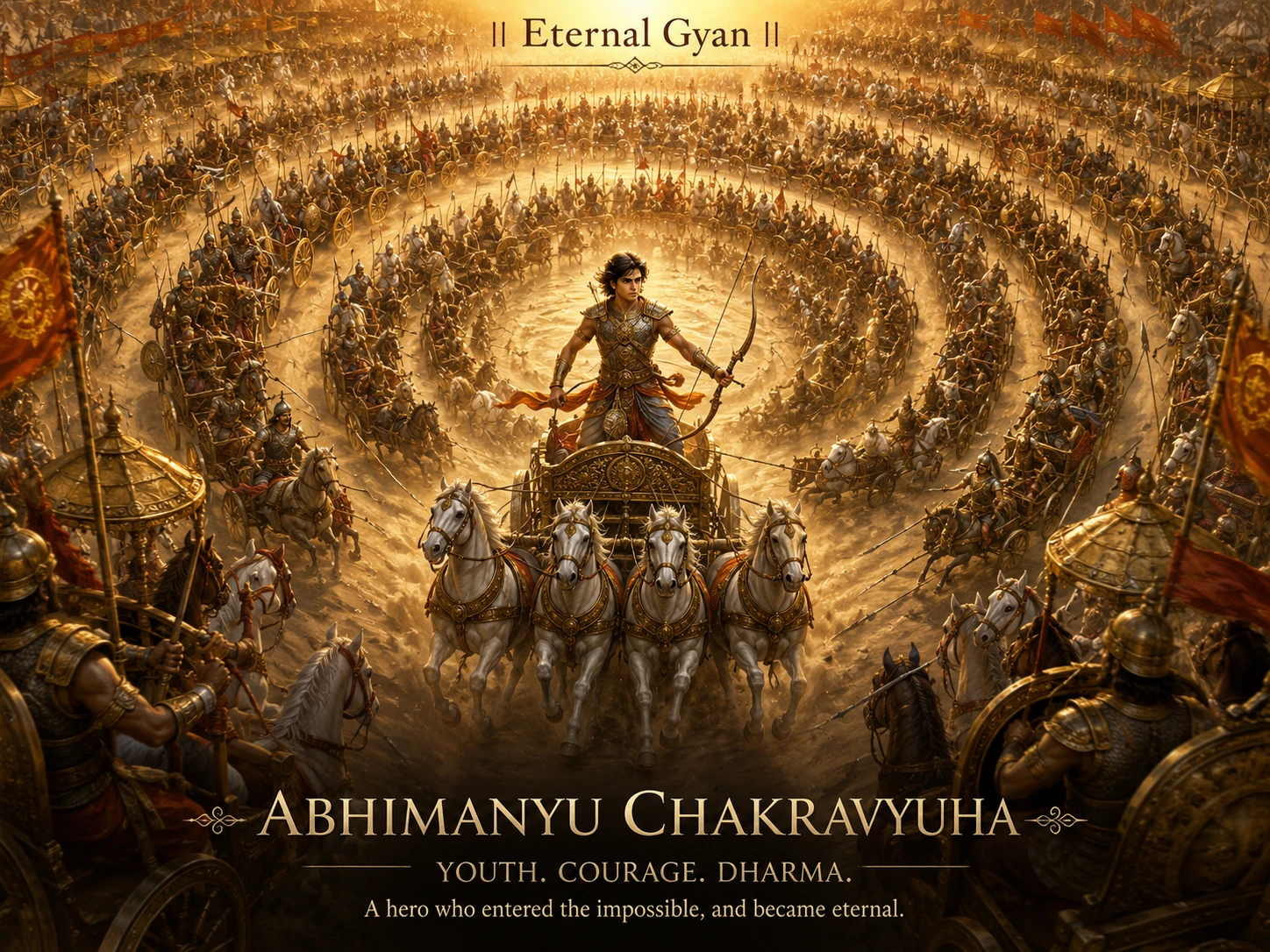
Abhimanyu and the Chakravyuha -- The Boy Who Knew How to Enter but Not How to Leave
14 min read
Adbhuta Ramayana -- The Ramayana Where Sita Becomes Kali
9 min read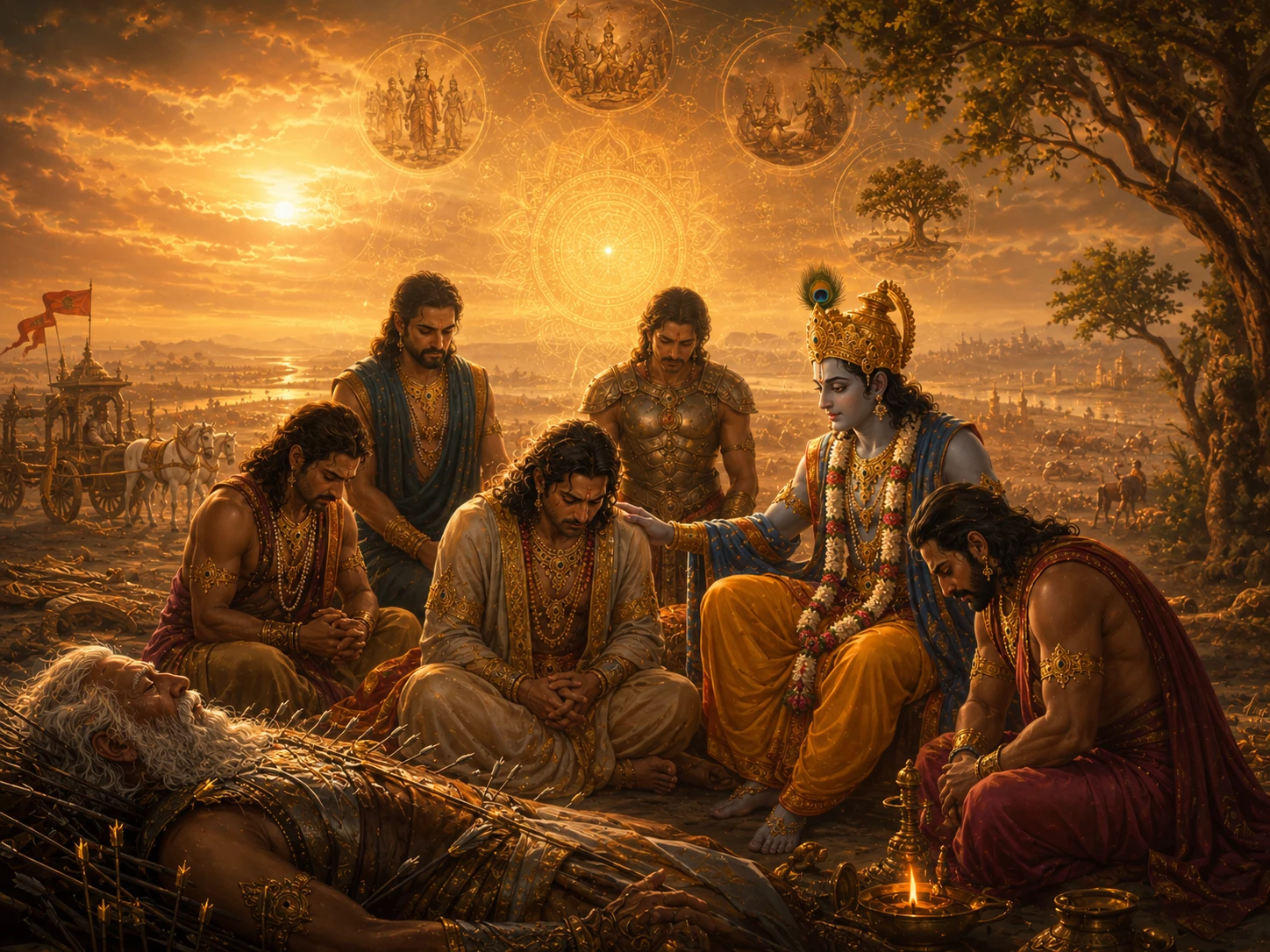
After Kurukshetra -- What Happened Next
14 min readThe same translation error that turned '33 Koti' into '33 crore' in Hinduism also happened in Buddhism. The Chinese translation of Buddhist texts rendered 'Sapta Koti Buddha' (7 Supreme Buddhas) as '7 Crore Buddhas.' The…
Deities AvatarsCommunity Reflections
🕉️
Be the first to share your reflection.