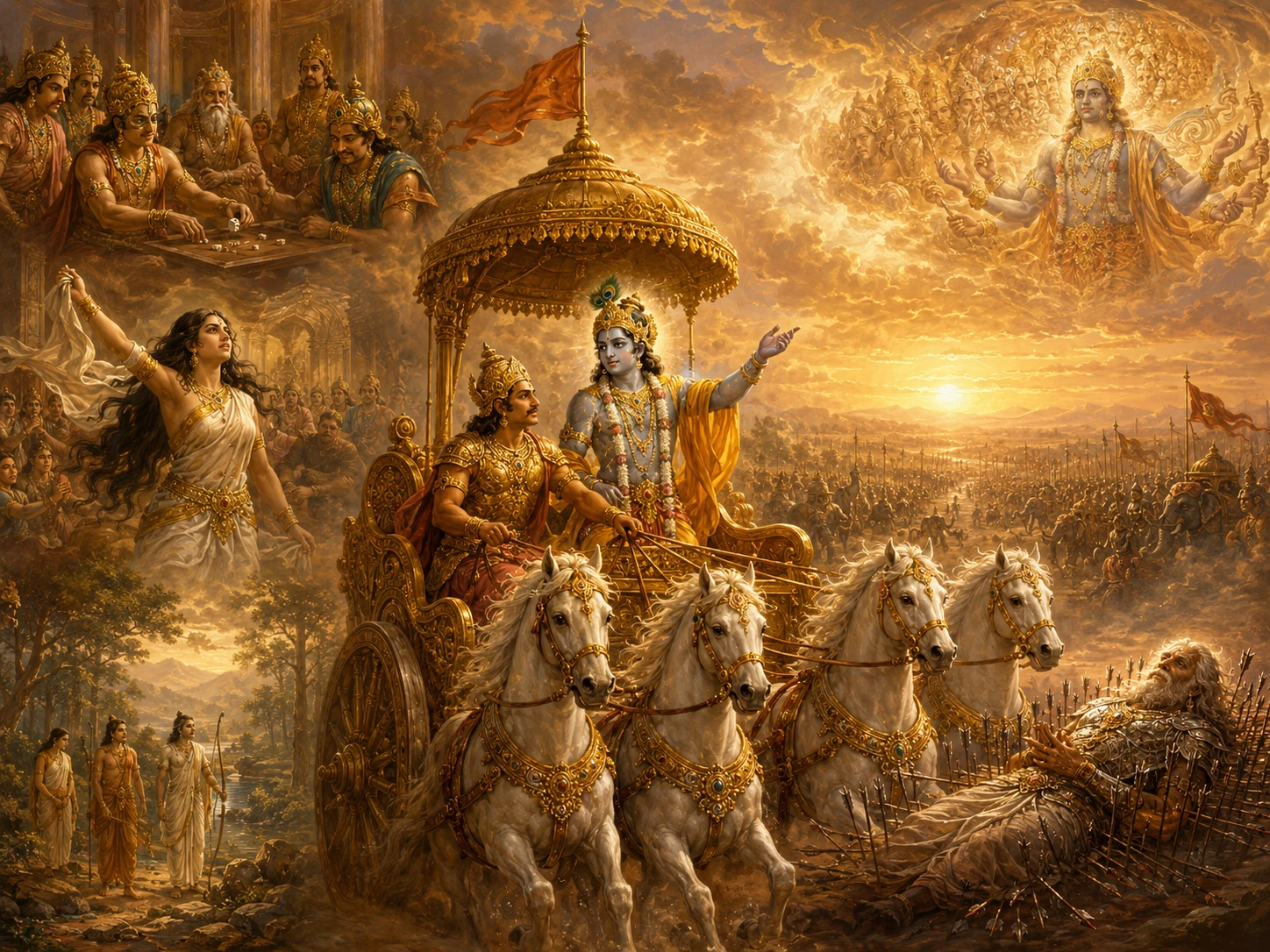
Shakuni -- The Wound That Became a Weapon
शकुनि -- वह घाव जो हथियार बन गया
Shakuni is the most distorted character in popular Indian memory. The version most modern readers carry, picked up from the BR Chopra serial and Star Plus's Mahabharat and a thousand WhatsApp forwards, is the bitter survivor with a limp, casting dice carved from his father's thigh bone, dedicated for thirty years to one revenge plot. This is a magnificent portrait. It is also largely not in the Mahabharata.
The canonical Mahabharata Shakuni is a different man. He is the brother-in-law of Dhritarashtra. He is the prince, later king, of Gandhara -- a region in what is today the Khyber Pakhtunkhwa province of Pakistan and adjoining eastern Afghanistan. He came to Hastinapura as a young man with his sister Gandhari for her marriage. He stayed because his sister was now the queen of one of the most powerful kingdoms in the world, and her hundred sons were nephews who had no other maternal uncle present. He took on the role of the kshatriya elder uncle in a court dominated by the Pandavas' faction. He grew old in that court. He fought in the war on the Kaurava side. He was killed by Sahadeva on the eighteenth day. His brothers and his father attended Yudhishthira's Rajasuya yajna -- they were not starved to death in a dungeon. His sons fought at Kurukshetra. The Mahabharata is explicit on these points.
What the canonical text emphasises about Shakuni is something the folkloric version actually obscures. Shakuni's strategic role in the dice game and in advising Duryodhana is real. His skill at dice is real. His enmity with the Pandavas is real. But his motivation, in the Mahabharata's own account, is uncomfortably banal. He was loyal to his nephew. He thought his nephew was being denied his rightful inheritance. He used the tools available to a kshatriya elder uncle to help his nephew. The tools he had were rhetoric, strategy, and a fortunate gift for dice. The Mahabharata's Shakuni is not a tragic vengeance figure. He is something more disturbing -- the senior family member whose love for his side of the family produced the world's most destructive war.
The folkloric version, with the bone-dice and the starvation, will be addressed in this article. The folk tradition is rich and old, and it travelled across India and into Indonesian Mahabharata adaptations. It tells us something true about how later generations interpreted the original. But the article will not pretend that the folklore is canonical. The Mahabharata's Shakuni and the folklore's Shakuni are two different characters serving two different psychological functions. Both are useful. Neither is the whole picture. The honest reading holds them apart.
अक्षद्यूते कुशलोऽहं तत्प्रिये पाण्डवा अपि। आहूय द्यूते निर्जिता दास्यन्ति वसुधामिमाम्॥
akṣa-dyūte kuśalo'ham tat-priye pāṇḍavā api āhūya dyūte nirjitā dāsyanti vasudhām imām
I am skilled at the game of dice, and the Pandavas too are fond of it. Once invited and defeated at dice, they shall hand over this earth itself.
— Mahabharata, Sabha Parva 45 -- Shakuni's offer to Duryodhana before the dice game
Shakuni's father was Subala, the king of Gandhara. The kingdom of Gandhara sat at the western edge of the Vedic world, on the trade routes between the Indo-Gangetic plain and the lands beyond the Hindu Kush. Subala had a hundred and one sons by his various consorts. Shakuni was one of them. The Mahabharata names several of his brothers -- Achala and Vrishaka are the most prominent, killed by Arjuna at Kurukshetra. He had at least one named son, Uluka, who served as the messenger between Duryodhana and the Pandavas before the war began.
The family's connection to Hastinapura began with Bhishma's marriage proposal. Bhishma, acting as regent for the Kuru kingdom, came west to Gandhara to ask for Princess Gandhari's hand for his blind nephew Dhritarashtra. Subala was reluctant. Dhritarashtra was blind. The marriage was a clear downgrade for his daughter. The Kuru reputation was high, but the specific groom was unappealing. Subala accepted out of political calculation -- the Kuru power was too great to refuse without provoking conflict.
Gandhari, on hearing of the marriage, did something the Mahabharata records with care. She did not protest. She did not weep. She tied a strip of cloth permanently across her eyes -- a vow that for the rest of her life she would not see what her husband could not see. The act was simultaneously an act of loyalty and an act of mourning. She was demonstrating dharmic equality with her husband, and she was also publicly grieving the marriage that had been arranged for her. Either reading is supported by the text. Probably both are correct.
Shakuni accompanied his sister to Hastinapura for the wedding. He was likely in his twenties at this point. He saw what the marriage was. He saw what his sister had decided to do with her eyes. The Mahabharata gives him no internal monologue here, but the text places him at the scene, and a reader can fill in what a brother would feel.
What the canonical text does not say -- and this is essential -- is that Shakuni was imprisoned, starved, broken-legged, or fed his father's flesh. The popular tradition will add all of these later. The canonical Shakuni simply stayed in Hastinapura as the maternal uncle of his sister's eventual hundred sons. He became part of the court. He grew old there. He watched the Pandavas-Kauravas tension develop over decades. He took the Kaurava side, as one would expect from a maternal uncle to a hundred Kaurava boys.
The folk-tradition Shakuni story -- the imprisonment of Subala's family by Bhishma, the single grain of rice, the dice carved from his father's thigh bone, the broken leg as a permanent reminder -- comes mostly from Jain Mahabharata retellings, the Odia regional Mahabharata, and oral village traditions across India. It is preserved beautifully in the BR Chopra serial and in Devdutt Pattanaik's modern retellings. The Wikipedia article on Shakuni is explicit that 'these narratives contradict the narrative attested in the Mahabharata; Subala and his sons attended Yudhishthira's Rajasuya yajna, while Shakuni's brothers fought in the great war at Kurukshetra.' Both stories are valuable. The folk version teaches us something the canonical version does not -- that audiences across centuries felt the canonical Shakuni's motivation was insufficient for the destruction he caused, and they invented a deeper wound to make sense of him. The folkloric Shakuni is the canonical Shakuni's psychological surplus.
The defining moment of Shakuni's life in the canonical text is the dice game at the Hastinapura sabha. The setup deserves attention. Yudhishthira had just performed the Rajasuya yajna at Indraprastha, the imperial consecration that established him as samrat -- emperor of all the surrounding kingdoms. Duryodhana had attended. Duryodhana had been forced to bow before his cousin as a tributary. Duryodhana had walked through the Mayasabha and fallen into water mistaking it for floor, and Bhima had laughed. Duryodhana returned to Hastinapura humiliated, brooding, and ready to listen to anyone who could give him a way back at his cousins.
Shakuni proposed the dice game. The proposal is recorded in Sabha Parva. He told Duryodhana -- I am skilled at dice, the Pandavas like dice, invite Yudhishthira to a game, and I will win whatever you want me to win. The Mahabharata is matter-of-fact about this. It does not say Shakuni used cursed bones. It does not say his dice were enchanted. It says Shakuni was a kushala-akshakara, a master of dice, in the same way a chess prodigy might be called a master of chess. Some texts hint at sleight of hand or psychological manipulation rather than supernatural cheating. The text does not need a supernatural explanation. A skilled adult playing against an opponent who was a known weak gambler -- Yudhishthira had a known love of dice and a known inability to stop playing once he started -- needs no enchantment to win.
The game itself was a legal act. The kshatriya code permitted dice games. The wagering of property, kingdoms, even oneself, was within the legal framework of the period. What Shakuni did was not unlawful. It was, in the strict sense, legitimate. This is part of what makes the scene so disturbing. Yudhishthira walked in, sat down at the dice board, lost his treasury, his kingdom, his army, his brothers, himself, and finally Draupadi -- all by his own consent, all under rules everyone in the court agreed to. Duryodhana ordered Dushasana to drag Draupadi in by the hair. Karna told Dushasana to disrobe her. The disrobing began. The court watched.
Shakuni's voice in this scene, where the text records it, is the voice of the lawyer-uncle keeping the procedure on the rails. He insists on the legal validity of each wager. He answers Vidura's protests with technical objections. He does not raise his voice. He does not gloat. He is competent. The horror of his role is precisely that he is competent. A drunk gambler in a wedding hall would not be a tragedy. A senior family member running the procedure correctly while a queen is dragged in by the hair -- that is what the Mahabharata wants you to see.
Two Shakunis -- Canonical vs Folkloric
| Element | Canonical Vyasa Mahabharata | Folk and Regional Tradition | Reading Implication |
|---|---|---|---|
| Origin of the enmity | Sister Gandhari married off to a blind king through Bhishma's pressure; Shakuni stays in Hastinapura as maternal uncle | Bhishma imprisons Subala and his hundred sons; the family is starved on a single grain of rice per day per person; Shakuni is the lone survivor | Canonical Shakuni acts from misguided family loyalty. Folkloric Shakuni acts from generational trauma. |
| The dice | Shakuni is described as kushala-akshakara, a skilled dice-player; the text suggests sleight of hand or strategy, not the supernatural | Shakuni's dice are carved from his father Subala's thigh bones; the bones contain Subala's vengeful soul; the dice obey Shakuni's voice | Canonical reading places responsibility on Shakuni's skill. Folkloric reading externalises responsibility to a curse. |
| Family fate | Subala attends Yudhishthira's Rajasuya yajna; Shakuni's brothers Achala and Vrishaka fight at Kurukshetra and are slain by Arjuna; Shakuni's son Uluka serves as messenger and survives the war | Shakuni's father and ninety-nine brothers all die in the dungeon before the dice game; Shakuni alone is released | Canonical Shakuni has a living family. Folkloric Shakuni is the last of his line. |
| Shakuni's body | No mention of a limp or any physical mark of trauma | Subala breaks Shakuni's leg before dying so the limp will be a permanent reminder of injustice | Folkloric reading wants the body itself to carry the wound. |
| Death | Sahadeva kills Shakuni on day eighteen of Kurukshetra in single combat; Shakuni's son Uluka is killed by Sahadeva first, then Shakuni | Same -- the death is consistent across both traditions | Both traditions agree on the ending; the divergence is entirely in the backstory. |
Read both columns. Canonical text matters most for serious study. Folkloric tradition matters most for understanding what audiences across centuries needed Shakuni to mean. The honest reader holds both without forcing them into one.
After the dice game, the Pandavas went into exile for thirteen years. Shakuni continued in his role as Duryodhana's senior counsellor in Hastinapura. The Mahabharata records his presence at almost every council meeting in the Udyoga Parva. When Krishna came as ambassador asking for the five villages, Shakuni was in the chamber. When Bhishma, Drona, Vidura, Gandhari, and Dhritarashtra all asked Duryodhana to relent, Shakuni was the voice on the other side, urging Duryodhana to hold his ground. The Mahabharata gives us specific scenes of Shakuni reinforcing Duryodhana's resolve at moments when the rest of the family was begging for compromise.
This is the Shakuni the canonical text wants us to see. Not the bone-dice mystic. The senior uncle in the council chamber, the strategist with grey hair, the brother-in-law who has lived in this palace for forty years and feels he has earned the right to be heard. He tells his nephew, day after day, that conceding is weakness, that Krishna is biased, that Bhishma is sentimental, that Vidura is a half-blood with no kshatriya stake, that the Pandavas have already insulted the family enough. Each of these arguments has just enough truth in it that Duryodhana, primed by his own moha, accepts them. The war that follows is built sentence by sentence in conversations like these, over a year of pre-war preparations.
The modern Indian equivalent is the senior cousin in the family WhatsApp group who keeps saying, in measured language, that the other branch of the family is up to no good. The senior partner at the firm who keeps reminding the founder that the rival has been undercutting them. The political advisor who keeps escalating, in private, what the rival party is plotting. None of these people seem extreme. None of them shout. Their work is the slow accumulation of grievance until grievance feels like reality.
Shakuni's tactical advice during the war itself is inconsistent in its quality. He fights well in some encounters and is forced to retreat in others. The Mahabharata gives him no tactical genius on the field. His genius was in the council chamber, in the year of pre-war diplomacy, in the framing of the Pandavas as enemies who deserved annihilation. By day eighteen of the war, with his nephews dead, his brothers dead, his son Uluka dead, he was on the field facing Sahadeva alone.
Sahadeva had taken a public vow during the dice game -- that he would kill Shakuni for what had been done to Draupadi. The vow had been kept open for thirteen years of exile and eighteen days of war. On day eighteen, Sahadeva and Nakula attacked Shakuni's contingent. Sahadeva killed Uluka first. Shakuni, in grief and rage, attacked Sahadeva. They fought from chariots, then on foot. Sahadeva struck Shakuni's head with an axe and killed him. The vow was complete.
The death is one of the last major killings of the great Kuru war. Duryodhana was already running toward Lake Dvaipayana at that hour, alone, the last surviving leader of his side, every counsellor he had ever known now gone. The Mahabharata does not dress up Shakuni's death with much drama. For the text, the death is simply the end of a Kuru-internal arc -- the man who had stepped into the Hastinapura court forty-five years earlier alongside his sister was now lying in the dust of the eighteenth day, his son and brothers dead around him.
There is a small but real Hindu temple dedicated to Shakuni at Pavithreswaram in Kollam district, Kerala. The temple does not worship him as evil. Local tradition holds that Shakuni, recognising the futility of his actions toward the end of his life, repented and performed tapasya at this site. The temple's existence is one of the strongest signs that Indian tradition has always held a more nuanced view of Shakuni than the simple 'villain' label. Even the man whose dice game caused the dice game has, somewhere in India, a temple in his name.
मातुलोऽहं तव तात भगिनेयस्त्वमेव च। हितं ते समुपश्यामि कुरूणां च जयं तथा॥
mātulo'ham tava tāta bhāgineyas tvam eva ca hitaṃ te samupaśyāmi kurūṇāṃ ca jayaṃ tathā
I am your maternal uncle, dear child, and you are my sister's son. I see only what is good for you, and the victory of the Kurus alongside.
— Mahabharata, Sabha Parva and Udyoga Parva (paraphrasing the structure of Shakuni's repeated counsel to Duryodhana across multiple chapters)
Why does Shakuni matter to you in 2026?
Because Shakuni is the most institutional character in the Mahabharata. He is not a charismatic leader. He is not a warrior of any particular brilliance. He is not a moral exemplar in any direction. He is a senior staff member who has stayed too long, accumulated too much resentment in private, and earned the right to whisper in the ear of the principal at the wrong moments. Every Indian organisation has at least one Shakuni, and most have several. The corporate version is the senior vice president who has been at the company for twenty-three years, lost a promotion battle to a younger executive in 2009, and has spent every meeting since then quietly steering decisions in directions that punish the executive's lineage even now that the executive has retired. The political version is the party general secretary who lost his constituency to a rival faction in 1992 and has been routing every appointment, every fund disbursement, every tactical decision since then in ways that bleed the rival faction. The family version is the elder uncle who carries an old slight, never confronts it, and instead works through children and grandchildren of the offending sibling, ensuring through dozens of small interventions over decades that the offending side never quite catches up.
None of these people seem extreme on any given day. That is the whole horror. They are competent, articulate, and present. They show up. They give counsel. The counsel is reasonable. Each individual conversation, taken in isolation, would not even register as adversarial. The damage is in the cumulative trajectory.
Shakuni's pattern is the easiest of the nine to miss in yourself. The other patterns announce themselves -- Arjuna's freezing is visible, Duryodhana's entitlement is loud, Karna's loyalty is dramatic. Shakuni operates quietly, in long time-frames, through indirect channels. The Shakuni in you is the part of you that has been carrying a grievance from a particular year, a particular meeting, a particular relative -- and is, very calmly, very competently, routing decisions to punish the source of that grievance, sometimes years or decades later, sometimes through people who had nothing to do with the original event.
The diagnostic question is simple. Pick a relationship in your life that has been quietly difficult for a long time -- an old colleague, an estranged sibling, an in-law, a former best friend. Ask yourself, slowly, when was the last time you took a small action -- a comment, a vote in a meeting, a recommendation, a piece of gossip dropped in the right WhatsApp group -- whose primary, unstated motivation was to make their life slightly worse. If the answer is recent, you have located your Shakuni. The Mahabharata is asking you to look at him.
The corrective the text offers, embedded in Krishna's last counsel to Yudhishthira after the war, is the discipline of finishing things. The fully aired conflict, the explicit conversation, the resolved grievance -- these are dharmic acts. The grievance held in private for thirty years, weaponised through small daily decisions, is its opposite. Shakuni's whole life is what happens when a feeling that should have become a single confrontation becomes instead a four-decade strategy. The text wants you to confront. Even if the confrontation goes badly. Even if you lose the argument. The cost of speaking is almost always smaller than the cost of accumulating.
The single conversation you have been postponing
There is one conversation in your life right now -- with a parent, a sibling, an old friend, a former colleague -- that you have been routing through indirect channels for years. Pick it. Open the chat. Send the first sentence. Even if it goes badly, you will have done the one thing Shakuni never did. Try a brief Mahabharata reading first to clear your head -- the Vidura Niti or Bhagavad Gita Chapter 16 on the nature of asuric speech.
Tags
Eternal Raga · शाश्वत राग
Institutional voice — scholarly articles on Sanatan Dharma
Deepen Your Understanding
अपनी समझ और गहरी करें
scriptural exegesis
The Kurukshetra Within -- Reading the Mahabharata as a Mirror of Your Mind
Vyasa wrote that whatever exists in the world also exists in the Mahabharata, and whatever is not there exists nowhere. This is not a boast. It is an instruction: every character in the epic is a character inside you. Read the war as a map of your mind.
scriptural exegesis
Duryodhana -- The Entitled Mind
He was the eldest, the heir, the host of Hastinapura. He had a hundred brothers, an unbreakable friendship with Karna, and a kingdom older than the Pandavas had ever held. And yet he could not bear that anything good went to anyone but himself. Duryodhana is what happens when birth-privilege gets confused for self-worth.
scriptural exegesis
The Dice Game -- The Darkest Hour of the Mahabharata
A king who cannot say no to a challenge. An uncle whose dice are loaded with the bones of the dead. A court full of elders who watch injustice and say nothing. And a woman who asks one question that nobody in the room can answer: 'Did my husband lose himself first, or me?' The dice game in the Sabha Parva is not a plot device. It is the moral black hole at the centre of the Mahabharata. Everything before it is prologue. Everything after it is consequence. And the central horror is not what happens -- it is who lets it happen.
scriptural exegesis
Draupadi in the Sabha -- The Trial That Started the War
A queen was dragged into a court full of kings, warriors, and elders. Not one stood up. She asked a single legal question that nobody could answer. Then she swore an oath that burned a civilization to the ground. Draupadi's Sabha episode is not a story about a helpless woman. It is the most devastating indictment of institutional silence in world literature.
scriptural exegesis
Vidura Niti -- The Wisest Counsel That the King Heard and Still Ignored
The night before the Pandavas' exile ended, when war was one decision away, a sleepless king called his wisest adviser. For eight chapters of the Udyoga Parva, Vidura -- the bastard son who could never be king, the only man in Hastinapura who always told the truth -- delivered 593 verses of raw, unfiltered counsel on leadership, ethics, self-mastery, and statecraft. Dhritarashtra listened to every word. Agreed with every point. And then did the opposite. Vidura Niti is not just political philosophy. It is the anatomy of a man who knew the right thing, had the right adviser, and chose wrong anyway.
scriptural exegesis
Kurukshetra Battle Alliances -- Which Kings Joined Which Side
Seven akshauhinis against eleven. 1.5 million warriors against 2.4 million. The Kurukshetra war was not two families fighting -- it was the entire Indian subcontinent choosing sides. From the Pandyas of Tamil Nadu to the Kambojas of Central Asia, from the Yadavas of Dwaraka to the Kekayas split down the middle -- here is the geopolitical map of who joined whom and why, sourced from Udyoga Parva.
scriptural exegesis
100 Kauravas -- The Forgotten Brothers of the Mahabharata
Everyone knows Duryodhana and Dushasana. But what about Vikarna, who stood up for Draupadi when no one else did? Or Yuyutsu, who defected to the Pandavas because his conscience demanded it? The Mahabharata names all 100 sons of Dhritarashtra -- warriors, strategists, and dissenters -- most of whom are killed across 18 days. Their story is not just a casualty list. It is the most devastating portrait of fratricidal war ever composed.
The folk-tradition Shakuni story -- the imprisonment of Subala's family by Bhishma, the single grain of rice, the dice carved from his father's thigh bone, the broken leg as a permanent reminder -- comes mostly from Jain…
More in Scriptural Exegesis
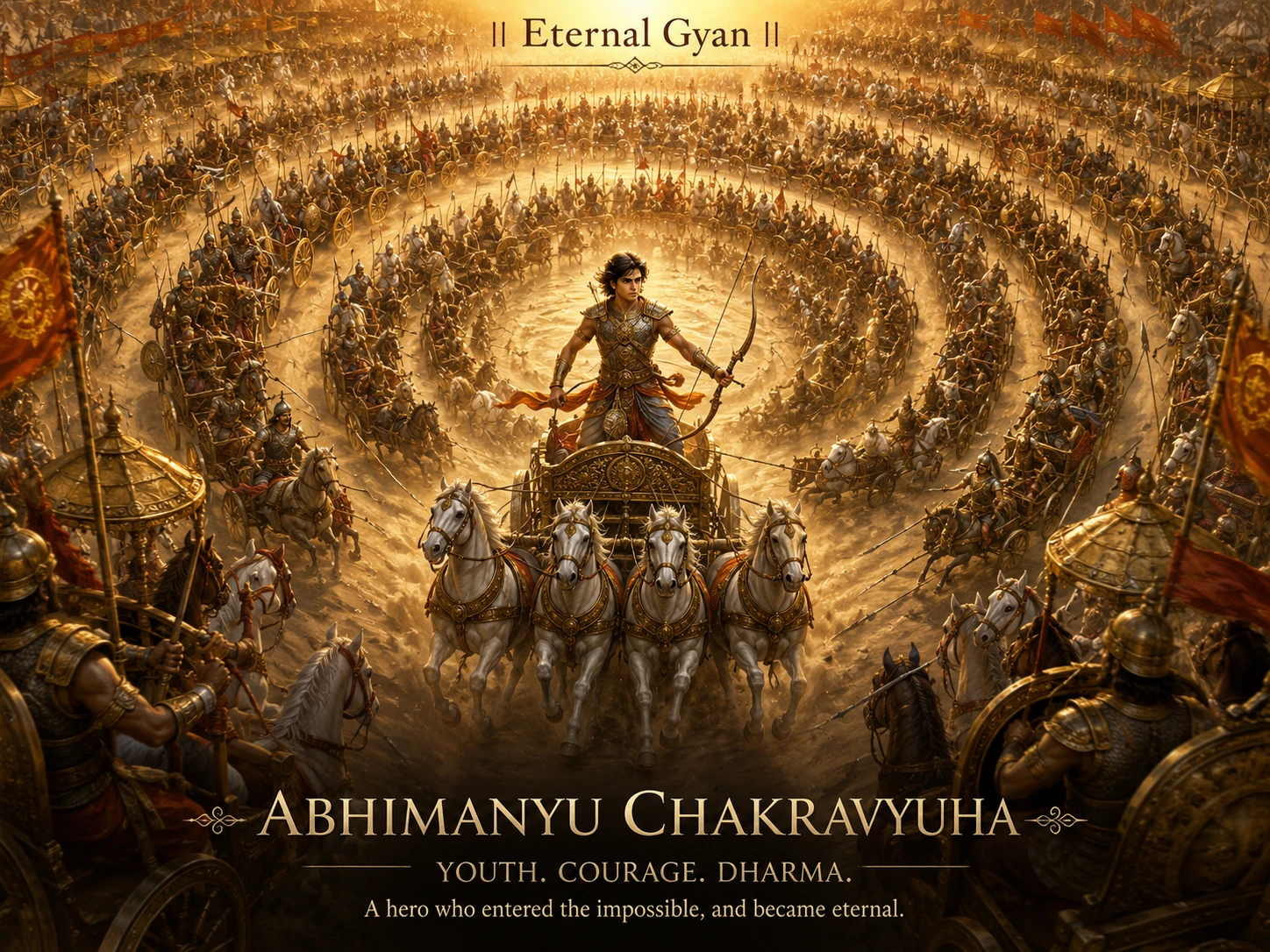
Abhimanyu and the Chakravyuha -- The Boy Who Knew How to Enter but Not How to Leave
14 min read
Adbhuta Ramayana -- The Ramayana Where Sita Becomes Kali
9 min read
After Kurukshetra -- What Happened Next
14 min readThe same translation error that turned '33 Koti' into '33 crore' in Hinduism also happened in Buddhism. The Chinese translation of Buddhist texts rendered 'Sapta Koti Buddha' (7 Supreme Buddhas) as '7 Crore Buddhas.' The…
Deities AvatarsCommunity Reflections
🕉️
Be the first to share your reflection.