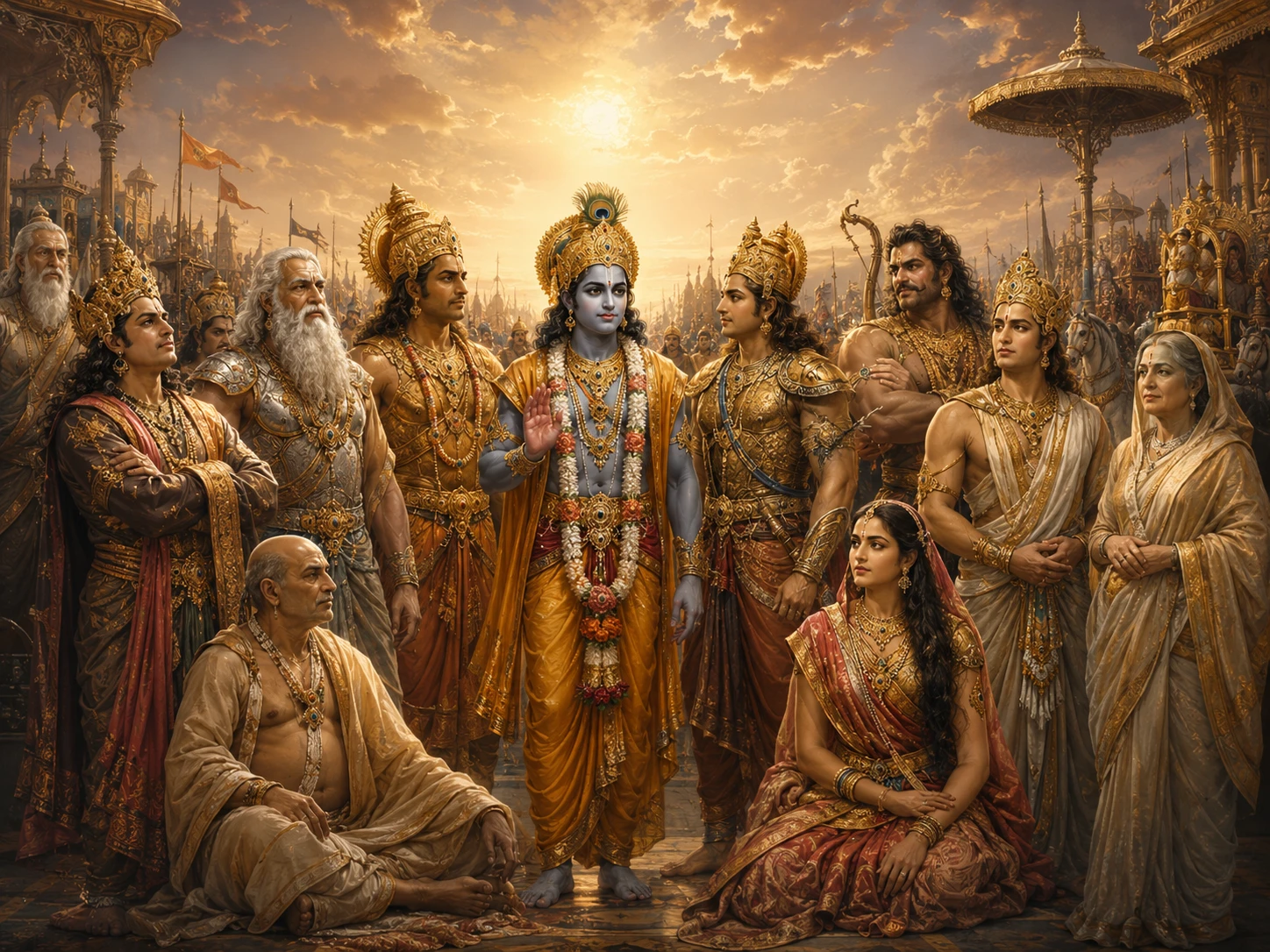
Duryodhana -- The Entitled Mind
दुर्योधन -- वह मन जो हक़ से बना था
Duryodhana is the most misunderstood character in the Mahabharata. The popular reading -- the one we inherit from the BR Chopra television serial, the comic books, the school plays -- is that he is the villain. The dark cousin. The bad guy. The one whose envy starts the war.
This is true. It is also too simple to be useful.
The text gives us a far more uncomfortable Duryodhana. He was the eldest son of Dhritarashtra and Gandhari. He was the heir to Hastinapura, the older capital, while his cousins were sent to develop a forest tract that became Indraprastha. He had ninety-nine brothers, all of whom died for him without question. He had a friendship with Karna so devoted that Karna refused the throne of the world rather than betray him. He could fight Bhima with a mace as an equal. He was, by every metric the Mahabharata cares about -- birth, training, valour, generosity to friends, loyalty to his army -- a high-functioning Kshatriya prince.
And he could not bear that the Pandavas existed.
This is the puzzle the text wants you to sit with. Duryodhana is not a small mind. A small mind would have been content with what he had. Hastinapura. The throne. The army. The gold. The friendship of Karna. The loyalty of his brothers. He had all of it. The Pandavas, by contrast, had been disinherited, lived in a wax house, escaped through a tunnel, lived as Brahmins in a stranger's village, married a princess only after the four older brothers had stood by while a Brahmin disguise won her. They had nothing for the longest time. And Duryodhana could not bear even the rumour of their flourishing.
The Mahabharata calls this pattern moha. Not envy. Not greed. Moha. The state of being so wrapped up in your own protection that anyone else's good feels like your loss. Anyone with a sibling, a cousin in the same business, a junior who got promoted faster, a school friend whose startup went public first -- knows this state from the inside. Duryodhana is what happens when that state is given a kingdom and a hundred brothers and a war to fight.
This article walks through his life. Not to redeem him. Not to condemn him. To make him visible. Because if you have seen him -- in the office, in the family, on Twitter, in the mirror -- you already know him. The Mahabharata is asking you to know him by name.
यावद्धि सूच्यास्तीक्ष्णाया विध्येदग्रेण मारिष। तावदप्यपरित्याज्यं भूमेर्नः पाण्डवान्प्रति॥
yāvad dhi sūcyās tīkṣṇāyā vidhyed agreṇa māriṣa tāvad apy aparityājyaṃ bhūmer naḥ pāṇḍavān prati
Even as much land as can be pierced by the sharp tip of a needle, dear (uncle) -- not even that much shall I yield to the Pandavas, ever.
— Mahabharata, Udyoga Parva (Bhagavad-Yana Parva), Duryodhana's reply to Krishna's peace embassy
His birth was wrong from the first hour. Gandhari, blindfolded by choice when she married a blind king, was pregnant for two full years. When the child finally emerged, it came as a hard mass of flesh, not a baby. Vyasa, the family's resident sage, divided the mass into a hundred and one parts and placed each in a clay pot of ghee. Over time, the parts became a hundred sons and one daughter. Duryodhana was the first to break out of his pot.
The omens at his birth, recorded in the Adi Parva, were terrible. Jackals howled in broad daylight from the city walls. Donkeys brayed at the time of an auspicious ritual. Birds wheeled in unnatural directions. Vidura, the wisest counsellor in the palace, came directly to Dhritarashtra with the recommendation to abandon this child. The shastras themselves prescribed it -- a child whose birth carried such omens was to be left for the welfare of the kuldharma. Dhritarashtra refused. He could not refuse his own son. The Mahabharata records this without judgement. The text simply notes that the choice was made, the warning was given, the warning was ignored, and now we will watch what happens.
This is the first thing about Duryodhana. He arrived in a world that had already been told to abandon him. He grew up in the love of a father who could not refuse him anything. Dhritarashtra was blind in two senses, the physical and the parental. Every transgression Duryodhana would commit, his father would forgive in advance. Every danger Vidura would warn against, his father would dismiss as the resentment of an outsider. Duryodhana was raised in a household where 'no' to him was effectively unspeakable.
When the Pandavas arrived at Hastinapura after Pandu's death, the household had to absorb five new princes. Bhima, the second Pandava, was a giant of a child even in childhood. He bullied the Kauravas physically -- pushed them around, dunked their heads in water, beat them with sticks during play, broke their toys. The Mahabharata is honest about this. Bhima was a brute as a boy. The hundred Kauravas, including Duryodhana, hated him for it. This hatred was not invented later. It was earned in the courtyards and the river-banks of Hastinapura, in the years when boys learn what it feels like to be smaller than someone you are supposed to dominate.
Duryodhana made his first attempt on Bhima's life when they were teenagers. He poisoned Bhima's food at a picnic on the Ganga, tied him up, and threw the unconscious body into the river. Bhima was carried by the current into the underworld of the Nagas, who recognised him as a kshatriya, gave him medicine that increased his strength tenfold, and sent him back. Bhima returned without remembering quite what had happened. Duryodhana never forgot. The first plot had failed. The second plot would be the wax house. Each plot taught him only one thing -- to plot more carefully.
After the Pandavas survived the lakshagriha plot through Vidura's secret tunnel, after Draupadi's swayamvara, after the Pandavas were openly recognised as alive and married to a Panchala princess, Bhishma and Vidura forced a settlement. The kingdom was divided. The Pandavas were given the half called Khandavaprastha -- a forest tract on the western edge of the realm, drier, less developed, considered a punishment posting. Duryodhana kept Hastinapura, the older capital with the older treasury and the older army. By every measure, the Kauravas had got the better half.
Then Krishna and Arjuna burnt the Khandava forest. Mayasura, the architect of the asuras, spared by Arjuna in that fire, returned the favour by building the Pandavas a magical assembly hall. The Mayasabha was unlike any structure ever seen. Floors that looked like water. Pools that looked like polished marble. Doors where there were walls. Walls where there were doors. The illusions were precise and total. Visitors from across the world would gather just to see this hall.
Duryodhana was invited. The Pandavas were not subtle hosts -- Yudhishthira had also performed the Rajasuya yajna, the imperial consecration, before this visit, and Duryodhana had been forced to bow before him as a tributary. The wound was already there. Then the Mayasabha completed the work.
Walking through the hall, Duryodhana misjudged the floor. He stepped onto what looked like solid stone, and it was water. He fell, soaked to the waist, in front of the assembled court. Bhima -- and this is the canonical text, this is what the Mahabharata records -- laughed at him. Bhima, his lifelong tormentor, the man who had been a brute to him since they were boys, laughed openly in the assembly hall. The popular television version of this scene shows Draupadi laughing and saying 'the son of the blind king is also blind.' That line is not in the Mahabharata. Draupadi is not the cause of this humiliation. Bhima is. The text is being edited in the popular memory to give Duryodhana a moral cover -- to make his rage at Draupadi feel justified. The text itself does not give him that cover.
The humiliation at the Mayasabha was the moment Duryodhana decided that the Pandavas had to fall. Not be defeated. Not be reduced. Fall. Stripped of everything they had. Reduced to nothing in front of the assembled world the way he had just been reduced. The dice game would be the instrument. Shakuni would be the dice-roller. Duryodhana would supply the will.
Duryodhana's Inner Circle -- The People Who Stood with Him to the End
| Person | Relationship | What They Gave Him | Why It Mattered to Him |
|---|---|---|---|
| Karna | Sworn friend, king of Anga | Refused the throne of the world to remain with Duryodhana even after Krishna revealed Karna's true birth | Karna was the only person in his life who chose him on merit and held that choice through every test |
| Dushasana | Younger brother, second of the hundred | Carried out the disrobing of Draupadi at his command; died at Bhima's hands keeping his vow | The brother who never asked questions, only acted; the inner circle's enforcer |
| Shakuni | Maternal uncle from Gandhara | Strategy, the dice game, decades of patient counter-planning | The first adult who took his hatred of the Pandavas seriously and weaponised it |
| Bhishma | Granduncle, regent of Hastinapura | Commander of the Kaurava army for ten days of the war despite his own moral disagreement | The institutional patriarch whose participation gave the war legitimacy in the kingdom's eyes |
| Drona | Royal teacher, family acharya | Took command after Bhishma fell; died in despair after the Ashwatthama deception | The guru who refused to teach Karna but fought for Duryodhana out of obligation, not affection |
| Ashwatthama | Drona's son, lifelong companion | The night raid on the Pandava camp after the war was lost; the killing of the Upapandavas | The friend who continued the war even after Duryodhana lay dying; loyalty past the point of all reason |
| Dhritarashtra | Father, blind king | Permission. Always permission. Every wrong forgiven in advance | The father who could not say no, and whose inability shaped the moral economy of the entire household |
Notice what Duryodhana inspired -- not strategic excellence, not innovation, not vision. He inspired loyalty. Even from people who openly disagreed with his choices, he received their bodies and their bows. This is the most uncomfortable thing about him.
The 2nd or 3rd century Sanskrit playwright Bhasa wrote a tragedy called Urubhangam (The Broken Thigh), in which Duryodhana is the protagonist, dying with his thigh shattered after Bhima's blow. Bhasa portrays him as a tragic hero who in his last hours achieves clarity, forgives his enemies, and prepares his son Lakshmana for what is to come. Urubhangam is one of the only ancient Sanskrit plays that ends with the death of its hero, and one of the only ones to take Duryodhana's perspective seriously. Long before modern revisionist novels, the tradition itself was already complicating its villain.
The dice game itself is told in the Sabha Parva. Yudhishthira accepted the invitation knowing it was rigged. Shakuni rolled. The Pandavas lost everything. Yudhishthira lost his treasury, his army, his kingdom, his brothers, himself, and finally Draupadi. Duryodhana ordered Dushasana to drag Draupadi into the assembly hall by her hair. He bared his thigh in front of her -- a gesture of explicit invitation, the most obscene thing a man could do to a woman in a public court. Bhima vowed in that moment to break that thigh.
When the disrobing failed -- by divine intervention or by Vidura's last-minute legal reasoning, the text records both -- Dhritarashtra finally intervened, gave Draupadi three boons, and undid the dice game's results. Duryodhana then forced a second round, with new stakes. The Pandavas lost again, this time accepting thirteen years of forest exile, with the thirteenth year in disguise.
Thirteen years passed. The Pandavas survived the disguise year at Virata's court. They returned. Yudhishthira asked, modestly, for just five villages -- one for each brother. Duryodhana refused. Krishna himself came as ambassador, asking for the same five villages. Duryodhana refused. Krishna asked for any compromise, even the smallest. Duryodhana said the line that defines him forever in Indian memory -- not even the land that fits the tip of a sharp needle will I give to the Pandavas, ever, without war.
It is worth pausing here. Duryodhana was offered every off-ramp. His grand-uncle Bhishma asked him to make peace. His teacher Drona asked him to make peace. His mother Gandhari, after removing her blindfold for the first time in decades, came to him weeping. His father Dhritarashtra, blinded but not stupid, asked him to relent. Vidura asked him. The general assembly of his court asked him. Krishna himself came down to ask him in person.
He refused all of them. Not because he was deceived. Not because he did not understand the consequences. He understood perfectly. The text is clear that Duryodhana could see the war coming, could see his hundred brothers dying, could see his own death. He chose it anyway. The choice is not stupidity. It is the most clarified form of moha -- the conviction that even with full knowledge, you would rather destroy than concede.
Karna's friendship is the one redemption arc Duryodhana actually has, and it deserves a paragraph of its own. The two met for the first time at the public archery tournament in Hastinapura, where Karna walked in as an unknown and challenged Arjuna. The court mocked him as a sutaputra -- a charioteer's son, not a kshatriya, not eligible. In a single act, Duryodhana made him king of Anga, gave him a kingdom, and made him eligible to challenge Arjuna by birth. The act took less than a minute. The friendship that formed in that minute lasted thirty years.
For those thirty years, Karna ate at Duryodhana's table, lived in his palace, fought his battles, walked his royal procession to Draupadi's swayamvara, defended his actions in the sabha, and was the only voice apart from Shakuni's that consistently advised war. When Krishna came as ambassador and revealed to Karna that he was actually Kunti's first-born, the eldest Pandava, the rightful heir to the entire kingdom -- Karna told Krishna no. He could not betray Duryodhana. He had eaten Duryodhana's salt for three decades. He would die fighting for him.
This is the relationship that complicates Duryodhana the most. A small man does not produce loyalty like Karna's. A purely venal man, a purely cruel man, would not have inspired such a sacrifice. Whatever Duryodhana was, he was capable of being a true friend. The text gives us this evidence and asks us to carry it. We do not get to dismiss him. We have to hold both -- the man who ordered Draupadi disrobed, and the man for whom Karna refused the throne of the world. They are the same man.
लप्स्यसे वीरशयनं काममेतदवाप्स्यसि। स्थिरो भव सहामात्यो विमर्दो भविता महान्॥
lapsyase vīraśayanaṃ kāmam etad avāpsyasi sthiro bhava sahāmātyo vimardo bhavitā mahān
You shall obtain the warrior's bed of rest. This desire of yours, you shall realise. Stand firm with your counsellors -- a great destruction is coming.
— Mahabharata, Udyoga Parva (Bhagavad-Yana Parva, Section 131) -- Krishna's parting warning to Duryodhana
The eighteen days of Kurukshetra were Duryodhana's strategic peak and his moral collapse held in the same hand. He commanded eleven akshauhinis to the Pandavas' seven. He had Bhishma, Drona, Karna, Kripa, Ashwatthama, Shakuni, and Shalya in his command structure. He had the granduncle who had effectively raised the entire family, the family teacher who had trained both armies, the king of Anga, and the king of Madra. Strategically, he was meant to win.
He lost because of the choices he made on each individual day. On day one, he insulted Bhishma in the war council, claiming Bhishma was holding back. Bhishma responded by telling him exactly how he could be killed -- through Shikhandi -- which Duryodhana ignored, and which the Pandavas later used. On day fifteen, after Drona was killed by deception, Duryodhana refused to negotiate even when Karna and Ashwatthama were exhausted. On day seventeen, when Karna's chariot wheel sank in the mud at the moment of his duel with Arjuna, Duryodhana could only watch from a distance. The man who had given Karna a kingdom in one minute was now powerless to save him in his last minute.
Day eighteen. The army was destroyed. The hundred brothers were dead. Bhishma was lying on a bed of arrows, alive but waiting for uttarayana. Drona, Karna, Shakuni -- all gone. Duryodhana hid in Lake Dvaipayana, using yogic technique to suspend himself underwater. The Pandavas tracked him there. They mocked him out of the lake. They demanded a final duel. He chose Bhima, the brother who had laughed at him in the Mayasabha. The mace fight that followed was the last act of his life.
Bhima broke his thigh -- below the waist, the dharmically prohibited zone in mace combat. Krishna had signalled the blow. Duryodhana fell. The Pandavas, the seven survivors of the war, gathered around him. Bhima placed his foot on Duryodhana's head. Yudhishthira reproved Bhima for the violation. And then Duryodhana, dying with both thighs shattered and blood pouring out, raised his head and gave the speech that closes Shalya Parva. He told the Pandavas -- I have died on the battlefield. I have died with all my counsellors and friends. I have died at the hands of a worthy opponent. I have died as a king dies. You have won the kingdom by deception, by killing your teachers and grandfathers and friends. You will inherit a wasteland. I die clean.
इष्टान् लोकाञ्जिता: स्वर्गे प्राप्य लोकाधिकं फलम्। वीरलोकं गमिष्यामि किं भवद्भिरुदीर्यते॥
iṣṭān lokān jitāḥ svarge prāpya lokādhikaṃ phalam vīralokaṃ gamiṣyāmi kiṃ bhavadbhir udīryate
Having conquered the worlds I desired, I shall reach the heaven of heroes -- a fruit greater than any world. What further word, then, can you (Pandavas) say to me?
— Mahabharata, Shalya Parva 60 (Gada-yuddha Parva) -- Duryodhana's deathbed reply to the gathered Pandavas
The most painful moment in the entire Mahabharata is not the war. It is what Yudhishthira sees when he finally arrives in heaven. Walking with Indra, after the long ascent through Mount Sumeru and the test with the dog, Yudhishthira enters svarga -- and the first person he sees, seated on a throne in honour, is Duryodhana.
Duryodhana. The cousin who had stolen the kingdom. The man who had tried to burn him alive in a wax house. The brother-in-law who had ordered Draupadi disrobed. The cousin whose hundred brothers had hunted his five for thirteen years. The man Krishna had spent a lifetime opposing.
In heaven. Smiling. Honoured.
Yudhishthira asks how this can be. The reply, given by Indra and later elaborated by Vyasa, is among the hardest moral lessons in any world scripture. Duryodhana fought a war he had himself declared. He died on the battlefield, in the duel he had himself chosen, against an opponent he had himself accepted. By the strict kshatriya code, this is the highest possible death. Death in battle, by your own hand's choice, in defence of your own interests, with your full counsellors and friends present, is the death that earns vira-loka. The heaven of heroes does not ask whether your cause was just. It asks only whether you fought.
Yudhishthira, the man who had spent thirteen years trying to avoid the war, the man who had asked for only five villages, the man who had agonised over every decision -- has to watch the cousin who refused him those five villages sit in heaven first. The text places this scene at the very end of the Mahabharata for a reason. It is the final disturbance. It is meant to break the satisfaction of the moralising reader. The Mahabharata is not a story where the good guys win and the bad guys go to hell. It is a story where the question of who was good and who was bad is itself shown to be smaller than the questions the text is asking.
Duryodhana in heaven is the Mahabharata's last word on entitlement. Even his fall was magnificent enough to earn a throne in svarga. The pattern that destroyed his world was also a pattern that, by its own logic, was rewarded by heaven. The text gives us no easy way out.
Bhima's vow to break Duryodhana's thigh was made in the Sabha Parva, the moment Duryodhana bared his thigh in front of Draupadi as an obscene invitation. Bhima held that vow for thirteen years of exile and eighteen days of war, and finally fulfilled it in the mace duel at Lake Dvaipayana. This is one of two parallel vows tracking the entire Mahabharata -- Bhima would break Duryodhana's thigh, and Bhima would drink Dushasana's blood from his torn chest. Both vows were kept. The Mahabharata, unlike most modern fiction, never lets a vow lapse. What is sworn in chapter ten is paid in chapter forty.
Why does Duryodhana matter to you in 2026?
Because the entitled mind is the most common moral failure of comfortable Indian life. The pattern arrives in small, defensible forms. The cousin who got into Bansal Classes and now believes he is at IIT because he was always meant to be. The promoter's son who calls himself an entrepreneur after inheriting a cement business his father built from nothing. The civil servant who, twenty years into a comfortable posting, has come to believe the system runs because of him and not despite him. The mid-career professional who has been promoted three times and now thinks anyone who has not been promoted three times must be lacking something he himself possesses. The Twitter influencer with a million followers who has confused his audience for an audience.
None of these people is evil. None of them woke up one day and decided to be Duryodhana. They got there by accumulating small unchallenged certainties. Each year they were given more. Each year they assumed it was earned. Each year the people around them stopped saying no -- because they were the boss now, the elder now, the senior now. Slowly, almost invisibly, they crossed the line where they could no longer hear a counter-argument. Their mother could plead. Their teacher could plead. Their oldest friend could plead. They would still refuse the five villages.
This is the Duryodhana test. Not whether you have ever done one cruel thing. Not whether you have ever lost your temper. The Duryodhana test is whether you can still hear no. From your wife. From your father. From your closest friend who has nothing to gain by upsetting you. If you cannot, the Mahabharata has already written your last chapter.
The corrective the text offers is not humility. Duryodhana could fake humility. The corrective is what Krishna asks of every Pandava in the Gita -- the willingness to surrender attachment to the fruit of your own work. The man who can release the fruit can release the throne. The man who cannot release the fruit will, in his own ninety-ninth year, refuse the tip of a needle to people who only wanted five villages. He will, with full knowledge, choose the destruction of his world over the small hurt of conceding.
The story of Duryodhana is not finished. He is alive in every Indian boardroom that has stopped hearing dissent. He is alive in every Indian household that has learnt to say only what the patriarch wants to hear. The Mahabharata is asking you, in the only voice left to a long-dead poet -- when was the last time you said no to someone who could afford to refuse you nothing? And when was the last time someone said no to you, and you actually listened?
Read the Vidura Niti
Vidura's counsel to Dhritarashtra in the Udyoga Parva is the single most concentrated set of warnings about the entitled mind in the Indian tradition. Read it slowly. Notice which warnings make you flinch. Those are the warnings Vidura is giving you, not Dhritarashtra.
Tags
Eternal Raga · शाश्वत राग
Institutional voice — scholarly articles on Sanatan Dharma
Deepen Your Understanding
अपनी समझ और गहरी करें
scriptural exegesis
The Kurukshetra Within -- Reading the Mahabharata as a Mirror of Your Mind
Vyasa wrote that whatever exists in the world also exists in the Mahabharata, and whatever is not there exists nowhere. This is not a boast. It is an instruction: every character in the epic is a character inside you. Read the war as a map of your mind.
scriptural exegesis
The Dice Game -- The Darkest Hour of the Mahabharata
A king who cannot say no to a challenge. An uncle whose dice are loaded with the bones of the dead. A court full of elders who watch injustice and say nothing. And a woman who asks one question that nobody in the room can answer: 'Did my husband lose himself first, or me?' The dice game in the Sabha Parva is not a plot device. It is the moral black hole at the centre of the Mahabharata. Everything before it is prologue. Everything after it is consequence. And the central horror is not what happens -- it is who lets it happen.
scriptural exegesis
Draupadi in the Sabha -- The Trial That Started the War
A queen was dragged into a court full of kings, warriors, and elders. Not one stood up. She asked a single legal question that nobody could answer. Then she swore an oath that burned a civilization to the ground. Draupadi's Sabha episode is not a story about a helpless woman. It is the most devastating indictment of institutional silence in world literature.
scriptural exegesis
Vidura Niti -- The Wisest Counsel That the King Heard and Still Ignored
The night before the Pandavas' exile ended, when war was one decision away, a sleepless king called his wisest adviser. For eight chapters of the Udyoga Parva, Vidura -- the bastard son who could never be king, the only man in Hastinapura who always told the truth -- delivered 593 verses of raw, unfiltered counsel on leadership, ethics, self-mastery, and statecraft. Dhritarashtra listened to every word. Agreed with every point. And then did the opposite. Vidura Niti is not just political philosophy. It is the anatomy of a man who knew the right thing, had the right adviser, and chose wrong anyway.
scriptural exegesis
Kurukshetra Battle Alliances -- Which Kings Joined Which Side
Seven akshauhinis against eleven. 1.5 million warriors against 2.4 million. The Kurukshetra war was not two families fighting -- it was the entire Indian subcontinent choosing sides. From the Pandyas of Tamil Nadu to the Kambojas of Central Asia, from the Yadavas of Dwaraka to the Kekayas split down the middle -- here is the geopolitical map of who joined whom and why, sourced from Udyoga Parva.
scriptural exegesis
100 Kauravas -- The Forgotten Brothers of the Mahabharata
Everyone knows Duryodhana and Dushasana. But what about Vikarna, who stood up for Draupadi when no one else did? Or Yuyutsu, who defected to the Pandavas because his conscience demanded it? The Mahabharata names all 100 sons of Dhritarashtra -- warriors, strategists, and dissenters -- most of whom are killed across 18 days. Their story is not just a casualty list. It is the most devastating portrait of fratricidal war ever composed.
scriptural exegesis
Pandavas in Hell -- The Shocking Finale of the Mahabharata
The Mahabharata does not end with victory. It ends with the heroes falling dead on a Himalayan climb, the villains seated in heaven, and the one righteous king demanding to be sent to hell. The Swargarohana Parva is the most unsettling, most philosophically radical, and most misunderstood finale in all of world literature.
The 2nd or 3rd century Sanskrit playwright Bhasa wrote a tragedy called Urubhangam (The Broken Thigh), in which Duryodhana is the protagonist, dying with his thigh shattered after Bhima's blow. Bhasa portrays him as a tr…
More in Scriptural Exegesis
Abhimanyu and the Chakravyuha -- The Boy Who Knew How to Enter but Not How to Leave
14 min read
Adbhuta Ramayana -- The Ramayana Where Sita Becomes Kali
9 min read
After Kurukshetra -- What Happened Next
14 min readThe same translation error that turned '33 Koti' into '33 crore' in Hinduism also happened in Buddhism. The Chinese translation of Buddhist texts rendered 'Sapta Koti Buddha' (7 Supreme Buddhas) as '7 Crore Buddhas.' The…
Deities AvatarsCommunity Reflections
🕉️
Be the first to share your reflection.