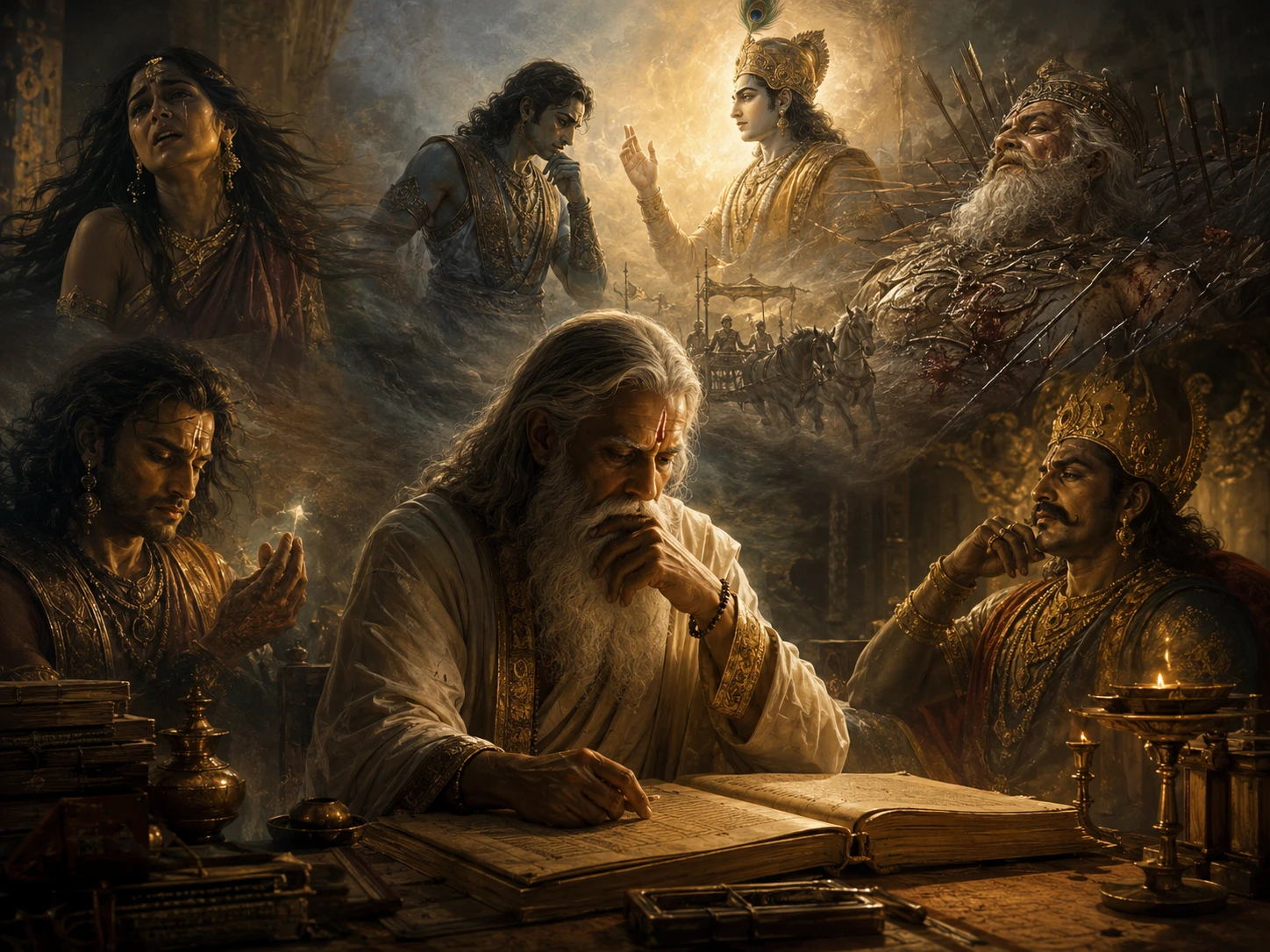
The Kurukshetra Within -- Reading the Mahabharata as a Mirror of Your Mind
तुम्हारे भीतर का कुरुक्षेत्र -- महाभारत को मन के दर्पण की तरह पढ़ना
There is a sentence Vyasa places at the very threshold of the Mahabharata, almost as a warning to the reader. Whatever exists in the world of dharma, artha, kama, and moksha exists somewhere in this text. And whatever is not in this text exists nowhere at all.
Most readers treat this line as ancient grandiosity. A poet praising his own poem. The kind of opening that big books need to feel important. Read it again, slowly. Vyasa is not bragging about coverage. He is making a quieter, more demanding claim. The Mahabharata is not a story about people who lived once on a battlefield in north India. It is a catalogue of patterns the human mind keeps producing. Every century. Every family. Every office in Gurgaon. Every hostel room in Kota. Every WhatsApp group of cousins fighting over property in 2026.
The characters in the epic are not characters at all. They are patterns. The high-performer who freezes at the moment of execution. The entitled mind that mistakes inheritance for achievement. The wounded boy who turns his pain into a weapon and aims it at the wrong people. The good man whose loyalty becomes the engine of disaster. The wise advisor whose advice is heard by everyone except the one who needed it. The woman whose dignity is treated as the price of someone else's politics. The seeker who is told to choose dharma over family and discovers that dharma costs more than he could have priced.
If you have lived a few years as an adult in India, you have met all of them. Not in books. In yourself. In your boss, your father, your ex, your closest friend. The Mahabharata is not about Hastinapur in 3100 BCE. It is about the chair you are sitting in right now.
This is the older Indian tradition of reading scripture, and it has a name. The classical commentators call it lakshana reading -- reading by indication. The surface story is one layer. Under the surface, the same words point at psychological structures, at moral patterns, at states of consciousness. The Bhagavata Purana operates the same way -- [Krishna](/scripture/eternal-gyan/scriptural-exegesis/krishna-parthasarathi)'s pastimes are also descriptions of how the soul meets the divine. The Yoga Vasishtha operates this way explicitly, with Vasishtha telling the young Rama -- this story about the king is also a story about you. Modern Indian readers have largely forgotten this reading mode. We have inherited the European habit of reading sacred narrative literally or dismissively, with no third option. Lakshana is the third option. The Mahabharata was always meant to be read this way.
This cluster of nine character portraits is built on that premise. Read the Mahabharata not as devotional homework. Not as Indian heritage to be defended in the comments section. Not as historical document to be debated in 4000-comment Twitter threads. Read it as a mirror. The kind of mirror that does not flatter you. The kind that shows you the version of yourself you have not yet admitted to. The kind that, if you sit with it long enough, gives you back not despair but a strange clarity -- the clarity of seeing something you had been carrying without seeing.
धर्मे चार्थे च कामे च मोक्षे च भरतर्षभ। यदिहास्ति तदन्यत्र यन्नेहास्ति न तत्क्वचित्॥
dharme cārthe ca kāme ca mokṣe ca bharatarṣabha yad ihāsti tad anyatra yan nehāsti na tat kvacit
O bull of the Bharatas, in matters of dharma, artha, kama, and moksha -- whatever is found here is found elsewhere; whatever is not found here, is found nowhere.
— Mahabharata, Adi Parva 1.56.33 (BORI Critical Edition); Adi Parva 62.53 (Ganguli)
The framework of this cluster is simple. Nine characters. Nine patterns of human consciousness. Each one a complete portrait, each one self-contained.
[Arjuna](/scripture/eternal-gyan/scriptural-exegesis/arjuna-partha-dhananjay) is the Paralysed Achiever. The kind of person who has trained for decades to be the best at one thing, and freezes at the precise moment that thing is required of him. Every JEE topper who collapsed in the interview round knows this man. Every fund manager who panicked in 2008 knows this man. He carries the Gandiva. He carries the world's confidence. He still cannot pick up the bow when the bow is needed.
[Duryodhana](/scripture/eternal-gyan/scriptural-exegesis/duryodhana-kaurava-yuvaraj) is the Entitled Mind. Born into privilege, he reads privilege as evidence of personal worth. He cannot tell the difference between what was given to him and what he earned. The cousin who got into the family business and now lectures everyone about hustle. The promoter's son convinced he is self-made. The political heir who thinks dynasty is destiny.
[Karna](/scripture/eternal-gyan/scriptural-exegesis/karna-suryaputra-anga-raj) is the Loyal Warrior on the Wrong Side. Wounded by birth, raised in the wrong house, given gifts he could never explain. He chooses his loyalty before he knows the consequences, and then refuses to revise that loyalty even when it is destroying him. Every brilliant Indian engineer who stayed at a toxic company for fifteen years out of gratitude knows him. Every artist who kept defending the abusive mentor knows him.
[Shakuni](/scripture/eternal-gyan/scriptural-exegesis/shakuni-gandhara-raj) is the Wound That Became a Weapon. He turned grief into strategy. His entire life is a long, calculated revenge dressed up as service to his nephew. The bitter senior at work who has not forgiven a slight from 1997 and is still routing decisions to punish the company that wronged him -- you know him.
[Bhishma](/scripture/eternal-gyan/scriptural-exegesis/bhishma-devavrata-gangaputra) is the Man Who Kept the Wrong Promise. He made one vow as a young man, in a moment of love and proof, and then spent the next century watching that vow destroy everyone he was sworn to protect. Anyone who has stayed too long in the family business out of duty knows him. Anyone who has stayed in a marriage long after the marriage was over knows him.
[Vidura](/scripture/eternal-gyan/scriptural-exegesis/vidura-mahatma) is the Wisest Man No One Listened To. The advisor born one tier below the throne, whose counsel was correct and whose counsel was ignored. The chief of staff who saw the disaster coming six quarters in advance and was thanked for the warning and overruled anyway. He is the most painful character because his pattern is the most common.
[Draupadi](/scripture/eternal-gyan/scriptural-exegesis/draupadi-panchali-yajnaseni) is the Fire That Refused to Die. Treated as property, gambled away, dragged into a court of men, she does not collapse. She does not forgive. She holds the question open until it forces a war. Every Indian woman who has refused to swallow a public humiliation knows her.
[Yudhishthira](/scripture/eternal-gyan/scriptural-exegesis/yudhishthira-dharmaputra) is the Man Who Chose Dharma Above All. He is the hardest character to like, because dharma in his case is not nobility. It is a cost. He pays the cost in his brothers, his wife, his peace, his throne. At the end of the road he is alone with a dog. He is the answer to the question -- what does it actually look like to choose the right thing every time, with no exceptions.
Krishna is the Smartest Person Who Chose to Drive. He could have been the king. He could have been the warrior. He chose to be the charioteer. The strategist who declines the chair at the head of the table because steering matters more than sitting. The mentor who refuses to take the credit. The advisor who knows that the person at the wheel is more powerful than the person on the throne.
Nine portraits. Nine recognisable shapes. Read each one as the Mahabharata's diagnosis of one possible human path -- and then ask yourself which one you are running today.
The Nine-Character Mirror -- Mahabharata as Map of the Mind
| Character | Primary Parva | Dharmic Question | Modern Pattern | Canonical Verse / Moment |
|---|---|---|---|---|
| Arjuna -- the Paralysed Achiever | Bhishma Parva (the Gita) | When the moment of execution finally comes, why does the body refuse the act it has trained twenty years to perform? | The IIT topper who freezes in the corporate interview. The startup founder who delays the hard layoff. The fund manager who cannot pull the trigger. | Bhagavad Gita 1.28-30 -- Arjuna's hands tremble, Gandiva slips from his grip |
| Duryodhana -- the Entitled Mind | Sabha Parva, Udyoga Parva | If you were given everything by birth, can you ever know the difference between deserving and demanding? | The promoter's son who calls himself self-made. The legacy admit who lectures merit students. The political heir who treats office as inheritance. | Udyoga Parva -- 'I will not give them as much land as fits the tip of a needle' (Bhagavad-Yana Parva) |
| Karna -- the Loyal Warrior, Wrong Side | Vana Parva, Karna Parva | When the world wounds you at birth, do you owe loyalty to the first hand that did not flinch -- even if that hand is leading you to ruin? | The brilliant employee who stays at a toxic firm out of gratitude. The artist who defends the abusive mentor. The friend who keeps showing up for someone who never showed up first. | Karna Parva 90-91 -- chariot wheel sinks, Brahmin's curse activates |
| Shakuni -- the Wound That Became a Weapon | Sabha Parva (the dice game) | Is grief a permission slip to spend the rest of your life as a strategist of destruction? | The senior who has not forgiven a slight from 1997 and is still routing every decision to punish the institution. The ex who weaponises children. The bureaucrat playing thirty-year games of revenge. | Sabha Parva 58-65 -- the loaded dice in the Hastinapura sabha |
| Bhishma -- the Man Who Kept the Wrong Promise | Adi Parva, Bhishma Parva | If a vow that began in love is now killing the people you love, is keeping it dharma -- or is keeping it the most spectacular form of cowardice? | The eldest son who stayed in the family business too long. The CEO bound by an old equity agreement. The spouse who refused to leave a dead marriage out of principle. | Adi Parva 94-100 -- the terrible vow before Satyavati's father |
| Vidura -- the Wisest Man No One Listened To | Sabha Parva, Udyoga Parva (Vidura Niti) | What is the dharma of speaking truth to a king who has decided in advance not to hear? | The chief of staff who flagged the disaster six quarters early. The compliance officer the board overruled. The wife who said no, twice, before the family signed. | Udyoga Parva 33-40 -- the Vidura Niti to Dhritarashtra at midnight |
| Draupadi -- the Fire That Refused to Die | Sabha Parva, Vana Parva | When dignity is treated as currency by the men in your room, is rage the dharmic response -- or the only response? | Every woman who has refused to swallow a public humiliation. The whistle-blower who would not retract. The complainant who insisted on the FIR. | Sabha Parva 67-69 -- Draupadi's question in court: 'Did he own himself first?' |
| Yudhishthira -- the Man Who Chose Dharma Above All | Vana Parva (Yaksha Prashna), Mahaprasthanika Parva | If choosing dharma every single time costs you your wife, your brothers, and your peace -- did dharma still win? | The honest civil servant who got passed over for promotion. The doctor who would not certify the false COVID-19 result. The CEO who shut the profitable but unethical line. | Vana Parva 297 -- the Yaksha questioning at the lake |
| Krishna -- the Smartest Person Who Chose to Drive | Bhishma Parva (Gita), Udyoga Parva (peace mission) | If you are the most powerful person in the room, what does it mean to deliberately not take the throne? | The ISRO mission director who never sought a Padma. The senior advisor at McKinsey who turned down the partnership. The mother whose career was the steering wheel for three other careers. | Bhagavad Gita 11.32 -- 'kalo'smi loka-kshaya-krit' (I am Time, the destroyer of worlds) |
Read each row as a diagnostic question, not as a moral verdict. The Mahabharata does not condemn these patterns -- it makes them visible.
Vyasa's claim 'yad ihasti tad anyatra' is not unique among Indian texts -- it sits alongside the Yoga Vasishtha and the Mahabhashya in asserting comprehensive coverage. But the Mahabharata is the only text that backs this claim with a hundred thousand verses, eighteen parvas, and a moral system in which no character -- not even Krishna -- escapes consequence.
There is a specific way to read this cluster, and it matters. The temptation, especially for an Indian raised on Sunday morning Mahabharat reruns and BR Chopra's score, is to read the characters as moral examples. Arjuna is the noble hero. Duryodhana is the villain. Karna is the tragic figure we feel sorry for. Yudhishthira is the boring one. Krishna is god.
This is the reading that television gave us. It is not the reading the text supports.
Vyasa is far more interesting than that. The Mahabharata he wrote does not have heroes and villains. It has people. Each one is given a complete chance to be understood, including the ones we are taught to hate. Duryodhana is not a cartoon -- he is a friend so devoted to Karna that the moment he hears Karna has been wounded, he refuses to leave the battlefield. Karna is not a saint -- he laughs at Draupadi's humiliation in the sabha and calls her things a kshatriya should never say to any woman. Yudhishthira is not a paragon -- he gambles his wife away and lies to his teacher's face during the war. Krishna himself uses every kind of strategy a normal human ethic would call deceit.
The Mahabharata does not give us moral characters. It gives us moral situations. And it gives them to us through people complex enough that no single label fits.
This is the reading discipline of the cluster. When you arrive at the Karna article, do not rush to forgive him. Sit with what he actually did. When you arrive at Duryodhana, do not rush to condemn him. Sit with what he was given and what he was denied. When you arrive at Krishna, do not rush to deify him. Sit with the choices he made and the choices he refused to make. The text rewards slow reading. It punishes the certainty you bring with you.
If you can hold all nine characters in your mind without turning any of them into a category, you will have read the Mahabharata. Most lifelong scholars never get there. The path begins with admitting that the war was never between two armies. It was between nine ways of being human, all of them coexisting inside one mind. Yours.
उद्धरेदात्मनात्मानं नात्मानमवसादयेत्। आत्मैव ह्यात्मनो बन्धुरात्मैव रिपुरात्मनः॥
uddhared ātmanātmānaṃ nātmānam avasādayet ātmaiva hy ātmano bandhur ātmaiva ripur ātmanaḥ
Lift yourself up by your own self; do not allow yourself to fall. The self alone is the friend of the self, and the self alone is the enemy of the self.
— Bhagavad Gita 6.5
This verse is placed here on purpose. Krishna gives it to Arjuna in the middle of the Gita, after the cosmic visions and before the practical instructions. It is the hinge of the whole Mahabharata project. The self is your friend. The self is your enemy. There is no third party.
The nine characters in this cluster are not nine separate people. They are nine versions of the same self under nine different stresses. When you have a tight deadline and freeze, you are Arjuna. When you get a promotion and start lecturing junior colleagues, you are a small Duryodhana. When you stay at the wrong job for the wrong boss out of misplaced loyalty, you are Karna. When you punish your spouse for something a parent did to you in 1992, you are Shakuni. When you are bound by a promise that no longer fits, you are Bhishma. When you give the right advice and watch it ignored, you are Vidura. When you walk into the room knowing they will not listen and refusing to be silenced anyway, you are Draupadi. When you choose the harder right thing in a small daily decision, you are Yudhishthira. And in the rare moments when you can see the whole field clearly and choose to coach instead of compete, you are Krishna.
This is the sukshma question Vyasa wants you to sit with. Not which character do you admire. Not which character would you like to be. The actual question. Right now, this week, in the meeting yesterday, in the family WhatsApp group three minutes ago -- which character were you running. Not which one you posted as your favourite on Twitter. Which one was actually controlling your hands and your mouth.
The answer changes by the hour. That is the point. The Mahabharata does not give you a fixed identity to settle into. It gives you a vocabulary to notice yourself. The moment you can name which character is operating you, you have created the smallest amount of distance from the operation. That distance is the entire spiritual technology of the epic. That is what Krishna is doing for Arjuna for eighteen chapters. He is not telling Arjuna who to be. He is teaching Arjuna how to watch himself be it.
A practical test, before you go further. Pick the last seventy-two hours of your life. Walk through them in your head, scene by scene -- the meeting on Tuesday, the dinner with parents on Wednesday, the message you sent at 1 AM, the small choice you made at the coffee machine. For each of those scenes, name the character. Not as judgement. Just as observation. Tuesday's meeting where you stayed silent when you should have spoken -- that was Vidura. Wednesday's dinner where you defended a family member you privately disagree with -- that was Karna. The 1 AM message where you settled an old score in soft language -- that was Shakuni in disguise. The coffee machine moment where you let a junior take credit for your idea because you remembered being junior once -- that was small Krishna. None of these is the whole you. All of them are passing through you, in a single seventy-two hour window.
This is how the Mahabharata wants to be used. Not as homework. Not as memorisation. As a vocabulary you carry into Tuesday morning. The text is roughly one hundred thousand verses long because the human range it has to cover is roughly that wide. Vyasa knew exactly how much was needed.
The Mahabharata is the only world epic where the omniscient narrator -- Vyasa himself -- is also a character inside the story. He fathers Pandu and Dhritarashtra, mentors his grandsons, watches the war, mourns the dead, and finally retires to Badrinath. The author is implicated. He has skin in the game. This is why the text refuses easy verdicts -- Vyasa knew everyone personally.
The cluster that follows is structured as nine self-contained portraits. You can read them in any order. You can read just one. You can read the one whose pattern you are running this week, and skip the rest until next month. The Mahabharata is not a course you complete. It is a library you keep returning to.
A suggestion. The first time through, read Arjuna. Almost everyone alive in modern India has lived inside Arjuna's question -- I have trained for this all my life and I cannot do it. Then read Vidura, because Vidura is the voice you ignore at your own cost, and once you can hear him on the page you can start hearing him in your own life. Then read whichever one is making your jaw tight. The character you do not want to read is usually the one operating you right now.
This cluster is paired with the existing articles in the Eternal Gyan library on the Yaksha Prashna, the dice game, the terrible vow of Bhishma, Vidura Niti, Draupadi in the sabha, the Kurukshetra battle alliances, Arjuna's many wives, the Pandavas in hell, and the path of Swargarohana. Read them as continuous. The Mahabharata was never written to be opened in pieces. Vyasa expected you to live inside it.
The Kurukshetra was not a place. It was a precision instrument for showing the human mind to itself. Eighteen days. Eighteen chapters of the Gita. Eighteen Puranas. The number is not coincidence. It is the basic count Vyasa believed it took to fully audit a single human life.
Let the audit begin.
Read the Bhagavad Gita slowly
The Gita is the Mahabharata's clearest mirror. Read one verse at dawn. Sit with it. Notice which of the nine characters in your day responds to it. Repeat tomorrow.
Tags
Eternal Raga · शाश्वत राग
Institutional voice — scholarly articles on Sanatan Dharma
Deepen Your Understanding
अपनी समझ और गहरी करें
scriptural exegesis
Yaksha Prashna -- Questions at the Lake
Four brothers lie dead beside an enchanted lake. One brother remains. A voice from the water asks 124 questions about dharma, death, happiness, and the self. Yudhishthira's answers in Vana Parva remain the most sophisticated ethical examination in all of Sanskrit literature.
scriptural exegesis
The Dice Game -- The Darkest Hour of the Mahabharata
A king who cannot say no to a challenge. An uncle whose dice are loaded with the bones of the dead. A court full of elders who watch injustice and say nothing. And a woman who asks one question that nobody in the room can answer: 'Did my husband lose himself first, or me?' The dice game in the Sabha Parva is not a plot device. It is the moral black hole at the centre of the Mahabharata. Everything before it is prologue. Everything after it is consequence. And the central horror is not what happens -- it is who lets it happen.
scriptural exegesis
Vidura Niti -- The Wisest Counsel That the King Heard and Still Ignored
The night before the Pandavas' exile ended, when war was one decision away, a sleepless king called his wisest adviser. For eight chapters of the Udyoga Parva, Vidura -- the bastard son who could never be king, the only man in Hastinapura who always told the truth -- delivered 593 verses of raw, unfiltered counsel on leadership, ethics, self-mastery, and statecraft. Dhritarashtra listened to every word. Agreed with every point. And then did the opposite. Vidura Niti is not just political philosophy. It is the anatomy of a man who knew the right thing, had the right adviser, and chose wrong anyway.
scriptural exegesis
Draupadi in the Sabha -- The Trial That Started the War
A queen was dragged into a court full of kings, warriors, and elders. Not one stood up. She asked a single legal question that nobody could answer. Then she swore an oath that burned a civilization to the ground. Draupadi's Sabha episode is not a story about a helpless woman. It is the most devastating indictment of institutional silence in world literature.
scriptural exegesis
Kurukshetra Battle Alliances -- Which Kings Joined Which Side
Seven akshauhinis against eleven. 1.5 million warriors against 2.4 million. The Kurukshetra war was not two families fighting -- it was the entire Indian subcontinent choosing sides. From the Pandyas of Tamil Nadu to the Kambojas of Central Asia, from the Yadavas of Dwaraka to the Kekayas split down the middle -- here is the geopolitical map of who joined whom and why, sourced from Udyoga Parva.
scriptural exegesis
Mahabharata -- History or Myth? What the Evidence Actually Says
Submerged cities off Gujarat. 35+ archaeological sites matching the epic's geography. 200+ astronomical events verified by planetarium software. A river that vanished exactly as the text describes. Five categories of evidence that do not 'prove' the Mahabharata -- but make dismissing it as pure fiction increasingly difficult.
scriptural exegesis
Pandavas in Hell -- The Shocking Finale of the Mahabharata
The Mahabharata does not end with victory. It ends with the heroes falling dead on a Himalayan climb, the villains seated in heaven, and the one righteous king demanding to be sent to hell. The Swargarohana Parva is the most unsettling, most philosophically radical, and most misunderstood finale in all of world literature.
Vyasa's claim 'yad ihasti tad anyatra' is not unique among Indian texts -- it sits alongside the Yoga Vasishtha and the Mahabhashya in asserting comprehensive coverage. But the Mahabharata is the only text that backs thi…
More in Scriptural Exegesis
Abhimanyu and the Chakravyuha -- The Boy Who Knew How to Enter but Not How to Leave
14 min read
Adbhuta Ramayana -- The Ramayana Where Sita Becomes Kali
9 min read
After Kurukshetra -- What Happened Next
14 min readThe same translation error that turned '33 Koti' into '33 crore' in Hinduism also happened in Buddhism. The Chinese translation of Buddhist texts rendered 'Sapta Koti Buddha' (7 Supreme Buddhas) as '7 Crore Buddhas.' The…
Deities AvatarsCommunity Reflections
🕉️
Be the first to share your reflection.