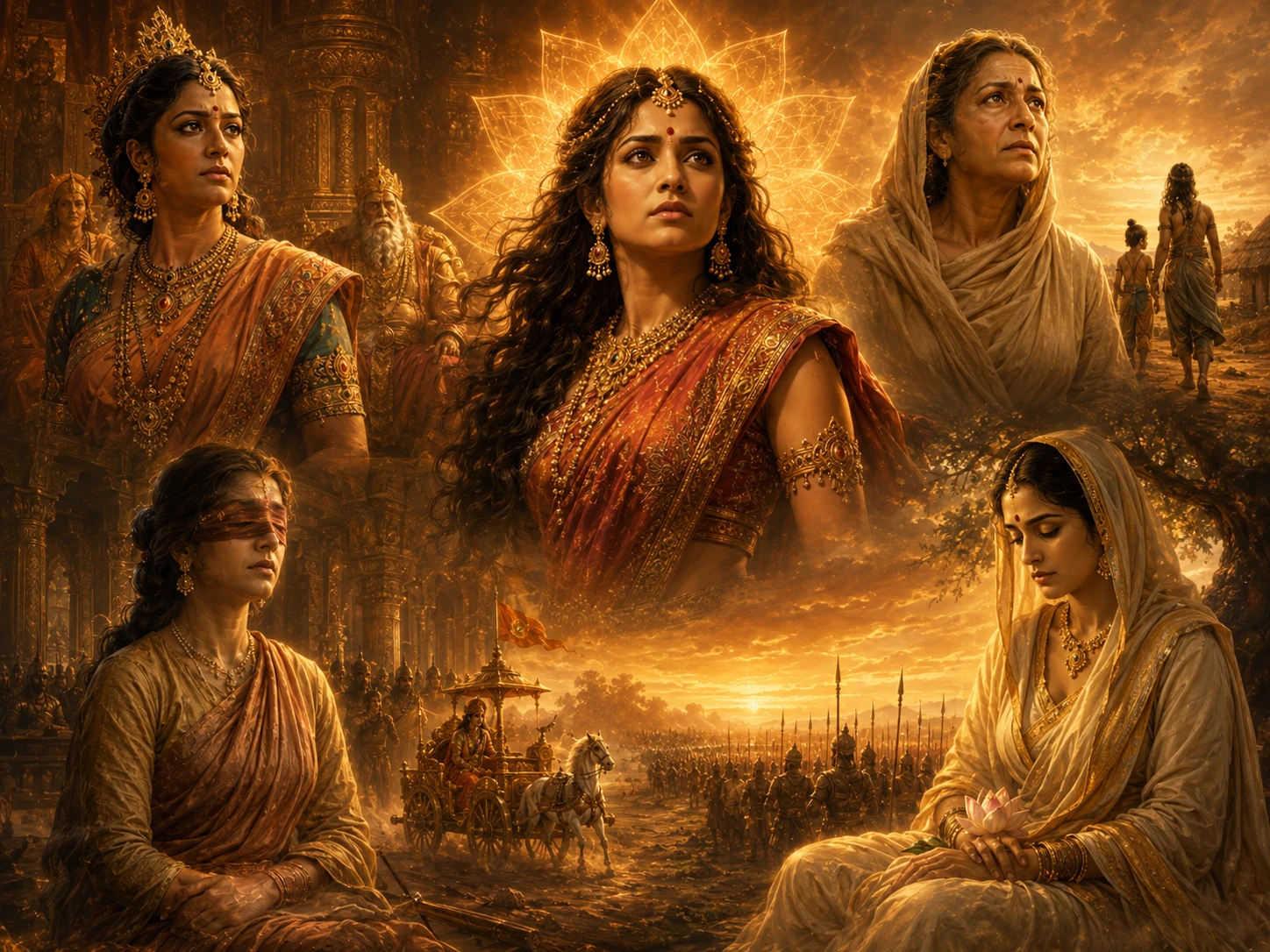
Draupadi -- The Question That Burned Down a Kingdom
द्रौपदी -- वह प्रश्न जिसने एक राज्य जला दिया
Draupadi is the only character in the Mahabharata who functions, simultaneously, as a queen, a divine incarnation, a wife to five men, a hostess of the imperial palace, a slave dragged in by the hair, the inciting cause of the great war, and the philosopher-questioner whose single sentence in the dice-game sabha hangs over the rest of the epic. The text gives no other character this many roles. It is impossible to write a portrait of her that does not feel partial. This article will be partial.
What I want you to carry through is the structural fact about Draupadi the popular tradition has gradually obscured. She is not the passive wife. She is not the suffering archetype. She is not the woman whose function is to be wronged so that the men around her can take vows of revenge. The text places her in those situations, but it also gives her, at every turn, the highest agency available to her. She chooses Arjuna at the swayamvara, even though all five brothers will become her husbands. She refuses to enter the Indraprastha palace before her husbands' kingdom is consolidated, and she is the one who designs the management of the Mayasabha. She speaks first when no one else in the dice game sabha will. She refuses to bind her hair for thirteen years until that hair is washed in Kaurava blood. She insists on staying in disguise at Virata's court despite the cost. She refuses to forgive Ashwatthama after the Upapandavas are killed, and she also refuses to allow Bhima to kill him. She is the moral centre of the war's aftermath, the one who decides what mercy looks like and what it does not look like.
The Mahabharata is written, in a sense, around her. The other male characters in this cluster -- Arjuna, Karna, Duryodhana, Bhishma, Yudhishthira -- have their lives shaped by their response to Draupadi. The dice game would not have happened without her. The war would not have happened without the dice game. The Pandavas' exile would not have happened the way it did. The vows that drove the war's specific cruelties were vows about her -- Bhima's vow about Dushasana's blood, Bhima's vow about Duryodhana's thigh, Draupadi's own vow about her hair. The text does not place her at the centre of every scene. The text places her at the centre of every consequential decision.
Reading her well requires letting go of two simplifications. The first is the simplification of victim-Draupadi -- the woman whose suffering provokes the men to action. The second is the simplification of warrior-Draupadi -- the action-movie revisionist version where she is essentially a vengeful kshatriya in a sari. Neither captures her. The Mahabharata's Draupadi is something more demanding -- a woman with full agency operating in a system that will not give her the means to use it cleanly, who finds the few avenues of agency available to her, and uses them with a precision that the men around her almost never match.
किं नु पूर्वं पराजैषीरात्मानं माम् नु भारत। ईशो न ह्यात्मनो यः स्यात्परं स्यात्क्षीणकर्मणः॥
kiṃ nu pūrvaṃ parājaiṣīr ātmānaṃ mām nu bhārata īśo na hy ātmano yaḥ syāt paraṃ syāt kṣīṇa-karmaṇaḥ
Whom did you wager first -- yourself, or me, O Bharata? For one who is not master of himself can have no authority over another. Once the karma of self-ownership is exhausted, no further property can be wagered.
— Mahabharata, Sabha Parva 67 -- Draupadi's question to the assembled Kuru sabha during the disrobing
Draupadi was born from fire. King Drupada of Panchala had performed a great yajna for the explicit purpose of obtaining a son who could kill his rival Drona, and a daughter who would change the course of history. Two figures rose from the sacrificial flame -- a young man, Dhrishtadyumna, who would grow up to kill Drona at Kurukshetra, and a young woman, fully grown, dark-skinned, breathtaking, with the fragrance of blue lotuses about her. She was named Draupadi -- daughter of Drupada -- and Krishnaa, the dark one, and Yajnaseni, the one born from the yajna. Her birth had no childhood. She arrived already a woman, already herself, already with the destiny attached.
The text records that she had been Vedavati in a previous life, and Nalayani before that, and Mudgalani in still earlier birth. She had asked Shiva for a husband five times in tapasya. Shiva, slightly amused, granted her exactly what she had asked for -- five husbands in her next birth. The boon came with the difficulties such boons always come with. Polyandry was rare even in the Vedic period. The legal frameworks for it were thin. The social contempt for it was substantial. Draupadi would have to negotiate her own position inside this arrangement throughout her adult life.
Drupada announced her swayamvara. The challenge was elaborate -- a fish target rotating high above, to be shot through the eye while the archer looked only at its reflection in a bowl of water below. Several kings tried. Several kings failed. Karna stood up to attempt and was disqualified by Draupadi herself, who refused to marry a sutaputra. Whether this refusal is a reflection of caste pride or of strategic instinct is one of the most-debated questions in Mahabharata commentary. The text records the refusal without condemning it. Karna sat down. The challenge continued.
Arjuna, disguised as a Brahmin during the Pandavas' exile-after-the-lakshagriha, stepped forward. He hit the target. Draupadi placed the garland around his neck. The Pandavas, with Draupadi, walked back to the potter's hut where Kunti was staying. Arjuna called out from outside the hut -- mother, see what we have brought. Kunti, without seeing, replied with the standard motherly instruction -- whatever it is, share it equally among yourselves. The instruction was given. The instruction had to be honoured. Draupadi was now to be the wife of all five Pandavas.
The text gives several rationalisations for the polyandry afterward -- the previous-life boon from Shiva, the dharmic principle that a mother's word once given cannot be revoked, the practical fact that no one of the five brothers wanted to be the one to refuse her. The historical fact may be simpler -- polyandry existed in some kshatriya traditions, the Pandavas chose to enter into it, Draupadi accepted the arrangement and built her life inside it. The text does not pretend the arrangement was easy for her. The text shows her, throughout her life, navigating five husbands, each of whom had separate marriages of their own, with a precision and a discipline that the men around her almost never reciprocated.
After the kingdom was divided and the Pandavas were given Khandavaprastha, Draupadi became the queen of Indraprastha. The Mayasabha rose from the desert. The Rajasuya yajna was performed. Yudhishthira became samrat. Draupadi sat as the empress of the most magnificent palace ever built. She had reached the apex of her possible status. She was, by every measure, secure.
The dice game came. The text gives the long version in the Sabha Parva, and almost every detail matters. Yudhishthira lost everything in stages. The kingdom. The treasury. The army. His four brothers. Himself. Then, in the worst single moment of his life, he wagered Draupadi.
What happened next is the scene the popular imagination remembers. Dushasana was sent to bring her. He found her in the inner apartments, performing her menstrual seclusion in a single cloth. She refused to come. He grabbed her by the hair and dragged her into the assembly hall. She was menstruating. She was wearing one cloth. She was unbathed. She was, by every standard of the period, the most ritually compromised body that could possibly be brought into a public assembly hall full of men. The text records her appearance with brutal honesty. The intention was humiliation. The execution was successful.
In the assembly, with Bhishma, Drona, Kripa, Vidura, Karna, Duryodhana, Dushasana, the hundred Kauravas, the five Pandavas, and Dhritarashtra all present, Draupadi did the thing the Mahabharata builds itself around. She did not weep first. She did not plead. She asked a question.
She asked, in the verse cited above, whether Yudhishthira had wagered himself before he wagered her. If he had wagered himself first and lost, he was a slave at the moment he wagered her, and a slave has no property to wager -- therefore the wager was legally invalid -- therefore she was not a slave -- therefore the disrobing was unlawful. The question is precise. It is a legal question. It is asked by a woman who has been dragged in by the hair into a court that does not, structurally, expect women to ask legal questions. She asks anyway.
The court could not answer. Bhishma equivocated, saying dharma is subtle. Drona was silent. Kripa was silent. Vidura supported her, but Vidura had no command authority. Karna mocked her. Duryodhana bared his thigh in front of her -- the obscene gesture that prompted Bhima's vow. Dushasana attempted to disrobe her. The akshaya-vastra protected her -- whether by Krishna's intervention or by a general dharmic mercy, the text records both. Eventually, after Gandhari's late intervention and bad omens, Dhritarashtra reversed the dice game's results.
But the question was never answered. The text records this with care. Draupadi's question is the unanswered legal question of the entire Mahabharata. The kingdom would have to be destroyed before it could be addressed.
After the disrobing was reversed, Draupadi made a vow that the Mahabharata returns to repeatedly across the next thirteen years. She vowed that she would not bind her hair until that hair could be washed in Dushasana's blood. She kept this vow for thirteen years of exile and eighteen days of war. She wore her hair loose and matted, an open declaration of unfinished business, throughout the time the Pandavas spent in the forest, throughout the year at Virata's court, throughout the war preparation, and throughout the war itself. On the day Bhima killed Dushasana, tearing open his chest and drinking his blood, Bhima carried that blood back to Draupadi. She washed her hair with it. The vow was complete. Only then did she bind her hair again.
The thirteen-year exile is the period of Draupadi's life that the popular imagination treats most lightly. The Mahabharata is precise about how hard it was. The Pandavas spent twelve years in the forest in vanaprastha conditions -- ascetic discipline, simple food, no royal comforts. Draupadi was with them. She had been queen of Indraprastha. She was now living on bark, gathering roots, sleeping on the ground in a forest in northern India where winters were severe and monsoons flooding. She did this without complaint that the text records, but the text also gives her several scenes in which her endurance is precisely shown.
In the Vana Parva, she has a conversation with Krishna's wife Satyabhama, who has come to visit. Satyabhama asks her how she manages five husbands successfully. Draupadi gives the longest sustained discourse on a wife's wisdom that any character in the Mahabharata gives. The discourse is not what one might expect. It is intensely practical. She discusses how to handle the moods of each husband, how to manage the staff, how to handle the household economy, how to read silences, how to build influence without appearing to seek it, how to know when to defer and when to refuse. The Vana Parva passage is the Mahabharata's working manual on how an intelligent woman runs a complicated marriage in difficult circumstances. It is delivered by a queen-in-exile dressed in bark in a forest hut. The dignity of the discourse is exact.
The thirteenth year was spent in disguise at the court of King Virata. The Pandavas took service positions. Yudhishthira became a chess teacher. Bhima a cook. Arjuna, in a curse-mandated transgender role, became Brihannala, the music and dance teacher of the princess Uttara. Nakula and Sahadeva took service in the stables. Draupadi served Queen Sudeshna as her sairandhri -- a hairdresser and personal attendant. She had been empress of the Mayasabha. She was now combing another woman's hair.
Kichaka, the queen's brother, took an interest in her. Draupadi rebuffed him. Kichaka, accustomed to taking what he wanted at the Virata court, did not accept the rebuff. He attempted to assault her. She came to Bhima at night, weeping. Bhima killed Kichaka in disguise, leaving the body so disfigured that no one could identify the killer. Draupadi was protected. The disguise of the Pandavas was preserved at the cost of one Kichaka and the suspicions that arose from his death. The thirteenth year ended. The Pandavas could now return.
Draupadi's Five Husbands -- Different Marriages Inside One Marriage
| Husband | His Quality | What She Got from Him | What He Got from Her |
|---|---|---|---|
| Yudhishthira | Eldest, dharma-king, ritual head of household | Status as empress of Indraprastha, ritual prestige, an austere companion | A queen who could perform yajnas with him, manage the imperial household during the Rajasuya, and eventually a wife who lost more in the dice game than he himself wagered |
| Bhima | Strongest, most loyal, most violent in protection | The husband who never failed to protect her physically; the avenger of Kichaka, Dushasana, and Duryodhana; a man who would burn the world for her | The reason for his deepest vows, the woman whose hair he could only wash in his enemies' blood, the centre of his entire warrior identity |
| Arjuna | Most skilled, most charming, most flattered by other women | The husband she chose at the swayamvara; the warrior who would actually win the war; her first emotional anchor; also the husband who married Subhadra and others | His swayamvara prize, the woman whose loss most enraged him, the centre around which his other wives were always secondary |
| Nakula | Gentle, beautiful, less prominent in the war | An attentive companion, a husband who did not compete for her attention with the older brothers | A wife who valued him without comparison to Arjuna, a quiet inner circle |
| Sahadeva | Wise, astrologer, also less prominent in the war | The youngest husband, the most knowledge-rich, the one she could speak to about practical questions and predictive matters | A wife whose intellect he respected, a partner in the household's quiet operational decisions |
The Mahabharata gives Draupadi five distinct marriages inside one marriage. The text is honest about the asymmetry -- her five husbands each had other wives, while she had only the five husbands. The asymmetry was painful, and the text shows her acknowledging it without bitterness. The skill she developed inside this arrangement was, in many ways, her most striking achievement.
नाहं तातं न च भ्रातॄन्नात्मानं न च बान्धवान्। तुष्टा प्रद्रौपदी ब्रूयाद्यथा कृष्णेति भारत॥
nāhaṃ tātaṃ na ca bhrātṝn nātmānaṃ na ca bāndhavān tuṣṭā pradraupadī brūyād yathā kṛṣṇeti bhārata
Neither father, nor brothers, nor self, nor kinsmen does Draupadi name with as much satisfaction, O Bharata, as she names the word Krishna.
— Mahabharata, Vana Parva (paraphrasing the structure of multiple Vana Parva and Sabha Parva passages where Krishna is described as Draupadi's primary refuge)
The war came. The eighteen days were what Draupadi had effectively been demanding for thirteen years. Her hair, still unbound. Her vow, still pending. The text records her at the Pandava camp throughout the war, hearing reports each evening of who had killed whom, who had survived, who had fallen. Bhishma fell on day ten. Drona on day fifteen. Karna on day seventeen. Duryodhana on day eighteen, with his thigh broken by Bhima. Dushasana, on day fourteen, was killed by Bhima, who tore open his chest and drank his blood. Bhima carried the blood to Draupadi. She washed her hair. The vow ended.
The night after Duryodhana's fall, when the Pandavas thought the war was over, Ashwatthama -- Drona's son, mad with grief -- crept into the Pandava camp under the cover of darkness and killed everyone he could find. Among the dead were the five sons of Draupadi, the Upapandavas, mistaken for the five Pandavas in the dark. Pratidvinda, son of Yudhishthira. Sutasoma, son of Bhima. Shrutakarman, son of Arjuna. Shatanika, son of Nakula. Shrutasena, son of Sahadeva. All five killed in a single night, in their sleep, by a single grieving warrior who had mistaken the dwelling.
Draupadi, the mother who had survived the dice game, the hair-vow, the thirteen-year exile, the Kichaka episode, the eighteen-day war, broke fully on this night. The text records her grief without ornament. She demanded Ashwatthama's death. The Pandavas pursued him. Bhima caught him. Krishna restrained Bhima from killing him outright -- Ashwatthama was a Brahmin, and brahmin-killing was a sin. Krishna ordered the gem on Ashwatthama's forehead -- the chudamani, his protective talisman -- to be torn out instead. Bhima did so. The bleeding wound on Ashwatthama's forehead would never heal. He was cursed to wander, deathless, immortal in his suffering. Draupadi, in her grief, accepted this as adequate punishment. She did not insist on Ashwatthama's death.
This is the most morally complex moment of her life. She had every right to demand his life. She did not. The same woman who had vowed to wash her hair in Kaurava blood, the same woman whose question had triggered the war, the same woman who had endured thirteen years -- chose mercy in the form she could control. She let Ashwatthama live. She would never see him again. The cursed wanderer would haunt the Indian subcontinent's stories for thousands of years afterward, in folklore from the Himalayas to the Deccan, the eternal wound of a man who had killed in grief and been spared in greater grief.
On the Mahaprasthana, the great northward final journey of the Pandavas after the war, when the five brothers and Draupadi began their walk into the Himalayas to leave the world behind, Draupadi was the first to fall. Yudhishthira, walking ahead, did not turn back to mourn her. Bhima asked him why. Yudhishthira answered with quiet honesty -- because she had a partiality. Among her five husbands, she loved Arjuna the most. The text records this with care. Even after a lifetime of equal duty to all five, even after the public exemplary management of the polyandrous arrangement, the inner truth was that her heart had chosen one. The Mahabharata does not punish her for this. It simply records it. The fall is not a verdict. It is a recognition that the heart, even the disciplined heart, retains its preferences.
Why does Draupadi matter to you in 2026?
Because Draupadi is the Mahabharata's most exact diagnosis of what happens when an institution structurally cannot answer a woman's question. She did not ask for revenge. She did not ask for protection. She did not ask for a man to fight for her. She asked a legal question. The court could not answer it. Eighteen years and millions of deaths later, the court still had not answered it. The Mahabharata's deepest critique of patriarchal kshatriya society is not that it humiliated her. It is that it could not, when she asked the right question, give her a response.
The modern Indian woman who comes closest to Draupadi's pattern is the woman who has, somewhere in her professional or personal life, asked the precise question that the room cannot answer. The HR complaint that everyone agrees is justified and that no one will sign. The MeToo allegation that is fully documented and that the institution will keep filing. The board memo about the founder's behaviour that the board accepts and does not act on. The grandmother in the family meeting who asks why the property was distributed the way it was, and is told that this is not the time to bring it up. The wife who asks her husband, after fifteen years, whether he had once at any point in their marriage genuinely chosen her -- and watches him try to answer.
These questions are not screams. They are precise. They use the institution's own language. They expect the institution's own framework to deliver the answer. The institution cannot. The Draupadi pattern is not the woman who is wronged. The Draupadi pattern is the woman who frames her wrong as a question the institution must answer in its own terms, and then waits while the institution discovers that it has no terms in which to answer her.
The Mahabharata's response to this pattern is not pretty. The institution that cannot answer the question must, eventually, be remade. The Kuru kingdom did not survive the question. The Pandavas inherited a wasteland. Hastinapura was never the same place again. The text seems to be saying -- when an institution's structure prevents it from answering a clean question, the cost of restructuring it is, almost always, the destruction of the institution. There is no cheaper option. The question, once asked, demands an answer. If the answer cannot be given through legitimate channels, it will be extracted through war.
Draupadi's life is the inside story of the asking. The text wants you to feel what it cost her -- the years of unbound hair, the hut in Virata's palace combing another woman's hair, the five sons killed in a single night, the partiality at Mahaprasthana that ended her walk. The cost was hers. The Mahabharata does not pretend otherwise.
The question for you in 2026 is not whether you, like Draupadi, will ever be in such a sabha. Some readers will be. Many will not. The question is whether, when you are in any room where someone has just asked the precise question that the room cannot answer, you will be one of the people who sits silent, hoping the question goes away, or one of the people who stands up and says -- she is right. The question is real. We must answer it. The Mahabharata gives us almost no examples of the second kind of person in Draupadi's sabha. Vidura, partially. Vikarna, the boy. That is all. Everyone else was silent.
Draupadi is the one who asked. The Mahabharata is asking, of you, only one thing. When the question is asked in the room you are in, what will you do?
Sit with Draupadi's question, alone, for one evening
There is a precise question someone in your life has asked, or is asking now, that the room around them cannot answer. It might be a colleague, a sister, a parent, a domestic worker, a daughter. Pick one. Read Sabha Parva 67 -- Draupadi's full question and the silence that followed. Then sit with the question that has been asked in your room. Decide whether you will be Bhishma, who said dharma is subtle. Vikarna, who tried. Vidura, who was overruled. Or the new voice the Mahabharata never got -- the one who answers.
Tags
Eternal Raga · शाश्वत राग
Institutional voice — scholarly articles on Sanatan Dharma
Deepen Your Understanding
अपनी समझ और गहरी करें
scriptural exegesis
The Kurukshetra Within -- Reading the Mahabharata as a Mirror of Your Mind
Vyasa wrote that whatever exists in the world also exists in the Mahabharata, and whatever is not there exists nowhere. This is not a boast. It is an instruction: every character in the epic is a character inside you. Read the war as a map of your mind.
scriptural exegesis
Draupadi in the Sabha -- The Trial That Started the War
A queen was dragged into a court full of kings, warriors, and elders. Not one stood up. She asked a single legal question that nobody could answer. Then she swore an oath that burned a civilization to the ground. Draupadi's Sabha episode is not a story about a helpless woman. It is the most devastating indictment of institutional silence in world literature.
scriptural exegesis
The Dice Game -- The Darkest Hour of the Mahabharata
A king who cannot say no to a challenge. An uncle whose dice are loaded with the bones of the dead. A court full of elders who watch injustice and say nothing. And a woman who asks one question that nobody in the room can answer: 'Did my husband lose himself first, or me?' The dice game in the Sabha Parva is not a plot device. It is the moral black hole at the centre of the Mahabharata. Everything before it is prologue. Everything after it is consequence. And the central horror is not what happens -- it is who lets it happen.
scriptural exegesis
Duryodhana -- The Entitled Mind
He was the eldest, the heir, the host of Hastinapura. He had a hundred brothers, an unbreakable friendship with Karna, and a kingdom older than the Pandavas had ever held. And yet he could not bear that anything good went to anyone but himself. Duryodhana is what happens when birth-privilege gets confused for self-worth.
scriptural exegesis
Karna -- The Loyal Warrior on the Wrong Side
Born to a princess who abandoned him, raised by a charioteer who loved him, refused by the kshatriya teachers, accepted by the man who would lead him to ruin -- Karna's life is the Mahabharata's longest meditation on what loyalty costs when it is given to the wrong person at the wrong moment.
scriptural exegesis
After Kurukshetra -- What Happened Next
The war ended. The Pandavas won. And then everything fell apart. Krishna's clan destroyed itself in a drunken brawl. Dwaraka sank into the sea. Arjuna's divine powers vanished. And the five brothers who fought the greatest war in history walked into the Himalayas to die. The Mahabharata's post-war chapters are darker, stranger, and more relevant than the war itself.
scriptural exegesis
Vidura -- The Wisest Man No One Listened To
He was an incarnation of Yama-Dharma, born to a maid, raised in the palace, brother to the king he could not crown. He spoke truth in every chamber the Mahabharata gave him. He was thanked, dismissed, and overruled in chamber after chamber. Vidura is the most painful character in the epic because his pattern is the most ordinary -- the right counsel given in the wrong room.
After the disrobing was reversed, Draupadi made a vow that the Mahabharata returns to repeatedly across the next thirteen years. She vowed that she would not bind her hair until that hair could be washed in Dushasana's b…
More in Scriptural Exegesis
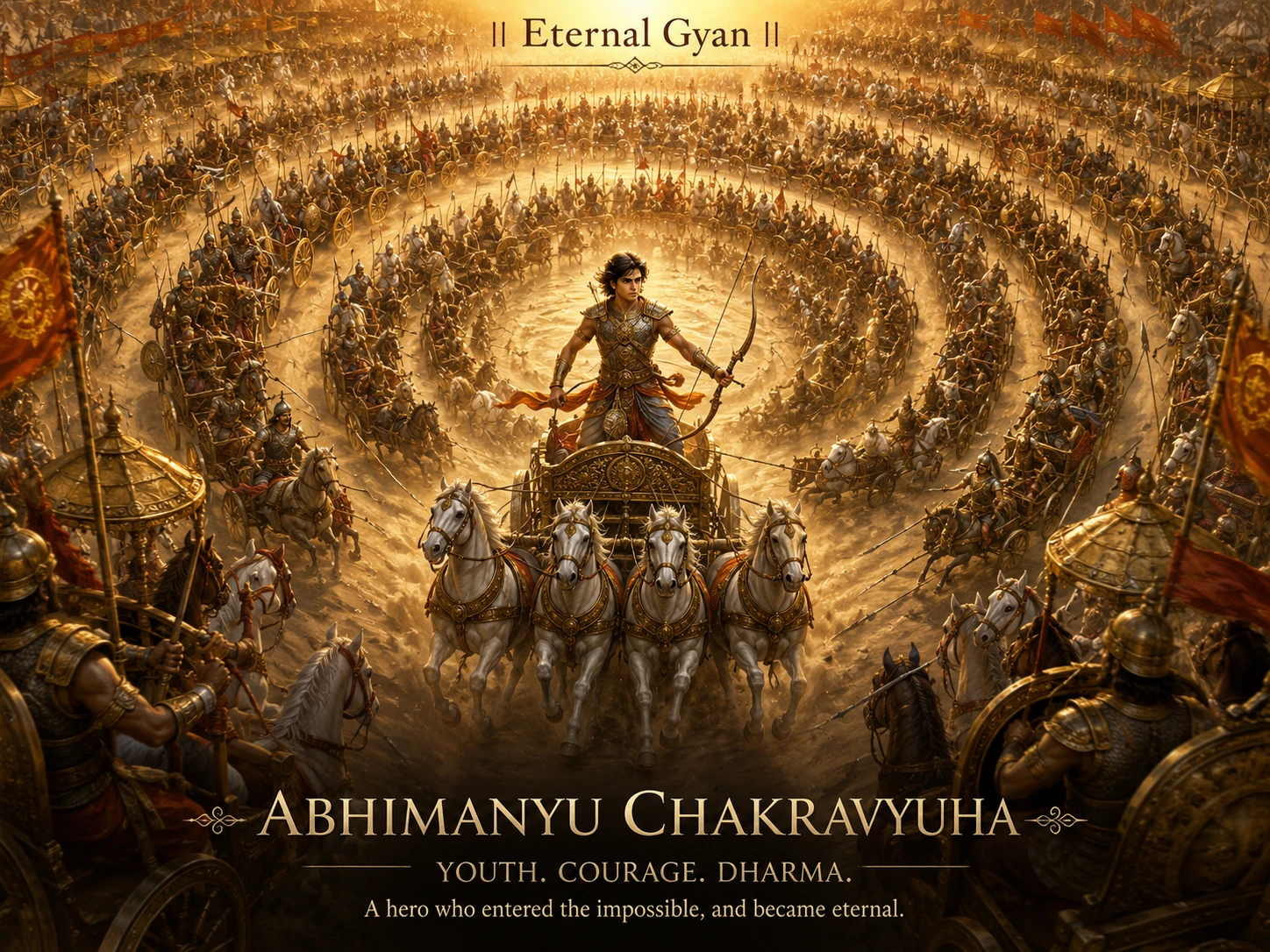
Abhimanyu and the Chakravyuha -- The Boy Who Knew How to Enter but Not How to Leave
14 min read
Adbhuta Ramayana -- The Ramayana Where Sita Becomes Kali
9 min read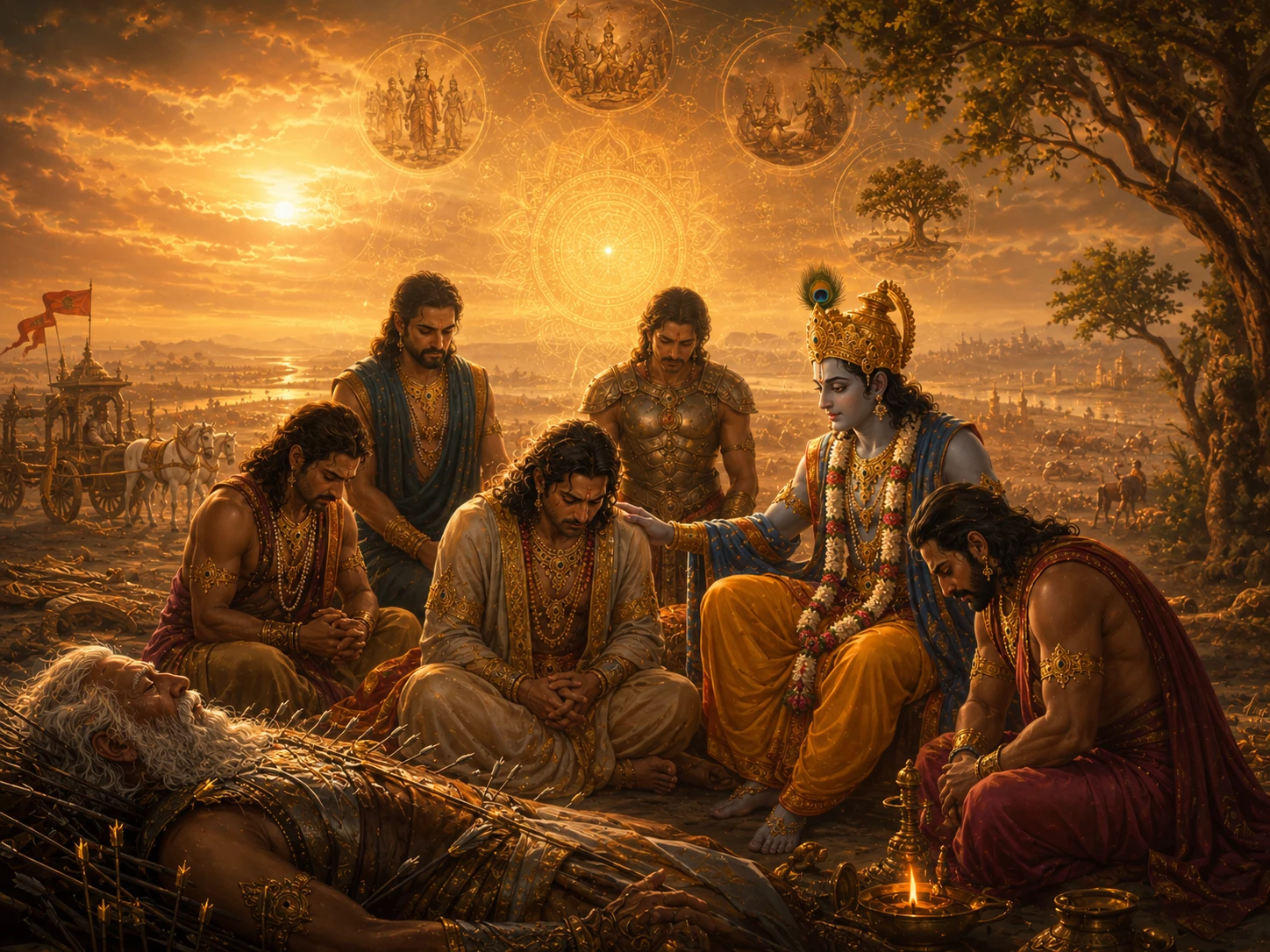
After Kurukshetra -- What Happened Next
14 min readThe same translation error that turned '33 Koti' into '33 crore' in Hinduism also happened in Buddhism. The Chinese translation of Buddhist texts rendered 'Sapta Koti Buddha' (7 Supreme Buddhas) as '7 Crore Buddhas.' The…
Deities AvatarsCommunity Reflections
🕉️
Be the first to share your reflection.