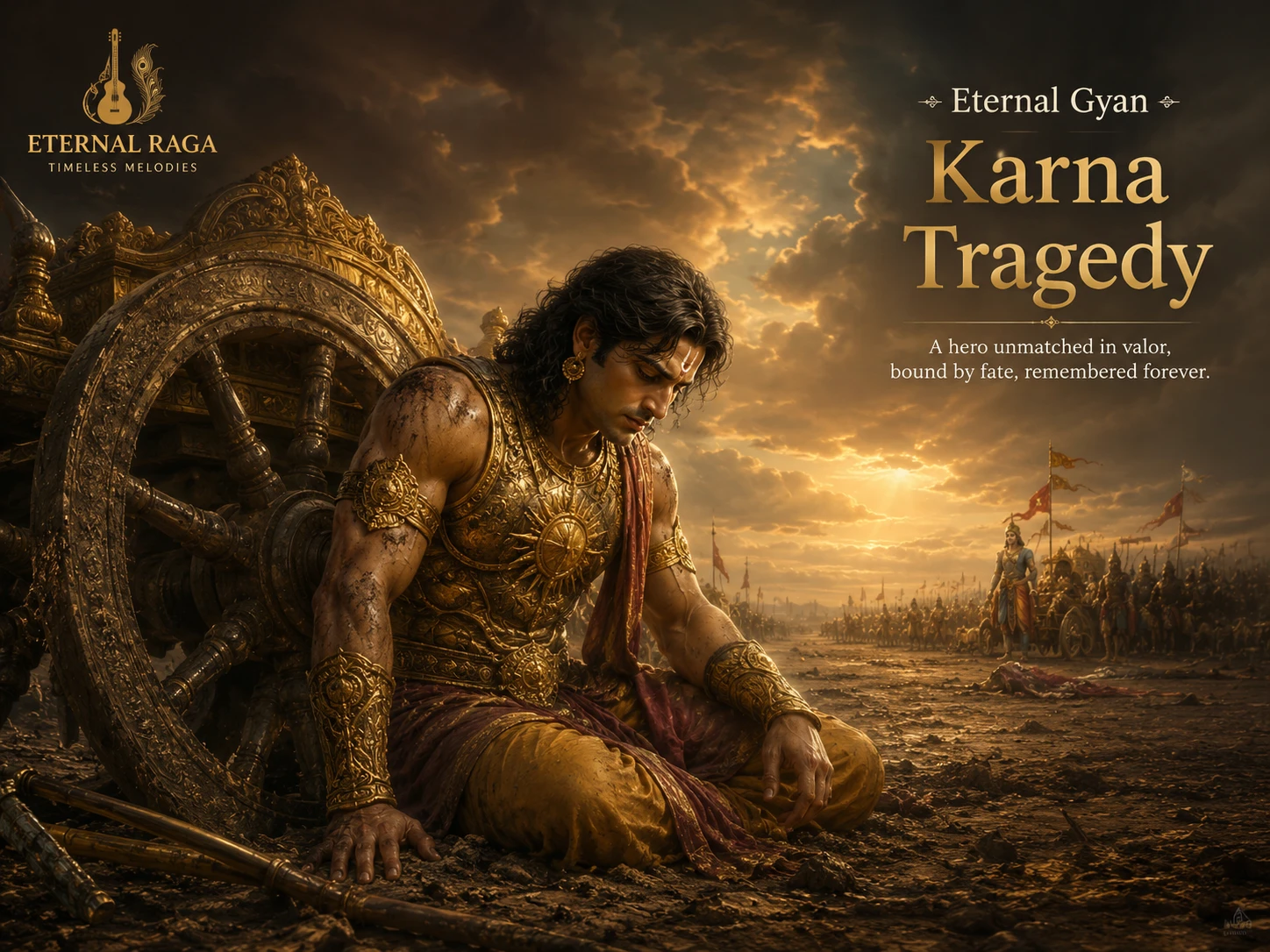
Karna -- The Loyal Warrior on the Wrong Side
कर्ण -- ग़लत तरफ़ का वफ़ादार योद्धा
Karna is the character every Indian audience already loves before reading the Mahabharata. The wounded outsider. The one denied by birth. The one who built himself in spite of the system. The Eklavya-shaped figure on the box of contemporary self-help branding -- the man who became great even though the world told him he was nothing.
This is the Karna we want him to be. The text gives us a more difficult man.
The Mahabharata's Karna is brilliant, generous, devoted, doomed -- and also wrong, often. He laughed openly when Draupadi was dragged into the Hastinapura sabha. He told Dushasana to strip her. He used a slur for her in front of the assembled kshatriya court that the text marks as the worst single moment of his life. He fought against his own brothers in a war he knew was unjust, on the side of a friend he knew was unjust. He carried the knowledge of his birth, given to him in private by Krishna, and chose silence over correction. He was, by his own admission to Krishna in the Udyoga Parva, ashamed of much that he had done. The text records his shame. It does not erase the deeds.
The English internet has flattened Karna into the tragic hero of the epic. The text is more subtle. The text wants us to hold both -- the boy abandoned in the basket on the river, and the man who ordered another man's wife disrobed. They are the same person. The Mahabharata's claim is that the boy in the basket grew into the man in the sabha because of the journey between them, not in spite of it. The wound he received from his mother was real. The wound he gave to Draupadi was also real. Neither cancels the other. Both are him.
This is the most demanding character portrait in the cluster. Read it slowly. The temptation to absolve him is strong. The temptation to condemn him is also strong. The text refuses both. It asks you to see him.
अक्षत्रियेण नीतोऽहं क्षत्रियाणां विवर्जितः। त्वया तु पार्थिवाद्ये त्वामहं पुत्र इत्यपि॥ गन्तुमर्हो न पाण्डूनां मातर्ज्येष्ठोऽपि सन्निह। सुहृदां च न शक्नोमि त्यक्तुं कौरवसङ्ग्रहम्॥
akṣatriyeṇa nīto'ham kṣatriyāṇāṃ vivarjitaḥ tvayā tu pārthivādye tvām ahaṃ putra ity api gantum arho na pāṇḍūnāṃ mātar jyeṣṭho'pi sann iha suhṛdāṃ ca na śaknomi tyaktuṃ kauravasaṅgraham
Raised by a non-kshatriya, denied by kshatriyas, abandoned by you, O queen -- though I am the eldest of the Pandavas, I cannot now go to them, mother. I cannot leave the alliance of the Kauravas, who are my friends.
— Mahabharata, Udyoga Parva (Bhagavad-Yana Parva, Section 146) -- Karna's reply to Kunti's plea on the bank of the Bhagirathi
Kunti was given a mantra in her teenage years by the sage Durvasa, in gratitude for her devoted service. The mantra was a power -- it would let her invoke any deva and be granted a son by him. The girl who received this mantra had no business holding it. She was, the text emphasises, very young. Curiosity won. Kunti tested the mantra. She invoked Surya, the sun-god. Surya appeared. The mantra worked. A child was conceived.
The Mahabharata is unflinching about what happened next. Kunti, terrified of social ruin, gave birth in secret. The boy was born wearing kavach -- divine armour fused to his skin -- and kundala, golden earrings that were inseparable from his ears. He was a child marked by a god from the moment of birth. Kunti looked at him, named him in her heart, placed him in a basket, and floated him down the river Ashvanadi. She watched the basket disappear and went home to her father's house, sixteen years old, no longer a virgin technically but socially restored, still eligible for the marriage Pandu would later offer her.
This is the wound that Karna will carry his entire life, even before he can name it. He grows up not knowing why the king's relatives whisper when he passes. He grows up assumed by everyone, including himself, to be the son of Adhiratha and Radha -- a sutaputra, a charioteer's son, a member of a respected but non-kshatriya caste. Adhiratha and Radha treat him with profound love. Radha's milk flowed at the sight of him; Adhiratha named him Vasusena, 'born with treasure', because of the kavach and kundala. The Mahabharata is careful to record the warmth of this household. The wound is not from his foster parents. The wound is from the river.
As a boy, Karna learned weaponry. The royal teachers Drona and Kripa took the kshatriya princes into the Hastinapura gurukul. Karna was not eligible. His birth, as everyone understood it, was wrong for kshatriya training. He went elsewhere -- and this is where the text becomes fascinating. He went to Parashurama, the Brahmin avatar of Vishnu, the rishi who had vowed to teach only Brahmins. Karna lied. He claimed Brahmin birth and was accepted. Parashurama trained him in every weapon. The training reached its peak when Parashurama gave him the mantras for the brahmastra and other divine astras.
The lie was discovered by accident. Parashurama was sleeping with his head in Karna's lap. A scorpion -- in some recensions, a scorpion-like insect -- crawled onto Karna's thigh and stung him. Karna did not move. The blood from the wound seeped onto Parashurama's hair. The guru woke. He looked at his student bleeding silently and said -- no Brahmin could endure pain like that without flinching. Only a kshatriya is built for that. Tell me the truth.
Karna told him. Parashurama, who had spent decades killing kshatriyas in twenty-one earth-clearing wars, looked at his deceived self and at the boy in front of him. He cursed Karna. The mantras he had taught him -- the brahmastra, the divine astras -- would all leave him at the precise moment Karna most needed them. Karna would forget them when his life depended on remembering. The curse was given. It would activate exactly thirty years later, on the seventeenth day of the Kurukshetra war.
This is the first of three curses Karna would accumulate. The second came soon after. Practising archery in a forest, Karna shot at a calf or cow that ran in front of his arrow -- the texts vary on the species. He killed a Brahmin's prized animal by accident. The Brahmin came out, raged, and cursed Karna -- when you most need the help of the earth, your chariot wheel will sink. The third curse, in some traditions, came from Mother Earth herself, after Karna had refused to compensate her for an indignity earlier in his life. The three curses interlock. They form the architecture of his eventual death.
The Mahabharata's pattern with curses is precise. They never trigger immediately. They wait. They sit. They activate at the exact moment when the cursed person has the most to lose. Karna's three curses converged at the moment of his duel with Arjuna, on day seventeen of the war. The wheel sank. He climbed down to lift it. He tried to invoke the brahmastra mantra. He could not remember it. The mantra had left him. He stood on the ground, defenceless, and Arjuna -- under Krishna's instruction -- shot him while he was disarmed and unarmed and trying to reset his chariot. The death itself was a violation of every kshatriya code. The Mahabharata gives us all three curses precisely so that we cannot pretend the killing was honourable. It wasn't. It was the only way to kill him.
The Three Curses of Karna -- Architecture of a Death
| Source of Curse | Cause | Content of the Curse | Activation Moment |
|---|---|---|---|
| Parashurama | Karna's deception about being a Brahmin to receive divine astra training | The mantras of the brahmastra and divine astras would leave him at the moment of greatest need | Day 17 of Kurukshetra -- Karna cannot recall the brahmastra mantra during his final duel with Arjuna |
| An angered Brahmin | Karna accidentally killed the Brahmin's homa-cow (or calf, depending on recension) with a stray practice arrow in the forest | When you most need the support of the earth, your chariot wheel will sink into it | Day 17 of Kurukshetra -- the left wheel of Karna's chariot sinks into soft ground at the duel |
| Mother Earth (Bhumi Devi) -- in southern recensions and folk traditions | Karna had earlier refused, in pride, to clean grain that had spilled and was sworn to (in some versions) by a maiden's tears -- detailed in southern Mahabharata variants and not always in BORI critical text | The Earth would not be his ally; she would withdraw at his hour of need | Day 17 of Kurukshetra -- the ground itself swallows the wheel rather than supporting it |
Note that only the first two curses are firmly canonical in the BORI Critical Edition. The third (Bhumi Devi's curse) is from southern recensions and oral tradition, often used to deepen the karmic completeness of the death scene. Whether one accepts two curses or three, the final picture is the same -- Karna dies because three pieces of his life converge at one moment.
Karna's birth-name Vasusena means 'born with treasure' -- a reference to the kavach and kundala fused to his body. The name Karna itself, in some etymologies, derives from the act of being recognised at the public archery tournament where he challenged Arjuna -- 'one who came forward'. He had three more names through life: Radheya (son of Radha), after his foster mother; Anga-raj, after Duryodhana made him king of Anga; and Suryaputra, son of Surya, the name he could only use after Krishna revealed his birth to him. Five names in one life, and not one of them was given to him by the woman who actually bore him.
The public archery tournament at Hastinapura was the moment Karna entered the Mahabharata's main story. Drona had finished training the Pandavas and the Kauravas. The princes were demonstrating their skills before the assembled court of kshatriyas. Arjuna performed the most dazzling display. The crowd was about to declare him the best in the world.
A stranger walked into the ring. Tall, golden-skinned, with kavach glowing faintly under his armour and kundala catching the late afternoon sun. He matched every feat Arjuna had performed, then exceeded them. Then he challenged Arjuna to a duel.
Kripa, the master of ceremonies, asked the only legally relevant question -- who is your father? Single combat between princes required equal birth. The stranger could not answer. The court began to laugh. He was identified as a sutaputra, the foster son of the charioteer Adhiratha. The duel was disallowed. Karna was about to be thrown out of the ring.
Duryodhana, watching all of this, walked across the arena, embraced Karna in front of the entire kshatriya world, and made him king of Anga on the spot. The act required nothing more than a royal seal and Duryodhana's word. The status of Anga-raj made Karna eligible for single combat by birth. The court fell silent. Adhiratha came rushing to embrace his son, and Bhima made a joke about charioteer-kings. Karna ignored him. He had been given everything he wanted in one minute by a man he had never met.
This is the bond that the rest of his life will be built around. Duryodhana did not just give Karna a kingdom. He gave him eligibility, kshatriya status, social existence. Karna had been refused by Drona. Refused by the kshatriya establishment. Refused by his own mother before he could speak. Duryodhana did not refuse him. The transaction was complete in one minute. The friendship that followed lasted thirty years and ended with Karna refusing to switch sides even when Krishna himself revealed that switching was both legitimate and inevitable.
The dice game in the Sabha Parva is the moment Karna's character is fixed for the rest of the epic. Yudhishthira had lost everything. Draupadi had been dragged in by the hair. Dushasana was attempting to pull her sari away. The court was watching in horrified silence -- Bhishma, Drona, Vidura, Vikarna -- and most of them, even those who knew this was wrong, were unable to speak. Draupadi turned to the assembly and asked her famous question: when Yudhishthira lost himself first in the dice game, did he still have the legal authority to wager me?
Karna spoke. He told the assembly that Draupadi was a slave, won fairly, and had no rights. He used a slur for her -- one the text records and the audience hears -- comparing her to a fallen woman. He told Dushasana to strip her in the open court because she belonged to the Kauravas now. The Mahabharata records this in unflinching detail. This is the worst single moment of Karna's life. He himself acknowledges it later, twice -- once to Krishna in the Udyoga Parva (5.139.45), and once in private grief to Duryodhana himself in the Karna Parva (8.1.7). He knew he was wrong. He spoke anyway. Loyalty to his friend overpowered the protest of his own conscience.
This is the moment that complicates Karna for all subsequent reading. The Indian internet has tried, increasingly, to write this scene out of him -- to suggest he was provoked, that Draupadi's earlier rejection at the swayamvara was the cause, that the slur was uttered by Duryodhana and Karna only stood by silently. The text does not support this revision. The court heard Karna's voice in that moment. Draupadi heard it. The shame in his own later confession is the shame of someone who knows he could have stayed silent and chose not to.
For the next thirteen years, the Pandavas would carry that scene. Bhima would vow to drink Dushasana's blood. Draupadi would refuse to wash her hair until that hair could be washed in Kaurava blood. And Karna -- the man who had given the order -- would walk through those thirteen years and the eighteen days of the war knowing exactly what he had said, and never quite finding a way to undo the saying.
Just before the war, Indra came to Karna disguised as a Brahmin beggar. Karna's father Surya had warned him in a dream the previous night -- this man will come, he will ask for your kavach and kundala, do not give them. The kavach was the divine armour fused to his skin. The kundala were the earrings he had worn since birth. Together they made him invulnerable. Surya told him plainly -- you are a target. Indra wants you defenceless before Arjuna. Refuse him.
Karna refused his father. He had vowed never to send a Brahmin away empty-handed at his daily evening worship. The vow was older than the war. The vow was the foundation of his self-respect. When Indra arrived in Brahmin disguise and asked for the kavach and kundala, Karna cut them from his own body. The skin tore. The blood ran. He gave the bleeding pieces to Indra and asked only one boon in return -- a single weapon that could not fail.
Indra gave him the Vasavi Shakti, his own personal lance. It would kill any single target it was hurled at. It could only be used once. Karna intended to use it on Arjuna.
Krishna's strategy on the fourteenth day of the war was to send Bhima's son Ghatotkacha into the night fighting in such terrifying form that Duryodhana would beg Karna to use the Vasavi Shakti against him. Karna resisted as long as he could. He knew the spear was meant for Arjuna. But Ghatotkacha, growing in size, was destroying the Kaurava army. Eventually Karna used the Shakti. Ghatotkacha died. The single most lethal weapon in the war was now spent. Arjuna's life was saved by his nephew's death. Three days later, on day seventeen, Karna would face Arjuna without the Shakti, without the kavach, without the brahmastra mantra, with the chariot wheel sinking into the earth. Every armour he had carried into the war had been spent or stripped or cursed away. He fought anyway. He was killed.
जानामि त्वा महाबाहो प्रजापत्यं स्थितं विभुम्। पाण्डवानां च मे राजन् ज्येष्ठो भ्राता ममेति च॥
jānāmi tvā mahābāho prajāpatyaṃ sthitaṃ vibhum pāṇḍavānāṃ ca me rājan jyeṣṭho bhrātā mameti ca
I know you, O mighty-armed one, established in the position of the lord of beings. I know also, O king, that I am the eldest brother of the Pandavas, and they are mine.
— Mahabharata, Udyoga Parva 140 (Bhagavad-Yana Parva) -- Karna's reply to Krishna's revelation, on the chariot leaving Hastinapura
Two conversations precede Karna's death. They are among the most important conversations in the Mahabharata, and most popular retellings either skip them or distort them.
The first is with Krishna, in Udyoga Parva 140. Krishna had failed his peace mission with Duryodhana. As he was leaving Hastinapura, he asked Karna to ride with him in his chariot. Once they were alone, Krishna told him the truth -- you are not Adhiratha's son. You are Kunti's first-born. Your father is Surya. The Pandavas are your younger brothers. Yudhishthira is the heir, but the moment we declare you the eldest, the kingdom is yours. The Kauravas are not your blood. The Pandavas are. Switch sides now and you will be king.
Karna's reply, recorded across multiple chapters, is the moral centre of his character. He told Krishna -- I know who I am. I have known for some time. I will not switch. Adhiratha and Radha are my parents in every meaningful sense. Duryodhana has fed me, sheltered me, defended me, made me a king. I cannot betray him on the day before the war. If I switch now, the Pandavas will know I switched only when I learnt of the kingdom waiting for me. The world will see a man who chose blood over salt. I will not be that man. I will fight, and I will die. Krishna, do not tell the Pandavas. Yudhishthira, if he knew, would refuse the kingdom out of guilt. Let me die on this side.
The second conversation is with Kunti. She came to him on the bank of the Bhagirathi as he performed his evening prayer. She told him directly -- I am your mother. He confirmed he already knew. She asked him to spare her four other sons, fight only Arjuna. He gave her this -- I will not kill Yudhishthira, Bhima, Nakula, or Sahadeva. The four will be safe. Between Arjuna and me, one will die. You will still have five sons after the war. Either Arjuna or I will be standing. The promise was kept. He never raised his weapon against the four others. On day seventeen, Arjuna survived. Karna fell.
Karna's last act, even as he was dying with his chariot wheel sunk and his life draining, was an act of generosity. A Brahmin appeared before him -- in some texts this is Krishna in disguise -- and asked for charity. Karna had nothing left. He pulled out a tooth that had a fragment of gold inlaid since childhood, washed it in his own dripping blood, and offered it as alms. The Brahmin accepted. The episode is preserved in the Karna Parva and folk tradition. Karna's defining trait, the one quality the Mahabharata insists on even at the moment of his most cursed death, is dana -- the giving away of what little remained.
Why does Karna matter to you in 2026?
Because his pattern is the most common spiritual trap of upwardly mobile Indian life. The pattern is this. You came from less. You worked harder than the people around you who came from more. You owe nothing to the institutions that initially refused you. The first person who really saw you -- the first boss who promoted you, the first investor who funded you, the first mentor who took your call when no one else would, the first lover who didn't ask about your father's profession -- earned a kind of loyalty from you that nothing else has ever earned. You will defend that person beyond all reason. You will fight their battles even when their battles are unjust. You will speak in rooms in their voice even when their voice is wrong. You will, when finally given a chance to leave, refuse on principle, because leaving would feel like a betrayal of the only door that ever opened.
The Mahabharata sees this pattern with appalling clarity. It does not condemn it. It does not romanticise it. It simply names the price.
The price is that the institution you finally chose, having been refused by every other institution, will sometimes ask you to do things that violate your own conscience. And you will do them. You will not be able to refuse. The cost of refusal would be the cost of un-belonging again, and you cannot bear that cost twice in one life. So you stay. You speak in their sabha. You laugh at their jokes about Draupadi. You agree to sit on their war councils. You die in their war. Loyalty has converted you into the enforcer of choices that were never yours.
This is what is meant by the loyal warrior on the wrong side. Karna's loyalty was real. It was beautiful. It was also the mechanism by which a man capable of giving away his own kavach to a stranger ended up calling Draupadi a slur in open court. The two were not separate decisions. The same thread ran through both. Loyalty without the willingness to revise loyalty in the face of evidence is the most expensive thing a person can carry.
Ask yourself, slowly. Who is the Duryodhana in your life? The boss, the mentor, the cousin, the institution, the political party, the abusive partner, the toxic workplace -- who is the person whose first welcome you have never been able to repay? And what would it cost you to leave? Karna's life is the Mahabharata's evidence that the cost of staying is, very often, larger than the cost of leaving. The man who could not switch sides at the war's eve discovered that he had switched sides much earlier -- against his own conscience, in the sabha, the day Draupadi asked her question and he chose to answer with a slur. The bigger betrayal had already happened. The choice not to switch sides was just the formality.
Sit with Surya at sunrise
Karna's defining ritual was the daily Surya arghya at dawn -- standing in water, offering water to the sun, refusing no Brahmin during that prayer. The practice exists today as Surya Namaskar and Sandhya Vandana. Try it for seven mornings. Notice what surfaces when you give the first hour of the day to the same deity who, the Mahabharata says, was Karna's father.
Tags
Eternal Raga · शाश्वत राग
Institutional voice — scholarly articles on Sanatan Dharma
Deepen Your Understanding
अपनी समझ और गहरी करें
scriptural exegesis
The Kurukshetra Within -- Reading the Mahabharata as a Mirror of Your Mind
Vyasa wrote that whatever exists in the world also exists in the Mahabharata, and whatever is not there exists nowhere. This is not a boast. It is an instruction: every character in the epic is a character inside you. Read the war as a map of your mind.
scriptural exegesis
Arjuna -- The Paralysed Achiever
He could shoot the eye of a wooden bird seeing only its reflection in water. He carried Gandiva, the bow of the gods. He won Draupadi at the swayamvara. And on the day of the war, his hands shook so badly the bow slipped from his grip. Arjuna is what happens when preparation meets the moment of execution.
scriptural exegesis
Duryodhana -- The Entitled Mind
He was the eldest, the heir, the host of Hastinapura. He had a hundred brothers, an unbreakable friendship with Karna, and a kingdom older than the Pandavas had ever held. And yet he could not bear that anything good went to anyone but himself. Duryodhana is what happens when birth-privilege gets confused for self-worth.
scriptural exegesis
Draupadi in the Sabha -- The Trial That Started the War
A queen was dragged into a court full of kings, warriors, and elders. Not one stood up. She asked a single legal question that nobody could answer. Then she swore an oath that burned a civilization to the ground. Draupadi's Sabha episode is not a story about a helpless woman. It is the most devastating indictment of institutional silence in world literature.
divine arsenal
Vasavi Shakti -- The One-Use Weapon That Changed Karna's Destiny
Karna gave away invincibility. In return, he received a spear of lightning that could kill anyone -- gods, asuras, or mortals -- but could be used only once. He saved it for Arjuna. Krishna ensured he spent it on Ghatotkacha instead. The Vasavi Shakti is the Mahabharata's most devastating lesson in strategic economics: the weapon you save for the perfect moment may never find that moment.
scriptural exegesis
Kurukshetra Battle Alliances -- Which Kings Joined Which Side
Seven akshauhinis against eleven. 1.5 million warriors against 2.4 million. The Kurukshetra war was not two families fighting -- it was the entire Indian subcontinent choosing sides. From the Pandyas of Tamil Nadu to the Kambojas of Central Asia, from the Yadavas of Dwaraka to the Kekayas split down the middle -- here is the geopolitical map of who joined whom and why, sourced from Udyoga Parva.
scriptural exegesis
The Dice Game -- The Darkest Hour of the Mahabharata
A king who cannot say no to a challenge. An uncle whose dice are loaded with the bones of the dead. A court full of elders who watch injustice and say nothing. And a woman who asks one question that nobody in the room can answer: 'Did my husband lose himself first, or me?' The dice game in the Sabha Parva is not a plot device. It is the moral black hole at the centre of the Mahabharata. Everything before it is prologue. Everything after it is consequence. And the central horror is not what happens -- it is who lets it happen.
Karna's birth-name Vasusena means 'born with treasure' -- a reference to the kavach and kundala fused to his body. The name Karna itself, in some etymologies, derives from the act of being recognised at the public archer…
More in Scriptural Exegesis
Abhimanyu and the Chakravyuha -- The Boy Who Knew How to Enter but Not How to Leave
14 min read
Adbhuta Ramayana -- The Ramayana Where Sita Becomes Kali
9 min read
After Kurukshetra -- What Happened Next
14 min readThe same translation error that turned '33 Koti' into '33 crore' in Hinduism also happened in Buddhism. The Chinese translation of Buddhist texts rendered 'Sapta Koti Buddha' (7 Supreme Buddhas) as '7 Crore Buddhas.' The…
Deities AvatarsCommunity Reflections
🕉️
Be the first to share your reflection.