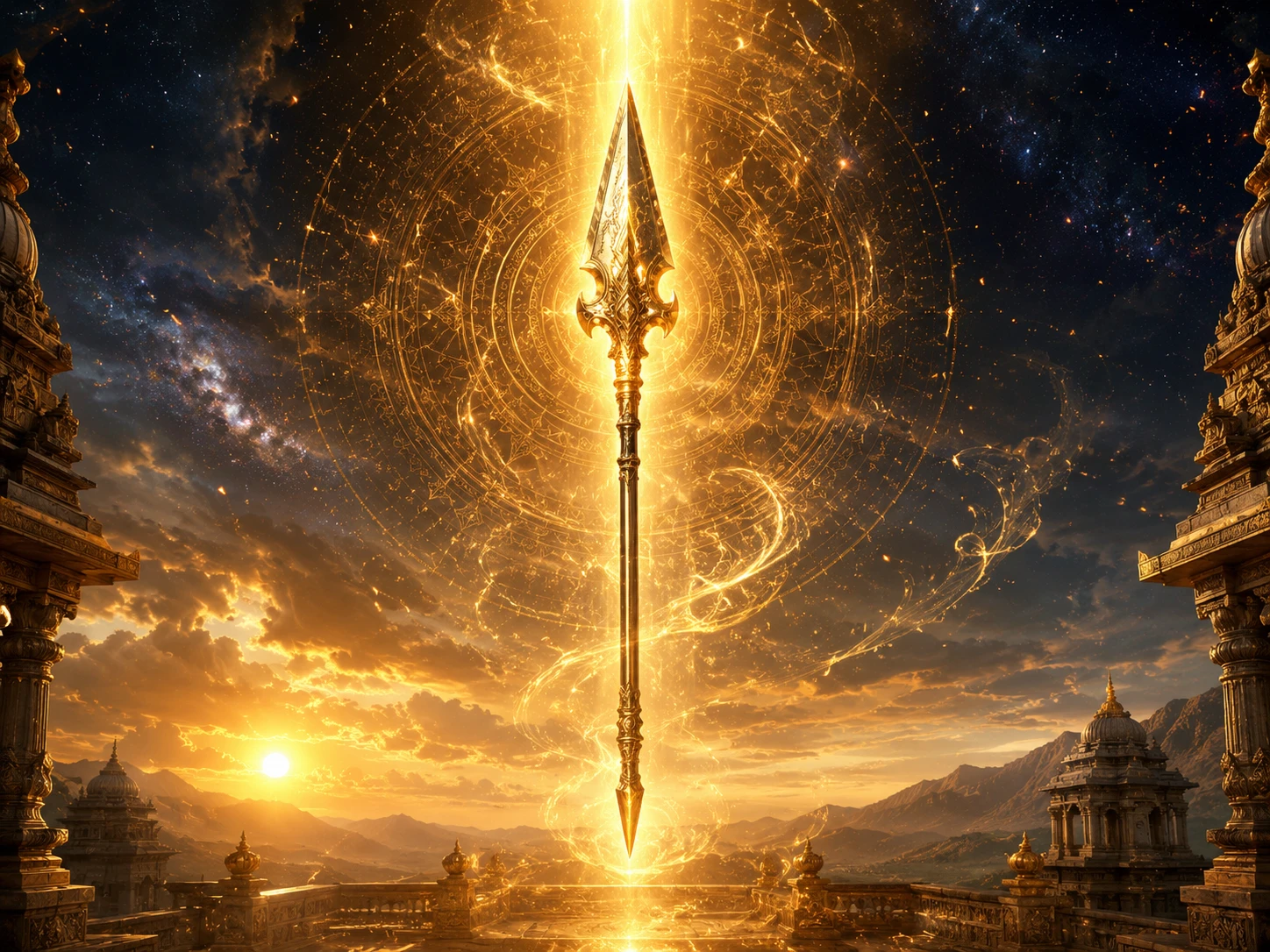
Vasavi Shakti -- The One-Use Weapon That Changed Karna's Destiny
वासवी शक्ति -- एकमात्र प्रयोग का शस्त्र जिसने कर्ण की नियति बदली
The Mahabharata's most agonising strategic dilemma begins with an act of generosity.
Karna, son of Surya and Kunti, was born wearing the Kavach-Kundal (divine armour and earrings) fused to his body. While he wore them, no weapon in the three worlds could pierce him. He was invincible -- not through training or tapas but through birth. The armour was a gift from his father the Sun God, and it made Karna, for all practical purposes, unkillable.
Indra, king of the gods and father of Arjuna, knew this. He also knew that the Kurukshetra War was coming and that Karna would fight against his son. A Karna wearing Kavach-Kundal meant an Arjuna who could not win. So Indra devised the most elegant deception in the entire Mahabharata: he would exploit Karna's one psychological vulnerability -- his compulsive generosity.
Karna had taken a vow: any Brahmin who approached him during his morning Surya Puja and asked for anything would not be refused. This was the Daanveer (Great Giver) vow that defined Karna's identity more than his archery, more than his friendship with Duryodhana, more than his rivalry with Arjuna. Karna's sense of self was built on the principle that he would never say no to a supplicant.
Indra appeared disguised as a Brahmin during Karna's morning worship and asked for the Kavach-Kundal. Karna recognised him instantly -- Surya himself had warned his son the previous night that Indra would come. Karna knew that giving away his armour meant giving away his invincibility, which meant almost certainly dying in the coming war. He gave them away anyway. He cut the armour from his own flesh -- the armour that was fused to his skin from birth -- and handed it to Indra with a smile.
This is the moment that makes Karna the most beloved character in the Mahabharata for millions of Indians. Not his archery. Not his loyalty to Duryodhana. His willingness to die for his principles. The Kavach-Kundal episode is the Hindu tradition's supreme case study in the conflict between self-preservation and self-definition: who are you when the thing that makes you safest is the thing that someone else needs?
Indra, shamed by Karna's nobility (a nobility that reflected the divinity of Surya, Karna's father), felt obliged to compensate. He offered Karna any weapon he wanted -- except the Vajra, his personal thunderbolt. Karna chose the Vasavi Shakti -- a divine spear of lightning that Indra himself rarely wielded. The spear had one absolute property: it would kill whoever it struck, without exception -- gods, asuras, humans, Rakshasas. Nothing could survive its impact. But the catch was devastating: it could be used only once, and after that single use, it would return to Indra.
One shot. One kill. And then the weapon is gone forever.
For the startup founder who has bootstrapped for years and has one shot at a Series A pitch. For the UPSC aspirant who gets one attempt at the interview. For the cricketer facing the last ball of a World Cup final. The Vasavi Shakti is the mythology of the decisive moment -- the one irreversible action that defines everything that follows.
वरजयित्वा तु मे वज्रं प्रवृणीष्व यदिच्छसि। कामं अस्तु तथा तात तव कर्ण यथेच्छसि॥
varajayitvā tu me vajraṃ pravṛṇīṣva yad icchasi | kāmaṃ astu tathā tāta tava karṇa yathecchasi ||
'Except for my thunderbolt alone, choose whatever weapon you desire. O Karna, my son, let it be as you wish!'
— Mahabharata, Vana Parva, Section CCCVIII (Indra to Karna after receiving Kavach-Kundal)
The Strategic Reserve -- Why Karna Saved It for Arjuna
From the moment Karna received the Vasavi Shakti, he had a single strategic objective: kill Arjuna.
The reasoning was simple. With his Kavach-Kundal gone, Karna was now mortal -- vulnerable to Arjuna's arrows in a way he had never been before. His only remaining advantage was the Vasavi Shakti, and its one-use limitation meant it had to be deployed at the moment of maximum strategic impact. Killing a minor warrior with it would be catastrophic waste. Killing Arjuna -- the Pandava army's decisive combat asset, the wielder of Gandiva, the student of Drona and the gods -- would collapse the Pandava war effort entirely. Without Arjuna, the Pandavas could not win.
Karna therefore treated the Vasavi Shakti as a strategic reserve -- held back from daily combat, preserved through sixteen days of increasingly brutal warfare, protected against the temptation to use it on lesser threats. This is textbook deterrence theory: the weapon's value is maximised by not using it, because the opponent must factor its potential deployment into every tactical decision. As long as Arjuna knew (or suspected) that Karna possessed a single-use weapon of guaranteed lethality, Arjuna had to fight cautiously -- allocating mental bandwidth to the possibility of a sudden, unstoppable strike.
In modern military terms, the Vasavi Shakti was Karna's SLBM (Submarine-Launched Ballistic Missile) -- a second-strike weapon held in reserve, invisible to the enemy, guaranteed to hit if launched, and valuable precisely because it had not been launched. India's INS Arihant nuclear submarine operates on the same logic: its value is not in firing its missiles but in the enemy's knowledge that it could fire them at any time.
The parallel extends to economics. The Vasavi Shakti is the ultimate scarce resource -- infinitely powerful but quantitatively limited to one use. Every decision about whether to deploy it is an opportunity cost calculation: if I use it now on this threat, I cannot use it later on a greater one. This is the fundamental problem of resource allocation under uncertainty, formalised in operations research as the Secretary Problem or the Optimal Stopping Problem. The optimal strategy, mathematically, is to observe the first 37 percent of options without acting, then choose the next option that exceeds all previously observed options. Karna's strategy -- observe sixteen days of battle without deploying the Shakti, then use it when the situation becomes existentially threatening -- approximates this optimal stopping rule.
The tragedy is that the optimal strategy was disrupted by Krishna's counter-strategy. And the disruption itself is a strategic masterclass.
The Night of the 14th Day -- Krishna's Masterstroke
The Mahabharata's greatest strategic manipulation occurs on the night of Day 14 -- after the killing of Jayadratha and the suspension of normal battle rules.
The war has extended into the night for the first time. Ghatotkacha -- Bhima's half-Rakshasa son, born of his union with the demoness Hidimbi -- enters the battlefield. Rakshasas gain supernatural power at night: their Mayavi (illusion) abilities magnify, their physical strength doubles, and their shape-shifting capabilities become nearly unstoppable. Ghatotkacha, already formidable during the day, becomes apocalyptic at night.
He rampages through the Kaurava army. He creates illusory armies of demons that terrify the soldiers. He grows to enormous size. He rains boulders, trees, and flaming weapons from the sky. Ashwatthama fights him and is repeatedly driven back. Karna duels him multiple times and, despite his skill, cannot stop the carnage. The Kaurava army is disintegrating. Duryodhana -- panicked, his forces crumbling around him, his flag in tatters -- turns to Karna and begs: use the Vasavi Shakti. Now. On Ghatotkacha. Before he destroys everything.
Karna is torn. He has saved this weapon for sixteen days. It is meant for Arjuna -- the one target whose death would win the war. Using it on Ghatotkacha would eliminate an immediate threat but surrender the strategic advantage that could have won everything. It is the classic military dilemma: spend your reserve on the current crisis, or hold it for the decisive battle that has not yet arrived?
Duryodhana's soldiers are dying by the thousands around him. The screams of the Kaurava army fill the night. Karna's loyalty to Duryodhana -- the one man who gave him dignity when the world called him a Suta-Putra (charioteer's son) -- overrides his strategic calculation. He hurls the Vasavi Shakti at Ghatotkacha.
The spear of lightning strikes Ghatotkacha's heart. He rises into the sky, expands his dying body to massive proportions, and crashes down onto one full Akshauhini of the Kaurava army -- 218,700 warriors killed by the corpse of the warrior the weapon was used to destroy. Even in death, Ghatotkacha extracts a devastating price.
Krishna, watching from the Pandava camp, smiles. This was his plan from the beginning. He summoned Ghatotkacha to the night battle specifically to force Karna into spending the Vasavi Shakti. The entire Ghatotkacha deployment was a sacrifice play -- sending Bhima's son to his death so that Arjuna's life would be saved on the day of the final confrontation. Krishna later tells the Pandavas: 'That Rakshasa was evil. I myself would have had to kill him eventually. But by dying at Karna's hand, he served a greater purpose -- he disarmed the one weapon that could have killed Arjuna.'
For the chess player: this is a queen sacrifice that wins the endgame. For the product strategist: this is forcing a competitor to burn their one differentiating asset on a secondary market. For the military analyst: this is the deliberate expenditure of a decoy to draw out the enemy's reserve weapon. In every domain, the principle is identical: sometimes the most powerful move is not deploying your best asset but forcing your opponent to deploy theirs at the wrong moment.
Single-Use Divine Weapons in the Mahabharata
| Weapon | Owner | Source | Limitation | Used Against | Strategic Outcome |
|---|---|---|---|---|---|
| Vasavi Shakti | Karna | Indra (in exchange for Kavach-Kundal) | One use only; returns to Indra after deployment | Ghatotkacha (Night of Day 14) | Karna lost his one weapon capable of killing Arjuna; Krishna's strategy succeeded |
| Narayanastra | Ashwatthama | Drona (transmitted knowledge) | Can only be used once per battle; second invocation fails | Pandava army (Day 15) | Neutralised by Krishna's order to surrender; single use meant no second attempt |
| Pashupatastra | Arjuna | Shiva (Kirata episode, Vana Parva) | Never to be used against humans; restricted to cosmic threats | Never used in the Kurukshetra War | Ultimate deterrent; value entirely in possession, not deployment |
| Shakti Astra (generic) | Multiple warriors | Various deities | Limited charges depending on deity's grant | Various targets | Strategic calculus depends on number of available uses |
| Brahmastra (Karna's) | Karna | Parashurama (through deception) | Cursed to fail at the moment of greatest need | Attempted against Arjuna (Day 17) -- mantra forgotten | Parashurama's curse activated; Karna could not invoke when most needed |
The Mahabharata's single-use weapons anticipate the concept of 'use-it-or-lose-it' in nuclear strategy: a weapon that degrades over time (or can only be used once) creates pressure to deploy it prematurely, potentially at a suboptimal target. Karna's dilemma with the Vasavi Shakti is structurally identical to the 'launch-on-warning' debate in Cold War nuclear doctrine.
Karna Without the Shakti -- The Final Day
Day 17. Karna versus Arjuna. The confrontation the entire war has been building toward.
Karna enters the battle with the Vijaya Dhanush (the invincible bow gifted by Parashurama), the Bhargavastra (Parashurama's personal missile weapon), and his matchless archery. But the Vasavi Shakti is gone. The one weapon that guaranteed Arjuna's death has been spent on Ghatotkacha three nights earlier.
The battle is extraordinary. Karna breaks Arjuna's bowstring multiple times. He wounds Arjuna repeatedly. At one point, his Nagastra (serpent missile) would have beheaded Arjuna had Krishna not pressed the chariot into the ground, causing the arrow to knock off Arjuna's crown instead of his head. The text makes clear that Karna, even without the Shakti, is Arjuna's equal or near-equal in combat skill.
But the curses accumulate. Parashurama's curse activates: at the moment Karna attempts to invoke the Brahmastra against Arjuna, the mantra vanishes from his memory. The earth-goddess's curse strikes: his chariot wheel sinks into the ground, immobilising him. Karna dismounts to free the wheel and invokes Dharma Yuddha rules, asking Arjuna to hold fire while he is unarmed and grounded.
Krishna's response is devastatingly precise. He reminds Arjuna -- and through Arjuna, Karna -- of every violation of Dharma that Karna participated in or witnessed without protest. Draupadi's disrobing. Abhimanyu's murder by six warriors against one. The rigged dice game. The thirteen years of exile. 'Where was your Dharma then, Karna?' Krishna asks. Arjuna fires the Anjalika Astra. Karna is beheaded.
The Vasavi Shakti's absence is the invisible cause of Karna's death. Had he possessed it on Day 17, the war's outcome might have been different. The weapon he sacrificed for loyalty to Duryodhana on Day 14 was the weapon that could have saved him on Day 17. This is the Mahabharata's cruellest irony: Karna's greatest virtue -- his loyalty -- was the instrument of his destruction.
For every professional who has burned a favour for a colleague who did not reciprocate. For every startup founder who gave equity to an early partner who left. For every person who sacrificed their own advantage out of loyalty and then discovered that loyalty did not protect them when they needed it most. Karna's story is not ancient mythology. It is Monday morning.
The deeper philosophical question the Vasavi Shakti episode raises is whether Karna ever had a real choice. His Kavach-Kundal was taken by Indra's manipulation of his Daanveer vow. His Brahmastra was neutralised by Parashurama's curse for the deception he committed to obtain it. His Vasavi Shakti was spent on Ghatotkacha through Krishna's manipulation of the battlefield. His chariot was immobilised by the earth-goddess's curse for accidentally killing a Brahmin's cow. Every advantage Karna possessed was systematically stripped by forces beyond his control -- divine curses, strategic manipulation, cosmic consequences of past actions.
The Mahabharata's answer is Karma itself. Karna's disadvantages are not random misfortune. They are the accumulated consequences of specific choices: the deception before Parashurama, the silence during Draupadi's disrobing, the participation in Abhimanyu's gang-killing, the lifetime of fighting for a cause he knew was adharmic because loyalty demanded it. The Vasavi Shakti's expenditure on Ghatotkacha is not Krishna cheating. It is Karma arranging the board so that the player who has been making morally compromised moves eventually runs out of pieces.
For the philosophy student: this is the problem of moral luck examined through mythological narrative. For the entrepreneur facing cascading failures: sometimes the question is not 'why is everything going wrong?' but 'what chain of decisions brought me here?' Karna's story is not about fate overpowering free will. It is about free will generating fate -- one choice at a time, compounding across a lifetime, until the final account comes due on the seventeenth day.
The Vasavi Shakti is one of the most popular weapons in contemporary Indian pop culture. The Japanese anime and game franchise Fate/Grand Order depicts Karna as a Lancer-class Servant whose Noble Phantasm (ultimate attack) is the Vasavi Shakti -- shown as a beam of solar light fired from a spear, requiring Karna to permanently sacrifice his golden armour to activate it. The Fate series' depiction has introduced millions of global anime fans to Karna's story, making him one of the most recognisable Hindu mythological characters in East Asian pop culture. Meanwhile, DRDO's BrahMos Aerospace (a joint Indo-Russian venture headquartered in New Delhi) develops cruise missiles that embody the Vasavi Shakti principle in engineering terms: a one-shot, one-kill weapon system with fire-and-forget guidance that guarantees target destruction. The BrahMos missile's speed (Mach 2.8, nearly three times the speed of sound) ensures that, like the Vasavi Shakti, once it is launched, no defence system on Earth can intercept it in time. Ancient mythology and modern missile engineering converge on the same insight: the most lethal weapon is the one that leaves nothing to chance.
Focus Your Shakti -- The One-Pointed Intention Practice
The Vasavi Shakti teaches that unlimited power with one chance demands absolute focus. Practise trataka daily -- ten minutes of unbroken one-pointed focus on a candle flame. When the flame wavers, your attention wavers. When the flame steadies, your sankalpa (intention) crystallises. One flame. One focus. One decisive action. That is the Shakti principle: not scattered effort across many targets, but concentrated force on the one target that matters most. The Steady Gaze dharana on Eternal Raga teaches the practice.
Tags
Eternal Raga · शाश्वत राग
Institutional voice — scholarly articles on Sanatan Dharma
Deepen Your Understanding
अपनी समझ और गहरी करें
divine arsenal
The Divine Shields and Armour -- Karna's Kavach-Kundal, Agastya's Gift, and the Spiritual Meaning of Protection
Karna was born wearing armour that made him invincible -- and gave it away to the one man who wanted him dead. Rama received divine armour from a sage moments before facing Ravana. In Hindu tradition, the greatest protection is not what you wear on your body but what you carry in your soul.
divine arsenal
Brahmastra vs Brahmashirsha -- The Escalation Ladder of Brahma's Weapons
Brahmastra was the nuclear bomb. Brahmashirsha -- with four heads of Brahma at its tip -- was the thermonuclear bomb, four times more powerful. And Brahmanda Astra could destroy the entire solar system. Three escalation tiers of the same divine weapons programme, created by the god of creation himself. The ethics of their use drives the Mahabharata's most devastating moral crisis.
divine arsenal
Astra Invocation and Withdrawal -- The Ritual of Weapons
A divine Astra was not merely fired. It was invoked -- summoned through a specific mantra, charged with the deity's power, released with precise intention, and -- if the warrior was skilled enough -- withdrawn before impact. The protocol for activating and deactivating a celestial weapon was as ritualised as a nuclear launch sequence. And the inability to withdraw was the difference between a warrior and a war criminal.
divine arsenal
Pashupatastra -- The Supreme Weapon Never Used
The most fearsome weapon in the Mahabharata was never deployed on the battlefield. Shiva granted it to Arjuna after a wrestling match in the forests of Indrakila, yet Arjuna carried it through all eighteen days of Kurukshetra without ever invoking it. The Pashupatastra's true power lay not in its destruction, but in its restraint -- a philosophy that modern nuclear doctrine would independently discover thousands of years later.
divine arsenal
Rules of War -- Dharmayuddha and the Geneva Conventions
Three thousand years before the Geneva Conventions, Indian warriors debated whether you could strike a man who had dropped his weapon. The Mahabharata's rules of engagement cover night fighting bans, non-combatant immunity, treatment of prisoners, proportional force, and the use of weapons of mass destruction -- and then shows what happens when every single rule is broken.
divine arsenal
10 Weapons That Changed the War
Across the Ramayana and Mahabharata, certain weapons did not merely kill -- they altered the course of history. From Rama shattering Shiva's bow to win Sita, to the Shakti that saved the Pandavas by killing the one person it should not have, these ten weapon-moments are the pivot points on which two epics turn.
divine arsenal
Vajra of Indra -- The Thunderbolt Forged from a Sage's Bones
No weapon of wood could kill him. No weapon of metal could harm him. No weapon that was wet or dry could touch him. When Vritra's boon made him immune to every known weapon, the gods needed something unprecedented -- a weapon forged from the bones of a sage who had dissolved the divine arsenal into his own skeleton. The Vajra is not just Indra's thunderbolt. It is the Rigveda's central symbol of sacrifice transforming into power.
The Vasavi Shakti is one of the most popular weapons in contemporary Indian pop culture. The Japanese anime and game franchise Fate/Grand Order depicts Karna as a Lancer-class Servant whose Noble Phantasm (ultimate attac…
More in Divine Arsenal
Akshauhini -- The Epic Army Structure Where Every Digit Sums to 18
14 min read
Ancient Indian Martial Arts -- Kalaripayattu to Malla-Yuddha
14 min read
Astra Invocation and Withdrawal -- The Ritual of Weapons
16 min readThe same translation error that turned '33 Koti' into '33 crore' in Hinduism also happened in Buddhism. The Chinese translation of Buddhist texts rendered 'Sapta Koti Buddha' (7 Supreme Buddhas) as '7 Crore Buddhas.' The…
Deities AvatarsCommunity Reflections
🕉️
Be the first to share your reflection.