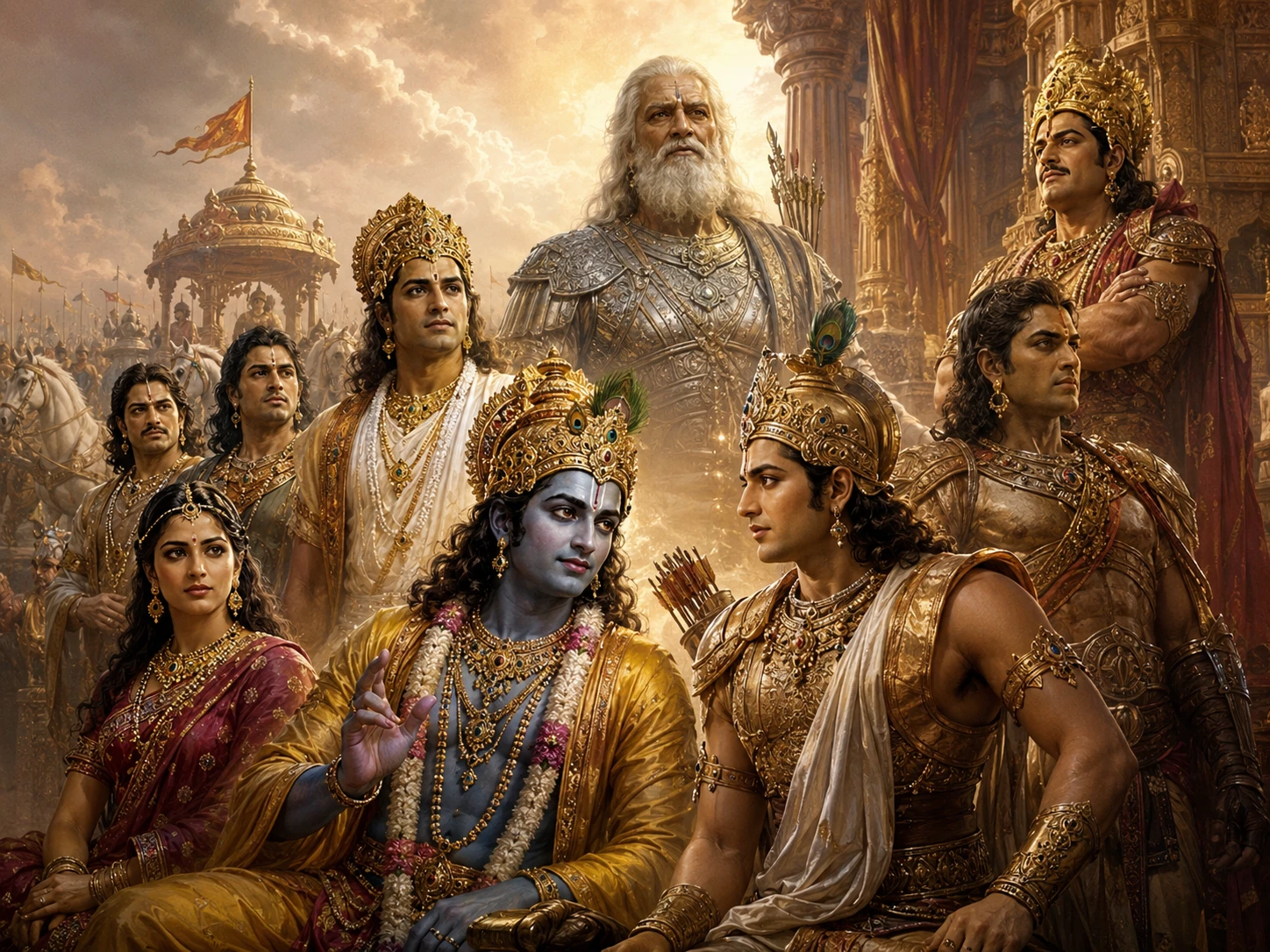
Arjuna -- The Paralysed Achiever
अर्जुन -- वह योद्धा जो ऐन वक़्त पर जम गया
The most uncomfortable thing about Arjuna is that he is the version of yourself you cannot quite admit you are.
Not Karna, the wounded outsider. Not Duryodhana, the entitled cousin. Not Bhishma, the patriarch trapped by his own oath. Arjuna is the high-performer. The one with the talent. The one who got into the right gurukul, finished at the top of the class, won every competition, married well, had every advantage, and then -- on the morning the actual test arrives -- found that his hands would not move.
In Indian life this is the recurring story. The IIT topper who freezes in the placement interview. The CA Final rank-holder who cannot pick up the phone to her own client. The doctor with three gold medals who cannot deliver the bad news to a patient's family. The startup founder who has built the deck a hundred times and freezes when the actual term sheet sits across the table. The cricketer who scores six centuries in domestic season and gets out for two on debut. We have a name for this in English -- imposter syndrome, performance anxiety, choking under pressure. The Mahabharata gave it a name three thousand years before the management literature did. It called the condition vishada -- the deep grief that comes precisely when you should be at your peak.
Vishada is the diagnosis the entire Bhagavad Gita is a treatment for. The Gita's first chapter is titled Arjuna Vishada Yoga -- the yoga of Arjuna's despair. Krishna does not start with cosmic philosophy. He starts with a man whose nervous system has crashed. The man with the world's most famous bow cannot lift it. The man who has been training for this exact day since he was seven years old has just told his charioteer he would rather be killed unarmed than do what he came to do.
This article walks through Arjuna's life from birth to death. Not as biography. As pattern. Because if you can see what produced him -- the gifts, the praise, the tutelage, the curse, the marriage, the exile, the boon, the year as Brihannala, the Gita, the war, the fall on Mount Meru -- you can see what is producing the version of yourself who cannot make the call this week. Arjuna is not in your past. He is in your inbox. Read on.
कार्पण्यदोषोपहतस्वभावः पृच्छामि त्वां धर्मसम्मूढचेताः। यच्छ्रेयः स्यान्निश्चितं ब्रूहि तन्मे शिष्यस्तेऽहं शाधि मां त्वां प्रपन्नम्॥
kārpaṇyadoṣopahatasvabhāvaḥ pṛcchāmi tvāṃ dharmasammūḍhacetāḥ yac chreyaḥ syān niścitaṃ brūhi tan me śiṣyas te 'haṃ śādhi māṃ tvāṃ prapannam
My very nature is overpowered by this stain of weakness. My mind is confused about dharma, and so I ask you. Tell me with certainty what is best for me. I am your disciple. I take refuge in you. Instruct me.
— Bhagavad Gita 2.7 (the moment Arjuna stops being Krishna's friend and becomes his disciple)
Arjuna was the third son of Pandu, born to Kunti through the boon of Indra. The boon mattered. Yudhishthira came from Dharma. Bhima came from Vayu, the wind. Nakula and Sahadeva came from the Ashwins, the celestial physicians. Arjuna was the only Pandava born of Indra, the king of the gods, the wielder of Vajra, the lord of the rains and of war. From the moment of birth, he carried the weight of being the favourite. Everyone, mortal and divine, had high expectations of him. This is the first thing the Mahabharata wants you to notice. The man who would freeze on the battlefield was the man who had been told from infancy that the battlefield was where he was destined to shine.
At Hastinapura, Drona arrived as the teacher of the princes. Drona was a Brahmin warrior from the lineage of Bharadwaja, embittered by Drupada's earlier insult, and he taught the Kuru princes archery as a discipline of body, breath, and mind. The famous test was the wooden bird in a tree. Drona asked each prince in turn what he saw. Yudhishthira saw the bird, the tree, the leaves, his cousins. Duryodhana saw the bird and his cousins watching him. Only Arjuna, when asked, said -- I see the eye of the bird. I see only the eye. Drona told him to release. The arrow flew. The eye was pierced. The story is famous because it is also a definition. To be Arjuna is to have a focus so narrow that the rest of the world disappears.
This is also Arjuna's first weakness, though no one in the gurukul saw it that way. The narrow focus made him the world's greatest archer. It also made him a man who could miss everything around the target -- the consequences, the relatives standing on the other side, the cost of the act of release. When Krishna had to spend eighteen chapters of the Gita expanding Arjuna's vision back to the full field, he was not adding something new. He was undoing the very narrowing that had made Arjuna who he was.
There is also the matter of Ekalavya. The forest-born Nishada boy who learned archery in front of a clay statue of Drona, became the equal of Arjuna, and was made to cut off his right thumb when Drona discovered him. Drona did this because he had promised Arjuna that no archer in the world would be his equal. Arjuna did not stop him. Arjuna accepted the gift of his teacher's cruelty as a tribute to himself. The Mahabharata records this without commentary. The text simply makes you watch.
After the lakshagriha plot -- the wax house Duryodhana built to burn the Pandavas alive -- the brothers escaped through a tunnel into the forest, disguised as Brahmin students. They lived for a while at Ekachakra. Bhima killed the demon Bakasura who was extorting the village. Then word came of Drupada's daughter's swayamvara at Panchala. Drupada had built a fish, suspended high on a revolving axis, and the test was to shoot its eye while looking only at its reflection in a pool of water below.
In the line of suitors, Karna lifted the bow. He was about to release. Draupadi's voice cut through the assembly -- I will not marry a sutaputra. Karna placed the bow back on the rack. Salya tried and failed. Other princes tried and failed. The bow was Lord Shiva's, given to Drupada as a wedding test no ordinary man could complete.
A young Brahmin walked out of the crowd. The bow had to be strung. Most princes could not even lift it. Arjuna lifted it as if it weighed nothing. He glanced at the spinning fish through its reflection. He released five arrows in succession. The fish fell. The princess garlanded him.
Back at the hut, the brothers called out to Kunti -- mother, see what we have brought. Kunti, busy at her chores, said without looking -- whatever it is, share equally amongst yourselves. The mother's word, once spoken, became dharma. So Draupadi, the daughter of fire, the most beautiful woman alive, became wife to all five Pandavas.
Western readers and modern Indian readers both stumble here. Polyandry. The text addresses the awkwardness directly. Vyasa explains the cosmic prehistory of Draupadi -- a woman who in a previous birth had asked Shiva five times for a husband, so Shiva granted her five husbands in this birth. The explanation is theological. The lived reality, in the household at Indraprastha, was complicated in ways the text only hints at. Draupadi loved Arjuna most. Her dignity at the dice game would not have shattered the way it did if she had not seen Arjuna -- of all people -- failing to defend her in the sabha.
Arjuna's Ten Names -- The Dasanama from Virata Parva 39
| Name | Devanagari | Meaning | Story Behind the Name |
|---|---|---|---|
| Arjuna | अर्जुन | The white, the pure, the spotless | Given by Indra at birth, denoting his unstained character and fair complexion |
| Phalguna | फाल्गुन | Born under the Phalguni Nakshatra (Uttara Phalguni) | Astrological birth name; same as the lunar month Phalguna |
| Jishnu | जिष्णु | The triumphant | Named for his victories from boyhood, including subduing Drupada at Drona's gurudakshina |
| Kiriti | किरीटी | Bearer of the diadem | Given a celestial crown (kiriti) by Indra in svarga during his weapons quest |
| Shvetavahana | श्वेतवाहन | Master of the white horses | His chariot in Kurukshetra was drawn by four pure white horses, gifted by Agni after Khandava-dahana |
| Bibhatsu | बीभत्सु | One who shrinks from a despicable act | Even in war, refused to attack a fleeing or unarmed warrior; held to kshatriya code |
| Vijaya | विजय | Always victorious | Named for never returning defeated from any single combat |
| Krishna | कृष्ण | The dark one | Born with a complexion as dark as the cloud-coloured Vasudeva-Krishna; the two are the second pair of Nara-Narayana |
| Savyasachi | सव्यसाची | Ambidextrous; left-handed and right-handed both | Could draw the Gandiva with either hand at full strength; in Kurukshetra he reportedly fired arrows from both hands at once |
| Dhananjaya | धनंजय | Conqueror of wealth | Earned during the digvijaya for Yudhishthira's Rajasuya yajna, when he subdued kingdoms across the north and brought their tribute |
These ten names are recited by Arjuna himself in Virata Parva, chapter 39, when revealing his identity to Uttara, the prince of Matsya, just before the battle with the Kauravas at the cattle raid.
Savyasachi -- Arjuna's name as the ambidextrous warrior -- has a literal modern parallel. Sportsbiomechanics studies on cricketers like Sachin Tendulkar (who batted right but bowled left, and famously wrote with his left hand) show that elite ambidextrous athletes have measurable advantages in reaction time and shot variation. The Mahabharata picks up on this two and a half millennia before sports science labs at the National Cricket Academy in Bengaluru began studying it.
After the marriage and the founding of Indraprastha, Arjuna entered the most carefree period of his life. Following an internal pact among the brothers about Draupadi's privacy with each, he accidentally walked in on Yudhishthira and Draupadi while retrieving weapons. The pact's penalty was self-imposed exile of twelve years.
This exile was not punishment in any meaningful sense. It was a tour of the subcontinent, with Arjuna meeting and marrying women from very different worlds. He went to the Ganga and met Ulupi, the Naga princess, who pulled him underwater into her father's kingdom and married him. They had a son named Iravan, who would later die at Kurukshetra. He went to Manipur and met Chitrangada, the warrior daughter of the Manipur king, married her, and they had a son named Babhruvahana, who much later -- in the Ashvamedha Parva -- would defeat Arjuna in battle without knowing he was his father.
Finally, at Prabhasa, Arjuna met Krishna again, this time as a brother-in-law. Krishna's sister Subhadra was at the Raivataka festival. Krishna himself, in one of the most charming pieces of strategy in the Mahabharata, advised Arjuna to abduct her -- knowing that Balarama, his elder brother, was inclined to give Subhadra to Duryodhana. Arjuna abducted Subhadra. They married. Their son Abhimanyu would, in time, walk into the chakravyuha at sixteen and die for his father's army.
From Dwaraka, returning to Indraprastha, Arjuna and Krishna passed through the Khandava forest. Agni, the fire-god, had been suffering from indigestion -- he had eaten too many ritual offerings -- and needed to consume the Khandava forest to recover. The forest was protected by Indra, Arjuna's own father. The fight that followed lasted days. Indra's clouds rained, Arjuna's arrows shielded the fire from the rain. By the end, the Khandava was burnt, the demon Mayasura was spared (and would later build the magical assembly hall of the Pandavas), and Agni gave Arjuna two divine gifts -- the Gandiva, the inexhaustible bow, and a chariot drawn by four white horses, with two inexhaustible quivers of arrows.
Gandiva is the bow that defines Arjuna for the rest of his life. It is also the bow that, on the morning of Kurukshetra, will slip from his hands.
Then came the dice game. Yudhishthira was lured by Shakuni into a rigged match, lost everything -- kingdom, brothers, his own freedom, finally Draupadi -- and the Pandavas were sentenced to thirteen years in the forest, the last of which had to be spent in disguise. If they were recognised in that final year, the cycle would restart.
In the forest exile, while the brothers grieved, Arjuna left them on a separate mission. The wisest among them had calculated that the war was inevitable, and the Pandavas would need divine weapons to win. Vyasa instructed Arjuna in a special technique. Arjuna travelled north, to a mountain peak called Indrakeel in the Himalayas. There, he undertook a tapasya so severe that the trees and animals around him began to feel the heat of his austerity. The gods grew alarmed.
Shiva himself came to test him, in the form of a Kirata, a forest hunter. A wild boar appeared between them. Both shot the boar simultaneously. An argument broke out about whose arrow had killed it. The Kirata mocked Arjuna's archery. Arjuna fought him -- with arrows that the Kirata absorbed without effect, with the Gandiva itself, with bare hands. Eventually, beaten down, Arjuna offered worship to a small lingam of clay. The flowers he placed on the lingam appeared on the Kirata's head. He understood. He fell at Shiva's feet.
Shiva, pleased, gave him the Pashupata. The Pashupata is not just another weapon. It is the world-ending astra. The mantra to invoke it includes such warnings that no kshatriya in the Mahabharata ever uses it in active combat. Arjuna receives it as a deterrent, not a tool. He learns its mantra of withdrawal at the same moment he learns its mantra of release. This itself is the sanity check the Mahabharata applies to terrible power -- the same mantra that summons the weapon must teach you how to take it back.
From Indrakeel, Indra's chariot came down for him. Arjuna ascended to svarga, lived there for some time as Indra's guest, learned the use of every divine astra from his father, and rejected the apsara Urvashi when she came to him. He addressed her as 'mother' because in the Pururavas-Urvashi lineage she had been the wife of an ancient ancestor. Urvashi, insulted, cursed him to spend a year as a eunuch. Indra mitigated the curse -- it would last only one year, and Arjuna could choose when to apply it.
This is the strange detail Mahabharata readers always pause over. The greatest archer in the world, son of the king of the gods, would spend one year of his life as Brihannala -- the dance teacher of the princess Uttara at the court of King Virata, with bangles, anklets, and braided hair. The thirteenth year of exile, the year of disguise, the curse fit perfectly. The most macho man in the Mahabharata literature spent twelve months as a teacher of girls. The text has no apology for this. The text seems to find it instructive.
कर्मण्येवाधिकारस्ते मा फलेषु कदाचन। मा कर्मफलहेतुर्भूर्मा ते सङ्गोऽस्त्वकर्मणि॥
karmaṇy evādhikāras te mā phaleṣu kadācana mā karma-phala-hetur bhūr mā te saṅgo 'stv akarmaṇi
Your right is to action alone, never to its fruits. Do not let the fruit of action be your motive. And let your attachment never be to inaction.
— Bhagavad Gita 2.47 (the answer Krishna gives to Arjuna's vishada)
After the year as Brihannala, after the cattle raid where Arjuna single-handedly defeated the entire Kuru army, after Krishna's failed peace mission, the war was set. Eighteen days at Kurukshetra. The largest battle the text imagines.
The first morning, Arjuna asked Krishna to drive his chariot between the two armies so he could see whom he would have to kill. Krishna obliged. Arjuna saw his grandfather Bhishma, his teacher Drona, his cousin Duryodhana, his half-brother Karna (though he did not know yet that Karna was Kunti's first son), uncles, friends, neighbours, the priests of his own family standing on the other side. The Gandiva slipped from his hands. He told Krishna -- I will not fight. Better to be killed unarmed than to do this.
What followed is the Bhagavad Gita. Eighteen chapters, seven hundred verses, the most-read philosophical document of the Indian tradition. Krishna does not give Arjuna a moral pep talk. He restructures Arjuna's understanding of the self, of action, of consequence, of identity, of death, of devotion. By the end of the eighteenth chapter, Arjuna says -- nashto mohah smritir labdha. My delusion is gone. I have recovered my memory. I am ready.
What the Gita does, to put it plainly, is treatment for a panic attack at the most consequential possible moment. Arjuna's nervous system has crashed. Krishna does not say snap out of it. He does not say think positive. He says -- here is who you actually are, here is what action actually is, here is why this fear is a category error, and here is the technique to keep doing the work without being destroyed by it. The treatment works. Arjuna fights.
For eighteen days he is the storm at the centre of the Pandava army. He kills Bhishma -- though more accurately Bhishma allowed himself to be killed by giving Arjuna instructions on how. He kills Karna while the chariot wheel is sunk. He kills Jayadratha by sunset of the fourteenth day, after a vow that nearly cost him his own life. He survives as one of the seven from his side at the end. The body of his sixteen-year-old son Abhimanyu is brought to him after the chakravyuha. The body of Karna, his half-brother, is shown to him after Kunti reveals the truth. The Pandavas win. The kingdom is theirs. The cost is everything they had hoped not to lose.
Karna's Vasavi Shakti -- Indra's spear, given as part of the trade for Karna's kavach-kundala -- could only be used once, and was meant for Arjuna. Krishna's strategy was to send Bhima's son Ghatotkacha into the night battle of the fourteenth day, knowing Karna would be forced to use the Vasavi Shakti against him. Ghatotkacha died. The single most lethal weapon in the war was spent on a rakshasa son. Arjuna's life was saved by his cousin's death. The Mahabharata never lets you celebrate without showing you the price.
After the war, before Krishna left for Dwaraka, Arjuna asked him -- I have forgotten everything you said on the battlefield. Can you teach me again? What follows in the Ashvamedhika Parva is called the Anugita. Krishna's reply is one of the most painful lines in the entire epic. He says, in essence -- the moment has passed. You were ready to receive the Gita then because you were broken open. You are not broken open now. I will tell you what I can tell you now, but you cannot have that teaching back. It was a one-time gift. The receiver had to be ready.
This is the cruel truth at the heart of Arjuna's life. The Gita arrived at the only moment Arjuna could receive it. After that moment, Arjuna himself could not get back to the version of himself that had heard it. He spent the rest of his life as a great king in a great kingdom, with great memories, but the inner clarity of that one morning never quite returned.
In the years that followed, the kingdom prospered. Yudhishthira ruled for thirty-six years. Then Krishna died -- struck by a hunter's arrow, after the entire Yadava clan had destroyed itself in a drunken brawl. Arjuna travelled to Dwaraka to bring back Krishna's relatives. On the way back, the city of Dwaraka was swallowed by the sea behind him. He tried to defend the women and elders from a band of common dacoits and discovered that his Gandiva would not respond. The bow that had won Draupadi at the swayamvara, the bow that had killed Bhishma and Karna, would not draw against bandits. The mantra had left him. The astras were no longer his.
Vyasa told him -- the work is done. Return the bow to Varuna. The mantras have been recalled by the gods who lent them to you. You are now an old man with old skills.
This is the moment you do not see in the Sunday morning television version. Arjuna's last weeks were not heroic. They were a long, slow encounter with the irrelevance of a man whose moment has passed.
The five Pandavas, Draupadi, and a dog set out for Mount Meru on the final journey, the Mahaprasthana. They walked north into the Himalayas, towards the snow line. They walked in single file, in silence, and one by one they fell.
Draupadi fell first. Yudhishthira, walking ahead without looking back, told Bhima -- she loved Arjuna more than the rest of us. That was her flaw. Then Sahadeva fell -- pride in his own wisdom. Then Nakula fell -- pride in his beauty. Then Arjuna fell.
When Bhima asked why Arjuna had fallen, Yudhishthira replied -- 'Arjuna had said that he would consume all our enemies in a single day. Proud of his heroism, he did not, however, accomplish what he had said. Hence has he fallen down. This Phalguna disregarded all wielders of bows. One desirous of prosperity should never indulge in such sentiments.' This is the actual line from the Mahaprasthanika Parva.
Arjuna did not fall because of cowardice. He fell because of pride. The same pride that had driven him to be the world's greatest archer, the same pride that had let him watch silently while his teacher mutilated Ekalavya, the same pride that had led him to make a vow he could not fulfill -- that he would defeat the Kauravas in a single day -- this pride was the last impurity he had to shed before reaching heaven, and he could not shed it in his own lifetime.
This is the most painful judgement in the Mahabharata. The man who heard the entire Bhagavad Gita from Krishna's own mouth, the man who had been told personally by god that he should act without attachment to the fruits of action, was the man who in the end could not leave behind his attachment to being the best. The Gita had not stayed with him. The teaching was a moment of grace, not a permanent state.
एकाह्ना निर्दहेयं वै शत्रूनित्यर्जुनोऽब्रवीत्। न च तत्कृतवानेष शूरमानी ततोऽपतत्॥
ekāhnā nirdaheyaṃ vai śatrūn ity arjuno 'bravīt na ca tat kṛtavān eṣa śūramānī tato 'patat
Arjuna had said -- 'I shall consume all enemies in a single day.' Yet, proud of his heroism, he did not accomplish that. For this reason, he has fallen.
— Mahabharata, Mahaprasthanika Parva 17.2 -- Yudhishthira's reply to Bhima
Why does this matter to you, in 2026, sitting in your apartment in Indiranagar or your hostel in Kota or your shared flat in Toronto?
Because Arjuna's pattern is the most common spiritual pattern in achievement-oriented Indian life. The pattern goes like this. You are good at something. People notice you are good at it. You start identifying as the person who is good at this thing. Your worth becomes contingent on your continued performance of this thing. The fear of failing at it grows in proportion to your reputation for it. By the time you reach the actual high-stakes moment -- the conference talk, the deal close, the stage performance, the difficult diagnosis you have to deliver, the resignation letter you need to write -- the fear is so dense that the body itself refuses.
This is the diagnostic the Gita opens with. And the cure the Gita offers is not 'try harder' or 'visualise success.' The cure is identity surgery. Krishna asks Arjuna to detach from the version of himself that is doing the action. Drop the fruit. Drop the doer. Just do the work. The famous line karmanyevadhikaraste is not a productivity hack. It is a survival instruction for high-performers whose nervous systems have learned to fail at peak load.
The modern Arjunas are everywhere. The 24-year-old at a Bengaluru product company who has been promoted three times in two years and now cannot sleep before a quarterly review. The IAS officer in his second posting who is paralysed at every signature because of what could go wrong. The classical singer at the Music Academy who lost her voice in the second concert of her career and never quite got it back. The PhD student at IIT Delhi who has the highest GRE in his year and whose advisor cannot get him to submit a draft. They are all running Arjuna's pattern. They are all waiting for someone to drive their chariot.
This is what makes Arjuna important. Not as a hero you should aspire to. As a diagnosis you should recognise. He is the cautionary tale built into the most celebrated narrative of his own civilisation. The text is asking you -- do you really want to be him?
And if the honest answer is yes, you already are -- the same text is offering you the same chariot, the same charioteer, and the same eighteen chapters of recovery from your own paralysis. You only have to be broken enough to listen.
Read Chapter 2 of the Bhagavad Gita aloud
The Sankhya Yoga, the second chapter, is where Krishna's actual treatment of Arjuna's vishada begins. Read it aloud, slowly, in either Sanskrit or your native language. Notice which verses make your throat tight. Those are the verses your inner Arjuna is currently fighting.
Tags
Eternal Raga · शाश्वत राग
Institutional voice — scholarly articles on Sanatan Dharma
Deepen Your Understanding
अपनी समझ और गहरी करें
scriptural exegesis
Wives of Arjuna -- Four Women Who Shaped the War
Arjuna did not marry for romance. Each of his four marriages -- to Draupadi, Subhadra, Ulupi, and Chitrangada -- was a strategic alliance that brought the Pandavas military power, divine protection, or political legitimacy they could not have won on the battlefield. A Panchala princess, a Yadava sister, a Naga queen, and a Manipuri warrior-princess: four women from four different civilisations, each changing the course of the Mahabharata.
divine arsenal
The Celestial Bows -- Pinaka, Gandiva, Sharanga, Vijaya and the Sacred Art of Dhanurvidya
Five bows shaped the fate of two great epics. Forged by Vishwakarma and Brahma, wielded by Shiva, Rama, Arjuna, Vishnu, and Karna -- these were not mere weapons but extensions of cosmic will. Know their origins, their powers, and the warriors who earned them.
divine arsenal
Vasavi Shakti -- The One-Use Weapon That Changed Karna's Destiny
Karna gave away invincibility. In return, he received a spear of lightning that could kill anyone -- gods, asuras, or mortals -- but could be used only once. He saved it for Arjuna. Krishna ensured he spent it on Ghatotkacha instead. The Vasavi Shakti is the Mahabharata's most devastating lesson in strategic economics: the weapon you save for the perfect moment may never find that moment.
scriptural exegesis
The Kurukshetra Within -- Reading the Mahabharata as a Mirror of Your Mind
Vyasa wrote that whatever exists in the world also exists in the Mahabharata, and whatever is not there exists nowhere. This is not a boast. It is an instruction: every character in the epic is a character inside you. Read the war as a map of your mind.
scriptural exegesis
Kurukshetra Battle Alliances -- Which Kings Joined Which Side
Seven akshauhinis against eleven. 1.5 million warriors against 2.4 million. The Kurukshetra war was not two families fighting -- it was the entire Indian subcontinent choosing sides. From the Pandyas of Tamil Nadu to the Kambojas of Central Asia, from the Yadavas of Dwaraka to the Kekayas split down the middle -- here is the geopolitical map of who joined whom and why, sourced from Udyoga Parva.
scriptural exegesis
After Kurukshetra -- What Happened Next
The war ended. The Pandavas won. And then everything fell apart. Krishna's clan destroyed itself in a drunken brawl. Dwaraka sank into the sea. Arjuna's divine powers vanished. And the five brothers who fought the greatest war in history walked into the Himalayas to die. The Mahabharata's post-war chapters are darker, stranger, and more relevant than the war itself.
scriptural exegesis
Pandavas in Hell -- The Shocking Finale of the Mahabharata
The Mahabharata does not end with victory. It ends with the heroes falling dead on a Himalayan climb, the villains seated in heaven, and the one righteous king demanding to be sent to hell. The Swargarohana Parva is the most unsettling, most philosophically radical, and most misunderstood finale in all of world literature.
Savyasachi -- Arjuna's name as the ambidextrous warrior -- has a literal modern parallel. Sportsbiomechanics studies on cricketers like Sachin Tendulkar (who batted right but bowled left, and famously wrote with his left…
More in Scriptural Exegesis
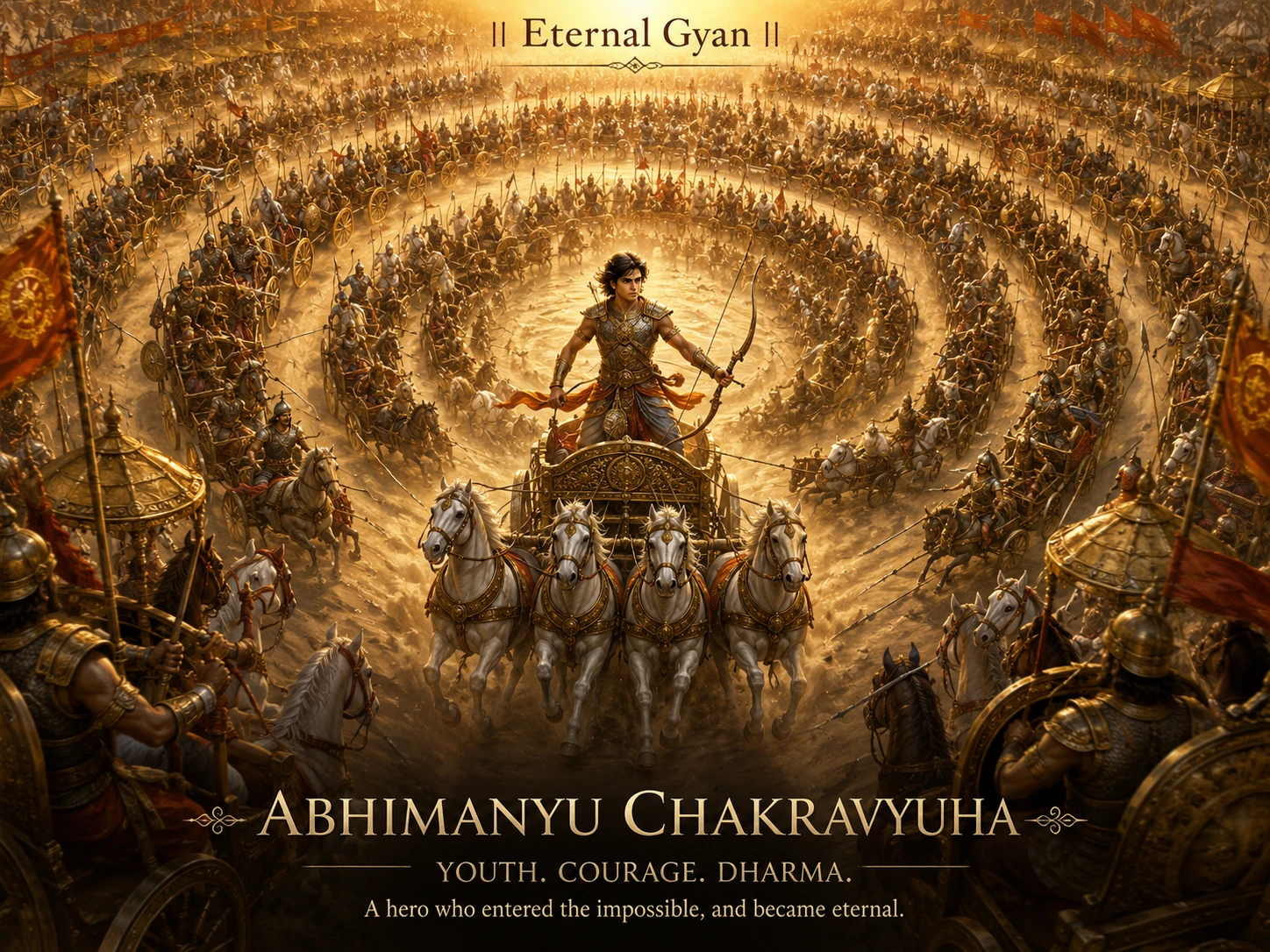
Abhimanyu and the Chakravyuha -- The Boy Who Knew How to Enter but Not How to Leave
14 min read
Adbhuta Ramayana -- The Ramayana Where Sita Becomes Kali
9 min read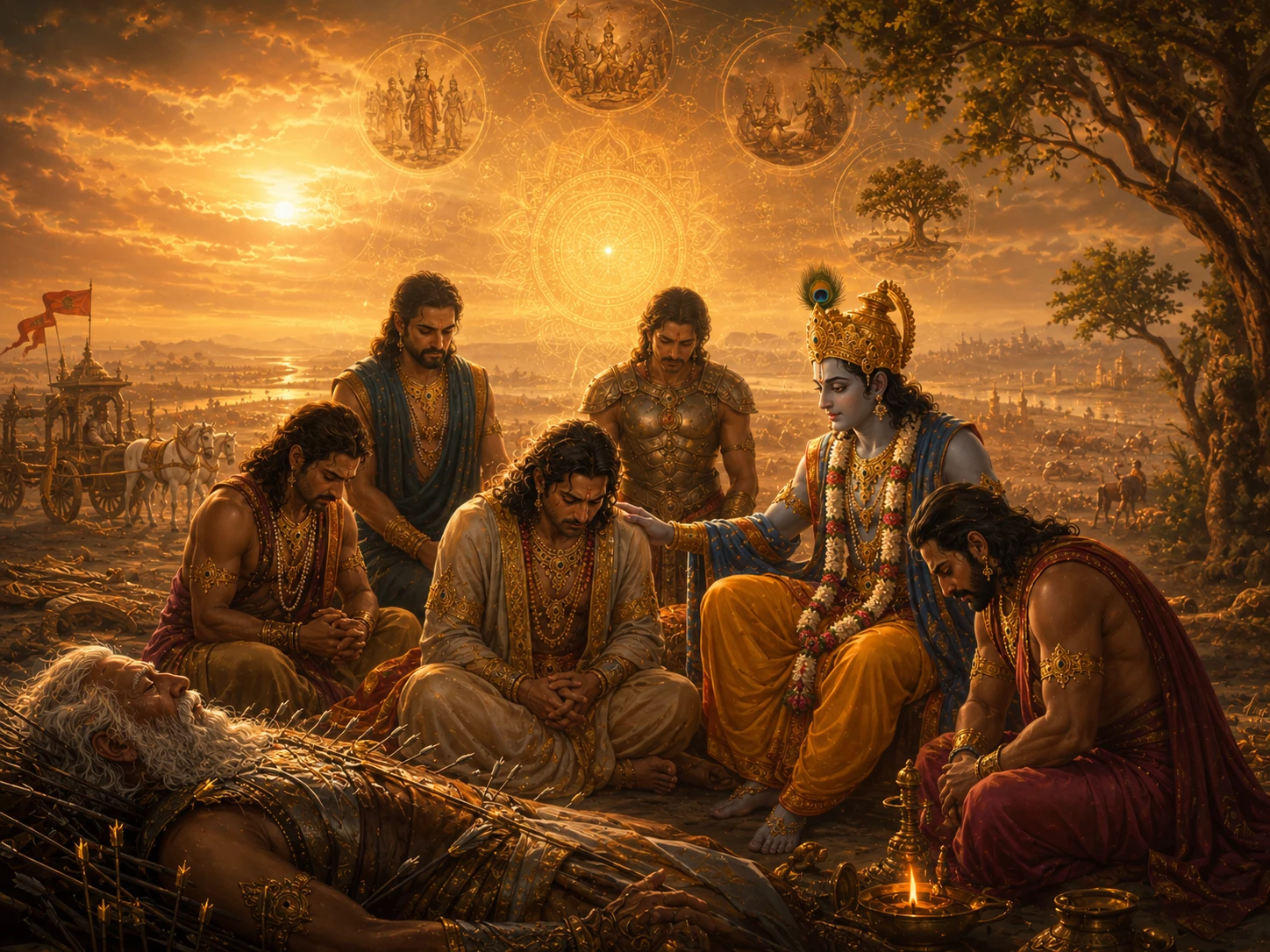
After Kurukshetra -- What Happened Next
14 min readThe same translation error that turned '33 Koti' into '33 crore' in Hinduism also happened in Buddhism. The Chinese translation of Buddhist texts rendered 'Sapta Koti Buddha' (7 Supreme Buddhas) as '7 Crore Buddhas.' The…
Deities AvatarsCommunity Reflections
🕉️
Be the first to share your reflection.