The Bhagavad Gita -- An Overview of the Song of God
भगवद्गीता -- भगवान के गीत का परिचय
Two armies face each other on the plain of Kurukshetra. Conches have been blown; the bowstrings are drawn. In the space between the lines a chariot stops, because the warrior in it has asked his charioteer to drive there so that he can see who he is about to fight. He sees teachers, uncles, cousins and friends. His bow slips from his hand, and he sits down in the chariot and says he will not fight.
The warrior is Arjuna. The charioteer is Krishna. What Krishna says to him over the next seven hundred verses is the Bhagavad Gita, "the song of the Lord" -- the most widely read, translated and commented-on text in Hindu tradition, and for many Hindus the one book that sums up all the others.
The Gita is not a separate book that was later attached to the epic. It sits inside the Mahabharata, in the Bhishma Parva, the sixth of the epic's eighteen books, where it runs across eighteen chapters. The frame is a report within a report: the blind king Dhritarashtra, far from the battlefield in Hastinapura, asks his minister Sanjaya what is happening, and Sanjaya -- given divine sight by the sage Vyasa -- describes the scene and repeats the conversation word for word. That is why the very first verse of the Gita is spoken by Dhritarashtra, and why chapters end with Sanjaya's voice rather than Krishna's.
Tradition counts seven hundred verses, almost all in the simple anushtubh metre of the epic, with a few longer verses in the tristubh metre at moments of high feeling, especially in the eleventh chapter, where Arjuna sees Krishna's cosmic form. Krishna speaks most of it; Arjuna's questions shape it. His doubts are the reason the teaching moves where it does.
कर्मण्येवाधिकारस्ते मा फलेषु कदाचन । मा कर्मफलहेतुर्भूर्मा ते सङ्गोऽस्त्वकर्मणि ॥
karmaṇyevādhikāraste mā phaleṣu kadācana | mā karmaphalaheturbhūrmā te saṅgo'stvakarmaṇi ||
Your right is to the action alone, never to its fruits. Do not let the fruit of action be your motive, and do not be attached to not acting either.
— Bhagavad Gita 2.47
Arjuna's problem is not cowardice. It is a moral argument, and a good one: killing one's elders and kin is wrong, the wealth won by it would be stained with blood, and war destroys families and the order they hold together. Krishna does not answer with one argument but with several, layered, and the eighteen chapters are often read as moving through them in turn.
The first answer is about the self. What Arjuna fears to kill cannot be killed: the Self in every body is unborn and does not die when the body dies. The second is about action. No one can live without acting, so the question is not whether to act but how -- and the answer, karma yoga, is to act fully and well while letting go of the claim on results. The third is about God. Behind every action and every being stands one Lord, and the deepest form of action is to offer it to him. In the closing chapters these threads are drawn together, and Arjuna, his doubt gone, picks up his bow.
How the Eighteen Chapters Are Usually Grouped
| Chapters | Emphasis | Key ideas |
|---|---|---|
| 1 -- 6 | Karma yoga (the path of action) | Arjuna's despair; the undying Self; acting without attachment to results; meditation (chapter 6) |
| 7 -- 12 | Bhakti yoga (the path of devotion) | Krishna's nature; the cosmic form (chapter 11); devotion as the most direct path (chapter 12) |
| 13 -- 18 | Jnana yoga (the path of knowledge) | The field and its knower; the three gunas; the divine and demonic natures; renunciation and surrender (chapter 18) |
This three-part grouping is a traditional teaching aid, associated especially with later commentators; it describes where each section places its weight, not watertight divisions. All three paths appear throughout, and the commentators disagree sharply about which one the Gita finally ranks highest.
यदा यदा हि धर्मस्य ग्लानिर्भवति भारत । अभ्युत्थानमधर्मस्य तदात्मानं सृजाम्यहम् ॥
yadā yadā hi dharmasya glānirbhavati bhārata | abhyutthānamadharmasya tadātmānaṃ sṛjāmyaham ||
Whenever dharma declines, O Bharata, and adharma rises, then I send myself forth.
— Bhagavad Gita 4.7
Because the Gita says so much in so little space, every major school of Vedanta wrote a commentary on it, and each read it in its own light. Adi Shankaracharya (around the eighth century) read it as teaching that liberation comes from knowledge of the one Self, with action as a preparation that purifies the mind. Ramanuja (eleventh to twelfth century) read it as teaching loving devotion to a personal God, with the soul as forever distinct from and dependent on him. Madhva (thirteenth century) read it in a strictly dualist way. Later Bhakti teachers made its last chapter -- "abandon all dharmas and take refuge in me alone" -- the heart of the whole text.
In modern India the Gita became something else as well: a book for public life. Bal Gangadhar Tilak wrote a long study of it as a call to action; Mahatma Gandhi called it his "mother" and read it as teaching non-attachment and selfless service, even though its setting is a war. That one text could support such different readings is part of why it has lasted.
The Gita closes each chapter with a colophon that names it "an Upanishad, a science of Brahman, a scripture of yoga". Tradition takes this seriously: the Gita is counted with the Upanishads and the Brahma Sutras as one of the three foundational texts of Vedanta, the prasthana-traya, which is why every founder of a Vedanta school had to write a commentary on it to be taken seriously.
सर्वधर्मान्परित्यज्य मामेकं शरणं व्रज । अहं त्वा सर्वपापेभ्यो मोक्षयिष्यामि मा शुचः ॥
sarvadharmānparityajya māmekaṃ śaraṇaṃ vraja | ahaṃ tvā sarvapāpebhyo mokṣayiṣyāmi mā śucaḥ ||
Abandon all dharmas and take refuge in me alone. I will free you from every sin; do not grieve.
— Bhagavad Gita 18.66
For a first reading, many teachers suggest starting not at chapter one but at chapter two, from its eleventh verse, where Krishna begins to speak; reading chapter twelve, the shortest and simplest, on devotion; and then reading the whole through slowly, a chapter a sitting. The Gita repays rereading more than any first pass: its verses were meant to be learnt, recited and carried, and many people know a handful by heart long before they understand them.
The question it was spoken to answer is still the ordinary human one: what to do when every choice costs something, and how to act well without being crushed by the outcome. That is why a dialogue set at the start of a war is read every day in homes far from any battlefield.
Read the Bhagavad Gita verse by verse
All eighteen chapters on Eternal Raga, with Sanskrit, transliteration, word-by-word meaning and translation in English and Hindi.
Tags
Eternal Raga · शाश्वत राग
Institutional voice — scholarly articles on Sanatan Dharma
Deepen Your Understanding
अपनी समझ और गहरी करें
scriptural exegesis
Gita Chapter 2 -- Sankhya Yoga: The Chapter That Changed Indian Philosophy Forever
Arjuna drops his bow. His hands shake. He tells Krishna he would rather beg for food than kill his teachers and cousins. Krishna's response in Chapter 2 is the philosophical backbone of the entire Gita -- covering the immortality of the soul, the ethics of action without attachment, and the portrait of the Sthitaprajna (the person of steady wisdom). This single chapter contains more quotable verses than most entire scriptures. 'Karmanye vadhikaraste' lives on WhatsApp statuses for a reason.
scriptural exegesis
Gita Chapter 3 -- Karma Yoga: Why Sitting Still Is Not an Option
After hearing Chapter 2, Arjuna asks the most logical follow-up question in the history of philosophy: 'If knowledge is superior to action, why are you pushing me to fight?' Krishna's answer in Chapter 3 builds the complete architecture of Karma Yoga -- why action is inescapable, how selfless action purifies, why leaders must act even when they have nothing to gain, and how desire is the real enemy on every battlefield.
scriptural exegesis
Gita Chapter 12 -- Bhakti Yoga: The Shortest Chapter With the Longest Impact
With just 20 verses, Gita Chapter 12 is the shortest in the entire scripture -- yet it answers the biggest question: what does God actually want from you? Krishna's answer is not rituals, not renunciation, not philosophy. It is love. And then he draws the most specific personality sketch of an ideal human being ever written.
scriptural exegesis
Gita Chapter 18 -- Moksha Sannyasa Yoga: The Final Exam Where Krishna Says 'Do As You Wish'
78 verses. The longest chapter in the Gita. Krishna classifies everything -- knowledge, action, doer, intellect, happiness -- into three gunas, then drops the most radical verse in Indian scripture: abandon all dharmas and just surrender to Me. And then, in a move no dictator would ever make, he tells Arjuna: now do as you wish.
scriptural exegesis
The Mahabharata -- The Text Behind the World's Longest Epic
Most people who say they have read the Mahabharata mean they have read a retelling of the dice game, the exile, and Kurukshetra. Few have asked how the book itself is built: eighteen numbered parvas, a traditional count of one hundred thousand verses, and a story that reaches every reader through three narrators nested inside one another, the outermost speaking at a sacrifice convened because a king's father died of snakebite. This is that architecture, not the episodes.
scriptural exegesis
Krishna -- The Charioteer Who Steered the Cosmos
He was Vishnu's purna avatar in human form, born in a Mathura prison, raised in a Vrindavan cowherd village, king of Dwaraka, charioteer to Arjuna, the speaker of the Gita, the witness who watched the Mahabharata unfold and quietly guided every consequential decision in it. The other characters in this cluster are people. Krishna is something else. The Mahabharata is, in the end, his story.
scriptural exegesis
The Kurukshetra War -- What Happened in Eighteen Days
Eighteen armies, eighteen days, and four Kaurava commanders who fell one after another. A day-by-day guide to the war at the heart of the Mahabharata -- who led, who fell, and how the rules agreed on the first morning were broken one by one.
The Gita closes each chapter with a colophon that names it "an Upanishad, a science of Brahman, a scripture of yoga". Tradition takes this seriously: the Gita is counted with the Upanishads and the Brahma Sutras as one o…
More in Scriptural Exegesis
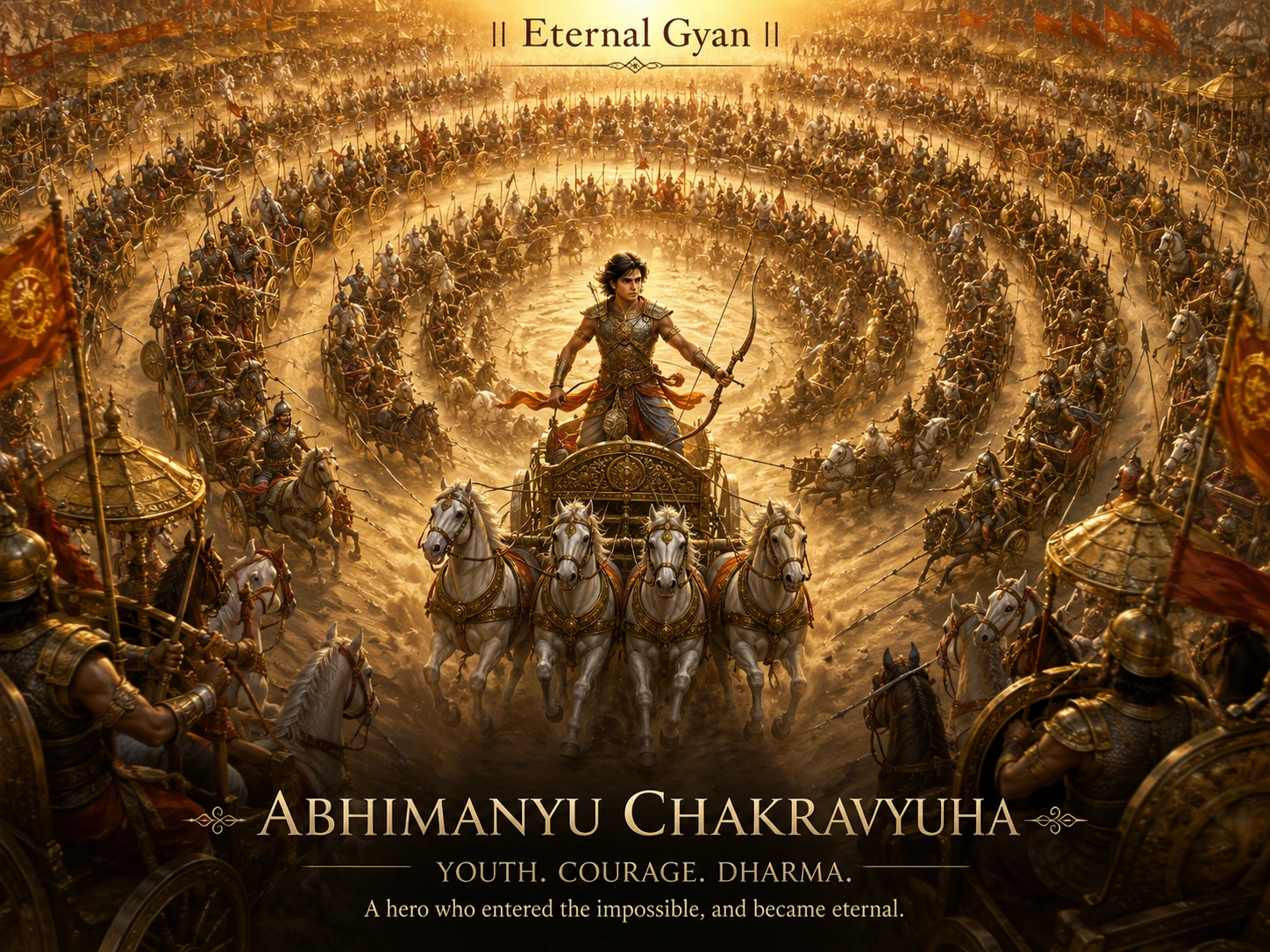
Abhimanyu and the Chakravyuha -- The Boy Who Knew How to Enter but Not How to Leave
14 min read
Adbhuta Ramayana -- The Ramayana Where Sita Becomes Kali
9 min read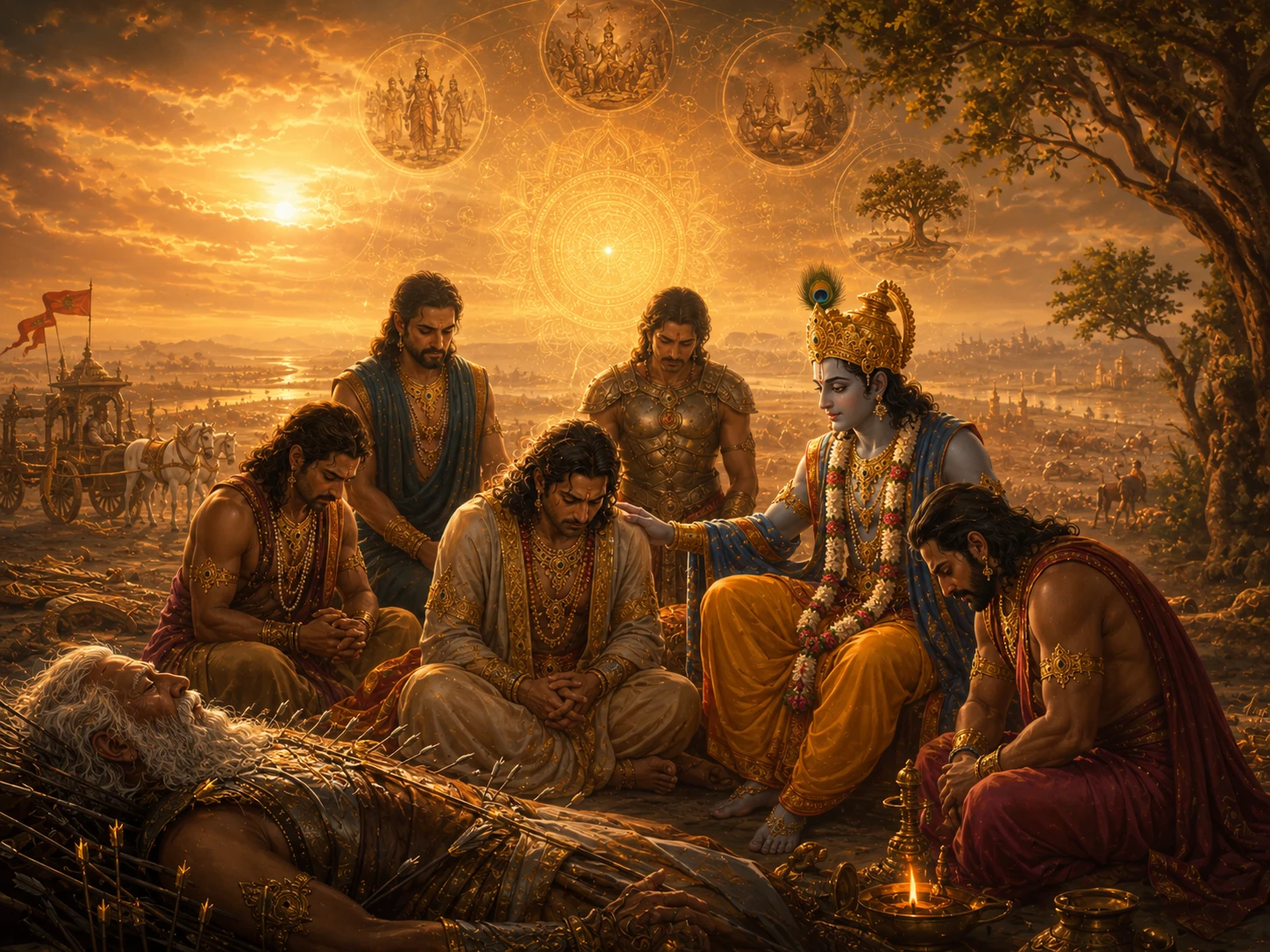
After Kurukshetra -- What Happened Next
14 min readThe same translation error that turned '33 Koti' into '33 crore' in Hinduism also happened in Buddhism. The Chinese translation of Buddhist texts rendered 'Sapta Koti Buddha' (7 Supreme Buddhas) as '7 Crore Buddhas.' The…
Deities AvatarsCommunity Reflections
🕉️
Be the first to share your reflection.