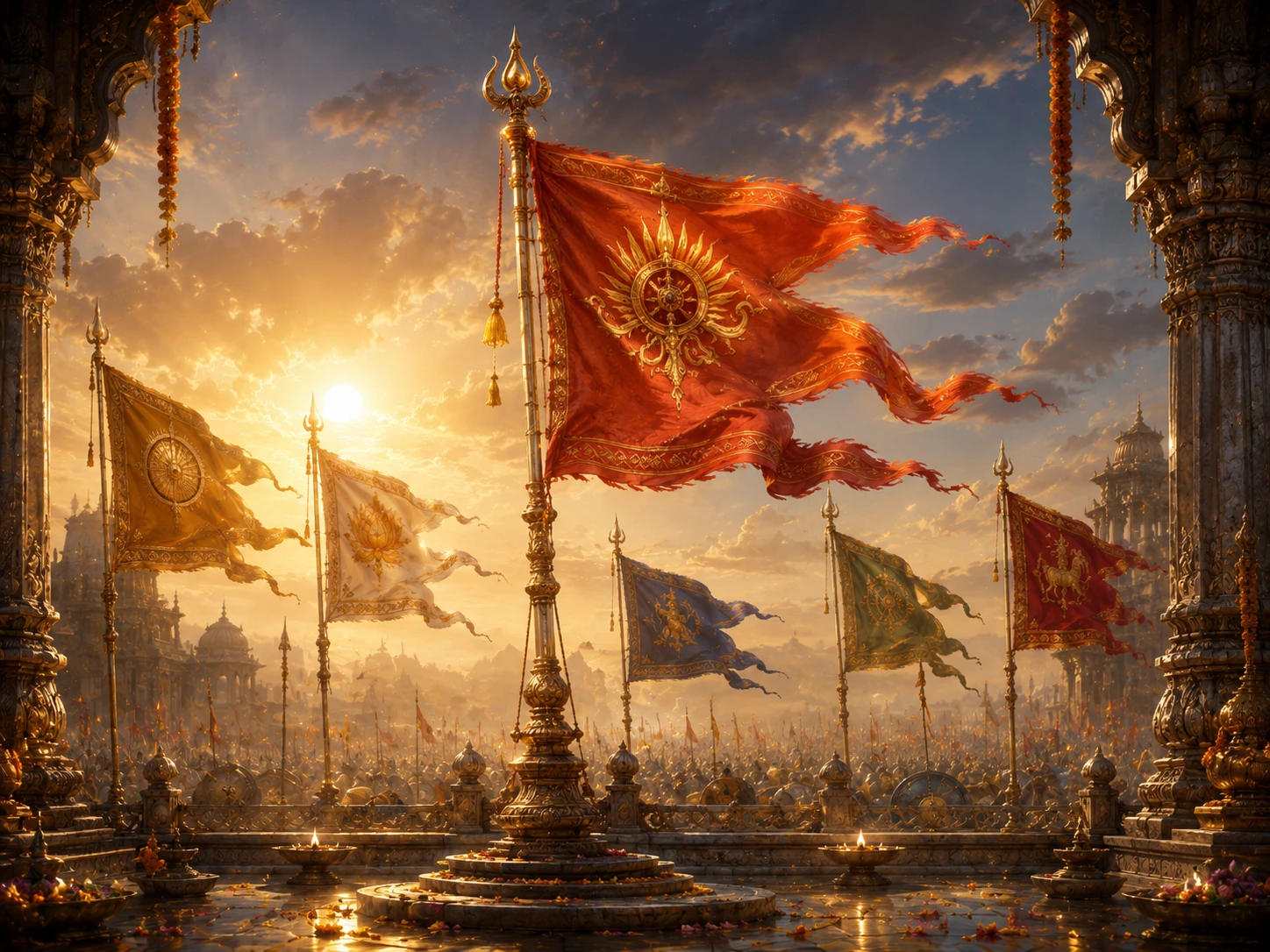
Sacred Flags & Standards -- Kapidhwaj and Garudadhwaj
पवित्र ध्वजा एवं पताका -- कपिध्वज और गरुडध्वज
Modern armies use encrypted radio, satellite positioning, and standardised insignia to identify their forces on the battlefield. Ancient armies had the Dhwaja -- a tall standard mounted on a chariot, visible across the dust and chaos of war, carrying the emblem of its warrior. When the Dhwaja fell, the warrior was assumed dead or defeated. When it stood tall, the army held firm.
In the Mahabharata, the Dhwaja system is described with the precision of a military manual. Every major warrior has a unique, identified standard. The texts specify what animal, god, or symbol each flag bears, and the battlefield narrative frequently uses the status of various Dhwajas as a real-time reporting mechanism -- the ancient equivalent of a command-and-control dashboard.
Among all the standards of Kurukshetra, none was more significant than Arjuna's Kapidhwaj -- the monkey-banner. Because the monkey on that flag was not a symbol of Hanuman. It was Hanuman.
कपिध्वजं महेष्वासं गाण्डीवं च महद्धनुः। वैजयन्तीं महाकेतुं दृष्ट्वा सैन्यानि कम्पिरे॥
kapidhvajam maheshvaasam gaandivam ca mahaddhanuh | vaijayantim mahaketum drishtvaa sainyaani kampire ||
Seeing the great archer with his monkey-banner, the mighty Gandiva bow, and the great Vaijayanti standard, the enemy armies trembled.
— Mahabharata, Bhishma Parva
The story of how Hanuman came to reside on Arjuna's chariot flag is one of the Mahabharata's most delightful sub-narratives. During the exile period, Arjuna encounters Hanuman in a forest. Arjuna, displaying characteristic pride, wonders aloud why Rama needed a monkey army to build a bridge to Lanka when he could have simply used arrows. Hanuman, amused, challenges him: build a bridge of arrows strong enough for me to walk across.
Arjuna builds one. Hanuman, in his minuscule form, steps onto it. The bridge collapses. Arjuna rebuilds, puts more arrows, and the bridge again crumbles under Hanuman's weight. Humiliated, Arjuna prepares to enter the fire in shame. Vishnu appears, stops him, and explains: Arjuna and Hanuman are both his devotees, and neither should feel superior to the other.
Hanuman, moved by Arjuna's sincerity, promises that he will sit on Arjuna's battle standard during the great war, lending his roar to Arjuna's battle cry. This is why Arjuna's chariot emits a sound so terrifying that it demoralises enemies before a single arrow is fired. The Kapidhwaj is not a passive flag. It is a living presence -- the power of the Ramayana literally riding into the war of the Mahabharata.
Major Battle Standards (Dhwajas) of the Mahabharata
| Warrior | Dhwaja Name | Emblem | Significance |
|---|---|---|---|
| Arjuna | Kapidhwaj | Hanuman (living presence) | Carries the power of the Ramayana; emits terrifying battle roar |
| Bhishma | Tala Dhwaja | Palm tree (Tal Vriksha) | Symbol of unwavering resolve; the tree that bends but never breaks |
| Drona | Kamandalu Dhwaja | Water pot and bow | Marks the Brahmin-warrior duality; teacher turned commander |
| Karna | Elephant-rope Dhwaja | Elephant goad (Ankusha) | Charioteer's son who commands elephants; aspiration beyond birth-station |
| Duryodhana | Naga Dhwaja | Serpent | Power, cunning, and the coiled tension of dynasty politics |
| Yudhishthira | Golden Moon Dhwaja | Moon on golden standard | Calm authority; the king who fights reluctantly but stands firm |
| Bhima | Simha Dhwaja | Lion | Raw power; the Pandava whose physical strength matched his flag's beast |
| Krishna | Garudadhwaj | Garuda (divine eagle) | Vishnu's own mount as standard; marking the charioteer as the supreme deity himself |
Note that Krishna's Garudadhwaj appears on his chariot even though he fights as a charioteer (Sarathi), not a warrior. The flag announces his true identity to anyone paying attention.
The Dhwaja tradition extends beyond the battlefield into temple architecture. Every major Hindu temple has a Dhwaja Stambha -- a flagpole -- positioned in the direct line of sight between the entrance and the garbhagriha (sanctum sanctorum). The Dhwaja Stambha at the Meenakshi Temple in Madurai, the Chidambaram Nataraja Temple, the Jagannath Temple in Puri, and the Virupaksha Temple in Hampi are among the most iconic.
Theologically, the Dhwaja Stambha represents the spine of the cosmic Purusha -- the vertical axis connecting earth to heaven. Devotees touch or circumambulate the Dhwaja Stambha before entering the sanctum. In some South Indian traditions, specific festivals (Brahmotsavam) begin with the hoisting of a flag on the Dhwaja Stambha, and the festival does not end until the flag is lowered.
This is the direct descendant of the battlefield Dhwaja. The warrior's flag announced 'I am here, and I have not fallen.' The temple's flag announces 'God is here, and the faith has not fallen.' The function is identical -- identification, presence, and psychological assurance -- translated from military to spiritual context.
The Indian Army's regimental system continues the Dhwaja tradition. Each regiment has its own flag, battle honour, and mascot. The Madras Regiment (est. 1758) is one of the oldest serving regiments in the world. The Rajputana Rifles carries battle honours from the Siege of Bharatpur (1825) to Kargil (1999). The Maratha Light Infantry's regimental mascot is a deer -- echoing the animal-banner tradition of the epics. At the National War Memorial in New Delhi, the flame of remembrance (Amar Jyoti) functions as a permanent Dhwaja Stambha -- a flag that never falls.
Chant Hanuman Chalisa for Strength
Hanuman sat on Arjuna's flag and roared courage into an entire army. Invoke that same strength through the Hanuman Chalisa, which is on Eternal Raga with its meaning.
Tags
Eternal Raga · शाश्वत राग
Institutional voice — scholarly articles on Sanatan Dharma
Deepen Your Understanding
अपनी समझ और गहरी करें
divine arsenal
The Celestial Chariots -- Pushpaka Vimana, Arjuna's Ratha, and the Flying Machines of Hindu Mythology
Ravana's Pushpaka Vimana could fly across oceans and read its owner's mind. Arjuna's chariot bore Hanuman on its flag and was driven by God himself. These were not fairy tale carriages -- they may be literary encodings of technologies that ancient India actually possessed.
divine arsenal
The Sacred Conch Shells -- Panchajanya, Devadatta and the War Horns of Kurukshetra
The Bhagavad Gita opens not with words but with sound -- the thunderous blowing of five sacred conch shells that signalled the beginning of the greatest war in mythology. Each conch had a name, a story, and a power. Know them all.
divine arsenal
10 Weapons That Changed the War
Across the Ramayana and Mahabharata, certain weapons did not merely kill -- they altered the course of history. From Rama shattering Shiva's bow to win Sita, to the Shakti that saved the Pandavas by killing the one person it should not have, these ten weapon-moments are the pivot points on which two epics turn.
divine arsenal
Astra vs Shastra -- The Two Classes of Weapons in Hindu Warfare
One is hurled with mantras and divine invocation. The other is wielded by hand and muscle. Understanding the fundamental difference between Astra and Shastra unlocks the entire weapons philosophy of ancient India.
divine arsenal
The Celestial Bows -- Pinaka, Gandiva, Sharanga, Vijaya and the Sacred Art of Dhanurvidya
Five bows shaped the fate of two great epics. Forged by Vishwakarma and Brahma, wielded by Shiva, Rama, Arjuna, Vishnu, and Karna -- these were not mere weapons but extensions of cosmic will. Know their origins, their powers, and the warriors who earned them.
divine arsenal
Pashupatastra -- The Supreme Weapon Never Used
The most fearsome weapon in the Mahabharata was never deployed on the battlefield. Shiva granted it to Arjuna after a wrestling match in the forests of Indrakila, yet Arjuna carried it through all eighteen days of Kurukshetra without ever invoking it. The Pashupatastra's true power lay not in its destruction, but in its restraint -- a philosophy that modern nuclear doctrine would independently discover thousands of years later.
The Indian Army's regimental system continues the Dhwaja tradition. Each regiment has its own flag, battle honour, and mascot. The Madras Regiment (est. 1758) is one of the oldest serving regiments in the world. The Rajp…
More in Divine Arsenal
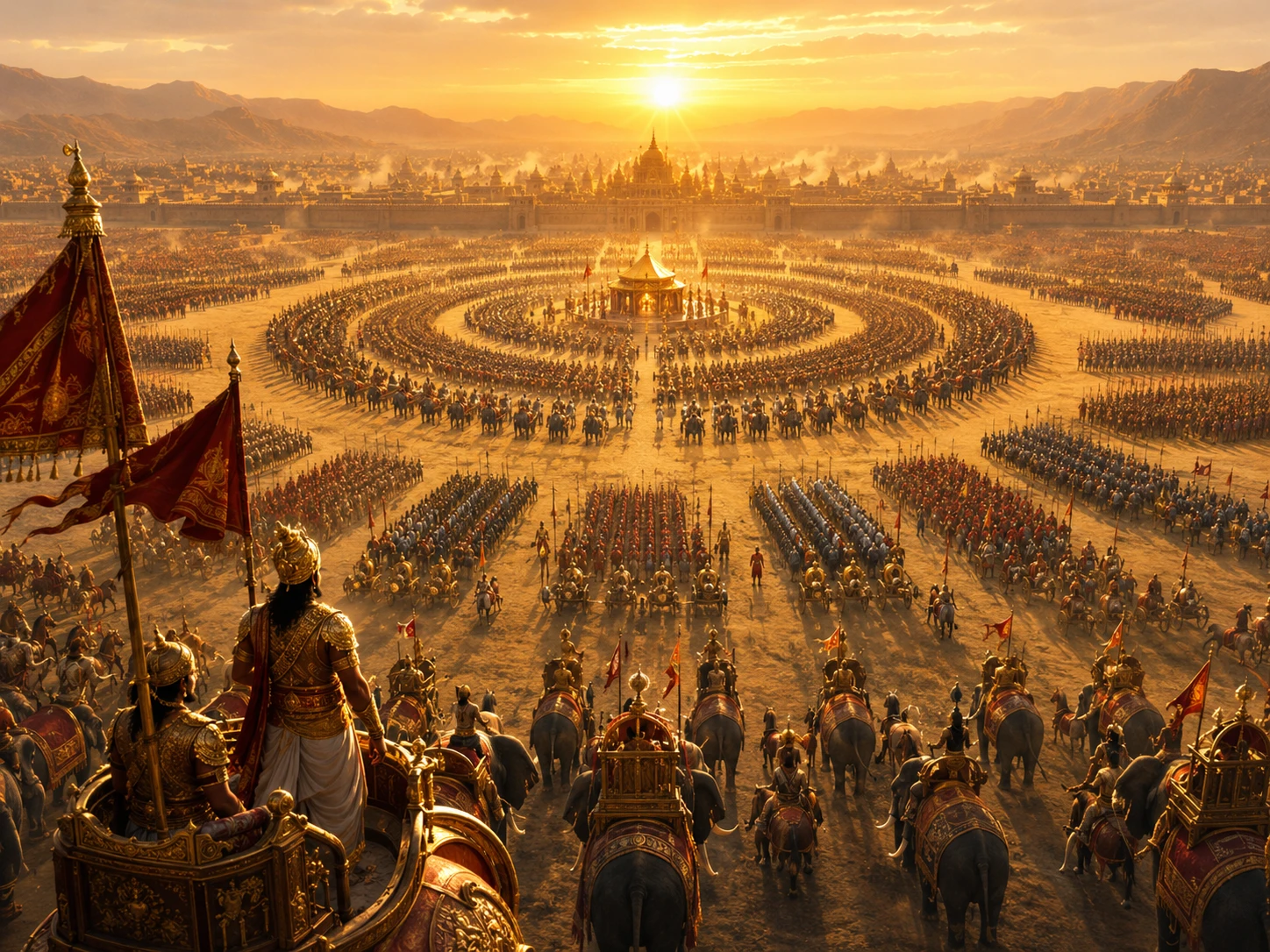
Akshauhini -- The Epic Army Structure Where Every Digit Sums to 18
14 min read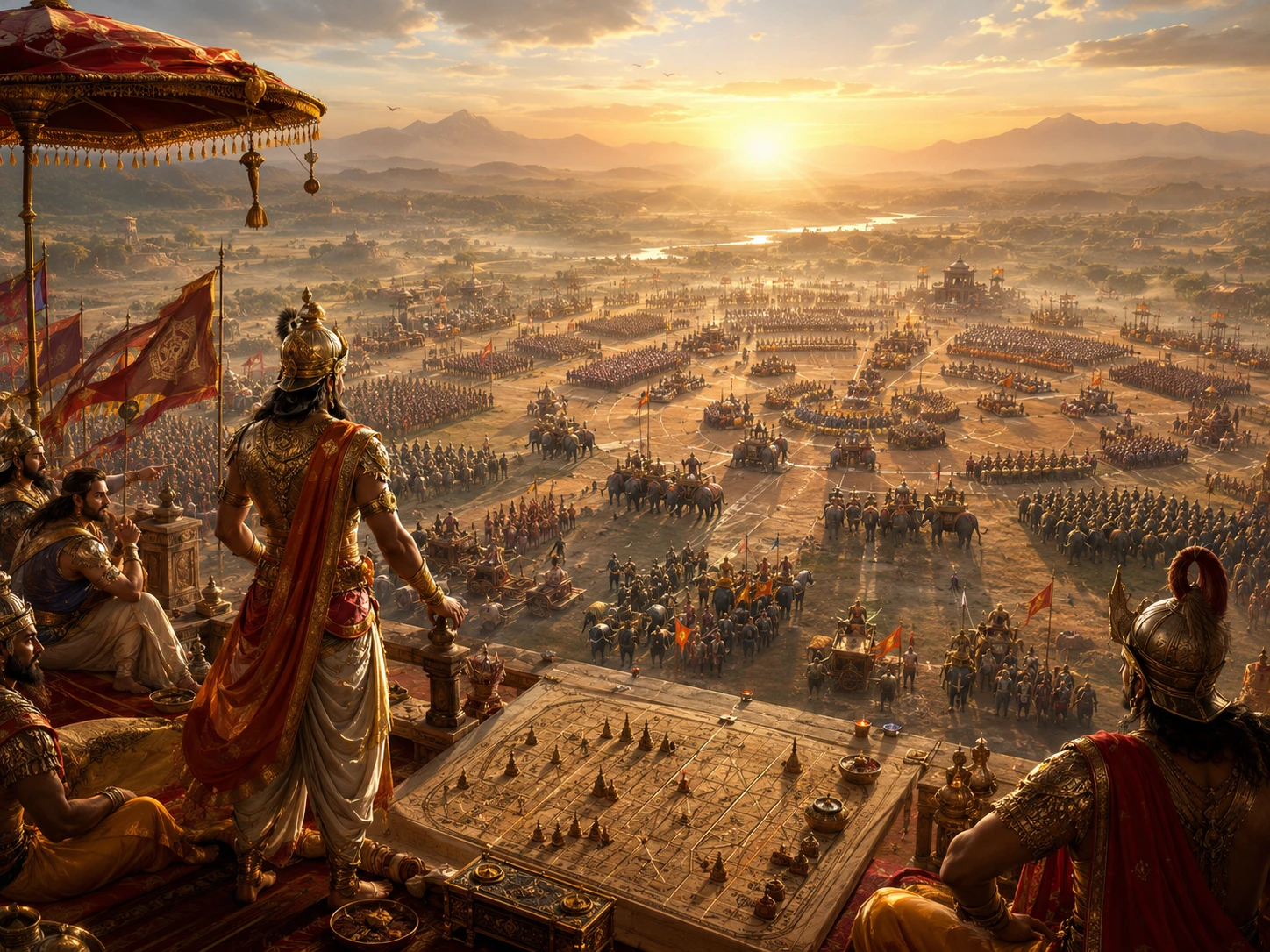
Ancient Indian Martial Arts -- Kalaripayattu to Malla-Yuddha
14 min read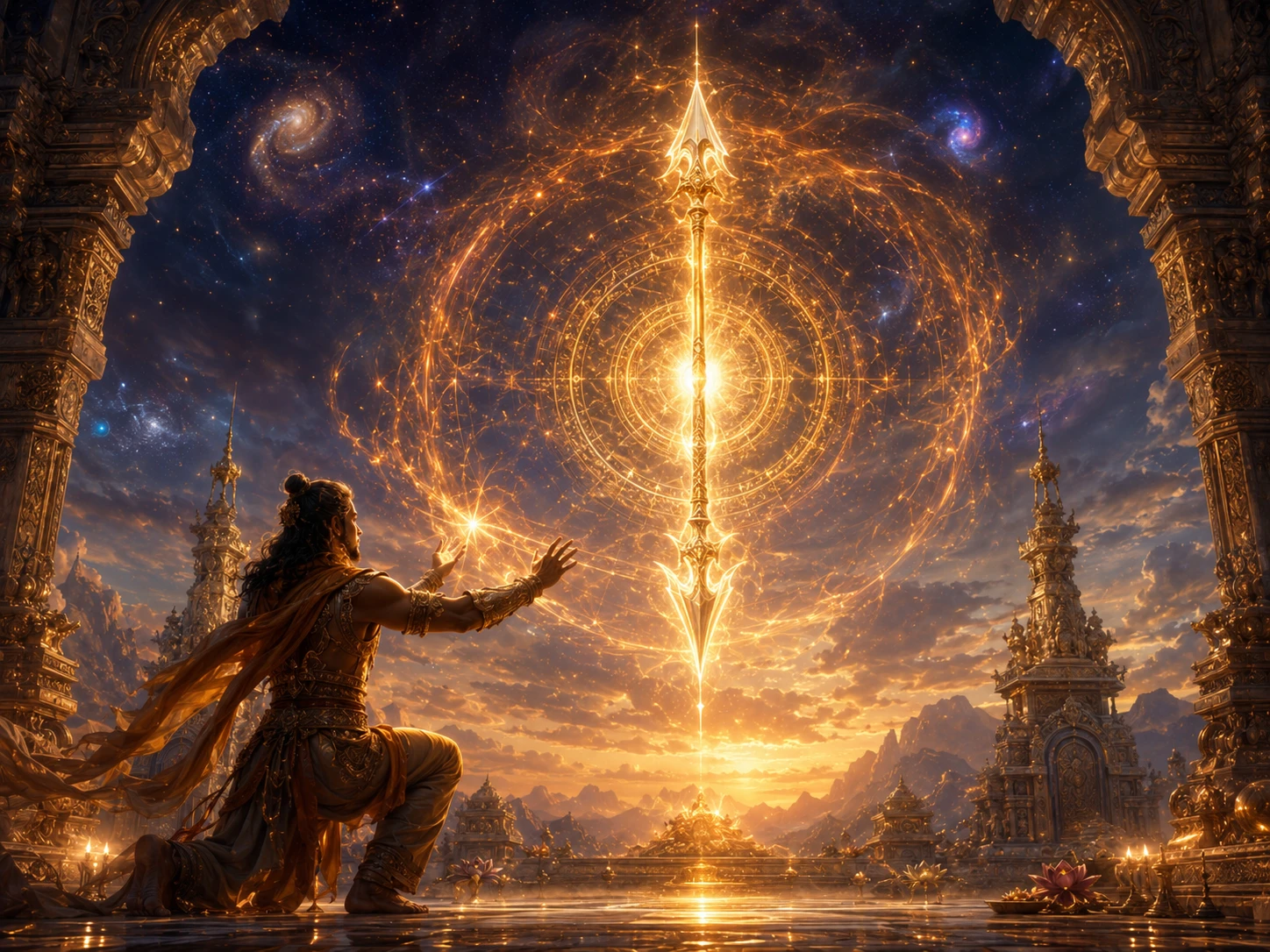
Astra Invocation and Withdrawal -- The Ritual of Weapons
16 min readThe same translation error that turned '33 Koti' into '33 crore' in Hinduism also happened in Buddhism. The Chinese translation of Buddhist texts rendered 'Sapta Koti Buddha' (7 Supreme Buddhas) as '7 Crore Buddhas.' The…
Deities AvatarsCommunity Reflections
🕉️
Be the first to share your reflection.