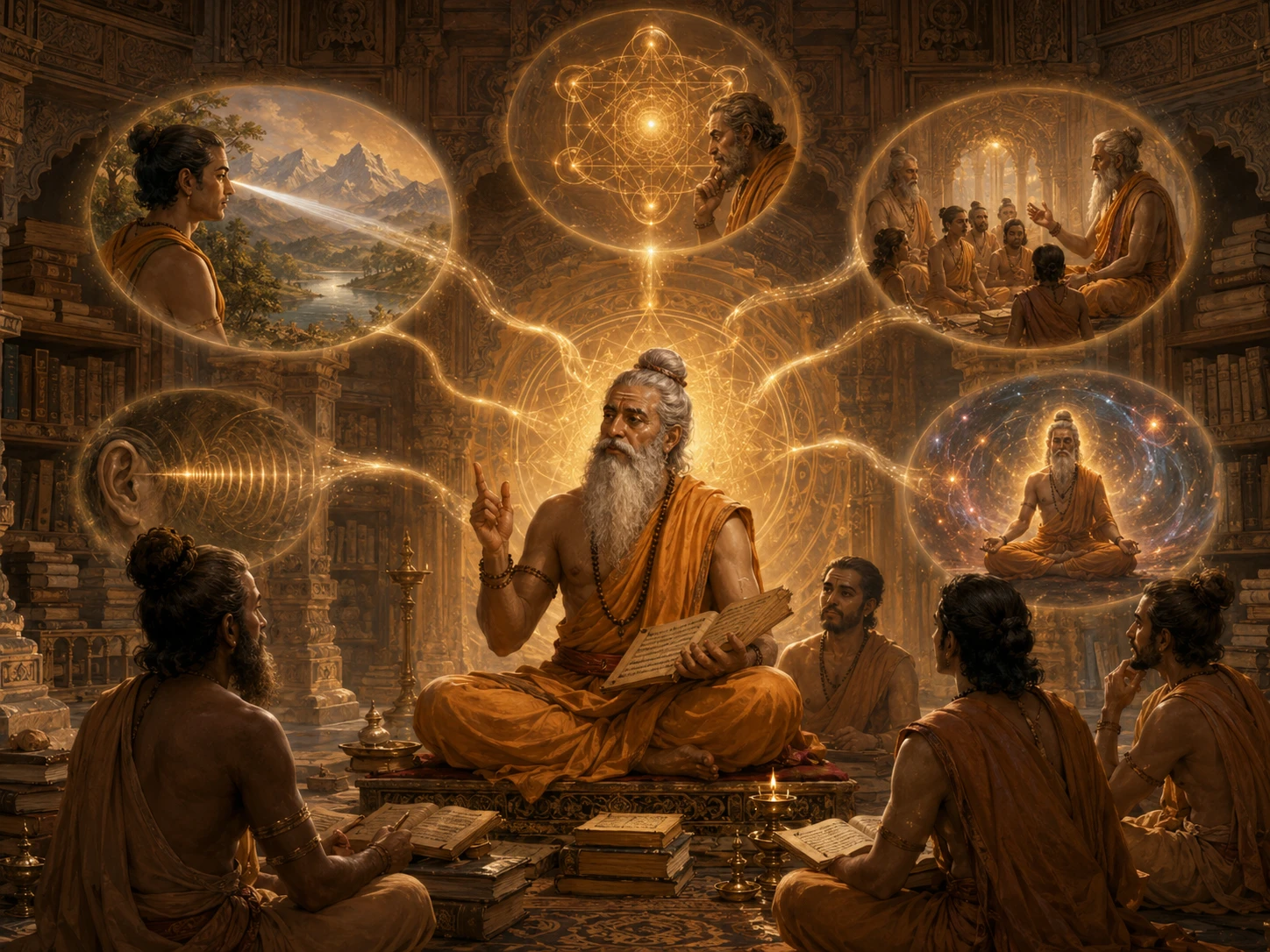
Pramana -- How Hindu Philosophy Decides What Is True
प्रमाण -- हिन्दू दर्शन कैसे तय करता है कि सत्य क्या है
Your friend in Kota forwards you a WhatsApp message: 'NASA has confirmed that chanting Om at 432 Hz can cure cancer.' Your Instagram feed shows a guru claiming that ancient Indians had nuclear weapons. A coaching centre pamphlet asserts that Aryabhata invented the internet. A Reddit thread argues that all Hindu philosophy is 'just mythology with no logical basis.'
How do you evaluate any of these claims? What tools do you have for separating truth from falsehood, valid knowledge from noise, genuine insight from dressed-up nonsense?
Indian philosophy had exactly this problem 2,500 years ago -- not with WhatsApp forwards, but with competing claims from Vedic ritualists, materialist Charvakas, Buddhist logicians, Jain perspectivists, and rival Hindu schools. The stakes were high. Each school claimed to offer the path to liberation, and each attacked the others as false. In this philosophical battlefield, the question 'How do you know?' became as important as 'What do you know?'
The answer was the Pramana system -- arguably India's greatest contribution to the philosophy of knowledge. A Pramana (from the root 'pra' + 'ma', to measure correctly) is a valid means of acquiring true knowledge. It is not the knowledge itself but the instrument by which knowledge is obtained. Think of it as a telescope for truth: the telescope is not the star, but without the telescope you cannot see the star.
Different schools accepted different numbers of Pramanas, and this disagreement is itself philosophically significant. It tells you what each school considers a legitimate source of knowledge and what it does not. The Charvaka materialists accepted only one (Pratyaksha -- direct perception). Samkhya and Yoga accepted three. Nyaya accepted four. Mimamsa and Advaita Vedanta accepted six. The number of Pramanas a school accepts reveals its epistemological generosity or austerity -- how many ways it believes truth can be reached.
प्रत्यक्षानुमानागमाः प्रमाणानि॥
pratyakṣānumānāgamāḥ pramāṇāni ||
Perception, inference, and reliable testimony -- these are the valid means of knowledge.
— Yoga Sutras of Patanjali, Sutra 1.7
Let us walk through all six Pramanas as recognised by Advaita Vedanta and Purva Mimamsa -- the most comprehensive list. The first three are accepted by nearly all schools; the last three are where the interesting philosophical disputes begin.
Pratyaksha (Direct Perception) -- the gold standard. You see fire. You feel heat. You taste sweetness. Your sense organs are in direct contact with an object, and knowledge arises without the mediation of inference or testimony. Every school of Indian philosophy accepts Pratyaksha as a valid Pramana -- even the Charvakas, who accept nothing else.
But Pratyaksha is not as simple as it seems. Indian epistemologists distinguish between Nirvikalpaka Pratyaksha (indeterminate perception -- pure sensory contact before the mind categorises it) and Savikalpaka Pratyaksha (determinate perception -- 'this is a red ball'). The Buddhists argued that only Nirvikalpaka is truly valid; the moment you categorise, you are adding mental construction. The Nyaya school disagreed: Savikalpaka is also valid knowledge because it correctly identifies objects. This debate about the boundary between raw perception and conceptual interpretation anticipates the 20th-century debates between phenomenologists and analytic philosophers in the West.
Anumana (Inference) -- reasoning from evidence. You see smoke rising from a distant hill and infer fire. You see a swollen river and infer recent rainfall. You observe your friend's red eyes and hoarse voice and infer they have been crying. Anumana is knowledge derived not from direct perception but from a logical connection between what is perceived and what is not.
The Nyaya school developed the most elaborate theory of Anumana, formalising it into a five-membered syllogism (Panchavayava Nyaya): (1) Pratijna (thesis): 'The hill has fire.' (2) Hetu (reason): 'Because it has smoke.' (3) Udaharana (example): 'Wherever there is smoke, there is fire, as in a kitchen.' (4) Upanaya (application): 'The hill has smoke.' (5) Nigamana (conclusion): 'Therefore, the hill has fire.' This five-step structure is more rigorous than Aristotle's three-step syllogism because it requires a concrete example (Udaharana) grounded in lived experience, not just abstract logical categories.
Shabda (Verbal Testimony) -- knowledge from reliable authority. This is the most distinctively Indian Pramana and the most contentious. Shabda means the testimony of a trustworthy source -- specifically, the Vedas (for Astika or orthodox schools) and, by extension, the words of an Apta (qualified, trustworthy person). You know that Everest is 8,849 metres tall not because you measured it but because you trust the testimony of surveyors. You know that a particular medicine works because you trust peer-reviewed clinical trials. Shabda is this kind of knowledge, elevated to epistemological principle.
The Charvakas rejected Shabda entirely: only what you perceive directly is real. The Buddhists accepted the testimony of the Buddha but not the authority of the Vedas. The Nyaya school accepted Shabda but only as a subcase of Anumana (inference from a reliable speaker). Mimamsa and Vedanta elevated Shabda to an independent Pramana, arguing that the Vedas are Apaurusheya (not authored by any person, including God) and therefore free from the errors, biases, and deceptions that afflict human testimony.
For the modern Indian, Shabda raises critical questions about authority, trust, and expertise. When a doctor at AIIMS prescribes a treatment, you accept it on Shabda (expert testimony). When your grandmother says 'drink haldi doodh for immunity', that is also Shabda -- but the reliability of the source and the basis of the claim must be evaluated. Shabda is not 'believe whatever you are told.' It is 'there are legitimate sources of knowledge that cannot be reduced to perception or inference, and learning to identify them is itself a skill.'
The remaining three Pramanas -- accepted by Mimamsa and Advaita Vedanta but not by all schools -- deal with subtler forms of knowledge.
Upamana (Comparison / Analogy) -- knowledge through similarity. A city dweller who has never seen a wild buffalo is told: 'A gavaya (wild buffalo) looks like a cow but is larger and more muscular.' Later, in a forest near Ranthambore or Jim Corbett, they see an animal matching this description and recognise it: 'This must be a gavaya.' The knowledge arose neither from direct perception alone (they had never seen a gavaya) nor from inference (there was no logical deduction), nor from testimony alone (the testimony gave a description, not a direct pointing). It arose from the comparison of a new perception with a prior description. That cognitive act is Upamana. Nyaya subsumes Upamana under Anumana; Mimamsa insists it is irreducibly independent.
Arthapatti (Postulation / Presumption) -- knowledge through necessary implication. Devadatta is fat but never eats during the day. You postulate: he must eat at night. This is not inference (you have no evidence of night-eating). It is a postulation required to resolve a contradiction between two known facts (fatness + no daytime eating). Without the postulation, the facts cannot coexist. Arthapatti is the epistemological equivalent of the detective's reasoning: given these clues, only one explanation makes them all consistent.
In modern life, Arthapatti operates constantly. Your colleague submits excellent code but is never at his desk during office hours. Postulation: he works remotely at odd hours. Your friend's social media shows constant travel but they claim to have no money. Postulation: someone else is paying, or the posts are fabricated. Every time you resolve a contradiction between observed facts through a necessary hypothesis, you are performing Arthapatti.
Anupalabdhi (Non-apprehension / Absence) -- knowledge through the cognition of absence. You walk into your room and know 'there is no elephant in this room.' How do you know? Not by perceiving an elephant (there is none to perceive). Not by inference (there is no smoke-fire style reasoning). You know it by the sheer non-apprehension of an elephant in a place where one could be apprehended if it existed. The knowledge of absence is a distinct cognitive act, not reducible to the other five.
This is philosophically significant because it addresses the question: can 'nothing' be known? The Nyaya school says the knowledge of absence is just a form of perception (you perceive the empty room). The Mimamsa school insists that absence is a distinct category of knowledge, because perceiving an empty room is not the same as perceiving the absence of a specific object. You can perceive a room without noticing that your keys are missing. The specific knowledge 'my keys are not here' requires a distinct cognitive act -- Anupalabdhi.
For the UPSC aspirant, the Pramana system is a goldmine for Indian Philosophy and Logic questions. For the data scientist at an IT company in Bangalore, the Pramana categories map surprisingly well onto data validation methods: Pratyaksha is primary data collection, Anumana is statistical inference, Shabda is expert consultation and literature review, Upamana is benchmarking against comparable datasets, Arthapatti is hypothesis formation to explain anomalies, and Anupalabdhi is the detection of missing data. The ancients mapped the epistemological territory; we are building on their coordinates.
The Six Pramanas -- Who Accepts What
| Pramana | Meaning | Example | Accepted By |
|---|---|---|---|
| Pratyaksha | Direct perception | You see fire, feel heat | All schools (Charvaka, Buddhism, Jainism, all Hindu schools) |
| Anumana | Inference | Smoke on hill implies fire | All except Charvaka |
| Shabda / Agama | Reliable testimony | Vedas, expert witness, trustworthy teacher | Samkhya, Yoga, Nyaya, Vaisheshika, Mimamsa, Vedanta |
| Upamana | Comparison / Analogy | Recognising gavaya by description 'looks like cow' | Nyaya, Mimamsa, Vedanta (not Samkhya, Yoga, Vaisheshika) |
| Arthapatti | Postulation / Presumption | Devadatta is fat but does not eat by day -- he must eat at night | Mimamsa, Vedanta only |
| Anupalabdhi | Non-apprehension | Knowing 'there is no pot on the table' by its absence | Mimamsa, Vedanta only |
The Charvaka school's acceptance of only Pratyaksha is the most radical empiricist position in world philosophy. Buddhism accepts Pratyaksha and Anumana. Jainism adds Shabda. The broader the epistemological toolkit, the more types of reality a school can access -- which is why Vedanta, with all six, claims the broadest metaphysical reach.
The Nyaya school's five-membered syllogism was so sophisticated that when European scholars first encountered it in the 18th century, they were startled by its resemblance to -- and in some respects superiority over -- Aristotelian logic. The German Indologist Max Mueller called Nyaya 'the most elaborate system of formal logic produced outside the Western tradition.' The Nyaya-Vaisheshika tradition also developed a theory of logical fallacies (Hetvabhasa) cataloguing five types of flawed reasoning -- remarkably similar to the informal fallacy lists taught in modern critical thinking courses at IITs and IIMs. When a UPSC coach in Old Rajinder Nagar teaches students to identify logical fallacies in essay questions, they are, without knowing it, teaching a simplified version of what Gautama's Nyaya Sutras formalised over 2,000 years ago.
Sharpen Your Buddhi -- A Pramana Exercise
The next time you encounter a claim -- in a WhatsApp forward, a news headline, or a conversation -- ask: what Pramana supports this? Is it Pratyaksha (I saw it myself)? Anumana (I inferred it from evidence)? Shabda (a reliable source told me)? If none apply, the claim may not be valid knowledge at all.
Eternal Raga · शाश्वत राग
Institutional voice — scholarly articles on Sanatan Dharma
Deepen Your Understanding
अपनी समझ और गहरी करें
philosophy darshana
Sankhya -- The Oldest Philosophy of Creation
Before the Bhagavad Gita. Before Patanjali. Before Shankaracharya. There was Sankhya -- a philosophy that explained everything from cosmic creation to human suffering without invoking God. Founded by Kapila, compressed into 72 devastating verses by Ishvarakrishna, and quietly embedded in every other Indian philosophical system that came after it.
philosophy darshana
Yoga Darshana -- Patanjali's Science of the Mind
Before yoga became a global fitness trend worth $80 billion, it was India's most rigorous system of psychology. Patanjali's 196 sutras are not about touching your toes -- they are about rewiring your mind. Here is the philosophy the world forgot when it turned yoga into exercise.
philosophy darshana
Dvaita vs Advaita -- The Greatest Debate in Hindu Philosophy
Are you and God the same being, temporarily confused? Or are you and God eternally different, connected by love but never identical? This question split Hindu philosophy into rival schools, produced centuries of razor-sharp debate, and still determines whether you pray saying 'I am Brahman' or 'I am Brahman's servant'. The answer depends on which genius you believe -- Shankaracharya or Madhvacharya.
philosophy darshana
Neti Neti -- The Method of Negation That Reveals Everything
What is Brahman? Not the body. Not the mind. Not the intellect. Not the ego. Not the universe. Not even the gods. The Brihadaranyaka Upanishad's 'Neti Neti' is the most radical answer ever given to the most fundamental question -- an answer that works by refusing to answer, stripping away everything false until only truth remains.
philosophy darshana
Antahkarana -- Manas, Buddhi, Chitta, Ahamkara
Your mind is not one thing. It is a factory with four departments -- a sensory processor (Manas), a decision-maker (Buddhi), a memory bank (Chitta), and an ego that claims credit for everything (Ahamkara). Hindu philosophy mapped these 1,200 years before cognitive science, and the map is still more elegant than anything a neuroscience lab has produced.
philosophy darshana
Atman and Brahman -- The Self and the Absolute
The Upanishads make a claim so radical that 3,000 years have not dulled its edge: the individual self (Atman) and the ultimate reality of the universe (Brahman) are not two different things. They are one. Every school of Hindu philosophy is essentially an argument about what this identity means.
philosophy darshana
Moksha -- What Liberation Really Means
It is not heaven. It is not an afterlife reward. It is not escaping the world. Moksha -- the ultimate goal of Hindu life -- is the recognition that you were never bound in the first place. But each school defines it differently: for Advaita it is knowledge, for Dvaita it is eternal love, for Yoga it is aloneness. Same word, radically different destinations.
The Nyaya school's five-membered syllogism was so sophisticated that when European scholars first encountered it in the 18th century, they were startled by its resemblance to -- and in some respects superiority over -- A…
More in Philosophy & Darshana
The 14 Lokas -- Hindu Cosmology as a Map of Consciousness
14 min read
Achintya Bhedabheda -- Chaitanya's Theology of Inconceivable Difference-and-Unity
13 min read
Adhyasa -- Superimposition and the Foundational Error of the Self
13 min readThe same translation error that turned '33 Koti' into '33 crore' in Hinduism also happened in Buddhism. The Chinese translation of Buddhist texts rendered 'Sapta Koti Buddha' (7 Supreme Buddhas) as '7 Crore Buddhas.' The…
Deities AvatarsCommunity Reflections
🕉️
Be the first to share your reflection.