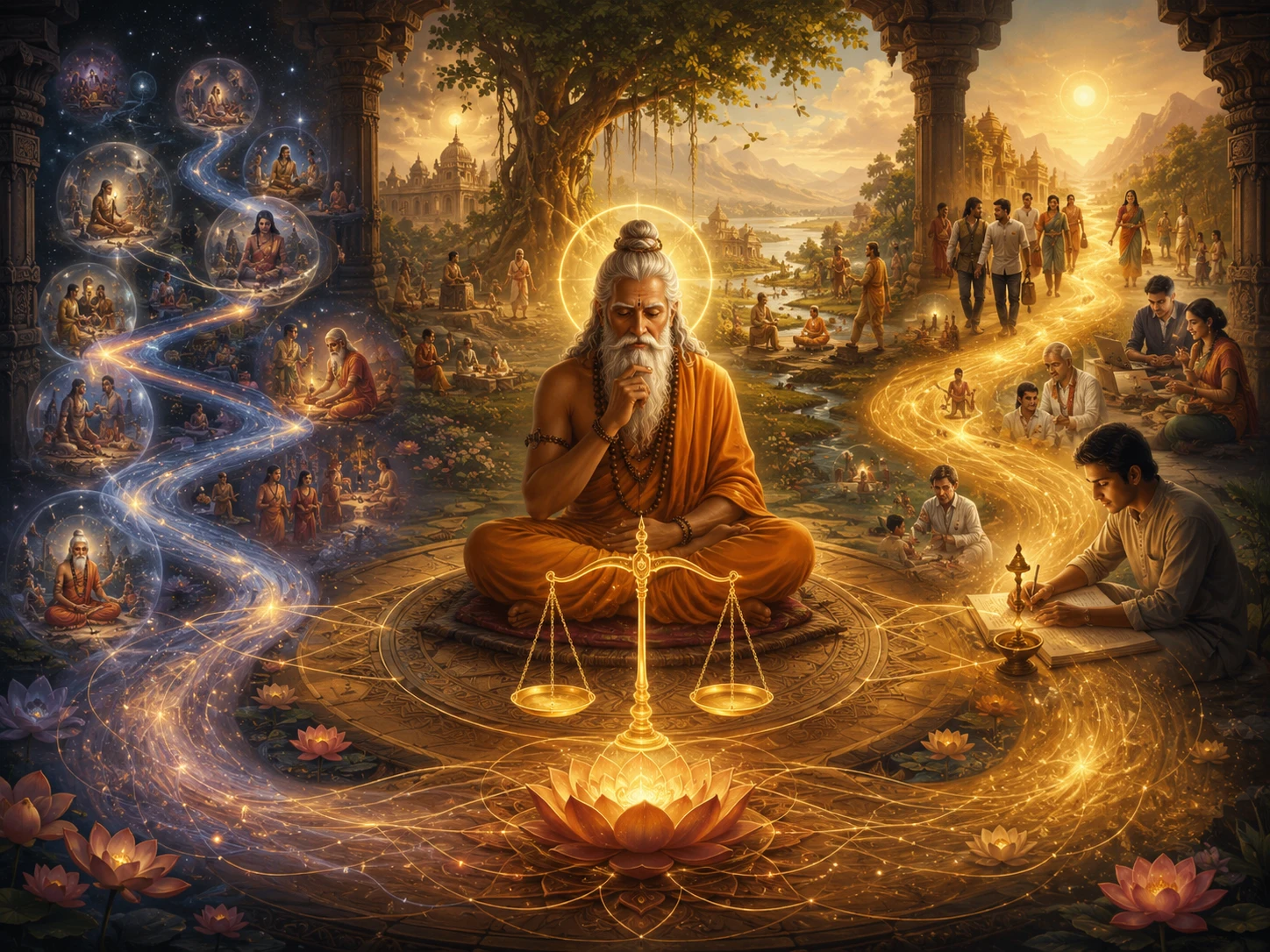
Three Types of Karma -- Why Life Feels Unfair
कर्म के तीन प्रकार -- संचित, प्रारब्ध, क्रियमाण
The first time karma fails the fairness test is usually somewhere in the second year of college. You watched the topper of your batch -- the one who never missed a class, the one your mother kept comparing you to at every family wedding -- get rejected by every campus placement company. Meanwhile, a classmate who barely showed up walked out with a 28 lakh package from a Bangalore startup. You did the spreadsheet. You counted the hours, the GPAs, the certifications. The numbers do not match the outcome. Something inside you closes a door very quietly.
This is the moment most people stop believing in karma. Not loudly, not with debate. Just a small inner shrug. If it were real, things would add up.
Hindu tradition has a different answer. Karma is real. But what most people call karma is barely the surface layer. Beneath it sits a system described in detail by the Vivekachudamani, the Yoga Vasishtha, and centuries of Vedanta commentary. Action does not return as a single mirror. It returns as a layered set of forces, ripening on different timelines, mixing with intentions, accumulating across lifetimes, and occasionally interrupted by grace. The reason your friend who copied in his JEE Main paper got a better rank is not that the universe is broken. You are looking at one frame of a film that started running long before you were born.
This article walks through the three operating layers of karma -- Sanchita, Prarabdha, and Kriyamana -- and uses five case studies from the epics and Puranas to show how the system actually behaves. By the end, the question changes. Not is it fair, but what part of this can I move. The second question is the one Hindu tradition was built to answer.
कर्मणो ह्यपि बोद्धव्यं बोद्धव्यं च विकर्मणः। अकर्मणश्च बोद्धव्यं गहना कर्मणो गतिः॥
karmaṇo hy api boddhavyaṁ boddhavyaṁ ca vikarmaṇaḥ akarmaṇaś ca boddhavyaṁ gahanā karmaṇo gatiḥ
One must understand right action, wrong action, and inaction. The path of karma is profound and hard to grasp.
— Bhagavad Gita 4.17
The Vivekachudamani, traditionally attributed to Adi Shankara, distinguishes three operating layers of karma. Later Vedantic commentaries sometimes add a fourth. Each name matters because it tells you what that layer can and cannot be moved by.
**Sanchita karma** is the warehouse. It is the total stockpile of karmic impressions accumulated across all your past lives -- every action, intention, vow, and habit you ever recorded into the soul's ledger. Most of it is not active right now. It sits in storage, waiting for the right conditions, the right body, the right environment to ripen. Think of it as a filing cabinet so deep that you have lost track of what is inside. You cannot directly see it. You cannot directly remember it. But it is the reason some seven-year-old in Mumbai picks up a violin and plays Raag Bhairavi without instruction, and another seven-year-old struggles to hold the bow at all.
**Prarabdha karma** is the arrow already in flight. It is the slice of Sanchita that has been released into this lifetime -- the body you were born into, the family you woke up inside, the country, the caste, the chronic illness, the natural talent. Prarabdha is what astrologers read in your janma kundali. It is what the Bhagavata calls bhoga -- the experience that must be lived through. You cannot pull this arrow back. You can change how you stand when it lands.
**Kriyamana karma** is the seed you are planting right now. Every choice you make in this lifetime, every word, every intention, every Instagram comment, every act of kindness or cruelty -- all of it is being written into the next round of impressions. Some of it ripens immediately, like getting fired for shouting at your boss. Most of it goes into the warehouse. This is the only layer that is fully under your control. Vedanta calls this the door through which the bound soul becomes free.
A fourth term, **Agami karma**, appears in works such as the Vivekachudamani and in Sadhguru's modern usage. It refers to the portion of Kriyamana that does not ripen in this lifetime but is stored for later. The categorisation is not standardised across traditions. The three-fold scheme -- Sanchita, Prarabdha, Kriyamana -- is what most teachers of Vedanta hold to.
The Three Layers of Karma -- Side by Side
| Layer | परत | What It Is | Control | Scriptural Anchor |
|---|---|---|---|---|
| Sanchita | संचित | Total karmic stockpile across all past lives, not yet ripened | No direct control. Can be reduced over time through jnana, dispassion, surrender. | Vivekachudamani; Yoga Vasishtha; Brahma Sutra Bhashya |
| Prarabdha | प्रारब्ध | The slice of Sanchita released into this lifetime -- body, family, station, fixed circumstances | Cannot be cancelled. Must be lived through. Response can be chosen. | Bhagavata Purana; Garuda Purana; classical jyotisha texts |
| Kriyamana | क्रियमाण | Karma being created right now through every action, word, and intention | Fully under your control. The only layer where free will operates. | Bhagavad Gita 3.4, 3.5, 4.17; Manu Smriti |
| Agami (optional) | आगामी (वैकल्पिक) | The portion of Kriyamana that does not ripen now and is stored for later lifetimes | Indirectly controlled by managing intention behind present action. | Vivekachudamani; later Vedanta commentaries |
The three-fold scheme is older and more widely accepted. The four-fold scheme separates Kriyamana (immediately ripening) from Agami (deferred). Different teachers use the terms with slight variations -- the underlying mechanics are the same.
The three layers describe the storage and timing of karma. They do not yet describe its weight. Two more variables decide how heavily any single action lands on the warehouse floor: **intention** and **dharma**.
Intention is the inner mood from which an action arises. The Sanskrit word is bhava, sometimes sankalpa. A surgeon cuts open a chest cavity and saves a life. A street thug stabs the same chest cavity and ends a life. The physical action is similar at the level of muscle and steel. The karmic weight is opposite. The Manu Smriti and the Mahabharata both insist on this distinction repeatedly. The Mahabharata's Shanti Parva is full of cases where two outwardly identical acts produce opposite karmic consequences because the inner intention behind them was different.
This is why the Gita, in chapter 2 verse 47, tells Arjuna to act without attachment to fruit. The instruction is not pious decoration. It is a direct karmic technology. Action performed for pure outcome ripens differently from action performed for ego, fear, or greed. Same action, different inner mood, different karmic load. A young analyst at a Mumbai bank who works late to genuinely serve the client builds a different Sanchita than the same analyst working late only to be seen working late by the boss. Outwardly, both are at the desk at midnight. The warehouse keeps separate folders.
Dharma is the second modifier. It asks a different question -- not what is your inner mood, but is this action in alignment with your station, your training, your role, your phase of life. A soldier who refuses to fight in a just war is not virtuous. A monk who picks up a sword is not virtuous either. Same action, different actor, different dharma, different karmic outcome. The Gita's category of svadharma -- one's own dharma -- is the technical name for this fit.
Slide ten of the carousel that triggered this article puts it cleanly. Past karma, plus present action, plus intention, plus dharma -- this is the equation that produces the experience you call your life. Drop any of the four variables and the equation no longer matches the data. Most popular karma talk drops three of them and keeps only present action. That is why most popular karma talk feels broken on contact with reality.
Once you hold the full equation in mind, the case studies of the next section become readable. Markandeya carries a heavy Prarabdha but his intention is total surrender, and his dharma as the son of a rishi is precisely to seek Shiva. Arjuna's intention is gentle but his dharma is to fight. Rama's action is exact, his intention is unbroken, his dharma is the dharma of a son of Ayodhya, and yet his Prarabdha includes exile. Karna's intention is mostly noble, but his dharma alignment is fractured by his loyalty to Duryodhana. Ajamila's lifetime karma is heavy, but his final intention -- even mistakenly directed -- meets grace. Five lives, five different mixes of the same five variables.
Theory is one thing. The system becomes vivid only when you watch it operate inside specific lives. Five figures from the Hindu canon show five different ways the three layers interact -- and five different lessons for anyone reading this.
**Markandeya -- Prarabdha overridden by grace.** The Shiva Purana and the Markandeya Purana tell of Mrikandu rishi and Marudvati, who received a boon from Shiva: a virtuous son who would die at sixteen, or a dull son who would live a hundred years. They chose the first. On his sixteenth year, Markandeya wrapped his arms around the Shiva linga and recited the Mahamrityunjaya. Yama arrived with his noose. The noose fell over the linga and the boy together. Shiva erupted from the linga as Kalantaka, struck Yama down, and granted Markandeya immortality. The Prarabdha was real -- death at sixteen was the arrow already in flight. But surrender to the divine name interrupted it. Even fixed karma is not absolute when bhakti rises high enough.
**Arjuna -- intention without dharma still binds.** On the first morning at Kurukshetra, Arjuna's reasoning is gentle. Why should I kill cousins, teachers, grandfathers? Better to live by alms than to inherit a kingdom soaked in family blood. The intention is good. The motive is human. Krishna spends eighteen chapters explaining why this is still wrong. Karma is not measured by feeling alone. It is measured against svadharma -- the action that fits your station, your training, your duty. Arjuna's good intention, applied as inaction in the face of adharma, would have created its own karma. Avoiding the fight was not freedom from karma. It was a different karma, with its own debt.
**Rama -- right action does not guarantee immediate reward.** The Ayodhya Kanda is the sharpest case study in the Hindu canon. Rama lives in perfect dharma. He honours his father's word, refuses the throne, walks into fourteen years of forest exile without a single line of complaint. The reward arrives only at the end. Dharma is not a vending machine. It does not return immediate fruit. It builds something larger over a longer arc. Your present life is a mix of past karma plus the cosmic role you carry -- and sometimes the role demands a chapter of loss before the chapter of return.
**Karna -- many forces stacked together.** Karna was generous, loyal, fierce, wronged from birth. The Mahabharata is honest about his nobility. And yet his life ends in humiliation -- the chariot wheel stuck, the kavach gone, Krishna's instruction to Arjuna to shoot anyway. Karna's outcome is not the verdict of one action. It is the sum of past karma carrying him into a lower-born identity, the curse of his guru Parashurama, the curse of a Brahmin whose cow he killed, his alliance with Duryodhana, and his own choices over a lifetime. Many forces stacked together. This is why karmic outcomes look unjust to a single-cause mind. They are never single-cause.
**Ajamila -- consciousness at death rewrites the ending.** The Bhagavata Purana, Canto 6, tells of a fallen Brahmin named Ajamila who spent decades drinking, gambling, and abandoning his vows. At the moment of death, terrified by Yama's messengers, he cried out the name of his youngest son -- Narayana. Vishnu's messengers intervened. The chant of the divine name, even uttered without devotional intent, was enough to overturn a lifetime of accumulation. Ajamila is the textbook case for one Vedantic claim: consciousness at the final moment can shift outcomes that decades of action could not.
एतावताऽलमघनिर्हरणाय पुंसां सङ्कीर्तनं भगवतो गुणकर्मनाम्नाम्। विक्रुश्य पुत्रमघवान्यदजामिलोऽपि नारायणेति म्रियमाण इयाय मुक्तिम्॥
etāvatā 'lam agha-nirharaṇāya puṁsāṁ saṅkīrtanaṁ bhagavato guṇa-karma-nāmnām vikruśya putram aghavān yad ajāmilo 'pi nārāyaṇeti mriyamāṇa iyāya muktim
This much alone -- the chanting of the names, qualities, and acts of the Lord -- is enough to wash away the accumulated sins of human beings. Even the sinful Ajamila, calling out for his son with the name Narayana at the moment of death, attained liberation.
— Bhagavata Purana 6.3.24
The Vedantic distinction between Sanchita and Prarabdha is what jyotisha rests on. A janma kundali maps Prarabdha -- the part of your karmic warehouse that has already been released into this body and lifetime. It cannot show Sanchita, because Sanchita has not yet been activated. This is why two siblings born minutes apart in the same hospital can have radically different lives. Same family, same parents, same star -- different slice of Prarabdha released. The chart is a map of the arrow already in flight, not the arrows still in the quiver.
Translate this into the actual lives the readers of this article are living right now.
A NEET aspirant in Kota studies for sixteen hours a day for two years. Her cousin in the next coaching block puts in maybe ten, half-hearted. The cousin clears AIIMS Delhi. She does not. Same prep, same teachers, same syllabus. The fairness reading collapses. The three-layer reading does not. The cousin is collecting on Sanchita -- some accumulation from a previous life, perhaps a previous mind shaped to absorb biology fast. The aspirant is paying down a different Prarabdha, one that asks her to learn what failure feels like before it asks her to learn medicine. Her Kriyamana, the studying itself, is not wasted. It is added to the warehouse. It will ripen. The film has more frames than this one.
A 38-year-old IT manager in Pune is laid off in a global cost-cut. He is the most loyal person on his team. He has not missed a single deadline in seven years. The pink slip arrives anyway. By the simple-karma reading, this is unjust. By the three-layer reading, the pink slip is Prarabdha unfolding -- a chapter the universe is closing so a chapter he has not yet imagined can open. His response in the next ninety days, that is Kriyamana. Bitterness adds to Sanchita. Patience adds to Sanchita. Both will ripen. He chooses what he plants.
An NRI in New Jersey, second generation, raised on Hindu Sundays at the Edison temple but otherwise on American school timing, finds herself sitting in her grandmother's funeral in Kolkata, listening to the priest chant verses she does not fully understand, weeping in a way she cannot explain to her American husband. That weeping is Sanchita surfacing. Some impression from a previous life or a deeper layer is brushing against her conscious mind. Hindu tradition would not call that random. It would call it the warehouse opening a small drawer.
A 26-year-old founder in Koramangala raises a seed round on her third pitch, blows through eighteen months of runway, and shuts down the company three days before a competitor with the worse product gets acquired by a US giant. The simple-karma reading screams unfairness. The three-layer reading reads it differently. Her Prarabdha brought her to the founder seat -- not everyone gets that arrow. Her Kriyamana over those eighteen months built executive muscle, network, scar tissue, and a Sanchita deposit of hard-won judgement that no MBA could replicate. The competitor's exit was the visible win. The founder's transformation was the deeper one. Five years later, when she joins a Series B as VP Product and ships the breakout feature of the decade, the audit becomes legible. The original Prarabdha did not come for the company. It came for who she would have to become to survive its closing.
Karma is not the universe being unfair. Karma is the universe being denser than the part of it you can see in any one lifetime, in any one role, in any one Excel sheet.
Three lessons emerge from the five case studies and the modern translations.
First, you cannot read karma off a single frame. Karna in his last hour looks like a man being punished. Karna across his full arc is something else -- a soul carrying many forces at once, ending one chapter, opening another. If you look at your own life as a single screenshot, the math will always feel wrong. The math was never meant to balance inside one lifetime.
Second, the Prarabdha you cannot move. The Kriyamana you can. This is the practical instruction that comes out of every Vedantic text on karma. Stop arguing with the arrow already in flight. Plant the seed in front of you with the most awake intention you can manage. Over time, that practice does two things. It exhausts old Sanchita through equanimity. And it stops loading the warehouse with new debt.
Third, grace is real, and it sits above the system rather than inside it. Markandeya should have died at sixteen. Ajamila should have descended into lower worlds of suffering. Both walked free because of bhakti -- a sincere reaching toward the divine that the ledger of action alone cannot account for. This is not a loophole. It is the place where Hindu tradition acknowledges that the soul's relationship with Ishvara is older and deeper than the soul's relationship with karma. When devotion rises high enough, fixed karma loosens. The Markandeya story is in the canon precisely so you do not give up on the day you finally see your full karmic balance sheet.
Karma is not punishment. It is not justice. It is a system of growth, and the only correct response to a growth system is to keep growing. The arrow in flight will land. What you plant today will ripen. The warehouse will open the drawers it chooses to open, in the order it chooses to open them. And somewhere above all of it, grace remains free to act. The mature student of Hindu philosophy stops asking why and starts asking how. How do I respond to what already arrived. How do I plant the next seed cleanly. How do I keep my intention high enough that the system has something good to ripen later.
Begin Your Mahamrityunjaya Japa
The Mahamrityunjaya mantra -- the one Markandeya is said to have recited at sixteen -- is the classic practice for softening prarabdha and shaping kriyamana karma. Begin with 108 repetitions on a mala. Its page on Eternal Raga gives the meaning and how to chant it.
Tags
Eternal Raga · शाश्वत राग
Institutional voice — scholarly articles on Sanatan Dharma
Deepen Your Understanding
अपनी समझ और गहरी करें
philosophy darshana
Karma Explained -- Not Punishment, Not Reward, but the Physics of Action
Karma is not cosmic revenge. It is not 'what goes around comes around.' It is India's most sophisticated theory of causation -- a framework that explains why your choices matter, why consequences are inescapable, and why freedom is still possible. The Gita's karma teaching changed Oppenheimer's life. It might change yours.
philosophy darshana
Rta, Dharma, Karma -- The Three Threads of Cosmic Order
Long before any tradition coined the word 'ethics,' Vedic thought had three distinct words for what holds existence together. Rta is the order itself. Dharma is your part within it. Karma is the receipt every action issues. This is how they fit, and why mixing them up is the most expensive error in Indian thought.
scriptural exegesis
Gita Chapter 3 -- Karma Yoga: Why Sitting Still Is Not an Option
After hearing Chapter 2, Arjuna asks the most logical follow-up question in the history of philosophy: 'If knowledge is superior to action, why are you pushing me to fight?' Krishna's answer in Chapter 3 builds the complete architecture of Karma Yoga -- why action is inescapable, how selfless action purifies, why leaders must act even when they have nothing to gain, and how desire is the real enemy on every battlefield.
scriptural exegesis
Gita Chapter 4 -- Jnana Karma Sannyasa Yoga
Chapter 4 of the Bhagavad Gita contains the most quoted verse in all of Hinduism -- 'Yada Yada Hi Dharmasya' -- and the most radical claim Krishna ever made: that He incarnates across ages whenever dharma declines. But this chapter is not just about avatars. It is a masterclass in how knowledge transforms action from bondage into liberation.
vedic sciences
Kaal Ganana -- The Hindu Measure of Time
From a single blink of the eye (Nimesha) to one Day of Brahma (4.32 billion years) -- explore the complete cosmic time hierarchy of Hindu cosmology, anchored in Vishnu Purana 1.3, with its remarkable parallels to modern science.
The Vedantic distinction between Sanchita and Prarabdha is what jyotisha rests on. A janma kundali maps Prarabdha -- the part of your karmic warehouse that has already been released into this body and lifetime. It cannot…
More in Philosophy & Darshana
The 14 Lokas -- Hindu Cosmology as a Map of Consciousness
14 min read
Achintya Bhedabheda -- Chaitanya's Theology of Inconceivable Difference-and-Unity
13 min read
Adhyasa -- Superimposition and the Foundational Error of the Self
13 min readThe same translation error that turned '33 Koti' into '33 crore' in Hinduism also happened in Buddhism. The Chinese translation of Buddhist texts rendered 'Sapta Koti Buddha' (7 Supreme Buddhas) as '7 Crore Buddhas.' The…
Deities AvatarsCommunity Reflections
🕉️
Be the first to share your reflection.