Upanayana -- The Sacred Thread That Makes You 'Twice-Born'
उपनयन संस्कार -- वो पवित्र सूत्र जो 'द्विज' बनाता है
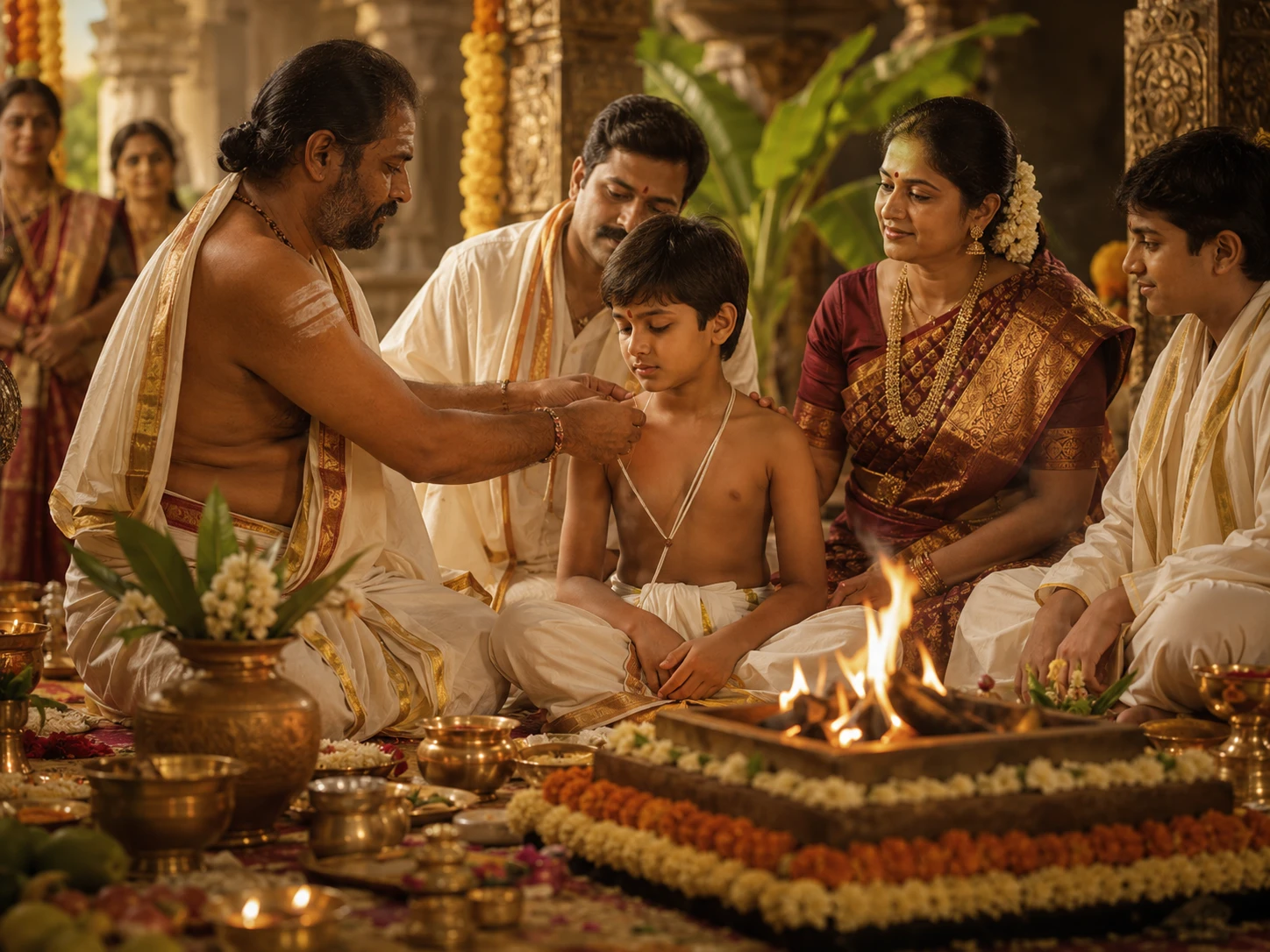
In a middle-class home in Pune, a Sunday morning. The living room has been cleared, a small havan kund set up, and the family pandit has arrived. A boy, typically between eight and twelve, sits cross-legged before the fire. His head has been partially shaved. He wears new white cotton clothes. His maternal uncle stands behind him. The atmosphere is a mix of solemnity and celebration -- somewhere between a graduation and a baptism.
The pandit chants. The fire crackles. And then comes the moment the entire ceremony builds toward: the guru leans forward and whispers the Gayatri Mantra into the boy's right ear. 'Om Bhur Bhuvah Svaha, Tat Savitur Varenyam, Bhargo Devasya Dhimahi, Dhiyo Yo Nah Prachodayat.' This is Mantra Upadesa -- the transmission of the most sacred mantra in the Vedic tradition from teacher to student.
A three-stranded cotton thread -- the Yajnopavita (popularly called Janeu in Hindi, Poonal in Tamil, Zunnar in Marathi) -- is then placed over the boy's left shoulder, running diagonally across the chest and under the right arm. From this moment, the boy is Dvija: twice-born. His first birth from his mother's womb was biological. This second birth, from the guru's mantra and the sacred fire, is spiritual. He has been 'led near' (upa-nayana) to knowledge, to discipline, and to the Vedic tradition.
The Upanayana is the tenth of the sixteen Samskaras enumerated in the Grihya Sutras. It marks the formal beginning of Brahmacharya Ashrama -- the student phase of life -- and traditionally, it was the gateway to Vedic education. No Vedic instruction could begin without Upanayana. No one could chant the Gayatri Mantra without first receiving it through this ceremony. The thread was not a decoration. It was an admission ticket to the university of Vedic knowledge.
Today, the ceremony survives in most Brahmin, Kshatriya, and Vaishya families -- though often compressed into a single morning rather than the multi-day event it once was. In many families, the boy receives the thread but does not enter Brahmacharya in any meaningful sense -- he goes back to his CBSE school on Monday. The thread becomes a cultural marker rather than a functional initiation. And yet, even in its abbreviated form, the Upanayana retains a power that every participant feels: the moment when the Gayatri is whispered into the ear, something genuinely shifts. The mantra, spoken by a guru in the presence of fire, enters the consciousness of the child and plants a seed that may take decades to germinate -- but that seed is real.
ॐ भूर्भुवः स्वः तत्सवितुर्वरेण्यं भर्गो देवस्य धीमहि धियो यो नः प्रचोदयात्॥
oṁ bhūr bhuvaḥ svaḥ tat savitur vareṇyaṁ bhargo devasya dhīmahi dhiyo yo naḥ pracodayāt
We meditate upon the glorious radiance of the divine Sun (Savitri). May that luminous being illuminate our intellect and inspire our understanding.
— Rigveda 3.62.10 (Gayatri Mantra)
The Three Strands -- What the Thread Actually Means
The Yajnopavita is not a random piece of string. It is a precisely constructed sacred object with specific symbolic layers.
The thread consists of three strands, each representing a different triad. The most common interpretation: the three strands represent the three Vedas (Rig, Yajur, Sama), the three Gunas (Sattva, Rajas, Tamas), the three states of consciousness (Jagrat/waking, Svapna/dream, Sushupti/deep sleep), or the three debts (Rishi Rna, Deva Rna, Pitri Rna). Some traditions add a fourth strand at the time of marriage, representing the responsibility to Grihastha Ashrama.
The thread is worn over the left shoulder and under the right arm (Upavita position) during normal worship and auspicious occasions. During Shraddha and ancestral rites, it is reversed -- worn over the right shoulder and under the left arm (Prachinavita position). During certain purificatory rites, it is worn as a garland around the neck (Nivita position). The three positions encode three orientations: toward the divine (Upavita), toward the ancestors (Prachinavita), and toward the self (Nivita).
The thread must be cotton -- not silk, not synthetic. It is typically white, representing purity. It is replaced annually during the festival of Avani Avittam (Upakarma), when the old thread is removed and a new one is ceremonially adopted after a renewal of the commitment to Vedic study.
For the young man who received his thread at age eight and now wears it at twenty-eight without thinking about it: the thread is a daily reminder, worn against the skin, of a commitment made in childhood. Every time you bathe, every time you change clothes, every time you feel the thread against your chest -- it asks the same question: are you living up to the knowledge that was transmitted to you? Are you a Dvija in substance, or only in ceremony?
Upanayana -- Age, Varna, and Regional Variations
| Aspect | Traditional Prescription | Modern Practice | Regional Name |
|---|---|---|---|
| Brahmin initiation age | 8 years (spring) | 8-12 years | Janeu (Hindi), Poonal (Tamil), Zunnar (Marathi) |
| Kshatriya initiation age | 11 years (summer) | Rarely observed as separate | Yajnopavita |
| Vaishya initiation age | 12 years (autumn) | Rarely observed as separate | Jandhyam (Telugu) |
| Thread material | Cotton (Brahmin), Hemp (Kshatriya), Wool (Vaishya) | Cotton for all | Brahma Sutra |
| Number of strands | 3 (bachelor), 6 (married), 9 (with dependents) | 3 or 6 most common | Varies by tradition |
| Annual renewal | Upakarma / Avani Avittam (Shravan Purnima) | Still widely observed in South India | Janeu Purnima (North), Avani Avittam (South) |
The Dharmasutras (Apastamba, Baudhayana, Gautama) differ slightly on exact ages and materials. Modern practice has largely standardised across Varnas, with cotton thread and an age range of 8-12 being most common.
The Controversy -- Caste, Gender, and Modern Reform
The Upanayana is one of the most contested rituals in contemporary Hinduism. Historically restricted to the three 'upper' Varnas (Brahmin, Kshatriya, Vaishya), it excluded Shudras and women -- a restriction that reformers have challenged for over a century.
Dayananda Saraswati and the Arya Samaj movement (founded 1875) argued that the Vedic right to Upanayana belonged to all Hindus regardless of birth-caste, based on their reading of the Vedas themselves. The Arya Samaj performed (and continues to perform) Upanayana for members of all castes, including Dalits, making it the most significant reform movement in this space.
The gender question is equally significant. Classical Dharmashastra texts (Manusmriti, Yajnavalkya Smriti) restricted Upanayana to males. However, earlier Vedic texts suggest that women could undergo the ceremony. The Harita Dharmasutra explicitly mentions two categories of women: Brahmavadinis (those who pursue lifelong Vedic study, for whom Upanayana is prescribed) and Sadyovadhus (those who proceed directly to marriage). Gargi and Maitreyi -- celebrated women scholars of the Upanishadic period -- were clearly Brahmavadinis who must have received formal initiation.
In modern India, several reform movements and individual families have begun performing Upanayana for girls. The practice is not yet widespread, but it is growing -- particularly among families influenced by the Arya Samaj, progressive Shaiva traditions, and individual gurus who advocate gender-inclusive Vedic education.
The thread itself has become a political symbol in some contexts -- a marker of Brahmin identity that some reject as casteist and others defend as sacred. This tension is real and should not be glossed over. The tradition's response must evolve: if the Upanayana is about knowledge-initiation (which the Vedas clearly intend), then restricting it by birth or gender contradicts its own foundational purpose. The thread should be the beginning of learning, not the badge of a birth-group.
The Gayatri Mantra transmitted during Upanayana is the most widely chanted mantra in the world. It appears in Rigveda 3.62.10 and is attributed to Rishi Vishwamitra. The mantra has been studied by acoustic researchers who found that its specific syllable pattern creates a resonance frequency that activates the prefrontal cortex -- the brain region associated with concentration and higher cognitive function. IIT Kanpur's Centre for Cognitive Science has conducted studies on Vedic chanting and neural synchronisation, finding measurable differences in brain wave patterns between experienced Gayatri chanters and control groups. The Rishis encoded a brain-optimization tool in a 24-syllable mantra and transmitted it through a ceremony designed to ensure it would be chanted daily for a lifetime.
The Ceremony Step by Step -- What Actually Happens
The Upanayana ceremony is one of the most elaborate domestic rituals in the Hindu tradition, traditionally spanning two to three days though now often condensed into a single morning. Understanding the sequence reveals a carefully designed psychological and spiritual journey.
The ceremony begins with Ganesh Puja and Punyaha Vachanam (purification of the space and participants). The boy's maternal uncle plays a significant role, traditionally providing the boy's ritual clothes and gifts. This maternal involvement encodes a social principle: the child's spiritual development is the responsibility of both paternal and maternal families.
The Mundan (partial head shave) or Chuda Karma may occur during or just before the Upanayana, symbolising the shedding of accumulated impurities from childhood. The boy then bathes and dons new white clothes -- representing the blank slate of a new spiritual birth.
The central sequence includes: Homa (sacred fire ritual) establishing the Aupasana fire that the boy will theoretically maintain through life. Acharyasana -- the boy formally approaches the Acharya (guru) and requests instruction. The guru accepts and the Guru-Shishya relationship is formally established. This is the 'Upanayana' proper -- the act of being 'led near' to knowledge.
The Gayatri Mantra Upadesa follows -- the guru covers himself and the boy with a cloth (symbolising the private, intimate nature of mantra transmission) and whispers the Gayatri into the boy's right ear. The boy repeats it. This moment is considered the actual 'second birth.' The cloth covering symbolises that sacred knowledge is not public spectacle but private transmission.
The Yajnopavita Dharana -- the placing of the sacred thread -- happens next. The thread is placed on the left shoulder, running diagonally across the chest to the right hip. The guru instructs the boy in the proper wearing and the three positions (Upavita, Prachinavita, Nivita).
The ceremony concludes with Bhiksha Charana -- the newly initiated boy symbolically begs for alms from his mother and other family members. This act embeds humility into the very first hour of the boy's new identity. A Dvija's first act after receiving the highest mantra is to beg. The message: knowledge does not elevate you above others. It places you in a position of dependence on the community that sustains you.
The boy is then traditionally supposed to leave for the Guru's Ashram to begin formal Vedic education. In modern practice, the family serves a feast, the boy receives gifts, and life returns to normal by evening. But the thread remains -- a permanent, physical reminder of a commitment that was made.
Upanayana in the 21st Century -- Relevance and Revival
The question every modern Hindu family faces: is Upanayana still relevant when the boy is going to IIT coaching, not a Vedic gurukul?
The answer depends on what you think the ceremony is for. If it is merely a gateway to Vedic chanting, then its relevance diminishes for families where Vedic study is not a daily practice. But if it is understood as what it was originally designed to be -- a formal initiation into disciplined learning, a public commitment to ethical conduct, and the establishment of a guru-shishya relationship -- then it is more relevant than ever.
Consider what the Upanayana provides that modern education does not: a ritual acknowledgement that learning is sacred, not merely transactional. A formal moment where the child commits to discipline, not just curriculum. A mantra (the Gayatri) that serves as a daily anchor for the rest of life. And a physical symbol (the thread) that reminds the wearer, every single day, of their commitment.
Modern education gives the child a school ID. Upanayana gives the child an identity. The ID expires. The identity endures.
Several initiatives across India are reviving Upanayana with modern adaptations. The Arsha Vidya Gurukulam (founded by Swami Dayananda Saraswati) conducts Upanayana for boys and men of all ages and backgrounds, followed by structured Vedic study programmes. The Chinmaya Mission includes Upanayana as part of its youth spiritual development track. In Pune, Nashik, and Chennai, community Upanayana ceremonies are organised where multiple families participate together, reducing costs and creating a shared experience.
For the family considering Upanayana for their son: the minimum viable ceremony requires a Gayatri Mantra Upadesa from a qualified guru, the placement of the Yajnopavita, and a Homa. This can be done in two hours. The maximum elaboration can span three days with Vedic chanting, Nandi Shraddha, and elaborate feasting. Both are valid. What matters is that the boy understands what the thread means and commits to wearing it -- not as jewelry but as a daily reminder that knowledge, discipline, and dharma are the real ornaments of a human life.
For the adult man who never had Upanayana but wishes to adopt the practice: it is never too late. Many traditions permit adult Upanayana (Vriddha Upanayana). The Arya Samaj performs it for men of any age. The Gayatri Pariwar (founded by Pandit Shriram Sharma Acharya) has initiated millions of men and women into Gayatri practice regardless of prior ceremony. The thread can be worn at any age. The commitment it represents has no expiration date.
Chant the Gayatri Mantra Daily
Whether or not you have undergone formal Upanayana, the Gayatri mantra is open to every seeker. Chant it 108 times on a mala at a sandhya (sunrise, noon or sunset). The tradition prescribes three sandhyas daily -- start with one and build from there. The Gayatri mantra's page on Eternal Raga gives its meaning.
Eternal Raga · शाश्वत राग
Institutional voice — scholarly articles on Sanatan Dharma
Deepen Your Understanding
अपनी समझ और गहरी करें
rituals traditions
The 16 Samskaras -- Rites of Passage from Womb to Pyre
Hinduism does not leave life to chance. From the moment a couple decides to conceive to the moment the body returns to the five elements, there are sixteen rituals -- samskaras -- designed to refine the human being at every critical transition. Think of them as firmware updates for the soul, installed at precisely the right moments.
rituals traditions
Sandhyavandana -- The Daily Vedic Practice That Even Rama and Krishna Never Skipped
Three times a day, at the junction of night and day, morning and afternoon, afternoon and night, the twice-born Hindu is commanded to stop everything and perform Sandhyavandana. It combines pranayama, the Gayatri Mantra, water offerings, and meditation into a single twenty-minute ritual. The Ramayana shows Rama doing it in the forest. The Mahabharata shows Krishna doing it before battle. And somewhere in India right now, an IIT student is doing it in his hostel room.
rituals traditions
Nitya, Naimittika, and Kamya Karma -- The Three Categories of Duty
Hinduism does not say 'do good things.' It says 'know which kind of action you are performing and why.' The three-fold classification of Karma into Nitya (daily non-negotiable), Naimittika (occasion-triggered), and Kamya (desire-driven) is the most practical decision-making framework the tradition offers -- and it works as well in a Bangalore startup as it did in a Vedic gurukul.
rituals traditions
Havan Vidhi -- The Vedic Fire Ritual That Purifies Air, Mind, and Karma
Every major Hindu milestone -- birth, thread ceremony, wedding, housewarming, death -- involves fire. The havan is the oldest continuous ritual technology in Hinduism, dating to the Rig Veda. You pour ghee, herbs, and grains into a consecrated fire while chanting 'Svaha,' and Agni carries your offering to the gods. Modern science confirms: the smoke actually does purify the air. Here is the complete procedure.
rituals traditions
Sankalpa -- The Ritual GPS That Locates You in the Cosmos Before Every Puja
Before any Hindu ritual begins, there is a quiet declaration that most people rush through without understanding. It names the current cosmic age, the ruling Manu, the Yuga, the year, the season, the month, the fortnight, the day, the star, the continent, the country, the river, your name, your lineage, and your exact intention. This declaration -- Sankalpa -- is the most sophisticated geo-temporal tagging system in any religious tradition. It tells the universe: I am here, I am this person, and I intend to do this specific act.
rituals traditions
Panchamaha Yajnas -- The 5 Daily Duties Every Householder Owes
You owe five debts the moment you wake up: to knowledge, to the divine, to your ancestors, to all living beings, and to fellow humans. The Panchamaha Yajnas are not grand fire rituals -- they are five daily micro-acts that the tradition considers the minimum operating system of a responsible life. Skip them and you are, according to Manu, living as a thief.
rituals traditions
Vrata -- What a Hindu Vow Really Means (It Is Not Just Fasting)
Your mother kept Karva Chauth without water for sixteen hours. Your grandmother observed Ekadashi every fortnight without fail. Your colleague skips lunch on Tuesdays 'for Hanuman.' The world sees Hindu fasting as dietary restriction. The tradition sees it as something far more radical: Vrata is a voluntary, time-bound act of self-imposed discipline that rewires the relationship between desire and willpower. Fasting is the most visible expression. But the real Vrata happens inside.
The Gayatri Mantra transmitted during Upanayana is the most widely chanted mantra in the world. It appears in Rigveda 3.62.10 and is attributed to Rishi Vishwamitra. The mantra has been studied by acoustic researchers wh…
More in Rituals & Traditions
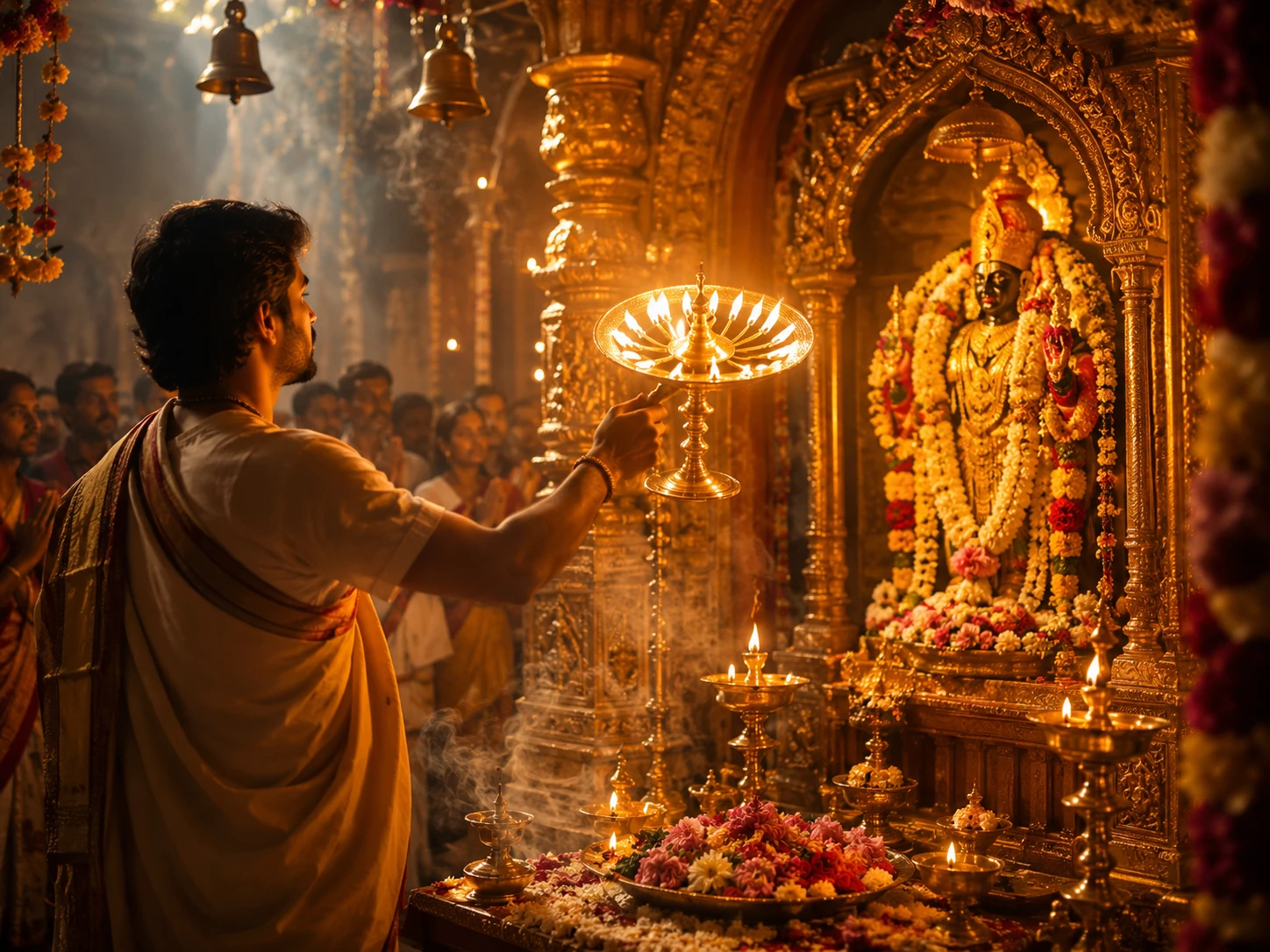
Aarti -- Why Hindus Circle Light Before God
13 min read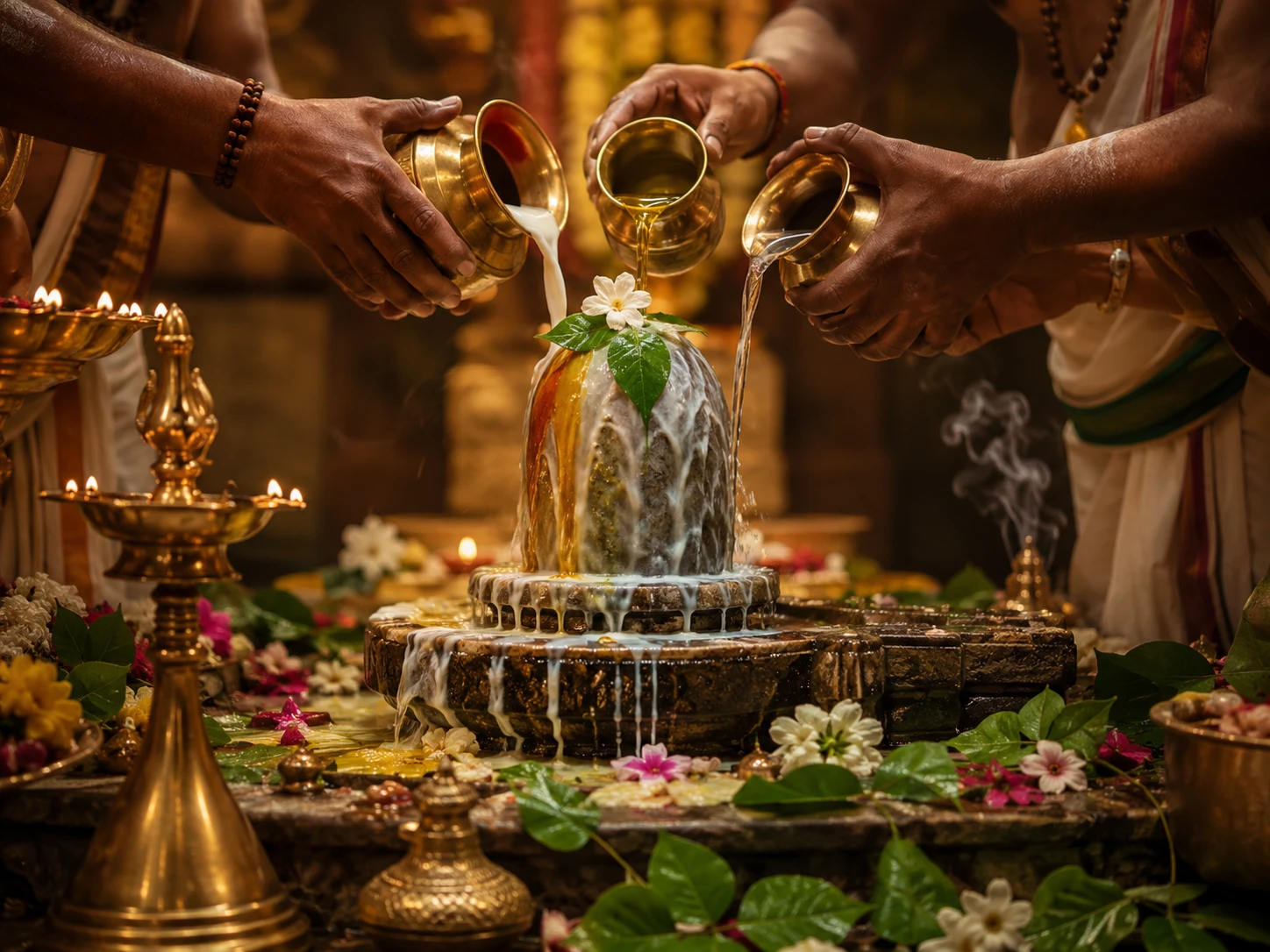
Abhisheka -- Why Hindus Bathe Their Gods
10 min read
Akshaya Tritiya -- The Day Nothing Given Away Runs Out
12 min readThe same translation error that turned '33 Koti' into '33 crore' in Hinduism also happened in Buddhism. The Chinese translation of Buddhist texts rendered 'Sapta Koti Buddha' (7 Supreme Buddhas) as '7 Crore Buddhas.' The…
Deities AvatarsCommunity Reflections
🕉️
Be the first to share your reflection.