Ravana Lifts Kailash -- How the Demon King Became Shiva's Greatest Devotee
रावण ने कैलाश उठाया -- कैसे राक्षस-राजा शिव का सबसे बड़ा भक्त बना
Ravana is the villain of the Ramayana. Every Dussehra, his effigy burns across North India -- ten heads stuffed with firecrackers, each representing a vice: lust, anger, greed, delusion, pride, envy, ego, mind, intellect, and selfishness. Children cheer. Sparklers fly. The moral is clean: evil is destroyed.
But here is what the burning effigy does not tell you: Ravana was one of the greatest Shiva devotees in all of Hindu literature. He was a Brahmin by birth (son of the sage Vishrava). He had mastered the four Vedas and the six Shastras. He was a virtuoso of the veena. He performed tapasya so intense that Brahma himself descended to grant him boons. And the hymn he composed while trapped under a mountain -- the Shiva Tandav Stotram -- is still chanted in Shiva temples across India, by the very people who burn his effigy ten days earlier.
The story comes from the Uttara Kanda of the Valmiki Ramayana, Sargas 16-17, and is one of the most sculpted episodes in Indian art history -- immortalised in the massive Ravananugraha relief at the Kailasha Temple in Ellora (8th century CE). Here is what happened.
Ravana had just conquered Alaka, the city of his half-brother Kubera, the god of wealth. He seized Kubera's treasures and his flying chariot, the Pushpaka Vimana, and was flying back to Lanka in triumph. As the Vimana passed over the Himalayas, it suddenly stopped. It could not cross a particular stretch of mountain. That mountain was Kailash.
The Confrontation, the Curse, and the Crushing
At the foot of the blocked path, Ravana encountered Nandi -- Shiva's bull-faced attendant and gatekeeper. Nandi informed Ravana that Lord Shiva and Parvati were on the mountain and no one could pass. Ravana, drunk on his recent military victory, laughed and mocked Nandi's appearance, calling him 'monkey-faced'.
Nandi's response was a curse that would echo across the entire Ramayana: 'Monkeys will destroy you and your kingdom.' This is one of the Ramayana's great structural ironies -- the Vanara army that would eventually bring Lanka to its knees was set in motion not by the abduction of Sita but by this single insult on the slopes of Kailash, years before Rama was even born.
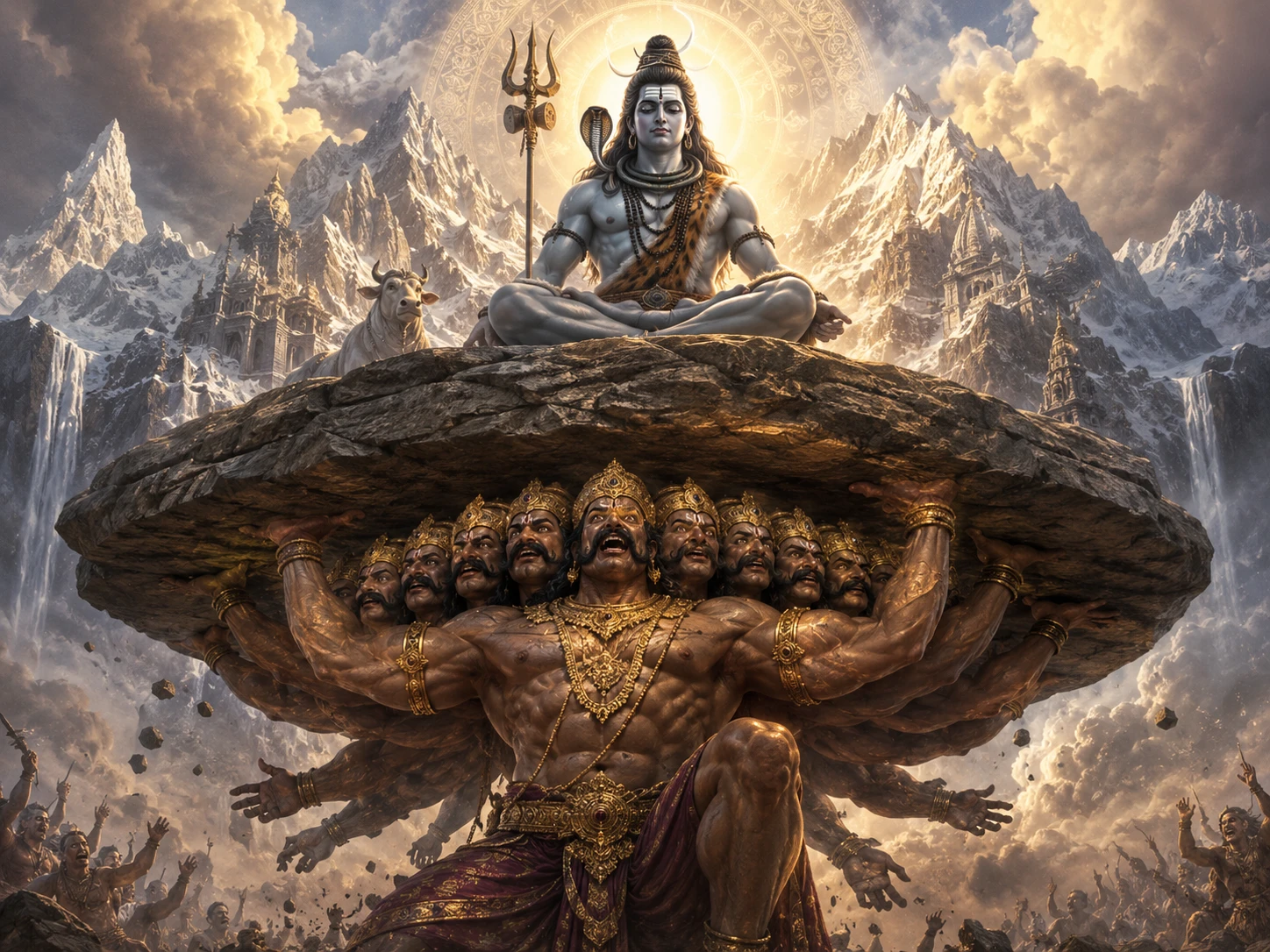
Ravana, enraged by the curse and by the indignity of being stopped, decided to do something no being had ever attempted: uproot Kailash itself. He placed all twenty of his arms beneath the mountain and began to lift.
Kailash shook. The ground trembled. Rivers reversed. Parvati, terrified, clung to Shiva. The ganas scattered. For a brief, impossible moment, the mountain actually rose.
Shiva responded with the most understated display of cosmic power in all of Hindu literature. He did not stand. He did not raise a weapon. He did not even open his eyes, in some versions. He simply pressed his big toe against the mountain. Kailash descended. Ravana's twenty arms were trapped beneath it. His fingers were crushed. He screamed -- and the scream was so loud that it shook the three worlds. This is how, according to tradition, he got his name: 'Ravana', from the root 'ru' -- to cry, to scream.
Trapped, in agony, unable to move, Ravana did the only thing left to him. He sang.
जटाटवीगलज्जलप्रवाहपावितस्थले गलेऽवलम्ब्य लम्बितां भुजङ्गतुङ्गमालिकाम्। डमड्डमड्डमड्डमन्निनादवड्डमर्वयं चकार चण्डताण्डवं तनोतु नः शिवः शिवम्॥
jaṭāṭavīgalajjalapravāhapāvitasthale gale'valambya lambitāṃ bhujaṅgatuṅgamālikām | ḍamaḍḍamaḍḍamaḍḍamanninādavaḍḍamarvayaṃ cakāra caṇḍatāṇḍavaṃ tanotu naḥ śivaḥ śivam ||
With his neck consecrated by the flow of water from the river of his matted hair, and on his neck a serpent hung like a garland, and the drum that makes the sound 'damat damat damat damat' -- Lord Shiva performed the fierce Tandava dance. May He grant us prosperity.
— Shiva Tandav Stotram, Verse 1 (attributed to Ravana, Uttara Kanda tradition)
The Thousand-Year Hymn and Its Aftermath
What Ravana sang, trapped beneath Kailash, is the Shiva Tandav Stotram -- seventeen quatrains of Sanskrit so rhythmically powerful that they sound like drumbeats even when spoken quietly. The metre is iambic octameter (16 syllables per line, alternating laghu-guru), and the alliteration creates a percussive effect that mimics the very damaru drum of Shiva's dance. It is not just a devotional poem. It is an acoustic experience -- a hymn designed to be felt in the chest before it is understood by the mind.
The Tamil tradition adds a layer: trapped under Kailash, Ravana severed one of his own heads, fashioned a veena from the skull, strung it with his own tendons, and used it to accompany his singing. This image -- a demon king playing a veena made from his own body to praise the god who crushed him -- is one of the most viscerally powerful in all of Hindu iconography.
Ravana sang for a thousand years. Some versions say he sang without pause. Others say Shiva listened from the beginning but waited to see how long the devotion would last. Eventually, Shiva was pleased. He released Ravana. He forgave him. And he granted him two gifts: the name 'Ravana' (the one whose cry makes the world tremble) and the Chandrahasa -- a celestial sword that could not be broken, as long as it was never used against the innocent.
This episode explains the central paradox of Ravana's character. He is not a simple villain. He is a man of extraordinary knowledge and genuine devotion who is undone by a single flaw: his inability to control his desire. The same pride that made him try to lift Kailash would later make him abduct Sita. The same arrogance that made him mock Nandi would make him dismiss Vibhishana's counsel. Ravana's tragedy is not that he lacked virtue. It is that his virtues were not strong enough to contain his appetites.
For a modern reader, the Ravananugraha episode teaches something uncomfortably relevant: talent without humility is self-destructive. The most brilliant person in the room -- the IIT topper, the startup unicorn founder, the Bollywood superstar -- can still be crushed by a single toe of reality if they mistake their talent for invincibility. And the only recovery from that crushing is not more force, not revenge, not denial -- but song. Surrender. Devotion. The willingness to praise what is greater than you.
The Kailasha Temple at Ellora, one of the largest monolithic rock-cut structures in the world, features a human-sized Ravananugraha relief under its southern porch. Ravana strains beneath the mountain. Shiva sits calm above, one arm around a clinging Parvati, making the abhaya mudra (fear-not gesture) with the other. The message is carved in stone: the universe runs on balance, not brute strength. And the god who destroys the universe in the Tandava can hold it in place with a toe.
Ravana -- The Paradox of the Villain-Devotee
| Aspect | Ravana the Scholar-Devotee | Ravana the Villain |
|---|---|---|
| Lineage | Brahmin by birth; grandson of Rishi Pulastya; son of sage Vishrava | Half-Rakshasa through his mother Kaikesi |
| Knowledge | Mastered 4 Vedas, 6 Shastras; expert in Ayurveda and Jyotisha | Used knowledge for conquest and domination, not liberation |
| Music | Virtuoso veena player; composed the Shiva Tandav Stotram | Made a veena from his own severed head -- devotion through self-destruction |
| Tapasya | Performed intense penance; received boons from Brahma and Shiva | Used boons to terrorise Devas, conquer the three worlds |
| Devotion | Greatest Shiva devotee; worshipped Shiva daily in Lanka | Arrogance led him to lift Kailash -- devotion laced with ego |
| Gifts from Shiva | Received Chandrahasa (invincible sword) and the Atmalinga | Lost the Atmalinga to Ganesha's trick; eventually defeated by Rama |
| Death | Rama gave him full Brahmin funeral honours; 'enmity ends with death' | Died because his boon excluded humans -- the one species he underestimated |
Ravana is the Mahabharata's Karna transplanted into the Ramayana -- a man of immense gifts destroyed by a single tragic flaw. The tradition does not reduce him to evil. It holds both truths simultaneously.
The Kailasha Temple at Ellora (Cave 16), built in the 8th century CE under the Rashtrakuta dynasty, was carved top-down from a single basalt cliff. An estimated 200,000 tonnes of rock were removed. The Ravananugraha relief at the base is one of the largest narrative sculptures in India. The entire temple is named after the very mountain Ravana tried to lift -- making the architectural structure itself a retelling of the story. Visitors to Ellora are literally walking through the episode: Kailash above, Ravana below, Shiva unmoved.
Recite the Shiva Tandav Stotram
Recite the hymn the tradition says Ravana composed beneath Kailash. The Shiva Tandav Stotram is on Eternal Raga with its meaning; feel the rhythm of Shiva's cosmic dance in its syllables.
Tags
Eternal Raga · शाश्वत राग
Institutional voice — scholarly articles on Sanatan Dharma
Deepen Your Understanding
अपनी समझ और गहरी करें
scriptural exegesis
Warriors Who Defeated Ravana Before Rama
Before Rama drew his bow, Ravana had already been humiliated by at least five beings -- crushed under Shiva's toe, trapped in Vali's armpit, imprisoned by Kartavirya Arjuna, clawed by Jatayu's father, and humbled by a child-sage. The 'invincible' demon king of Lanka was anything but. Here is the resume of defeats that the Dussehra effigies never mention.
deities avatars
Who is Shiva?
He is the ash-smeared ascetic who is also the ideal husband. The destroyer of the universe who is called 'The Auspicious One.' The god of death who drank poison to save all life. He sits in meditation on a Himalayan peak, and simultaneously dances the cosmos into existence and annihilation. No deity in Hinduism contains more contradictions -- and no deity resolves them more completely. This is not a mythology explainer. This is an attempt to stand at the foot of the mountain and look up.
deities avatars
Nine Forms of Shiva -- The Many Faces of Mahadeva
He is the silent teacher under a banyan tree and the screaming destroyer on a battlefield. He is half-woman and half-man. He drank the poison that would have ended the universe and his throat turned blue. Nine scripturally-attested forms of Shiva -- from Nataraja to Rudra -- and why each one exists.
deities avatars
Daksha's Yagna and Sati -- Why Daksha Hated Shiva
A father so offended by his son-in-law that he held a cosmic sacrifice and invited every god in the universe -- except Shiva. A wife so devastated by the insult that she walked into the sacred fire and burned herself alive. And a husband so enraged by her death that he created a warrior from his dreadlock who destroyed the entire ceremony and beheaded the father-in-law. The Daksha Yagna is not a domestic dispute. It is the origin story of the Shakti Peethas, the theology of Shiva's rage, and the reason Parvati exists.
divine arsenal
Pashupatastra -- The Supreme Weapon Never Used
The most fearsome weapon in the Mahabharata was never deployed on the battlefield. Shiva granted it to Arjuna after a wrestling match in the forests of Indrakila, yet Arjuna carried it through all eighteen days of Kurukshetra without ever invoking it. The Pashupatastra's true power lay not in its destruction, but in its restraint -- a philosophy that modern nuclear doctrine would independently discover thousands of years later.
deities avatars
Nataraja -- The Cosmic Dancer
One foot crushes a dwarf. The other is raised in liberation. A ring of fire frames the dance. A drum beats creation into existence. An open palm says 'do not fear.' This is Nataraja -- Shiva as the Lord of Dance -- and it is the single most replicated Indian bronze in the history of art. The physicists at CERN chose it to stand outside the world's largest particle accelerator. The Chola bronzesmiths of Tamil Nadu perfected it a thousand years ago. And every time a subatomic particle appears and disappears, the cosmic dance continues.
The Kailasha Temple at Ellora (Cave 16), built in the 8th century CE under the Rashtrakuta dynasty, was carved top-down from a single basalt cliff. An estimated 200,000 tonnes of rock were removed. The Ravananugraha reli…
More in Scriptural Exegesis
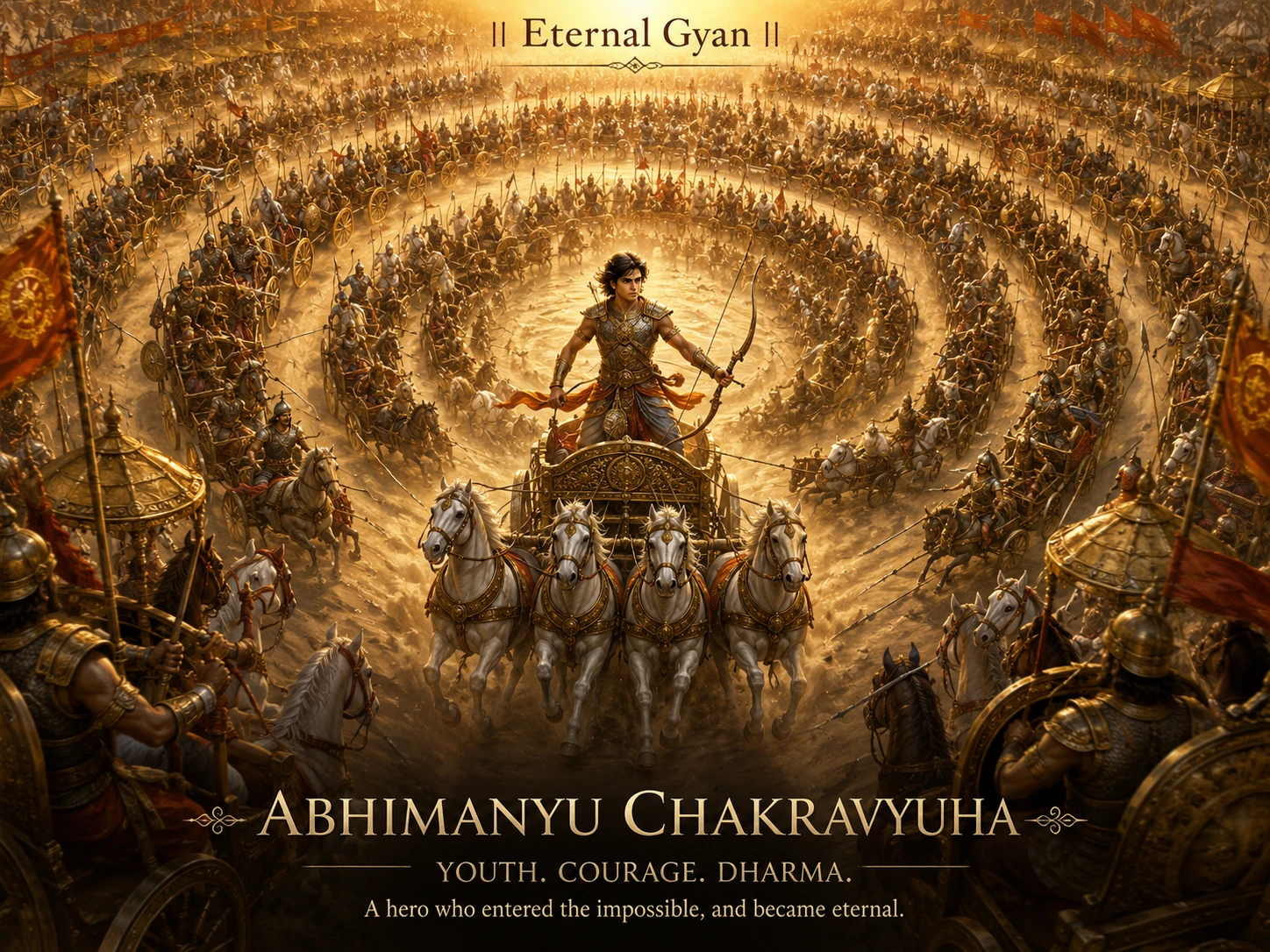
Abhimanyu and the Chakravyuha -- The Boy Who Knew How to Enter but Not How to Leave
14 min read
Adbhuta Ramayana -- The Ramayana Where Sita Becomes Kali
9 min read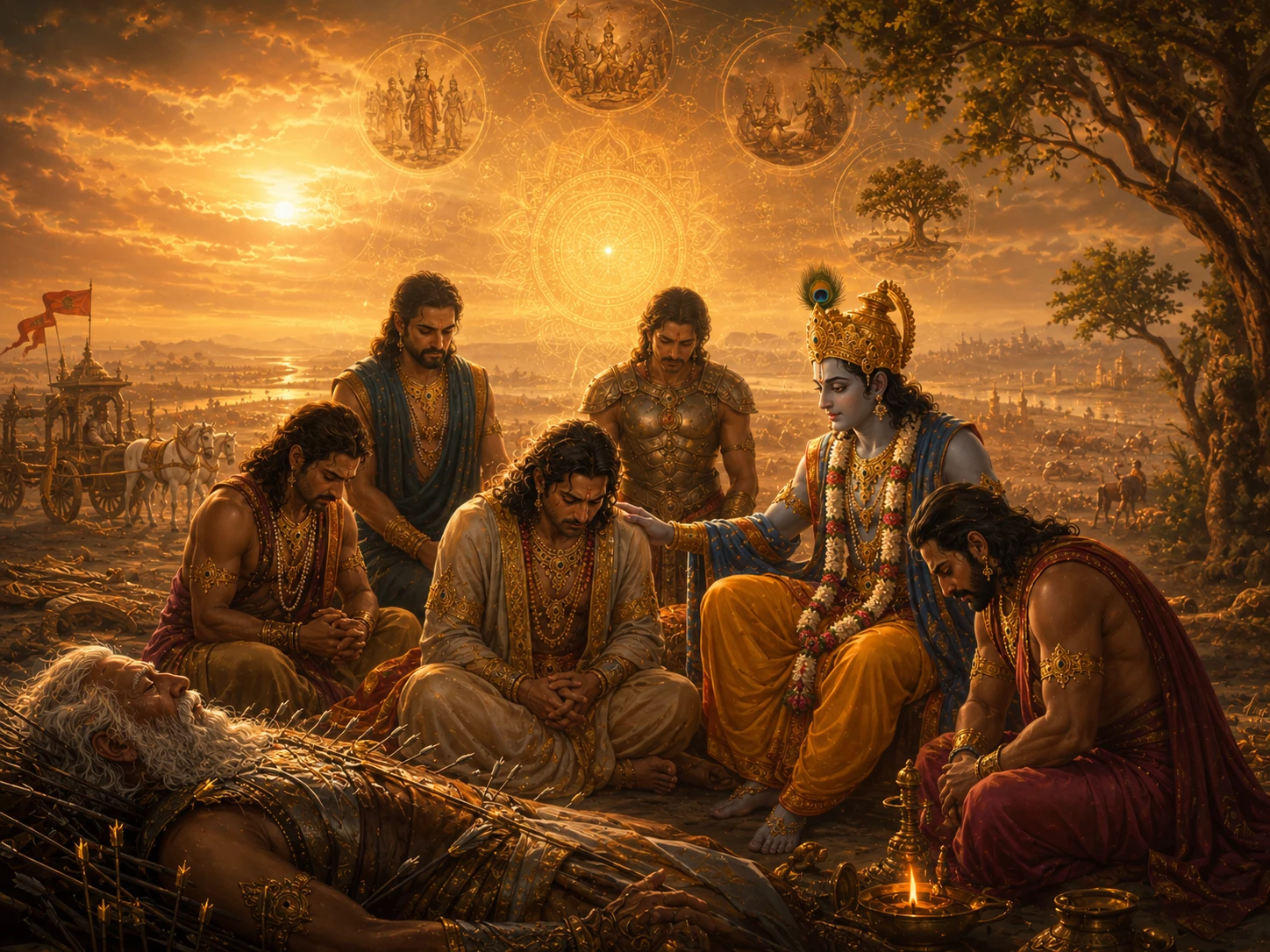
After Kurukshetra -- What Happened Next
14 min readThe same translation error that turned '33 Koti' into '33 crore' in Hinduism also happened in Buddhism. The Chinese translation of Buddhist texts rendered 'Sapta Koti Buddha' (7 Supreme Buddhas) as '7 Crore Buddhas.' The…
Deities AvatarsCommunity Reflections
🕉️
Be the first to share your reflection.