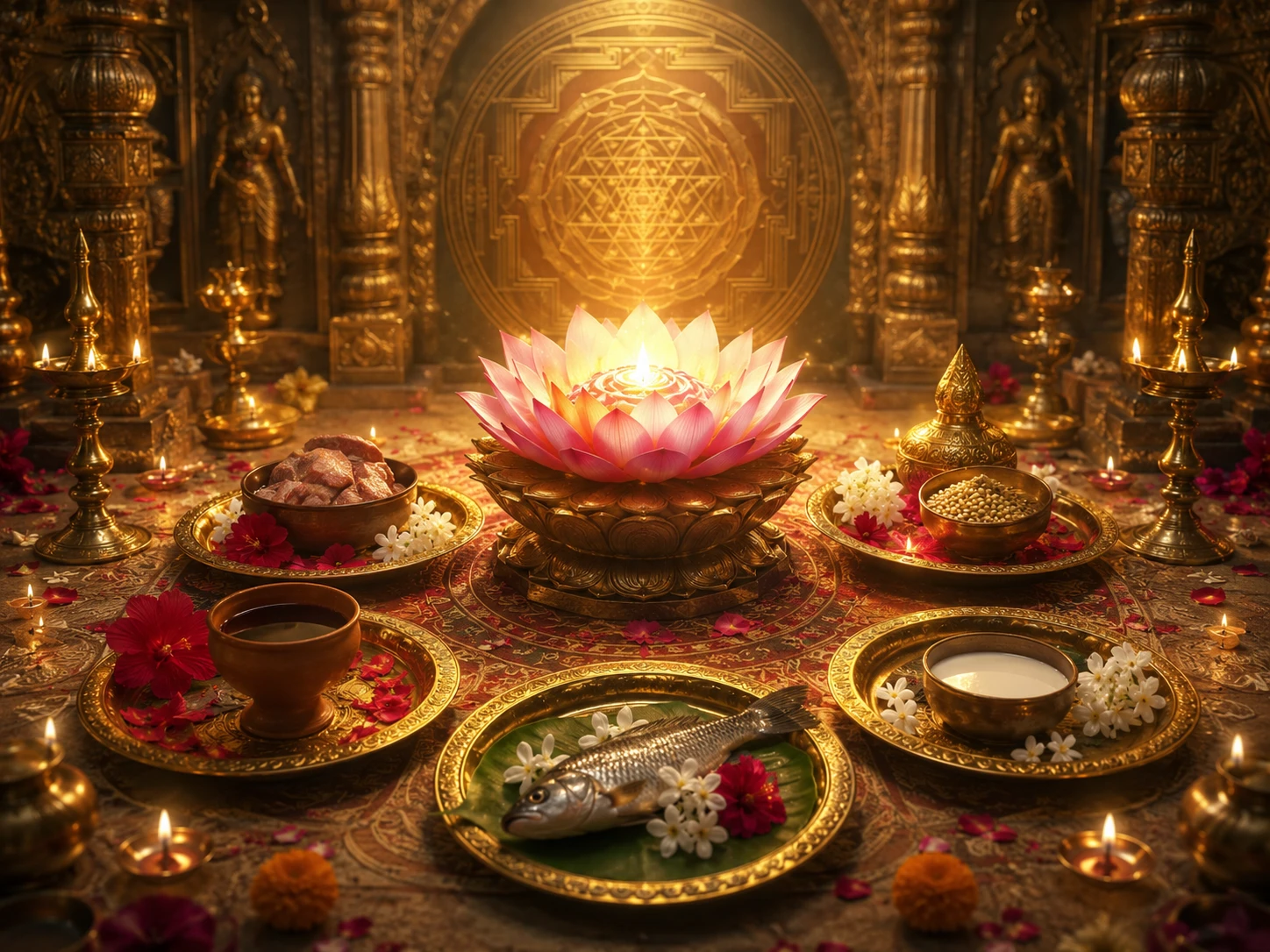
Panchamakara -- Literal, Symbolic, Esoteric Readings
पंचमकार -- शाब्दिक, प्रतीकात्मक, गूढ़ पाठ
Few topics in Hindu spirituality are as misunderstood by outsiders and as carefully handled by insiders as Panchamakara, the five substances beginning with the Sanskrit letter M that sit at the heart of Kaula tantric ritual. The five are Madya (wine), Mamsa (meat), Matsya (fish), Mudra (parched grain, or in some readings ritual hand gestures), and Maithuna (sexual union). Every one of the five violates some part of the standard Hindu code of ritual purity. Wine is forbidden to orthodox brahmanas. Meat is restricted in most Vaishnava traditions. Fish is avoided during religious observance in many communities. Parched grain is unusual in puja offerings. And Maithuna outside sanctified marriage is considered a serious spiritual transgression across most Hindu strands. The tantric tradition takes these five and makes them the centre of its ritual. The result is a body of practice that Hindu orthodoxy has historically distrusted, Western Orientalist scholars have often misrepresented, and modern media routinely sensationalises. The truth lies in between and requires patience to map.
The first thing to understand about Panchamakara is that the tradition itself offers multiple readings simultaneously, and each reading is considered valid within its proper context. There are three layers. The literal reading, followed by the strictest Kaula or Vamachara schools, uses the five substances as physical offerings in ritual. Wine is poured, meat is cooked, fish is prepared, parched grain is served, and in the advanced Maithuna practice, ritual union takes place between a consecrated practitioner couple within carefully circumscribed conditions. The symbolic reading, preferred by the Samaya or Dakshinachara schools, takes each of the five as a pointer to something else entirely. Madya becomes the amrita nectar that drops from the sahasrara during deep kundalini states. Mamsa becomes the drawing in of the tongue during khechari mudra. Matsya becomes the balanced flow of breath in ida and pingala like two swimming fish. Mudra becomes the specific internal gestures or ritual hand positions used during yoga and japa. Maithuna becomes the internal union of Shiva at the sahasrara and Shakti at the muladhara within the upasaka's own body. No external objects are used. The esoteric reading, found mainly in advanced Kashmir Shaiva and certain Kaula-tantric contexts, treats the five as stages of cosmic realisation that the upasaka actually embodies rather than either enacts externally or merely visualises internally. Each of the three readings has its own scriptural warrant and its own lineage of teachers.
मद्यं मांसं च मीनं च मुद्रा मैथुनमेव च। मकारपञ्चकं ह्येतन्मोक्षदं महतामपि॥
madyaṃ māṃsaṃ ca mīnaṃ ca mudrā maithunameva ca | makārapañcakaṃ hyetanmokṣadaṃ mahatāmapi ||
Wine and meat and fish, and mudra, and maithuna -- this fivefold set of letters beginning with M bestows liberation even on the great ones.
— Kulachudamani Tantra, a classical Kaula scripture cited by John Woodroffe in Shakti and Shakta (1918) and attested in Bengali tantric manuscript tradition
Madya is the first of the five and the one most frequently misread. The literal Kaula use of wine is not casual drinking. The quantity offered in ritual is typically a few drops to a small ladle-full, consecrated with specific mantras, offered first to the Goddess on the altar, and only then taken as prasada by the initiated participants. The setting is a formal ritual within a closed circle of consecrated practitioners. The wine is not served throughout the ritual but at specific moments keyed to specific mantras. Anyone who has watched a legitimate Kaula puja at Tarapith or Kamakhya knows that there is nothing resembling a party atmosphere. The ritual is solemn, silent, and technically demanding. The symbolic reading of Madya identifies it with the soma, the ambrosia that ancient Vedic rituals offered to Indra, and in the yogic interpretation with the amrita that advanced kundalini practitioners experience dripping from the sahasrara down into the body. A Samaya upasaka substitutes this internal amrita for the external wine and performs the ritual without any physical alcohol. Both are valid within their frames. What is not valid is treating wine as ordinary drink that happens to be part of a spiritual practice.
Mamsa, meat, follows the same structural logic. In literal Kaula ritual, the meat used is typically from a specific animal prescribed for the specific deity being worshipped -- goat meat for Kali, sometimes fish or buffalo in other contexts. The meat is prepared with ritual discipline, offered first to the Goddess, and consumed as prasada by the consecrated circle. Vegetarian Kaula lineages exist, especially in South India, and these substitute coconut meat or specially prepared grain preparations to fulfil the ritual requirement without animal products. The symbolic reading interprets Mamsa as the tongue drawn upward in khechari mudra, where the practitioner tucks the tongue back against the soft palate and experiences a specific internal energetic effect. Another symbolic reading treats Mamsa as speech that is drawn inward, representing the discipline of holding the tongue in silence during extended japa. The esoteric reading treats Mamsa as the absorption of the animal nature itself into awareness, the moment in sadhana where the practitioner stops identifying with her biological impulses without suppressing them. Each reading carries weight within its frame. A Vaishnava-trained seeker naturally gravitates toward the symbolic reading. A Bengali Kaula initiate may receive the literal version. Both can legitimately claim to be performing Panchamakara.
The Three Readings of Panchamakara
| Makara | Literal (Kaula/Vamachara) | Symbolic (Samaya/Dakshinachara) | Esoteric (Advanced Yogic) |
|---|---|---|---|
| Madya (wine) | Consecrated wine offered and consumed in small ritual quantity | Amrita dripping from sahasrara during kundalini ascent | Ecstatic non-dual awareness itself |
| Mamsa (meat) | Consecrated meat from prescribed animal, offered and shared | Tongue drawn up in khechari mudra; restrained speech | Absorption of animal nature into pure awareness |
| Matsya (fish) | Consecrated fish prepared in specific ritual manner | Balanced breath in ida and pingala nadis | Union of outgoing and incoming currents of awareness |
| Mudra (parched grain) | Parched grain offered on altar | Specific ritual hand gestures used in japa and meditation | Spontaneous internal seal of consciousness in samadhi |
| Maithuna (union) | Ritual union between consecrated partners in circumscribed setting | Internal union of Shiva and Shakti at sahasrara | Non-dual realisation where duality itself dissolves |
These three columns are not rivals. They are three different registers in which Panchamakara has been practised by different lineages across a thousand-year history. The Guru determines which register applies to which disciple.
Matsya, fish, is in some ways the least controversial of the five because even the literal Kaula ritual uses a symbolically small quantity, and the fish is typically of a small ceremonial variety. The rich symbolism of fish in Indian culture -- Vishnu's first avatar Matsya, the twin fish as auspicious symbol on ritual floors, the fish motif in Bengali and Keralite temple art -- feeds into the tantric use. The yogic reading is particularly elegant. Ida and Pingala, the two major nadis running on either side of the spinal column, are described in tantric texts as resembling two fish intertwined around the central Sushumna. When the breath flows equally in both nostrils, balanced and rhythmic, the two fish are said to be swimming together in harmony. This is the internal Matsya state. Pranayama techniques that balance the breath between the two nostrils are quietly doing Matsya upasana without using the word. A Mumbai yoga practitioner who sits each morning for nadi shodhana pranayama, alternate-nostril breathing, is actually performing the internal form of Matsya. The tradition does not require her to eat fish to do this. Symbolic reading is not a watered-down version of literal reading. It is the same ritual transposed into a different register.
Mudra is where translation becomes especially tricky because the word mudra in Sanskrit has several distinct technical meanings. In the Panchamakara context, the most common literal reading takes Mudra as parched grain, typically roasted rice or roasted chickpeas, offered on the altar and consumed as prasada. This is the reading followed in most Bengali Kaula rituals. A second technical meaning of Mudra is ritual hand gestures, of which hundreds are described in tantric, yogic and nritya texts. In the symbolic reading of Panchamakara, Mudra refers to the specific hand gestures used during japa, nyasa, and meditation -- gestures like Gyan mudra, Chin mudra, Dhyana mudra, and more specialised tantric variants like Yoni mudra and Linga mudra. A third esoteric reading treats Mudra as the spontaneous internal seal that arises in deep samadhi, where awareness locks itself into a specific configuration without any external gesture. This is the unforced natural mudra that advanced meditators describe. The three readings together give Mudra a conceptual range from edible prasada to cosmic seal of awareness. Which one the upasaka works with depends on her lineage, her stage of practice, and her Guru's assessment. Trying to collapse the three into a single reading misses the richness of the tradition.
Maithuna is the fifth makara and the one that has drawn most Western attention, most distorted representation, and most serious misuse. The literal Kaula practice of Maithuna is a ritual union between a consecrated practitioner couple within a carefully circumscribed setting. It is not a public event, not an orgy, not a casual encounter, and not available to uninitiated participants. The couple is prepared through years of individual sadhana first. The union takes place within a ritual container that includes preparatory mantras, nyasa on both bodies, visualisation of the self as the specific deity and the partner as the corresponding consort, and strict protocols about what is permitted and what is not. In most genuine lineages, the ritual union does not involve ejaculation, which is considered a loss of the very Shakti the ritual is trying to concentrate. Instead, the union is held as a motionless embrace of extended duration, sometimes hours, during which the practitioners together attempt to move energy upward through the central Sushumna channel. The goal is an internal event called urdhvaretas, the upward retention and sublimation of sexual energy into pure awareness. Most Kaula practitioners never actually reach the Maithuna stage of the five Ms. They work with the other four externally and keep Maithuna in its symbolic register for decades, only attempting literal practice under direct Guru supervision once every other preparation is complete.
The symbolic reading of Maithuna is universally accessible and is the form in which most Sri Vidya practice actually operates, even in nominally Kaula lineages. Internal Maithuna is the union of the Shiva-bindu at the sahasrara with the Shakti-bindu at the muladhara within the upasaka's own body, accomplished entirely through mantra, visualisation, and subtle-body work with no external partner. The tradition considers this internal union fully equivalent to external Maithuna for the purposes of sadhana, and in most cases preferable because it does not require two compatible consecrated partners or the specific conditions needed for external ritual union. The esoteric reading goes one step further. At its highest level, Maithuna is the realisation that Shiva and Shakti were never two, and therefore no union is needed -- there was only ever a single non-dual awareness that had appeared to itself as two in order to play the game of creation. A practitioner who has reached this realisation has completed Panchamakara in its deepest sense. She may choose to continue external ritual for the benefit of community and lineage, but the internal work is done.
The history of Panchamakara abuse deserves blunt treatment because it is where the tradition has suffered the most damage. Between the 16th and the 19th centuries, certain peripheral lineages in Bengal, Assam and Nepal drifted into literal Panchamakara practices that had lost their ritual frame. Wine became ordinary drinking. Meat became feasting. The ritual hand gestures were forgotten. And Maithuna became an excuse for exploitative practices that concealed sexual predation under tantric language. British Orientalist scholars in the 19th century encountered these degenerate forms and generalised them as the entire tantric tradition, producing a body of scholarship that painted Panchamakara as inherently orgiastic. The Bengali Renaissance figures in the early 20th century, embarrassed by what their own regional traditions had become, often joined the Orientalist critique rather than defending the authentic tradition. It took scholars like John Woodroffe, writing as Arthur Avalon, and later Bharati Krishna Tirtha and Swami Lakshmanjoo, to slowly rebuild the distinction between authentic Kaula Panchamakara and its degenerate imitations. The contemporary Indian reader in 2026 who approaches the topic fresh should understand that both extremes have existed historically. What exists now in reputable lineages is controlled and small. What has existed in ruins of lineages and in internet-era fake tantrism is something else entirely.
A 2026 aspirant should be given blunt practical advice. Do not attempt literal Panchamakara without initiation from a verified Guru in a documented lineage. There are no shortcuts. No online course that promises to teach you Panchamakara through video modules is legitimate. No weekend tantra workshop run by a Western teacher with unclear Indian credentials is teaching authentic Panchamakara. No self-styled tantric who responds to Instagram DMs promising Maithuna practice is working within any recognised tradition. The genuine article exists, it is transmitted, and it is accessible to those who undertake the slow preparatory work over years. It is not widely advertised and does not need to be. A sincere aspirant who wants to encounter authentic Panchamakara can visit Tarapith during Kaushiki Amavasya in August, observe legitimate Kaula worship from a respectful distance, and if moved to go deeper, approach an established matha in Kamakhya or certain Kolkata-based teacher lineages through formal introduction. The preparatory practices for even being considered include years of Bala Tripura Sundari mantra, Devi Mahatmya recitation, and Guru seva. Only after this preparation does the question of Panchamakara even arise.
A specific modern misconception deserves correction. Popular literature often claims that Panchamakara was a radical inclusion of women, casteless persons, and marginalised identities into the spiritual mainstream, transgressing caste and gender rules. There is partial truth here. Kaula Tantra did admit women as full initiates, did sometimes admit non-brahmanas, and did in principle assert that the Goddess is equally accessible regardless of social location. But claiming this as a simple egalitarian move misses the controlled, guild-like nature of actual Kaula transmission. Admission to Kaula initiation was tightly gated. It required extensive preparation, recommendation from existing initiates, and a specific assessment of personal readiness by the Guru. The lineage was selective, not democratic. Marginalised individuals who were admitted were admitted because their individual temperament and preparation made them suitable, not because the tradition treated every marginalised person as automatically qualified. This careful gating is one reason genuine Panchamakara practice has survived for over a thousand years without fully collapsing into the abuse patterns discussed earlier. The lineages protected themselves by being slow to admit and strict about preparation. Contemporary activist readings of tantra as a proto-egalitarian movement miss this operational detail and therefore misrepresent how the tradition actually protected itself and its practitioners.
To close on a philosophical note, Panchamakara ultimately encodes a specific claim about the nature of spiritual progress. Most Indian religious traditions ask the aspirant to renounce certain categories of experience -- meat, wine, sexual activity, transgressive contact -- as a way of stabilising the mind. The Kaula position is that renunciation without prior engagement is incomplete. The aspirant who has never encountered what she renounces has not actually transcended anything; she has only avoided contact. True transcendence requires the full encounter. The aspirant who, with proper preparation and Guru supervision, enters the ritual space where wine, meat, fish, grain and union are all present, offers them to the Goddess, consumes them as prasada, and emerges with her awareness unchanged by the encounter -- that practitioner has actually transcended the categories. The ones who never touched the substances may be safer, but they cannot claim to have transcended. The Kaula position is unpopular because it is uncomfortable. Most Hindu orthodoxy prefers the safer path of simple renunciation. Kaula insists that the safer path is also the incomplete path. Whether this argument is correct is for each sincere practitioner to examine for herself. The tradition does not require agreement. It only requires honesty about where one stands and clarity about what path one is actually walking.
A distinction worth making clearly is between Panchamakara as a ritual unit and the individual M items taken in isolation. Many commentators, both old and new, get into trouble because they discuss Madya alone, or Maithuna alone, without recognising that the Kaula ritual treats the five as a single coordinated offering to the Goddess. The five are consumed or engaged with in a specific sequence with specific mantras connecting them. The whole is not the sum of the parts. A ritual that includes only Madya without the other four is not performing a fifth of Panchamakara. It is performing a different ritual altogether and should not be described using Panchamakara language. This coordinated structure is one reason why genuine Kaula Panchamakara cannot be casually excerpted. You cannot legitimately perform only the wine offering and claim tantric credentials. You cannot legitimately perform only the Maithuna and claim the same. The whole sequence, or none of it, is the tradition's rule. Casual practitioners who pick and choose are by definition outside the tradition, regardless of what they believe they are doing. This holds equally for the symbolic register. A Samaya upasaka who performs internal Madya meditation without the corresponding internal Mamsa, Matsya, Mudra and Maithuna work is also not performing full Panchamakara. She is performing one component of a five-component practice and should describe her work accurately rather than borrowing the inclusive term.
The Mahanirvana Tantra, composed probably in the late 18th or early 19th century in Bengal, made a specific legal-cultural move that shaped how Panchamakara was interpreted in the British colonial period. Its composer, working within Kaula tradition but sensitive to growing British scrutiny, wrote a text that could be read as permitting symbolic substitutions for all five Ms except in specific advanced contexts. Milk for wine. Ginger for meat. Wheat cakes for fish. This allowed Bengali Kaula practitioners to maintain their ritual structure while being legally defensible under British law that criminalised certain traditional practices. The Mahanirvana became unusually influential in the 19th and early 20th century partly because it provided this legally-compatible framework. Scholars today debate whether it was a pragmatic adaptation or a compromising dilution, but its historical function is clear. Traditions that survive across colonial and post-colonial transitions often do so by producing texts that allow symbolic reinterpretation at exactly the right historical moment. The Mahanirvana Tantra is one of the clearest examples of this protective textual strategy in Hindu history.
Read Before You Practise
Before anyone even considers approaching panchamakara in any register, the preparatory reading is years of classical devotional and philosophical texts. Start with the Soundarya Lahari, with Lakshmidhara's commentary. Move to the Lalita Sahasranama with Bhaskararaya's gloss. Then read the Kularnava Tantra slowly, chapter by chapter, in a published translation. By the end of this cycle you will know whether your interest is authentic or romantic; only if it remains sincere should you approach a lineage guru. Eternal Raga has the Lalita Sahasranama with each name's meaning and the opening verses of the Soundarya Lahari; the Tantras themselves are not on the site.
Tags
Eternal Raga · शाश्वत राग
Institutional voice — scholarly articles on Sanatan Dharma
Deepen Your Understanding
अपनी समझ और गहरी करें
tantra mantra yantra
Kaula and Samaya Traditions
Inside Shakta tantra there are two sharply distinct roads to the same goal. Kaula is the left-hand path -- physical, ritualistic, willing to use wine, meat, transgressive imagery. Samaya is the right-hand path -- internal, contemplative, working entirely through mantra and meditation without any external transgression. Both end at Lalita Tripura Sundari. Both claim to be the authentic way. The split has shaped the last fifteen hundred years of Indian spiritual life.
tantra mantra yantra
Sri Vidya -- The Supreme Worship System
Sri Vidya is the most guarded, most intricate worship system inside Hinduism. It worships the Divine Mother Lalita Tripura Sundari through a fifteen-syllable mantra, the Sri Chakra yantra, and an initiation line that reaches back through Adi Shankaracharya to the Rig Veda. Miss the diksha and nothing works. Receive it, and the entire cosmos reorganizes itself inside you.
tantra mantra yantra
Tantraloka of Abhinavagupta
Around 1000 CE in Kashmir, a polymath named Abhinavagupta composed the most ambitious tantric text in Hindu history. The Tantraloka is 5800 verses across 37 chapters, synthesising every Shaiva tantric tradition available to the 10th century into a single non-dual philosophy. It remains the definitive statement of Kashmir Shaivism and one of the most challenging texts in all of Indian thought. Understanding it requires learning how to read Kashmir at all.
tantra mantra yantra
Diksha -- Why Initiation Matters and What It Actually Means
The Kularnava Tantra is unambiguous: there is no liberation without Diksha, no Diksha without a Guru, and no Guru without a Parampara. In an age where mantras are available on YouTube and spiritual apps offer 'instant enlightenment,' understanding why initiation is non-negotiable separates the seeker from the tourist.
tantra mantra yantra
Kundalini -- The Serpent Power That Sleeps at Your Spine's Base
A coiled serpent sleeps at the base of your spine. When awakened through yoga, mantra, or guru's grace, she rises through seven energy centres, dissolving every limitation of body and mind, until she merges with pure consciousness at the crown of your head. This is not New Age fantasy. This is the central psycho-spiritual technology of Tantric Hinduism -- mapped in Sanskrit texts over 1,500 years ago and now studied by neuroscientists at institutions from Harvard to NIMHANS Bangalore.
tantra mantra yantra
Navavarana Puja -- Sri Chakra Worship
Navavarana Puja is the crown ritual of Sri Vidya. Nine concentric enclosures of the Sri Chakra, each housing a circle of yoginis, each offering a distinct siddhi, are worshipped one by one. The full ritual moves either from outside inward, dissolving the world into the Goddess, or from the centre outward, bringing Her out to fill the world. A seasoned upasaka finishes in three hours. The structure itself holds a full cosmology.
tantra mantra yantra
Dasha Mahavidya -- Ten Wisdom Goddesses Who Map the Entire Universe
One holds her own severed head. Another is an ugly old widow. A third paralyses enemies by seizing their tongues. The Dasha Mahavidya are not comfortable goddesses. They are the ten dimensions of reality that most religions are too afraid to acknowledge -- from transcendent beauty to terrifying destruction, from cosmic abundance to abject poverty. Together, they form the most complete map of feminine divinity ever conceived.
The Mahanirvana Tantra, composed probably in the late 18th or early 19th century in Bengal, made a specific legal-cultural move that shaped how Panchamakara was interpreted in the British colonial period. Its composer, w…
More in Tantra, Mantra & Yantra
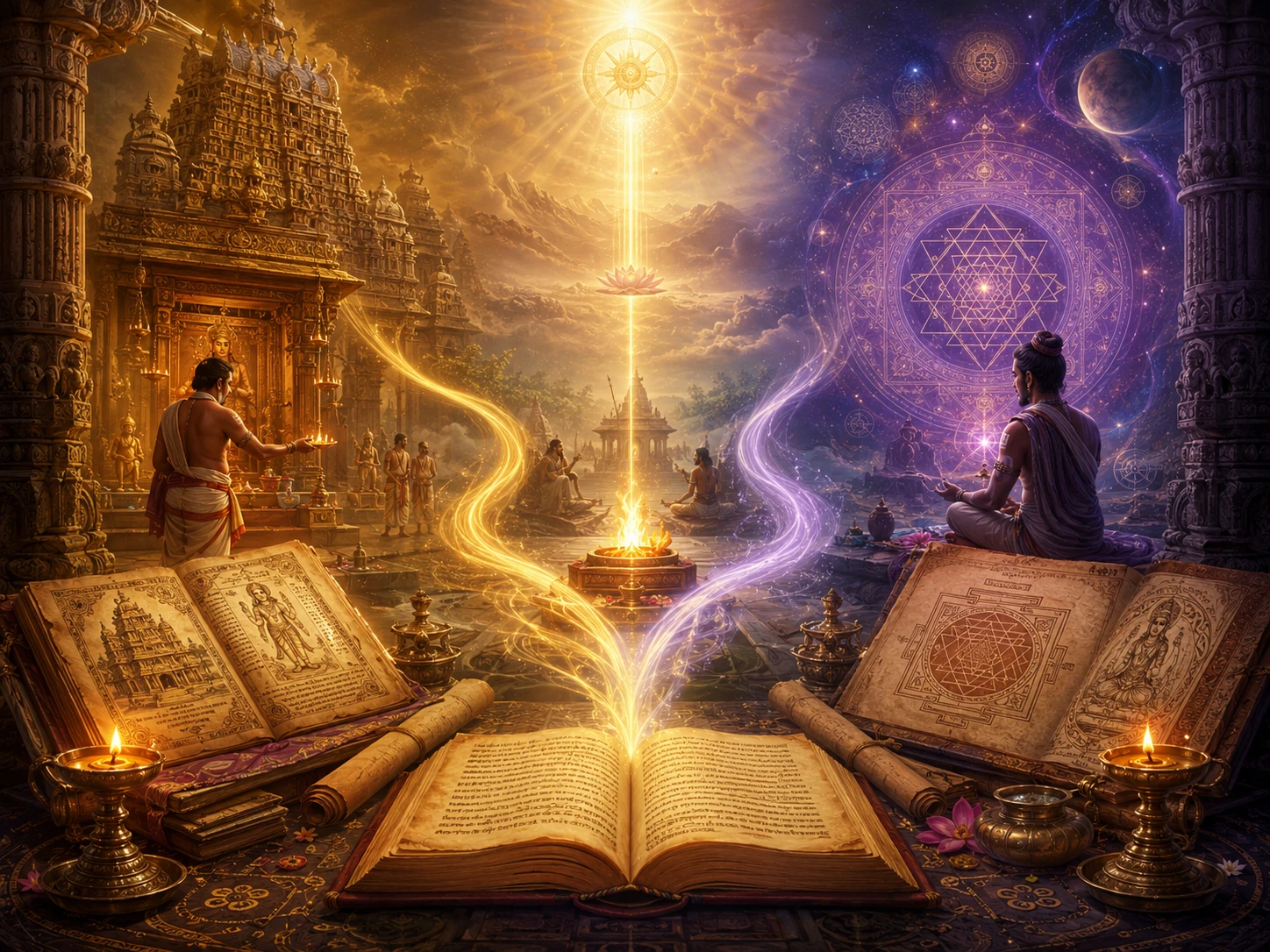
Agama vs Tantra vs Veda -- Three Streams of Hindu Practice
14 min read
Agni Dhyana -- What Meditation on Fire Is Actually Grounded In
8 min read
Ashta Siddhi -- The Eight Yogic Powers and How Hanuman Embodies Them
13 min readThe same translation error that turned '33 Koti' into '33 crore' in Hinduism also happened in Buddhism. The Chinese translation of Buddhist texts rendered 'Sapta Koti Buddha' (7 Supreme Buddhas) as '7 Crore Buddhas.' The…
Deities AvatarsCommunity Reflections
🕉️
Be the first to share your reflection.