The Natyashastra -- Bharata's Fifth Veda of Drama, Dance and Rasa
नाट्यशास्त्र -- नाटक, नृत्य और रस का भरत का पंचम वेद
In the Treta Yuga, says the first chapter of the Natyashastra, the gods came to Brahma with a request. People had fallen into greed, anger and grief, and the four Vedas could not be heard by everyone. They asked for something that could be both seen and heard, and that everyone could share. So Brahma composed a fifth Veda, the Natyaveda, drawing on the other four: recitation from the Rigveda, song from the Samaveda, acting from the Yajurveda and emotion, rasa, from the Atharvaveda. He gave it to the sage Bharata, who taught it to his hundred sons, and the first play was performed.
The book that tells this story is the Natyashastra, "the treatise on drama", attributed to Bharata Muni. It is one of the most remarkable works of the ancient world: a complete manual of the performing arts in thirty-six or thirty-seven chapters and some six thousand verses, with passages in prose. Scholars date its compilation to somewhere between about 200 BCE and 200 CE, drawing on older material.
Almost nothing about performance is left out. The Natyashastra describes how to build a playhouse and consecrate the stage; the kinds of plays and how plots are structured; the gestures of the hands (mudras), the movements of the eyes, brows, neck and feet; costume and make-up; speech, metre and the regional dialects actors should use; music, its scales and instruments; and how an audience should judge a performance. The book even records a quarrel: when the first play showed the gods defeating the asuras, the asuras in the audience were offended and disrupted it -- and so Vishvakarma was asked to build a proper, protected theatre.
The Eight Rasas of the Natyashastra
| Rasa (aesthetic flavour) | Sthayi bhava (underlying emotion) |
|---|---|
| Shringara -- the erotic, love | Rati -- love, delight |
| Hasya -- the comic | Hasa -- mirth |
| Karuna -- the compassionate, tragic | Shoka -- sorrow |
| Raudra -- the furious | Krodha -- anger |
| Vira -- the heroic | Utsaha -- energy, resolve |
| Bhayanaka -- the terrible | Bhaya -- fear |
| Bibhatsa -- the odious | Jugupsa -- disgust |
| Adbhuta -- the marvellous | Vismaya -- wonder |
Later theorists, above all Abhinavagupta in the eleventh century, argued for a ninth rasa, shanta, the peaceful, whose basis is the stilling of desire. With it the list became the familiar navarasa, the nine rasas.
The Natyashastra's most influential idea is rasa, literally "juice" or "flavour". Its famous formula, the rasa-sutra, says that rasa arises from the combination of vibhavas (the causes, such as the characters and setting), anubhavas (the outward signs, such as tears or a trembling voice) and vyabhichari bhavas (the passing emotions). A spectator watching a play about grief does not simply feel sad; through art, sorrow is turned into the savoured experience of karuna, the compassionate rasa, which can be enjoyed even though it is about pain.
That distinction -- between a raw emotion and its aesthetic, shareable form -- shaped Indian thinking about all the arts for two thousand years. Abhinavagupta, the great philosopher of Kashmir, wrote the classic commentary on the Natyashastra, the Abhinavabharati, and compared the tasting of rasa to the bliss of realising Brahman. For him, art at its height was close to spiritual experience.
In 2025 UNESCO added manuscripts of the Natyashastra, together with the Bhagavad Gita, to its Memory of the World Register, which records documents of world significance. India's classical dance forms -- Bharatanatyam, Kathak, Odissi, Kuchipudi, Mohiniyattam, Kathakali, Manipuri and Sattriya -- each trace their grammar of gesture back to it.
Bharatanatyam, whose very name many dancers today connect with Bharata, shows the Natyashastra's afterlife most clearly. It grew from the temple dance of Tamil Nadu, performed for centuries in the sacred precincts, and was reshaped in the early nineteenth century by four brothers at the Thanjavur court, the "Thanjavur Quartet", who gave the recital its modern order. In the twentieth century, as the temple tradition declined, revivalists such as Rukmini Devi Arundale brought it to the concert stage, consciously drawing on the Natyashastra and later texts such as the Abhinaya Darpana.
In all these forms, the Natyashastra's founding promise holds: a dancer telling the story of Krishna or Shiva through hand gestures and the movement of the eyes is still offering what Brahma made the fifth Veda to be -- the truths of the other four, made visible to everyone.
Explore Gandharvaveda, the science of music
The Upaveda of music and sound, closely tied to the Natyashastra's chapters on music.
Tags
Eternal Raga · शाश्वत राग
Institutional voice — scholarly articles on Sanatan Dharma
Deepen Your Understanding
अपनी समझ और गहरी करें
vedic sciences
Gandharvaveda -- The Science of Music and Sound
The forgotten Upaveda of the Sama Veda treats music as a path to liberation. From the seven swaras to Nada Brahma, Gandharvaveda is the textbook behind every Hindustani raga, every Carnatic kriti, and every bhajan you have ever sung along to.
vedic sciences
Nada Brahma -- Sound as Creation in Hindu Sangeet Shastra
Long before raags had names, India held one foundational claim: sound is creation itself. Trace the lineage from the Sama Veda's chants to Bharata's Natya Shastra to Sharangadeva's Sangeet Ratnakara -- the spine of classical music as sadhana.
vedic sciences
Upavedas -- The Four Applied Sciences of Hindu Tradition
The Vedas gave India its philosophy and rituals. The Upavedas gave India its professions. Four applied knowledge systems -- Ayurveda (medicine), Dhanurveda (warfare), Gandharvaveda (music and performing arts), and Sthapatyaveda (architecture) -- were classified as subsidiary Vedas, each attached to one of the four main Vedas. They represent the Hindu tradition's insistence that sacred knowledge must produce practical results: a healed body, a defended nation, a beautiful performance, a well-built home. Together, the Upavedas form the intellectual infrastructure of pre-modern Indian civilisation -- from the surgeon's scalpel to the architect's blueprint to the musician's raga.
deities avatars
Nataraja -- The Cosmic Dancer
One foot crushes a dwarf. The other is raised in liberation. A ring of fire frames the dance. A drum beats creation into existence. An open palm says 'do not fear.' This is Nataraja -- Shiva as the Lord of Dance -- and it is the single most replicated Indian bronze in the history of art. The physicists at CERN chose it to stand outside the world's largest particle accelerator. The Chola bronzesmiths of Tamil Nadu perfected it a thousand years ago. And every time a subatomic particle appears and disappears, the cosmic dance continues.
sacred artefacts
Divine Musical Instruments -- Veena, Damaru, Murali
Saraswati's Veena created knowledge. Shiva's Damaru created language. Krishna's Murali created longing. Three instruments, three cosmic functions -- and the foundation of one of the world's oldest musical traditions. From the 14 Maheshwara Sutras that birthed Sanskrit grammar to the raga system that maps human emotion, Hindu mythology placed music at the centre of creation itself.
tantra mantra yantra
Mudras in Ritual and Yoga -- The Silent Language of the Hands
When you press your palms together and say Namaste, you are performing Anjali Mudra -- a gesture older than any surviving scripture. When you meditate with thumb touching index finger, you are performing Gyan Mudra -- uniting individual consciousness with the universal. Mudras are the oldest programming language in human history, and your hands are the keyboard.
In 2025 UNESCO added manuscripts of the Natyashastra, together with the Bhagavad Gita, to its Memory of the World Register, which records documents of world significance. India's classical dance forms -- Bharatanatyam, K…
More in Vedic Sciences
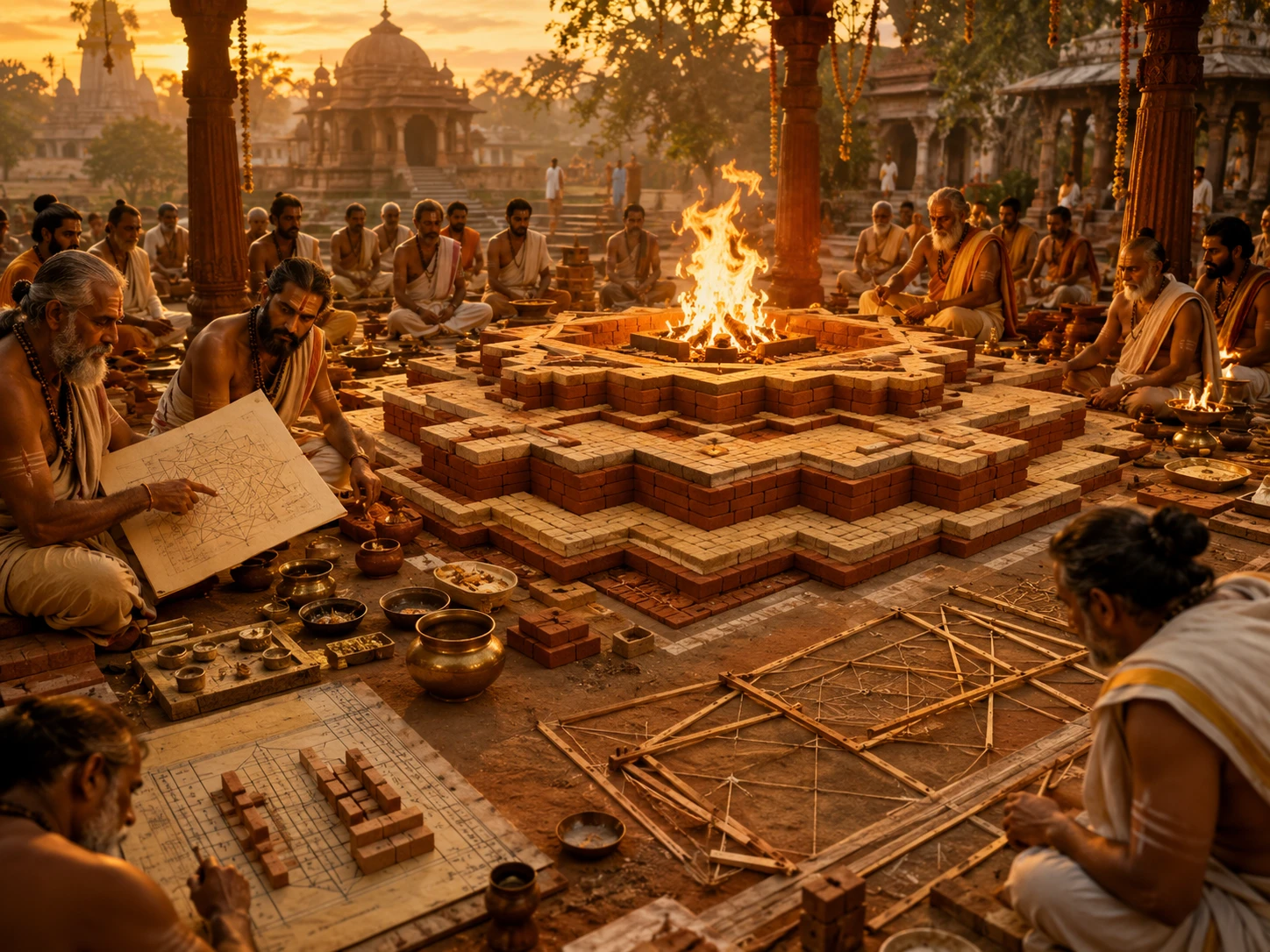
Agnichayana -- The Falcon-Shaped Fire Altar That Survived 3,000 Years
12 min read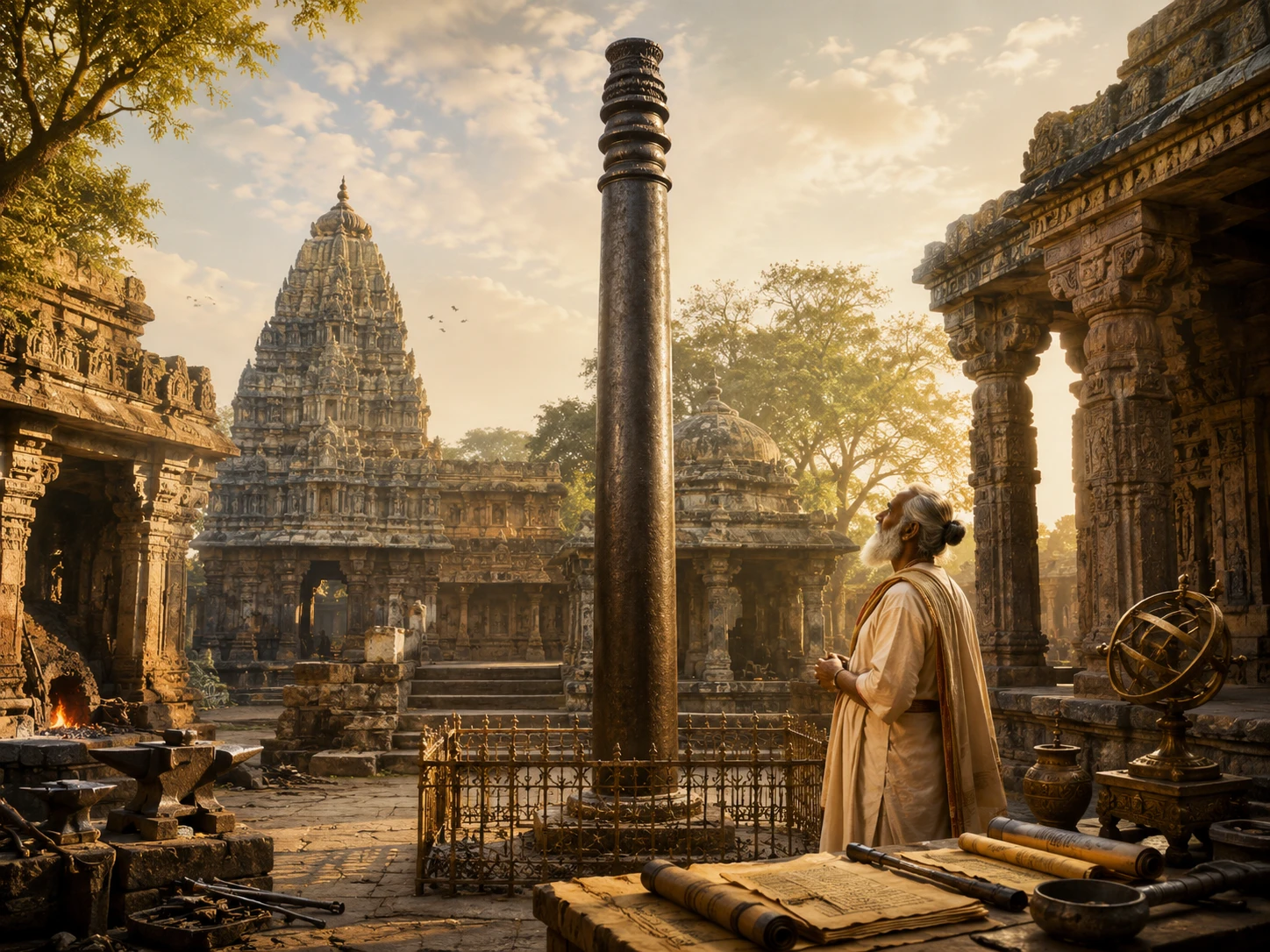
Ancient Indian Metallurgy -- The Iron Pillar That Refuses to Rust
13 min readAryabhata -- The Astronomer Who Said the Earth Turns
3 min readThe same translation error that turned '33 Koti' into '33 crore' in Hinduism also happened in Buddhism. The Chinese translation of Buddhist texts rendered 'Sapta Koti Buddha' (7 Supreme Buddhas) as '7 Crore Buddhas.' The…
Deities AvatarsCommunity Reflections
🕉️
Be the first to share your reflection.