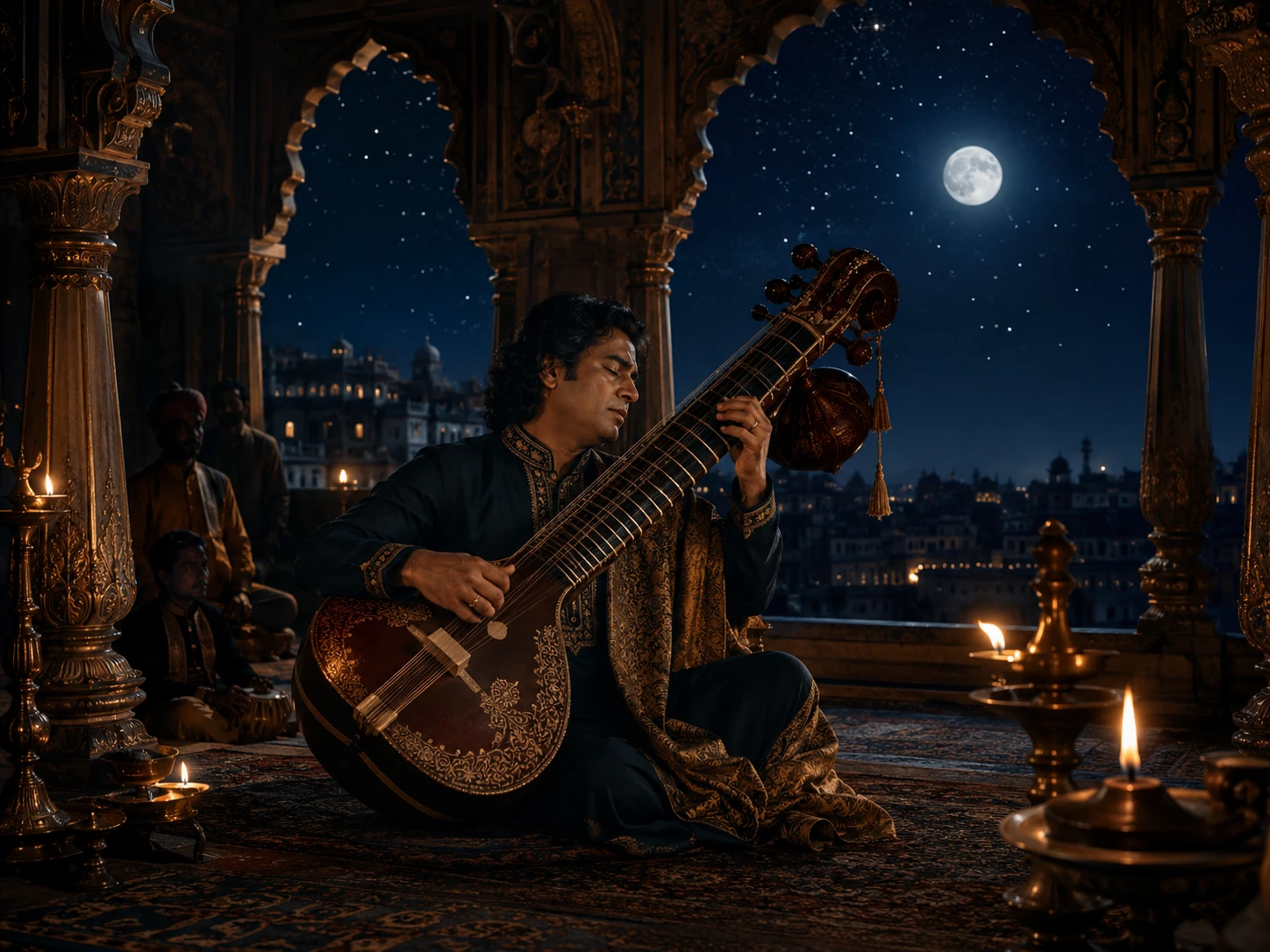
Raag Darbari Kanada -- The Court Raag of the Deep Night
राग दरबारी कानड़ा -- गहरी रात्रि का दरबारी राग
It is 1:15 in the morning at a small private mehfil in a south Delhi haveli. The audience of forty has been listening since 8 pm. The earlier raagas of the evening have moved through Yaman, Bageshri, Malkauns. The host's silver tray of paan and warm chai has made its second round. The senior vocalist who closed the first half has handed the stage to the headliner of the night, a Patiala gharana ustad in his sixties. The ustad sits behind the tanpura, takes a moment, and then opens with one of the slowest alaaps anyone in the room has ever heard. The first phrase is barely audible. Sa, lower Ni, Sa, descending komal Dha, lower komal Ni, returning slowly to Re. Then a deep andolan on komal Ga that lasts almost forty seconds. The audience sits absolutely still. The raag is Darbari Kanada. There is no other raag for this hour. The deep night belongs to Darbari, and Darbari belongs to the deep night.
Darbari Kanada -- often shortened to just Darbari -- is the most regal raag in the Hindustani tradition. The name itself means 'of the court' (darbar), a designation that tradition attributes to Tansen, who is said to have composed the raag for Akbar's court at Fatehpur Sikri or Agra in the late 16th century. Whether or not the specific attribution is historically defensible, the name has held for at least four centuries, and the raag has carried the weight of court music throughout that period. A Darbari performance is not light. It is not playful. It does not seek to please. It declares itself with the dignity of a Mughal court session, and the audience either receives the declaration or does not. There is no middle ground.
This article is the ninth in the Eternal Gyan music cluster, and the sixth of seven raag profiles. The previous profiles -- Bhairav at dawn, Todi in late morning, Bhimpalasi in the afternoon, Yaman at dusk, Malhar through the monsoon -- have walked through the day and the year. Darbari sits in the deepest hour, the fourth Prahar of the night, roughly midnight to 3 am. It is the raag of the late-night concert that has been going for six hours. It is the raag of the studio session that has run past midnight. It is the raag of the long-distance flight passenger who cannot sleep and reaches for headphones at 1 am. Darbari sits where the day's accumulation has nowhere left to go but inward, and the music opens that inward space the way no other raag can.
यथा दीपो निवातस्थो नेङ्गते सोपमा स्मृता। योगिनो यतचित्तस्य युञ्जतो योगमात्मनः॥
yatha dipo nivata-stho nengate sopama smrita yogino yata-chittasya yunjato yogam atmanah
As a lamp in a windless place does not flicker -- this is the simile used for the yogi of controlled mind, who is engaged in the meditation of the self.
— Bhagavad Gita 6.19
Krishna's image of the windless lamp is the textual description of the inner state that Darbari opens. The late-night Prahar -- 12 to 3 am -- is the period when the body's natural rhythms have settled into the deepest stillness of the twenty-four-hour cycle. Cortisol is at its lowest. Digestive activity has slowed. The mind, if it is not interrupted by sleep or by wakeful anxiety, can settle into a quality of attention that no other hour offers. The Hindu yogic tradition has long recognized this hour. The Brahma Muhurta from 4 to 6 am gets the popular attention, but the deeper meditative tradition has always held that the hours from midnight to 3 am are when the unconditioned consciousness is most accessible. Darbari is the auditory expression of that accessibility.
The mood of Darbari is sometimes translated as 'gambhir' or 'serious', but neither word quite captures it. The closest English approximation is 'gravitas' -- the kind of weight that comes not from sadness but from concentrated dignity. A Darbari alaap does not weep. It does not yearn in the way Bhimpalasi yearns or Todi yearns. The yearning, if there is any, is for something that the singer has already accepted is not coming back. The acceptance is what makes Darbari weighty without making it sad. The raag arrives at a place that other night raagas only point to.
There is a specific physical effect that careful Darbari listeners notice. The slow andolan on komal Ga -- which is the raag's structural signature -- tends to slow the listener's breath. The exhalations lengthen. Researchers studying physiological responses to slow-tempo Hindustani classical music have documented modest reductions in heart rate and respiratory rate during sustained listening, though the published studies tend to focus on slow-tempo classical music broadly rather than on Darbari specifically, and findings should be treated as suggestive rather than conclusive given small sample sizes. What is consistent is the anecdotal evidence from generations of late-night Darbari listeners. The music produces a settling that other raagas do not produce as reliably. The Hindustani tradition arrived at this insight through centuries of empirical performance. The mechanism is not fully understood. The settling is real.
There is also a textual lineage that gives Darbari its philosophical context. The Mandukya Upanishad describes four states of consciousness -- waking (jagrat), dreaming (svapna), deep sleep (sushupti), and the fourth state (turiya) which is the unconditioned awareness underlying all three. The deep night Prahar of Darbari corresponds metaphorically to the sushupti-turiya threshold, the moment when the boundaries between ordinary consciousness and the deeper awareness become permeable. Adi Shankara's Nirvana Shatakam, composed in the 8th century CE, opens with the famous declaration -- I am not the mind, the intellect, the ego, the memory -- which is the verbal expression of the same threshold. Darbari is the musical expression. The Sanskrit philosophical tradition and the late-night raag converge on the same insight from different directions.
The Asavari Family -- Major Raags Sharing the Three Komal Swaras
| Raag / राग | Distinguishing Feature | Time / Mood | Standard Recording |
|---|---|---|---|
| Darbari Kanada / दरबारी कानड़ा | Deep andolan on komal Ga; Ma-Re-Sa avaroh signature | 12 am to 3 am, regal gravitas | Ustad Amir Khan -- Indore gharana 1960s |
| Asavari / आसावरी | Skips Ga and Ni in aroh; full komal in avaroh | 10 am to 12 noon, sober contemplation | Pt. Bhimsen Joshi -- AIR archives |
| Jaunpuri / जौनपुरी | Similar to Asavari but with shuddha Re emphasis | Late morning, lighter than Asavari | Smt. Kishori Amonkar -- Jaipur-Atrauli readings |
| Adana / अड़ाना | Like Darbari but faster, livelier; usually drut | Late night, energetic counterpart to Darbari | Pt. Jasraj -- Mewati gharana renderings |
| Komal Rishabh Asavari / कोमल ऋषभ आसावरी | Asavari with komal Re instead of shuddha Re | Late morning, deeper Asavari mood | Ustad Bade Ghulam Ali Khan -- Patiala gharana |
| Suha Kanada / सूहा कानड़ा | Lighter Kanada family member; Krishna-leaning | Late evening to early night, devotional | Pt. Ulhas Kashalkar -- Gwalior-Jaipur readings |
| Kaunsi Kanada / कौंसी कानड़ा | Mixes Malkauns with Darbari; rare and demanding | Late night, mystical-meditative | Pt. Mallikarjun Mansur -- Jaipur-Atrauli gharana |
The Kanada raag family is unusually large in the Hindustani repertoire, with at least fifteen distinct named variants. Darbari Kanada is the largest and most performed of these. Adana is its drut (fast tempo) counterpart, often programmed in the same concert immediately after Darbari to provide rhythmic contrast. The other Kanada variants -- Suha, Kaunsi, Sughrai, Nayaki, Hussaini -- are considered specialized territory, performed by senior artists who have already established their command of Darbari.
Darbari Kanada uses seven swaras with three altered notes -- Sa, Re, komal Ga, Ma, Pa, komal Dha, komal Ni. The three komal swaras place the raag in the Asavari Thaat family. What separates Darbari from Asavari, Jaunpuri, and the other Asavari Thaat raagas is not the swaras themselves but the way Darbari deploys them. The aroh-avaroh structure, the vakra (winding) movements, the specific andolan on komal Ga, and the centre of gravity in the lower octave together produce a raag that no other Asavari Thaat member can be mistaken for.
The aroh of Darbari has a vakra structure. A typical ascent runs Sa, Re, komal Ga, Ma, Pa, komal Dha, komal Ni, Sa -- but in actual performance the singer rarely runs straight up. The phrase typically winds. Sa, Re, komal Ga, Ma, Re, komal Ga, Ma, Pa is more characteristic than a straight ascent. The avaroh runs upper Sa, komal Dha, komal Ni, Pa, Ma, Pa, komal Ga, Ma, Re, Sa -- again with the Pa returning between Ma and komal Ga. The signature avaroh phrase is komal Ga, Ma, Re, Sa, with a heavy meend connecting komal Ga to Ma and a slow andolan on the komal Ga before it descends. This phrase, executed cleanly with the andolan, is what tells a trained listener within the first fifteen seconds that the raag is Darbari.
The vadi-samvadi pair places Re as vadi and Pa as samvadi. Both fall in the lower tetrachord, which by Bhatkhande's rule places the raag firmly in the second half of the night. The Re is approached specifically from below -- through the lower octave's komal Ni and Sa -- rather than from above. This lower-octave approach to the vadi is one of the elements that gives Darbari its weighted feeling. The singer spends extended time in the mandra saptak (lower octave) before ever venturing into the madhya saptak (middle octave). A Darbari that begins in the middle octave and stays there is being sung wrong, regardless of how technically accurate the swaras are.
The defining element of Darbari is the andolan on komal Ga. This is not the gentle oscillation of Bhairav or the deeper but quicker oscillation of Todi. Darbari's komal Ga andolan is the slowest and longest sustained oscillation in any Hindustani raag. The trained singer holds the komal Ga for what feels like a full breath, oscillating slowly between the komal Ga and the shuddha Ga it deliberately is not, never quite landing on the komal Ga as a fixed pitch. This sustained andolan is what produces the heart-rate settling effect that careful listeners notice. It is also the element that takes longest for a student to master. A student who has been training for ten years may still produce a Darbari komal Ga that sounds nearly right but lacks the specific quality of the andolan that the gharana lineage transmits. The reason senior teachers are reluctant to let new students perform Darbari publicly is precisely this. The komal Ga andolan is the test, and most students fail it for the first decade of their training.
The pakad of Darbari is widely accepted as -- Re, komal Ga (with andolan), Ma, Re, Sa. Five swaras. The compactness is deceptive. Each note in this five-note phrase has to be executed with specific timing, specific weight, and specific micro-pitch positioning. The Re at the start carries weight; the komal Ga oscillates and breathes; the Ma is touched but not held; the Re returns with its initial weight; the Sa lands. Five swaras, fifteen seconds in performance, and the raag's identity is established. Recognition is as quick as Yaman's, but the technical demand on the performer is several times higher.
मनो बुद्ध्यहंकारचित्तानि नाहम् न च श्रोत्रजिह्वे न च घ्राणनेत्रे। न च व्योम भूमिर्न तेजो न वायुः चिदानन्दरूपः शिवोऽहं शिवोऽहम्॥
mano buddhy ahankara chittani naham na cha shrotra-jihve na cha ghrana-netre na cha vyoma bhumir na tejo na vayuh chidananda-rupah shivo'ham shivo'ham
I am not the mind, nor the intellect, nor the ego, nor the memory. I am not the ears, the tongue, the nose, or the eyes. I am not space, earth, fire, or wind. I am the form of consciousness and bliss. I am Shiva, I am Shiva.
— Nirvana Shatakam, verse 1 (Adi Shankaracharya)
Adi Shankara's Nirvana Shatakam declares the via negativa of Advaita Vedanta -- the negation of every conditioned identity until only unconditioned awareness remains. The deep night Prahar of Darbari is the traditional hour for this kind of contemplation, and the raag's structural slowness creates the conditions in which the contemplation becomes available. A devotee who chants the Nirvana Shatakam at 1:30 am while listening to a Darbari recording in the background is doing what the tradition has prescribed for centuries -- the philosophical text and the musical structure converging on the same interior moment.
The historical position on Darbari's authorship requires the same caution that applied to Miyan ki Malhar in the previous article. Tradition attributes the composition of Darbari Kanada to Mian Tansen at Akbar's court, sometime between Tansen's joining the court around 1562 and his death in 1589. The general claim is plausible -- Tansen was the central court musician of Akbar's reign, and a court raag named after the court would naturally have come from the senior court musician. The specific compositions attributed to Tansen survive through later transmissions in the Senia gharana, the lineage that traces back to him. Some of these compositions are likely close to what Tansen actually performed, others have evolved through centuries of transmission. The honest scholarly position is that Tansen's centrality to the early shaping of Darbari is well-established but the specific bandishes attributed to him should be treated as Senia tradition rather than verified 16th-century composition.
Among 20th and 21st century performers, Ustad Amir Khan (1912-1974) of the Indore gharana is widely considered the canonical Darbari reference. His vilambit Darbari alaaps from the 1950s and 1960s, particularly the long-form HMV recordings and the All India Radio archive sessions, set the standard for how the raag opens at slow tempo. Amir Khan's Darbari is the recording that vocal teachers play for new students who have completed their five-year foundation and are now ready to begin the Darbari apprenticeship. The recordings have been re-released across multiple formats since Amir Khan's death and remain in active circulation through Saregama, Underscore Records, and the AIR Heritage archive.
Pt. Bhimsen Joshi recorded Darbari throughout his career, and his approach was different from Amir Khan's. Where Amir Khan held the alaap in extreme slow tempo for thirty minutes or more, Bhimsen Joshi's Darbari moved more steadily, with a stronger emphasis on the bandish development and a faster transition into rhythmic composition. Both approaches are correct. They produce recognizably the same raag with different emotional weights -- Amir Khan's Darbari is more meditative, Bhimsen Joshi's is more performative. The 1985 Sawai Gandharva Mahotsav recording of Bhimsen Joshi's Darbari is the canonical Kirana gharana reference.
Ustad Bade Ghulam Ali Khan's Darbari from the Patiala gharana brought yet another approach, with greater emphasis on emotional expressiveness and faster taans. Pt. Mallikarjun Mansur of the Jaipur-Atrauli gharana recorded Darbari into his nineties, and his late-career performances from the 1980s carry an unusual quality of acceptance and stillness that few other performers have matched. Smt. Kishori Amonkar's Darbari from the same gharana is the canonical female vocal reference, particularly her 1990s recordings. Among instrumentalists, Ustad Vilayat Khan's sitar Darbari and Pt. Hariprasad Chaurasia's flute Darbari are the standard references. Pt. Ravi Shankar performed Darbari less often than Yaman or Bhairav in his international concerts -- the raag's slow tempo and demanding andolan made it a difficult fit for shorter Western concert programs -- but his rare long-form Darbari recordings are widely circulated.
The Hindustani repertoire holds dozens of bandishes in Darbari, with the Senia gharana compositions forming the historical core and the gharana-specific additions across centuries forming the broader corpus. Three bandishes deserve specific mention.
The first is Kin Bairan Kaan Bhare -- 'who has filled your ears, my enemy' -- a slow vilambit composition addressed to a beloved who has been turned against the speaker by an unnamed adversary. The lyric is on its surface a love-quarrel scene, but the slow vilambit treatment in Darbari turns the whispered enemy into something larger -- the world itself, the doubts that fill the listener's mind in the deep night, the voices that turn the soul against its own peace. The second is Sajan Tum Kahe Ko Naina Lagaye -- 'why did you cast your eyes on me' -- a viraha bandish of acceptance rather than yearning, where the speaker accepts that the beloved's gaze has bound her to a separation she did not ask for and cannot escape. This bandish is performed by Smt. Kishori Amonkar in her canonical Darbari recordings. The third is Itni Vinati Sun Le Saiyaan -- 'hear this small request, my beloved' -- a direct address to Krishna in the Mira-Surdas register, often paired with the Nirvana Shatakam meditation register that the deep night invites.
There is also a long tradition of training-bandishes that vocal teachers use specifically to teach Darbari to advanced students. These compositions are simpler than the concert bandishes but they isolate the structural elements that students need to master -- the vakra aroh, the lower-octave development, the komal Ga andolan, the avoidance of premature movement to the upper octave. A serious vocal student in 2026 in Banaras Hindu University, ITC Sangeet Research Academy, or Bhatkhande Music Institute University will encounter these training-bandishes in her seventh or eighth year of training, depending on her gharana lineage. By her tenth year, if she has the talent and the discipline, she may begin to perform short Darbari pieces in private concerts. By her fifteenth year, if her teacher signs off, she may begin to perform full vilambit Darbari in public. The apprenticeship is long because Darbari does not forgive shortcuts. The audience can hear immediately when a singer is technically capable of the swaras but has not yet earned the andolan.
For the listener, the apprenticeship is also long but in a different way. A first exposure to Darbari -- whether through Amir Khan, Bhimsen Joshi, or any of the other canonical recordings -- often produces no immediate impression. The raag is too slow, too quiet, too internal. The first listening may feel like nothing is happening. The second listening may begin to register the andolan but not yet the architecture. By the fifth or tenth listening, the architecture begins to assemble itself, and the listener starts to recognize what is and is not a competent Darbari. By the twentieth listening, the recordings start to differentiate themselves, and the listener can hear why Amir Khan's 1962 Darbari is different from Amir Khan's 1965 Darbari, why Bhimsen Joshi at 1985 is different from Bhimsen Joshi at 1995. The deep night raag rewards the listener the same way it rewards the performer -- through patience that compounds across years.
All India Radio's 1985 broadcast of Pt. Bhimsen Joshi's Darbari Kanada from the Sawai Gandharva Mahotsav was scheduled in the late-night classical slot beginning at 11:30 pm. What was unusual was the broadcast's length. The Darbari alone ran 78 minutes, with Bhimsen Joshi developing the vilambit alaap for nearly 35 minutes before any rhythmic composition began. AIR archivists have noted that this was among the longest single-raag classical broadcasts the network had aired since its inception in 1936. Listeners across North and West India who tuned in at 11:30 pm and stayed through 12:48 am for the full piece -- estimated in the hundreds of thousands based on contemporary listenership figures -- experienced one of those cultural moments that did not make it into the next morning's newspapers but settled into the memory of an entire generation. The recording is now part of the AIR Heritage archive and is the canonical Bhimsen Joshi reference for Darbari Kanada.
Darbari has translated into modern Indian life less visibly than Bhairav, Yaman, or Bhimpalasi, but the translation is real and arguably deeper. The reason is that Darbari is the raag for the hours when modern Indian life has stopped pretending to be social and become genuinely solitary -- the long-haul flight in the middle of the night, the post-midnight working session in a Bengaluru WeWork, the insomnia hour in a Mumbai high-rise, the 1 am meditation in a New Delhi apartment after the in-laws have gone to bed.
Hindi film music has used Darbari sparingly compared to other major raagas. The reason is partly its slowness -- Hindi film songs typically need a more upbeat tempo than Darbari naturally provides -- and partly its specificity. A Darbari-based song works only if the scene genuinely requires deep-night gravitas, and Hindi cinema has fewer such scenes than scenes calling for dawn devotional weight (Bhairav) or evening celebration (Yaman). When Darbari does appear in films, it is almost always in introspection scenes set in late-night palaces, prison cells, or solitary contemplation spaces. Vishal Bhardwaj used Darbari-leaning melodies for several scenes in Maqbool (2003) and Haider (2014), particularly the prison and palace-at-night sequences. Sanjay Leela Bhansali's compositions for Bajirao Mastani (2015) drew on Darbari for the late-night court scenes between Bajirao and Mastani. A.R. Rahman has used Darbari inflections in introspection sequences across multiple films, though without naming the raag explicitly.
On the listening side, Spotify's Indian classical analytics show Darbari-tagged content peaking between 11 pm and 2 am every weekday, with a different demographic profile from other classical raagas. The late-night Darbari listenership skews heavily toward urban professionals in their 30s, 40s, and 50s, with a smaller secondary peak among university students who use the raag for late-night study sessions. Apple Music's Indian classical playlists follow a similar pattern. The yoga and meditation app market uses Darbari less than Bhairav or Bhimpalasi -- the raag's complexity makes it less suitable as background music -- but apps that focus specifically on advanced meditation practice, like Sattva's deep meditation tier, do use Darbari for late-night sessions.
There is also a specific demographic that has emerged around Darbari over the past decade -- the tech worker who has settled into late-night working hours and uses Darbari as the soundscape for the deep work block from 11 pm to 2 am. The Bengaluru and Hyderabad tech communities have informal lists of canonical Darbari recordings circulated on Slack and WhatsApp groups, with Amir Khan's 1962 HMV recording almost universally at the top. The pattern is downstream of the raag's structural fit with deep concentration, and it represents one of the few examples of classical Indian music finding new utility in a specifically modern professional context without losing its traditional integrity.
For the practical listener in 2026 looking to actually experience Darbari, the entry point is Ustad Amir Khan's vilambit Darbari from his 1960s recordings, played at any hour between midnight and 3 am. The recording is widely available on Spotify, Apple Music, YouTube Music, and Saregama Carvaan. It does not need to be played at full volume. Played softly, in a dimly lit room, with no other input, the recording produces an alignment between music and consciousness that no amount of prose can substitute for. The Hindustani tradition arrived at this alignment through centuries of empirical performance. The alignment still holds. Darbari does what Darbari has always done -- it opens the deep night, returns the listener to the unconditioned awareness underlying ordinary thought, and waits in stillness for the listener to settle into the same stillness.
Listen to Raag Darbari Late at Night
Listen to Darbari Kanada late at night, when its slow, heavy movement belongs: a vilambit khayal, or a film song set in it such as 'O Duniya Ke Rakhwale'. Listen for the oscillating komal ga and komal dha that are its signature. Eternal Raga does not yet have raag-wise collections; its Listen page has a devotional album and a daily Gita podcast.
Tags
Eternal Raga · शाश्वत राग
Institutional voice — scholarly articles on Sanatan Dharma
Deepen Your Understanding
अपनी समझ और गहरी करें
vedic sciences
Raag Yaman -- The King of Evening Raagas
Yaman is the most performed raag in Hindustani classical music -- the dusk sandhi prakash piece every student learns first, every concert opens with, every gharana claims its own reading of. Read its swara structure, its Persian-Hindustani synthesis, its standard bandishes, and the long lineage of canonical recordings.
vedic sciences
Raag Bhairav -- The Dawn Raag of Shiva
Bhairav is the first raag of the Hindustani morning -- austere, slow, weighted, named after Shiva's most fearsome form. Read its swara structure, its tantric backdrop, its great recordings, and why every classical concert that runs through the night ends with Bhairav at sunrise.
vedic sciences
Raag Todi -- The Late-Morning Raag of Surrender
Todi is the raag of intense yearning -- four altered notes packed into a single octave, traditionally attributed to Tansen, sung between 9 am and noon. Read its swara structure, its Tansen lineage, the tragic story behind Bilaskhani Todi, and the canonical Amir Khan recordings.
vedic sciences
Samay Chakra -- Why Each Raag Has Its Hour
Hindustani classical assigns each raag to a specific Prahar of the day or season. Bhairav at dawn, Yaman at dusk, Malhar in monsoon. Decode the architecture of samay -- the time-of-day theory that turns 24 hours into a musical map.
vedic sciences
Dasha Thaat -- Bhatkhande's Modern Map of Hindustani Raagas
How does a tradition with hundreds of raagas teach itself? Pt. Vishnu Narayan Bhatkhande's answer was the ten-Thaat system, published between 1909 and 1935. Trace the system, its limits, and why every Hindustani conservatory still teaches by it.
All India Radio's 1985 broadcast of Pt. Bhimsen Joshi's Darbari Kanada from the Sawai Gandharva Mahotsav was scheduled in the late-night classical slot beginning at 11:30 pm. What was unusual was the broadcast's length. …
More in Vedic Sciences
Agnichayana -- The Falcon-Shaped Fire Altar That Survived 3,000 Years
12 min read
Ancient Indian Metallurgy -- The Iron Pillar That Refuses to Rust
13 min readAryabhata -- The Astronomer Who Said the Earth Turns
3 min readThe same translation error that turned '33 Koti' into '33 crore' in Hinduism also happened in Buddhism. The Chinese translation of Buddhist texts rendered 'Sapta Koti Buddha' (7 Supreme Buddhas) as '7 Crore Buddhas.' The…
Deities AvatarsCommunity Reflections
🕉️
Be the first to share your reflection.