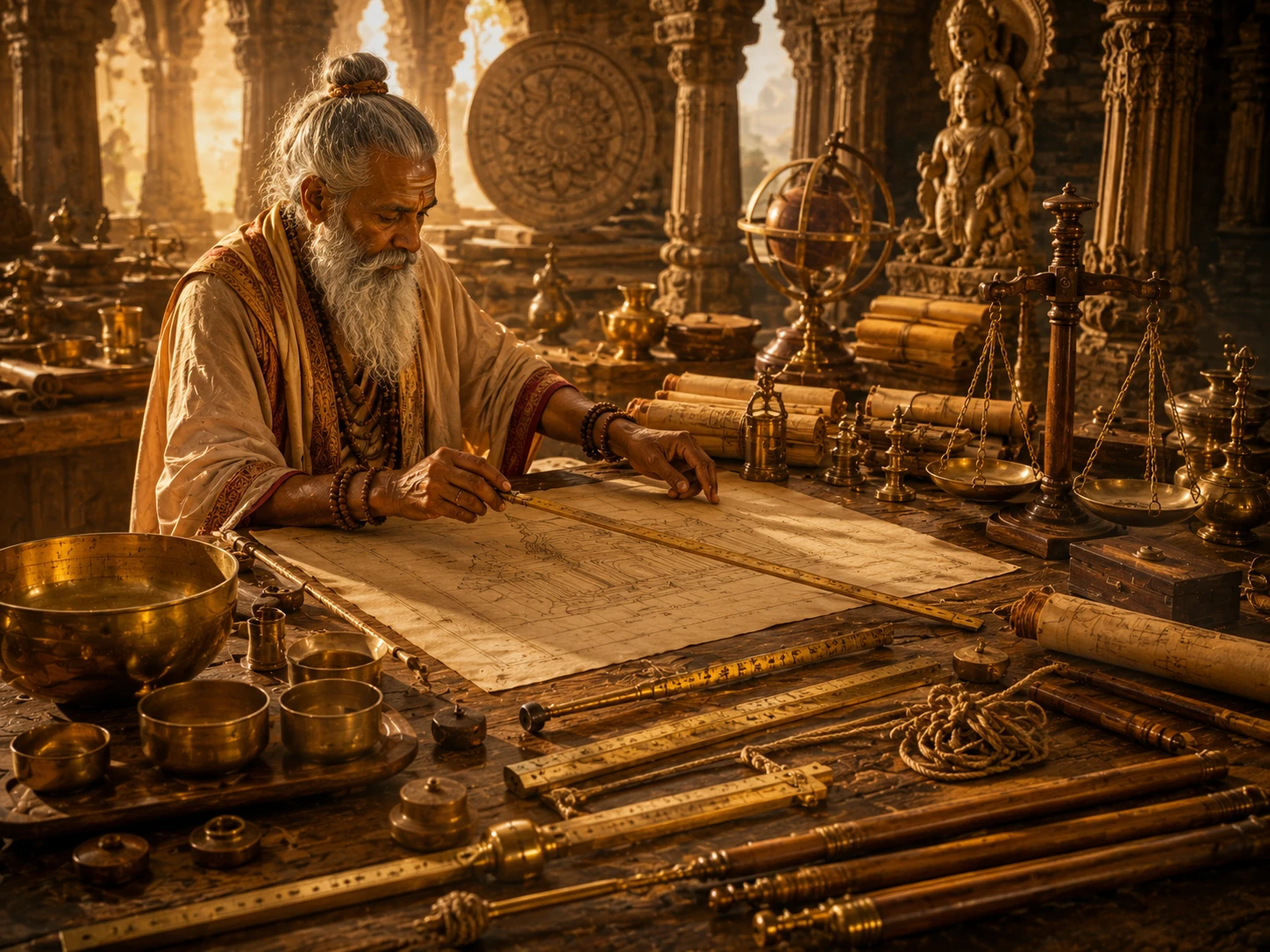
Truti to Kalpa, Angula to Yojana -- How Ancient India Measured Time, Length, and Weight
त्रुटि से कल्प, अंगुल से योजन -- प्राचीन भारत ने समय, लम्बाई, और भार कैसे मापा
Ancient India developed measurement systems of extraordinary range and precision -- from the sub-microsecond to the multi-billion-year, from the width of a finger to distances spanning continents, from the weight of a single seed to loads carried by elephants. These were not folk approximations. They were systematised, standardised, and enforced by state authority. The Arthashastra of Kautilya (circa 3rd century BCE) dedicates entire chapters to weights and measures, specifies the appointment of officers to ensure compliance, and prescribes penalties for merchants who use fraudulent standards. The Surya Siddhanta provides a time hierarchy of mathematical precision. The Vishnu Purana and Bhagavata Purana embed time units within cosmological narratives that span cycles of creation and dissolution.
Three domains stand out: time, length, and weight. Each domain has its own hierarchy of units, its own source texts, and its own living legacy in modern India. The time system is the most famous -- its smallest unit, the truti, measures roughly 29.6 microseconds, while its largest, the Kalpa, spans 4.32 billion years. The length system, anchored by the angula (finger-width), builds up through the hasta (cubit), dhanusha (bow-length), krosa (earshot distance), and yojana (a day's march). The weight system, based on natural standards like the gunja seed and the rice grain, served Indian commerce for over two millennia.
What makes these systems historically significant is not just their antiquity but their internal consistency. The Arthashastra's measurement hierarchy is not a loose collection of folk terms. It is a designed system where each unit is defined as a fixed multiple of the unit below it, creating a decimal or binary chain from the smallest to the largest. This is the hallmark of a metrological tradition -- not 'we roughly measure things' but 'we have a standardised, state-enforced framework for measurement.' India had this framework by the 3rd century BCE at the latest, and possibly much earlier.
षट् प्राणान् विनाडी स्यात् तत्षष्ट्या नाडिका स्मृता। नाडीषष्ट्या तु नाक्षत्रमहोरात्रं प्रकीर्तितम्॥
ṣaṭ prāṇān vināḍī syāt tat-ṣaṣṭyā nāḍikā smṛtā | nāḍī-ṣaṣṭyā tu nākṣatram ahorātraṁ prakīrtitam ||
Six pranas (respirations) make a vinadi; sixty vinadis make a nadi; and sixty nadis constitute one sidereal day and night.
— Surya Siddhanta, Chapter 1, Verses 11-12
Time Units -- From Truti to Kalpa (Surya Siddhanta and Puranic Sources)
| Unit | Sanskrit | Equals | Modern Equivalent | Source |
|---|---|---|---|---|
| Truti | त्रुटि | Smallest defined time unit | ~29.6 microseconds (1/33,750th of a second) | Surya Siddhanta |
| Tatpara | तत्पर | 100 Trutis | ~2.96 milliseconds | Surya Siddhanta |
| Nimesha | निमेष | ~1 eye-blink | ~88.9 milliseconds | Surya Siddhanta |
| Kashtha | काष्ठ | 18 Nimeshas | ~1.6 seconds | Vishnu Purana |
| Kala | काला | 30 Kashthas | ~48 seconds | Vishnu Purana |
| Prana | प्राण | 1 respiration cycle | ~4 seconds | Surya Siddhanta |
| Vinadi | विनाडी | 6 Pranas | ~24 seconds | Surya Siddhanta |
| Nadi / Nadika | नाडी / नाडिका | 60 Vinadis | ~24 minutes | Surya Siddhanta |
| Muhurta | मुहूर्त | 2 Nadis | ~48 minutes | Arthashastra; Panchang |
| Ahoratra | अहोरात्र | 30 Muhurtas / 60 Nadis | ~24 hours (1 sidereal day) | Surya Siddhanta |
| Paksha | पक्ष | 15 Tithis | ~15 days (fortnight) | Panchang |
| Masa | मास | 2 Pakshas / 30 Tithis | ~1 month | Panchang |
| Ritu | ऋतु | 2 Masas | ~2 months (season) | Vedanga Jyotisha |
| Ayana | अयन | 3 Ritus / 6 months | ~6 months (solstice half) | Vedanga Jyotisha |
| Samvatsara | संवत्सर | 2 Ayanas | ~1 year | Vedanga Jyotisha |
| Yuga (Kali) | कलियुग | 432,000 solar years | 432,000 years | Surya Siddhanta / Puranas |
| Chaturyuga | चतुर्युग | Satya + Treta + Dvapara + Kali | 4,320,000 years | Surya Siddhanta / Puranas |
| Kalpa | कल्प | 1,000 Chaturyugas | 4.32 billion years | Surya Siddhanta / Puranas |
The Kalpa (4.32 billion years) is strikingly close to modern geology's estimate of the earth's age (4.54 billion years). This is not evidence of ancient scientific knowledge of geology -- it is a numerical coincidence within a cosmological framework. But the fact that Indian tradition conceived of time in billions of years, when most ancient cultures measured creation in thousands, reflects a fundamentally different civilisational imagination of cosmic scale.
The length system is most comprehensively documented in Kautilya's Arthashastra. The base unit is the angula -- defined as 'the middle joint of the middle finger of a man of average size,' approximately 16.76 mm. From this biological constant, the system builds upward: 4 angulas make a dhanurgraha (fist-grip); 24 angulas make a hasta (cubit, ~40 cm); 96 angulas make a dhanusha (bow-length, ~1.6 m); 108 angulas make a garhpatya dhanusha (~1.81 m, used for road and land measurement); 2,000 dhanushas make a goruta; and 4 gorutas (or 8,000 dhanushas) make a yojana (~14.5 km).
The krosa (also gavyuti or goruta) deserves special mention. It literally means 'the distance at which a cow's call can be heard' -- roughly 3.6 km. This acoustic definition is not arbitrary; in a pre-modern agricultural society, the distance at which you can hear your livestock is a genuinely useful unit for land management. The yojana, at roughly 14.5 km, represents approximately the distance a bullock cart can travel in one day -- another functionally meaningful unit.
The weight system is equally systematic. The Arthashastra establishes multiple series for different purposes: one for precious metals (gold, silver), another for diamonds, and a third for general trade. The baseline unit for gold is the gunja seed (ratti) -- the seed of the Abrus precatorius plant, which is naturally uniform in weight at approximately 0.12 grams. Indian goldsmiths in Jaipur, Varanasi, and Thrissur used gunja seeds as weight standards well into the 20th century. From the gunja: 5 gunjas make 1 masha (~0.6 g); 16 mashas make 1 karsha/tola (~9.6 g -- the tola is still used in Indian gold trade today); 100 palas make 1 tula (~3.84 kg).
These systems were not replaced overnight. When the British introduced Imperial measures in 1864, Indian markets continued using traditional units. When India adopted the metric system in 1956, the transition took decades. Even today, gold in India is quoted per tola (10 grams, adjusted from the original ~9.6 g), land in many states is measured in bigha and kanal rather than hectares, and the muhurta remains the standard unit for auspicious timing in every Panchang.
Length and Weight Units -- Arthashastra System
| Domain | Unit | Sanskrit | Equals | Modern Equivalent |
|---|---|---|---|---|
| Length | Angula | अंगुल | 1 finger-width (base unit) | ~16.76 mm |
| Length | Vitasti / Span | वितस्ति | 12 Angulas | ~20.1 cm |
| Length | Hasta / Cubit | हस्त | 24 Angulas | ~40.2 cm |
| Length | Dhanusha | धनुष | 96 Angulas (ordinary) | ~1.61 m |
| Length | Garhpatya Dhanusha | गार्हपत्य धनुष | 108 Angulas (for roads) | ~1.81 m |
| Length | Krosa / Goruta | क्रोश / गोरुत | 2,000 Dhanushas | ~3.6 km (earshot of a cow) |
| Length | Yojana | योजन | 4 Krosas / 8,000 Dhanushas | ~14.5 km |
| Weight | Gunja / Ratti | गुंजा / रत्ती | 1 Abrus seed (base unit) | ~0.12 g |
| Weight | Masha | माशा | 5 Gunjas | ~0.6 g |
| Weight | Tola / Karsha | तोला / कर्ष | 16 Mashas | ~9.6 g (gold standard) |
| Weight | Pala | पल | 4 Karshas | ~38.4 g |
| Weight | Tula | तुला | 100 Palas | ~3.84 kg |
The tola (~10 g in modern standardisation) remains the unit used by Indian jewellers for gold pricing. When you hear 'gold rate per tola' on NDTV or Zee Business, you are hearing a unit from the Arthashastra. The Mohenjo-daro scale (circa 2600 BCE) has graduated markings consistent with the Arthashastra's angula, suggesting the measurement system may predate Kautilya by two millennia.
The Surya Siddhanta's truti (29.6 microseconds) is the smallest named unit of time in any pre-modern civilisation -- smaller than anything the Greeks, Romans, Chinese, or Arabs defined. The gunja seed (Abrus precatorius) used as a weight standard is so naturally uniform that modern botanical studies have confirmed its mass variation is less than 5% across populations -- making it a remarkably reliable natural standard. The Archaeological Survey of India found graduated measuring scales at Lothal (Gujarat) and Mohenjo-daro (Sindh) dating to circa 2600 BCE, with divisions consistent with the angula system described in the Arthashastra 2,300 years later. The word 'mile' in English may trace back to the Latin 'mille passus' (1,000 paces), but the Indian krosa (earshot of a cow) is a far more poetic -- and arguably more practical -- way to define a walking distance. India's gold markets still quote prices per tola, and the Rajasthan land revenue system still uses bigha and biswa for agricultural holdings -- making traditional Indian units among the longest-surviving pre-metric measurement systems in active commercial use anywhere in the world.
Explore Kaal Ganana on Eternal Raga
The traditional time system -- from truti to kalpa -- is part of the larger Kaal Ganana (time-reckoning) framework that governs the Hindu Panchang, festival calendar, and cosmological worldview. Explore the full article in Eternal Gyan.
Tags
Eternal Raga · शाश्वत राग
Institutional voice — scholarly articles on Sanatan Dharma
Deepen Your Understanding
अपनी समझ और गहरी करें
vedic sciences
Kaal Ganana -- The Hindu Measure of Time
From a single blink of the eye (Nimesha) to one Day of Brahma (4.32 billion years) -- explore the complete cosmic time hierarchy of Hindu cosmology, anchored in Vishnu Purana 1.3, with its remarkable parallels to modern science.
vedic sciences
Vedanga Jyotisha -- The Oldest Indian Calendar Science and the Eye of the Veda
Before Aryabhata, before the Surya Siddhanta, before the elaborate planetary models of classical Indian astronomy, there was a small text of 36 verses (Rig Veda recension) or 44 verses (Yajur Veda recension) that laid the foundation for everything. The Vedanga Jyotisha, attributed to the sage Lagadha and dated to roughly 1400-1200 BCE, is the oldest surviving Indian text on astronomy and calendrical science. It is not a stargazer's manual. It is a ritual engineer's handbook -- designed to answer one critical question: when exactly should the Vedic sacrifices be performed? From that question emerged the entire Indian tradition of tracking the sun, moon, and stars.
vedic sciences
Surya Siddhanta -- The Ancient Astronomy Text That Got the Year Right to 1.4 Seconds
Before Copernicus, before Galileo, before the telescope existed -- an Indian text calculated the tropical year as 365.2421756 days. The modern value is 365.2421904. The difference is 1.4 seconds per year. The Surya Siddhanta also described gravity, computed planetary diameters within 1% accuracy, and invented the sine function. It did all this in Sanskrit verse.
vedic sciences
Panchang -- The Five-Limbed Hindu Calendar That Runs on the Moon and the Sun
Your phone uses the Gregorian calendar. Your grandmother uses the Panchang. One tracks the Sun. The other tracks the Sun AND the Moon AND the stars AND something called Yoga AND something called Karana. Five moving parts, one unified system -- and it determines every wedding date, every festival, and every 'shubh muhurat' in a billion Hindu lives.
vedic sciences
How Vedic Astronomers Mapped the Planets -- Before Telescopes, Before Copernicus
A thousand years before Copernicus proposed that the earth moves, Aryabhata wrote in Pataliputra: the earth rotates on its own axis daily, and the apparent motion of the stars is an illusion caused by that rotation. He calculated the sidereal year to within 3 minutes and 20 seconds of the modern value. The Surya Siddhanta described planetary orbits using epicyclic models. Varahamihira compiled five competing astronomical schools into one text. And Sawai Jai Singh built stone observatories so massive they are still the world's largest sundials. Indian astronomy was not folklore. It was precision science -- conducted in Sanskrit, computed by hand, and accurate enough to predict eclipses centuries in advance.
vedic sciences
The Invention of Zero -- India's Gift That Made Modern Civilisation Possible
Without zero, there is no binary code, no computers, no GPS, no banking system, no physics equation that works. The number that represents nothing is the single most important invention in the history of mathematics -- and it came from India. Not as a sudden discovery but as a centuries-long evolution: from a philosophical concept of 'shunya' (void) in Sanskrit thought, to a placeholder dot in the Bakhshali manuscript, to Aryabhata's positional number system, to Brahmagupta's formal arithmetic rules for zero in 628 CE. From India it travelled through Arab scholars to Europe, replacing Roman numerals and igniting the Scientific Revolution. This is the story of how nothing changed everything.
vedic sciences
Shulba Sutras -- Geometry of Sacred Altars
Centuries before Pythagoras was born, a Vedic priest named Baudhayana wrote a rule about rectangles, diagonals, and areas that would later bear a Greek mathematician's name. The Shulba Sutras are where Indian mathematics began -- not in a classroom, but at a fire altar, with a rope and a stake, solving geometry because the gods demanded precision.
The Surya Siddhanta's truti (29.6 microseconds) is the smallest named unit of time in any pre-modern civilisation -- smaller than anything the Greeks, Romans, Chinese, or Arabs defined. The gunja seed (Abrus precatorius)…
More in Vedic Sciences
Agnichayana -- The Falcon-Shaped Fire Altar That Survived 3,000 Years
12 min read
Ancient Indian Metallurgy -- The Iron Pillar That Refuses to Rust
13 min readAryabhata -- The Astronomer Who Said the Earth Turns
3 min readThe same translation error that turned '33 Koti' into '33 crore' in Hinduism also happened in Buddhism. The Chinese translation of Buddhist texts rendered 'Sapta Koti Buddha' (7 Supreme Buddhas) as '7 Crore Buddhas.' The…
Deities AvatarsCommunity Reflections
🕉️
Be the first to share your reflection.