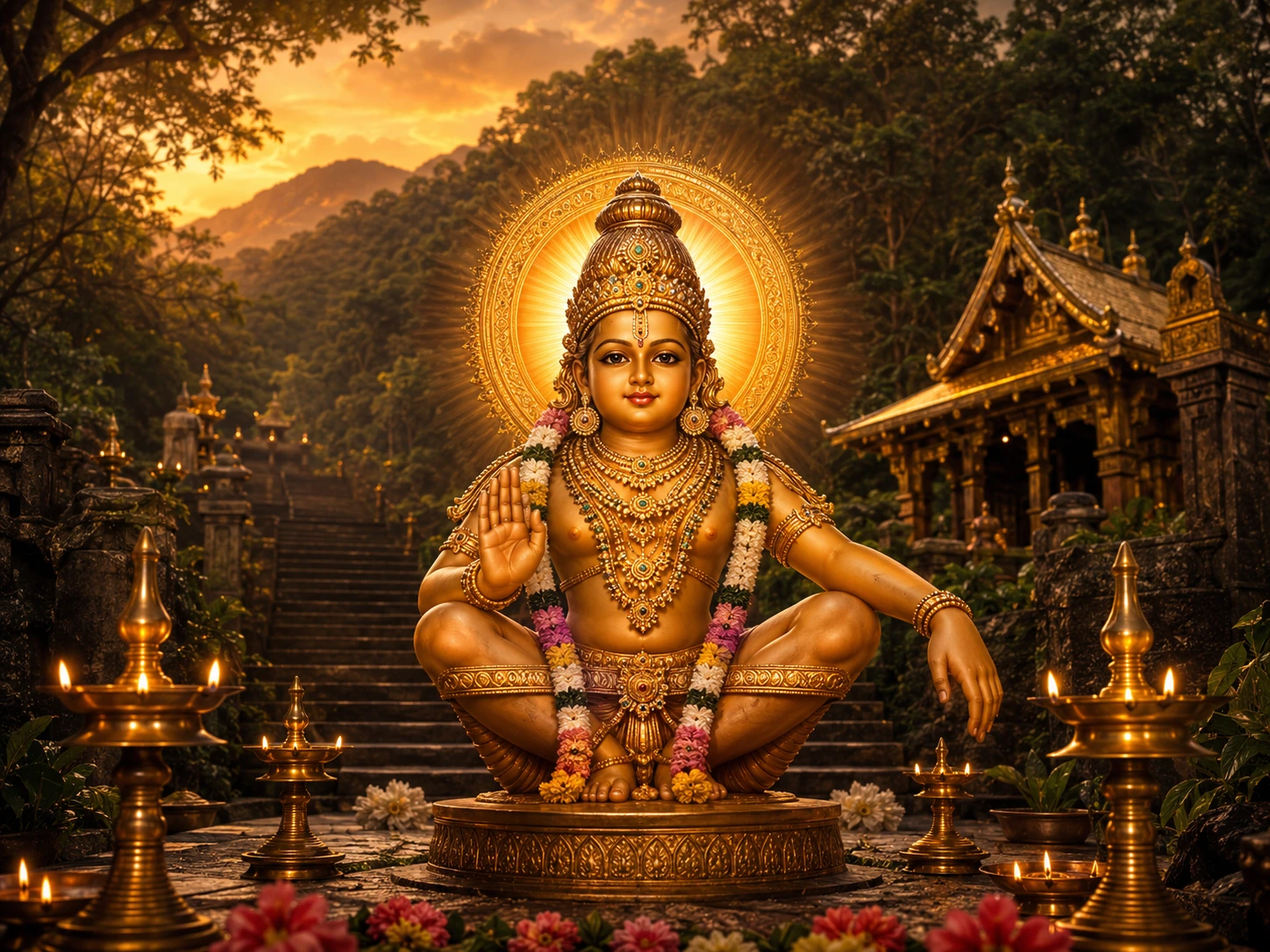
Ayyappa -- The Lord of Sabarimala
अय्यप्पा -- शबरीमला के स्वामी
On the evening of 14 January, when the sun crosses from Dhanu to Makara rashi, a fire flickers on a hill called Ponnambalamedu, fifteen kilometres across the Pamba valley from the main shrine at Sabarimala. The flame lasts a few minutes. From the eighteen steps of the Ayyappa temple, half a million pilgrims watch it appear, disappear, reappear, three times. The flame is called the Makaravilakku. It is the reason an estimated fifty million people across November to January travel to Sabarimala every year -- making it one of the largest annual pilgrimages on earth.
Ayyappa is the deity at Sabarimala. He is known across South India also as Dharma Sastha, Manikandan, and Hariharaputra, the son of Hari (Vishnu) and Hara (Shiva). His iconography is unusual. He sits in a yogic pose called pattabandha, left leg folded over right, hands resting on his knees, a belt tied around his lower legs and back. He wears a bell around his neck, given to him by the king who raised him. He is young, beardless, often shown wearing only a black dhoti. No wife, no consort in the main shrine.
Of all the great gods of the Hindu pantheon, Ayyappa is the most recent in terms of widespread pan-Indian recognition. His temple festival calendar was formalised through the medieval period, and the modern Sabarimala pilgrimage scaled up massively only in the last century. Yet the traditions behind him, the Shasta worship of the Tamil country, go back to the Sangam age. He is old and new at the same time.
The origin story involves the two greatest gods of the Hindu pantheon deciding to have a child together. During the churning of the ocean, Vishnu took the form of Mohini to distract the asuras and secure the amrita for the devas. In a later episode found in the Brahmanda Purana and the Bhutanatha Upanishad, Shiva encounters Mohini, and from that meeting a child is born. The child is called Hariharaputra, literally the son of Hari and Hara, or Ayyappa.
The child is placed on the banks of the Pamba river. The king of Pandalam, Rajashekara Pandyan, childless, finds the baby. Around the baby's neck is a golden bell, a mani. The king names the child Manikandan, bell-necked. Manikandan grows up in the Pandalam palace, learns martial arts, Vedic scripture, and becomes the beloved heir. Then the king's new wife, under the influence of an advisor, tries to prevent Manikandan's coronation. She feigns a severe headache that she claims can only be cured by the milk of a tigress.
Manikandan volunteers to get the milk. He walks into the forest. He encounters the asuri Mahishi -- the sister of the demon Mahisha whom Durga had killed -- who had a boon that only a son of both Hari and Hara could defeat her. Manikandan kills her. He brings back a herd of tigresses to Pandalam, ridden by forest tribal men. At this point the king recognizes the truth. Manikandan reveals himself as Ayyappa, son of Shiva and Vishnu, and tells the king that he will not return to the palace. He will become the deity of the Sabarimala hill, accessible only after a 41-day vow, and will meet his adopted father once a year when the king's royal ornaments are brought to him on Makara Sankranti. This ceremony, the Thiruvabharanam procession, continues to this day. A delegation from the Pandalam royal family carries the jewels from Pandalam to Sabarimala every January, arriving at the shrine just before the Makaravilakku.
हरिवरासनं विश्वमोहनं हरिदधीश्वरं आराध्यपादुकम्। अरिविमर्दनं नित्यनर्तनं हरिहरात्मजं देवमाश्रये॥
harivarāsanaṁ viśvamohanam haridadhīśvaraṁ ārādhyapādukam, arivimardanaṁ nityanartanam hariharātmajaṁ devamāśraye.
I take refuge in the god who is the son of Hari and Hara. He sits on the seat of Hari, enchants the world, is the lord of the directions, wears adored sandals, crushes the enemies of his devotees, and dances eternally.
— Harivarasanam (Hariharaatmaja Ashtakam), Verse 1, by Kumbakudi Kulathur Iyer, chanted at Sabarimala temple-closing ritual
The Sabarimala shrine sits at an altitude of about 1,260 metres on a forested ridge inside the Periyar Tiger Reserve. There is no road to the top. The last four kilometres from Pamba base camp are a steep climb through the jungle. The temple itself is small. The eighteen steps leading to the sanctum are golden-plated and can only be crossed by pilgrims carrying the sacred Irumudi bundle. Each step corresponds to something: the first five are said to stand for the five senses, the next eight for the eight emotions, the next three for the three gunas, and the last two for vidya and avidya, knowledge and ignorance. The climb is a compressed course in yoga psychology. Every stair is a lesson underfoot.
At the top, the darshan of the deity lasts roughly four seconds. Eighteen or twenty pilgrims at a time are led past the sanctum. The idol is small, about forty-five centimetres tall, made of panchaloha. Ghee brought in the Irumudi is poured over the deity as abhishekam. After the pilgrimage, one leaves by a separate route, down the other side of the hill. The physical pattern is the same as any major life-event: long preparation, sudden encounter, changed return.
The reason the climb is possible for people from every background is the 41-day preparation. Caste does not matter during the vow. A Malayali Brahmin doctor, a Tamil auto driver, a Telugu software engineer, and a Marathi schoolteacher who have all taken the Irumudi on the same day address each other as Swami, meaning the lord himself. No caste names. No family names. No professional titles. Equality is not aspirational here; it is the condition of admission.
The 41-day vratham is not a formality. It is a complete rewiring of daily life. The pilgrim wears only black, blue, or saffron clothing. No footwear. No shaving. A rudraksha and tulsi mala around the neck from the first day. No non-vegetarian food. No alcohol. No sex. No sleeping on a bed -- the floor, or at most a simple mat. Two baths a day. Morning and evening visits to a Shasta temple or home altar. Reading from the Bhagavata or Ramayana or chanting Ayyappa namavalis. The pilgrim is addressed as Swami for the full 41 days by family and colleagues, and himself addresses others the same way.
On the final two days, the pilgrim prepares the Irumudi. This is a cloth bundle with two compartments. The front compartment carries three items for Ayyappa: ghee sealed inside a coconut (the central offering), camphor, incense, turmeric, and a silver coin. The back compartment carries the pilgrim's own provisions for the road. The front is for the lord. The back is for the self. The bundle is carried on the head all the way from Erumeli, about fifty kilometres from Sabarimala, across forest and river. The final crossing of the Pamba river and the last climb through the jungle are done barefoot.
What does a 41-day vratham do to someone? Corporate managers who have done it describe it as the most disciplined period of their adult life. A 45-day stretch without alcohol, without meat, sleeping on the floor, waking at four, with every action framed as seva, rewires something. The body loses weight. The mind clears. Small addictions -- coffee, sugar, scrolling -- lose their grip. After the darshan, most pilgrims return to normal life, but many find that certain aspects of the vratham remain with them: an earlier bedtime, a cleaner diet, a weekly day of silence.
The Stages of the Sabarimala Pilgrimage
| Stage / पड़ाव | Location / स्थान | Duration / अवधि | Core Practice / मुख्य क्रिया |
|---|---|---|---|
| Vratham begins / व्रत आरंभ | Home, own temple / घर, अपना मंदिर | Day 1 of 41 / 41 में से पहला दिन | Maala dharana, black dhoti, address as Swami / माला धारण, काली धोती, स्वामी संबोधन |
| Irumudi kettu / इरुमुडि कट्टु | Home or nearest Sastha shrine / घर या निकट शास्त्ता मंदिर | Day 40 / चालीसवां दिन | Sealed coconut with ghee, blessing of bundle / सील बंद नारियल में घी, गठरी का पूजन |
| Erumeli halt / इरुमेली विराम | Erumeli, Kottayam district / इरुमेली, कोट्टयम ज़िला | Half-day / आधा दिन | Pettathullal forest dance for first-time pilgrims / पहली यात्रा करने वालों का पेट्टतुल्लल नृत्य |
| Pamba bathing / पंपा स्नान | Pamba river bank / पंपा नदी तट | 2-3 hours / 2-3 घंटे | Ritual bath, deposit of first coconut / स्नान, पहले नारियल का अर्पण |
| Final climb / अंतिम चढ़ाई | Pamba to Sannidhanam / पंपा से सन्निधानम | 4-6 hours barefoot / 4-6 घंटे नंगे पांव | Chanting Swamiye Saranam Ayyappa / स्वामिये शरणं अय्यप्पा जप |
| Darshan of eighteen steps / अठारह सीढ़ियों के दर्शन | Sannidhanam / सन्निधानम | About 4 seconds / लगभग 4 सेकंड | Breaking coconut, ghee abhishekam / नारियल फोड़ना, घी अभिषेक |
First-time pilgrims, called Kanni Ayyappans, wear a special garland called tulasi and perform the pettathullal dance at Erumeli before crossing into the forest. Repeat pilgrims skip this stage.
Before Ayyappa was a pan-South-Indian deity, he was Shasta, Aiyanar, or Dharma Sastha. In Tamil Nadu, village Shasta shrines, usually sited at the boundary of a village, have been worship centres for at least fifteen hundred years. These are guardian deities, often accompanied by stone horses, protectors against epidemic and drought. Ayyappa at Sabarimala is the most famous of these Shasta figures, but not the only one. There are Shasta temples at Achankovil, Aryankavu, Kulathupuzha, and Kanthamalai, where the deity is shown in different life stages -- child, youth, married householder, seated yogin. The Sabarimala Ayyappa is the celibate yogin form.
Ayyappa has two companions often found near him. Vavar, a Muslim warrior and companion in his forest exploits, has a shrine at the foot of the hill at Erumeli, and Sabarimala pilgrims stop there to offer respects before beginning the ascent. Kaduthaswamy, a forest guardian, has a small shrine as well. Ayyappa worship, in its classical form, recognizes these companions openly, and the Erumeli mosque is historically a stop on the pilgrimage route for Ayyappa devotees from every community.
The best-known public form of Ayyappa worship outside Sabarimala is the Ayyappa Bhajana, a group singing session held in homes and halls across Kerala, Tamil Nadu, Karnataka, Andhra Pradesh, and the Gulf diaspora. Families take turns hosting. A small Ayyappa idol is installed for the evening. Oil lamps, incense, and a group singing of the 108 namavali of Ayyappa, followed by the Harivarasanam, close the evening. In Dubai, Bahrain, and Muscat, a Malayali family may host a bhajana for fifty people in a three-bedroom apartment. The tradition travels without temples.
The Sabarimala pilgrimage may be the largest annual religious gathering in the world where caste is temporarily set aside by ritual rule. For the 41 days of the vratham, every Ayyappa pilgrim, regardless of birth, is addressed as Swami -- lord. They sleep on the same temple floors, eat from the same kitchen queue, and walk barefoot on the same forest path. A Harvard Business Review study of Sabarimala crowd logistics in 2018 noted the surprising orderliness of five hundred thousand people moving through a narrow mountain forest path daily, and attributed a good part of it to this cultural equalisation. For one month every year, class and caste get parked at the base of the mountain.
One question dominates any contemporary discussion of Sabarimala: the traditional restriction on women of menstruating age from entering the shrine. The tradition is not uniform across all Shasta temples. At Achankovil, Aryankavu, and many other Shasta shrines, women of all ages enter without issue. The restriction is specific to Sabarimala and grounded in the celibate yogin form of the deity there. The reasoning given in tradition: this particular deity has taken a vow of yogic celibacy, and the vow is maintained at the level of the shrine itself. Other traditions interpret it differently, seeing the restriction as a local custom that hardened over time.
The 2018 Supreme Court ruling in Indian Young Lawyers Association v. State of Kerala struck down the restriction on constitutional grounds. A five-judge bench, by a 4:1 majority, held that the restriction was a violation of the right to worship under Article 25. The ruling was followed by intense protest and a review petition that was referred to a larger bench in 2019. The matter remains pending before a nine-judge bench as of this writing. The Sabarimala question has become one of the most closely watched religious-rights cases in modern Indian constitutional history, pitting concepts of gender equality, temple-specific custom, and the limits of judicial review against each other.
The editorial position of this piece is not to adjudicate. The legal question is before the Supreme Court. The theological question is live within the Hindu tradition itself. What is worth saying is that the contemporary Sabarimala conversation is a serious one, fought out by serious people with serious arguments on both sides. It deserves engagement, not dismissal from either direction.
What does Ayyappa offer someone in 2026 who has never climbed a single step of Sabarimala? The gift of the vratham is transferable even without the climb. A Bengaluru startup founder, sleep-deprived from funding rounds, may take an Ayyappa mala for 41 days as a corporate reset -- no alcohol at networking events, no meat, early morning walks in Cubbon Park, reading one chapter of the Ramayana each evening. A UPSC aspirant in Old Rajinder Nagar may adopt the same routine in the final six weeks before the prelims, addressing her flatmates as Swami and skipping weekend restaurant meals. The practice works without Sabarimala in the picture, because the practice is the point.
The name Ayyappa translates loosely as father-father, Ayya being a respectful term for a father figure in Tamil. He is the god to whom the orphan, the bachelor, the adopted son, and the person in the middle of a divorce may come. He himself was born without a conventional mother, raised by a king not of his blood, took on a demon not his enemy by birth, and chose a hill over a throne. His appeal is precisely to those who do not fit conventional family templates. A child adopted from an orphanage in Chennai. A gay man in a Gulf expat community who cannot come out at work. A widow of 34 in Thiruvananthapuram re-thinking the rest of her life. Ayyappa's biography makes room for all of them. The swamiyee saranam chant heard along the forest path carries something of this message: everyone is welcome, on the condition that they have done the vratham.
The Thiruvabharanam procession deserves its own paragraph because it is one of the most moving spectacles in the Indian ritual calendar. Every year on 12 January, three ornamented caskets containing the gold jewels of Ayyappa leave Pandalam palace on the shoulders of descendants of Rajashekara Pandyan's royal line. The procession walks 83 kilometres over three days, stopping at designated halts. The jewels are believed to be those that Ayyappa wore as Manikandan, returned to him by his adopted father annually. The caskets reach Sabarimala on the evening of 14 January, Makara Sankranti, at the exact moment the Makaravilakku flame is lit on Ponnambalamedu hill across the valley.
A Brahmani kite, locally called Krishna Paruntu, is said to circle overhead during parts of the procession, and the pilgrims watch for its appearance as a confirmation that the jewels are being accompanied by divine presence. Ornithologists treat this sceptically; devotees treat the bird's circling as a sacred companion. Either reading does not diminish the scene: seventy kilometres of forest, tens of thousands of devotees lining the road, a single procession carrying a king's inheritance to a son who gave up the throne. In 2026, the procession was broadcast live on Asianet television, watched by millions of Malayalis in Kerala and the Gulf, and streamed on the Devaswom Board app.
The Malikappurathamma shrine a short walk from the main Sabarimala sanctum deserves a mention. Malikappurathamma is a young devi, installed at a subsidiary shrine, and tradition says she waits for Ayyappa to marry her. Ayyappa has told her that he will marry her only in the year that no new first-time pilgrim (Kanni Ayyappan) climbs Sabarimala. Since hundreds of thousands of first-time pilgrims arrive every year, the wedding remains perpetually postponed. The shrine stands as a reminder that Ayyappa's celibacy is not a rejection of womanhood; it is a vow maintained for the sake of the tradition. Malikappurathamma receives her own offerings, and her shrine is visited by every pilgrim after the main darshan.
A word on the origin of Sabarimala's name. The hill is named after Shabari, the old tribal woman devotee in the Ramayana who waited decades in her forest hermitage for Rama to visit her. When Rama and Lakshmana came, she tasted each of the forest berries first to ensure none was bitter and then offered him the sweet ones. The gesture broke every rule of ritual purity -- a tribal woman offering half-eaten fruit to a prince -- and Rama accepted with the argument that devotion outranks rule. The same hill that was Shabari's later became Ayyappa's. The continuity is not accidental. Ayyappa's worship retains the idea of devotion overriding caste and protocol. The Vavar shrine at the foot of the hill, the tribal hunters who first accompanied Manikandan, and the Pulaya priests who traditionally assisted in certain forest rituals all belong to this pattern. The mountain itself teaches the point: the steep climb is indifferent to the pilgrim's birth.
In the age of the smartphone, the Ayyappa tradition has adapted without losing shape. The Kerala Devaswom Board now operates a virtual queue system that books darshan slots in advance, reducing the chaotic crush that marked the 1980s and 1990s. Live streams of the Makaravilakku bring the moment to Malayali families in Chicago, Toronto, Muscat, and Melbourne. Ayyappa WhatsApp groups coordinate 41-day vrathams among office colleagues in Bengaluru and Hyderabad. The Harivarasanam recording by the late Dr. K.J. Yesudas, first released in 1975, has been played at Sabarimala temple-closing every night for nearly five decades -- an unbroken continuity made possible by a single recording. Tradition has not stiffened. It has absorbed the tools and moved on.
The Irumudi Kettu is the object that makes a Sabarimala pilgrim a Sabarimala pilgrim. Literally it means 'two-knotted bundle', and it is a plain cotton cloth tied into two compartments that the devotee carries on their head for the entire climb. The front pouch, called the Munmudi, holds everything meant for Ayyappa: a coconut filled with ghee (the Neyyabhishekam coconut), flowers, incense, camphor, betel leaves, jaggery, rice. The rear pouch, the Pinmudi, holds only what the pilgrim needs for themselves on the road: a change of clothes, basic food, a small amount of money. The symbolism is exact. The Lord's share comes first, is bigger, and rides in front. The self's share comes last, is smaller, and rides behind. The Irumudi is tied at a temple closer to home, usually in a specific ritual called Kettunira, conducted by a guruswamy who has made the pilgrimage multiple times. Until the Irumudi rests on the pilgrim's head, they are an ordinary person. Once it is placed there, they are a swami, addressed by everyone on the road as Ayyappa. No pilgrim is allowed to climb the eighteen steps at Sabarimala without the Irumudi on their head. The bundle is not a ritual accessory. It is the passport. And the Neyyabhishekam coconut inside it will be broken on arrival, the ghee poured over the idol of Ayyappa in the main abhishekam of the pilgrimage -- the moment every pilgrim prepares for across 41 days.
The eighteen steps, the Pathinettampadi, are the visual signature of Sabarimala and also the key to its theology. Every explanation of what the eighteen steps stand for is valid, because no single list is official. The most common reading places the first five steps as the five sense-organs (eye, ear, nose, tongue, skin), the next eight as the eight emotional tendencies that bind a person (kama, krodha, lobha, moha, mada, matsarya, ahamkara, avidya), the next three as the three gunas (sattva, rajas, tamas), and the final two as knowledge and ignorance, or vidya and avidya. To climb the eighteen steps, then, is to walk over everything that normally runs the ordinary mind. Another reading, more popular among Kerala's temple scholars, maps the steps to the eighteen Puranas. A third ties them to the eighteen Ayudhas or divine weapons of Ayyappa. The brilliant thing about the temple architecture is that it refuses to choose. The steps are just there, gold-plated since the 1980s, eighteen of them, and every pilgrim brings their own theology. This openness is Ayyappa's deepest gift to contemporary Hindu practice. He is Hariharaputra, the son of Vishnu and Shiva, and his worship has historically dissolved the Shaiva-Vaishnava sectarian divide that runs through much of Hindu history. A Tamil Iyengar Vaishnava from Chennai, a Kannadiga Smarta, a Kerala Namboodiri, a Dalit from Palakkad, a Muslim trader from Malappuram who does the Erumeli leg in the Vavar mosque tradition -- all climb the same eighteen steps, and the deity at the top does not check where anyone comes from before accepting the ghee.
At Erumely, roughly sixty kilometers before Sabarimala itself, every pilgrim makes a stop that would surprise anyone reading only a narrow version of Hindu devotion. Inside Erumely town stands the Vavar Palli, a mosque dedicated to Vavar Swami, the Muslim warrior who is remembered in Ayyappa tradition as the god's trusted lieutenant. In one strand of the tradition, the historical Vavar was an Arab sea captain defeated by the young Manikandan in battle and turned into a lifelong companion. A pilgrim to Sabarimala offers black pepper or rose water at the mosque before continuing to the hill. The sequence is non-negotiable. You cannot climb the eighteen steps without first stopping at Vavar Palli. Pilgrims shout the slogan 'Swamiyae Saranam Ayyappa, Vavarae Saranam Ayyappa' -- I take refuge in the Lord, I take refuge in Vavar. In a period of Indian public life that often treats Hindu and Muslim practice as sealed compartments, the Erumely stop is a quiet correction. It says the road to the deity runs through a mosque. It says the lieutenant who carries the deity's trust is Muslim. It says the devotee who refuses this stop has not understood the tradition they claim. The shrine is maintained jointly by a Muslim mahant family and the Kerala state administration.
The stretch between Erumely and the forest entry point at Pampa hosts one of the most physically intense episodes of the pilgrimage: the Petta Tullal, the wild dance at Petta. First-time pilgrims, called Kanni-Ayyappans, smear their bodies with colored powders and sandal paste, tie leaves around their waists, carry a wooden stick, and break into a dance through the streets of Erumely that imitates the deity's own hunt of the demoness Mahishi. The dance is not a performance. It is the pilgrim unlearning the urban polish of ordinary life before entering the forest. A software project manager from Kochi who spends the year in air-conditioned meeting rooms suddenly finds himself running bare-chested through a small Kerala town, shouting, laughing, falling on the road in mock-exhaustion, getting up to run again. The Tullal is age-blind and class-blind. A fifty-five-year-old school principal dances beside a twenty-three-year-old fresher just out of college. Petta has its own small Sastha temple where the dancers finally gather, catch their breath, and take a few hours of rest. The entire episode is reserved for first-time pilgrims. From the second year onward, the devotee watches rather than dances. Watching is also a practice, because without the older pilgrims cheering from the sidelines, the Kanni-Ayyappans would not know how far to go.
The human core of the Ayyappa story sits in the old kingdom of Pandalam in central Kerala, about 150 kilometers south of Kochi. According to tradition, the childless king of Pandalam, Rajashekara Pandyan, found a divine infant with a golden bell around his neck while hunting near the Pampa river. He named the child Manikandan, the one with the bell, and raised him as his own. Manikandan grew into a boy of extraordinary wisdom and martial skill, but the queen, pressured by a minister who feared the boy would take the throne from her newborn son, asked Manikandan to fetch tigress milk as medicine for a pretended illness. Manikandan went into the forest, defeated the demoness Mahishi, and returned riding a tigress, revealing his divine nature to the kingdom. He then declared he would return to the forest at Sabarimala but promised that any devotee who observed the forty-one day vratham and climbed the eighteen steps would reach him. The Pandalam royal family still plays the central role in the Thiruvabharanam procession, and the current titular raja participates each year in sending the ornaments to Sabarimala. This anchoring of the deity's story in a specific living royal lineage is unusual in Hindu tradition. It keeps Ayyappa close to history, not only to cosmology.
The simplest way to begin an Ayyappa practice at home is the evening lamp. Light a small brass lamp at dusk, place it before a picture or small bronze of Ayyappa, and chant the Saranam Ayyappa eighteen times on eighteen consecutive days. No Irumudi. No 41-day restriction. Just eighteen days of eighteen repetitions. Many families in Kerala begin this practice in the week before Mandalapooja, which falls on the 41st day of the Sabarimala season in late December. Over time, some people extend to the full vratham, some to the pilgrimage, and some stop at the lamp. All three are legitimate. The god does not require the full climb to answer. The vratham is not a minimum requirement; it is a form the tradition offers to those who need it.
Light the Sandhya Deepam for Ayyappa
Light a lamp at dusk and recite Ayyappa's names, or listen to the Harivarasanam, the lullaby sung as the Sabarimala shrine closes each night. Those keeping the 41-day Mandala vratham follow the traditional discipline of Kerala households: simple vegetarian food, celibacy, black or blue clothing and daily worship. Read about the temple itself on its Eternal Raga page.
Tags
Eternal Raga · शाश्वत राग
Institutional voice — scholarly articles on Sanatan Dharma
Deepen Your Understanding
अपनी समझ और गहरी करें
scriptural exegesis
Mohini and Shiva -- Why the Bhagavatam Tells This Story
Social media loves verse 8.12.32 -- Shiva loses control chasing Mohini. It never shows verse 8.12.36 -- where Shiva recovers instantly and is not at all surprised. It never shows 8.12.37 -- where Vishnu is very pleased to see Shiva unagitated and unashamed. And it never shows 8.12.38 -- where Vishnu Himself declares that Shiva is 'established in his position' despite everything. This is not a story about Shiva's weakness. It is the Bhagavatam's most powerful teaching on Maya, surrender, and why even the greatest ascetic needs divine grace.
deities avatars
Who is Shiva?
He is the ash-smeared ascetic who is also the ideal husband. The destroyer of the universe who is called 'The Auspicious One.' The god of death who drank poison to save all life. He sits in meditation on a Himalayan peak, and simultaneously dances the cosmos into existence and annihilation. No deity in Hinduism contains more contradictions -- and no deity resolves them more completely. This is not a mythology explainer. This is an attempt to stand at the foot of the mountain and look up.
deities avatars
Dashavatara -- Why Vishnu Comes Back Ten Times
Fish, tortoise, boar, half-lion, dwarf, axe-warrior, prince, cowherd, enlightened teacher, future horseman. The ten avatars of Vishnu are not random folklore. Read them in sequence and you get something startling -- a narrative that mirrors evolutionary biology, tracks the rise and fall of political systems, and argues that God does not sit above history but enters it, gets dirty, and does the work. The Dashavatara is Hinduism's answer to the question every civilisation asks: why does the world keep breaking, and who fixes it?
rituals traditions
Vrata -- What a Hindu Vow Really Means (It Is Not Just Fasting)
Your mother kept Karva Chauth without water for sixteen hours. Your grandmother observed Ekadashi every fortnight without fail. Your colleague skips lunch on Tuesdays 'for Hanuman.' The world sees Hindu fasting as dietary restriction. The tradition sees it as something far more radical: Vrata is a voluntary, time-bound act of self-imposed discipline that rewires the relationship between desire and willpower. Fasting is the most visible expression. But the real Vrata happens inside.
rituals traditions
Tirtha Yatra -- Why Hindus Travel to Get Closer to God
The word 'Tirtha' does not mean 'holy place.' It means 'crossing point' -- a ford where the river of worldly existence can be crossed to reach the far shore of liberation. Hindu pilgrimage is not tourism with a spiritual label. It is the deliberate journey to locations where the boundary between the material and the divine is believed to be thinnest -- where the crossing is easiest. From Kashi to Kailash, from Char Dham to Kumbh Mela, the tradition maps a sacred geography onto the physical landscape of the subcontinent, turning the act of travel itself into a spiritual practice.
scriptural exegesis
Samudra Manthan -- When Gods and Demons Ran a Joint Venture and the Universe Almost Died
A cosmic ocean. A mountain for a churning rod. A serpent king for a rope. Gods on one end, demons on the other. And out came 14 treasures -- including wealth, beauty, medicine, immortality, and one poison so lethal it could end creation itself. The Samudra Manthan is not mythology. It is the original playbook for collaboration, crisis management, and how to handle it when your joint venture partner tries to cheat you.
deities avatars
Mahishasuramardini -- The Slayer of the Buffalo Demon and India's Most Iconic Image of Power
No single image has been reproduced more in Indian art than a goddess standing on a buffalo, trident in hand. From Gupta-era gold coins to Kolkata's 40,000 Durga Puja pandals, Mahishasuramardini -- the Slayer of the Buffalo Demon -- is the defining visual of Hindu civilisation's most radical claim: that the ultimate power in the universe is feminine.
The Sabarimala pilgrimage may be the largest annual religious gathering in the world where caste is temporarily set aside by ritual rule. For the 41 days of the vratham, every Ayyappa pilgrim, regardless of birth, is add…
More in Deities & Avatars
33 Koti Devata -- Why Hinduism Has 33 Types of Gods, Not 33 Crore
13 min read
Agni -- The Fire God
19 min read
Annapurna -- Goddess of Food
19 min readThe same translation error that turned '33 Koti' into '33 crore' in Hinduism also happened in Buddhism. The Chinese translation of Buddhist texts rendered 'Sapta Koti Buddha' (7 Supreme Buddhas) as '7 Crore Buddhas.' The…
Deities AvatarsCommunity Reflections
🕉️
Be the first to share your reflection.